
How to Spot Burnout Early and What to Do Next
Burnout is a chronic state of physical, emotional, and cognitive depletion caused by prolonged, unmanaged workplace stress, and it is entirely distinct from temporary exhaustion. You can spot it early by paying attention to persistent mental fog, a growing sense of cynicism toward your work, and the realization that a weekend of rest no longer restores your energy. Addressing this crisis requires moving beyond simple self-care routines to establish strict behavioral boundaries, initiate candid conversations with management to restructure workloads, and implement systemic changes to how you engage with your career.
What Exactly Is Burnout?
We all experience days where we feel overwhelmed, short-tempered, and dread the upcoming workweek. The natural instinct is to chalk these feelings up to normal stress or temporary fatigue. However, treating burnout as if it were just a passing rough patch is a recipe for long-term psychological and physical damage. When you treat burnout like ordinary stress, you apply the wrong solutions and keep spinning your wheels without ever recovering 12.
The World Health Organization (WHO) officially classifies burnout in its 11th Revision of the International Classification of Diseases (ICD-11). Crucially, the WHO does not classify burnout as a medical condition, but rather as an "occupational phenomenon" 23. It is defined strictly as a syndrome resulting from chronic workplace stress that has not been successfully managed 145.
According to the WHO classification, burnout is characterized by three distinct dimensions. The first is exhaustion, defined by feelings of severe energy depletion and deep physical fatigue 123. The second dimension is cynicism, which manifests as increased mental distance, negativism, or emotional detachment related to one's job 13. The third is reduced professional efficacy, characterized by a noticeable decline in productivity and a diminished sense of personal accomplishment, often leading individuals to feel that nothing they do matters 123.
In layman's terms, while stress is feeling overwhelmed for a while, burnout is what happens when that feeling never really goes away - leaving you drained, disengaged, and struggling to function at a baseline level 1.
The Critical Differences Between Stress and Burnout
While stress and burnout share overlapping symptoms, they are fundamentally different experiences that require different responses. Stress is characterized by too much pressure, too many demands, and emotional over-engagement. Burnout, conversely, is characterized by too little - feeling empty, devoid of motivation, and beyond caring 16.
When you are stressed, your nervous system is highly active, pumping adrenaline and cortisol to help you tackle immediate threats. When you are burned out, that same system has effectively collapsed from overexertion 29.
| Feature | Ordinary Stress | Clinical Burnout |
|---|---|---|
| Core Sensation | Feeling overwhelmed by "too much" pressure and responsibility. | Feeling entirely depleted, empty, and experiencing "too little" motivation. |
| Emotional State | Over-engaged, reactive, anxious, and sometimes irritable or hyperactive. | Disengaged, blunted emotions, detached, cynical, and emotionally numb. |
| Physical Response | Tense, alert, racing heart, difficulty falling asleep due to racing thoughts. | Chronic fatigue, heavy exhaustion, feeling completely drained even after sleep. |
| Motivation | You still care deeply and are actively trying to keep up with daily demands. | You have lost interest, feeling hopeless and like nothing you do makes a difference. |
| Recovery | Usually eases once the pressure passes or after a short period of rest. | Does not resolve with temporary rest; requires structural changes to the environment. |
The Battery Metaphor: Understanding Energy Depletion
One of the most effective ways to conceptualize the difference between normal fatigue and burnout is the phone battery analogy. We live in an era where the average human processes roughly 72 gigabytes of information per day, requiring massive cognitive energy 10.
Think of normal, daily stress as running a few heavy applications on your smartphone. The battery drains faster, and the device might heat up, but when you plug it in overnight, it recharges back to maximum capacity. You start the next day with a full tank.
Burnout, on the other hand, is what happens when you deplete the battery down to zero day after day, ultimately degrading the battery's chemical capacity over time 11. You push yourself until you collapse, hoping that a single weekend at the spa or a yoga class will act as a quick supercharger. But a degraded battery takes much longer to charge and holds significantly less energy 1112. When you are burned out, rest alone is rarely enough to recover because the underlying operating system is still running malicious, energy-draining background programs in the form of chronic anxiety and dread 1213. You feel empty, lacking in motivation, and completely flat 6.
The 12 Stages: How Burnout Sneaks Up on You
One of the most dangerous misconceptions about burnout is that it happens overnight. You do not simply wake up one morning completely burned out. Instead, it is a gradual erosion of your psychological and physical reserves.
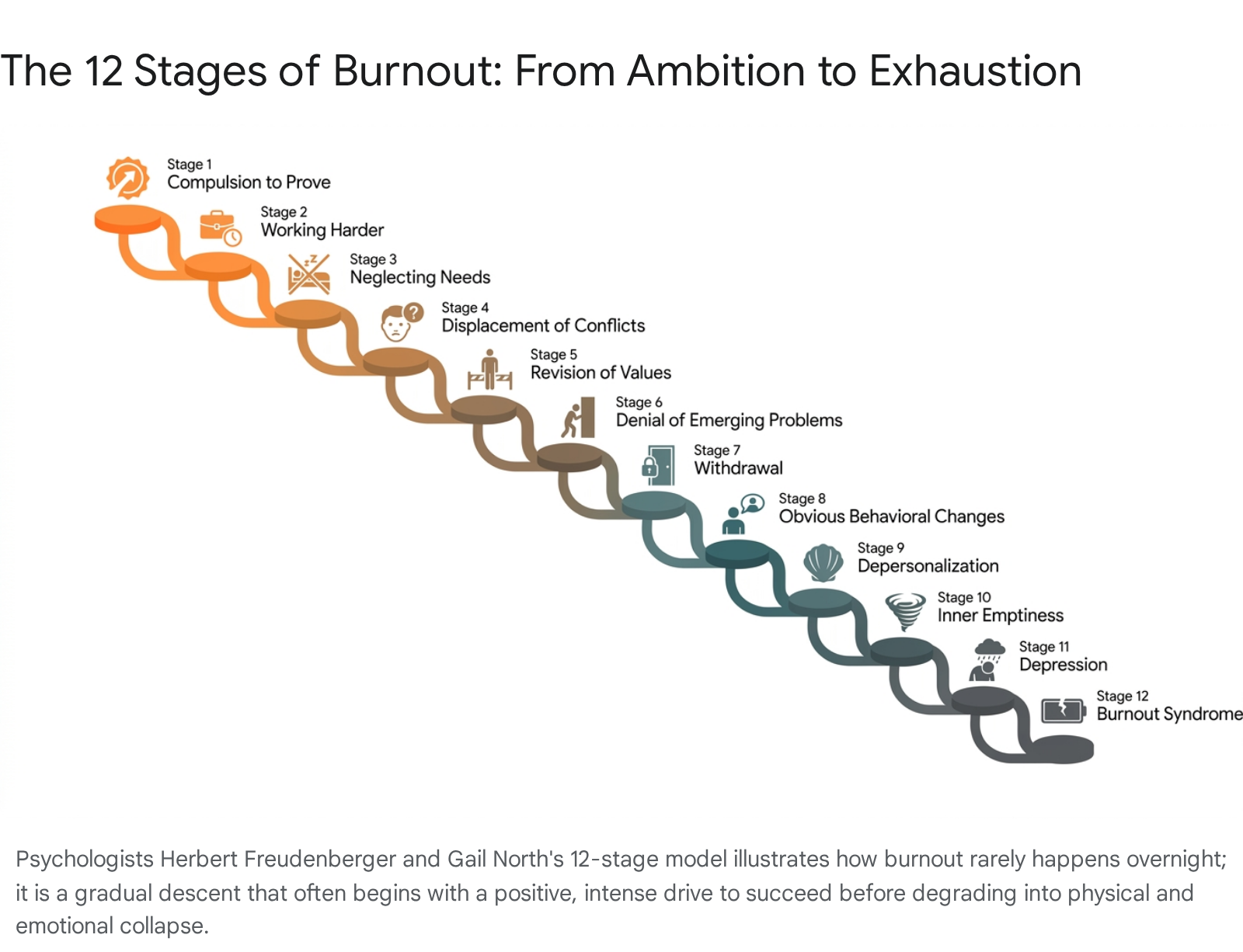
In 1974, psychologist Herbert Freudenberger, alongside Gail North, developed a comprehensive 12-stage model of burnout that remains a cornerstone of occupational psychology 141516. Understanding these stages provides a roadmap for early detection. Interestingly, the cycle does not begin with fatigue - it almost always begins with high ambition.
The Early Stages: From Ambition to Denial
The early stages of burnout are highly deceptive because they often look like stellar employee performance. The first stage is the compulsion to prove oneself. This stage typically affects the best, most enthusiastic employees who feel a constant, obsessive need to demonstrate their worth, taking on responsibilities readily to show they are capable 14167. To meet these self-imposed expectations, workers enter the second stage: working harder. They become unable to switch off, taking on more tasks, answering emails on weekends, and working late into the evening 157.
The first true personal sacrifices occur in the third stage, which is neglecting needs. To make room for more work, individuals skip meals, sacrifice sleep, and stop exercising, while friends and family are put on the back burner 1415. As the toll mounts, the fourth stage involves the displacement of conflicts. You begin to feel threatened, panicky, and jittery, but you dismiss these problems and rationalize away the warning signs, convincing yourself that things will calm down after the next big project 14167.
This leads directly into the fifth stage, a revision of values. Your entire value system shifts to accommodate work. Hobbies are seen as irrelevant, and personal relationships are dismissed as secondary as work becomes your sole focus and source of self-worth 147. Finally, in the sixth stage, individuals exhibit denial of emerging problems. You become intolerant and cynical, perhaps viewing colleagues as lazy, demanding, or undisciplined. You blame your stress entirely on time pressure and external factors, denying that your own lifestyle changes are the root of the problem 167.
The Late Stages: From Detachment to Collapse
If left unchecked, the psychological defenses break down entirely, leading to severe behavioral and physical consequences. The seventh stage is withdrawal. Your social life shrinks to almost nothing; you actively avoid interaction and may turn to alcohol, drugs, or excessive eating to feel temporary relief from the relentless stress 167. This transitions into the eighth stage, marked by odd behavioral changes. Your friends, family, and coworkers become noticeably concerned as you exhibit impatience, uncharacteristic aggression, or snap at loved ones over minor issues 1416.
In the ninth stage, depersonalization occurs. You become completely emotionally detached, feeling robotic and viewing neither yourself nor others as valuable 1516. This paves the way for the tenth stage, an inner emptiness. A profound sense of numbness sets in, and to combat this void, individuals often escalate their use of coping mechanisms, such as substance abuse or compulsive behaviors 14167.
The penultimate eleventh stage is depression. You feel entirely lost, exhausted, and apathetic. The future looks bleak and dark, and you feel like giving up entirely 1416. The final, twelfth stage is full burnout syndrome. This is a total mental and physical collapse. At this point, the individual can no longer function at work or home, often requiring immediate medical intervention and extended leave to stabilize 14168.
Early Warning Signs You Should Never Ignore
Because burnout is a progressive syndrome, recognizing it early is the most effective way to prevent a total collapse. Research syntheses on the early indicators of burnout divide the symptoms into distinct cognitive, emotional, and physical domains 9.
Cognitive and Emotional Red Flags
Long before your body gives out, your brain will show signs of cognitive weariness. Persistent clinical burnout is associated with impaired executive functioning 2. You may notice poor working memory, sudden difficulties in concentration, and an inability to maintain attention on tasks that used to be easy 2910. Because your brain is depleted, you have to invest significantly more mental energy just to solve standard problems, which in turn necessitates more time to recover from basic cognitive efforts 221.
Emotionally, this manifests as deep cynicism. You may find yourself thinking, "nothing I do matters anyway" 2. Activities and projects that once excited you begin to feel hollow, and you may develop an uncharacteristic irritability toward clients or coworkers 210. It is important to note that while these emotional symptoms overlap heavily with clinical depression, a key distinguishing factor is context: early-stage burnout symptoms are typically strictly work-related and may improve temporarily with time away from the office, whereas clinical depression tends to persist across all domains of life 9. However, if ignored, severe habitual burnout leaves individuals highly susceptible to frank clinical depression 211.
Physical Symptoms and Somatic Arousal
Your body will also attempt to warn you. The onset of burnout is often marked by physical signs of somatic arousal 29. Persistent, high-level stress keeps the sympathetic nervous system engaged for too long, leading to above-normal levels of cortisol in the bloodstream 212.
This chronic physiological stress response can cause sweeping physical changes. Individuals frequently experience changes in appetite and severe sleep disruption, ranging from insomnia to restless, unrefreshing sleep 910. Frequent, unexplained headaches and muscle tension are incredibly common as the body braces against perceived threats 2410. Gastrointestinal and bowel issues also frequently arise, alongside a weakened immune system that leads to frequent colds or lingering illnesses 2924.
The Root Causes of the Burnout Epidemic
Burnout is not a personal failing or a lack of resilience; it is overwhelmingly a reaction to a dysfunctional environment. The Mayo Clinic and the World Health Organization highlight several structural risk factors that reliably predict burnout in the workplace 511.
Chief among these is a lack of control. When employees have no say in their schedules, workloads, or assignments, they are stripped of their agency, leading to rapid psychological depletion 511. This is often compounded by a lack of clarity regarding expectations; if the goalposts are constantly moving, workers never experience the psychological reward of completing a task successfully 511. Furthermore, extreme workloads, toxic workplace dynamics - such as an office bully or a micromanaging boss - and a lack of social support isolate the worker and accelerate the path to exhaustion 5.
Economic Pressures and the Cost of Living Crisis
The modern macroeconomic landscape has drastically exacerbated these baseline issues. In 2026, global workplace surveys indicate that a staggering 67% of all workers report experiencing burnout symptoms at their current jobs, a sharp increase from 52% in 2021 13. In the United States, 77% of full-time employees report experiencing burnout 1427.
A major driver of this recent spike is economic uncertainty. Inflation and the rising cost of living have intensified stressors across the board. Job insecurity, fear of layoffs during economic downturns, and the pressure of stagnant real wages create a pervasive background anxiety that follows employees home 15. Furthermore, as companies execute cost-cutting measures, they often freeze hiring and distribute the work of missing employees onto the remaining staff, creating an unmanageable workload without commensurate pay increases 15.
This epidemic results in massive financial losses for the global economy. In the U.S. alone, burnout costs employers an estimated $322 billion annually through lost productivity, absenteeism, and rampant turnover 132729. Furthermore, workplace stress accounts for an estimated $190 billion in U.S. medical costs each year as chronic stress translates into physical illness 2916.
The Hidden Drain of Remote Work and Smartphones
Interestingly, location also plays a significant role in burnout risk, though not in the way many expect. Remote and hybrid workers are currently experiencing burnout at higher rates (72%) compared to fully in-office employees (63%) 13.
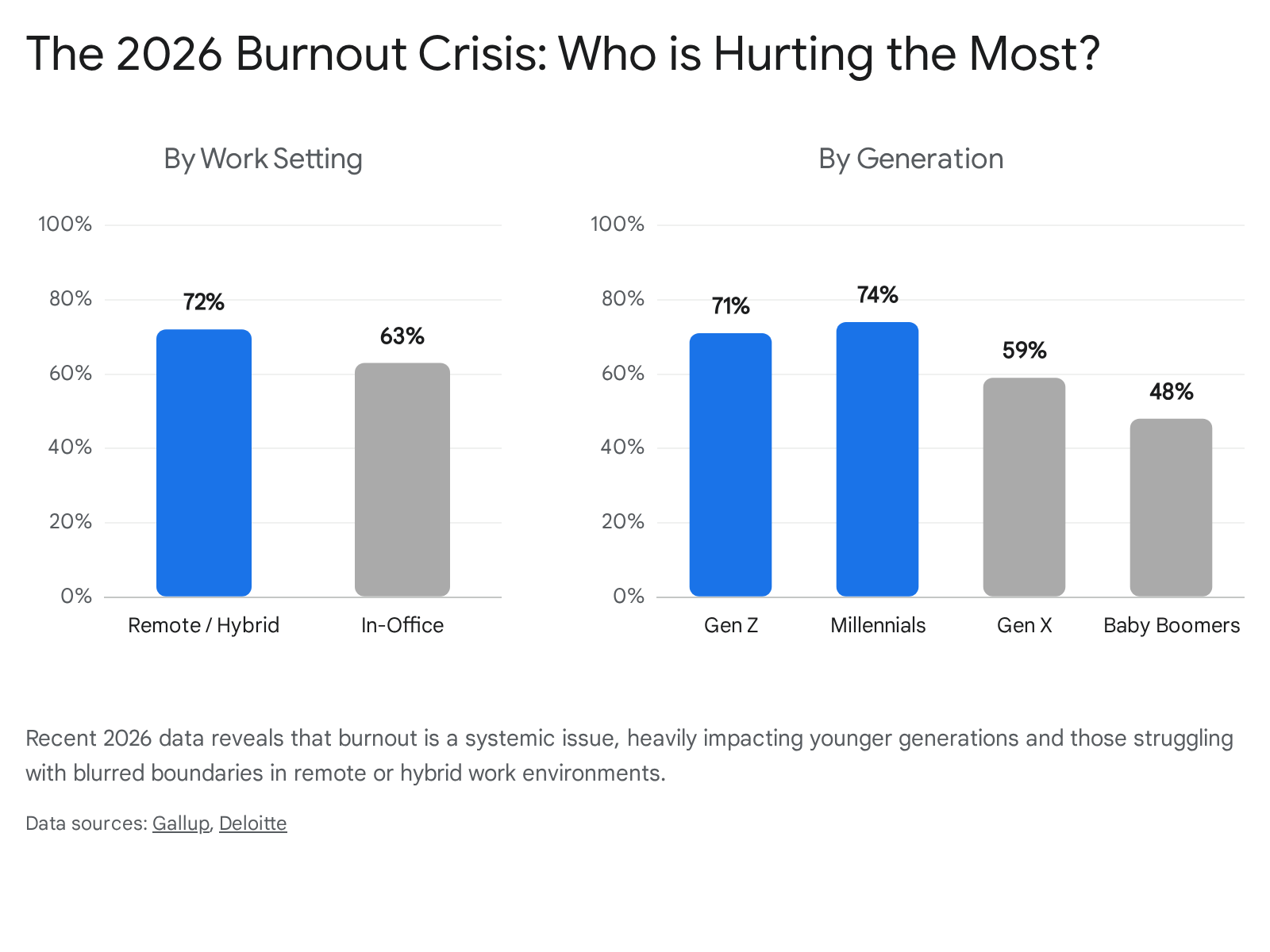
The primary driver of remote burnout is the blurring of boundaries. Without the physical transition of a commute to separate the professional from the personal, 48% of remote employees report working outside scheduled hours at least three times per week, logging an average of 2.5 additional hours per day compared to their in-office counterparts 13.
Smartphones are central to this boundary erosion. A constant stream of push notifications and alerts keeps the brain in a state of cognitive overload, fragmenting attention and constantly taxing cognitive resources 17. Crucially, engaging with work emails or messaging platforms on a phone right before bed directly disrupts sleep. The blue light emitted by screens delays melatonin production, making it harder to fall asleep and stay asleep 17. This creates a vicious cycle: the device that keeps you tethered to work also destroys the deep, restorative sleep you desperately need to recover from it.
Extreme Hustle: Global Lessons on Overwork
To understand the ultimate consequences of unchecked workplace stress, researchers often look to regions where overwork has been deeply institutionalized over decades. The physical toll of ignoring the early warning signs of burnout can be devastating.
In Japan, the post-bubble economy of the 1990s led to chronically understaffed companies and a culture where leaving the office before the boss was seen as a betrayal 1819. This environment gave rise to the tragic phenomenon of Karoshi, translated literally as "death by overwork." Karoshi is characterized by fatal heart attacks, strokes, or suicides directly linked to extreme fatigue and chronic stress 18. In 2025 alone, Japan officially recognized over 1,300 cases of overwork-related deaths and health disorders, representing the highest figure on record 18.
Similar patterns exist throughout East Asia. In South Korea, the phenomenon is known as Gwarosa, driven by rigid corporate hierarchies and immensely long hours 1834. In China, it is termed Guolaosi, fueled by the infamous "996" schedule - working 9 a.m. to 9 p.m., six days a week - which was openly championed by tech billionaires throughout the 2010s 182036.
What Western corporate culture must learn from these extremes is that past a certain biological threshold, true productivity collapses. Human beings cannot sustain intense cognitive focus for 70 hours a week. Consequently, prolonged overwork devolves into performative efficiency - employees staying late simply to be seen, managers spending hours in redundant meetings to display hierarchy, and overall output declining due to sheer exhaustion and a high rate of errors 19. The appearance of endurance replaces actual effectiveness.
Evidence-Based Interventions: What Actually Works?
When individuals recognize the signs of burnout, they often seek quick fixes. However, mitigating burnout requires a nuanced approach, blending daily personal habits with broader structural changes. Recent comprehensive reviews have evaluated the efficacy of various interventions.
The Limits and Benefits of Individual Strategies
If you recognize the signs of burnout in yourself, ignoring them will only accelerate your progress toward a total collapse. While systemic workplace changes are the most effective cure, there are evidence-based actions you can take immediately to protect your nervous system.
Recent meta-analyses and Cochrane Database Systematic Reviews evaluating individual-level interventions to mitigate burnout among healthcare professionals and general workers have found measurable, albeit varied, success 2122.
- Mindfulness and Yoga: Studies suggest that mindfulness-based interventions can result in significant reductions in emotional exhaustion, particularly among nurses and mixed health care professionals 23. Specific clinical trials on yoga demonstrate that even short, 20-minute daily yoga modules can significantly improve scores in emotional exhaustion and depersonalization 2425. Yoga acts as an effective intervention because the physical practice and breathwork help regulate the sympathetic nervous system and downregulate the hypothalamic-pituitary-adrenal (HPA) axis, leading to measurable reductions in salivary cortisol 1226.
- Professional Coaching: For certain high-pressure roles, such as physicians, professional coaching focusing on goal setting, work-life balance, and finding professional purpose has been shown to be effective in reducing burnout symptoms when sustained for more than four weeks 2327.
- Cognitive Behavioral Training (CBT): The Cochrane reviews indicate that individual-level interventions like CBT and relaxation techniques can reduce stress symptoms in the short to medium term 2228.
To implement these findings daily, wellness experts recommend creating a personal "user manual" for your energy, identifying exactly what fuels you and what drains you 11. Because you cannot defer recovery to a distant annual vacation, you must build what are known as "micro and macro recharges" into your routine 11. Micro-recharges are daily, non-negotiable boundaries, such as a 10-minute phone-free walk or eating lunch away from your desk. Macro-recharges are weekly commitments to deep physical rest, social connection, or creative play 11.
Why Systemic Organizational Change is Required
Despite the benefits of individual coping mechanisms, experts caution that their long-term effects remain highly uncertain if the environment does not change. An individual can meditate daily and practice yoga, but if they return to a toxic, unmanageable workload, the burnout will inevitably return 2228.
The ultimate responsibility for preventing burnout lies with the organization. Research consistently demonstrates that organizational interventions - such as workload restructuring, supportive leadership training, and promoting a positive, psychologically safe culture - are highly effective at reducing burnout, often more so than individual resilience training alone 94529. Healing requires a match between working time and workload; without this balance, self-care is merely a band-aid on a gaping wound.
How to Talk to Your Manager About Burnout
One of the most critical steps in arresting burnout is having a candid conversation with your employer to restructure your workload. Because burnout feels deeply isolating and impacts self-esteem, many employees hesitate to bring it up, fearing it will reflect poorly on their competence or label them as weak 3048. However, managers cannot fix a workload imbalance they cannot see.
Preparing for the Conversation
Do not walk into a meeting with leadership simply to vent; preparation and framing are key to achieving a productive outcome.
First, drop the shame. Burnout is incredibly common and is an occupational phenomenon, not a sign of personal weakness or an inability to do your job 48. Framing it internally as a systemic issue helps remove the emotion from the conversation.
Second, document the evidence. Come prepared with specific, tangible examples. Bring emails showing after-hours requests from clients, document unrealistic project deadlines, and outline the exact volume of your workload compared to your job description 48. Concrete evidence shifts the conversation from a subjective feeling of "being tired" to an objective business problem that threatens productivity.
Third, brainstorm solutions. Never bring a problem to a manager without proposing a potential solution 3048. Before the meeting, outline what adjustments would actually help you recover. Do you need a deadline extended? Do you need to shift off a particularly demanding account? Do you need clear rules about offline hours and response times?
Structuring the Discussion and Proposing Solutions
During the conversation, focus on outcomes and use "I" statements 30. Explain how the current setup is affecting your ability to deliver quality work, which aligns your health with the company's goals.
For example, rather than saying, "You are giving me too much work," try framing it collaboratively: "I want to ensure my output remains high quality, but the current volume of tasks is resulting in mental fatigue that makes it difficult to focus. I'd like to discuss how we can reprioritize these deliverables" 3049. Share examples of where your work-life balance is lacking, such as skipping breaks or feeling expected to reply to emails late at night 49.
If your manager is unwilling to make reasonable adjustments after a well-prepared conversation, it may be a clear signal that the organizational culture is fundamentally incompatible with your long-term health. In such cases, it may be necessary to involve Human Resources to explore internal transfers, or to begin evaluating a career transition entirely 3031.
The Future of Work and the Right to Disconnect
Recognizing the dangers of the modern "always-on" culture, several international governments have stepped in to force corporate boundaries where organizations have failed to do so voluntarily. The "Right to Disconnect" is a growing legal framework that allows employees to disengage from work-related communications - like emails, texts, and calls - outside of designated hours without fear of reprisal or penalty 5152.
France pioneered this legislation in 2017, requiring companies with over 50 employees to negotiate terms that protect employees' off-hours as part of annual collective negotiations 5253. Belgium subsequently expanded similar rules to companies with 20 or more employees, requiring formal guidelines to respect personal time 52. Australia is one of the latest countries to adopt this, enacting laws in 2024 and 2025 that allow employees to ignore after-hours contact unless their refusal is deemed strictly unreasonable 52. Other countries, like Ireland, have instituted formal Codes of Practice that outline an employee's right not to work outside normal hours 5253.
The data on the efficacy of these policies is highly encouraging. A comprehensive Eurofound report based on surveys in Belgium, France, Italy, and Spain assessed the impact of these regulations. While Right to Disconnect policies do not magically stop all late emails from being sent, they drastically improve the workplace culture and empower employees to ignore them. Workers in companies with these policies reported much higher job satisfaction and significantly better work-life balance (92% satisfaction compared to 80% in companies without such policies) 32. Furthermore, health issues like chronic stress and anxiety dropped notably in environments where the right to disconnect was culturally enforced 32.
Ultimately, defeating the burnout epidemic requires treating human energy with the same rigorous management and respect as financial capital. It is finite, it requires active and daily replenishment, and burning through it for short-term gains always results in a devastating long-term deficit.
Bottom line
Burnout is not just a passing phase of stress; it is a profound physical, cognitive, and emotional depletion caused by chronic, unmanaged workplace pressures. Spotting it early requires noticing mental fog, emotional cynicism, and physical exhaustion before they cascade into a full collapse. While individual strategies like micro-recharges, yoga, and boundary-setting are crucial first steps for nervous system regulation, long-term recovery depends heavily on structural organizational changes and open communication with leadership to correct unsustainable workloads.