
Causes of feeling like an impostor at work
The experience of feeling like an intellectual or professional fraud despite objective, measurable evidence of success represents a pervasive psychological pattern in modern professional environments. Individuals frequently report meeting or exceeding all performance targets, securing promotions, and receiving external accolades, yet concurrently harboring a persistent fear that they will inevitably be exposed as incompetent. This paradox - high achievement coupled with high, chronic self-doubt - is deeply rooted in a combination of cognitive attribution errors, structural workplace dynamics, shifting communication paradigms in remote work, and broader sociocultural dimensions.
Understanding why measurable success fails to translate into internal confidence requires analyzing the phenomenon not as a standalone pathology, but as an ongoing interaction between individual cognitive processing and environmental stressors.
Clinical Status and Diagnostic Parameters
First identified by clinical psychologists Pauline R. Clance and Suzanne A. Imes in 1978, the "impostor phenomenon" (IP) was initially observed among high-achieving women who exhibited an internal experience of intellectual phoniness 123. Despite outstanding academic and professional accomplishments, these individuals persisted in believing they were not truly intelligent and had merely fooled others into overestimating their capabilities 245. Subsequent empirical research over the past four decades has demonstrated that the phenomenon is widespread across genders, professions, and cultural backgrounds 6. Current estimates suggest that up to 70% to 82% of high-achieving individuals experience impostor feelings at some point in their careers 3789.
It is critical to note that the impostor phenomenon is not a recognized psychiatric disorder. It is absent from the American Psychiatric Association's Diagnostic and Statistical Manual of Mental Disorders (DSM-5) and the International Classification of Diseases (ICD-11) 369. Experts deliberately avoid the term "impostor syndrome" to prevent pathologizing a standard psychological experience, preferring "impostor phenomenon" or "impostor experience" 2410. However, while not a standalone disorder, persistent impostor feelings are frequently comorbid with clinical issues, demonstrating strong positive correlations with generalized anxiety, depression, burnout, and emotional exhaustion 91112.
The phenomenon is characterized by distinct cognitive distortions. Individuals suffering from IP cannot internalize their successes 9. Instead of integrating positive feedback and target attainment into their self-concept, they deploy a specific set of attributional biases that systematically discount their own capabilities and augment the perceived difficulty of the environment.
Measurement and the Clance Impostor Phenomenon Scale
The primary diagnostic tool used in academic research to quantify these feelings is the Clance Impostor Phenomenon Scale (CIPS), developed in 1985 1913. The CIPS measures the extent to which individuals perceive themselves as incompetent despite external indicators of success. It consists of 20 items scored on a 5-point Likert scale, evaluating dimensions such as the fear of evaluation, the discounting of positive feedback, and the attribution of success to luck 1414.
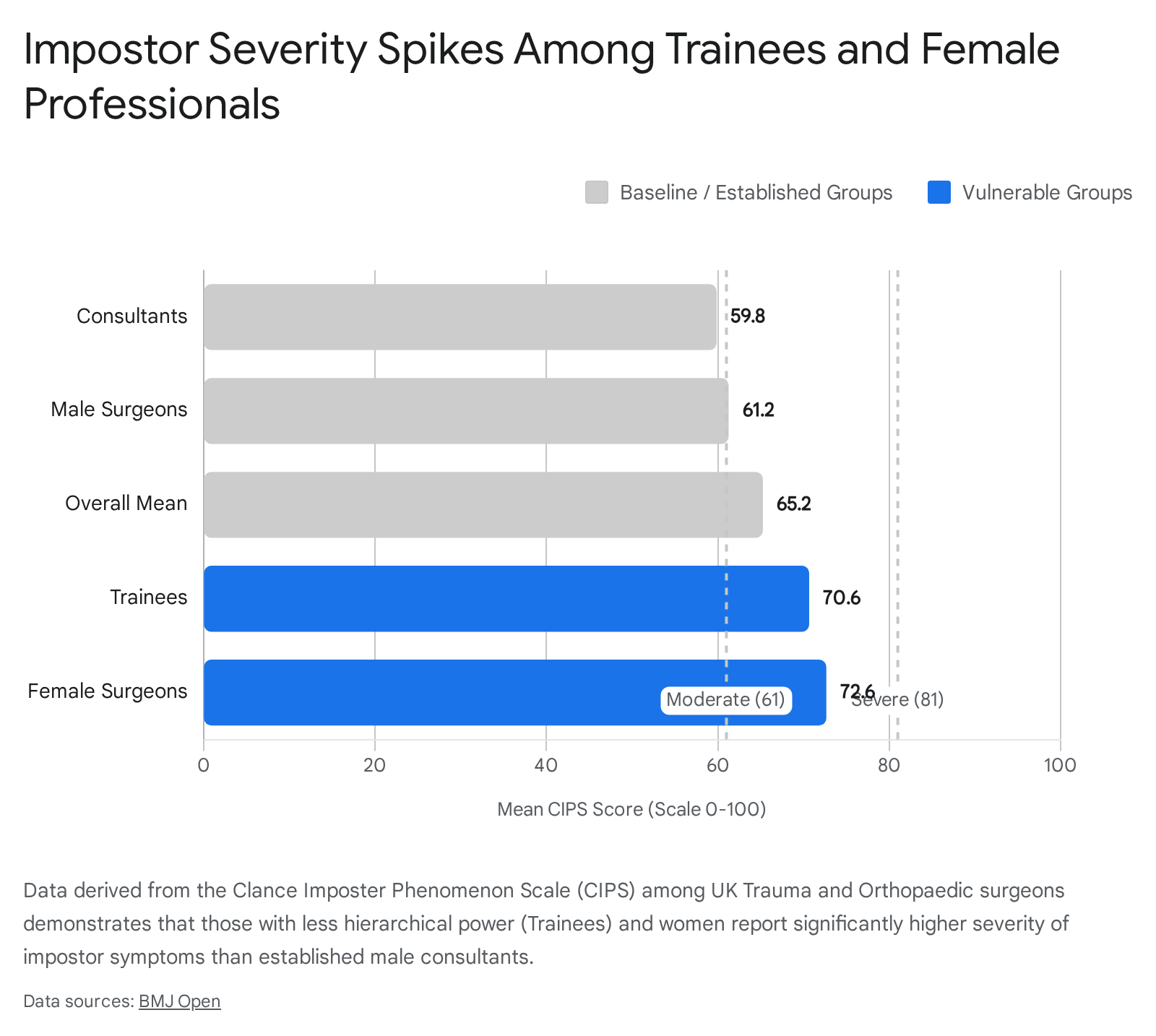
Scores above 61 generally indicate moderate to frequent impostor symptoms, while scores above 80 indicate intense experiences of the phenomenon 1315. The CIPS has demonstrated high internal reliability, with a coefficient alpha typically ranging from 0.85 to 0.96 across diverse populations 114. Alternative measurement tools, such as the Harvey Impostor Phenomenon Scale, the Young Impostor Scale, and the Leary Impostor Scale, are also utilized, though the CIPS remains the prevailing standard in contemporary research 913.
Differential Diagnosis and Comorbidity
Because the impostor phenomenon lacks formal consensus criteria in the DSM-5, clinicians and organizational psychologists must carefully differentiate it from other psychological states that manifest in the workplace. The differential diagnosis for individuals presenting with intense self-doubt often overlaps with formal mood and anxiety disorders 9.
| Psychological State | Core Mechanism | Distinguishing Feature from Impostor Phenomenon |
|---|---|---|
| Impostor Phenomenon | Inability to internalize objective success; fear of exposure. | Occurs despite clear evidence of competence and high achievement. 17 |
| Generalized Anxiety Disorder | Excessive, uncontrollable worry across multiple domains. | Anxiety is diffuse and not strictly tied to achievement, evaluation, or fraudulence. 9 |
| Dunning-Kruger Effect | Metacognitive deficit leading to overestimation of ability. | The exact opposite of IP; low-competence individuals over-participate, whereas high-competence IP individuals under-participate. 16 |
| Clinical Depression | Persistent low mood, anhedonia, and global feelings of worthlessness. | Low self-esteem in depression is global; in IP, self-doubt is typically hyper-focused on intellectual/professional domains. 69 |
| Burnout | Emotional exhaustion, depersonalization, reduced personal accomplishment. | Burnout is an outcome of chronic workplace stress; IP is a cognitive processing error that leads to burnout via overwork. 39 |
Cognitive Attribution Mechanisms
To understand why meeting professional targets fails to alleviate feelings of fraudulence, one must examine how the human brain attributes causality to success and failure. Attribution Theory, pioneered by Bernard Weiner, studies individuals' perceptions of the causality of events, categorizing explanations based on three primary characteristics: locus of control (internal versus external), stability (stable versus unstable), and controllability 171918.
Reversal of the Self-Serving Bias
In standard psychological functioning, individuals often exhibit a "self-serving bias" - a systematic tendency to attribute successes to internal, stable factors (such as inherent intelligence, skill, or effort) and failures to external, unstable factors (such as an exceptionally difficult task, bad luck, or poor management) 1918. This bias serves as an evolutionary psychological defense mechanism to protect self-esteem and maintain motivation in the face of adversity 19.
The impostor phenomenon represents a severe, maladaptive reversal of this bias. Individuals experiencing IP systematically attribute their objective, measurable successes to external, transient, or uncontrollable factors 17191920. Common external attributions include luck, highly favorable timing, the assistance of a team, or the perceived low standards of evaluators 1719. Conversely, they attribute failures, setbacks, or even minor constructive criticisms to internal, stable characteristics - specifically a perceived lack of inherent intelligence or foundational capability 19.
Because success is persistently attributed to external variables (e.g., "I hit my sales quota because the macroeconomic conditions were favorable," or "I received the promotion because no one else applied"), the accomplishment yields no psychological dividend 719. It does nothing to build internal self-efficacy or competence. Consequently, every new performance target met is perceived as a successfully executed deception rather than a reflection of skill. The individual believes they have narrowly escaped detection and that their luck cannot hold indefinitely, thereby increasing, rather than decreasing, their anxiety for the next task 419.
Self-Handicapping and Expectancy-Value Theory
The discounting of success is intimately linked to the psychological concept of self-handicapping. In highly competitive academic or corporate environments, the threat of failure endangers an individual's core sense of self-worth 21. Self-handicapping involves creating real or claimed obstacles to success so that, if failure occurs, it can be blamed on the obstacle rather than a lack of innate ability (the discounting principle) 2122. If success occurs despite the obstacle, the individual's ability is theoretically judged to be even greater (the augmentation principle) 23.
However, individuals with intense impostor phenomenon rarely engage in augmentation to build self-esteem. Instead, their fear of failure drives a chronic, internal self-handicapping mechanism fueled by maladaptive perfectionism 1722. According to Expectancy-Value Theory, which examines why individuals are motivated to complete tasks, those with IP place an intensely high value on the outcome but hold exceptionally low expectancies for their own unassisted ability 17. This results in the "Impostor Cycle," a behavioral loop that activates whenever the individual faces an achievement-related task.
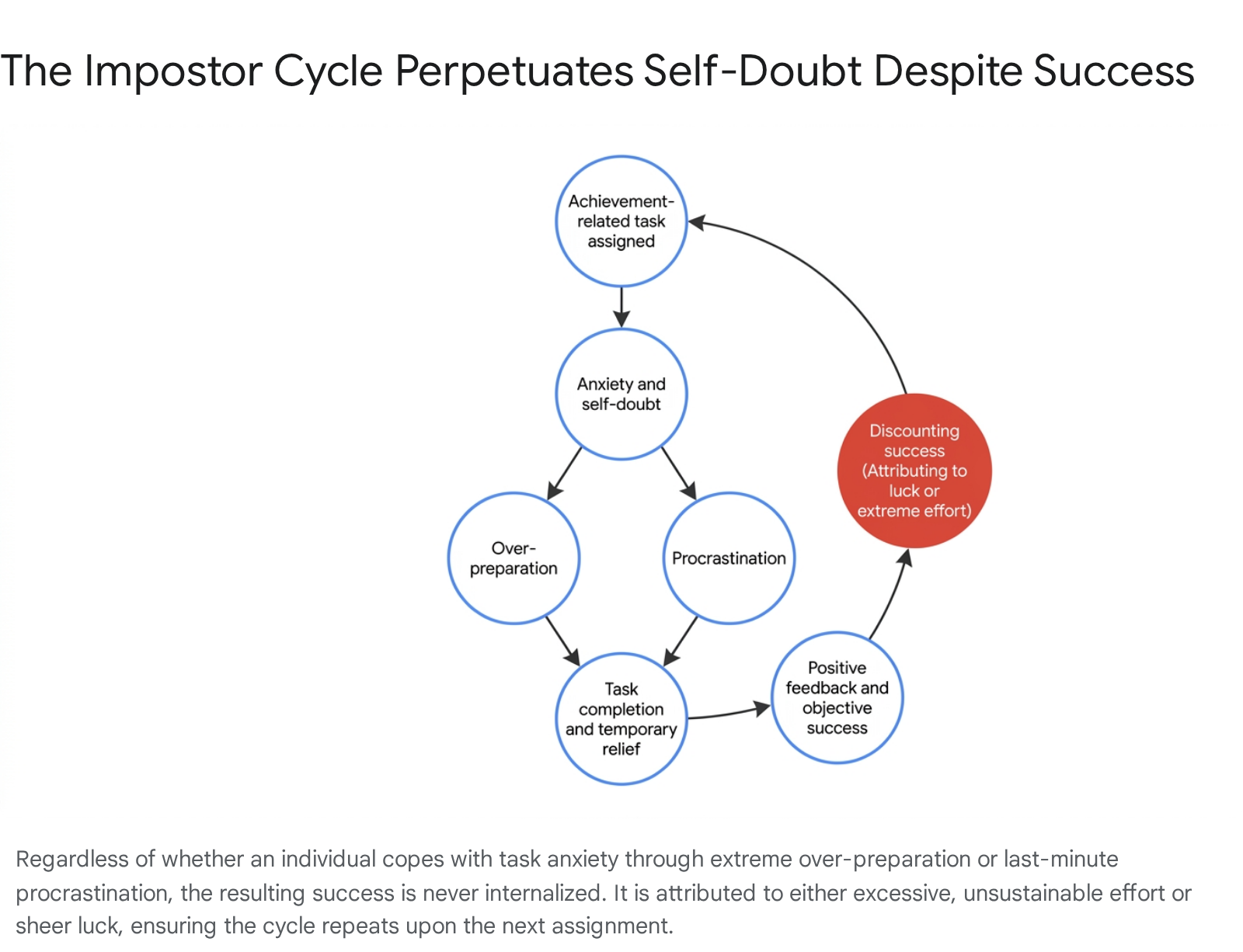
When assigned a new project, the individual experiences immediate anxiety and self-doubt. They typically respond through one of two divergent behavioral pathways: procrastination or extreme over-preparation 9. * If they choose procrastination and ultimately succeed, they attribute the success to a last-minute burst of unrepeatable adrenaline or sheer luck 9. * If they choose extreme over-preparation and succeed, they attribute the success to an unsustainable, excessive volume of hard work, believing that an intellectually capable person would not have needed to expend so much effort 917.
In both scenarios, the target is met, but the achievement is completely divorced from the individual's perception of their own competence.
Sociocultural Dimensions and Intersectionality
The experience of feeling like a fraud is not uniform across all demographics. Cultural values, societal expectations, and intersecting identities deeply influence the severity, etiology, and presentation of the impostor phenomenon 24. While early literature treated IP as a monolithic experience, modern psychology recognizes it as highly sensitive to cultural context.
Individualism Versus Collectivism
Geert Hofstede's cultural dimensions theory, particularly the spectrum of Individualism-Collectivism, provides a crucial framework for analyzing how workplace IP manifests globally 252826.
In highly individualistic cultures - predominantly observed in Western societies such as the United States and Western Europe - the workplace emphasizes autonomy, personal achievement, self-reliance, and direct competition 2826. Accountability is heavily individualized, meaning success is framed as a personal victory and failure as a personal defect 27. In these environments, employees often feel solely responsible for outcomes 27. The cultural expectation to constantly self-promote and achieve independent milestones places immense pressure on individuals. When success occurs, the intense pressure to continuously outperform peers fuels IP; when failure occurs, the lack of collective buffering leads to severe self-doubt.
Conversely, in collectivist cultures - frequently observed in Asian and Latin American societies - the workplace emphasizes group cohesion, shared responsibility, interdependence, and loyalty 2826. While this communal approach might intuitively seem protective against isolated impostor feelings, it introduces an entirely different set of stressors. Collectivist cultures often place a high premium on "saving face" (upholding social integrity) and maintaining interpersonal harmony 2829. Individuals may downplay their talents or avoid asserting their competence to prevent disrupting group dynamics or appearing arrogant 16.
If an individual's success places them in a leadership role that structurally isolates them from the group, the resulting psychological dissonance can manifest as severe IP. This is often exacerbated by a cultural hesitation to seek psychological support or express vulnerability, due to the stigma of burdening others or disrupting the collective peace 2528. Furthermore, high power-distance orientations - common in hierarchical collectivist structures - make it exceedingly difficult for employees to challenge negative self-perceptions, as feedback from authority figures is rarely questioned and is often internalized as absolute truth 3031.
| Cultural Dimension | Primary Values | Impostor Phenomenon Triggers | Mitigation Strategies |
|---|---|---|---|
| Individualistic | Autonomy, personal achievement, self-reliance. 2826 | Pressure to self-promote, sole accountability for failure, hyper-competition. 27 | Emphasizing continuous learning over innate talent, structured peer reviews. 16 |
| Collectivistic | Interdependence, group harmony, saving face. 2826 | Fear of standing out, disruption of group dynamics, high power-distance evaluation. 162830 | Collective recognition of success, mentoring that respects cultural values. 16 |
Intersectional Vulnerabilities and Systemic Bias
When examining the impostor phenomenon through an intersectional framework, it becomes evident that individuals from racially and ethnically minoritized groups, as well as LGBTQ+ individuals, experience overlapping systemic pressures that mimic, exacerbate, or fundamentally alter the nature of IP 2435.
For minoritized groups, self-doubt is frequently not a cognitive distortion rooted in individual pathology, but rather a highly rational response to objectively hostile, biased, or exclusionary environments 363732. The term "impostor syndrome" is often utilized as a convenient scapegoat to mask systemic racism and sexism in corporate and academic settings 1036. The nuances of these intersectional experiences include:
- African American and Latinx Professionals: The impostor phenomenon in these groups is frequently linked to the internalization of negative racialized stereotypes, daily microaggressions, and the implicit organizational message that their presence is tokenistic or a result of affirmative action initiatives rather than merit 33. Studies indicate that high levels of IP, when interacting with high levels of racial discrimination, are strongly linked to severe depression and burnout 33.
- Asian Americans: The phenomenon is frequently driven by the "model minority myth" and the subsequent unreasonably high intellectual expectations placed upon them by both society and their families 2933. This leads to elevated levels of shame and distress when perfection is not achieved, driving intense IP behaviors 33.
- LGBTQ+ Professionals: Research among undergraduate STEM students reveals that sexual identity intersects with race to alter the prevalence of IP. LGBTQ+ individuals often report lower senses of belonging, fear of being compared to normative peers, and heightened self-doubt in highly competitive, heteronormative cultures 35.
By labeling these experiences purely as a deficit of confidence ("impostor syndrome"), organizations risk gaslighting their employees - instructing them to correct their mindset when the environment itself is systematically generating the feelings of inadequacy 103441.
Systemic and Workplace Cultural Catalysts
Contemporary organizational psychology firmly positions the impostor phenomenon not solely as an internal cognitive defect, but as a direct response to systemic environmental factors 53435. The structure, climate, and ideological rules of a workplace dictate the prevalence and severity of impostor feelings among its workforce.
Competitive vs. Cooperative Climates
Research encompassing multi-institutional experimental studies indicates that impostor feelings are triggered and amplified by specific work cultures 534. The phenomenon is highly prevalent in organizations that emphasize relentless competition over cooperation and collective achievement 36.
In competitive climates, colleagues are structurally positioned as rivals who must be outdone to secure recognition, promotions, or finite resources 34. This environment enforces constant upward social comparison - the psychological practice of comparing oneself to individuals perceived as superior in skill, status, or output 537. While upward social comparison can theoretically drive self-improvement and adaptation, in psychologically unsafe or hyper-competitive environments, it primarily breeds inadequacy and dissatisfaction 37. Employees in such settings frequently believe that others are performing effortlessly while they themselves are struggling, resulting in the chronic fear of exposure that defines the impostor phenomenon 34.
The impact of competitive environments is heavily modulated by structural hierarchy and gender. For instance, data regarding trauma and orthopaedic surgeons - a highly demanding and historically male-dominated field - demonstrates that IP does not affect all practitioners equally.
Ideological and Representational Toxicity
At a deeper, systemic level, organizational cultures foster IP through unspoken ideological rules and representational deficits 35. Workplaces steeped in "hustle culture," where 24/7 availability is glorified as a badge of honor and perpetually unreachable performance standards are established, universally position employees as inadequate 1035. When the baseline expectation of the organization is flawlessness or continuous, unsustainble overwork, any standard human limitation or need for rest is internalized by the employee as a personal, fraudulent failure.
Furthermore, a lack of representational diversity in leadership heavily influences self-appraisal. Research into organizational psychological safety highlights that day-to-day interpersonal experiences and observations dictate an employee's sense of professional worth 35. When individuals are consistently treated as though their contributions matter less, or when they observe that no one in senior leadership shares their background or demographic identity, they internalize this external reality as evidence of their actual lack of worth, initiating or solidifying feelings of imposture 373538.
The Impact of Remote and Hybrid Work Environments
The global transition toward remote and hybrid work models, accelerated by the COVID-19 pandemic, has introduced novel structural triggers for the impostor phenomenon. As of early 2025, data indicates that approximately 29% of paid working days in the United States remain remote, with flexible work establishing a long-term, structural equilibrium in the corporate landscape 394041.
While remote work undeniably reduces exposure to certain toxic office politics and offers higher overall engagement and productivity for many - with remote-only workers logging up to 51 more productive minutes per day than their office-based peers - it radically alters the mechanisms of professional feedback, creating a fertile ground for self-doubt 394042.
The Feedback Vacuum and Non-Verbal Cues
In traditional in-person work settings, competence is continuously, albeit subtly, validated through informal micro-interactions: a reassuring nod from a manager during a presentation, a casual compliment in the hallway, or the visible observation of peers experiencing similar day-to-day struggles. Remote work effectively strips the professional environment of these crucial, informal feedback loops 38.
Without casual interactions, remote employees suffer from professional isolation and struggle to accurately gauge their performance relative to organizational expectations 38. The virtual meeting environment is notoriously devoid of nuanced social cues; silence on a video call, a lack of immediate eye contact, or a delayed response in an asynchronous messaging application leaves a communicative void 38. Given the cognitive distortions already associated with IP, employees predictably fill this void with negative self-interpretation. They perceive neutral digital responses as implicit criticism, disinterest, or undeniable evidence of their own inadequacy 38. Consequently, HR organizations have reported dramatic surges in imposter syndrome inquiries, with a 75% increase noted in recent workplace psychology reports 38.
Visibility, Tangibility, and Proximity Bias
Remote workers frequently question whether their work is seen, valued, or even noticed by leadership 38. Digital contributions can feel inherently less tangible than physical presence. In environments where managers harbor "proximity bias" - the lingering belief that in-office workers are harder working, more dedicated, or more trustworthy simply because they are physically visible - remote employees often feel compelled to overcompensate 50. Survey data from 2024 indicates that 55% of employees still believe their managers view in-office staff as harder working 50.
To prove they are not "getting away with it" or slacking while at home, high-achievers raise their own output benchmarks faster than they can attain them 43. They may engage in "polyworking" or performative digital presence to signal productivity, accelerating the path to burnout while simultaneously reinforcing the core impostor belief that their employment relies on continuous, exhausting deception rather than actual competence 50.
Organizational Remediation and Leadership Interventions
Because the impostor phenomenon is heavily driven by structural variables, ideological norms, and communication paradigms, remediation must move beyond the individual level and focus on systemic organizational change 84144. While individual interventions - such as Cognitive Behavioral Therapy (CBT) and Mindfulness-Based Stress Reduction (MBSR) - effectively help professionals identify distorted thought patterns and reframe their attribution errors 144, sustainable alleviation requires employers to alter the very conditions under which employees work.
Restructuring Feedback and Performance Evaluation
Impostor phenomenon thrives in ambiguity and feedback deserts 4345. To combat this, organizations must systematically audit and overhaul their feedback mechanisms and performance review structures.
- Calibration Over Reassurance: Vague reassurance (e.g., "You're doing great," or "Don't worry, you are smart") does not alleviate IP because the impostor brain easily dismisses it as mere politeness or lowered standards 41. Instead, managers must be trained to provide "calibration feedback" tied strictly to specific, observable evidence and outcomes 4143. Pointing out exactly how a specific action influenced a positive outcome (e.g., "The specific way you structured the financial model reduced our risk exposure by 10% and changed the executive team's decision") forces the employee to confront objective data regarding their competence 41.
- Redefining Competence and Learning: Performance reviews should emphasize a growth mindset, evaluating employees on skill acquisition, resilience, and applied effort, rather than demanding innate, flawless brilliance 54. Treating mistakes as necessary data points for professional development rather than fatal errors helps dismantle the perfectionism that drives the impostor cycle 3854.
- Transparent Progression Criteria: When the metrics for promotion are opaque, employees logically assume that advancement is based on luck, nepotism, or shifting goalposts 41. Establishing transparent, uniformly applied criteria ensures that when an employee meets their targets, they can intellectually connect their labor to their advancement, removing a structural contributor to self-doubt 41.
Building Psychological Safety and Active Sponsorship
A culture of psychological safety - where individuals feel secure taking interpersonal risks, asking questions, and admitting knowledge gaps without fear of penalization or humiliation - is the strongest organizational defense against the impostor phenomenon 373546. Leaders must model vulnerability by openly discussing their own struggles, missteps, and learning curves, thereby normalizing the human experience of professional growth and uncoupling the concept of "competence" from "perfection" 3846.
Furthermore, organizations must shift their talent development approach from passive mentorship to active sponsorship 41. Individuals grappling with high IP are significantly less likely to volunteer for stretch assignments, lead high-visibility projects, or apply for promotions due to the paralyzing fear of exposure, even when they are the most qualified candidates 841. While mentors offer advice and a sounding board, sponsors actively act: they advocate for individuals in closed-door meetings, open operational doors, and leverage their own political capital to place competent but self-doubting employees into advanced roles 41. Active sponsorship bypasses the individual's hesitation and provides an undeniable institutional endorsement of their capability, fundamentally disrupting the impostor narrative.
Conclusion
Feeling like an impostor despite consistently meeting or exceeding performance targets is rarely a reflection of actual incompetence. Rather, it is the predictable outcome of a complex interplay between cognitive attribution errors - where the brain systematically assigns success to external luck rather than internal skill - and modern workplace environments that inadvertently sustain chronic self-doubt. Systemic issues such as hyper-competitive organizational cultures, the feedback vacuums inherent to remote work, and the heavy intersectional burdens of bias, stereotyping, and lack of representation create rational grounds for employees to question their belonging and competence.
Addressing the impostor phenomenon requires a comprehensive paradigm shift. Individuals must be supported in recognizing and reframing their maladaptive cognitive cycles, but more importantly, organizations must cease pathologizing their high performers. By implementing precise, evidence-based calibration feedback, fostering robust psychological safety, and dismantling opaque, toxic hierarchies, leadership can create professional environments where success is not just mechanically achieved, but deeply and accurately internalized.