
Discrepancies in Free Neutron Lifetime Measurements
Fundamental Physics of Neutron Decay
The free neutron is the simplest archetype of charged-current semi-leptonic weak interactions. While neutrons bound within stable atomic nuclei are prevented from decaying by nuclear binding energy, an isolated free neutron is inherently unstable 1. Through the weak nuclear interaction, it undergoes beta decay, transforming into a proton ($p$), an electron ($e^-$), and an electron antineutrino ($\bar{\nu}_e$) 12. At the fundamental level, this involves a down quark converting into an up quark via the emission of a virtual $W^-$ boson, which subsequently decays into the lepton pair 13.
The energy release, or $Q$-value, of this decay is governed by the mass difference between the initial and final states ($M_n - M_p - m_e \approx 0.782$ MeV) 4. Because this energy release is nearly three orders of magnitude smaller than the nucleon mass itself, the available phase space for the decay products is highly restricted. This kinematic limitation is the primary reason the free neutron exhibits a relatively long mean lifetime ($\tau_n$) of approximately 15 minutes, which corresponds to a half-life of roughly 608 seconds 14.
The precise measurement of this lifetime is a central objective in particle physics because it directly parameterizes the weak interaction. The transition probability of polarized neutron beta decay is described by several measurable correlation coefficients. These include the electron-neutrino asymmetry ($a$), the neutron spin-electron momentum correlation ($A$), and the neutron spin-neutrino momentum correlation ($B$) 34. The lifetime $\tau_n$, combined with the ratio of the axial-vector to vector weak coupling constants ($g_A/g_V$, denoted as $\lambda$), completely defines the decay rate within the Standard Model 23. Because free neutron decay is not complicated by the multi-nucleon structural effects present in complex nuclear beta decays, it provides an exceptionally clean theoretical laboratory for testing extensions of the Standard Model, such as the existence of non-standard scalar or tensor weak currents 4.
The Beam Method Architecture
Experimental measurement of the neutron lifetime is notoriously difficult. A 15-minute lifetime is too short to allow for extended observation without significant population loss, yet too long to observe the complete decay of a high-statistics sample instantaneously 5. The first of the two primary experimental methodologies developed to overcome this challenge is the beam method, which operates by counting the decay products of neutrons in flight.
In-Flight Decay Counting Principles
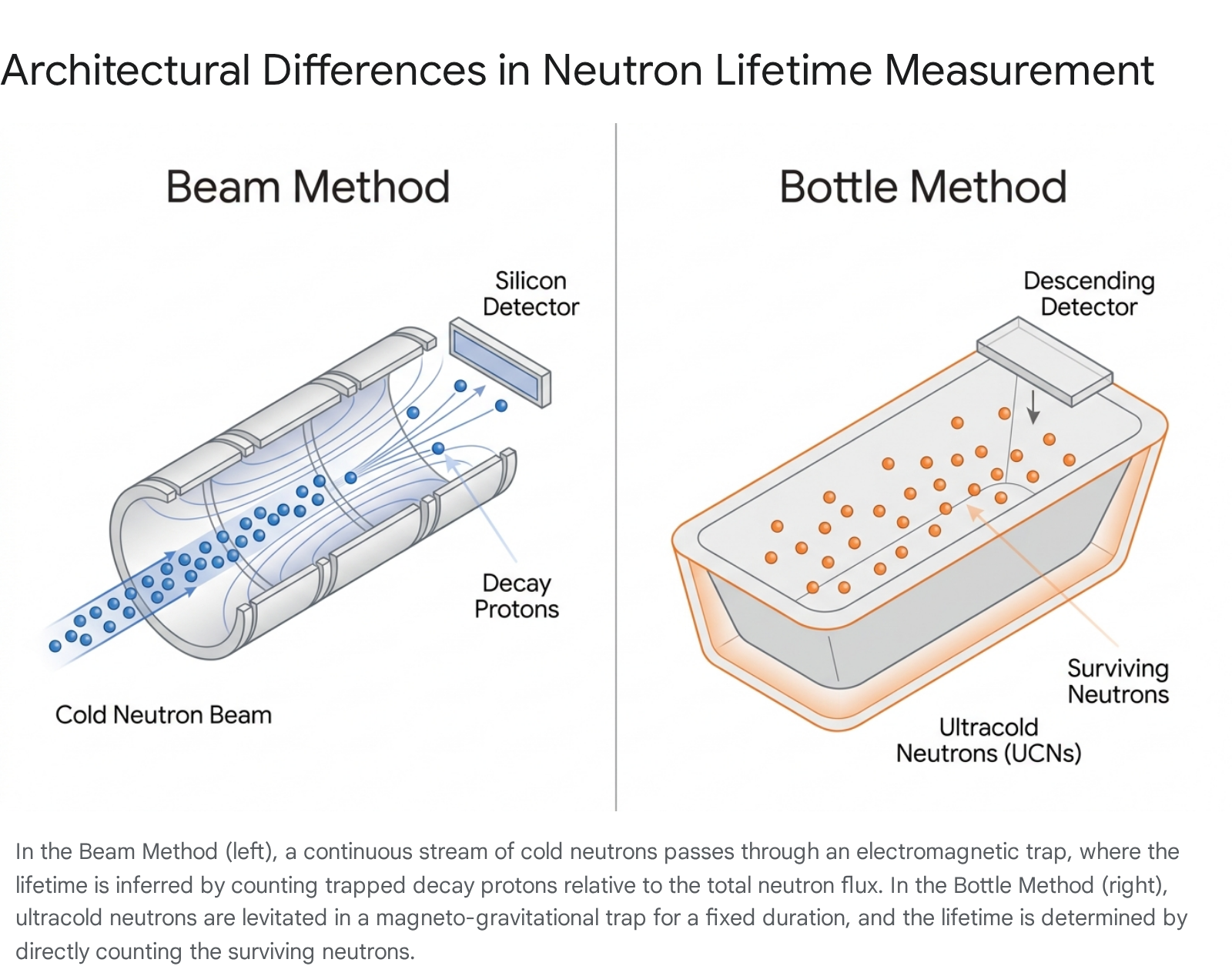
In a typical beam experiment, a well-collimated continuous flux of cold neutrons (with kinetic energies on the order of $10^{-3}$ eV) is directed through a high-vacuum electromagnetic trap 678. Rather than attempting to measure the disappearance of the neutrons themselves, the apparatus detects the protons or electrons generated by beta decay within a highly specific fiducial volume 69.
The neutron lifetime $\tau_n$ is extracted using the differential form of the exponential decay law: $\tau_n = N / \dot{N}$, where $N$ represents the absolute number of neutrons present within the specified decay volume, and $\dot{N}$ represents the absolute rate of neutron decay 7. This requires two distinct, absolute measurements to be performed simultaneously with extreme precision: the counting of the decay products and the determination of the total neutron fluence traversing the trap 5910.
The NIST Quasi-Penning Trap Apparatus
The most precise realizations of the proton-detecting beam method have been conducted at the National Institute of Standards and Technology (NIST) Center for Neutron Research (NCNR) 911. In the NIST BL1 and BL2 experimental setups, a cold neutron beam passes through a segmented quasi-Penning trap situated within a superconducting solenoid 612.
When a neutron decays inside this trap, the resulting proton (which has a maximum kinetic energy of 751 eV) is confined radially by a strong axial magnetic field and axially by an electrostatic potential applied to a series of door and mirror electrodes 12. The trap operates on a cyclic basis. At a specific frequency, typically around 100 Hz, the electrostatic door is rapidly lowered to ground potential 12. The trapped protons are then transported along a 9.5-degree bend in the magnetic field lines - a maneuver designed to separate the protons from the intense background radiation of the primary neutron beam - and are accelerated into a silicon surface barrier detector where they are counted 912.
Absolute Neutron Fluence Calibration
To determine the denominator of the decay equation, the absolute neutron flux must be continuously monitored. The NIST apparatus achieves this by placing a thin deposit of Lithium-6 ($^6$Li) in the path of the beam 12. Neutrons captured by the $^6$Li foil trigger the $^6$Li(n,$\alpha$)$^3$H reaction, emitting alpha particles and tritons that are counted by dedicated proportional counters 12.
Because the beam method's precision is entirely dependent on knowing the exact efficiencies of these detectors, absolute calibration is critical. The efficiency of the neutron flux monitor is cross-referenced using an Alpha-Gamma (AG) device placed on an independent, monochromatic neutron beam 913. The AG device utilizes Passivated Implanted Planar Silicon (PIPS) detectors and High-Purity Germanium (HPGe) detectors to measure neutron capture rates on specific isotopes, reducing the systematic uncertainty of the neutron fluence measurement to 0.06% 91415.
Systematic Uncertainties in Beam Measurements
The beam method is highly susceptible to systematic biases that could artificially skew the detected proton rate. Any mechanism that causes decay protons to be lost prior to detection will artificially depress $\dot{N}$, resulting in a calculated lifetime that is erroneously long 567.
Extensive modeling and experimental runs have been dedicated to identifying and quantifying these proton loss mechanisms. Known systematic effects include backscattering off the dead layer of the silicon proton detector and geometric losses due to the cyclotron orbits of protons expanding beyond the active detector radius (the "beam halo" effect), which necessitated specific timing and geometric corrections 79. Another heavily investigated loss mechanism is charge exchange. If a trapped proton collides with a molecule of residual hydrogen gas ($H_2$) in the ultra-high vacuum system, it can steal an electron to become a neutral hydrogen atom. Lacking a positive charge, this atom is no longer confined by the electromagnetic fields and escapes the trap uncounted, leaving behind an $H_2^+$ ion 616. Dedicated experimental reviews of the NIST data in 2026 searched for the presence of these $H_2^+$ ions and concluded that the ultra-high vacuum conditions rendered charge exchange losses negligible relative to the overall statistical uncertainty 616. Accounting for these known systematic corrections, the average neutron lifetime measured by proton-detecting beam experiments stands at $888.1 \pm 2.0$ seconds 1217.
The Ultracold Neutron Storage Method
The second major architecture for measuring the neutron lifetime circumvents the difficulties of absolute particle counting by utilizing a relative measurement technique. The "bottle" method relies on trapping a known population of neutrons in a confined space and directly counting the number of survivors after varying periods of time 71819.
Ultracold Neutron Kinematics
The bottle method is made possible by the unique physics of Ultracold Neutrons (UCNs). When neutrons are cooled to kinetic energies below approximately 50 nano-electron-volts (neV), their velocities drop below 8 meters per second, and their corresponding De Broglie wavelengths stretch to several hundred angstroms 1920. At these extreme macroscopic limits, UCNs undergo total external reflection when striking certain material boundaries due to a repulsive neutron-nuclear strong interaction potential . Furthermore, their kinetic energy is on the same order of magnitude as typical gravitational potential energy ($\approx 100$ neV/meter) and magnetic potential energy ($\approx 60$ neV/Tesla) 20. Consequently, UCNs can be physically contained within macroscopic vessels, levitated by magnetic fields, or trapped by the Earth's gravity 1920.
Material and Magneto-Gravitational Traps
Early implementations of the bottle method utilized physical containers lined with specialized materials or oils. However, these material bottles introduced significant systematic uncertainties. Even at ultracold energies, a small fraction of neutrons interacting with the physical walls would be absorbed or up-scattered (gaining thermal energy and escaping the trap) 221. These wall losses mimicked beta decay, requiring complex variable-volume extrapolations to isolate the true weak decay lifetime 27.
To eliminate wall interaction losses entirely, contemporary experiments utilize magneto-gravitational traps. The most precise realization of this technology is the UCN$\tau$ experiment located at the Los Alamos National Laboratory (LANL) 121922. The UCN$\tau$ trap is an asymmetric, bathtub-shaped vessel 1921. The interior surface of the trap is lined with over 4,000 Neodymium-Iron-Boron (NdFeB) permanent magnets arranged in a Halbach array 21. The Halbach configuration creates an exponentially decaying, highly non-uniform magnetic field that generates a strong repulsive force ($F = \mu \cdot \nabla B$) against UCNs polarized in the weak-field-seeking spin state 1921.
As UCNs are loaded into the open-top trap, they fall under the influence of gravity toward the magnet array. Before they can strike the physical surface, the repulsive magnetic gradient reflects them upward 21. Gravity eventually halts their ascent and pulls them back down, creating a stable, levitating population of neutrons completely isolated from material surfaces 1921.
Storage Method Measurement Cycles
A single measurement cycle in the UCN$\tau$ experiment begins by filling the trap with polarized UCNs. A high-pass UCN energy filter is often utilized to remove marginally trapped, high-energy neutrons that might otherwise escape the magnetic confinement slowly over time 19. Once loaded, the trap is sealed, and the UCN population is allowed to evolve for holding times ranging from hundreds to thousands of seconds 1923.
At the conclusion of the specified storage period, a multilayer $^{10}$B-coated Zinc-Sulfide (ZnS) scintillator detector is mechanically lowered directly into the trap volume to actively count the surviving neutrons in situ 1219. By comparing the populations of surviving neutrons across multiple storage intervals, the lifetime is extracted purely from the exponential decay curve. Because magnetic trapping effectively reduces wall losses to zero, the disappearance rate of the UCNs represents the true inclusive lifetime of the particle 1221. The highest-precision data from the LANL UCN$\tau$ collaboration yields an average lifetime of $877.82 \pm 0.22_{\rm(stat.)} {}^{+0.20}{-0.17}{}{\rm(sys.)}$ seconds 26. Across all leading magnetic and material UCN storage experiments, the globally accepted average is $878.4 \pm 0.5$ seconds 12.
Emerging Space-Based Lifetime Measurements
A novel, third independent technique for measuring the neutron lifetime has been pioneered using planetary science data gathered by space probes. The space-based method bridges the conceptual gap between beam and bottle techniques by measuring the decay of free neutrons in the vacuum of space over immense distances 242526.
Cosmic Ray Spallation and Planetary Transport
Planetary bodies lacking thick atmospheres, such as the Moon and Mercury, are continuously bombarded by high-energy Galactic Cosmic Rays (GCRs). When GCRs impact the regolith, they initiate spallation reactions that liberate large quantities of fast neutrons 2527. Through subsequent collisions with the planetary surface material, a fraction of these neutrons thermalize, achieving velocities of only a few kilometers per second 2627.
Due to the weak gravitational pull of these bodies, a substantial population of thermal and epithermal neutrons escapes the surface and travels ballistic trajectories into space. Crucially, neutrons with kinetic energies below 0.0295 eV ejected from the lunar surface lack escape velocity and become gravitationally bound 26. If these bound neutrons do not undergo beta decay in flight, they eventually fall back to the surface. However, because their flight times easily stretch into minutes, a significant percentage of them decay while aloft 2526.
Orbital Spectrometry and Systematic Complexities
The space-based measurement technique utilizes neutron spectrometers aboard orbiting spacecraft, such as NASA's Lunar Prospector (LP) and the MESSENGER mission to Mercury 2427. By measuring the flux of surviving neutrons at varying orbital altitudes, researchers can map the attenuation of the neutron population over distance (and thus time) 2425. Comparing this empirical attenuation against sophisticated Monte Carlo models of neutron production and gravitational transport yields an estimate of the free neutron lifetime 2426.
Initial proof-of-concept analyses of the Lunar Prospector data produced a lifetime estimate of 887 seconds, remarkably close to the laboratory beam average 24. However, further detailed analysis revealed that this methodology is currently dominated by immense systematic uncertainties 1028. The production rate and initial energy spectrum of spalled neutrons are highly dependent on the local elemental composition and subsurface temperature of the planetary regolith 2628. Variations in these parameters require significant scaling corrections to the macroscopic neutron absorption cross-sections used in the transport models 26.
Depending heavily on the specific latitude-dependent temperature models and compositional resolution maps (e.g., 5-degree versus 20-degree binning) applied to the Lunar Prospector data, the extracted neutron lifetime fluctuates wildly between $738.6 \pm 10.8$ seconds and $777.6 \pm 11.7$ seconds 28. Because these planetary science missions were not optimized for precision nuclear physics, the current space-based data cannot resolve the laboratory discrepancy, though the methodology provides a foundational proof-of-concept for future, dedicated fundamental physics missions 102628.
The Neutron Lifetime Puzzle
When compiling the highest-precision data from the two principal laboratory architectures, a stark anomaly is immediately evident.
The global average lifetime derived from proton-detecting beam experiments is $888.1 \pm 2.0$ seconds 1217. In sharp contrast, the global average derived from UCN magnetic bottle storage experiments is $877.8 \pm 0.3$ seconds 1217.
This divergence of approximately 10 seconds - far exceeding the sub-second statistical and systematic error bars reported by the respective experimental collaborations - constitutes the "Neutron Lifetime Puzzle" 121823. The statistical tension between the two methods approaches five standard deviations ($5\sigma$), proving that the gap is not a random fluctuation but a fundamental discrepancy in measurement 1217.
| Experimental Methodology | Detection Mechanism | Current Precision Average | Uncertainty Margin |
|---|---|---|---|
| Bottle Method (UCN Storage) | Inclusive disappearance of ultracold neutrons | $877.8$ seconds | $\pm 0.3$ seconds 1722 |
| Beam Method (Proton Detection) | Exclusive observation of Standard Model protons | $888.1$ seconds | $\pm 2.0$ seconds 1217 |
This puzzle forces the physics community to confront two mutually exclusive possibilities. The conservative conclusion is that despite decades of rigorous refinement, one or both experimental methodologies suffer from deeply hidden, unrecognized systematic errors 1227. The more radical conclusion is that both experiments are measuring exactly what their architectures dictate, and the difference in their values is exposing new physics beyond the Standard Model 1029.
Standard Model Tests and CKM Unitarity
The resolution of the 10-second gap is highly consequential for the internal mathematical consistency of the Standard Model. A primary application of the neutron lifetime is the extraction of the $V_{ud}$ element of the Cabibbo-Kobayashi-Maskawa (CKM) quark mixing matrix 23. The CKM matrix parameterizes the probability of flavor-changing weak decays among the three generations of quarks. A strict requirement of the Standard Model is that the CKM matrix must be exactly unitary, meaning the sum of the squares of the elements in the first row ($|V_{ud}|^2 + |V_{us}|^2 + |V_{ub}|^2$) must equal 1 327.
Historically, the value of $V_{ud}$ has been derived from superallowed $0^+ \to 0^+$ nuclear beta decays 4. However, extracting $V_{ud}$ from heavy nuclei requires substantial theoretical corrections to account for complex nuclear structure effects and isospin symmetry breaking, which inherently limit the precision of the calculation 430. The beta decay of the free neutron provides a theoretically "clean" alternative, as it involves no nuclear structure 431.
To extract $V_{ud}$ purely from free neutron decay, physicists require the precise value of the lifetime ($\tau_n$) and the axial-to-vector coupling ratio ($g_A/g_V$, measured via the electron asymmetry correlation coefficient $A$) 3. The 10-second discrepancy in $\tau_n$ creates an immediate bottleneck in this fundamental test. When the shorter 878-second bottle lifetime is used in the calculation, the resulting $V_{ud}$ value is broadly consistent with both the results from superallowed nuclear decays and the requirement of CKM unitarity 30. Conversely, if the longer 888-second beam lifetime represents the true value, the extracted $V_{ud}$ falls significantly short, indicating a violation of CKM unitarity 2730. A confirmed violation of unitarity would necessitate massive revisions to the Standard Model, potentially requiring the existence of right-handed weak currents or undiscovered quark generations 230.
Cosmological Implications and Big Bang Nucleosynthesis
The impact of the neutron lifetime extends from the subatomic scale to the cosmological evolution of the early universe. The Standard Theory of Big Bang Nucleosynthesis (BBN) describes the formation of the first light isotopes ($^1$H, D, $^3$He, $^4$He, and $^7$Li) during the first three minutes following the Big Bang 123233.
Thermal Equilibrium and Weak Freeze-Out
In the early radiation-dominated era, when the temperature of the universe was $T \sim 1$ MeV (roughly 1 second after the Big Bang), weak interactions were in strict thermal equilibrium 33. The rapid interconversion of protons and neutrons via neutrino and electron collisions established a predictable neutron-to-proton number density ratio governed by the mass difference $Q = 1.293$ MeV 33. The rate of these weak interconversions per nucleon scales steeply with temperature ($\Gamma_{n\leftrightarrow p} \sim G_F^2 T^5$) 33.
As the universe expanded and cooled, the Hubble expansion rate ($H \sim \sqrt{g_*} G_N T^2$) eventually outpaced the rapidly falling weak interaction rate 33. At this critical juncture - known as "freeze-out" - the continuous interconversion ceased, and the global neutron-to-proton ratio was fixed at approximately $n/p \simeq 1/6$ 33.
From the moment of freeze-out until the temperature dropped sufficiently to allow stable nuclear fusion to begin (roughly 180 seconds later), free neutrons were subject only to beta decay 3334. Because free neutrons decay exponentially, the exact duration of the neutron mean lifetime directly dictated how many neutrons survived this temporal gap to participate in nucleosynthesis 123439. A longer neutron lifetime implies a slower decay rate, resulting in a larger surviving inventory of neutrons at the onset of fusion 34.
Primordial Helium Abundance and Observational Tensions
Once the ambient temperature cooled to roughly 0.07 MeV, the "deuterium bottleneck" cleared 3935. Protons and neutrons rapidly fused into deuterium, which almost immediately underwent further highly efficient fusion reactions 3935. Because the binding energy of Helium-4 ($^4$He) is exceptionally high, virtually all surviving primordial neutrons were swept up into $^4$He nuclei 123435.
The primordial mass fraction of Helium-4, denoted as $Y_p$, can be approximated by the simple stoichiometric relation $Y_p \simeq 2(n/p) / (1 + n/p)$ 34. Consequently, $Y_p$ is highly sensitive to the neutron lifetime. BBN calculations utilize the neutron lifetime alongside the baryon-to-photon ratio ($\eta$, determined independently from the Cosmic Microwave Background) to theoretically predict $Y_p \approx 0.245 \pm 0.003$ 33.
These theoretical predictions are cross-examined against astronomical observations. To measure the primordial $Y_p$ empirically, astronomers study the emission lines of helium and hydrogen in extremely metal-poor, unevolved dwarf galaxies (H II regions), where contamination from subsequent stellar nucleosynthesis is minimized 3436. Recent high-precision observational data, such as that gathered by the "Extremely Metal-Poor Representatives Explored by the Subaru Survey" (EMPRESS) collaboration using the Subaru Telescope, have indicated $Y_p$ values that are slightly lower than historical averages 3437.
A lower observed abundance of Helium-4 requires a smaller initial inventory of primordial neutrons, which in turn strongly favors the shorter 878-second neutron lifetime established by the UCN bottle experiments 34. Theoretical simulations using advanced computational tools like the PRyMordial Python package confirm that the 888-second beam lifetime generates Helium-4 predictions that are in noticeable tension with these recent astronomical observations 3435. While the systematic uncertainties in both astronomical measurements and empirical nuclear reaction rates (e.g., deuterium burning cross-sections like $d(d,n)^3$He evaluated by the NACRE II and PRIMAT collaborations) remain significant, reducing the uncertainty in $\tau_n$ is a strict prerequisite for utilizing BBN to constrain the number of effective relativistic neutrino species ($N_{\rm eff}$) or other early-universe physics 333435.
Theoretical Frameworks for Beyond Standard Model Physics
If the systematic integrity of both the beam and bottle measurements is accepted, the 10-second discrepancy implies the existence of uncharacterized decay channels outside the Standard Model (BSM) 52930.
This conclusion rests on the distinct operational mechanics of the two experiments. The bottle method traps neutrons and counts how many disappear over time; it is completely agnostic to the mechanism of their disappearance. It therefore measures the inclusive lifetime of the particle 521. The beam method, conversely, operates by actively detecting the specific charged products of beta decay - namely, protons. If a neutron decays into something other than a Standard Model proton and electron, the beam detector records nothing. It therefore measures an exclusive lifetime 538.
If approximately 1% of free neutrons undergo a "dark decay" into invisible particles that bypass the beam detectors, the bottle method will accurately record the true, faster disappearance rate (878 seconds), while the beam method will artificially calculate a slower rate (888 seconds) because it is blind to 1% of the decay events 233844.
Dark Matter Fermion and Photon Emission
Theoretical models developed by Fornal and Grinstein proposed that the neutron could decay into a stable dark matter Dirac fermion ($\chi$) 293839. The simplest realization of this theory is the channel $n \to \chi + \gamma$, where the neutron emits a dark fermion and a monochromatic photon 2938.
For this model to be phenomenologically viable, strict kinematic boundaries must be enforced. To prevent the spontaneous decay of stable atomic nuclei (such as Beryllium-9) into dark matter, the mass of the dark fermion ($m_\chi$) must be heavier than the mass of the proton minus the electron ($937.993$ MeV) 2938. Simultaneously, for the decay to be energetically permissible for a free neutron, $m_\chi$ must be lighter than the free neutron itself ($939.565$ MeV) 2939.
This tightly constrained mass window predicts that the accompanying monochromatic photon must carry an energy between 0.782 MeV and 1.664 MeV 293839. Subsequent targeted experiments specifically scanned this energy bracket for anomalous gamma-ray spikes during neutron decay. The results were negative, effectively excluding the $n \to \chi + \gamma$ channel at the 1% branching ratio required to solve the puzzle 52938. A heavily suppressed sub-channel involving electron-positron emission ($n \to \chi + e^+ + e^-$) was similarly ruled out by data from the UCNA (Ultracold Neutron Asymmetry) experiment, which excluded it as the dominant dark decay pathway at the $5\sigma$ level 384041.
Dark Scalar Emission and Neutron Star Constraints
While photon and lepton emission channels have been largely excluded, a variation involving the emission of a dark scalar or vector boson ($n \to \chi + \phi$) remains theoretically possible 294442. In this scenario, the mass of the light scalar is restricted to an exceedingly narrow window ($2m_e < m_\phi < 2m_e + 0.0375$ MeV) to remain consistent with BBN and Higgs physics constraints 4442.
The primary obstacle for any neutron dark decay theory is astrophysics. The core of a neutron star is supported against gravitational collapse by neutron degeneracy pressure. If free neutrons can easily decay into dark matter fermions, the macroscopic neutron population within a neutron star core would undergo continuous conversion into dark matter until chemical equilibrium is reached 4142. This extensive conversion would drastically soften the nuclear equation of state, robbing the star of its supporting pressure and restricting its maximum theoretical mass to well below $0.7 M_\odot$ 4441. Because astronomical observations have conclusively identified neutron stars with masses exceeding $2 M_\odot$, simple dark decay models are fundamentally contradicted 4142.
To reconcile the scalar dark decay model with neutron star masses, theorists must introduce powerful, repulsive self-interactions among the dark matter particles, or an effective repulsive interaction with standard baryons mediated by scalar-Higgs coupling 444142. These strong repulsive forces provide the necessary internal pressure to support massive neutron stars even if substantial dark matter conversion occurs 4142.
Exotic Theoretical Frameworks
Beyond the emission of specific dark sector particles, other exotic mechanisms have been proposed. One hypothesis suggests that free neutrons might oscillate into "mirror neutrons" - exact copies residing in an parallel mirror sector of the universe that interact primarily through gravity 510.
Another framework, proposed by Eugene Oks, theorizes the existence of "Second Flavor Hydrogen Atoms" (SFHA). Based on alternative mathematical solutions to the Dirac equation that account for the finite charge density distribution within the proton, this theory posits that a decaying neutron might occasionally form a hydrogen atom strictly in an S-state 43. Because these S-state atoms possess zero angular momentum and do not interact with electromagnetic radiation, they remain "dark" 43. If 1% of neutron beta decays resulted in the formation of SFHA rather than separated protons and electrons, the beam method's magnetic trap would fail to confine them, elegantly explaining the 10-second lifetime gap without violating stability constraints on heavy nuclei 43. Other theoretical approaches include the inverse quantum Zeno effect, which posits that the continuous interaction of UCNs with the trap boundaries in bottle experiments might subtly alter the radioactive decay rate itself 18.
| BSM Hypothesis | Decay Mechanism | Primary Constraints & Exclusions | Current Status |
|---|---|---|---|
| Dark Photon | $n \to \chi + \gamma$ | Monochromatic photon emission limits ($0.782 - 1.664$ MeV) | Excluded by experimental gamma-ray searches 52938 |
| Dark Leptons | $n \to \chi + e^+ + e^-$ | Electron/positron emission limits | Excluded by UCNA experiment at $5\sigma$ level 4041 |
| Dark Scalar | $n \to \chi + \phi$ | Neutron star maximum mass limits ($> 2M_\odot$) | Viable; strictly requires strong repulsive DM self-interactions 4442 |
| Second Flavor | $n \to \text{SFHA} + \bar{\nu}_e$ | Formation of non-interacting, dark S-state hydrogen | Theoretical proposal; aligns with anomalous 21cm cosmic absorption 2343 |
Next-Generation Experimental Upgrades
To definitively distinguish between unaccounted systematic errors and exotic BSM physics, the global physics community is deploying upgraded infrastructure designed to test the methodologies with unprecedented resolution.
The J-PARC Time Projection Chamber
A paradigm-shifting advancement in the beam methodology was recently executed at the Japan Proton Accelerator Research Complex (J-PARC). Recognizing that the 10-second anomaly hinges entirely on the detection of protons escaping the magnetic traps of traditional beam experiments, the J-PARC collaboration designed a beam experiment that measures the electrons emitted during beta decay 124445.
At the J-PARC MLF BL05 facility, a high-intensity pulsed cold neutron beam is segmented by a spin-flip chopper and injected into a Time Projection Chamber (TPC) 454647. The TPC is filled with a working gas mixture consisting primarily of Helium-4 and carbon dioxide, but crucially laced with a meticulously controlled trace amount of Helium-3 ($^3$He) 1246.
This configuration allows the simultaneous detection of beta decay events (via electron ionization tracks) and total neutron flux (via the $^3$He(n,p)$^3$H neutron capture reaction) within the exact same detector volume 4546. Because the reaction cross-section of $^3$He absorption scales inversely with neutron velocity ($1/v$) in the exact same mathematical manner as the probability of neutron beta decay, taking the ratio of decay electrons to $^3$He absorption events yields the neutron lifetime completely independently of the absolute neutron velocity 4546.
In late 2024, utilizing upgraded beam transport systems and meticulous time-of-flight background suppression, the J-PARC collaboration reported a highly refined neutron lifetime of $877.2 \pm 1.7_{\rm(stat.)}~ ^{+4.0}{-3.6}{}{\rm (sys.)}$ seconds 4447. This result is extraordinary because an in-flight beam method has yielded a lifetime entirely consistent with the UCN bottle average ($877.8$ s) 44. The J-PARC data exhibits a $2.3\sigma$ tension with the NIST proton-detecting beam average, heavily suggesting that the 10-second discrepancy is an artifact localized entirely to proton confinement architectures, rather than evidence of invisible dark matter decay channels 124445.
Apparatus Enhancements at NIST and LANL
To confirm the J-PARC findings, the legacy experiments in the United States are undergoing massive scale-ups. At NIST, the proton-detecting beam method is transitioning to the BL3 apparatus. Expected to complete commissioning in 2026, BL3 increases the diameter of the cold neutron beam from 10 mm to 35 mm, yielding a proton counting rate over 100 times higher than previous iterations 1213. Utilizing larger-area, segmented silicon detectors to minimize geometric proton losses, and the aforementioned Alpha-Gamma calibration device, BL3 aims to shatter the statistical limits of the beam method and achieve an uncertainty of less than 0.3 seconds 121331.
Simultaneously at LANL, the leading storage experiment is being upgraded to UCN$\tau$+ 1222. The LANL collaboration is implementing an adiabatic neutron "elevator" to load the magneto-gravitational trap with vastly greater efficiency, projecting a 5 to 10-fold increase in ultracold neutron density 1222. To handle this increased flux without introducing rate-dependent systematic errors, the team is deploying advanced, fast-response LYSO-based or perovskite scintillators 1922. UCN$\tau$+ targets a final overall uncertainty of an astonishing 0.1 seconds, approaching the theoretical limits of current metrology 22.
Gravity and Spin Experiments at the Institut Laue-Langevin
Complementary precision measurements are actively being pursued at the Institut Laue-Langevin (ILL) in Grenoble, utilizing the intense cold and ultracold neutron fluxes of the PF1B and PF2 beamlines 4849. The $\tau$SPECT experiment at ILL provides an independent verification of the magnetic storage methodology. Unlike the asymmetric bathtub trap of UCN$\tau$, $\tau$SPECT confines neutrons in a purely three-dimensional magnetic field gradient and utilizes a double-spin-flip mechanism to maximize trap filling 1748. Furthermore, the BRAND experiment at ILL is currently performing simultaneous measurements of 11 distinct correlation coefficients in neutron beta decay (five of which have never been measured previously) to rigidly constrain scalar and tensor weak couplings, ensuring that no subtle Standard Model violations are responsible for the lifetime anomaly 48.
The convergence of data from J-PARC's electron detection, NIST's BL3 scale-up, and LANL's UCN$\tau$+ upgrade is expected to definitively resolve the free neutron lifetime puzzle by the end of the decade, either confirming a hidden systematic flaw in proton metrology or confirming the need for a revised architecture of fundamental particle physics.