
The S8 tension in precision cosmology
Cosmology has undergone a profound transformation over the past three decades, evolving from a discipline characterized by order-of-magnitude estimates into a rigorous, data-driven science. At the heart of this transition is the $\Lambda$CDM (Lambda Cold Dark Matter) standard model. By postulating a universe dominated by cold, collisionless dark matter and a cosmological constant ($\Lambda$) driving accelerated expansion, this framework has successfully explained a vast array of observational phenomena. The standard model accurately predicts the synthesis of light elements in the primordial universe, details the temperature and polarization fluctuations of the Cosmic Microwave Background (CMB) to a precision of one part in one hundred thousand, and describes the distribution of galaxies across billions of light-years 122. However, the transition into an era of ultra-precision cosmology has subjected the $\Lambda$CDM model to unprecedented stress tests, revealing subtle but statistically significant discrepancies between the universe's early conditions and its late-time local state 14.
While the Hubble ($H_0$) tension - a divergence in the universe's measured expansion rate - is widely documented, a second, equally profound discrepancy has crystallized in recent years: the $S_8$ tension 23. This tension manifests as a discrepancy in the amplitude of matter clustering. Late-universe large-scale structure (LSS) surveys, which map the distribution of matter using weak gravitational lensing and galaxy clustering, consistently measure a smoother, less clumpy matter distribution than the $\Lambda$CDM model predicts when calibrated against the early-universe CMB data 45.
It is a critical misconception to interpret this tension as evidence that the $\Lambda$CDM standard model is completely debunked or fundamentally broken 46. Rather, these discrepancies are the hallmarks of precision science operating at the very limits of observational capability. The baseline $\Lambda$CDM model remains an exceptionally robust and predictive approximation of cosmic evolution, correctly describing the cosmological information in over a billion map pixels with just six parameters 2. The $S_8$ tension does not herald the collapse of modern cosmology; instead, it signals the precise location where unaccounted-for astrophysical systematics, highly localized model extensions, or subtle new physical interactions may be operating in the shadows of the dark sector 67.
The Mathematical and Physical Baseline of $S_8$
To rigorously evaluate the tension and the myriad theories proposed to resolve it, one must first establish the exact physical meaning and mathematical formulation of the parameters in question. The discrepancy revolves around two fundamental cosmological parameters: the matter density parameter ($\Omega_m$) and the clustering amplitude ($\sigma_8$). Together, these form the composite parameter $S_8$, which serves as the primary metric for the tension 410.
The Density Parameter ($\Omega_m$)
The parameter $\Omega_m$ represents the present-day matter density of the universe, expressed as a fraction of the critical density ($\rho_c$) required to yield a spatially flat universe. The critical density is defined mathematically as $\rho_c = 3H_0^2 / (8\pi G)$, where $G$ is the gravitational constant and $H_0$ is the present-day Hubble expansion rate. Consequently, the matter density parameter is formulated as $\Omega_m = \rho_m / \rho_c$, where $\rho_m$ encapsulates the total mass density of both standard baryonic matter and non-baryonic cold dark matter. In the context of the $\Lambda$CDM framework, $\Omega_m$ is a pivotal parameter because it governs the overall deceleration of the cosmic expansion prior to the dark energy-dominated epoch, and it establishes the total budget of gravitating material available to collapse into cosmic structures such as galaxies and galaxy clusters 4.
The Clustering Amplitude ($\sigma_8$)
While $\Omega_m$ dictates the absolute quantity of matter in the universe, $\sigma_8$ dictates its spatial distribution, specifically the degree of "clumpiness" or the variance of density fluctuations 411. Physically, $\sigma_8$ is defined as the root-mean-square variance of the linear matter density contrast field, denoted as $\delta(\mathbf{x}) = (\rho(\mathbf{x}) - \bar{\rho})/\bar{\rho}$, smoothed over a spherical volume with a comoving radius of $R = 8 \ h^{-1} \text{Mpc}$. This specific radius of 8 megaparsecs (scaled by the dimensionless Hubble parameter $h$) was chosen historically because the variance of galaxy counts inside spheres of this exact size is approximately unity, making it a convenient normalization scale for structure formation 34.
Mathematically, $\sigma_8$ is derived directly from the linear matter power spectrum, $P(k)$, through the integral equation: $$\sigma_8^2 = \int_0^\infty \frac{k^3 P(k)}{2\pi^2} W^2(kR) d\ln k$$ In this formulation, $k$ represents the comoving wavenumber, and $W(kR)$ represents the Fourier transform of a spherical top-hat window function of radius $R$. A higher value of $\sigma_8$ implies a universe characterized by more pronounced density extremes, resulting in denser, more massive galaxy clusters separated by vaster, emptier cosmic voids. Conversely, a lower $\sigma_8$ value characterizes a universe where matter is more evenly and diffusely spread out 11.
The $S_8$ Degeneracy Parameter
The necessity for the composite parameter $S_8$ arises from the statistical mechanics of late-universe weak gravitational lensing observations, commonly referred to as cosmic shear surveys 10. Cosmic shear relies on observing the subtle, coherent distortions in the shapes of millions of distant background galaxies caused by the gravitational potential of intervening large-scale dark matter structures. The strength of this observable gravitational potential is determined by a product of both how much total matter exists ($\Omega_m$) and how tightly that matter is clustered together ($\sigma_8$). Because an increase in total matter can mimic an increase in clustering, weak lensing observables scale approximately as the product of $\sigma_8$ and $\Omega_m^{0.5}$ 412.
When researchers map constraints from cosmic shear in the two-dimensional $\sigma_8$ versus $\Omega_m$ parameter space, the resulting probability contours form a highly elongated, "banana-shaped" degeneracy curve 10. Analyzing data along this curved space is statistically cumbersome. To linearize this degeneracy and create a statistically orthogonal parameter that captures the primary constraining power of weak lensing, cosmologists mathematically define the $S_8$ parameter as: $$S_8 \equiv \sigma_8 \sqrt{\frac{\Omega_m}{0.3}}$$ By normalizing the matter density to a fiducial baseline value of 0.3, the $S_8$ parameter effectively straightens the banana-shaped contour into a linear constraint. This allows for direct, highly precise, one-dimensional statistical comparisons between vastly different cosmological surveys and observational probes, setting the stage for quantifying the tension between the early and late universe 3410.
The Observational Landscape: Early Predictions vs. Late Measurements
The foundation of the $S_8$ tension rests on a persistent, multi-sigma statistical bifurcation between predictions derived from the primordial universe and direct, empirical measurements of the local universe 78. This is not a failure of a single instrument, but a sustained disagreement between distinct regimes of cosmic time.
The Early Universe Baseline: Planck and the Combined CMB
For the past decade, the European Space Agency's Planck satellite has served as the gold standard for early-universe cosmology. Between 2009 and 2013, Planck continuously scanned the microwave and submillimeter sky, mapping the CMB temperature and polarization anisotropies with unparalleled precision 214. By analyzing the 18 distinct acoustic peaks and troughs in the CMB power spectra - which arise from gravity-driven acoustic oscillations in the baryon-photon plasma prior to recombination - Planck was able to measure five of the six base $\Lambda$CDM parameters to better than one percent precision 29. Assuming the standard $\Lambda$CDM model is entirely correct, the Planck 2018 Legacy release extrapolated these primordial density fluctuations forward over 13.8 billion years of cosmic expansion to predict a present-day clustering amplitude of $S_8 = 0.832 \pm 0.013$ 216.
Recent analytical developments in 2026 have sought to reinforce this early-universe baseline against claims of instrument-specific bias by establishing a unified "Combined CMB" framework. This updated baseline incorporates the legacy Planck data alongside extremely high-resolution, ground-based measurements from the Atacama Cosmology Telescope (ACT DR6) and the South Pole Telescope (SPT-3G) 78. This comprehensive combined analysis yields an even tighter, slightly higher constraint of $S_8 = 0.836^{+0.012}_{-0.013}$. The consistency between independent CMB observatories solidifies the early-universe prediction, indicating that the tension cannot be dismissed as a mere artifact of the Planck satellite's calibration 78.
The Late Universe Probes: Global Weak Lensing Surveys
Standing in opposition to the CMB predictions are the Stage-III weak gravitational lensing surveys. These massive international collaborations map the distribution of dark matter in the relatively recent universe by observing cosmic shear 611.
The Kilo-Degree Survey (KiDS), operating from the VLT Survey Telescope in Chile using the OmegaCAM instrument, has consistently reported low $S_8$ values over its various data releases. In its refined analyses of the KiDS-1000 dataset, the collaboration utilized multi-band image simulations and introduced an implementation of the MetaCalibration pipeline to compare against the traditional lensfit shape measurement algorithm. By successfully reducing multiplicative shear biases, the KiDS team constrained the parameter to $S_8 = 0.776_{-0.027-0.003}^{+0.029+0.002}$, representing a roughly 2.3$\sigma$ tension with the Planck baseline 1018. The subsequent KiDS Legacy release maintained this lower clustering amplitude, confirming $S_8 = 0.789_{-0.024}^{+0.020}$ 10.
Similarly, the Dark Energy Survey (DES), operating from the Cerro Tololo Inter-American Observatory, surveyed over 100 million source galaxies to conduct a sophisticated $3 \times 2$pt analysis, which jointly models cosmic shear, galaxy-galaxy lensing, and galaxy clustering. The DES Year 3 (Y3) configuration space analysis reported an $S_8$ value of $0.759^{+0.025}{-0.023}$ 511. Extended harmonic space analyses and the highly anticipated DES Year 6 (Y6) results further entrenched this discrepancy, utilizing the METADETECTION algorithm to achieve sub-percent multiplicative bias uncertainties, yet still exhibiting a statistically significant tension of 2.4$\sigma$ to 2.7$\sigma$ relative to the CMB 78. Notably, a joint analysis combining the DES Y3 and KiDS-1000 datasets yielded a constrained mean value of $S_8 = 0.790^{+0.018}{-0.014}$, which, while slightly higher due to projection effects in the multi-dimensional parameter space, maintains a 1.7$\sigma$ tension with Planck 20.
Providing critical globally diverse coverage is the Hyper Suprime-Cam (HSC) Subaru Strategic Program. Leveraging the immense light-gathering capability of Japan's 8.2-meter Subaru Telescope on Maunakea, Hawaii, the HSC survey opts for a "narrow but deep" observational strategy compared to the wider, shallower footprints of KiDS and DES 12. The HSC Year 3 blind cosmic shear analysis initially reported $S_8 = 0.769_{-0.034}^{+0.031}$ for a flat $\Lambda$CDM cosmology, reinforcing the tension reported by its European and American counterparts 12. However, the landscape of HSC results recently evolved. A 2025 reanalysis of the HSC Y3 data, utilizing highly accurate clustering redshifts calibrated against the Dark Energy Spectroscopic Instrument (DESI), significantly reduced systematic photometric redshift uncertainties. This improved calibration shifted the HSC constraint considerably higher to $S_8 = 0.805 \pm 0.018$ 13. While this specific dataset now aligns more closely with Planck, the broader tension across the ensemble of global weak lensing surveys remains a statistically pressing issue 713.
Comparative Table of $S_8$ Constraints
The following table synthesizes the specific numerical $S_8$ values and their corresponding 68% confidence intervals reported by the primary cosmological observatories, demonstrating the quantitative gap between the early and late universe.
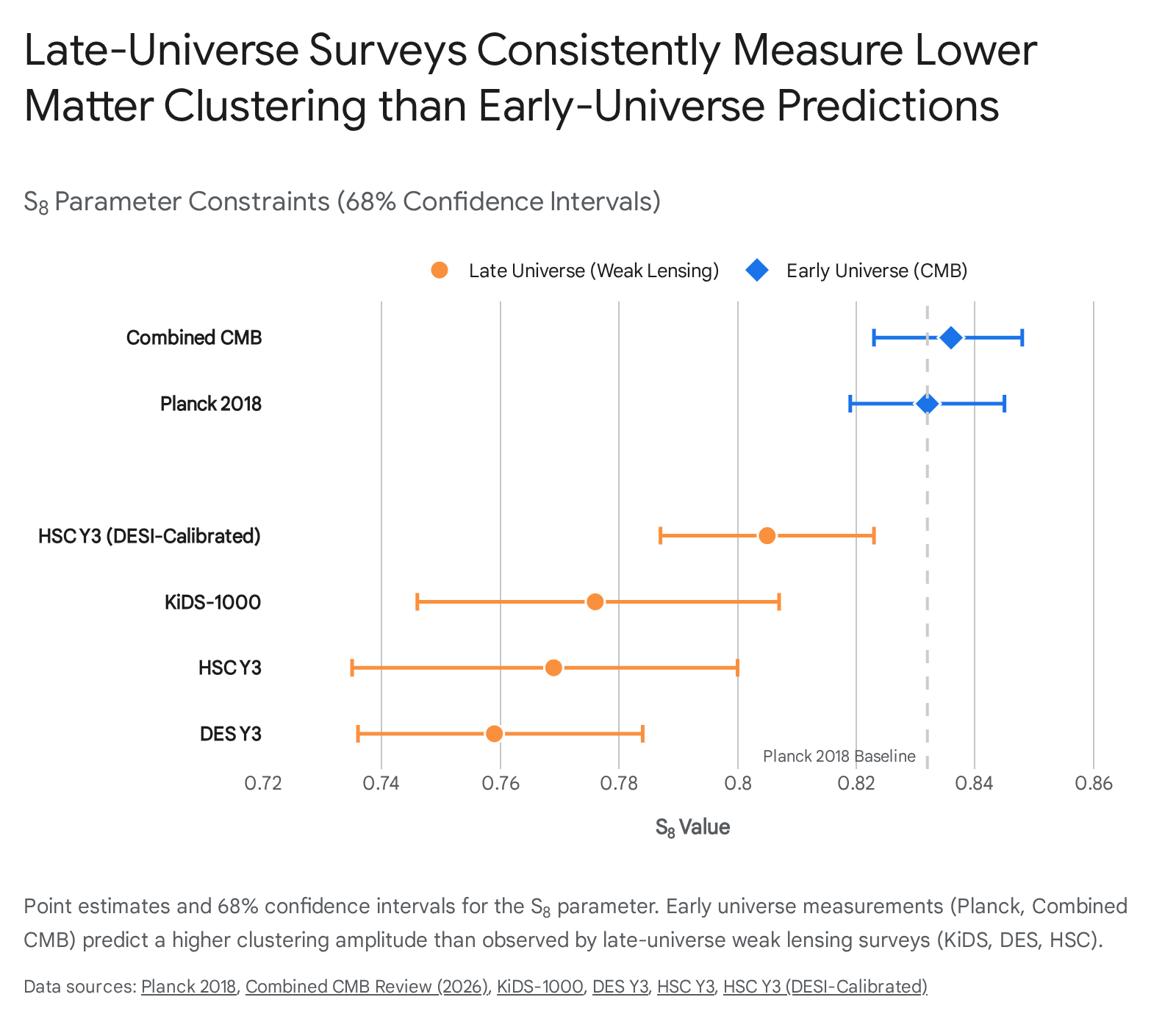
| Observatory / Survey | Measurement Probe | $S_8$ Value | Error Margin (68% CL) | Reference |
|---|---|---|---|---|
| Combined CMB (2026) | CMB Temp, Pol & Lensing | $0.836$ | $+0.012$ / $-0.013$ | 78 |
| Planck 2018 Legacy | CMB Temp, Pol & Lensing | $0.832$ | $\pm 0.013$ | 16 |
| HSC Y3 (DESI Calibrated) | Cosmic Shear (Weak Lensing) | $0.805$ | $\pm 0.018$ | 13 |
| DES Y3 + KiDS-1000 | Joint $3\times2$pt Analysis | $0.790$ | $+0.018$ / $-0.014$ | 20 |
| KiDS-1000 | Cosmic Shear (Weak Lensing) | $0.776$ | $+0.031$ / $-0.030$ | 18 |
| HSC Y3 (Baseline) | Cosmic Shear (Weak Lensing) | $0.769$ | $+0.031$ / $-0.034$ | 12 |
| DES Y3 | $3\times2$pt (Shear + Clustering) | $0.759$ | $+0.025$ / $-0.023$ | 511 |
Note: Error margins for KiDS-1000 represent the combined statistical and systematic uncertainties added in quadrature.
Evaluating Systematic Errors and Astrophysical Contaminants
Before invoking fundamental alterations to the laws of physics to bridge the numerical gap between the early and late universe, the observational cosmology community must exhaustively account for standard astrophysical processes and measurement systematics. It is entirely possible that the $S_8$ tension is an artifact of highly complex, non-linear astrophysics that artificially suppresses the late-universe clustering signal during data analysis 614.
The Role of Photometric Redshift Uncertainties
To accurately measure the evolution of large-scale structure over cosmic time, lensing surveys must determine the distances - or redshifts - to tens of millions of source galaxies. Because obtaining precise spectroscopic measurements for billions of individual galaxies is observationally prohibitive, large surveys rely on photometric redshifts (photo-$z$). This technique estimates distances based on the relative brightness of galaxies across various broadband optical and near-infrared filters 812.
Biases in photo-$z$ calibration translate directly and severely into biases in $S_8$. If a survey systematically underestimates the mean distance to its source galaxies, the analysis pipeline will consequently underestimate the amount of intervening dark matter required to produce the observed gravitational lensing signal, leading to an artificially suppressed $S_8$ value. The extreme sensitivity of this systematic was demonstrated by the recent reanalysis of the HSC Y3 data 13. The KiDS Legacy analysis similarly showcased the importance of this effect by employing a sophisticated self-organizing map (SOM) methodology, combined with extensive spectroscopic calibration samples, to drive redshift distribution uncertainties down to sub-percent levels 8. The dichotomy between survey results often stems directly from the methodology used to handle these photometric errors, cementing photo-$z$ calibration as a primary suspect in generating artificial cosmological tension 78.
Intrinsic Alignments (IA) of Source Galaxies
The entire premise of weak gravitational lensing assumes that the intrinsic shapes and orientations of galaxies are completely random. Therefore, any coherent, statistical alignment observed across a wide patch of the sky must be due to the optical distortion caused by the gravitational shear of intervening mass 4. However, galaxies are not isolated islands; they form within the same underlying cosmic web and are subject to the same tidal gravitational fields during their formation and evolution. This physical reality leads to Intrinsic Alignments (IA), one of the most formidable astrophysical contaminants in precision cosmology 1516.
There are two primary manifestations of IA that contaminate the cosmic shear signal. The first is the Intrinsic-Intrinsic (II) correlation, which occurs when galaxies physically close to one another in three-dimensional space align with the exact same local tidal field, mimicking a lensing signal. The second, and more insidious, is the Gravitational-Intrinsic (GI) correlation. The GI effect occurs when a background galaxy is optically sheared by a massive foreground dark matter halo, while a foreground galaxy's physical orientation is simultaneously altered and aligned by the tidal forces of that same halo 17.
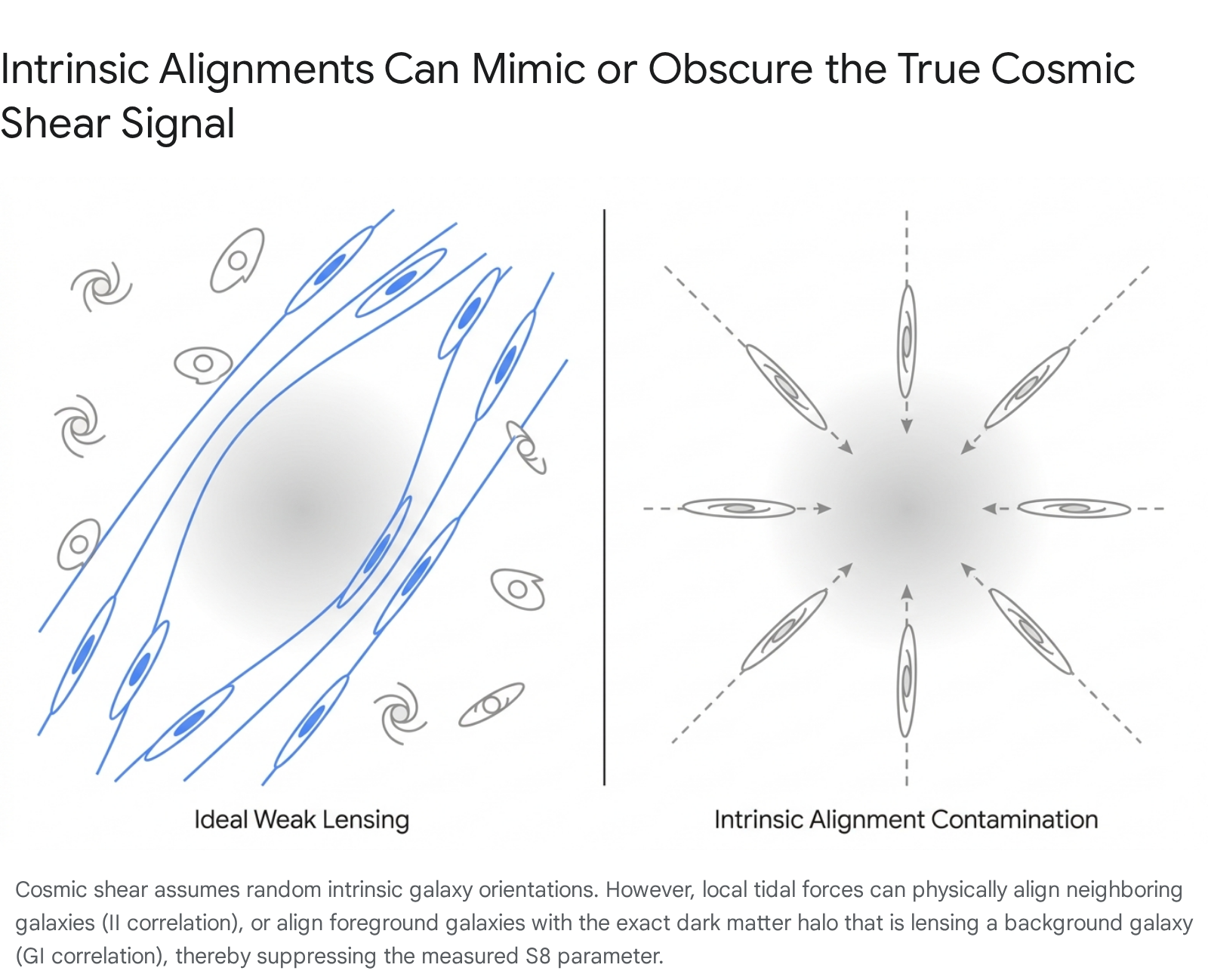
Crucially, the GI correlation acts to anti-correlate with the true cosmic shear. It actively subtracts from the measured lensing signal, pulling the derived $S_8$ value downward 17.
Because early-type (red, elliptical) galaxies are supported by random stellar motions and reside in denser environments, they exhibit much stronger intrinsic alignments than late-type (blue, spiral) galaxies. Proposed mitigation strategies involve highly parameterized modeling of the IA power spectrum or utilizing nulling techniques that explicitly exclude red galaxies from the shear analysis 1517. However, extensive simulated likelihood analyses across the DES, KiDS, and planned Euclid pipelines indicate that while IA modeling choices certainly shift the derived $S_8$ values, they do not systematically shift them by the full multi-sigma margin required to completely reconcile the surveys with the Planck CMB predictions 81115.
The Impact of Extreme Baryonic Feedback
In foundational dark-matter-only N-body simulations, matter clusters unimpeded purely under the influence of gravity. However, the real universe is populated by baryons (normal matter) that are subject to highly complex hydrodynamic and thermodynamic forces. Processes such as radiative cooling, stellar winds from supernovae, and crucially, feedback from Active Galactic Nuclei (AGN), violently redistribute gas throughout cosmic history 2718. When supermassive black holes located at the centers of galaxies accrete matter, they launch powerful, relativistic jets that heat and forcefully expel vast quantities of gas far beyond the dark matter halos of galaxies and galaxy clusters 2919.
This violent baryonic expulsion physically smooths out the matter distribution in the late universe, heavily suppressing the non-linear matter power spectrum $P(k)$ at small physical scales (specifically wavenumbers $k \gtrsim 1 \ h \text{Mpc}^{-1}$). Because weak lensing observables integrate over these highly non-linear scales, failing to accurately model the severity of AGN feedback results in theoretical predictions that overestimate clustering, making the observed $S_8$ appear artificially low 519.
To test the viability of this systematic, researchers rely on massive cosmological hydrodynamical simulations. Recent analyses utilizing the FLAMINGO suite and the BAHAMAS simulations systematically varied the efficiencies of AGN and stellar feedback to map their effects on the power spectrum 141820. These studies projected the simulations into observable harmonic space and found that standard, observationally calibrated baryonic effects are simply not sufficiently large to remove the $S_8$ tension 2032. While it is mathematically possible to utilize extreme feedback models - such as the high AGN heating models found in the ANTILLES simulation suite - to generate enough suppression to match the low $S_8$ data, these extreme models violently expel so much gas that they drastically underpredict the observed gas fractions in current X-ray and thermal Sunyaev-Zel'dovich (tSZ) cluster observations 291933. Furthermore, independent observational tests of AGN host galaxy populations in simulations like EAGLE, SIMBA, and TNG100 show large discrepancies with reality, indicating that the subgrid physics of AGN feedback is still poorly understood 34. Unless current X-ray baryon budget estimates are fundamentally biased by a factor of several, baryonic physics alone cannot bear the full weight of the $S_8$ tension 33.
Theoretical Resolutions: New Physics Beyond $\Lambda$CDM
If exhaustive analyses of systematic errors and baryonic physics cannot fully bridge the numerical gap between the early and late universe, the $S_8$ tension may represent a genuine empirical signature of new fundamental physics 21432. Theoretical physicists have proposed a myriad of extensions to the standard model, focusing either on altering the composition and interactions of the dark sector or fundamentally modifying the behavior of gravity on cosmological scales.
Categorizing the Proposed Explanations
The debate over the origin of the $S_8$ tension can be structurally categorized into efforts to refine astrophysics versus efforts to rewrite fundamental physics. The following table contrasts the major proposed explanations across these two distinct paradigms.
| Broad Category | Specific Mechanism | Primary Physical Effect on $S_8$ | Viability & Current Drawbacks |
|---|---|---|---|
| Systematic Errors / Astrophysics | Photometric Redshift Bias | Systematically underestimating source galaxy distance artificially suppresses the inferred $S_8$. | Highly plausible contributor; highly survey-dependent (e.g., resolved within HSC Y3 via DESI calibration) 813. |
| Systematic Errors / Astrophysics | Extreme AGN Feedback | Expels intra-cluster gas from halos, severely lowering $P(k)$ at non-linear, small scales. | Contradicts current independent X-ray observations of galaxy cluster baryon fractions 2933. |
| Systematic Errors / Astrophysics | Intrinsic Alignments (GI) | Galaxy orientations anti-correlate with true lensing, suppressing the measured optical signal. | Largely accounted for in modern mitigation pipelines; insufficient to bridge the full 3$\sigma$ gap alone 1517. |
| New Physics | Modified Gravity (e.g., $f(R)$) | Alters the linear growth rate of structures dynamically depending on the environmental density. | Heavily constrained by solar system tests unless robust, non-linear "chameleon screening" is applied 3536. |
| New Physics | Interacting Dark Sector (iDEDM) | Energy and momentum transfer from DE to DM creates a "drag," suppressing late-time growth. | Highly effective for resolving $S_8$, but models struggle to seamlessly resolve the $H_0$ tension simultaneously 373839. |
| New Physics | Cold New Early Dark Energy | Shifts early recombination physics via a trigger field while maintaining accurate late-time growth. | Addresses both $H_0$ and $S_8$ simultaneously, but introduces highly complex, multi-field scalar dynamics 4041. |
Interacting Dark Matter-Dark Energy (iDEDM) Models
Within the standard $\Lambda$CDM model, dark matter and dark energy are assumed to be entirely separate, non-interacting components that evolve independently according to their respective equations of state. Interacting Dark Energy-Dark Matter (iDEDM) models fundamentally relax this assumption, positing a phenomenological physical coupling between the two dark fluids. At the rigorous level of fluid dynamics, the standard covariant conservation of energy-momentum is explicitly modified. Instead of individual conservation, the equations become $\nabla_\mu T^\mu_{\nu(DM)} = Q_\nu$ and $\nabla_\mu T^\mu_{\nu(DE)} = -Q_\nu$, where the interaction vector $Q_\nu$ governs the exact rate of energy and momentum exchange between the sectors 3739.
If the interaction coupling strength (often parameterized as $\xi$) is positive, energy and momentum flow directly from the dark energy field into the dark matter fluid. This interaction subjects the dynamics of dark matter particles to an effective cosmological "drag" force 373942. This drag actively suppresses the linear growth rate of matter density perturbations at late cosmic times. Consequently, while the early universe physics remains entirely consistent with what Planck observed in the CMB, the late universe structures grow significantly more sluggishly than $\Lambda$CDM predicts. This naturally yields the lower $S_8$ values observed by LSS surveys like DES and KiDS without violating early-universe acoustic peak constraints 3843. However, a significant drawback of purely phenomenological iDEDM models is that while they effectively cure the $S_8$ tension, they generally fail to simultaneously resolve the $H_0$ tension, as both dark components still favor a higher present-day matter density 37.
Early Dark Energy (EDE) and Cold NEDE
Early Dark Energy (EDE) was initially theorized primarily to solve the Hubble ($H_0$) tension. The model posits the existence of an ultra-light scalar field that briefly acts as a cosmological constant in the pre-recombination universe, providing a temporary boost to the cosmic expansion rate before rapidly decaying away 42. However, traditional EDE models suffer from a critical flaw: they typically worsen the $S_8$ tension. To maintain the exquisitely precise fit to the CMB temperature power spectrum while altering the early expansion rate, EDE requires a compensatory increase in the baseline cold dark matter density ($\omega_{cdm}$). This increased dark matter density inherently enhances the small-scale matter power spectrum over cosmic time, driving the predicted $S_8$ value even higher, often exceeding $S_8 > 0.84$, which radically contradicts weak lensing data 3742.
A highly sophisticated theoretical evolution of this concept is "Cold New Early Dark Energy" (Cold NEDE) 4041. Cold NEDE introduces a fast-triggered phase transition that occurs precisely around the epoch of matter-radiation equality. By allowing the scalar trigger field to contribute a trace, non-negligible amount (roughly 0.5%) to the total dark matter energy density, the model subtly alters the microscopic perturbation dynamics. This incredibly slight injection of energy modifies the growth of perturbations just enough to suppress late-time structure formation, resolving the $S_8$ tension while perfectly preserving EDE's established ability to elevate the Hubble constant and resolve the $H_0$ tension 4041.
Modified Gravity and Chameleon Screening
Alternatively, the $S_8$ tension may indicate a fundamental breakdown of Einstein's General Relativity on the largest cosmological scales. Theoretical extensions such as $f(R)$ gravity attempt to solve the issue by adding a non-linear arbitrary function of the Ricci scalar ($R$) directly into the Einstein-Hilbert action. This modification effectively introduces a new, light scalar degree of freedom - colloquially known as a "fifth force" - that acts alongside standard gravity to mediate the growth of cosmic structure over time 3544.
A major hurdle for any modified gravity theory is that extremely stringent solar system tests and laboratory experiments (such as the Eöt-Wash torsion balance experiments) explicitly prohibit any measurable deviations from Newtonian gravity in our local environment 35. To be viable, $f(R)$ models must rely on a highly non-linear "chameleon mechanism" 3536. In chameleon theories, the effective mass of the mediating scalar field is dynamically dependent on the ambient matter density. In high-density environments, such as within the Milky Way or the solar system, the scalar field becomes incredibly massive, ensuring the fifth force operates only over microscopic ranges, effectively "screening" it from detection 3645. However, in the ultra-low density environments of vast cosmic voids, the scalar field becomes extremely light, allowing the fifth force to operate over megaparsec scales, altering the rate at which dark matter clusters. While $f(R)$ chameleon models exhibit a rich and mathematically fascinating phenomenology regarding non-linear structure formation, meticulously tuning the models to perfectly suppress the late-time power spectrum to solve the $S_8$ tension - while simultaneously evading all local screening constraints - remains a daunting theoretical challenge 354546.
Global Collaborations and the Next Generation of Precision Observatories
The international cosmological community is currently undergoing a massive transition from Stage-III ground-based surveys (like DES, KiDS, and HSC) to next-generation Stage-IV space and ground observatories. These upcoming mega-projects are specifically engineered with the optical resolution and statistical volume required to deliver definitive data capable of breaking the degeneracies between astrophysical systematic errors and genuine new physics 2122.
The European Space Agency's Euclid Mission
Launched in July 2023 on a SpaceX Falcon 9 to the Earth-Sun L2 Lagrange point, the ESA's Euclid mission (featuring critical detector contributions from NASA) represents Europe's flagship endeavor to illuminate the dark universe 212324. Euclid's primary objective is to conduct a sweeping Wide Survey that will cover 15,000 square degrees - nearly a third of the entire sky - operating simultaneously in both visible and near-infrared wavelengths 2425.
By operating in the vacuum of space, Euclid entirely eliminates the atmospheric blurring (known as "seeing") that fundamentally limits ground-based cosmic shear measurements. This pristine environment allows for exquisitely precise, highly stable galaxy shape determinations across billions of targets 2125. Furthermore, its combined visible and near-infrared spectrometry and photometry will drastically reduce the photometric redshift uncertainties that currently plague ground-based surveys, targeting the exact systematic vulnerability that caused the significant $S_8$ shifts observed in the recent HSC Y3 reanalysis 1321. Following a period of performance verification and initial "quick releases" targeting 50 square degrees in 2025, Euclid is slated to publish its monumental Data Release 1 (DR1) in November 2026. This release will cover the first full year of the survey (2,500 square degrees) and is universally expected to provide unprecedented, ultra-high-fidelity constraints on the $S_8$ tension 2124.
The Vera C. Rubin Observatory and LSST
Funded collaboratively by the U.S. National Science Foundation (NSF) and the Department of Energy (DOE), the Vera C. Rubin Observatory, located on Cerro Pachón in Chile, is preparing to execute the Legacy Survey of Space and Time (LSST) 2627. Equipped with the LSSTCam - a staggering 3,200-megapixel digital camera, the largest ever constructed for astrophysics - Rubin will scan the entire visible southern sky every few nights for a full decade 27.
The observatory achieved its critical "First Photon" milestone in mid-2025 and has subsequently transitioned into its commissioning phases. The scientific community already has access to Data Preview 1 (DP1), which contains processed image catalogs from the commissioning camera (LSSTComCam) 2228. The observatory will transition into full, science-grade operations with the release of Data Preview 2 (DP2) expected between July and September 2026 2229. The sheer data volume generated by the LSST - cataloging billions of distinct galaxies and generating up to 7 million real-time transient alerts per night - will reduce standard statistical errors in cosmological parameters to near zero 27. For Rubin, the primary challenge in measuring $S_8$ will be entirely systematic 1526. However, the immense depth and multi-band coverage of the survey will allow for extensive cross-correlations between cosmic shear and galaxy clustering. This capability is vital, as it will allow cosmologists to mathematically isolate the intrinsic alignment signals and definitively test whether the $S_8$ tension is merely a highly complex artifact of IA contamination 415.
The Nancy Grace Roman Space Telescope
Scheduled for launch no later than May 2027, with targeted readiness as early as the fall of 2026, NASA's Nancy Grace Roman Space Telescope represents the ultimate tool for precision infrared cosmology 3031. Roman's Wide Field Instrument (WFI) features a field of view 200 times larger than that of the Hubble Space Telescope's infrared camera, while miraculously maintaining the same legendary image sharpness and sensitivity 3032.
Roman will dedicate roughly 75% of its five-year primary mission to conducting three core community surveys. The High-Latitude Wide-Area Survey will cover over 5,000 square degrees to map hundreds of millions of galaxies, yielding weak lensing maps of unparalleled depth and clarity 32. Concurrently, the High-Latitude Time-Domain Survey will revisit the same orbital fields every few days for 180 days to discover tens of thousands of Type Ia supernovae 3033. The unprecedented combination of Roman's infrared weak lensing measurements (to map structure growth) with its vast supernovae catalogs (to map the expansion rate) will allow cosmologists to simultaneously measure both $H_0$ and $S_8$ over the past 10 billion years of cosmic history 303360. If dark energy is dynamically interacting with dark matter (as proposed in iDEDM models), or if early dark energy triggered a phase transition, Roman's combined datasets possess the exact sensitivity required to detect the precise cosmic epoch where these new physical interactions began to alter the universe's growth 3260.
Conclusion
The $S_8$ tension currently stands at the absolute forefront of modern theoretical and observational astrophysics. The persistent 2 to 3$\sigma$ discrepancy between the highly robust predictions of the early universe CMB and the increasingly precise measurements of late-universe weak lensing surveys is not an indictment of the $\Lambda$CDM model's failure, but rather a profound testament to its historical success 14. Only a model as mathematically predictive and resilient as $\Lambda$CDM could reveal such subtle, localized deviations across billions of years of cosmic evolution.
As the global cosmological community pushes into late 2026 and beyond, the resolution of the $S_8$ tension balances on a razor's edge. It may ultimately yield to mundane but highly complex astrophysics - such as the severe underestimation of AGN feedback mechanisms, the insidious contamination of intrinsic galaxy alignments, or subtle, survey-specific biases in photometric redshift calibration 71333. Alternatively, it may be the first genuine shadow cast by interacting dark sectors, trigger-field early dark energy, or screened modifications to General Relativity 3639. The imminent data avalanche from the ESA's Euclid mission, the Vera C. Rubin Observatory, and NASA's Roman Space Telescope guarantees that the ultimate resolution to the $S_8$ tension is not a matter of if, but when.