
Primordial Gravitational Waves and CMB B-mode Polarization
Theoretical Foundations of Primordial Tensor Perturbations
The cosmic microwave background represents the most pristine observable record of the early universe, carrying fundamental information regarding the initial conditions of spacetime. While precision mapping of the temperature anisotropies within the cosmic microwave background has rigorously constrained the standard six-parameter $\Lambda$CDM cosmological model, the polarization of this relic radiation contains distinct, largely untapped physical parameters. The polarization of the cosmic microwave background arises fundamentally from the physics of Thomson scattering at the surface of last scattering, which occurred approximately 380,000 years after the initial expansion event 11. When photons scatter off free electrons in the primordial plasma, they acquire a linear polarization, provided that the incident radiation field exhibits a local quadrupole anisotropy 1.
Because the resulting polarization directions must be oriented either parallel or perpendicular to the incident photon wavevector, the total polarization field can be decomposed into two geometrically distinct components based on their parity and spatial derivatives. These are designated as E-modes and B-modes 132.
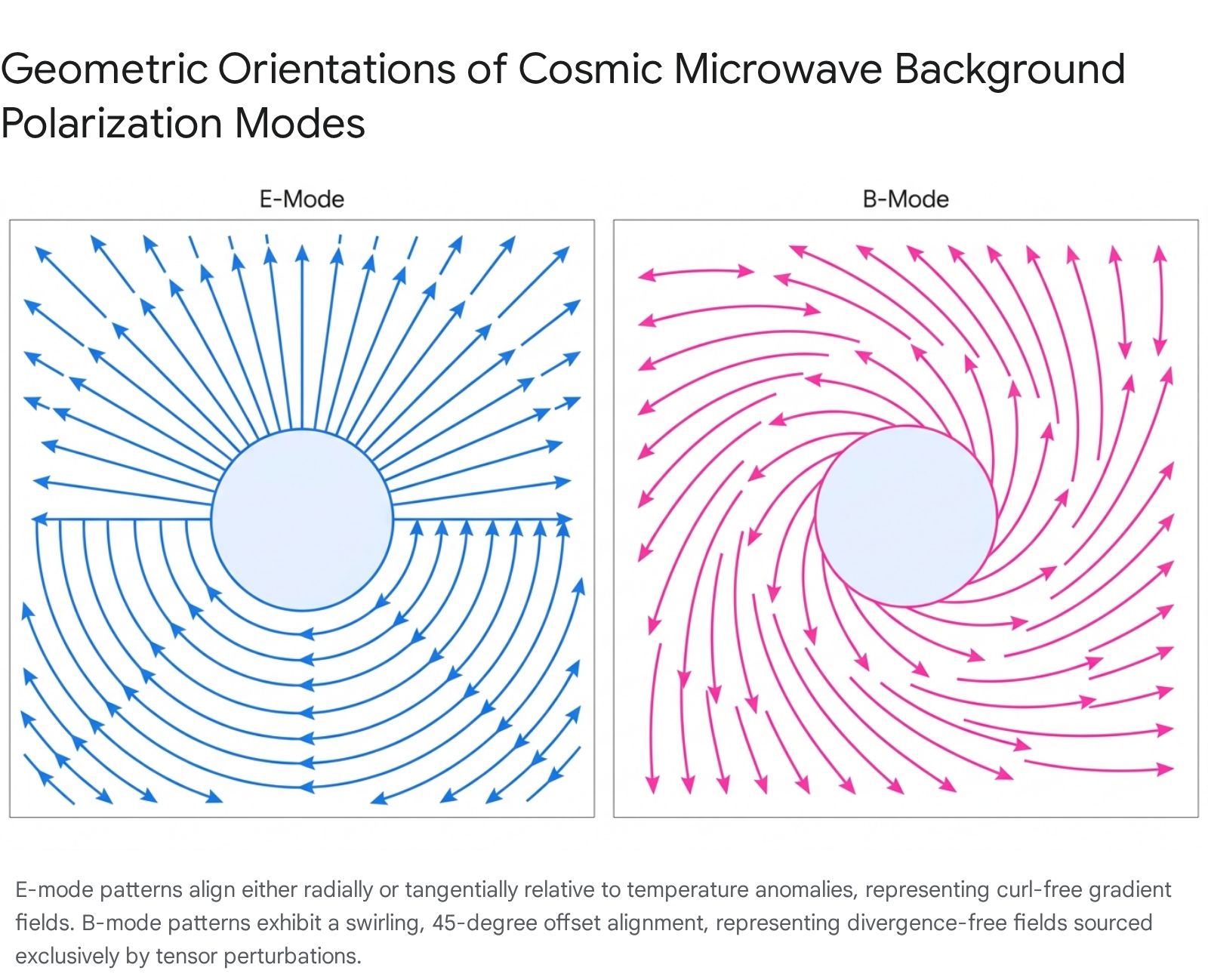
E-modes are gradient-like and curl-free, drawing their nomenclature from the electrostatic field. They are generated primarily by standard scalar density perturbations, which are the same primordial density fluctuations responsible for seeding the formation of large-scale galactic structures in the late universe 12. Because scalar fluctuations are spherically symmetric and possess no inherent handedness, they are mathematically incapable of imparting a curl-like pattern to the polarization field at linear order.
Conversely, B-modes are divergence-free and possess a curl, named in direct analogy to magnetic fields. Standard scalar density perturbations cannot source B-mode polarization linearly. Instead, primordial B-modes are sourced uniquely by tensor perturbations, commonly known as primordial gravitational waves 132. These geometric metric perturbations act to stretch and squeeze the fabric of spacetime, creating both a curl-free E-mode and a curled B-mode pattern in the cosmic microwave background 1. Consequently, the detection of a primordial B-mode signal is widely considered the definitive signature of tensor perturbations originating in the early universe, free from the overwhelming scalar noise that dominates the temperature and E-mode spectra 11.
Cosmic Inflation and the Tensor-to-Scalar Ratio
The dominant theoretical paradigm for the origin of these primordial tensor perturbations is cosmic inflation, a proposed epoch of exponential spatial expansion occurring approximately $10^{-35}$ seconds after the Big Bang 34. During the inflationary epoch, microscopic quantum fluctuations in the vacuum are stretched to macroscopic, cosmological scales. Fluctuations within the scalar field driving inflation, known as the inflaton, manifest as density variations, while zero-point quantum fluctuations in the metric of spacetime itself manifest as a stochastic background of gravitational waves 14.
The amplitude of these primordial gravitational waves relative to the scalar density fluctuations is quantified by the tensor-to-scalar ratio, denoted as $r$. Mathematically, this ratio is defined as $r \equiv A_t / A_s$, where $A_t$ represents the amplitude of the primordial tensor power spectrum and $A_s$ denotes the amplitude of the scalar power spectrum at a specific cosmological pivot scale 1. In standard slow-roll inflationary models, $r$ is intimately related to the underlying dynamics of the inflaton field. In the lowest-order analytical approximation, $r$ is linked to the first slow-roll parameter $\epsilon$ by the relation $r \approx 16\epsilon$ 7. While some physicists debate whether this standard expression serves as a sufficient approximation compared to exact numerical computations of the perturbation amplitudes - particularly when comparing cold inflation to complex warm inflation scenarios where thermal backgrounds couple to the field - it remains the foundational metric for evaluating cold inflationary mechanics 7.
The Energy Scale of Inflation and Inhomogeneous Initial Conditions
The precise magnitude of the tensor-to-scalar ratio provides a direct mathematical linkage to the energy scale at which inflation occurred. According to the fundamental mechanics of slow-roll inflation, the potential energy of the inflaton field $V(\phi)$ is related to the tensor-to-scalar ratio through the approximation $V^{1/4} \approx (r/0.01)^{1/4} \times 1.04 \times 10^{16}$ GeV 5. An eventual observational detection of $r \sim 0.01$ would immediately place the energy scale of inflation near the Grand Unified Theory energy scale, providing researchers with an empirical window into physical processes operating at energies a trillion times higher than those accessible by modern particle accelerators.
Furthermore, the tensor-to-scalar ratio defines the total excursion of the inflaton field through the Lyth bound, which connects the amplitude of tensor perturbations to the total distance the scalar field rolls through its potential space. Observational bounds on $r$ therefore dictate whether inflation was structurally a "large-field" or "small-field" model. However, recent theoretical advancements derived from numerical simulations of inhomogeneous initial conditions suggest an absolute mathematical floor for robust single-field inflation. Recent modeling using $\alpha$-attractor T-models indicates that if the initial scalar field conditions feature order-unity inhomogeneities in both kinetic and gradient energies, inflation only successfully achieves the necessary 60 e-folds if the characteristic scale of the potential $\mu_{crit}$ is sufficiently large 67.
Analytical arguments show that these constraints bound the critical tensor-to-scalar ratio at a minimum of $r_{crit} \gtrsim 5.6 \times 10^{-6}$ 6. Below this critical threshold, localized regions of the scalar field fail to remain on the slow-rolling plateau and instead fall into the potential minimum, collapsing into primordial black holes. These black holes are not adequately diluted, causing the entire inflationary paradigm to fail 6. Consequently, an observational limit pushing below $r \sim 10^{-6}$ would fatally challenge the robustness of single-field inflation under generic, inhomogeneous initial conditions.
Non-Inflationary Sources: Early Causal Tensors
While a confirmed detection of B-mode polarization has historically been characterized as the ultimate "smoking gun" of cosmic inflation 34, this interpretation has been heavily scrutinized by the modern cosmological community. Primordial B-modes can theoretically be generated by complex non-inflationary physical processes operating in the early universe, broadly classified under the universality class of Early Causal Tensors (ECTs) 1112. ECTs encompass causality-limited, sub-horizon sources operating well before the epoch of recombination. Representative examples include first-order cosmological phase transitions, the decay dynamics of topological defects such as cosmic strings, and enhanced scalar-induced tensor modes acting at second order in cosmological perturbation theory 11128.
Recent theoretical frameworks have identified a universal characteristic of Early Causal Tensors that explicitly distinguishes them from inflationary gravitational waves. While inflation canonically predicts a nearly scale-invariant spectrum across a wide range of frequencies, featuring a slight red tilt, ECTs are fundamentally constrained by sub-horizon causality. Any finite-duration post-inflationary source possessing a locally conserved stress-energy tensor and limited spatial correlations inherently exhibits a white-noise scaling on super-horizon scales in the deep infrared limit. Consequently, the tensor power spectrum for ECTs universally scales as $P_h(k) \propto k^3$ at small wavenumbers 119.
When translated to the observable cosmic microwave background B-mode angular power spectrum, this $k^3$ scaling results in highly suppressed signal power at large angular scales, corresponding to low multipoles ($\ell < 10$). Unlike inflation, which generates a distinct and highly visible "reionization bump" at very low multipoles due to the late-time scattering of photons during the epoch of reionization, ECT signals peak strongly at small angular scales ($\ell \sim 10^3$) due to the mathematical $k$-dependence of the Bessel functions 9. Therefore, a positive B-mode signal detected exclusively at intermediate angular scales ($\ell \sim 100$) could theoretically belong to either inflation or ECTs; definitively distinguishing the source physics requires broad-spectrum measurements across a wide multipole range to confirm either the low-$\ell$ plateau of inflation or the steep $k^3$ drop-off characteristic of causal sources 119.
Alternative Cosmological Models and Tensor Signatures
The failure of early-generation cosmic microwave background experiments to detect an observable tensor-to-scalar ratio has effectively ruled out the simplest foundational classes of single-field inflation. Historic monomial power-law potentials, such as $V(\phi) \propto \phi^2$ or $V(\phi) \propto \phi^4$, generally predicted large values of $r \ge 0.05$, which definitively conflict with modern observational boundaries 1510. Similarly, classical exponential potential models driven by $V(\phi) = V_0 e^{-\lambda\phi}$ predicted an $r$ value as high as $0.256$ given the measured scalar spectral index, leading to their absolute falsification 10. This progressive tightening of limits has inspired renewed attention toward alternative cosmological paradigms that eschew the mechanism of inflation entirely, predicting distinctly different signatures within the tensor sector.
String Gas Cosmology
String Gas Cosmology is an early-universe framework rooted in the robust symmetries of string theory, specifically utilizing T-duality to provide an alternative mechanism for generating scale-invariant cosmological perturbations without requiring an epoch of exponential spatial expansion 11. In this framework, the universe originates in a hot, dense phase governed by a gas of fundamental strings in thermal equilibrium near a limiting maximum temperature known as the Hagedorn temperature 11. The generation of large-scale structure relies entirely on the thermal fluctuations of two distinct types of string states: momentum modes, which represent the center-of-mass motion of the string, and winding modes, which count the number of times a string wraps around the toroidal dimensions of space 1118.
String Gas Cosmology successfully generates a nearly scale-invariant spectrum of adiabatic scalar perturbations with a slight red tilt, matching the dominant features of the observed cosmic microwave background 1812. However, its predictions for the tensor sector diverge sharply from standard inflation. While inflation necessitates a slight red tilt for the tensor power spectrum due to standard matter energy conditions, String Gas Cosmology predicts a nearly scale-invariant tensor spectrum with a distinct blue tilt 1812. The specific numerical prediction for the tensor-to-scalar ratio in String Gas models is highly constrained by the coupling constants and the background entropy of the universe. Updated parametrizations incorporating string-corrected scalar field formalisms have demonstrated that the theory can yield highly suppressed tensor amplitudes, sometimes rendering the tensor-to-scalar ratio effectively unobservable at $r \sim 10^{-17}$, depending on the chosen values of the fundamental constants 13.
Bouncing and Ekpyrotic Cosmologies
Bouncing cosmologies attempt to fundamentally resolve the initial singularity problem of the Big Bang by proposing that the current expanding phase of the universe was immediately preceded by a distinct contracting phase. In symmetric matter bounce scenarios, the universe contracts in a matter-dominated state until it reaches a minimum scale factor, at which point it undergoes a non-singular bounce into outward expansion 212223. The contracting phase naturally acts to generate a scale-invariant spectrum of scalar perturbations.
The primary mathematical challenge for matter bounce models has historically been controlling the subsequent amplitude of the resulting tensor perturbations. Standard fast-roll contraction models typically produce an exceedingly large tensor-to-scalar ratio around $r \simeq 1/9$, which blatantly violates all current observational upper bounds and effectively falsifies that subset of models 24. However, symmetric bounces featuring specifically sourced fluctuations, or those relying on non-minimal derivative couplings between a scalar field and gravity, can drastically alter the expected tensor amplitude. Some symmetric matter bounce variants, particularly those where fluctuations are sourced by a U(1) gauge field coupled to a bouncer scalar field, suppress the tensor-to-scalar ratio well below $r \lesssim 10^{-2}$, allowing the models to remain theoretically viable within current observational limits 2122.
Furthermore, specific generalized bounce cosmologies predict unique three-point correlation functions for the B-mode auto-bispectrum. These bispectrum signatures are heavily suppressed and effectively unobservable in standard general relativity inflation, but bouncing models with non-minimal couplings can achieve observable signal-to-noise ratios. Theoretical calculations indicate the B-mode auto-bispectrum could reach a signal-to-noise ratio of up to 5.39 for $\ell_{max} = 100$, offering a unique parity-based statistical test to definitively distinguish bouncing theories from standard inflation 1426.
Conformal Cyclic Cosmology
First proposed by theoretical physicist Roger Penrose, Conformal Cyclic Cosmology conceptualizes the overarching history of the universe as an infinite sequence of distinct cycles, defined as "aeons" 15. The future timelike infinity of a prior expanding aeon - where all massive particles eventually decay into radiation and the universe becomes infinitely diffuse - is mathematically identified, via an exact conformal rescaling, with the Big Bang singularity of the subsequent aeon 15. Conformal Cyclic Cosmology completely displaces the mechanism of inflation, moving the required period of exponential expansion to the remote, dark-energy-dominated future of the previous aeon 1629.
In Conformal Cyclic Cosmology, the tensor power spectrum generated during the previous cycle is intensely blue-tilted, and its overall amplitude upon passing through the crossover boundary into the current aeon is vastly diminished. The resulting gravitational waves are many orders of magnitude lower than the lowest detection limits accessible by foreseeable microwave background polarization experiments 17. Therefore, the framework predicts that no primordial B-mode signal from gravitational waves will be detected at large angular scales 17.
Instead, Conformal Cyclic Cosmology predicts highly localized geometric anomalies in the cosmic microwave background temperature variance. The theory asserts that the final Hawking evaporation of supermassive black holes in the previous aeon concentrates vast amounts of energy that manifest as "Hawking points" across the crossover boundary. These anomalies theoretically appear as concentric rings of anomalously low variance and highly raised-temperature spots in the current microwave sky 16293118. While some proponents claim to have identified these exact signatures in WMAP and Planck satellite data at high statistical confidence, the broader cosmological community heavily contests these findings. Independent re-evaluations, including deep-learning searches utilizing ResNet18 algorithms (HawkingNet), suggest that the identified Hawking points are statistically consistent with standard Gaussian random noise when the "look-elsewhere" effect is properly accounted for, leaving Conformal Cyclic Cosmology without widely accepted empirical support 153118.
| Cosmological Framework | Scalar Spectrum Tilt | Tensor Spectrum Tilt | Tensor-to-Scalar Ratio ($r$) Prediction | Primary Mechanism of Structure Generation |
|---|---|---|---|---|
| Standard Slow-Roll Inflation | Slight Red | Slight Red | Dependent on energy scale (Observable, $r > 10^{-6}$) | Quantum fluctuations stretched during exponential expansion. |
| String Gas Cosmology | Slight Red | Slight Blue | Highly suppressed ($r \sim 10^{-17}$ possible) | Thermal fluctuations of string winding and momentum modes. |
| Matter Bounce (Fast-Roll) | Scale-Invariant | Scale-Invariant | $r \simeq 1/9$ (Observationally Falsified) | Contracting matter-dominated phase preceding a bounce. |
| Matter Bounce (Sourced) | Scale-Invariant | Scale-Invariant | Suppressed ($r \lesssim 10^{-2}$) | Non-minimal couplings or specifically sourced gauge fields. |
| Conformal Cyclic Cosmology | Inherited from prior Aeon | Blue | Effectively zero (Observationally inaccessible) | Conformal continuation of a previous, fully expanded aeon. |
| Early Causal Tensors (ECTs) | N/A (Post-inflationary) | White Noise ($P_h \propto k^3$) in IR | Current limit $r_{ect} < 0.0077$ | Cosmological phase transitions or cosmic string decay. |
Recent Observational Constraints on the Tensor-to-Scalar Ratio
Synthesizing BICEP, Keck Array, and Planck Satellite Bounds
The technological pursuit of B-mode polarization has driven the deployment of increasingly sensitive ground-based microwave arrays. In 2014, the BICEP2 collaboration announced a high-profile detection of B-mode polarization at degree angular scales, initially interpreted as a landmark confirmation of cosmic inflation with an implied tensor-to-scalar ratio of $r \sim 0.2$ 1333. However, subsequent multi-frequency analysis incorporating data from the Planck satellite revealed that the observed signal was overwhelmingly dominated by thermal dust emission from within the Milky Way galaxy, nullifying the primordial claim 119.
Since that retraction, the architecture of ground-based arrays and satellite missions has focused heavily on rigorous foreground subtraction strategies utilizing broad frequency coverage. The latest generation of data, synthesizing observations from the BICEP/Keck Array 2018 mapping the deep field from the South Pole, combined with the final Planck PR4 data release and Baryon Acoustic Oscillation measurements, have successfully set the tightest empirical limits on tensor perturbations to date. When fitting the data consistently with the six standard $\Lambda$CDM parameters without fixing the reionization optical depth $\tau$, the combined likelihoods yield a strict upper limit of $r < 0.032$ at a 95% confidence level 102021.
An alternative Bayesian analysis leveraging modified gravity parametrizations has attempted to push these bounds even further. By incorporating Nash's embeddings and extrinsic curvature dynamics against the exact same BICEP/Keck and Planck PR4 datasets, researchers placed a slightly tighter bounding threshold of $r < 0.0303$ at a 95% confidence level 22. Independent of the precise statistical methodology employed, these bounds conclusively falsify several historically significant inflationary models, including the simple monomial $V(\phi) \propto \phi^2$ and $V(\phi) \propto \phi^4$ potentials, which mathematically predict $r > 0.05$ 10. Conversely, models such as Higgs inflation, which predict $r \approx 0.003$, remain in excellent agreement with the current observational limits 10.
Non-Inflationary Upper Limits
The massive observational datasets originally designed to constrain cosmic inflation have recently been repurposed to bound post-inflationary tensor sources. In early 2026, a comprehensive analysis utilizing aggregated data from BICEP/Keck, SPTpol, SPT-3G, Planck, and WMAP published the first rigorous empirical constraints on Early Causal Tensors. By modeling the causal tensor power spectrum via the parameter $r_{ect}$ - defined as the ratio of causal tensor power to total scalar power at a pivot scale of $k = 0.01 \text{ Mpc}^{-1}$ - researchers successfully derived a 95% confidence limit of $r_{ect} < 0.0077$ 8938. This robust bound effectively limits the maximum allowable energy density of present-day gravitational waves generated by ultra-low frequency causal sources in the early universe, placing strict physical limitations on the energy scale of first-order cosmological phase transitions and topological defects 8.
The Impact of the BAO-CMB Tension
It is critical to note that constraints on inflationary parameters rely implicitly on the baseline mathematical assumptions of late-time cosmology. A 2026 study highlighted that ongoing mild statistical discrepancies between cosmic microwave background observables and Baryon Acoustic Oscillation mapping - the so-called BAO-CMB tension - heavily influence derived limits on early universe physics 23. The tension primarily affects calculations of late-time matter density constraints, which in turn propagate through the modeling software to shift the derived scalar spectral index $n_s$ 23.
Because theoretical inflation models map specific mathematical curves in the $(n_s, r)$ parameter space, an artificial shift in $n_s$ due to late-time data conflicts can erroneously alter the apparent viability of various inflationary potentials 23. Consequently, researchers have warned that until the BAO-CMB tension is fully resolved - whether through better calibration of observational systematics or via the introduction of new physics - the absolute location of specific inflationary models within the allowed $(n_s, r)$ contour remains subject to underlying dataset dependency and should not be treated as absolute 23.
Current and Future Cosmic Microwave Background Observatories
The ongoing scientific push to cross the $r \sim 10^{-3}$ measurement threshold, which would either conclusively detect the signal from complex plateau-based inflation models or definitively rule out vast swaths of the theoretical landscape, requires massive leaps in detector sensitivity and continuous, uninterrupted survey durations.
The Rise and Fall of the Cosmic Microwave Background Stage Four (CMB-S4)
The Cosmic Microwave Background Stage Four (CMB-S4) experiment was long conceived as the definitive ground-based observatory for microwave background science. Endorsed as the highest-priority new project by the US High Energy Physics Advisory Panel and the Astro2020 Decadal Survey, CMB-S4 was designed as a massive dual-site deployment: ultra-deep surveys conducted from the pristine atmosphere of the South Pole targeting 3% of the sky, and wide-deep surveys from the Atacama Plateau in Chile mapping 70% of the sky 192425. Armed with over 500,000 highly sensitive superconducting detectors across multiple frequencies, CMB-S4 was projected to push the constraint on the tensor-to-scalar ratio down by a factor of five compared to previous limits 19.
Despite its unparalleled scientific mandate, the project suffered critical administrative and logistical setbacks. In May 2024, the National Science Foundation announced that the project could not advance to the design stage in its proposed form 26. The primary justification cited a severe backlog of critical infrastructure recapitalization required at the South Pole. Exacerbated by the COVID-19 pandemic, construction of new lodging facilities at the McMurdo coastal base was delayed, strictly limiting the number of personnel allowed to deploy. Furthermore, urgent needs to physically lift existing buildings at the Pole due to dangerous snow accumulation effectively prevented the deployment of any new, massive scientific payloads to the continent for the foreseeable future 26.
In direct response to a formal charge from the National Science Foundation and the Department of Energy, the CMB-S4 scientific collaboration spent a year extensively redesigning the observatory into a "Chile-only" concept. This alternative plan relocated the ultra-deep survey telescopes to the Atacama Desert, attempting to maintain the core scientific goals albeit with significantly higher environmental challenges due to Chile's atmospheric conditions relative to the South Pole 25432728. In April 2025, the collaboration submitted a revised project plan detailing a $468 million baseline configuration consisting of six Small Aperture Telescopes and one Large Aperture Telescope entirely situated in Chile 25.
Despite these extensive reconfiguration efforts, on July 9, 2025, the Department of Energy and the National Science Foundation issued an unsigned joint statement abruptly informing the collaboration that they had "jointly decided that they can no longer support the CMB-S4 Project" 2429. The unexpected cancellation triggered an orderly shutdown of the multi-national project, effectively terminating the most ambitious US-led ground-based cosmology initiative of the decade 244330.
Accelerated Expansions of the Simons Observatory
Following the catastrophic collapse of the CMB-S4 project, the immense burden of ground-based B-mode detection shifted substantially to the Simons Observatory. Located at a high-desert elevation of 5,200 meters in the Atacama Desert in Chile, the Simons Observatory was initially designed as a technological precursor and complement to CMB-S4 3149.
To aggressively compensate for the loss of CMB-S4, the Simons Observatory collaboration rapidly accelerated its expansion roadmap. By early 2024, the initial baseline configuration of three 0.4-meter Small Aperture Telescopes and one 6-meter Large Aperture Telescope began active commissioning and initial surveying 31. A major upgrade schedule has since been implemented: by 2027, the observatory will double its Small Aperture Telescope fleet from three to six, pushing its detector count in the critical 93 GHz and 145 GHz frequency channels to over 48,000 individual detectors 4950. Concurrently, the 6-meter Large Aperture Telescope is undergoing a comprehensive upgrade expected to be complete by 2028, effectively doubling its mapping speed by integrating 30,000 new detectors alongside a massive new photovoltaic power array 51.
With these substantial hardware expansions and a newly planned extension of the primary survey duration stretching to 2035, updated 2025 forecasting models indicate a massive leap in functional sensitivity. Assuming a moderately complex mathematical model for Galactic foregrounds and successfully removing 70% of the gravitational lensing B-mode contamination using high-resolution data from the Large Aperture Telescope, the Simons Observatory is expected to achieve a constraint on the tensor-to-scalar ratio of $\sigma_r = 1.2 \times 10^{-3}$ 50. Under highly optimistic atmospheric and systemic noise assumptions, this boundary could be pushed as low as $\sigma_r = 7 \times 10^{-4}$, recovering much of the theoretical discovery space previously lost by the CMB-S4 cancellation 50.
The LiteBIRD Space Mission
While ground-based observatories utilize large telescope apertures to achieve the high angular resolution required for delensing algorithms and small-scale B-mode searches, they are fundamentally blind to the absolute largest angular scales of the cosmic microwave background. The obscuring effects of the Earth's atmosphere, coupled with the limited viewable sky from a single planetary latitude, mathematically prevent the accurate mapping of the lowest multipoles ($\ell \le 10$). These extremely large scales are critical, as they contain the "reionization bump" - an elevation in the B-mode power spectrum caused by the late-time scattering of cosmic microwave background photons off electrons that were reionized by the universe's first stars 332.
Accessing this reionization bump is physically essential to definitively distinguish between the scale-invariant tensor spectrum characteristic of cosmic inflation and the $k^3$ scaling intrinsic to Early Causal Tensors 932. This measurement explicitly requires space-based observation. LiteBIRD (the Lite satellite for the study of B-mode polarization and Inflation from cosmic background Radiation Detection) is a strategic large-class space mission led by the Japan Aerospace Exploration Agency 5333.
Originally slated for the late 2020s, the LiteBIRD mission underwent a stringent reformation and rescoping phase throughout 2024 and 2025 to increase mission feasibility, lower systematic risk, and accommodate shifted procurement chains resulting from changing technological contributions in Europe and North America 3435. Following a highly successful Key Decision Point review at the Institute of Space and Astronautical Science in September 2025, the mission was officially approved to advance toward Phase A concept development, targeting an eventual launch on JAXA's H3 rocket in 2036 323334.
Operating from the thermally stable Sun-Earth Lagrangian point L2, LiteBIRD is programmed to conduct a three-year, all-sky survey across 15 distinct frequency bands spanning from 34 to 448 GHz 533334. The satellite will utilize a highly simplified single-telescope design equipped with approximately 4,000 cryogenically cooled transition edge sensor detectors operating at 5 Kelvin 5334. This extensive frequency coverage is optimized solely for component separation - the intricate mathematical process of modeling and subtracting Galactic thermal dust and synchrotron emission from the pristine primordial signal 5333. LiteBIRD aims to achieve an unprecedented final combined sensitivity of $2.16 \, \mu\text{K}\cdot\text{arcmin}$, allowing for an ultimate constraint on the tensor-to-scalar ratio on the order of $\sigma(r) \sim 10^{-3}$, completely free of atmospheric limitations and systematically probing the lowest possible multipoles 3253.
| Observatory Platform | Primary Location | Operational Era | Hardware / Detector Focus | Targeted Metric / Limit Goal |
|---|---|---|---|---|
| BICEP/Keck Array (BK18) | South Pole | Present (2018 Data) | Small Aperture Arrays | $r < 0.032$ (Current working limit) |
| CMB-S4 | South Pole & Chile | Cancelled (July 2025) | 500,000+ Detectors, LATs & SATs | N/A (Project formally terminated) |
| Simons Observatory (SO) | Atacama Desert, Chile | 2024 - 2035 | 6 SATs, 1 Upgraded LAT (~80k det) | $\sigma_r \approx 1.2 \times 10^{-3}$ |
| LiteBIRD Spacecraft | L2 Orbital Point | Launch 2036 | 15 Frequency Bands (34-448 GHz) | $\sigma_r \approx 10^{-3}$ (Targets $\ell \le 10$) |
Conclusion
The ongoing pursuit of primordial B-mode polarization stands as one of the most critical and technologically demanding observational objectives in fundamental physics. The tensor-to-scalar ratio $r$ remains the sole empirical mathematical gateway to discerning the energy scale of the universe in its initial fractions of a second. While standard slow-roll cosmic inflation remains the dominant theoretical paradigm, the increasingly tight observational ceiling - currently locked beneath $r < 0.032$ - has ruthlessly pared down the allowable parameter space. This empirical reality has forced the cosmological community to recognize the mathematical viability of alternative genesis mechanisms.
Whether the universe emerged from a conformal continuation of a previous aeon, bounced out of a contracting matter-dominated phase, or was subjected to violent phase transitions that sourced Early Causal Tensors, each non-inflationary model leaves distinct topological, scalar, and tensorial fingerprints on the fabric of spacetime. With the unfortunate dissolution of the CMB-S4 collaboration in 2025, the burden of discovery now rests heavily on the rapid architectural expansion of the ground-based Simons Observatory and the long-term, space-borne precision of the LiteBIRD satellite. As these highly specialized instruments begin to map the polarized microwave sky into the next decade, their incoming data will either finally uncover the faint, swirling echo of quantum gravity born from cosmic inflation, or force a monumental theoretical rewriting of cosmic origins.