
What Has the James Webb Space Telescope Found So Far
Since beginning its science operations, the James Webb Space Telescope has fundamentally transformed astrophysics by peering into the infrared universe to reveal galaxies born just after the Big Bang and decoding the chemical atmospheres of distant exoplanets. The observatory has not broken standard cosmological models, but it has uncovered new celestial phenomena, such as "black hole stars" and rogue planetary systems. Ultimately, these discoveries are forcing scientists to rewrite the timelines of galactic evolution and rethink the definitions of planetary formation.
Seeing the Unseen: The Power of Infrared
Launched on December 25, 2021, the James Webb Space Telescope (JWST) is the premier orbital observatory of the decade, representing a massive international collaboration between the U.S. National Aeronautics and Space Administration (NASA), the European Space Agency (ESA), and the Canadian Space Agency (CSA) 123. Since releasing its first full-color images in July 2022, the telescope has routinely shattered astronomical records 25.
A common misconception among the general public is that JWST is merely a replacement for the iconic Hubble Space Telescope 63. In reality, the two observatories serve completely different, yet complementary, functions. Hubble was optimized to view the universe primarily in visible and ultraviolet light 384. JWST, however, was designed from the ground up to view the universe almost exclusively in the infrared spectrum 338.
The Physics of Cosmic Expansion
This design choice was deliberate and necessary to answer the deepest questions in cosmology. Because the universe has been expanding since its inception, light traveling from the most distant, ancient galaxies is physically stretched as it moves through the fabric of space 3410. By the time this primordial light reaches Earth, its shorter, bluer wavelengths have been stretched out into longer, redder wavelengths - a phenomenon known as "redshift" 341011.
The earliest light in the universe has redshifted entirely out of the visible spectrum and deep into the infrared, rendering it completely invisible to human eyes and optical telescopes like Hubble 285. To capture this ancient, faint heat radiation, Webb required specific engineering. It orbits the Sun 1.5 million kilometers (about 1 million miles) from Earth at the second Lagrange point (L2), protected by a tennis-court-sized, five-layer Kapton sunshield that keeps its sensitive instruments protected from the heat of the Sun, Earth, and Moon 126.
Furthermore, JWST features a massive 6.5-meter primary mirror made of 18 hexagonal, gold-coated beryllium segments 3264. The gold coating provides exceptional infrared reflectivity, giving Webb roughly six times the light-gathering area of Hubble and allowing it to detect objects up to 100 times fainter 3264.
Comparing the Great Observatories
To understand the monumental leap in capability that JWST represents, it is helpful to look at its hardware specifications compared to its predecessor.
| Feature | Hubble Space Telescope | James Webb Space Telescope |
|---|---|---|
| Primary Mirror Diameter | 2.4 meters (7.9 feet) | 6.5 meters (21.3 feet) |
| Light-Collecting Area | 4.0 square meters | 25.4 square meters |
| Primary Wavelengths | Ultraviolet, Visible, Near-Infrared | Long-wavelength Visible, Near to Mid-Infrared |
| Wavelength Range | 0.1 to 2.5 microns | 0.6 to 28.5 microns |
| Orbit Location | Low Earth Orbit (~547 km altitude) | Sun-Earth Lagrange Point 2 (1.5 million km away) |
| Operating Temperature | ~15°C (59°F) | Below -223°C (-370°F) to 7 Kelvin |
Because human eyes cannot perceive infrared radiation, all JWST images released to the public are presented in "false color." Scientists assign visible colors - like red, green, and blue - to different infrared wavelengths 26. This translates invisible cosmic heat data into the stunning, aesthetically pleasing images we see on screens, a technique that has long been used for Hubble's narrower infrared and ultraviolet data 26.
The International Instrument Suite
The success of the James Webb Space Telescope is largely due to its advanced suite of scientific instruments, which were developed through global partnerships. ESA and CSA provided critical hardware that makes Webb's unique observations possible 27.
The Mid-Infrared Instrument (MIRI), developed jointly by NASA and ESA, is essential for studying cold stellar clusters, thick dust clouds, and the faint emissions of exoplanets 215. MIRI operates at an incredibly cold 7 Kelvin (-266°C), requiring a specialized helium mechanical cooler 315. Meanwhile, the Near-Infrared Spectrograph (NIRSpec), built by European industry to ESA specifications, can simultaneously obtain spectra from over 100 distant galaxies using a quarter of a million microscopic shutters 27158.
Canada's contribution centers on the Fine Guidance Sensor (FGS) and the Near-Infrared Imager and Slitless Spectrograph (NIRISS) 2159. The FGS is so precise it can detect an angular displacement equivalent to the thickness of a human hair from a kilometer away, ensuring Webb remains locked onto its targets 39. Together, these instruments allow astronomers to not only take pictures of the universe but to analyze its chemical makeup.
How Webb Detects Alien Worlds
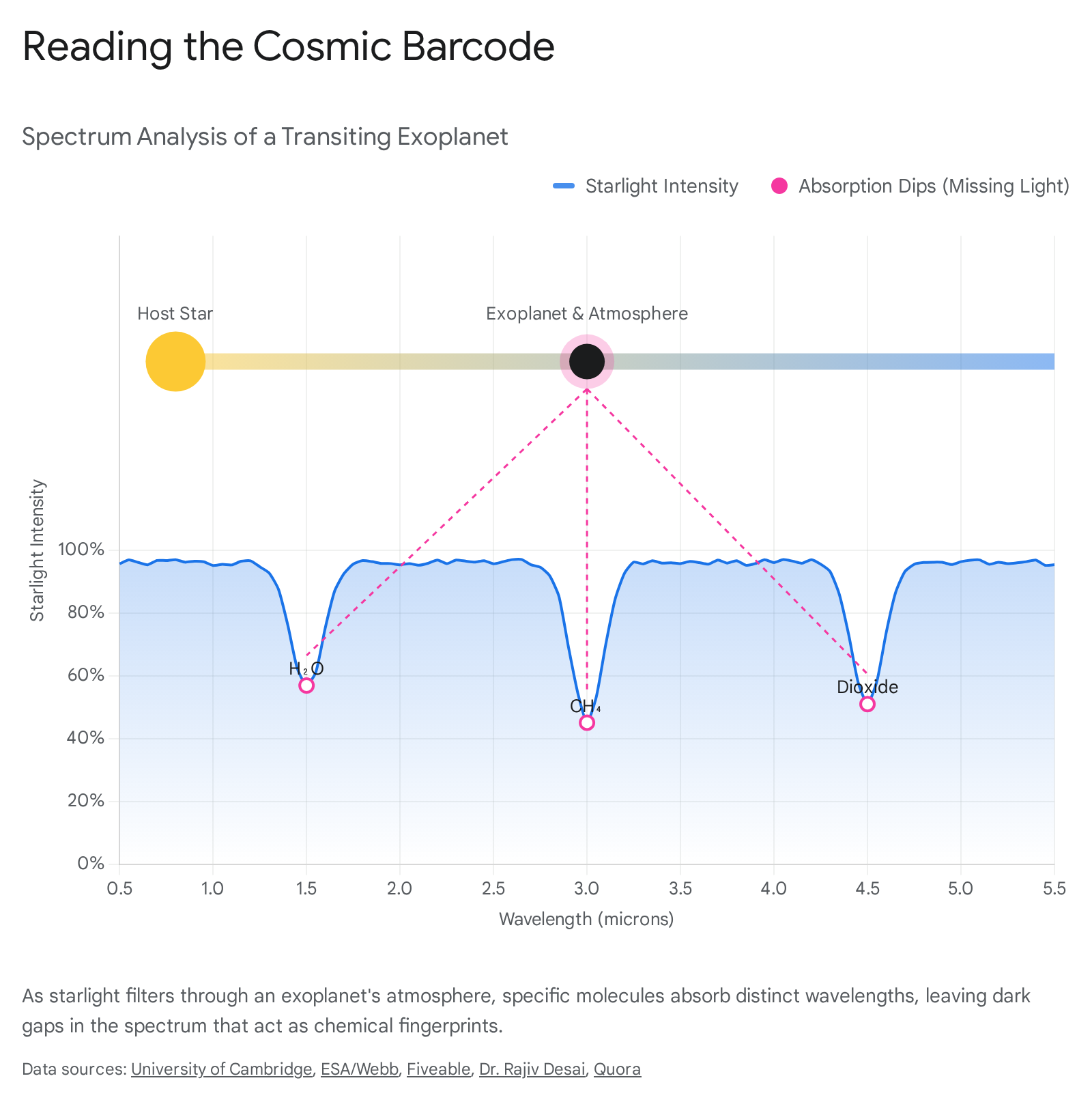
Beyond imaging the deep universe, JWST is revolutionizing the study of exoplanets - planets orbiting stars outside our solar system. The telescope is not merely looking for these distant worlds; it is reading the chemical composition of their skies using a technique called transmission spectroscopy 101120.
When an exoplanet transits (passes directly in front of) its host star from Earth's perspective, a tiny fraction of the starlight filters through the planet's atmospheric halo before continuing its journey through space 10112021. Different chemical molecules - such as water vapor, methane, and carbon dioxide - absorb specific wavelengths of this light 1120.
By using instruments like NIRSpec and NIRISS, JWST splits the incoming starlight into a spectrum 289. The resulting data acts as a cosmic barcode; if specific "lines" or wavelengths of light are missing from the spectrum, scientists know exactly which chemicals absorbed them in the alien atmosphere 112223.
The Hunt for Biosignatures: The K2-18b Controversy
One of the most highly publicized exoplanet targets for JWST has been K2-18b, a sub-Neptune world located 124 light-years away in the constellation Leo 1213. It is about 8.6 times the mass of Earth and 2.6 times its radius, sitting squarely in its star's habitable zone 121326. Early atmospheric modeling suggested it might be a "Hycean" world - a theoretical class of planet characterized by a thick, hydrogen-rich atmosphere covering a global ocean of liquid water 21122627.
In 2023, and again with follow-up observations in early 2025, an astronomical team led by researchers at the University of Cambridge announced they had detected robust signatures of methane and carbon dioxide on K2-18b 21122728. The presence of these carbon-based molecules, combined with a lack of ammonia, is consistent with predictions for a Hycean environment 211228.
More provocatively, the team reported tentative signs of dimethyl sulfide (DMS) and its chemical cousin, dimethyl disulfide (DMDS) 211214. On Earth, DMS is a compelling biosignature; it is produced almost exclusively by living organisms, specifically marine phytoplankton 12132614. The international media quickly heralded the finding as the strongest hint yet of extraterrestrial biological activity 132630.
The Limits of Statistical Confidence
However, the scientific process requires rigorous skepticism, and the DMS claim was immediately met with caution from the broader astronomical community 132631. The signal for DMS in the Webb data was detected at roughly a 2.7 to 3-sigma level of statistical confidence 213132. This translates to about a 0.3% probability that the signal occurred by chance 2131. While this sounds promising, a definitive scientific discovery in physics and astronomy generally requires a 5-sigma threshold, meaning there is only a 0.00006% chance the result is a statistical anomaly 21133132.
Subsequent independent models and re-analyses in late 2025 and 2026 dampened the initial excitement. Other researchers argued that the spectroscopic data is better explained by a lifeless, gas-rich "mini-Neptune" with no defined surface or ocean at all 2815. In this alternative model, the methane and carbon dioxide are produced by standard thermochemical processes deep within the planet's interior, and the weak DMS signal is likely a false positive, an artifact of data noise, or the result of unknown abiotic chemistry 26283015.
Ultimately, whether K2-18b hosts an ocean teeming with life remains fiercely debated and unconfirmed 2631. Researchers agree that an additional 16 to 24 hours of dedicated JWST observation time - or future data from ground-based observatories like the Extremely Large Telescope (ELT) - will be required to settle the dispute 2115.
TOI-199b: A Mild Gas Giant Wrapped in Methane
While the search for definitive biosignatures continues, JWST is successfully mapping the chemistry of entirely new classes of planets. In May 2026, astronomers published groundbreaking findings on TOI-199b, a giant planet roughly the size of Saturn located approximately 330 light-years away in the constellation Dorado 161736.
What makes TOI-199b unique is its climate. The vast majority of giant exoplanets studied prior to JWST are "hot Jupiters" - worlds orbiting so close to their host stars that their atmospheric temperatures reach thousands of degrees 1637. Conversely, the giant planets in our own solar system are frozen 1637. TOI-199b sits in a rare cosmic sweet spot. Orbiting its star every 100 days, it has an estimated temperature of around 175°F (79°C) 161736. While certainly hot by human standards - roughly the temperature inside a parked car in direct summer sunlight - it is considered a "temperate" gas giant 161737.
Using transmission spectroscopy, Webb confirmed that TOI-199b's atmosphere is packed with methane, alongside hints of carbon dioxide and ammonia 3637. This discovery was a triumph for planetary science, as it proved theoretical models right. Scientists had long predicted that temperate gas giants should harbor significant amounts of methane, but previous observatories lacked the instrumental sensitivity to verify these predictions 3638.
Blurring the Lines Between Planets and Stars
JWST's sensitivity is not only finding new planets but is actively dismantling the established definitions of what constitutes a planet versus a star.
The Identity Crisis of 29 Cygni b
For decades, the dividing line between the largest gas giant planets and the smallest "failed stars" (brown dwarfs) was defined by mass. Objects heavier than roughly 13 Jupiter masses were thought to be brown dwarfs capable of fusing deuterium in their cores, while lighter objects were classified as planets 18. Furthermore, astronomers believed that stars and brown dwarfs formed "top-down" from the gravitational collapse of massive interstellar gas clouds 194142. Planets, on the other hand, form "bottom-up," slowly accumulating pebbles, dust, and gas within a protoplanetary disk orbiting a young star - a process known as core accretion 19414220.
In April 2026, researchers using Webb's NIRCam with a specialized coronagraph - a physical mask that blocks the blinding light of a host star to reveal faint objects nearby - directly imaged an object known as 29 Cygni b 1941422021.
The object weighs 15 times the mass of Jupiter, placing it firmly above the deuterium-burning limit and into the traditional weight class of a star 41422021. However, Webb's spectral data revealed it is heavily enriched with heavy elements like carbon and oxygen, holding the equivalent of 150 Earths' worth of solid material 194120.
This extreme heavy metal enrichment, combined with ground-based optical data showing its distant orbit is perfectly aligned with the spin axis of its host star, provides conclusive evidence that 29 Cygni b formed bottom-up within a protoplanetary disk 19414220. Despite its immense, star-like mass, 29 Cygni b is an overgrown planet 4142. This discovery has challenged the fundamental limits of how massive a planet can grow through core accretion and is forcing space agencies to reconsider how they categorize celestial bodies 184142.
Free-Floating JuMBOs
Adding to the complexity of planetary formation, JWST has discovered hundreds of "rogue" planets drifting through star-forming nebulas, completely untethered to any host star 1822. While solitary rogue planets were known to exist, Webb recently spotted dozens of Jupiter-Mass Binary Objects (JuMBOs) 2246.
These are pairs of rogue planets, roughly the size of Jupiter, orbiting one another while floating freely through the Milky Way 2246. Standard theories of planetary formation cannot easily explain how a star could eject two massive gas giants simultaneously while allowing them to remain gravitationally bound to each other 22. The existence of JuMBOs suggests there are dynamic mechanisms of planetary formation and ejection that the astronomical community does not yet understand 22.
Rewriting the Dawn of the Universe
When astronomers point JWST at the darkest patches of the sky, they are engaging in cosmic archaeology. To understand the sheer scale of these discoveries, one must envision a cosmic timeline. Beginning with the Big Bang approximately 13.8 billion years ago, the universe entered a period known as the Dark Ages, characterized by a thick fog of neutral hydrogen. Then came the "Cosmic Dawn" - the first few hundred million years when the earliest stars and galaxies ignited, clearing the hydrogen fog in an era known as reionization 2324255026.
The Most Distant Galaxies Ever Seen
Prior to JWST, the farthest known galaxy was GN-z11, discovered by Hubble, existing roughly 400 million years after the Big Bang 1052. Webb shattered that record almost immediately.
In 2024, astronomers confirmed the discovery of JADES-GS-z14-0, a highly luminous galaxy sitting at a redshift of 14.32, meaning we are observing it as it was just 290 million years after the Big Bang 53542756. The galaxy spanned over 1,600 light-years across and contained an estimated half a billion solar masses of stars 2757. Its existence challenged early models, which assumed galaxies required much more time to assemble such massive stellar populations 2756.
In May 2026, JWST broke its own record yet again. An international team of astrophysicists announced the spectroscopic confirmation of MoM-z14, a remarkably bright galaxy at a redshift of 14.44, pushing the observational frontier back to a mere 280 million years after the Big Bang (when the universe was just 2% of its current age) 2425582829.
Comparing the Oldest Known Galaxies
| Galaxy Name | Redshift (z) | Time After Big Bang | Discovered By | Key Characteristic |
|---|---|---|---|---|
| GN-z11 | 10.60 | ~400 million years | Hubble | Previous record holder; proved galaxies existed earlier than thought. |
| JADES-GS-z14-0 | 14.32 | ~290 million years | JWST | Highly luminous; contains ~500 million solar masses of young stars. |
| MoM-z14 | 14.44 | ~280 million years | JWST | Current record holder; unusually high nitrogen enrichment and extreme brightness. |
Data sourced from JWST extragalactic surveys 1052542758.
MoM-z14 is incredibly compact - only about 240 light-years across, or roughly 400 times smaller than the Milky Way - but it is roughly 100 times brighter than theoretical cosmological models predicted for that era 5255228.
Furthermore, spectroscopic analysis revealed high concentrations of nitrogen relative to carbon, a chemical signature typically found in dense, ancient globular clusters within our own galaxy 58283062. This suggests that the dense, primordial environment of the early universe allowed for the rapid formation of supermassive stars that lived fast and died young, enriching the surrounding gas with heavy elements much earlier than previously thought 525829.
Did Webb Really "Break" the Big Bang?
In 2023 and early 2024, headlines proclaimed that JWST had "broken the universe." Initial observations found a surprising number of ancient galaxies that appeared to be monstrously massive - up to 100 times heavier than scientists believed was possible for the first 500 to 700 million years of cosmic history 112353. These early objects were quickly dubbed "universe breakers" because they seemingly contradicted the established Lambda-CDM (Cold Dark Matter) model of the Big Bang, which dictates that large galaxies take billions of years to slowly pull together through gravity 5112353.
However, the scientific consensus has since clarified that the Big Bang theory remains intact 313233. The confusion stemmed from two primary factors regarding how astronomers measure distant light.
First, early distance estimates relied on "photometric redshift," a technique that is notoriously uncertain and can be thrown off by heavy cosmic dust making galaxies appear farther than they actually are 5332. When astronomers later used JWST's NIRSpec instrument to obtain more precise "spectroscopic redshifts," several of these "universe breaker" galaxies were revealed to be much closer, and therefore much older and normally sized, than initially thought 5332.
Second, scientists discovered that the extreme brightness of these early objects was not coming entirely from billions of stars. Instead, a significant portion of the light was being emitted by active supermassive black holes feeding on gas at the centers of these galaxies 3134. When the blinding light of the black hole was factored out of the equation, the actual stellar mass of the galaxies aligned perfectly with standard cosmological models 3134.
While fringe alternative theories like "Tired Light" - which suggests light merely loses energy over time rather than space expanding - saw brief resurgences in popular media, they remain largely rejected by the astronomical community because they fail to account for the cosmic microwave background and the observed abundance of light elements 6768.
The Mystery of the "Little Red Dots"
The realization that supermassive black holes were inflating the brightness of early galaxies led to the discovery of an entirely new class of celestial objects: "Little Red Dots" (LRDs) 34357036.
Scattered across the ancient universe, these compact, brilliantly red sources emit chemical signatures that defy traditional categorization 7072. Researchers now theorize that many of these objects are actually "black hole stars" - gigantic, dense spheres of cold hydrogen gas that obscure a ravenous supermassive black hole at their core 353672. Instead of being powered by nuclear fusion like a normal star, they are powered by the intense friction and energy of the black hole swallowing matter 353672.
In May 2026, researchers using Webb mapped the motion of gas around one of these little red dots, known as Abell2744-QSO1, located over 13 billion light-years away 3774. By observing the Keplerian motion of the gas, they directly measured the mass of the black hole at 50 million times the mass of our Sun 7475.
Astonishingly, the black hole makes up at least two-thirds of the entire object's total mass 7475. In modern galaxies like our Milky Way, the central black hole makes up only a tiny fraction of a percent of the total galactic mass 317475. This finding suggests that in the early universe, some supermassive black holes formed directly from the collapse of massive gas clouds, completely predating the formation of the stars and the galaxy around them 377475.
Surprises Closer to Home
While Webb was built to look to the edge of the universe, it has also turned its golden mirrors toward our own cosmic backyard, solving long-standing mysteries.
For decades, measurements of Saturn's rotation rate seemed to shift arbitrarily, leading to the physically impossible conclusion that the massive gas giant was constantly speeding up and slowing down 76. In May 2026, Webb observations revealed that the shifting measurements were not the planet changing speeds, but were actually tracking powerful, self-sustaining atmospheric winds generated by heat from Saturn's dazzling northern auroras 76.
Further out in the Milky Way, observing the planetary nebula Tc 1 - a cloud of gas ejected by a dying star 10,000 light-years away - Webb mapped the presence of Buckminsterfullerenes 77. These complex carbon molecules, shaped exactly like soccer balls and consisting of 60 carbon atoms, are providing new clues into how dying stars enrich the galaxy with the chemical building blocks necessary for future planets and biological life 77.
Bottom line
The James Webb Space Telescope has fundamentally altered the landscape of modern astrophysics. By peering deeper into the infrared spectrum than ever before, it has pushed the boundary of the observable universe back to a mere 280 million years after the Big Bang, revealing an early cosmos filled with mature galaxies and colossal "black hole stars." While early fears that Webb had broken standard cosmological models have been resolved through more precise data, its ongoing discoveries - from the chemical barcodes of temperate exoplanets to massive rogue worlds defying the definitions of planetary formation - guarantee that our understanding of the universe will continue to evolve rapidly in the years to come.