
What Is Doomscrolling and Why Do We Keep Reading Bad News
Doomscrolling is the compulsive habit of continuously scrolling through negative and distressing news on digital platforms. Driven by our ancient evolutionary instinct to scan our environment for threats, this behavior is heavily exploited by social media algorithms that use unpredictable rewards to keep us hooked. Ultimately, while seeking out bad news starts as an attempt to feel prepared, it frequently traps users in a cycle of anxiety, sleep disruption, and cognitive fatigue.
The Origins and Evolution of a Digital Epidemic
The concept of consuming bad news is not a novel phenomenon, but the sheer velocity, volume, and accessibility of negative information available in the digital age are unprecedented. The term "doomscrolling" (or its earlier variation, "doomsurfing") was coined around 2018 by journalist Ashik Siddique, but it exploded into mainstream consciousness during the COVID-19 pandemic 12. In 2020, as the World Health Organization warned of a global "infodemic" characterized by widespread misinformation and panic, individuals confined to their homes turned to their screens to make sense of a rapidly shifting reality 134.
By late 2020, doomscrolling had become a defining behavioral quirk of the digital era, earning recognition as a Word of the Year from dictionaries like Macquarie and Oxford, before being officially added to Merriam-Webster in 2023 124. In 2022, an American Psychological Association (APA) survey found that 73% of Americans reported engaging in doomscrolling, highlighting its deep integration into daily life 3.
The behavior represents a specific intersection of human vulnerability and technological design. It is closely related to the broader cultural concern of "brain rot" - which was named Oxford University Press's 2024 Word of the Year 45. Interestingly, the first recorded use of "brain rot" traces back to Henry David Thoreau's 1854 book Walden, where he criticized society's tendency to devalue complex ideas in favor of trivial distractions 45. Today, while "brain rot" refers broadly to the cognitive deterioration resulting from the overconsumption of low-quality online sludge, doomscrolling is uniquely focused on the obsessive pursuit of negative, threatening, and pessimistic narratives 48.
The Evolutionary Psychology: Why We Are Drawn to Bad News
To understand why intelligent people actively seek out content that makes them feel miserable, it is necessary to look past the screen and into human biology. Doomscrolling is not a moral failing, a sign of laziness, or a simple lack of willpower; it is ancient survival software running inside an environment designed to exploit it 910.
The Evolutionary Negativity Bias
The human brain is biologically hardwired with a "negativity bias," an evolutionary mechanism that automatically prioritizes threatening information over positive or neutral data 11126. For early humans hunting and foraging in the wild, missing a beautiful sunset carried no consequences, but failing to notice the subtle signs of a predator was fatal. The ancestors who survived and passed on their genes were the ones who paid disproportionate attention to danger 1011127.
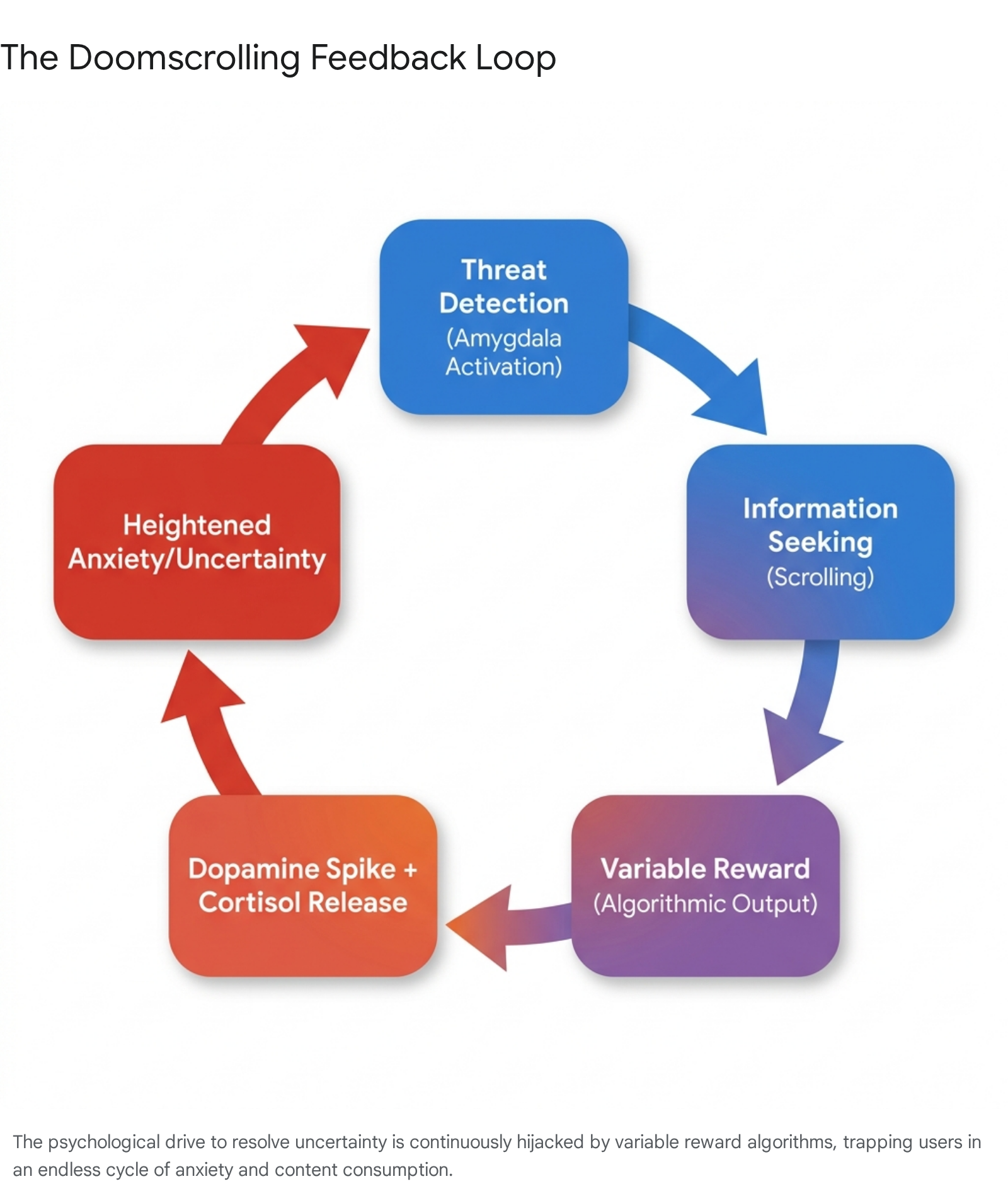
When you scroll past a terrifying headline about a natural disaster, an economic crash, or political unrest, the brain's amygdala - the almond-shaped center responsible for emotion and threat detection - lights up immediately 978. It triggers the release of stress hormones like cortisol and adrenaline, forcing the body into a state of high alert 399. The brain cannot easily distinguish between the immediate physical threat of a predator and the abstract, distant threat of a global crisis presented on a 6-inch smartphone screen. As a result, your nervous system remains stuck in "fight or flight" mode, demanding more information to assess the danger 81011.
The Illusion of Control and Anticipatory Coping
Beyond raw survival instincts, doomscrolling is often driven by a deep psychological need for control. During periods of high uncertainty, individuals consume negative news as a form of "anticipatory coping" 1019. By obsessively monitoring developing crises, users believe they are gaining a lead time for response - mentally bracing themselves for the worst-case scenario so they are not caught off guard 1912.
Psychologists note that this behavior often functions as a misguided emotional regulation strategy. According to emotion regulation theory and Viktor Frankl's existential concepts of meaning-making, immersing oneself in chaotic news is an unconscious attempt to reshape emotional responses and find a sense of connectedness in global suffering 1921. Paradoxically, the sheer volume of negative information quickly overwhelms the individual's capacity to process it. Instead of providing closure or a sense of preparedness, the endless scroll amplifies uncertainty, creating a feedback loop where the user scrolls more to alleviate the very anxiety the scrolling produced 61013.
The Role of Cognitive Dissonance
When people are feeling depressed or anxious, they also suffer from cognitive dissonance if the outside world appears overly cheerful. A person feeling internal dread will actively seek out information that confirms their negative emotional state 914. "Doomscrolling operates with the same mindset: If you're feeling negative, then reading negative news only reconfirms how you feel," explains clinical psychologist Dr. Susan Albers 14. Once this pattern is established, it becomes a mindless habit that operates almost entirely below the threshold of conscious awareness 14.
The Algorithmic Engine: How Platforms Keep Us Hooked
Human vulnerability only explains half of the doomscrolling equation. The other half is the highly engineered architecture of modern digital platforms. Social media feeds are not neutral information delivery systems; they are billion-dollar infrastructures optimized for user engagement and retention 1024.
The Slot Machine Effect and Variable Rewards
In the 1950s, behavioral psychologist B.F. Skinner conducted experiments on pigeons, discovering that animals trained on "variable ratio reinforcement schedules" - meaning they receive rewards at entirely unpredictable intervals - engage in behaviors far more obsessively than those on fixed, predictable schedules 2415. Even when the pigeons were no longer hungry, they would continue pecking at a lever up to 12,000 times an hour, just for the chance of a reward 24.
Digital platforms leverage this exact psychology, making social media the largest Skinner box ever constructed. Every time a user opens an app or uses the "pull-to-refresh" gesture, they are effectively pulling the lever of a digital slot machine 15262716. The user never knows if the next post will be a funny meme, an enraging political statement, or a terrifying piece of breaking news. This unpredictability keeps the brain searching for the next update. Crucially, the neurotransmitter dopamine is released not when the user receives a reward, but during the anticipation of it 27.
Because discovery algorithms prioritize emotionally charged, polarizing, and sensational content (which naturally generates the highest engagement metrics), the "reward" delivered is overwhelmingly negative 31129. The user becomes locked in a state of craving - a jittery, unfulfilled hunger for the next piece of novel information that is entirely distinct from genuine yearning or long-term satisfaction 16.
The 2025 Shift in Short-Form Video Algorithms
The rise of short-form video (SFV) platforms like TikTok, Instagram Reels, and YouTube Shorts has supercharged the doomscrolling phenomenon. In recent years, algorithms have shifted from prioritizing explicit engagement (likes and comments) to heavily prioritizing "watch time" and completion rates 303132.
By 2025, platform algorithms have become exceptionally skilled at session-based tracking 17. They monitor not just what you watch, but how quickly you scroll past certain topics, measuring milliseconds of hesitation. If the algorithm detects that geopolitical conflict or climate disaster content keeps your screen active longer than cooking videos, it will dynamically adjust your "For You" page to serve a frictionless stream of hyper-personalized distress 2617.
Because the infinite scroll interface removes natural stopping cues - like reaching the bottom of a printed page or the end of a television broadcast - users easily slip into a dissociative state often referred to as "the zone." In this state, conscious awareness fades, and individuals lose track of time while their working memory is continuously bombarded 1015.
The Habituation Effect and Cognitive Decline
The impact of this algorithmic environment on the brain is profound. A massive 2025 systematic review and meta-analysis examining data from 98,299 participants across 71 studies investigated how short-form videos rewire cognition 35. The researchers uncovered what they termed the "Habituation Effect."
The data revealed a moderate negative correlation ($r = -0.34$) between heavy short-form video scrolling and overall cognitive performance 35. More specifically, the endless scrolling targeted and degraded two critical cognitive functions: 1. Sustained Attention ($r = -0.38$): The ability to focus deeply on a single, complex task without distraction. 2. Inhibitory Control ($r = -0.41$): The brain's ability to suppress impulsive behaviors and resist the urge to context-switch 35.
In essence, the algorithm literally trains the brain to reject deep work and nuance in favor of rapid, highly stimulating micro-narratives 435.
The Mental and Physical Toll of Endless Bad News
The consequences of prolonged doomscrolling extend well beyond temporary digital fatigue. A growing body of clinical research from 2023 to 2025 supports the identification of doomscrolling as a distinct behavioral addiction with severe mental and physical health implications 31819.
Worsening Psychological Distress
Studies consistently link doomscrolling to higher levels of chronic stress, anxiety, and depressive symptoms 310142021. By keeping the sympathetic nervous system locked in a state of hypervigilance, doomscrolling prevents the brain from emotionally recovering.
Over time, constant exposure to the traumas of others can result in "vicarious trauma" (also known as secondary traumatic stress). This occurs when individuals internalize the emotional weight of global disasters, mass shootings, or wars without ever experiencing them directly 10112022. Symptoms can closely mimic post-traumatic stress disorder (PTSD), including intrusive thoughts, emotional numbing, and a profound sense of helplessness 101119.
For younger users, the risks are particularly acute. A 2024 report by the American Psychological Association (APA) emphasized that the brains of adolescents and young adults (up to age 25) are still developing crucial self-control and emotional regulation mechanisms. Infinite scrolling and push notifications exploit these vulnerabilities, making young people significantly more susceptible to the psychological distress caused by endless negative feeds 923.
Physical Manifestations
The body also absorbs the impact of the digital scroll. The physiological manifestations of doomscrolling are highly documented and include: * Sleep Disruption: Scrolling late at night overstimulates the brain. The combination of psychological stress and the suppression of melatonin caused by the blue light emitted from screens severely impairs the ability to enter deep, restful sleep phases. This results in "stress hangovers" the following morning 11141824. * Chronic Pain: The physical posture associated with endless scrolling leads to muscle tension, frequent headaches, and chronic neck and shoulder pain 1118. * Hormonal Imbalance: The continuous activation of the threat-detection system elevates levels of cortisol and adrenaline, which over time can lead to a suppressed immune system and chronic exhaustion 991126.
Does Doomscrolling Cause Existential Dread?
A landmark 2024 cross-cultural study led by Flinders University explored the deeper, philosophical toll of doomscrolling. Surveying 800 university students across the United States (a Western, individualistic culture) and Iran (an Eastern, collectivist culture), researchers sought to understand how the behavior affected core beliefs about humanity 2222526.
The findings were striking: despite vast cultural and geographic differences, heavy doomscrolling uniformly predicted high levels of "existential anxiety" - the profound dread surrounding the meaninglessness of life, human fragility, and the inevitability of death 222526.
Furthermore, high consumers of negative news showed elevated levels of misanthropy (a deep distrust and dislike of humanity) and a decreased belief in a just world 222526. By constantly viewing the worst aspects of human behavior concentrated into a single feed, users develop a distorted, highly pessimistic perception of reality. The researchers compared the psychological effect of doomscrolling to "being in a room where people are continuously shouting at you," noting that it challenges people's fundamental assumptions about the fairness and benevolence of society 22.
Social and Cultural Consequences
Doomscrolling does not just alter individual brains; it shapes societal worldviews, political engagement, and cultural interactions.
Echo Chambers and Political Polarization
While the internet theoretically provides access to diverse viewpoints, social media platforms are economically incentivized to keep users engaged. Research indicates that algorithms frequently limit exposure to counter-attitudinal news (news that challenges a user's pre-existing beliefs) because encountering conflicting information might prompt the user to log off 27.
Large-scale field experiments reveal an interesting paradox: when users are organically exposed to opposing political views, their negative attitudes toward the opposing party actually decrease 2728. However, social media algorithms rarely serve this moderating content 27. Consequently, doomscrolling often traps users in ideologically isolated echo chambers, amplifying outrage against out-groups and coarsening public debate 2829.
Global News Avoidance
The emotional exhaustion caused by doomscrolling has triggered a massive cultural backlash against journalism itself. According to the 2025 Reuters Institute Digital News Report, nearly 40% of global respondents now say they "sometimes or often" actively avoid the news - the joint-highest figure on record 229.
As traditional institutional journalism struggles with declining trust, audiences - particularly Gen Z and Millennials - are shifting their consumption to alternative media environments. Younger demographics increasingly rely on TikTok, Instagram, and Reddit for news, where partisan influencers and personalities often bypass traditional fact-checking, further complicating the public's ability to separate factual threats from sensationalized outrage 2930.
Breaking the Cycle: Digital Detox vs. Digital Literacy
As awareness of the doomscrolling epidemic grows, behavioral psychologists and public health advocates are debating the most effective methods for reclaiming mental well-being. The interventions generally fall into two distinct strategies: the short-term Digital Detox and the long-term cultivation of Digital Literacy.
Comparing the Two Primary Interventions
| Intervention Strategy | Definition & Mechanism | Efficacy & Evidence | Limitations |
|---|---|---|---|
| Digital Detox | A voluntary, strict cessation or significant reduction of digital device and social media usage for a set period 31. Relies on avoidance and removal of the algorithmic stimuli 32. | A 2025 PNAS Nexus trial showed that a two-week smartphone block slashed screen time from 314 to 161 minutes daily, improving attention span and sleep for 90% of participants 3334. A meta-analysis found it significantly mitigates depressive symptoms (24.8% reduction) 313554. | Provides only short-term relief. Addiction researchers note that total abstinence can cause withdrawal symptoms. Without building coping mechanisms, users often experience a severe "rebound effect" (bingeing content) once the detox ends 3236. |
| Digital Literacy & Cognitive Hygiene | Cultivating metacognition and mindful awareness of how technology impacts psychology. Reframing screen use as an intentional choice rather than a reflex 1932. | Empirical evidence from cyberpsychology journals shows that interventions teaching mindful tech use produce longer-lasting reductions in anxiety and burnout than short-term abstinence 32. | Requires sustained daily effort and self-awareness. Harder to implement initially than simply deleting an app 32. |
The Case for Cognitive Hygiene and Micro-Boundaries
Because modern life requires digital connectivity for work, communication, and basic functioning, experts increasingly advocate for digital literacy over complete avoidance. Rather than trying to go "cold turkey," which rarely works long-term, psychologists suggest practicing "cognitive hygiene" 1936.
Cognitive hygiene involves identifying the emotional triggers (such as anxiety, loneliness, or boredom) that precede the urge to scroll, and establishing firm, intentional micro-boundaries 192432. Effective, evidence-based strategies to break the doomscrolling loop include:
- Dismantling the Slot Machine: Turn off all non-essential push notifications. By removing the unpredictable pings and badges from the home screen, you transition the device from an active interrupter to a passive tool 3757.
- Creating Digital-Free Zones: Banning phones from the bedroom is one of the most effective ways to protect sleep hygiene and prevent late-night stress loops 2457.
- Scheduled News Consumption: Instead of relying on an algorithmic feed to serve breaking news unpredictably, set a specific time of day (e.g., 20 minutes after lunch) to check a trusted news source directly. This satisfies the evolutionary need for information without triggering the continuous dopamine loop of infinite scrolling 324.
- Nature-Based Mindfulness: Practices such as shinrin-yoku (forest bathing) and silent walking have been empirically linked to lowering cortisol levels and repairing the sustained attention deficits caused by heavy screen use 57.
Bottom line
Doomscrolling is the product of an ancient human brain colliding with modern algorithmic design. What begins as a natural, evolutionary drive to gather information and protect oneself in a crisis is quickly hijacked by digital platforms engineered to reward us with a continuous, unpredictable stream of anxiety. While total withdrawal through a short-term digital detox offers immediate relief from depression and sleep loss, it is rarely sustainable. Building long-term digital literacy, establishing physical boundaries with our devices, and intentionally curating the information we consume are the most effective ways to break the cycle and view the world with a clearer, more balanced perspective.