
What Happens in Your Brain When You Share Online
When individuals share content online, the brain rapidly evaluates how the information affects their self-image and their relationships with others. These complex social and personal calculations converge in the brain's reward center, which computes a unified value signal that drives the final urge to post. Over time, the continuous anticipation of this social feedback creates a powerful neurochemical loop, altering attention spans, memory consolidation, and cognitive control.
The Neuroscience of Hitting "Share"
Information sharing is an integral part of human interaction, serving to build social relationships, establish alliances, and affect attitudes across large populations 12. In the digital age, this fundamental evolutionary drive has been amplified by the frictionless environment of social media. To understand what happens neurologically when a person decides to retweet a news article, forward a video, or post a photograph, cognitive neuroscientists rely on a robust theoretical framework known as "value-based virality" 34.
The value-based virality model posits that the brain treats the decision to share information much like any other value-based decision, such as choosing what to eat, evaluating a financial gamble, or deciding whether to purchase a product 445. Before a user clicks a share button, the brain seamlessly and rapidly integrates multiple streams of abstract social and personal information into a single, domain-general value signal 26. This subconscious calculation unfolds across three distinct, chronologically integrated neural stages that map onto specific regions of the human cortex.
Stage 1: The Self-Relevance Filter
The first input involves calculating expectations of self-related outcomes. When an individual encounters online content, the brain implicitly evaluates how sharing this specific piece of information will affect their self-presentation, their internal self-concept, or their potential for self-enhancement 36. People want to be perceived as intelligent, helpful, humorous, or uniquely informed, and the content they disseminate acts as an extension of this identity.
Neurologically, this self-referential processing is heavily localized in the medial prefrontal cortex (MPFC) and the precuneus, which sits within the posterior cingulate cortex (PC/PCC) 36. These regions act as an internal cognitive mirror. They activate strongly when individuals reflect on their own traits, personal values, and public image 7. If an article about a new scientific discovery or a highly stylized photograph aligns with how the potential sharer wishes to be seen, the MPFC lights up, signaling that the content holds high self-related value 38. The stronger the activation in the MPFC, the more likely the user is to internalize the message and feel compelled to broadcast it to their network.
Stage 2: The Social Relevance Filter
Because humans are inherently social creatures wired by evolution to seek acceptance and avoid rejection, the brain must also calculate the social impact of sharing a piece of information 310. This involves a sophisticated cognitive process known as "mentalizing" or Theory of Mind. Mentalizing is the ability to consider the mental states, existing knowledge, unique interests, and potential emotional reactions of other people 6.
When users evaluate whether their followers will enjoy, agree with, or be offended by a post, the brain engages its social cognition system. This widespread network includes the middle-medial prefrontal cortex, the dorsomedial prefrontal cortex (dmPFC), the bilateral temporoparietal junction (TPJ), and the right superior temporal sulcus 6910. The TPJ, in particular, is highly active when inferring the intentions and beliefs of others, acting as a simulator for social outcomes 13. Interestingly, functional magnetic resonance imaging (fMRI) studies show that the MPFC and TPJ experience increased connectivity even during rest periods after people encode new social information. This suggests that the brain constantly tunes itself to the social environment, preparing for future interactions and calibrating its understanding of the group dynamic even when the user is offline 13.
Stage 3: The Final Value Computation
The brain must eventually translate the abstract concepts of self-presentation and social awareness into a concrete behavioral action. It achieves this by routing the signals from the self-related and social cognition networks directly into the brain's central valuation system 16.
The valuation system primarily consists of the ventromedial prefrontal cortex (vmPFC) and the ventral striatum (VS) 46. These regions operate as the brain's ultimate currency exchange. Whether a person is evaluating primary physical rewards like sugar and water, or secondary abstract rewards like monetary gain and social approval, the vmPFC and VS transform these diverse inputs onto a common neurochemical scale 411. If the combined self-related and social benefits of a post outweigh the potential risks - such as social backlash, controversy, or ignoring social norms - the valuation system generates a strong activation signal. The stronger the neural activity in the vmPFC and VS, the higher the perceived value of sharing the information, which directly triggers the motor execution of clicking the share button 14.
| Sharing Stage | Primary Brain Regions Involved | Psychological Function | Behavioral Consequence |
|---|---|---|---|
| 1. Self-Relevance | Medial Prefrontal Cortex (MPFC), Precuneus (PC/PCC) | Evaluates how content reflects on one's personal identity, values, and desired self-presentation. | Increases the perceived value of the content if it enhances the user's self-image. |
| 2. Social Relevance | Temporoparietal Junction (TPJ), Dorsomedial Prefrontal Cortex | Engages Theory of Mind to anticipate how an audience will react to and interpret the information. | Increases value if the content is expected to foster social bonds or generate peer approval. |
| 3. Valuation | Ventromedial Prefrontal Cortex (vmPFC), Ventral Striatum (VS) | Integrates self and social inputs into a single "common currency" value score. | High signal intensity directly correlates with individual sharing behavior and overall content virality. |
Neuroforecasting: The Brain as a Predictor of the Crowd
One of the most profound discoveries in recent behavioral neuroscience is that the brain activity of a remarkably small group of individuals can predict the large-scale behavior of entirely different populations. This phenomenon has given rise to a framework known as the "brain-as-predictor" approach, or "neuroforecasting" 121613.
Traditionally, marketing researchers, sociologists, and communication scientists relied on self-reported surveys or focus groups to guess what content might go viral. However, self-reports are notoriously flawed. Individuals often lack conscious access to their true underlying motivations, or they unconsciously alter their answers to appear more socially acceptable to researchers 413. Neuroscience bypasses this conscious filter by looking directly at the brain's internal valuation system before the individual has a chance to rationalize their choices. By flipping the traditional scientific model on its head - treating neural activation as the independent variable that predicts real-world outcomes - researchers can forecast mass behavior with unprecedented accuracy 1614.
Predicting Virality in the Laboratory
In landmark fMRI studies conducted by researchers including Christin Scholz and Emily Falk, scientists observed the brain activity of small groups of participants (typically around 40 people) as they read the headlines and abstracts of 80 real New York Times health and science articles 26. While in the scanner, the participants were simply asked to consider whether they would share the articles on their own social media feeds. Simultaneously, the researchers tracked the Application Programming Interface (API) data from the New York Times to see how many times those specific articles were actually shared by the global readership, encompassing hundreds of thousands of organic interactions 2619.
The results demonstrated that the strength of the neural activity in the participants' valuation regions - specifically the vmPFC and VS - reliably tracked with the population-level virality of the articles 212. In other words, articles that elicited stronger domain-general value signals in the brains of a few dozen laboratory participants were the exact same articles that millions of strangers decided to share across the internet 26. The neural activity predicted population-level outcomes over and above the variance explained by the characteristics of the articles themselves or the commonly used self-report measures of sharing intentions 2.
Cross-Cultural Generality of the Value Signal
Furthermore, this predictive power holds true across different geographic and cultural populations. In a preregistered replication study involving participants in both the United States and the Netherlands, researchers found that the neural signals predicting sharing behavior generalized seamlessly across the two distinct national subsamples 12.
While the American participants' self-reported intentions to share were slightly more predictive of actual sharing than the Dutch participants' self-reports, the underlying neural value signal was universally reliable across both groups 12. The predictiveness of the region-of-interest (ROI) based brain scores did not differ significantly between the US and Dutch participants. This suggests that while local cultural norms and communication habits may dictate what people explicitly say they will share, the fundamental neurocognitive mechanism that calculates the value of sharing is a shared, universal human trait 12. These early emotional and value-based responses are widely shared across individuals, whereas the reflective stages of decision-making tend to be more varied and individualized 13.
The Dopamine Misconception and the "Like" Economy
Understanding why individuals share content provides only half of the equation; it is equally vital to understand the neurological cascade that occurs after the content is shared. The modern social media ecosystem is heavily engineered around the brain's reward circuitry, specifically targeting the mesolimbic dopamine pathway 2015.
A widespread societal misconception is that dopamine is the "pleasure chemical," a substance released by the brain when a person feels good or receives a reward. However, decades of neuroscientific research, pioneered by scientists such as Kent Berridge at the University of Michigan, have demonstrated that dopamine is primarily a neurotransmitter of wanting, motivation, and anticipation, rather than liking or consumption 16.
When a user posts a photograph or shares a controversial article, the brain does not immediately flood with dopamine upon receiving a digital "like." Instead, the dopamine surge occurs in the agonizing moments of uncertainty leading up to the feedback 2016. When the phone buzzes in a pocket, or when the user instinctively opens an application to check for new notifications, dopamine-producing neurons in the ventral tegmental area (VTA) fire rapidly, flooding the nucleus accumbens in the ventral striatum 1016. This chemical surge creates a profound sense of craving and an almost irresistible compulsion to check the screen.
The Mechanics of Variable Ratio Reinforcement
The effectiveness of this anticipation loop is deeply rooted in foundational behavioral psychology. B.F. Skinner's famous mid-century experiments with pigeons demonstrated that animals will press a lever far more compulsively, frantically, and persistently when a reward is delivered unpredictably, rather than on a reliable, fixed schedule 16.
Social media platforms, whether by evolutionary design or deliberate engineering, operate on this exact principle of unpredictable, variable ratio reinforcement 201623. A user never knows if their next post will garner zero engagement, a few polite likes from close friends, or massive viral attention. This engineered "intermittent absence of the like" mirrors the exact psychological mechanics of a casino slot machine 23. Because the brain cannot predict when the next social reward will arrive, the dopamine system remains locked in a state of hyper-arousal and craving 23. The highest dopamine release occurs during the period when the result is uncertain, making the anticipation far more stimulating to the nervous system than the reward itself 20.
Over time, this constant, artificial dopamine release can push the brain into a state of severe dopamine deficit. To restore homeostasis and protect itself from overstimulation, the brain downregulates its dopamine receptors 24. Consequently, users may experience heightened anxiety, anhedonia (a reduced ability to feel pleasure in offline activities), and an intense drive to continue scrolling just to achieve a baseline feeling of normalcy 24.
The Transition from Impulsive to Compulsive Use
Research into the neurobiology of behavioral addictions, including Internet Gaming Disorder and problematic social media use, shows that as usage becomes heavier, the brain's processing of digital cues undergoes a physical transition. In early stages of use, activity is heavily concentrated in the ventral striatum, which handles initial reward processing and approach behaviors 17. However, as the behavior becomes an ingrained habit, control shifts to the dorsal striatum 17. This transition from ventral to dorsal processing is a hallmark of substance addiction, marking the shift from voluntarily seeking a reward (impulsivity) to feeling trapped in an automatic, habitual behavior regardless of the actual pleasure derived (compulsivity) 17.
The Distinct Neurology of Anticipation vs. Consumption
The brain actually processes social feedback through dissociable neural networks depending on whether the individual is anticipating the reward or actively consuming it 18. While the ventral striatum is heavily engaged during the anticipation of both monetary and social rewards, the actual consumption of social approval uniquely engages the amygdala and other regions tied to deep emotional processing and self-referential thought 1018.
When the received feedback falls short of expectations, it triggers the anterior cingulate cortex 10. This brain region is intimately linked to the experience of physical pain, explaining why a lack of online validation, or being ignored in a group chat, can feel genuinely, physically distressing 10. The brain maps social rejection onto the same neural architecture used to process bodily injury, highlighting how critical social belonging is to human survival.
| Habit Loop Stage | Social Media Action | Neurological Mechanism | Psychological Experience |
|---|---|---|---|
| 1. The Cue | A phone buzzes, a notification badge appears, or a feeling of boredom arises. | Sensory cortex activation; memory retrieval associating the device with past rewards. | A sudden shift in attention; a mild sense of discomfort or curiosity. |
| 2. The Routine | Opening the app, swiping down to refresh the feed, or checking a post's status. | Ventral Tegmental Area (VTA) fires; heavy dopamine release in the Ventral Striatum. | Intense craving, anticipation, and motivation to execute the action. |
| 3. The Reward | Seeing new likes, reading a funny comment, or viewing a shocking video. | Amygdala activation for social consumption; gradual transition to Dorsal Striatum over time. | Temporary relief of the craving; reinforcement of the behavior for the next cycle. |
The Neuroscience of Providing Feedback
Interestingly, the brain's reward system is not only activated by receiving validation; it is also highly engaged when providing it to others. Many fMRI studies simulating the interface of platforms like Instagram have shown that when adolescents and young adults provide positive feedback - such as liking a peer's photograph - they exhibit significant activation in the exact same reward circuitry, including the ventral striatum and the VTA 192820.
This suggests that the act of "liking" another person's content is intrinsically rewarding to the human brain. It likely serves as an evolutionary mechanism for reinforcing shared experiences, signaling affiliation, and fulfilling the biological imperative to build reciprocal social bonds within a community 19. However, in the context of digital architecture, it also means that users are continuously experiencing micro-doses of reward-circuit activation even when they are entirely passive - simply consuming and engaging with the feeds of others. This constant low-level activation further deepens the habitual nature of platform usage, making it difficult to disengage from the environment even when not actively creating content 20.
The Infinite Scroll and the Erosion of Cognitive Control
As social media algorithms have evolved over the past decade to maximize user retention and time-on-device, the nature of shared content has shifted dramatically. The landscape is now dominated by the "infinite scroll" of short-form videos, popularized by platforms like TikTok, Instagram Reels, and YouTube Shorts. This specific format of rapid-fire media consumption introduces severe neurological consequences that extend far beyond the standard dopamine habit loop 2122.
Algorithmic Exploitation of the Active Inference Model
To understand how infinite, algorithmic feeds alter human cognition, neuroscientists look to the "active inference" framework (AIF). This theoretical model reimagines the human brain as a continuous, relentless prediction engine 3223. Rather than passively waiting for sensory input, the brain proactively builds a "generative model" - a structured, internal understanding of the world's statistical regularities 23. It constantly uses this model to predict incoming sensory information and acts to minimize any discrepancy (prediction errors) between what it expects and what it encounters 3223.
Algorithmic, infinitely scrolling feeds hijack this delicate predictive machinery. By constantly bombarding the brain with hyper-curated, highly stimulating, and emotionally charged content, the platform feeds the brain distorted evidence about the offline environment 2324. Because algorithms prioritize engagement, they heavily weight content that induces anger, anxiety, outrage, or extreme novelty 24.
The brain, operating as a prediction engine, incorporates this skewed data and updates its generative model. This leads to a state of cognitive entrenchment, where users begin to perceive the real world as vastly more chaotic, threatening, and polarized than it actually is 232536. This warped worldview activates chronic stress responses in the nervous system, strongly coupling the amygdala (fear and emotion) with the prefrontal cortex 3626. Combined fMRI and EEG data reveal that exposure to this outrage-inducing content causes high-frequency Gamma surges in the brain, indicating that intense emotional stimuli can completely override rational cognitive control, driving users to impulsively share harmful or radicalized content out of a perceived sense of threat 26.
The Degradation of Prospective Memory
The rapid context-switching demanded by short-form videos - where a user swipes from a comedy sketch to a tragic news story to a dance trend in intervals of 15 to 60 seconds - exacts a massive toll on cognitive resources 22.
A critical cognitive function uniquely affected by this behavior is prospective memory. Think of prospective memory as the brain's internal sticky note. It is the complex executive function that allows a person to formulate an intention, hold onto it while performing a completely unrelated task, and successfully execute it at a later time 22.
Recent experimental research from institutions like LMU Munich and the University of Bath, presented at human-computer interaction conferences, has demonstrated the fragility of this system in the face of the infinite scroll. In controlled laboratory settings, participants were given a primary task and a prospective memory task to complete after a 10-minute break. Participants who spent their break resting, reading text on Twitter, or watching a single long-form YouTube video retained their prospective memory flawlessly. However, participants who spent just 10 minutes scrolling through short-form videos on TikTok experienced a massive, undeniable drop in their ability to remember what they were supposed to do 22. The sheer volume of rapid context-switching overloads the brain's working memory buffers, literally wiping the cognitive hardware required to remember the user's own future plans 22.
Sustained Attention and Executive Control Deficits
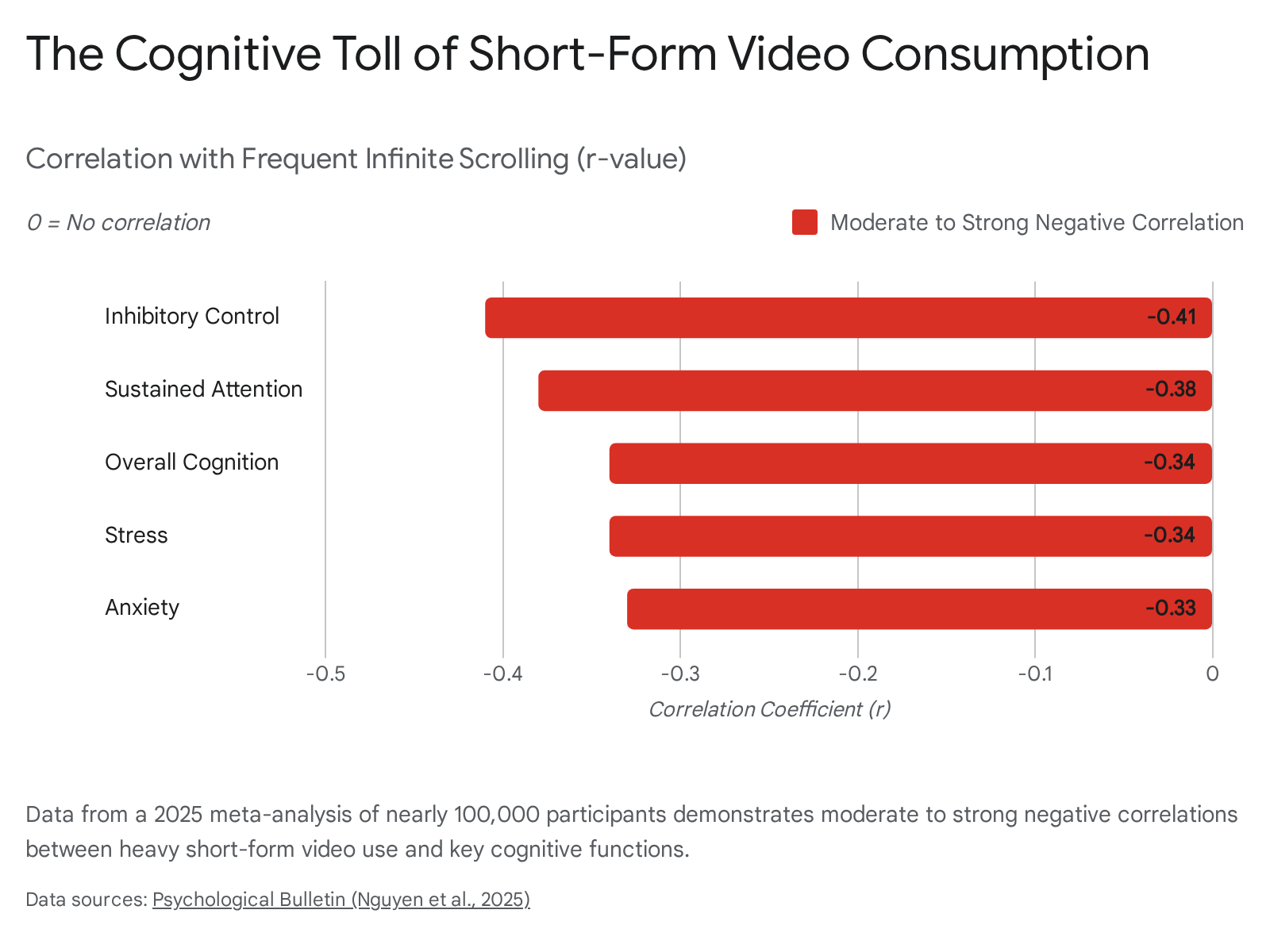
The damage extends beyond forgetting daily tasks. A landmark 2025 meta-analysis encompassing 71 studies and nearly 100,000 participants confirmed that heavy consumption of short-form videos is directly linked to measurable, systemic deficits across multiple cognitive domains 2127.
The data shows moderate to strong negative correlations between short-form video use and sustained attention, inhibitory control, and overall mental health 21.
Electroencephalography (EEG) studies reveal that mobile short-video addiction tendencies correlate with significantly reduced prefrontal theta-band power during executive control tasks. This specific neural signature indicates impaired conflict monitoring and a diminished capacity to allocate attention effectively when faced with complex, slow-paced, or challenging offline tasks 21. Furthermore, chronic consumption leads to habituation, where the brain becomes desensitized to normal environmental stimuli, leading to a profound inability to engage in deep reading, problem-solving, or long-term learning without requiring an artificial, high-velocity dopamine pacifier 28.
Cultural Differences in the Sharing Brain
While the underlying mechanisms of dopamine anticipation and the final vmPFC valuation signal are universal human traits, the initial stages of processing information - the "self" and "social" filters - are highly modulated by an individual's cultural background 2930. The emerging interdisciplinary field of cultural neuroscience provides robust neuroimaging evidence that the neural underpinnings of behavior, perception, and sharing differ markedly between individualistic and collectivistic societies 2930.
Independence vs. Interdependence
Individualistic cultures, predominantly Western societies such as the United States and the United Kingdom, emphasize autonomy, self-expression, and personal achievement 4243. In these environments, individuals view themselves as stable, independent entities, distinct from their surrounding environment and social groups 7.
Conversely, collectivistic cultures, such as those in East Asia (e.g., China and Japan) as well as countries like Malawi, prioritize group harmony, interdependence, and strict adherence to societal norms. Individuals in these cultures view the self as a highly dynamic entity, continually defined by its social context and relationships 74231.
These cultural paradigms physically shape how the brain processes basic sensory information and perceives the world 945. When presented with a visual scene, fMRI studies reveal that Westerners demonstrate additional neural processing in object-focused regions, attending analytically to salient objects independently of their background 1045. East Asians, however, show broader neural recruitment indicative of holistic processing, focusing inherently on contexts, backgrounds, and the complex relationships between objects 104532.
How Culture Shapes the Decision to Share
When determining the value of sharing content online, these deep-seated cultural differences dictate which neural pathways are most heavily recruited during the evaluation phase.
In Western populations, social media use and the drive to share are heavily influenced by a "promotion orientation" - the pursuit of personal growth, aspirations, and self-enhancement 33. Consequently, when evaluating content, individuals from individualistic cultures show heightened activation in the medial prefrontal cortex associated with general, stable self-reflection. They also exhibit increased activity in regions related to reward and salience when the information allows for self-promotion, asserting uniqueness, or building a personal brand 73233. Western users prioritize direct communication and sharing unique opinions to stand out from the crowd 31.
In collectivistic populations, social media use is primarily driven by relational motives, social support, and maintaining group belonging 4331. When making self-judgments or evaluating social information for potential sharing, individuals from collectivistic cultures show distinct neural activation patterns. For instance, they tend to exhibit increased amygdala responses to social stimuli - independent of genetics, gender, or personality - reflecting a heightened cultural sensitivity to social harmony and potential social risks 29.
Additionally, they recruit different portions of the MPFC that are associated with contextual and situation-specific self-knowledge. Instead of asking "Does this post show who I am?", the collectivistic brain evaluates how sharing a piece of information will impact their specific role within their community, family, or professional network 732. Collectivistic users prefer indirect communication, sharing feelings and resources to fit in and maintain harmony rather than seeking individual disruption 3133.
| Cognitive & Neural Feature | Individualistic Cultures (e.g., US, UK) | Collectivistic Cultures (e.g., China, Japan) |
|---|---|---|
| Self-Construal | Independent: Views the self as a stable, autonomous entity separate from context 7. | Interdependent: Views the self as a dynamic entity embedded within a social context 7. |
| Primary Sharing Motivation | Self-expression, personal branding, standing out, and a "promotion orientation" 424333. | Social cohesion, group harmony, fitting in, and a "prevention orientation" 424333. |
| Visual Processing Style | Analytical: Focuses on salient objects (greater object-processing area activation) 1032. | Holistic: Focuses on contexts, backgrounds, and relationships 1032. |
| Medial Prefrontal Cortex (MPFC) Usage | Recruits areas associated with general, stable self-reflection and absolute traits 732. | Recruits areas associated with context-dependent and relational self-knowledge 732. |
Despite these profound differences in how information is weighed and filtered, the brain's ultimate arbiter remains structurally the same: the ventromedial prefrontal cortex acts as the universal calculator, taking culturally specific inputs and generating the final domain-general value signal that compels a user across any culture to share 12.
Inter-Brain Synchrony: The Neuroscience of the Network
The implications of online sharing extend beyond individual brains and into the realm of collective neuroscience. A growing body of research in social cognitive neuroscience is exploring "brain-to-brain coupling," viewing social interaction not as isolated events but as an integrated network of neural systems that dynamically shape shared cognitive states 4849.
When individuals communicate effectively or consume highly engaging shared narratives, their neural oscillations physically synchronize 49. The phase synchronization across brains during meaningful social interaction has been associated with subjective reports of social connectedness, engagement, and group cohesion 49.
Social media, at its core, is a massive engine for attempting to achieve this neural synchrony at scale. When an article or video goes viral, it is essentially creating transient networks of synchronized brain activity across thousands or millions of users. The brain-as-predictor approach confirms that content which successfully aligns the valuation systems of a small sample group is highly likely to synchronize the neural networks of the broader population 4934. However, as the active inference model warns, when this synchrony is achieved through algorithmically amplified outrage rather than genuine communication, the resulting social cohesion is brittle, defensive, and deeply polarizing 2349.
Rebuilding the Brain: Evidence-Based Digital Habits
The neuroscience of social media makes it unequivocally clear that digital platforms are engineered to exploit deeply rooted biological vulnerabilities. This is particularly concerning regarding the developmental sensitivities of the adolescent brain, where the ventral striatum and reward circuitry run "hotter" and are more reactive to social evaluation than the prefrontal executive control centers, which do not fully mature until the mid-twenties 201625.
However, the brain is not a static organ. The exact same principle of neuroplasticity that allows neural pathways to be hijacked by infinite scrolls and variable rewards also empowers the brain to heal, adapt, and rewire itself when exposed to healthier environments 2330. Because social media algorithms are optimized for the platform's attention economy rather than the user's cognitive well-being, maintaining neurological health requires intentional, structural friction 51.
Clinical guidelines from major health institutions and psychological research suggest several neuroscience-backed strategies for achieving digital wellness and breaking the compulsive loop:
1. Disrupt the Variable Reward Loop
The most effective way to weaken the dopamine anticipation cycle is to eliminate the environmental cues that trigger it. Experts universally recommend turning off all non-essential push notifications 5235. A study by the University of British Columbia found that when users turned off notifications, they reported significantly lower levels of inattention and hyperactivity compared to weeks when notifications were active 35. By removing the unpredictable auditory and visual cues, users prevent the VTA from firing unnecessarily, thereby starving the compulsion loop of its initiating spark.
2. Implement Physical Friction and Digital Curfews
To combat the degradation of executive function and protect the brain's delicate sleep architecture, it is critical to establish tech-free zones and enforce digital curfews at least one hour before bed 525455. Screens emit blue light that aggressively suppresses the production of melatonin, the hormone responsible for sleep regulation 3555. Furthermore, algorithmic content triggers cognitive arousal and emotional reactivity right when the nervous system needs to downregulate. Removing devices from the bedroom prevents the brain from associating the sleep environment with high-velocity dopamine hits, facilitating neuro-restoration and memory consolidation during sleep 55.
3. Train "Algorithmic Diversity"
Users can actively retrain the artificial intelligence curating their feeds by utilizing tools like the "Not Interested," "Snooze," or content suppression functions. Internal platform documentation from companies like Meta has shown that actively signaling disinterest carries a significantly higher weighting multiplier (often 3x) than passive scrolling behavior 2551. By actively curating feeds to include educational, long-form, or slower-paced content, users force the algorithm to serve information that requires sustained attention. This exercises the prefrontal cortex, promoting deep processing rather than merely stimulating the reactive limbic system 22.
4. Transition from Passive to Active Engagement
Research indicates a stark neurological difference between passive and active social media use. Passive consumption - the endless, scrolling consumption of other people's curated lives - heavily correlates with lower psychological well-being, increased depressive symptoms, and social isolation 35. In contrast, active engagement - purposeful posting, sending direct messages, participating in community discussions, and providing genuine support - does not carry the same negative psychological burden 35. Shifting from a passive consumer of an algorithmic feed to a mindful, active participant in a digital community can mitigate feelings of isolation and align digital behavior with the brain's natural, healthy social imperatives.
Bottom line
When a person decides to share information online, the brain acts as an extraordinarily rapid social calculator. It relies on regions like the medial prefrontal cortex and temporoparietal junction to weigh self-presentation against social expectations, ultimately synthesizing these inputs in the ventromedial prefrontal cortex to compute a domain-general value signal that drives the action. However, the architecture of modern social platforms exploits these ancient neural pathways through variable reward schedules, utilizing dopamine to foster intense anticipation and behavioral compulsion. While emerging data conclusively links the heavy consumption of infinite, short-form content to degraded attention, warped worldviews, and impaired memory, understanding these neurobiological mechanisms is the critical first step in leveraging neuroplasticity to establish resilient, healthy digital boundaries.