
The Science of Human Attention and Focus
The contemporary perception that human attention is collapsing has become a pervasive cultural narrative. Across digital platforms, academic literature, and clinical settings, individuals increasingly report a diminished capacity to sustain focus, read long-form text, or engage in deep, uninterrupted cognitive work. This phenomenon is frequently attributed to the proliferation of smartphones, algorithmic feeds, and constant digital connectivity. However, investigating the science of attention requires distinguishing between neurobiological degradation and functional adaptation. The scientific consensus indicates that the human brain's fundamental capacity for attention has not biologically deteriorated; rather, modern digital environments have been meticulously engineered to exploit the brain's evolutionary mechanisms for reorienting focus. This report provides an exhaustive analysis of the cognitive, neurobiological, environmental, and socio-cultural dimensions of human attention. By examining longitudinal data on screen focus, recent meta-analyses on short-form media, the neuroanatomy of attentional networks, and the cognitive consequences of digital memory offloading, this research synthesizes the precise mechanisms driving the modern attention crisis.
The Myth of the Goldfish Attention Span
Discussions regarding modern attention spans frequently cite a specific statistic: that the human attention span has degraded from twelve seconds in the year 2000 to eight seconds today, purportedly placing human focus one second behind that of a goldfish, which allegedly possesses a nine-second attention span 112. This claim gained immense global traction after it was published in a 2015 report by Microsoft Canada's Consumer Insights team. Following its publication, the statistic generated headlines across major international media outlets, cementing the narrative of a biological attention collapse into the public consciousness 134.
However, rigorous investigative journalism and scientific scrutiny have entirely debunked this statistic. The figure cited in the Microsoft report did not originate from primary neurological or quantitative research conducted by the corporation. Instead, it was sourced from an infographic provided by a web entity called Statistic Brain 113. When researchers and journalists attempted to verify the primary sources listed by Statistic Brain - which included the National Center for Biotechnology Information and the Associated Press - they found no record of any such study existing 12. The graph demonstrating the decline from twelve to eight seconds was entirely fabricated 3.
Furthermore, the foundational premise regarding the goldfish is biologically inaccurate. Marine biologists and neuro-psychologists have demonstrated that goldfish possess robust memories lasting for several months, and the species is actively used as a biological model for memory formulation in scientific research because of its high retention capabilities 13. The concept of a universal "average attention span" measured in seconds is scientifically meaningless 34. Attention is not a static, monolithic state of mind or a quantifiable reservoir that shrinks uniformly. It is a highly dynamic, context-dependent cognitive process managed by complex neural networks 346. Therefore, the sensation of diminished focus experienced by modern populations is not a biologically inherited shrinking of a generalized attention span, but a shift in how specific attentional networks are deployed in highly stimulating environments.
Taxonomies of Cognitive Attention
To understand the mechanics of focus and distraction, cognitive psychology categorizes attention into several distinct functional types. It is difficult to establish rigid boundaries between attention and related cognitive processes such as perception and working memory, but clinical models - such as the Sohlberg and Mateer hierarchical model - provide a structured framework 5. Broadly defined, attention represents the allocation of limited cognitive resources. This creates an "attentional bottleneck," meaning the brain can only process a fraction of sensory input at any given moment; for instance, human vision processes less than one percent of visual input (approximately one megabyte per second), which gives rise to phenomena like inattentional blindness 5.
To systematically study how individuals allocate these limited resources, neuropsychologists rely on specific classifications of attentional capacity.
| Attention Type | Clinical Definition | Common Digital and Occupational Examples |
|---|---|---|
| Focused Attention | The baseline ability to respond discretely to specific sensory stimuli (visual, auditory, or tactile); orienting consciousness to a stimulus. | Hearing a smartphone notification chime and physically looking at the device; orienting to an alarm 58. |
| Sustained Attention | Also known as vigilance. The ability to maintain a consistent behavioral response during continuous and repetitive activities over an extended duration. | Watching a feature-length film, reading a complex textbook, or a surgeon operating over several hours 6596. |
| Selective Attention | The capacity to maintain a behavioral or cognitive set in the presence of distracting or competing stimuli; effectively filtering out irrelevant environmental information. | Working on a complex document in a noisy open-plan office while actively ignoring conversations and incoming email alerts 6596. |
| Alternating Attention | The mental flexibility to rapidly shift cognitive resources between tasks that possess different cognitive requirements. | Switching continuously between writing a report, checking a messaging application, and reviewing a spreadsheet data set 659. |
| Divided Attention | The allocation of cognitive resources to attempt the simultaneous handling of multiple demands or tasks concurrently. | Attempting to listen to an informational podcast while simultaneously writing an email, or a pilot managing multiple flight instruments 6589. |
The phenomenon colloquially referred to as "multitasking" is heavily reliant on alternating and divided attention. Cognitive science explicitly notes that the human brain cannot seamlessly process two cognitively demanding, effortful tasks simultaneously 1112. Instead, individuals engaging in multitasking are rapidly switching their selective attention back and forth between different stimuli. This rapid context switching incurs a high "switching cost," which depletes cognitive resources, increases error rates, and accelerates mental fatigue 11714. Continuous partial attention ultimately undermines the ability to engage in "deep work," which requires prolonged sustained attention to push cognitive capabilities to their limits 14816.
Neurobiological Mechanisms of Attentional Control
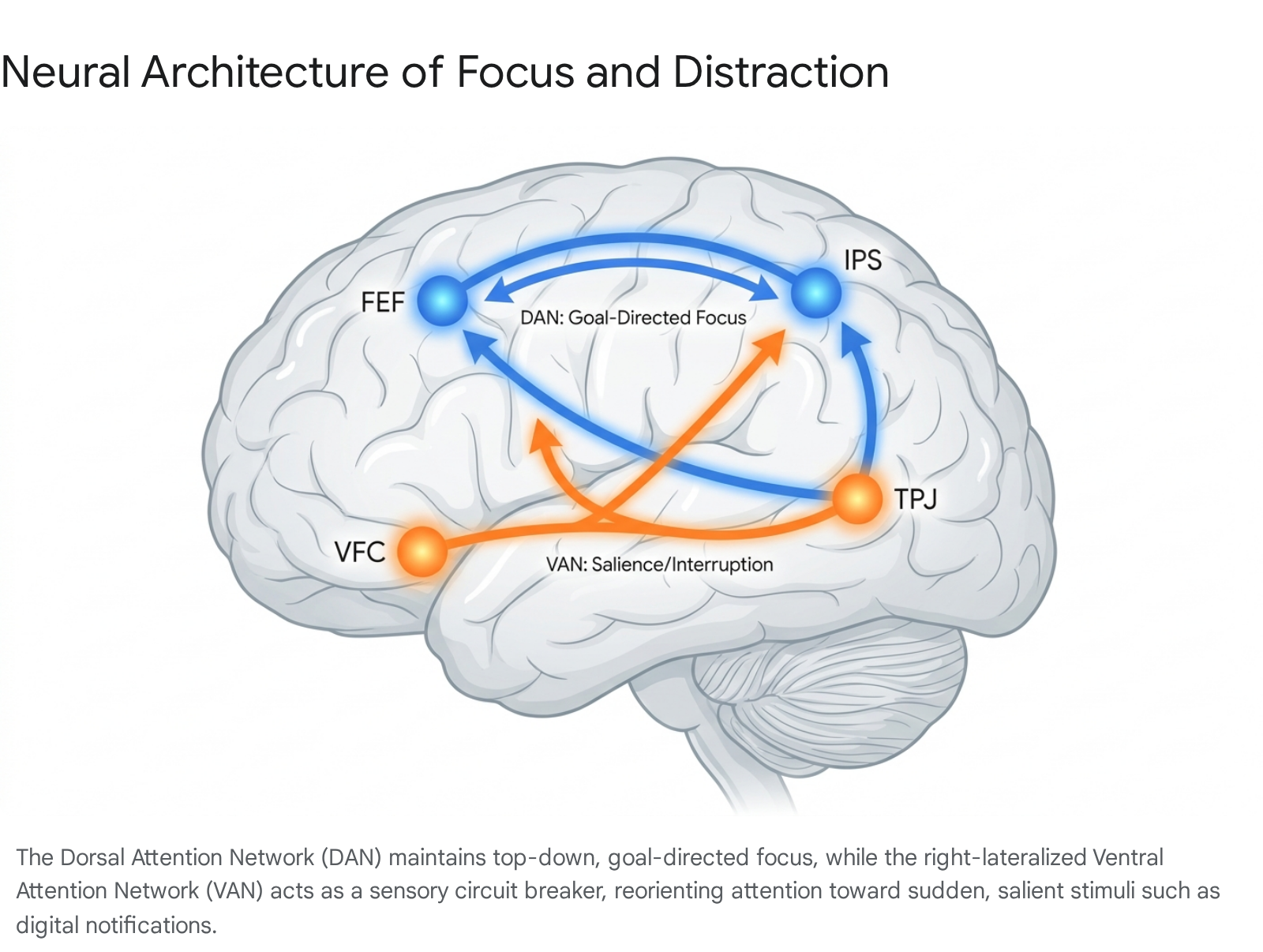
The human brain manages these various forms of attention through the interaction of distinct, large-scale neural networks. The interplay between these networks dictates how humans sustain focus on a specific goal versus how they react to sudden distractions in their environment. Two major frontoparietal systems are primarily responsible for this dynamic control: the Dorsal Attention Network and the Ventral Attention Network 149101112.
The Dorsal Attention Network
The Dorsal Attention Network (DAN), anatomically referred to as the dorsal frontoparietal network, is a bilateral system primarily composed of the intraparietal sulcus (IPS) and the frontal eye fields (FEF) 91012. The DAN is responsible for top-down, goal-directed, voluntary control of visuospatial attention 141112. When an individual consciously decides to focus on a specific task - such as reading a complex text, solving a mathematical problem, or searching for a specific object in a crowded room - the DAN is activated 141611.
This network maintains sustained attention, effectively operating as the brain's "aperture" to tune out miscellaneous noises and environmental changes 911. Effective connectivity studies, utilizing methodologies such as dynamic causal modeling and functional magnetic resonance imaging (fMRI), demonstrate that the IPS and FEF exert top-down influences on visual areas 101113. Essentially, the DAN instructs the sensory cortex on what visual or auditory information is relevant to the current internal goal, actively prioritizing those signals over background noise 91113.
The Ventral Attention Network
Operating in tandem with the DAN is the Ventral Attention Network (VAN), which acts as a bottom-up, stimulus-driven system 91011. Unlike the bilateral DAN, the VAN is heavily right-lateralized and comprises the temporoparietal junction (TPJ) and the ventral frontal cortex (VFC) 14911.
The primary biological function of the VAN is to serve as a sensory "circuit breaker" for the brain 1416914. It continuously monitors the environment for salient, unexpected, or highly relevant stimuli. When such a stimulus occurs - an evolutionary example being the snap of a twig indicating an approaching predator, or a modern digital example being the sudden vibration of a smartphone or a high-contrast pop-up notification - the VAN interrupts the ongoing cognitive activity in the DAN and forcibly redirects the individual's attention to the new stimulus 1416913.
During states of deep, top-down focus, particularly under high visual short-term memory loads, activity in the VAN is actively suppressed 11. This suppression serves as a filtering mechanism to protect goal-driven behavior from irrelevant environmental distractors. However, modern digital environments are explicitly engineered to bypass this suppression mechanism. Notifications, brightly colored badges, and sudden auditory cues are highly salient, designed specifically to trigger the VAN's circuit-breaking response 141615. Because the brain is evolutionarily wired to prioritize unexpected stimuli for basic survival, ignoring these digital triggers requires significant executive control orchestrated by the prefrontal cortex 1416. Constant deployment of this executive control to override the VAN leads to rapid cognitive depletion and mental exhaustion.
The Role of the Default Mode Network and Prefrontal Cortex
In addition to the DAN and VAN, the Default Mode Network (DMN) plays a crucial role in attention dynamics. The DMN is primarily active when the mind is at rest, unengaged with the external environment, and is heavily associated with daydreaming, introspection, and self-referential thought 14. While the DMN is not responsible for directed attention, mind-wandering triggered by the DMN can easily detract from focused attention, pulling cognitive resources away from the DAN 1416. Research indicates that the human brain possesses a continuous bias toward internally-generated thoughts, meaning that maintaining external focus on a task requires active executive control to override this natural resting state 16.
The prefrontal cortex (PFC) acts as the ultimate conductor of these networks 1416. It manages executive functions such as planning, complex decision-making, and inhibiting distractions. The PFC orchestrates the signals between the DAN, VAN, and DMN, ensuring that the brain can appropriately maintain focus, switch tasks when necessary, and prevent the constant intrusion of both external digital stimuli and internal mind-wandering 1413.
Longitudinal Shifts in Directed Screen Focus
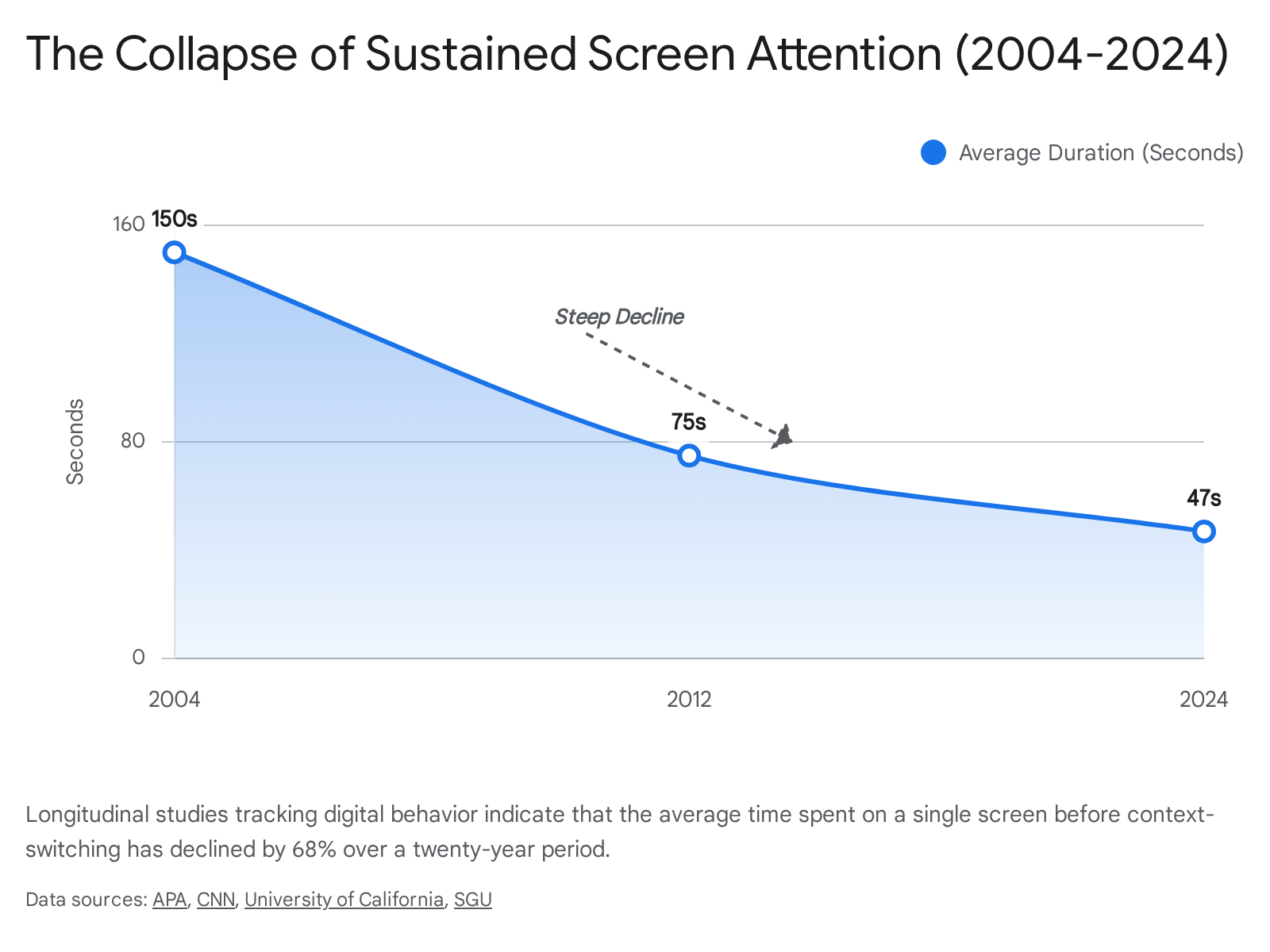
While the biological hardware of the human attention system remains functionally unchanged over recent millennia, the behavioral manifestation of attention on digital screens has shifted dramatically over the past two decades. Extensive longitudinal research, most notably conducted by Dr. Gloria Mark, Chancellor's Professor of Informatics at the University of California, Irvine, provides rigorous empirical evidence documenting the rapid decline in sustained screen focus 111617.
By utilizing precise digital logging techniques, observational shadowing, and stopwatch measurements in real-world environments, researchers have tracked the average duration an individual spends engaged with a single screen before switching to a different application, tab, or task. The resulting data illustrates a profound contraction of sustained attention.
| Year of Measurement | Average Screen Attention Duration | Measurement Methodology |
|---|---|---|
| 2004 | 150 seconds (2.5 minutes) | Stopwatches, observational shadowing in workplace environments 161819 |
| 2012 | 75 seconds (1.25 minutes) | Computer logging techniques tracking application switching 81618 |
| 2023-2024 | 47 seconds | Advanced digital tracking and replicated longitudinal surveys 1181619 |
The most recent data sets from the post-2020 era indicate an average duration of just 47 seconds before a context switch occurs 16181928. More significantly, the median attention span on a screen is 40 seconds. A median of 40 seconds dictates that precisely half of all recorded screen interactions last less than 40 seconds before the user's attention is diverted elsewhere 161728. This represents a 68 percent decrease in sustained screen attention over a twenty-year period.
This kinetic, highly fragmented state of attention carries severe secondary cognitive costs. Studies indicate that when an individual is interrupted and their attention is diverted from an active, demanding project, it requires an average of 25 minutes to fully refocus on the original task 181928. This lengthy recovery period occurs because the brain must disengage the ventral system, re-engage the Dorsal Attention Network, and completely rebuild the complex cognitive context of the primary task.
Interestingly, researchers note that external environmental triggers are not solely responsible for this fragmentation; self-interruption has become highly prevalent. As individuals become habituated to rapid context switching and the frequent dopamine releases associated with novel information, the absence of an external interruption often acts as a trigger in itself. If a user is not interrupted by a notification within a certain timeframe, they will turn inward and interrupt their own workflow to check an email or social media feed out of conditioned habit, thereby perpetuating the cycle of fragmented attention 111928.
Furthermore, research distinguishes between varying states of engagement. The brain operates in rhythms throughout the day, experiencing peaks of "focused attention" (where an individual is highly engaged and highly challenged) typically in the late morning and mid-to-late afternoon 1216. Conversely, "rote activity" (where an individual is engaged but not challenged, such as mindlessly scrolling social media or playing simple games) occurs relatively uniformly throughout the day 1216. The continual drain on attentional resources caused by multitasking and interruptions critically diminishes an individual's capacity to reach the peaks of true focused attention.
The Neurocognitive Impact of Algorithmic Short-Form Media
The transition from long-form digital content to short-form videos (SFVs) - popularized predominantly by platforms like TikTok, Instagram Reels, and YouTube Shorts - represents a fundamental architectural shift in media consumption. The design of these platforms relies on algorithmic feeds, infinite scrolling, and rapid stimulus delivery, with videos lasting typically between 6 to 60 seconds. This format uniquely stresses the human attention system by flooding it with rapid, unpredictable rewards.
Meta-Analytic Findings on Cognitive Degradation
In 2025, a landmark systematic review and meta-analysis titled Feeds, Feelings, and Focus was published in the Psychological Bulletin (Nguyen et al.) 202122. The researchers synthesized data from 71 distinct studies encompassing 98,299 participants to comprehensively measure the correlates of short-form video use on cognition, mental health, and well-being 222333.
The meta-analysis revealed consistent, statistically significant negative correlations between heavy SFV use and cognitive performance across all examined age demographics, challenging the notion that only developing adolescent brains are susceptible 2223. The analysis quantified the impact using correlation coefficients (r), demonstrating clear neurological associations.
| Cognitive/Psychological Domain | Effect Size (r) Correlation | Implications of Negative Association |
|---|---|---|
| Inhibitory Control | r = -0.41 | A moderate-to-strong impairment in the brain's ability to resist impulsive behaviors, suppress irrelevant stimuli, and delay gratification 2234. |
| Sustained Attention | r = -0.38 | A moderate-to-strong reduction in the capacity to maintain directed focus on cognitively demanding, non-stimulating tasks 2234. |
| Stress | r = -0.34 | A moderate increase in physiological and psychological tension associated with compulsive media consumption 2233. |
| Anxiety | r = -0.33 | A moderate increase in anxiety, likely linked to overstimulation and the disruption of normal emotional regulation 2233. |
| General Mental Health | r = -0.21 | A weak, but consistent overall decline in baseline psychological well-being 223334. |
The researchers concluded that the hyper-fast, endlessly scrolling nature of SFVs may lead to cognitive "habituation," wherein the brain's reward centers become desensitized to slow, complex tasks such as reading, deep learning, or problem-solving 232436. Because SFVs deliver rapid bursts of novel, highly stimulating data, they continually engage the brain's dopamine-driven reward system, specifically exploiting the mesolimbic pathway 252627. Heavy use of these platforms mimics the neurological patterns of substance use disorders; some studies suggest it can reduce the availability of the brain's D2 dopamine receptors by 20 to 30 percent, similar to the receptor down-regulation observed in cocaine addiction or pathological gambling 4041. Over time, this algorithmic conditioning recalibrates the user's baseline expectations for environmental stimulation, making unassisted, sustained attention feel unusually effortful and cognitively exhausting 232628.
The Scan-and-Shift Hypothesis
Further empirical evidence regarding the specific mechanics of SFV-induced distraction comes from a 2025 eye-tracking study conducted at San Diego State University by researcher Bridget Cole and her colleagues 29. The study evaluated the "scan-and-shift hypothesis," a theoretical framework suggesting that the rapid, fleeting pace of social media forces individuals to constantly scan varying pieces of content, thereby conditioning the brain to expect and require rapid attention shifts 2930.
In the experimental design, 242 university students were divided into two groups: an experimental group that browsed their personal TikTok feeds for five minutes, and a control group that did not use social media. Both cohorts were subsequently asked to read a series of long-form news articles from reputable outlets such as The New York Times and The Washington Post 29. Precise eye-tracking technology revealed that the students who had just consumed SFVs exhibited noticeably lower focus during the reading task. Their eyes moved far more rapidly across the text, exhibiting scattered, superficial scanning behavior rather than deep, linear reading 29. The study demonstrated that the cognitive leap required to transition from the passive, highly stimulated consumption of short videos to the active, sustained concentration required for reading proved to be a significant barrier 29. The brief exposure to the platform successfully conditioned their immediate cognitive processing style, hindering text comprehension.
Transactive Memory and Cognitive Offloading
Beyond the fragmentation of immediate visual and auditory focus, modern digital environments are fundamentally altering how the brain encodes, stores, and retrieves information - a neurological process deeply intertwined with attention. In traditional cognitive psychology, the concept of "transactive memory" refers to the way groups of people divide the labor of remembering 3132. For example, in a partnership, one individual might remember financial details and passwords, while the other remembers familial obligations and social dates, thus expanding the pair's collective memory capacity without increasing individual cognitive burden 3233. Today, the internet functions as humanity's primary, global transactive memory partner 3132.
This dynamic is commonly referred to in literature as the "Google Effect" or "Digital Amnesia" 323334. In a foundational 2011 series of four studies by researchers Sparrow, Liu, and Wegner, it was demonstrated that when individuals believe information will be saved and easily accessible in the future, their recall of the actual facts significantly diminishes 323334. Instead of utilizing attentional resources to encode the what (the factual information itself), the brain optimizes for efficiency by encoding the where (the search engine or folder where the information is located) 313233.
In one notable experiment, participants typed various trivia statements into a computer. The group informed that the data would be erased immediately after typing demonstrated strong subsequent recall of the trivia facts. Conversely, the group told that the data would be saved exhibited poor factual recall, demonstrating that the brain subconsciously withholds the effort required to commit information to long-term memory if it anticipates external access 3234.
Furthermore, habitual cognitive offloading via search engines and, increasingly, artificial intelligence, reduces the deep, sustained processing required for critical thinking 3349. When answers are instantly available without effort, individuals are less likely to engage in the sustained attentional wrestling necessary to build complex, interconnected internal knowledge structures 333449. Paradoxically, this reliance also artificially inflates "cognitive self-esteem." Users routinely misattribute the internet's vast information repository to their own internal cognitive capacity, leading them to feel that they possess greater knowledge than they actually do 3134. Neuroimaging studies have even indicated that recalling information learned online shows decreased activation in brain regions involved in memory formation compared to traditional learning, suggesting physical alterations in brain plasticity driven by search engine reliance 34.
Environmental Stressors and Physiological Mediators
Attention does not operate in a neurological vacuum; it is heavily modulated by physiological and environmental factors. The post-2020 era has witnessed a marked increase in global stress levels, which actively degrades the biological foundations of attentional capacity.
Sleep Deprivation and "Coronasomnia"
Adequate sleep is the physiological bedrock of executive functioning. Without sufficient sleep, the prefrontal cortex - the region responsible for high-level focus, complex decision-making, and suppressing the Ventral Attention Network - becomes severely impaired 714. Chronic sleep deprivation increases negative emotional responses to stressors and degrades core cognitive skills, including working memory, emotional regulation, and sustained attention 3536.
The COVID-19 pandemic triggered a global surge in severe sleep disturbances, a widespread phenomenon clinically dubbed "coronasomnia" 35. A comprehensive 2021 study encompassing 22,330 adults across 13 countries revealed that nearly 20 percent of participants met the clinical criteria for insomnia disorder - a rate more than double that of pre-pandemic measurements 35. Furthermore, a study involving over 900 participants from the Washington State Twin Registry conducted early in the pandemic showed that 32.9 percent of respondents experienced decreased sleep directly linked to heightened stress and anxiety 37. Because acute stress interferes with the sleep cycle, and poor sleep subsequently impairs the prefrontal cortex's ability to maintain attention and emotional regulation, many individuals reporting a sudden inability to focus are actually experiencing the downstream cognitive symptoms of chronic sleep deficits and elevated cortisol levels 353637.
The Bi-Directional Mental Health Loop
The relationship between attentional capacity and mental health is distinctly bi-directional. The 2025 Psychological Bulletin meta-analysis confirmed that alongside cognitive deficits, high short-form video use was significantly correlated with elevated stress and anxiety 2233. Constant exposure to hyper-stimulating, algorithmic content heavily taxes the nervous system. Conversely, the inability to achieve deep focus prevents individuals from entering "flow" states - periods of deep, rewarding concentration that psychological research shows are highly protective against anxiety and depression 1114. As focus degrades, stress increases, which in turn further degrades the prefrontal cortex's ability to maintain focus, creating a negative feedback loop.
Cross-Cultural Variances and Demographic Disparities
While the biological mechanisms of attention are a universal human trait, environmental, economic, and cultural factors significantly influence its application and the prevalence of digital distraction across different global populations.
Socioeconomic and Regional Screen Time Disparities
The distribution of screen time and its subsequent impact on attention is deeply tied to global economic development and national demographics. A comprehensive 2025 data analysis spanning 49 countries revealed that nations currently undergoing rapid economic development and possessing younger median populations experience the highest average daily screen times 53. For example, South Africa, which has a young median age of 30.4 years, reported the highest usage globally, with nearly 10 hours of screen time per user daily 53. Other rapidly developing nations such as Brazil, the Philippines, Colombia, and Argentina similarly dominated the highest rankings 53.
Conversely, highly economically developed nations display a tapering effect regarding screen time. In regions with advanced economies, higher personal incomes often correlate with reduced daily screen time. Affluent populations have greater resources to access diverse offline entertainment, structured physical activities, and luxury experiences, reducing reliance on digital devices for stimulation 53. Japan, with an older median age of 49.9 years and a highly developed economy, ranked last out of the 49 nations in average screen time usage 53. Regardless of the region, the OECD has noted that extended personal screen use (defined as over five hours daily) is globally associated with a 44 percent higher likelihood of poor mental well-being and a 62 percent higher likelihood of diminished life purpose, termed eudaimonia 38.
Cultural Cognitive Styles
Research in cross-cultural cognitive psychology also indicates that the fundamental deployment of visual attention varies between cultures, influencing how different populations process complex scenes. Seminal visual change-detection paradigms reveal that Westerners (such as North Americans) tend to utilize an "analytic" cognitive style, focusing their attention primarily on salient, focal objects within a visual environment 39. In contrast, East Asians tend to utilize a "holistic" cognitive style, distributing their attention more broadly to encompass the background context and the intricate relationships between objects and their environment 39.
In clinical experiments comparing American and East Asian participants, East Asians proved significantly faster and more accurate at detecting contextual changes in the periphery of a screen, whereas Westerners were faster at detecting changes in the center focal point 39. This fundamental difference in attentional breadth suggests that while digital distractions biologically affect all humans, the specific ways in which visual attention is captured, directed, and fragmented by user interfaces may have nuanced cultural dimensions that require localized study.
Economic Externalities and Advertising Attention Metrics
The widespread fragmentation of human attention has generated severe economic externalities, fundamentally altering the productivity landscape for modern corporations and knowledge workers. In environments where economic value is generated primarily through deep, sustained cognitive effort, the modern "interruption architecture" is proving to be highly destructive 40.
Analytics platforms tracking the digital activity of millions of users reveal an alarming reality: the average knowledge worker achieves only 1 hour and 12 minutes of completely uninterrupted focus time per day 40. Workers face an average of 275 interruptions per day, checking email or messaging platforms roughly every six minutes during core working hours 40. A robust 2023 study by Economist Impact modeled the economic cost of this lost focus across multiple developed nations. In the United States alone, the annual cost of workplace distraction was estimated at $468 billion 40. This staggering figure translates to roughly $37,000 in lost value per manager and $21,000 per individual contributor annually, highlighting a massive output gap between what organizations pay for and the cognitive labor they actually receive 40.
The Advertising Industry's Pivot to "Attention Metrics"
The undeniable decay of sustained human focus has also forced the multi-billion dollar digital advertising industry to rapidly adapt its measurement standards. Historically, digital media and advertisers relied on "viewability" as the gold standard for success (e.g., verifying that at least 50 percent of an ad's pixels were visible on a screen for a minimum duration) 41. However, because modern users have become highly adept at ignoring banner ads, navigating cluttered screens, and engaging in habitual scrolling, technical viewability no longer guarantees that any cognitive processing has actually occurred 41.
Consequently, the industry is transitioning away from traditional metrics toward "attention metrics." These new measurement frameworks utilize biometric data, eye-tracking technology, and contextual impression data to measure the actual duration and intensity with which a consumer looks at and processes an advertisement 4142. The financial rationale for this shift is robust; research indicates that high-attention impressions drive a 130 percent lift in conversion rates compared to standard, low-attention impressions 42. Furthermore, joint industry studies have demonstrated a nearly perfect mathematical correlation (0.98) between attentive minutes and incremental brand profit 41. This industry-wide shift underscores a stark reality: human attention is no longer viewed merely as a psychological state, but as a scarce, quantifiable, and highly competitive commodity that must be aggressively harvested 4160.
Conclusions and Future Outlook
The exhaustive scientific inquiry into human attention clarifies a critical reality: the human brain is not biologically devolving. The often-cited claim of an eight-second, goldfish-like attention span is a persistent, fabricated media myth devoid of empirical backing. Instead, human beings are experiencing a profound, unprecedented mismatch between their evolutionary neurobiology and modern environmental design.
The Dorsal Attention Network, structurally designed for sustained, goal-directed focus, finds itself in constant, exhausting competition with the Ventral Attention Network, which acts as a survival-based sensory circuit breaker. Algorithmic feeds, short-form videos, and ubiquitous digital notifications are explicitly engineered to hijack the Ventral system by delivering variable, high-dopamine rewards. Longitudinal data objectively confirms the behavioral consequences: the average duration of screen attention has collapsed from 150 seconds to a mere 47 seconds over a twenty-year period. Concurrently, phenomena such as the Google Effect demonstrate how the internet acts as a transactive memory partner, offloading the need for deep cognitive encoding and altering how humanity retains and interacts with information.
Compounded by global environmental stressors, widespread sleep deprivation, and the rapid context-switching inherent to modern digital workplaces, the subjective feeling of an "inability to focus" reported by millions is highly valid. It represents the chronic psychological fatigue of a brain continually forced to exercise prefrontal executive control to suppress environmental distractions. The science of attention dictates that restoring focus will not be achieved through mere individual willpower. Rather, it requires structural interventions that protect cognitive environments, limit algorithmic conditioning, and respect the fundamental biological limits of human information processing.