
How Social Media Actually Affects Mental Health
Social media is not inherently toxic or universally beneficial for mental health; its psychological impact depends largely on how it is used, who is using it, and what specific content is consumed. While active engagement can foster meaningful communities and provide vital social support, excessive passive scrolling is consistently linked to heightened risks of anxiety, depression, and poor sleep. Protecting psychological well-being requires moving away from unrealistic total screen-time bans and instead adopting a mindful "digital diet" that prioritizes healthy online interactions.
The Global Public Health Alarm
In recent years, the conversation surrounding social media and mental health has shifted from quiet academic inquiry to urgent public health warnings. In 2023, the U.S. Surgeon General issued a landmark advisory warning that social media poses a "profound risk of harm" to the mental health and well-being of children and adolescents 123. The advisory highlighted a stark reality: up to 95% of youth ages 13 to 17 use social media platforms, with more than a third reporting that they are online "almost constantly" 13. Recognizing the severity of the crisis, jurisdictions like New York City have even filed lawsuits against major technology conglomerates, formally classifying social networking sites as a public health threat 4.
This phenomenon is not isolated to North America. In 2024, the World Health Organization (WHO) Regional Office for Europe released data from a survey of 280,000 young people across 44 countries, revealing a sharp rise in problematic social media use. Between 2018 and 2022, the rate of adolescents showing addiction-like symptoms to digital platforms jumped from 7% to 11%, with girls experiencing higher rates of problematic use (13%) compared to boys (9%) 5.
The Evolving Science of Screen Time
Historically, parents, educators, and public health experts focused on a single, easily measurable metric: screen time. The underlying assumption was that the sheer volume of hours spent online operated like a toxin - the higher the dose, the worse the psychological outcome 67.
There is certainly data to support a dose-response relationship. Adolescents who spend more than three hours a day on social media face double the risk of experiencing poor mental health outcomes, including symptoms of depression and anxiety 2389. This is particularly concerning given that the average teenager in the U.S. spends roughly 3.5 to 5.3 hours a day across various platforms 238. A 2022 meta-analysis quantified this cumulative risk, finding that the odds of clinical depression increased by about 13% for every additional hour per day an adolescent spends on social media 8.
However, modern psychological science suggests that tracking raw hours is an incomplete and often misleading metric. The American Psychological Association (APA) emphasizes that using social media is not inherently beneficial or harmful; rather, adolescents' lives online both reflect and impact their offline realities 1011. A teenager spending two hours collaboratively building a community project or chatting with peers is having a vastly different psychological experience than a teenager spending two hours passively scrolling through highly edited, beauty-focused feeds.
To understand the nuance of how time spent translates to psychological outcomes, researchers now categorize varying usage profiles rather than relying strictly on the clock.
| Usage Profile | Typical Engagement Pattern | Psychological Correlates | Mental Health Risk Level |
|---|---|---|---|
| Low/Moderate (< 1-2 hours/day) | Intentional checking, messaging friends, time-bound usage. | Maintained baseline self-esteem, regular sleep cycles. | Low Risk. Often associated with a net-positive sense of social connection. |
| High (3+ hours/day) | Frequent logging in, heavy passive consumption, algorithm-driven viewing. | Increased upward social comparison, sleep displacement, mental fatigue. | Moderate Risk. Associated with double the risk of depressive symptoms in adolescents. |
| Problematic / Compulsive | Inability to control usage, withdrawal symptoms, neglected offline life. | Chronic cognitive overload, severe anxiety, isolation, and depressive episodes. | Severe Risk. Often requires clinical or behavioral intervention. |
Active vs. Passive Use: What Are You Doing Online?
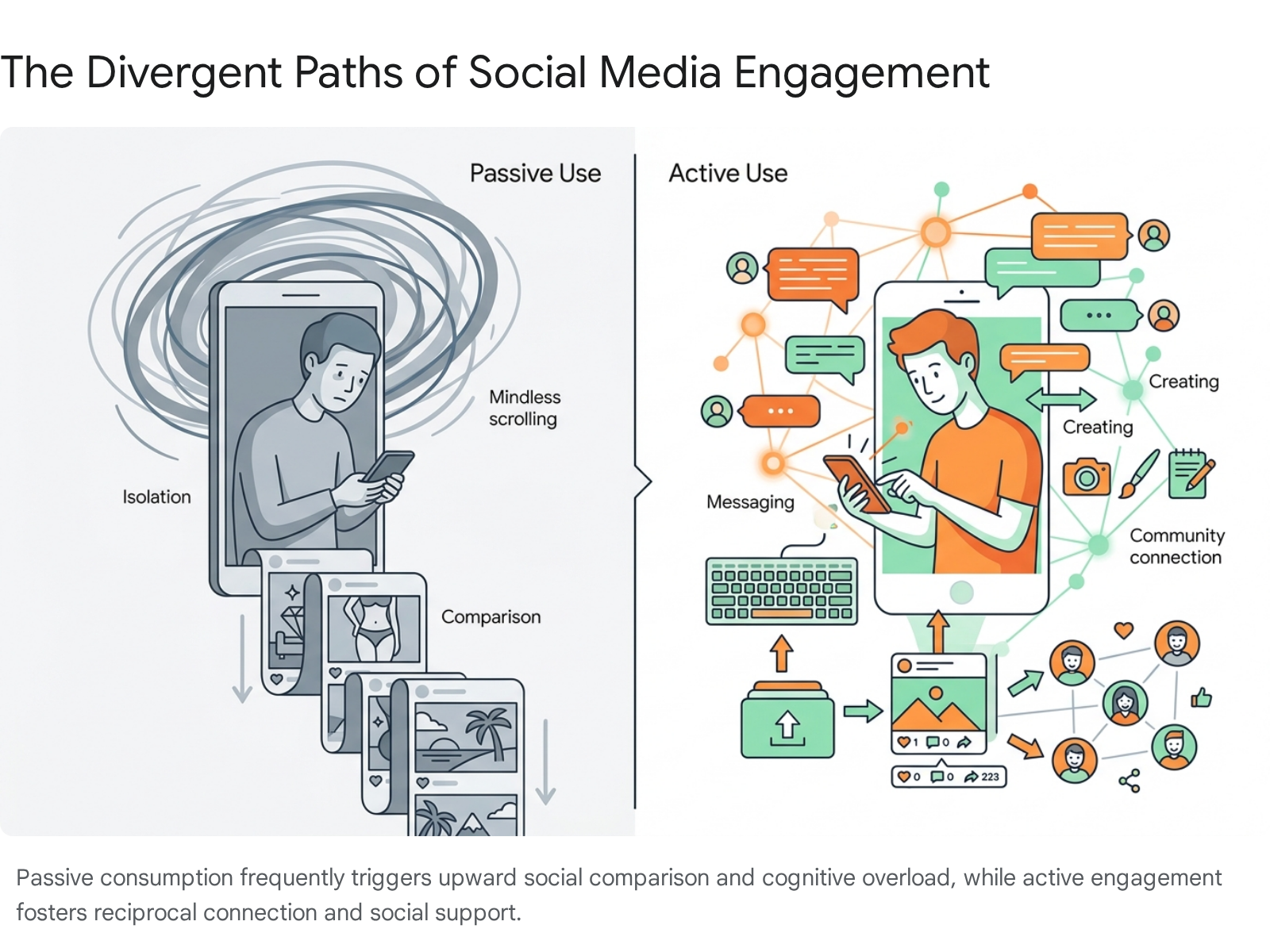
To resolve inconsistent findings regarding social media's harms, researchers developed the Active-Passive Social Media Use (ASMU-PaSMU) dichotomy 1213. This framework argues that what users do on platforms matters far more than how long they are logged in.
The Dangers of Passive Consumption
Passive social media use involves mindless scrolling, observing others' posts, and consuming content without direct interaction 1213. A comprehensive 2024 meta-analysis of 141 studies - encompassing roughly 145,000 participants - found that passive use is consistently tied to elevated depressive symptoms, anxiety, and a decline in overall subjective well-being 151614.
When users passively consume content, they are frequently subjected to a curated, idealized version of others' lives. This triggers "upward social comparison" - a psychological mechanism where individuals compare themselves to those they perceive as superior in beauty, financial success, or social acceptance 121318. Because social media profiles generally highlight only the best parts of people's lives, they create a false view of reality. For vulnerable individuals, this constant exposure breeds feelings of inadequacy, envy, and diminished self-worth 121318.
The Benefits of Active Engagement
Active social media use, conversely, involves creating content, sending direct messages, commenting, and participating in digital communities. The same 2024 meta-analysis found that active use is associated with greater online social support, positive affect, and slight overall well-being gains 151614. By facilitating reciprocal human connection, active use fulfills foundational psychological needs for belonging and friendship.
Interestingly, the effects of active versus passive use can vary significantly by age. A 2023 study from UCLA examining Facebook usage across demographics found that younger users benefited primarily from active engagement, which helped them build relationships and proactively reduce social isolation. Conversely, older demographics experienced a slight negative correlation with active use but benefited from passive use - likely because it allowed them to feel connected to family updates and global events without the stress and social pressure of actively maintaining a digital persona 15.
The Psychology and Neuroscience of the Scroll
The architecture of modern social media is not accidental; it is explicitly engineered to capture and retain human attention. Features like TikTok's "For You" page, Instagram Reels, and the ubiquitous "infinite scroll" exploit deep-seated psychological and neurological vulnerabilities to maximize user retention 181621.
Dopamine and Intermittent Reinforcement
Every swipe of the thumb holds the potential to deliver a novel, entertaining, or socially validating piece of content. This unpredictability mimics the mechanics of a slot machine 1617. The brain's reward center releases small bursts of dopamine - a neurotransmitter heavily involved in reward processing and motivation - in anticipation of what the next scroll might reveal 1818. Because the reward is unpredictable (a concept known as intermittent reinforcement), the behavior becomes highly resistant to extinction, leading to compulsive, habitual checking 1719. Over time, frequent engagement alters dopamine pathways, fostering a dependency that closely mirrors substance addiction 18.
The Zeigarnik Effect and Mindless Scrolling
Infinite scrolling eliminates natural friction. In early web design, reaching the bottom of a page required a conscious decision to click a "Next Page" button. Today, the feed simply replenishes automatically 16. This design choice triggers the Zeigarnik Effect, a psychological principle stating that humans remember and obsess over uncompleted tasks better than completed ones. Because an infinite feed never truly ends, the brain stays trapped in a continuous loop, waiting for a natural stopping point or a sense of completion that never arrives 1617.
Cognitive Overload and Default Mode Network Suppression
Endless feeds subject the brain to severe cognitive overload, impairing attention, decision-making, and shifting the user into a passive autopilot state 121619. Crucially, this constant influx of media prevents the activation of the brain's Default Mode Network (DMN) 20. The DMN is a widespread neural network that activates when the brain is resting, daydreaming, or otherwise disengaged from external tasks. It plays a vital role in processing daily experiences, reflecting on one's identity, ethical reasoning, and future planning. By filling every idle moment - waiting in line, commuting, or lying in bed - with algorithmic feeds, users deny their brains the true rest required for emotional regulation, contributing directly to rising rates of anxiety and mental fatigue 20.
The Rise of Doomscrolling
The compulsion to scroll is exacerbated when the content is negative. The term "doomscrolling" gained prominence during the COVID-19 pandemic to describe the behavior of compulsively consuming distressing news and catastrophic updates 1219. Algorithms naturally prioritize content with high emotional engagement, which is often sensational or polarizing. Continuous exposure to this alarming information creates a cognitive overload of negative possibilities, increasing ruminative thinking, disrupting sleep, and exacerbating generalized psychological distress 1219.
Proving Causation: Does Social Media Cause Poor Mental Health?
For years, technology companies and academic skeptics argued that the link between social media and mental illness was merely correlational. They posited a reverse-causality theory: social media doesn't make people depressed; rather, people who are already depressed simply spend more time isolating on social media 21. However, recent experimental and quasi-experimental research has provided compelling evidence that social media use does, in fact, exert a direct causal influence on mental health.
The Facebook Rollout Natural Experiment
One of the most robust demonstrations of causation comes from a 2022 study published in the American Economic Review by researchers at MIT, Bocconi University, and Tel Aviv University. The researchers utilized a unique natural experiment: the original, staggered rollout of Facebook across U.S. college campuses between 2004 and 2006. By pairing this specific rollout timeline with 430,000 responses from a semi-annual national college health survey, they were able to isolate Facebook's exact psychological impact independent of other societal trends.
The findings were stark: college-wide access to Facebook led to a 7% increase in severe depression and a 20% increase in anxiety disorders among the student body 212223. Beyond initial symptoms, a greater percentage of susceptible students began treating these symptoms with psychotherapy or antidepressants following the platform's introduction. The researchers estimated that the negative effect of Facebook on an individual's mental health was roughly 20% of the magnitude experienced by those who suffer sudden job loss 21.
Clinical Interventions and Deactivation Studies
Experimental interventions echo these historical findings. A landmark study at the University of Pennsylvania took 143 undergraduates and randomly assigned them to one of two groups: a control group that maintained normal social media habits, and a restricted group limited to 10 minutes per day each on Facebook, Snapchat, and Instagram. After three weeks, the limited-use group showed significant, objective decreases in both depression and loneliness. The researchers noted the irony that reducing digital social connection actually made participants feel less lonely, as it forced them to re-engage with their offline lives 24.
Similarly, a major study surrounding the 2020 U.S. elections found that paying users to completely deactivate Facebook and Instagram for six weeks resulted in significant improvements in an aggregate index of self-reported happiness, depression, and anxiety 2225.
The Longitudinal "Vicious Loop"
Longitudinal studies - which track the exact same individuals over months or years - further reveal that correlation and causation are not mutually exclusive; they form a "vicious cycle." Research tracking first-year university students in China demonstrated a clear bi-directional relationship: initial problematic social media use predicted subsequent increases in depression, anxiety, and loneliness. In turn, these worsening mental health conditions drove the students to seek further relief through more compulsive digital behaviors, creating a self-reinforcing downward spiral 2627. Similar longitudinal trajectories have been mapped in post-secondary students navigating the aftermath of the COVID-19 pandemic across various global regions 2829.
Core Mechanisms of Harm
When social media damages mental health, it generally operates through a few established biological, behavioral, and social mechanisms.
Sleep Displacement and Disruption
One of the most quantifiable harms of social media is its impact on sleep architecture. Using technology - and specifically social media - within one hour of bedtime significantly delays sleep onset and degrades overall sleep quality 1230. The blue light emitted by smartphone screens suppresses the brain's natural production of melatonin, while the emotional arousal of engaging with content keeps the nervous system in a state of high alert 12. Insufficient sleep is uniquely devastating to the developing adolescent brain, directly impairing executive function, altering emotional regulation, and dramatically increasing the risk of severe depressive episodes and suicidal ideation 1130. The WHO has explicitly linked problematic social media use to later bedtimes and chronic sleep deprivation 5.
The Amplification of Cyberbullying
The digital veil of anonymity and the speed of online communication amplify peer aggression to unprecedented levels. Globally, cybervictimization is a pervasive threat. UNICEF reports that approximately one in three young people worldwide have experienced online harassment, leading to severe emotional distress and instances of self-harm 9.
A comprehensive meta-analysis examining data from 42 countries found that problematic social media use drastically compounds this risk. Problematic users face a 48% higher risk of being victims of cyberbullying, and an 84% higher risk of perpetrating cyberbullying against others 31. A 2023 survey of adolescents in The Bahamas further illustrated this, showing that alongside high rates of cyberbullying, exposure to sexting and online harassment directly correlated with higher rates of suicidal ideation, particularly among young girls 32.
Toxic Echo Chambers and Maladaptive Content
Because machine learning algorithms are designed to maximize engagement, they often prioritize sensational, extreme, or emotionally triggering content 1819. For vulnerable users, this can quickly create dangerous psychological echo chambers. Adolescents experiencing low self-worth or body dissatisfaction may be algorithmically funneled toward content promoting eating disorders, restrictive dieting, or extreme body-image ideals 303334.
The American Psychological Association (APA) has explicitly warned that exposure to psychologically maladaptive behavior online - such as communities that romanticize self-harm or suicide - can normalize these actions and encourage health-risk behaviors in the real world 3233. Furthermore, repeated exposure to highly filtered, idealized images leads to body dissatisfaction and orthorexia symptoms, especially among young women 3035.
The Nuance of Positive Impact: When Social Media Helps
Despite the heavily documented risks, it is scientifically inaccurate to label social media as entirely detrimental. The narrative that "all screen time is toxic" oversimplifies a complex digital ecosystem. A 2022 survey found that 32% of adolescents believe social media has a mostly positive impact on their lives, compared to only 9% who report a mostly negative impact (with the majority feeling neutral) 36.
A Lifeline for Marginalized Communities
For geographically or socially isolated individuals, the internet is a vital lifeline. Marginalized groups, such as racial minorities and LGBTQ+ youth, frequently rely on online communities to find peer support, identity validation, and safe spaces that may be entirely absent in their physical environments 236. Across all user demographics, 80% of teenagers report that social media helps them feel more connected to their friends, 71% say it fosters creativity, and 67% say it makes them feel supported during tough times 36. For instance, 70% of adolescent girls of color report finding race-affirming and positive content through their social networks 236.
Digital Mental Health Interventions
Furthermore, the digital ecosystem offers unprecedented avenues for clinical support. Recent meta-analyses conducted between 2023 and 2025 evaluating randomized controlled trials demonstrate that mental health interventions delivered directly through social media platforms (such as structured support groups, digital cognitive-behavioral tools, or targeted psychoeducation) are significantly effective. These digital interventions have shown moderate but robust success in reducing generalized anxiety, depression, and stress across diverse populations, providing scalable care to those who might otherwise lack access to traditional therapy 143537.
A Global Phenomenon
The psychological impact of social media is not confined to the United States or Western Europe. As global internet penetration deepens, parallel mental health trends are emerging worldwide, shaped by local cultural contexts and infrastructure limitations.
| Region | Key Findings on Social Media and Mental Health | Unique Contextual Factors |
|---|---|---|
| North America & Europe | High rates of problematic use (11% of teens). Direct causal links established between platform rollouts and spikes in clinical depression and anxiety. | High focus on body image comparison, FOMO, and algorithmic echo chambers. Increasing regulatory pushback (e.g., city lawsuits) 4521. |
| Latin America | Acts as a mediating factor for resilience but also exacerbates anxiety. Significant gender disparities in usage and mental health impacts. | Social media deeply entrenched in daily communication; high focus on social connectivity vs. cybervictimization risks 38. |
| Sub-Saharan Africa | Rapid technology adoption among youth. High risk of cyberbullying compounding existing socioeconomic stressors. | Severe lack of physical mental health infrastructure (<2 psychiatrists per 100k) makes anonymous online support groups a critical lifeline 939. |
| East Asia (China, Japan, Korea) | Clear longitudinal evidence of bi-directional "vicious loops" where internet addiction fuels depression. Increased anxiety post-COVID-19 lockdowns. | High prevalence of problematic smartphone use among university students; cultural pressure and academic stress heavily mediate outcomes 264540. |
In regions with profound cultural taboos surrounding mental illness, such as parts of South Asia and Sub-Saharan Africa, anonymous online spaces allow teenagers to seek advice without fear of judgment 9. However, this benefit is counterbalanced by the severe lack of local regulatory oversight regarding cyberbullying, meaning digital harassment can spiral out of control without offline clinical support nets to catch the victims 939. The universal human vulnerabilities to variable dopamine rewards and social comparison suggest that platform mechanics operate similarly across borders, even if the specific cultural manifestations of distress vary.
Moving Toward a "Digital Diet" and Digital Hygiene
Because technology is an inescapable reality of modern educational and professional life, the American Psychological Association, the WHO, and leading researchers suggest that absolute abstinence is neither realistic nor necessarily beneficial. Instead, psychologists advocate for a "digital diet" or "digital hygiene" approach 41484243.
The concept of a "digital detox" - where a user swears off all screens for a weekend or a week - is increasingly viewed by psychologists as ineffective. Much like extreme crash dieting, detoxes rarely result in sustainable behavioral change and frequently lead to "bingeing" once the detox period ends 414445.
Conversely, the "digital diet" framework evaluates the quality and context of screen time rather than just the quantity. As child psychologists note, you cannot compare a cheeseburger to a green smoothie simply by weighing them; similarly, ten hours spent learning coding or facetiming a relative is fundamentally different from ten hours of doomscrolling traumatic news 748.
Cultivating sustainable digital hygiene involves several core strategies:
- Curate the Content: Users should actively audit their feeds, unfollowing accounts that trigger negative social comparisons, body image issues, or feelings of inadequacy. The goal is to train the algorithm to serve content that aligns with offline hobbies, educational goals, and positive interests 1046.
- Shift from Passive to Active Use: Transform mindless scrolling into intentional interaction. Use platforms purposefully to message friends, share creative work, or participate in meaningful community discussions 124346.
- Establish Tech-Free Boundaries (Context): The APA strongly recommends protecting the biological necessities of sleep and physical activity. Implementing a "digital curfew" by turning off notifications one hour before bed, and keeping charging devices out of the bedroom, dramatically improves sleep hygiene and reduces nighttime anxiety 11203042.
- Embrace the Default Mode Network: Intentionally schedule blocks of tech-free time during the day - such as taking a walk without headphones or sitting quietly on a commute. This allows the brain to rest, process complex information, and daydream without constant algorithmic interruption 2042.
- Gradual Autonomy for Youth: For young adolescents (specifically ages 10-14), parents are advised to heavily monitor usage, discuss digital literacy, and guide content selection. As cognitive maturity and self-regulation skills develop, parents can gradually expand the child's digital autonomy while respecting their privacy 1011.
Healthy digital hygiene is not about fearing screens or enforcing draconian bans. It is about teaching users - both children and adults - how to treat technology intentionally so that it remains a tool they control, rather than an environment that controls them 43.
Bottom line
Social media platforms are powerful psychological environments that amplify both human connection and human vulnerability. While active use can foster community, provide vital support for marginalized groups, and even deliver clinical interventions, the algorithmic push toward infinite scrolling and passive consumption poses profound, proven risks to mental health - highly correlating with clinical depression, severe anxiety, and sleep deprivation. Ultimately, mitigating these harms requires shifting our focus from arbitrary screen-time limits toward cultivating a mindful "digital diet" that prioritizes intentional engagement while fiercely protecting our sleep and offline relationships.