
Cognitive and psychological externalities of the attention economy
The modern digital landscape operates on a business model fundamentally predicated on the extraction, retention, and monetization of human attention. This paradigm, widely known as the attention economy, transforms user engagement into a quantifiable commodity sold to advertisers. As digital platforms optimize their algorithmic architectures to maximize user retention, a complex array of cognitive, neurobiological, and psychological externalities has emerged. This report examines the structural mechanisms through which human consciousness is commodified, analyzing the measurable impacts of these systems on cognitive load, reward processing, and population-level psychological well-being.
Financial Mechanics of Attention Capture
The commodification of attention is driven by specific financial metrics that dictate the design and algorithmic priorities of technology platforms. The primary metric of success in this ecosystem is Average Revenue Per User (ARPU), which reflects a company's efficiency in monetizing user traffic 1. ARPU functions as a composite of product price (advertising rates) and sales volume (the number of active users combined with the duration of their engagement) 12.
Revenue Growth and Unit Economics
The financial scale of the attention economy is vast and increasingly concentrated. Meta, maintaining its status as a dominant digital entity, reported $32 billion in revenue in the second quarter of 2023, representing an 11% to 12% year-over-year growth largely driven by advertising efficiency 34. Between 2011 and 2025, Meta's global ARPU surged by 1,040.6%, climbing from a baseline of $5.00 to $57.03 globally, illustrating highly aggressive monetization despite market saturation 5.
ByteDance, the parent company of TikTok, generated $29 billion in revenue during the same quarter in 2023, demonstrating a 40% year-over-year growth that highlights the intensely competitive nature of attention capture 3. TikTok's ad revenues specifically reached an estimated $13.2 billion in 2023 3. This revenue generation is closely monitored by venture capital and market analysts through strict unit economics, particularly the Lifetime Value to Customer Acquisition Cost ratio (LTV:CAC), which typically targets a 3:1 or higher benchmark to indicate sustainable scaling 6.
Stickiness and App Store Optimization
Because user growth eventually approaches the demographic limits of the global population, platforms must continually extract more engagement time from existing users to sustain revenue growth. This aligns corporate financial success strictly with maximizing the time users spend in-app 26. To measure this, platforms track the ratio of Daily Active Users to Monthly Active Users (DAU/MAU), referred to as the application's "stickiness" 6. While e-commerce platforms average a stickiness ratio of 10%, social applications frequently target and exceed 50%, requiring the average user to log in at least every other day 6.
This demand for continuous engagement has fundamentally altered app distribution mechanics. App Store Optimization (ASO) algorithms on both Google Play and the Apple App Store have shifted their ranking weights away from raw download counts toward post-install engagement metrics 7. Applications demonstrating strong "Day 7 retention" (users returning a week after installation) and extended session lengths are algorithmically favored in search results, effectively punishing applications designed for brief, utilitarian interactions 78.
Global User Engagement Metrics
The success of these platforms in capturing human time is evident in global usage statistics. Research indicates that the average internet user spends approximately 2 hours and 23 minutes per day on social media, accounting for over one-third of total daily online activity 121112. Over a full year, this equates to more than 260 trillion minutes of collective human attention allocated to social platforms 1.
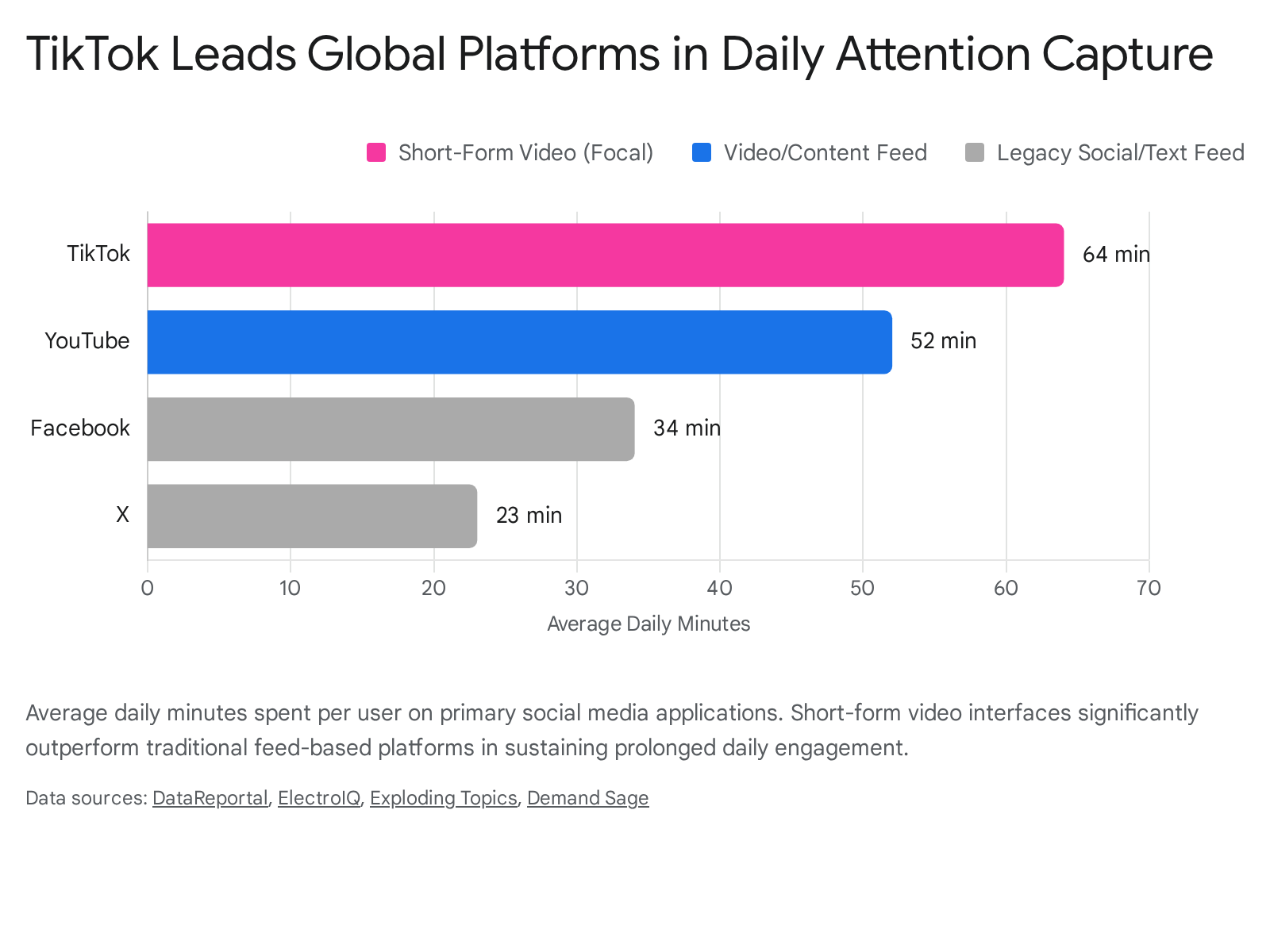
| Platform | Average Daily Time Spent per User (US/Global Estimates 2023-2025) | Average Monthly Time Spent |
|---|---|---|
| TikTok | ~58 to 69 minutes | 31.5 to 43.8 hours |
| YouTube | ~46 to 59 minutes | 28 to 29.3 hours |
| Facebook (Meta) | ~30 to 37 minutes | 16.4 to 19.7 hours |
| X (formerly Twitter) | ~11 to 35 minutes | 5.3 hours |
Note: Estimates vary by region and measurement methodology, but the hierarchy of engagement heavily favors short-form video formats 12111213.
User Interface Design and Algorithmic Feedback
The capacity of digital platforms to sustain unprecedented levels of engagement relies on specific user interface (UX) choices and underlying algorithmic architectures designed to minimize operational friction and exploit psychological vulnerabilities.
Frictionless Environments and Infinite Scrolling
Modern platforms utilize "frictionless" designs that remove natural stopping cues, making it cognitively easier for a user to continue consuming content than to disengage 315. The infinite scrolling mechanism ensures that the feed has no defined endpoint, preventing the brain from encountering a natural pause that might prompt self-reflection or task-switching 316. Actions such as liking, commenting, and sharing are mechanically integrated into simplified button gestures, transforming complex social interactions into habitual, low-effort behaviors 3.
Furthermore, the rise of the short-form video economy - exemplified by TikTok, YouTube Shorts, and Instagram Reels - leverages high completion rates. Videos under 90 seconds in duration retain viewers far more effectively than long-form content 15. The autoplay functionality eliminates decision-making barriers entirely, maximizing engagement time by removing the friction of selecting the next piece of media 15.
Personalization and Filter Bubbles
Behind the frictionless interface operates a highly tuned recommendation algorithm that acts as a "pleasure machine" 3. These systems analyze historical data, dwell time, and demographic patterns to continuously predict and serve content that guarantees user retention 315. This creates an "internal loop" of continuous, unconscious browsing, distinguished from the "external loop" of initially opening the application 3.
The algorithm's strict prioritization of engagement over informational utility inevitably leads to the cultivation of "filter bubbles" or "information cocoons" 3. Because outrage and extreme content have been shown to retain attention up to 43% longer than neutral material, algorithms systematically favor emotionally salient stimuli, narrowing the user's exposure to diverse perspectives 174.
Neurobiological Mechanisms of Addiction
The efficacy of algorithmic feeds in capturing attention is fundamentally rooted in the exploitation of human neurobiology, specifically the reward and motivation systems managed by dopaminergic pathways.
Variable Reward Schedules
The most profound mechanism driving digital engagement is the variable reward schedule 161719. Derived from behavioral reinforcement theory and identical to the mechanics utilized in casino slot machines, this psychological principle dictates that rewards delivered unpredictably produce a stronger and more persistent behavioral response than consistent rewards 1617.
When a user refreshes a feed or swipes to a new short-form video, they encounter an intermittent and unpredictable sequence of highly salient stimuli interspersed with uninteresting content 1516. Neuroimaging studies, including fMRI scans of TikTok users, demonstrate that this unpredictability effectively hijacks the brain's reward pathway 1517. The brain does not receive its primary dopaminergic spike from consuming the content itself, but rather from the anticipation and uncertainty of whether the subsequent swipe will yield a reward 164.
Re-evaluating the Dopamine Detox Narrative
In recent years, the concept of "dopamine addiction" and the subsequent "dopamine detox" have gained immense cultural traction. Popular narratives suggest that digital platforms trigger continuous "dopamine overdoses," necessitating periods of strict abstinence to "reset" neurochemical levels 20522.
However, neurobiological consensus indicates that this framing is a fundamental misunderstanding of brain chemistry 202223. Dopamine is a naturally occurring neurotransmitter responsible for motivation, learning, and the reinforcement of behaviors; it is not a chemical of pure euphoria, nor is it intrinsically addictive in isolation 52223. Addiction is fundamentally mediated by dopamine, rendering the phrase "dopamine addiction" medically redundant 20.
Instead of an acute overdose, the continuous, rapid-fire stimulation provided by digital platforms leads the brain to downregulate its own dopamine production and receptor sensitivity to maintain homeostasis 56. This chronic deficit - not an excess - results in symptoms such as low motivation, anhedonia, and anxiety 56. Consequently, individuals engage in compulsive scrolling not to achieve a euphoric high, but merely to restore a sense of normalcy and alleviate the dysphoria of a downregulated reward system 5.
Incentive Salience and Neural Adaptation
The neurobiological consensus aligns more accurately with the framework of "incentive salience," wherein cues associated with digital rewards (e.g., a notification chime, a red application badge) acquire a disproportionate, pathological motivational pull 6726.
Chronic overuse alters neural circuitry involved in mood and impulse control. Specifically, it diminishes prefrontal cortex activity and connectivity, resulting in poorer decision-making and a diminished capacity to resist compulsive checking behaviors 6. Conversely, structural and functional changes in limbic regions, such as the amygdala and nucleus accumbens, heighten cue reactivity and craving 176. For instance, dopamine activity within the ventromedial shell of the nucleus accumbens shifts dynamically from the reward itself to the predictive cues as behaviors become deeply habituated 23.
Cognitive Load and Attentional Interference
Beyond the reward system, the attention economy imposes severe externalities on human cognitive architecture. The constant influx of algorithmically sorted information and the demand for continuous partial attention fundamentally alter how individuals process data, learn, and perform complex tasks.
Cognitive Load Theory in Digital Environments
Cognitive Load Theory (CLT) posits that human working memory is strictly limited in capacity 8929. The theory categorizes cognitive load into three types: intrinsic (the inherent difficulty of a task), extraneous (the burden caused by poorly designed presentation or distractions), and germane (the mental resources dedicated to actual learning and schema formation) 89.
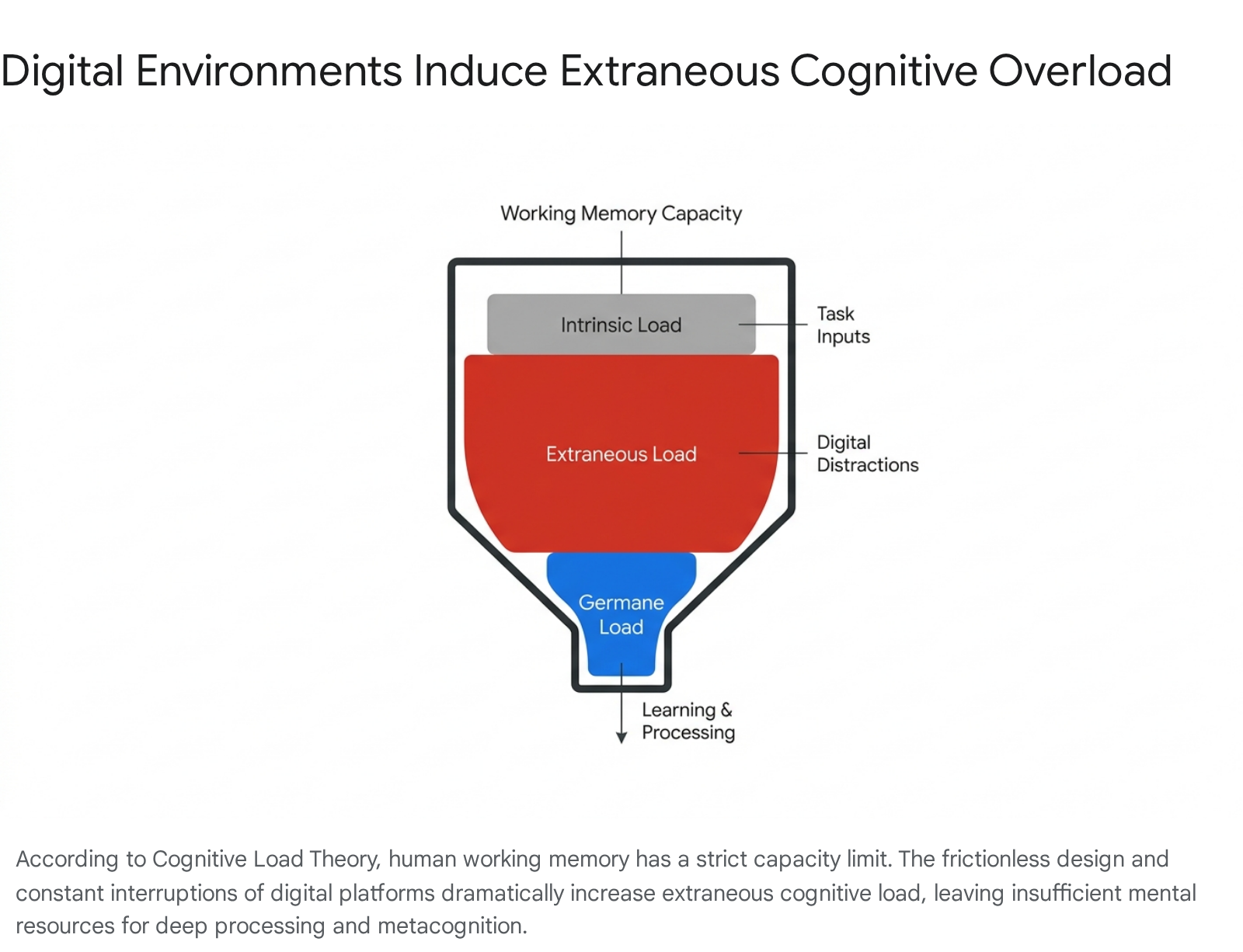
In digital environments, the integration of multiple media types, hyperlinked structures, and algorithmic interruptions massively inflates extraneous cognitive load 2930. When task demands exceed working memory capacity, the individual experiences cognitive overload, leading to impaired performance, reduced reading comprehension, and mental fatigue 92910.
Research indicates that heavy digital multitaskers - those habituated to rapidly switching between applications - take significantly longer to perform focused cognitive tasks 3211. Their working memory becomes inefficient at filtering out irrelevant stimuli, leading to diminished executive control and compromised selective attention 32. The architecture of social platforms intentionally cultivates this extraneous load; users must simultaneously navigate interfaces, process rapidly altering video formats, and manage the social implications of algorithmic feedback, leaving virtually no cognitive resources for deep processing 3435.
Gaze Dynamics and Physiological Markers
Empirical evidence of this cognitive strain is directly observable in ocular behavior. Eye-tracking technology reveals that high cognitive load definitively alters visual search patterns and gaze dynamics 812. Studies examining real-world task performance demonstrate that when individuals are subjected to concurrent cognitive load (simulating digital multitasking), their eye-hand span is reduced, and they exhibit more frequent, erratic fixations on irrelevant objects 12.
Furthermore, microsaccade rates - small, involuntary eye movements occurring during fixations - fluctuate predictably based on mental workload. Increased task complexity and visual clutter on digital interfaces alter microsaccade amplitude and frequency, serving as a reliable physiological marker of the attentional interference generated by hyper-stimulating platforms 8.
Metacognitive Deficits and the Verification Paradox
The behavioral consequence of cognitive overload is a measurable reduction in deep work and sustained attention 35. Metacognition - the capacity to monitor and regulate one's own cognitive processes - requires a state of reflective attention that the reactive nature of high-density digital environments systematically precludes 1135. The constant interruption from push notifications forces the brain's default mode network to atrophy under the strain of continuous task-switching, with studies suggesting it takes over 20 minutes to regain deep focus after a digital interruption 17.
This dynamic extends to the reliance on generative AI systems. Recent longitudinal research highlights a "verification paradox" among digital workers and students: as individuals increasingly rely on AI to solve complex tasks to reduce cognitive load, their verification confidence declines 38. The seamless provision of answers by algorithms engenders a "false self-efficacy" - users believe their competence has improved, while their actual cognitive mastery, critical thinking, and academic achievement degrade, resulting in a pronounced Dunning-Kruger effect 3813.
Psychological and Clinical Outcomes
The neurological adaptations and cognitive limitations driven by the attention economy manifest in broad, population-level psychological externalities. The correlation between heavy digital media consumption and adverse mental health outcomes has prompted aggressive responses from global health authorities.
Epidemiological Trends in Anxiety and Depression
Clinical data indicates steadily rising rates of anxiety and depression, particularly among younger demographics whose critical periods of neurodevelopment coincide with the ubiquity of smartphones. Data from the 2022 National Health Interview Survey indicated that approximately one in five U.S. adults experienced symptoms of anxiety or depression in the measured two-week period, with the highest prevalence among adults aged 18 to 29 14.
Globally, the incidence of anxiety disorders among individuals aged 10 to 24 increased by 52% between 1990 and 2021 15. The Global Burden of Disease study identifies that during this period, Disability-Adjusted Life Years (DALYs) for anxiety disorders rose significantly, disproportionately affecting females in the 20 - 24 age bracket 1516.
| Health Metric (Global Age 10-24) | Baseline (1990) | Recent Measurement (2021) | Percentage Change |
|---|---|---|---|
| Anxiety Disorder Incidence Rate (per 100,000) | 708.02 | 883.10 | + 52.00% |
| Prevalence Increase: 15-19 Years | - | - | + 19.32% |
| Prevalence Increase: 20-24 Years | - | - | + 23.16% |
Data source: Global Burden of Disease study, tracking trends in anxiety disorder incidence and prevalence 15.
Health Advisories and Warning Labels
The severity of these outcomes led U.S. Surgeon General Dr. Vivek Murthy to issue a major public advisory in 2023, followed by a 2024 call for congressional action to place tobacco-style warning labels on social media platforms 431718. The advisory cited specific research demonstrating that adolescents spending more than three hours a day on social media face double the risk of experiencing depression and anxiety symptoms 4319.
The Surgeon General's intervention underscored the unique vulnerabilities of the developing adolescent brain, which is neurologically primed to seek social feedback 17. Algorithmic features such as follower counts, public metrics, and the promotion of toxic beauty standards severely impact self-esteem 1717. Meta's own internal documents, leaked in recent years, explicitly acknowledged that Instagram worsened body image issues for roughly 32% of teen girls 1747. Furthermore, chronic screen stress - where the brain interprets digital social threats as physical threats - triggers continuous stress hormone release, compromising sleep quality and exacerbating mood disorders 1948.
Methodological Debates in Causality
Despite consensus among public health officials regarding the risks of excessive use, the academic community remains sharply divided on the exact causal relationship between the attention economy and the global mental health crisis.
Social psychologist Jonathan Haidt argues in The Anxious Generation that the transition to a "phone-based childhood" in the early 2010s is the primary causal driver of adolescent mental illness 2021. Haidt points to rapid declines in mental health that correspond precisely with the widespread adoption of smartphones, front-facing cameras, and algorithmically curated feeds, asserting that social deprivation and digital addiction act as direct causal agents 472021.
However, this hypothesis has faced rigorous methodological critique from peer-reviewed researchers 202151. Critics argue that many analyses mistake correlation for causation 2152. Independent meta-analyses frequently suggest that while a relationship exists, the effect sizes linking social media use to clinical depression are relatively small when confounding variables are controlled 4751.
The critiques center on the "blending" problem: many studies dilute results by combining heterogeneous technologies (grouping television with algorithmic social media) or blending clinical outcomes with general well-being metrics, which masks the specific harms of algorithmic feeds 47. Furthermore, critics point to the directionality of causation, arguing that deteriorating mental health may drive increased screen time as a coping mechanism (reverse causality), rather than the screen time exclusively initiating the decline 4721. Defending the causal model, proponents argue that high-quality longitudinal studies do show a forward relationship from heavy usage to subsequent depressive symptoms, suggesting the "precautionary principle" should guide policy rather than waiting for absolute epidemiological certainty 47.
Media System Dependency and Algorithmic Reliance
To understand how populations become locked into these ecosystems despite the documented negative externalities, sociology and communication researchers utilize the Media System Dependency (MSD) framework 322. Originally developed in the 1970s, MSD posits that an individual's reliance on a medium is dictated by its capacity to fulfill specific goals related to understanding, orientation, and play 2223.
Pervasive Ambiguity and Heightened Emotions
In the contemporary context, MSD has been updated to model "algorithmic dependence" 3. In a digital era characterized by high uncertainty and rapid social change - termed "pervasive ambiguity" - users increasingly turn to algorithmically curated feeds to orient themselves socially and politically 2324. The algorithms, optimized purely for engagement, exploit this dependency by serving emotionally salient, polarizing, and outrage-inducing content 423.
This creates a highly damaging cognitive feedback loop. Ambiguity drives the user to the platform; the platform serves emotionally heightened content that captures attention; the heightened emotional state reduces cognitive processing depth, making the user increasingly susceptible to heuristic thinking and misinformation; and the resulting anxiety reinforces the need to continue seeking orientation through the app 2324. Empirical studies measuring this dynamic demonstrate that algorithm dependence facilitates severe filter bubbles, which paradoxically limit exposure to diverse perspectives and reduce actual news knowledge, despite high media consumption rates 3.
Global Contexts and Occupational Externalities
The cognitive and psychological externalities of the attention economy extend beyond consumer social media, profoundly impacting occupational environments and global health systems, particularly in low- and middle-income countries (LMICs).
Digital Fatigue in Healthcare
The integration of digital health interventions across Latin America, Africa, and Southeast Asia illustrates the dual-edged nature of digital transformation 5625. While telemedicine and digital tracking tools aim to optimize workflows and facilitate active remote monitoring for long-term conditions (such as rheumatoid arthritis or schizophrenia), they frequently induce severe digital fatigue 5626.
Systematic reviews of healthcare interventions in these regions indicate that persistent technical limitations, complex interfaces, and the sheer volume of data input dramatically inflate the cognitive load placed on medical providers 56. Without user-centered design and adequate training, the intended efficiency gains are offset by technological burnout, compromising the quality of healthcare delivery in already resource-constrained settings 56. Cost-effectiveness analyses of remote monitoring apps confirm that while they can facilitate early intervention, they require careful calibration to avoid overwhelming both patients and providers with constant symptom-reporting demands 2627.
Workforce Disruption and LLM Integration
Similarly, the rapid integration of Large Language Models (LLMs) and generative AI into the global workforce represents a structural shift in occupational cognitive load. Current data suggests that AI primarily reshapes job functions through augmentation rather than outright displacement, drastically altering entry-level cognitive roles 2829. While AI adoption has been shown to boost immediate productivity and close skills gaps for certain tasks, researchers warn that the over-reliance on agentic tools risks eroding "durable skills" such as critical thinking, emotional intelligence, and complex problem-solving 2829. The challenge for future workforce architecture is maintaining human cognitive resilience in an AI-saturated environment.
Structural Interventions and Recommender Ecosystems
Addressing the externalities of the attention economy requires structural changes to the digital environment. Researchers in Human-Computer Interaction (HCI) and Computer-Supported Cooperative Work (CSCW) are actively exploring alternative architectural models that prioritize user well-being and cognitive autonomy over raw engagement metrics.
Designing User Friction
If frictionless design facilitates compulsive, unconscious use, the deliberate introduction of "user friction" serves as a primary regulatory mechanism 3. User friction involves designing natural pause cues into interfaces, enforcing transparent feedback alerts regarding time spent, and providing proactive user controls over algorithmic curation 3. By forcing the user to make an active, conscious choice to continue engaging, friction disrupts the automaticity of the internal loop and helps restore metacognitive awareness 3.
However, implementing these interventions is challenging due to observer effects. Studies utilizing smartphone logging and Experience Sampling Methods (ESM) to track digital behavior note significant reactivity: users temporarily reduce their screen time when they know their usage is being monitored, complicating the assessment of long-term digital detox interventions 30.
Decoupled Recommender Ecosystems and Pluralism
At a systemic level, researchers propose dismantling the monolithic nature of platform algorithms. Current social platforms operate as enclosed "walled gardens" where a single corporate entity dictates the singular recommendation logic for billions of users 316465. An emerging structural alternative is "algorithmic pluralism" or the use of "middleware" 3165.
Advanced simulation frameworks, such as SMORES (Simulation Model for Recommender EcoSystems), allow researchers to model digital environments where users possess "algorithmic choice" 316566. In a decoupled system, the content hosting infrastructure is separated from the recommendation engine 65. Consumers can select from a marketplace of third-party algorithms tailored to different goals - for instance, choosing an algorithm optimized for educational diversity or balanced political discourse rather than one optimized for maximum dwell time and outrage 316567.
Simulations utilizing large datasets (e.g., MovieLens 1M) demonstrate that decoupled recommender systems significantly improve utility and fairness for niche consumers who are poorly served by mainstream engagement algorithms, while also fostering a more equitable environment for independent content creators 316566. Implementing such systems requires robust legal frameworks for data portability - allowing users to securely transfer their profile and preference data between different algorithmic providers without losing their social graph 3164.
Policy Sandboxing and Collective Auditing
Regulatory approaches are beginning to mandate transparency. Initiatives like the Digital Services Act (DSA) require online platforms to report on content moderation decisions, prompting HCI researchers to develop "policy sandboxing" frameworks to test governance impacts before full implementation 68. Furthermore, systems like WeAudit are being deployed to allow end-users to collectively audit and report biases and harms in generative AI and recommender systems, decentralizing the oversight of algorithmic power 3270.
The transition from an attention-extractive business model to a pluralistic, human-centered digital ecosystem remains the central challenge of contemporary technology policy. By clearly defining the specific mechanisms of commodification - from the macroeconomics of ARPU to the neurobiology of incentive salience and the cognitive limits of working memory - stakeholders can design and mandate interventions that protect human cognitive autonomy and psychological health.