
What Have We Learned From Four-Day Work Week Trials
The four-day work week, specifically driven by the 100-80-100 model, has proven highly effective in 2026 trials for knowledge-based organizations, demonstrating longitudinal improvements in employee retention and stable or increasing corporate revenue. However, the evidence remains decidedly mixed for shift-based and client-facing sectors, with some major corporate reversals highlighting the rigidities of mandating an identical schedule without fundamental workflow redesign. Ultimately, what began as a radical experiment in work-life balance has matured into a nuanced, structural reevaluation of modern operational efficiency.
Imagine waking up on a Friday morning to a silent alarm, knowing that the office is closed, your inbox is paused, and your salary remains entirely untouched. For over a century, since Henry Ford popularized the standard forty-hour, five-day schedule in 1926, the Monday-through-Friday grind was accepted as the immutable law of corporate physics 1214. Yet, propelled by the post-pandemic search for flexibility and the recent integration of generative artificial intelligence into daily workflows, the traditional schedule is actively being dismantled 523. By 2026, the four-day work week has transitioned from a utopian talking point into a heavily scrutinized global policy. Backed by rigorous academic research from institutions like Boston College, the University of Cambridge, and the University of Technology Sydney, the movement has generated a wealth of data, enthusiastic adoptions, and a few notable corporate retreats 2249.
FAQ: What Exactly is the 100-80-100 Model (And What Is It Not)?
Before analyzing the success rates and failures of the global movement, it is critical to correct a pervasive misconception that plagues labor discussions: the difference between a genuine work-time reduction and a compressed work schedule 3410.
When labor economists and advocacy groups like 4 Day Week Global refer to the four-day work week, they are explicitly advocating for the 100-80-100 model. In this framework, companies authorize employees to receive 100 percent of their standard pay for working 80 percent of their traditional hours (typically 32 hours instead of 40), in exchange for a commitment to maintain 100 percent of their baseline productivity 15105. The philosophical underpinning of this model is that the fifth day is not merely dropped; rather, the 20 percent time reduction serves as a forcing function to surgically remove operational waste, such as redundant meetings, bureaucratic bottlenecks, and low-value administrative tasks 1210. The redesign is the actual intervention, and the reduced hours are the reward for heightened efficiency 2.
This is fundamentally opposed to the compressed hours model, commonly known as a 4x10 schedule. In a compressed schedule, employees still work a full 40 hours, but those hours are squeezed into four 10-hour shifts 53410. While some legislative frameworks - such as Belgium's 2022 Labour Deal Act - have codified the right to request compressed hours, the empirical outcomes of this approach are highly inconsistent 12614. A foundational 1999 meta-analysis published in the Journal of Applied Psychology found that while compressed workweeks slightly improved job satisfaction, they had negligible impacts on productivity or absenteeism 53.
More recent data continues to urge caution regarding compressed hours. A 2024 study tracking 247 construction workers revealed that condensing five days of labor into four often backfires by increasing daily fatigue and exacerbating stress, with the benefits largely mediated by employee expectations 53. When an organization fails to redesign how work is performed and merely compresses a 40-hour workload into fewer days, the policy generally collapses under the weight of heightened employee exhaustion and places nearly impossible burdens on staff with primary caregiving responsibilities 231516. The 100-80-100 model aims to solve this by genuinely returning 52 days of regenerative time to the employee each year 410.
FAQ: What Does the 2026 Data Tell Us About Employer and Employee Metrics?
Between 2022 and 2026, international trials coordinated by 4 Day Week Global provided the most definitive employer and employee metrics to date 22127. The most rigorous of these studies, led by sociologists at Boston College and published in Nature Human Behaviour in July 2025, tracked 2,896 employees across 141 companies in six countries - including Australia, Canada, Ireland, New Zealand, the United Kingdom, and the United States - over a six-month period 2212.
Employee Wellbeing and Health Metrics
The data overwhelmingly demonstrates that a thoughtfully implemented 100-80-100 model yields profound psychological and physical benefits for the workforce. Across the global trials, employees experienced a 71 percent reduction in burnout symptoms and a 39 percent decrease in overall stress 24108. Rates of anxiety, fatigue, and work-family conflict all saw sharp declines 1359.
The Nature Human Behaviour study identified three primary mechanisms driving these improvements. First, workers reported significantly fewer sleep problems, with employees gaining an average of 16 percent more sleep 22107. Second, having a regenerative third day off allowed workers to properly recover, leading to a massive drop in overall fatigue 2710. Third, the trials saw an enhanced sense of "work ability." This metric serves as a proxy for an employee's self-assessed productivity and capability 210. Approximately 55 percent of participants reported an increase in their work ability, suggesting that the autonomy granted during the schedule redesign helped them feel more effective and in control of their output 2721.
Furthermore, the data showed a strong dose-response relationship. Employees who experienced a true reduction of eight hours or more exhibited the greatest improvements in mental health and job satisfaction compared to those with smaller reductions 2. The drop in commuting also led to encouraging environmental outcomes, with a 2023 study from the Autonomy Institute noting up to a 21 percent reduction in carbon emissions and a half-hour reduction in weekly commuting time 92223.
Employer and Business Outcomes
Skeptics of the four-day work week frequently question its economic viability. Yet, the empirical evidence from 2026 suggests that the model is not an act of corporate philanthropy, but a highly effective talent management strategy.
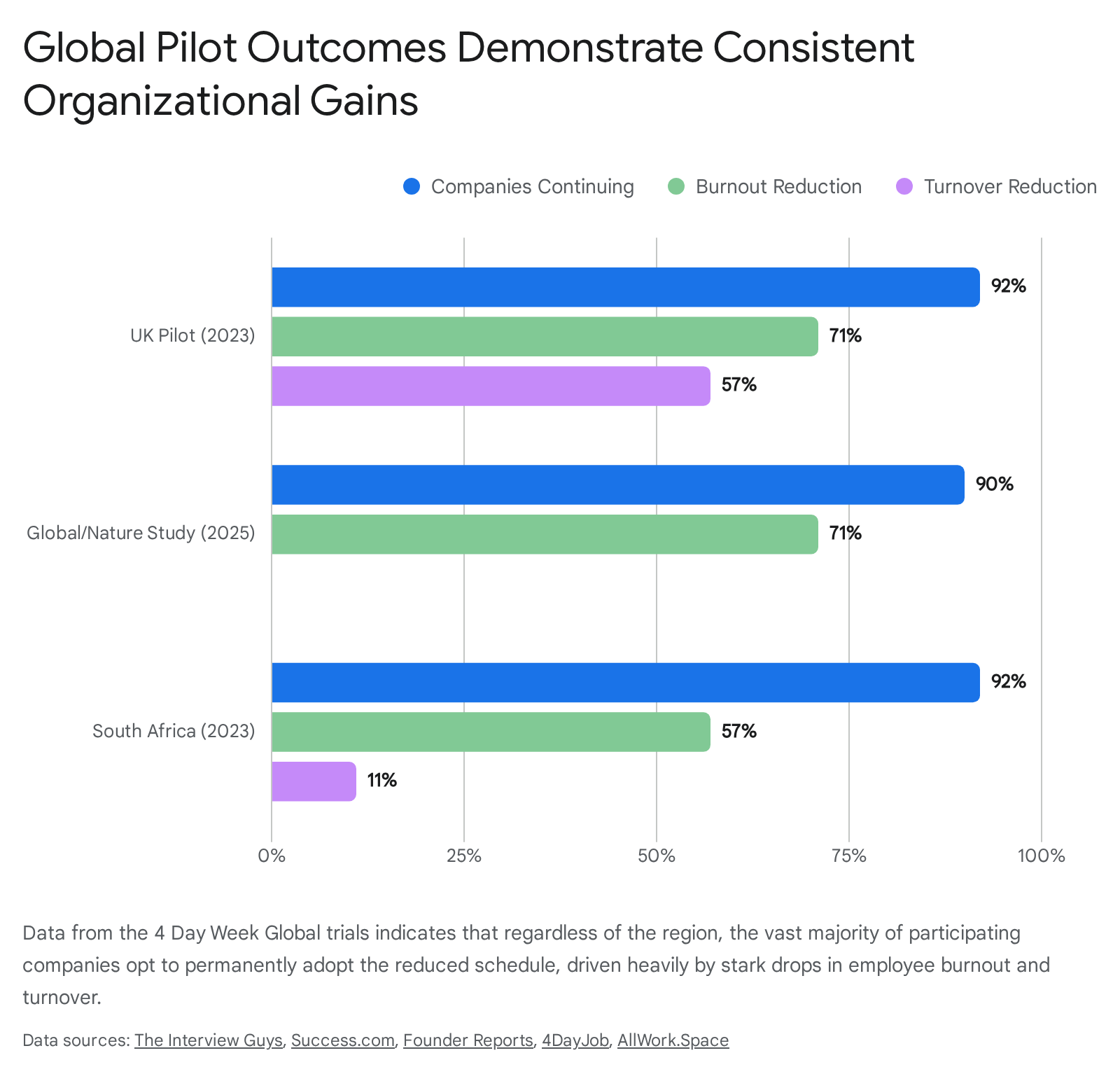
The most robust and consistent business outcome across all geographic trials is employee retention 24. Companies participating in the UK and Global trials saw a 57 percent reduction in staff turnover 4225. In employee surveys, between 10 percent and 15 percent of staff stated that no amount of money could convince them to return to a five-day schedule 32526. In an era of intense competition for specialized talent, the four-day week has become a premier non-salary benefit. For instance, Buffer, a social media management company that has maintained the policy for over three years, reported an 88 percent surge in job applications, while 91 percent of their employees reported feeling happier and more productive 227.
The fear of a 20 percent drop in output has largely been disproven in knowledge-work sectors. During the initial six-month UK trial, company revenues rose by an average of 1.4 percent, and when compared to similar financial periods in previous years, revenues increased by up to 35 percent 101225. Productivity - as measured by feature deployment, client acquisition, and internal key performance indicators - either held steady or improved, driven by a 65 percent reduction in absenteeism and sick leave 41025. These business metrics explain why, across massive global studies, approximately 90 to 92 percent of participating companies opted to permanently adopt the schedule 22109.
FAQ: Do the Benefits Last? A Look at Longitudinal Outcomes
Initial pilot programs are often subjected to the "honeymoon effect" critique by organizational psychologists 3. This theory suggests that employees will temporarily boost their productivity and report artificially high satisfaction to secure a permanent benefit, only to regress to baseline habits and lower productivity once the policy is codified 3. However, longitudinal data collected between 2024 and 2026 suggests the gains are highly durable.
A twelve-month follow-up report published by 4 Day Week Global on their initial United States, Canadian, and United Kingdom participants revealed that well-being gains held perfectly stable at the one-year mark 31228. Burnout symptoms continued to decline, dropping 69 percent overall, and self-reported work ability remained elevated for 57 percent of the workforce 328. Similarly, a 2024 follow-up by the Autonomy Institute tracking the original 61 UK pilot companies found that 89 percent (54 out of 61) were still operating on a four-day week one year later 22.
For scaling organizations, where institutional knowledge is a scarce resource, the sustained lift in employee retention has proven to be an economic anchor. The longitudinal data indicates a steady 32 percent decrease in the attrition rate over the extended trial period 28. As noted by researchers, that retention lift is one of the most robust work-life outcomes across geographies and sectors, often proving worth more to an employer than any marginal improvement in working time efficiency 24.
FAQ: How Are Different Regions Adapting the Four-Day Week?
While the core philosophy of work-time reduction remains consistent, cultural, economic, and legislative realities have forced distinct adaptations of the four-day work week across the globe.
South Africa: Developing Economy Dynamics
In 2023, South Africa concluded the first coordinated four-day work week trial in a developing nation. Involving 28 businesses (plus one from Botswana) and nearly 500 employees across sectors like technology, tax, and marketing, the results defied initial skepticism regarding the model's viability in Africa 262930. Participating companies recorded an 11 percent drop in resignations, a 9 percent decrease in absenteeism, and an impressive 10.5 percent average increase in revenue during the trial 263031. Employees valued the time immensely, with 51 percent stating they would require a 21 to 50 percent pay increase to revert to a five-day week at their next job 2629.
However, the structural realities of South Africa required a highly unique approach. Unlike the UK or the US, where businesses almost uniformly shut down on Fridays, fewer than a quarter of South African employees took Fridays off 11. This staggered approach was necessitated by the country's unreliable power grid (loadshedding), limited public transportation infrastructure, and the high prevalence of workers holding secondary jobs to make ends meet 11. Additionally, many South African firms struggled to achieve the full 20 percent reduction, averaging closer to a 12 percent drop in hours while maintaining output 26. Despite these hurdles and a reported workload increase for 31 percent of the sample, 92 percent of the companies opted to continue the model 2629.
Japan: Battling Demographic Crisis and Karoshi
Japan's engagement with the four-day work week is deeply tied to national survival. The country is battling a severe demographic crisis, with the fertility rate dropping to a record low of 1.2 children per woman in 2023, yielding only 727,277 births 121314. This demographic collapse operates alongside persistent issues of karoshi (death by overwork) and stark gender disparities in workforce participation, where women participate at 55 percent compared to 72 percent for men 161213.
Building on the 2019 success of Microsoft Japan - which reported a 39.9 percent productivity spike and a 23 percent drop in electricity costs after instituting three-day weekends - the Tokyo Metropolitan Government implemented a massive public-sector initiative starting in April 2025 261336. Spearheaded by Governor Yuriko Koike, approximately 160,000 government workers were offered the option to work a four-day week, taking three days off to accommodate childcare and family planning 22123637. While this is a highly progressive step for Japanese work culture, it operates closer to a flex-time compressed schedule, requiring employees to still meet a baseline of 155 working hours per month, often resulting in 10-hour days 131436. Other prefectures, including Ibaraki, Miyagi, and Chiba, have rapidly followed Tokyo's lead 1337.
Latin America: Rewriting the 48-Hour Legacy
Historically, Latin America has maintained some of the longest statutory working hours in the world, with 48-hour weeks being the norm for over a century 15. Between 2024 and 2026, severe union pressure, changing lifestyles, and generational shifts triggered rapid legislative overhauls across the region 1539.
In 2024, Brazil completed South America's first coordinated 100-80-100 trial, involving 21 companies and approximately 280 employees 404142. The results were deeply compelling: 71.5 percent of companies reported productivity increases, with a 61.5 percent boost in project execution and a 44.4 percent improvement in meeting deadlines 4043. Mental health improvements were stark, showcasing a 62.7 percent reduction in work-related stress and a 50 percent reduction in insomnia 4043. Unsurprisingly, 90 percent of these firms chose to maintain the schedule 2240. By May 2026, the Brazilian parliament advanced a highly popular constitutional amendment to formally abolish the traditional "6x1" schedule (six days of work, one day of rest), pushing the nation toward a 40-hour, five-day limit, with active debates continuing regarding a shift to 36 hours 151645.
Other Latin American nations have enacted binding legislation to reduce hours. Colombia passed Law 2101, slowly stepping down its 48-hour week; by July 15, 2026, the country will officially mandate a 42-hour maximum work week 153945. Chile's "40-Hour Law," passed in 2023, dropped the mandate to 42 hours in April 2026, with a target of 40 hours by 2028, and specifically legalizes 4x10 compressed work weeks for early adopters 371545. Mexico also formally enacted a labor reform to reduce its historic 106-year-old 48-hour limit. Starting in January 2027, the limit will decrease by two hours annually until it reaches 40 hours by 2030, alongside strict new electronic timekeeping requirements 1545.
Iceland: The Public Sector Pioneer
Iceland remains the global leader in widespread adoption 46. Following massive, successful public sector trials involving 2,500 workers (over 1 percent of the national workforce) between 2015 and 2019, Icelandic unions negotiated sweeping collective bargaining agreements 462446. Today, 86 percent of the Icelandic workforce has the legal right to work reduced hours - typically 35 to 36 hours a week - without any reduction in pay 46. The policy sparked widespread improvements in well-being and is frequently cited as the benchmark for national integration 146.
Structural Comparison of Regional Four-Day Week Models
To understand the nuanced differences in global implementation, the following table compares the distinct structural mechanisms utilized across four major jurisdictions as of 2026:
| Jurisdiction | Primary Mechanism | Legal / Operational Structure | Current Status & Adoption (2026) |
|---|---|---|---|
| Iceland | Union Negotiation & Collective Bargaining | 35-36 hour weeks (reduced hours, no pay cut). | Widespread. ~86% of the workforce has the legal right to reduced hours. |
| Japan (Tokyo) | Government Initiative | Flex-time compression; 155 hours/month over 4 days. | Public sector rollout (~160,000 workers); multiple prefectures following suit. |
| Brazil | Private Sector Pilots & Legislative Reform | 100-80-100 private trials; active constitutional reform moving to 40-hours. | 90% retention in 2024 private pilot; federal shift from 48 to 40 hours pending. |
| Belgium | Federal Legislation (Labour Deal Act 2022) | 4x10 Compressed Hours (40 hours total, no pay cut). | Legal right to request, but private sector adoption remains strictly limited. |
FAQ: What Are the Hidden Costs and Why Do Some Trials Fail?
Despite the overwhelmingly positive reporting from advocacy groups, the 2026 data warrants calibrated uncertainty. The four-day work week is not a utopian panacea. Not all trials succeed, and implementing a reduced schedule carries distinct operational and cultural risks that businesses must navigate carefully.
Operational Rigidity and Corporate Reversals
In July 2025, two major global corporations - health insurer Bupa and consumer goods giant Unilever - quietly abandoned their highly publicized shortened work week trials 47. Unilever had initially piloted the 100-80-100 model in New Zealand in December 2020 to great success, noting a 34 percent drop in absenteeism and a 33 percent fall in stress 484917. Emboldened, they expanded the trial to 500 workers in Australia in late 2022 4849. However, by 2025, the company reversed course. Unilever cited severe organizational "rigidity," concluding that forcing an entire enterprise into a uniform four-day model lacked the necessary flexibility for a globally integrated supply chain and dynamic customer service demands 47.
Similarly, Bupa ended its nine-day fortnight experiment for hundreds of employees after 18 months, opting to return to a typical five-day format to better meet the needs of a diverse workforce 47. Interestingly, during the same period, Bupa's direct rival, Medibank, doubled down on its four-day week for 550 employees, having successfully used the policy to force ruthless prioritization and eliminate wasteful meetings 4718. The divergence highlights that success is entirely dependent on execution; when organizations fail to clearly define performance metrics or restructure their workflows, the model struggles 47.
Increased Work Intensity and Boundary Creep
Critics point out that compressing a full workload into 32 hours without fundamentally changing the underlying business systems leads to heightened daily stress 21516. An experiment by Los Angeles-based marketing firm Alter Agents resulted in failure after just 10 weeks 19. The CEO found that employees suffered from boundary corruption; many continued to answer emails and perform small tasks on their days off to keep up with client demands 19. By the end of the trial, employee satisfaction had actually decreased because the arrangement created more anxiety about missed work than it alleviated 19.
Research published in the MIT Sloan Management Review in 2025 identified this as "operational unpreparedness" 2. Teams that simply drop a day without restructuring collaboration norms end up cramming the same obligations into fewer hours, yielding intense fatigue 2. Furthermore, "old-school mindset" resistance from leadership frequently dooms these initiatives. When senior leaders continue working five days while expecting staff to maintain output in four, the cultural signal collapses the policy within weeks 2.
Economic Math and the Service Sector Gap
The four-day week has thus far primarily benefited white-collar, desk-based knowledge workers 18. In continuous-operation industries like healthcare, hospitality, and retail, a business cannot simply "become 20 percent more efficient" to cover an empty shift; a store must remain open, and hospital beds must be staffed 25354. To implement a reduced-hour week in these sectors, employers must physically hire more staff to cover the missing hours, directly increasing overhead 54. A famous public sector trial in Gothenburg, Sweden, ultimately required a nursing home to hire 17 additional nurses; while well-being soared, the cost structure was deemed unsustainable and the pilot was terminated 54.
As noted by organizational analysts, the baseline math of the 100-80-100 model introduces a hidden economic challenge: if a company keeps pay flat while cutting hours by 20 percent, it has effectively raised its hourly labor costs by 25 percent 54. For high-margin technology firms leveraging AI to compensate for the lost time, this cost is easily absorbed by productivity gains 254. For tight-margin retail or manufacturing facilities, it poses a severe threat to profitability unless heavily subsidized by the state 54. Offering a four-day week exclusively to corporate staff while requiring frontline workers to maintain a standard schedule can create deep internal inequities and cultural friction 253.
FAQ: What Are the Practical Takeaways for Managers and Workers?
For organizations looking to transition to a four-day work week in 2026, the empirical data provides a clear roadmap of best practices and fatal pitfalls. Success does not happen by merely declaring Fridays a day off; it requires rigorous, structural operational redesign. 4 Day Week Global notes that success is crafted through specific adaptations in technology, communication, and process 55.
- Mandate a Preparation Sprint: The most successful trials, including those tracked by Nature Human Behaviour, mandated a two-month preparation period before altering the schedule 21043. During this phase, companies must form cross-functional "Tiger Teams" to audit how time is spent, categorize deep versus shallow work, and systematically eliminate administrative waste 10.
- Ruthless Meeting Purges: To achieve 100 percent output in 80 percent of the time, the culture of synchronous communication must change. Successful organizations default to the "25/50 Minute Rule" (shortening 30- and 60-minute meetings to build buffer time), mandate clear agendas with designated decision-makers, and embrace asynchronous updates (using tools like Loom or shared workspaces) instead of holding "status update" calls 11055. Many implement "No Meetings" days to protect deep work 10.
- Output Agreements Over Hours Logged: Managers must shift their performance metrics from tracking hours to tracking deliverables 10. Trust and flexibility are paramount. Research from the São Paulo School of Administration evaluating the Brazilian trials found that the four-day week is most effective in environments where employee autonomy is valued and relationships are based on mutual trust . When employees are given autonomy over how they achieve their goals, work ability and job satisfaction soar 2.
- Implement Shift Rotations for Coverage: To solve the customer service gap and prevent the boundary creep seen in failed trials, companies should avoid shutting down entirely. Instead, divide the workforce into cohorts - for example, one team works Monday through Thursday, while the other works Tuesday through Friday 427. This ensures continuous five-day client coverage while granting every employee a three-day weekend 27.
Bottom Line
As of 2026, the four-day work week is no longer a fringe experiment but a validated operational strategy with profound implications for the future of global labor. Longitudinal data confirms that the 100-80-100 model - when paired with deep systemic redesigns and the integration of modern productivity tools - delivers remarkable improvements in employee mental health, sleep, and job satisfaction. Concurrently, it allows companies to dramatically reduce burnout and retain top talent without sacrificing revenue.
However, it is not a universal solution. The failure of trials at major conglomerates like Unilever demonstrates that applying rigid, blanket schedules across highly complex or client-dependent operations can easily backfire. Furthermore, a failure to properly redesign workflows leads to intense work compression, nullifying the mental health benefits of the extra day off and replacing physical exhaustion with psychological anxiety. Ultimately, the successful transition to a four-day week requires organizations to stop measuring dedication by hours logged at a desk, and instead optimize for sustainable, output-driven human performance.