
How Remote Work Affects Wellbeing and Productivity
Hybrid work has emerged as the clear winner in the data, consistently outperforming both fully remote and full-time office setups in overall productivity, employee health, and talent retention. While fully remote arrangements offer massive gains in uninterrupted focus, they also carry hidden costs in the form of isolation, musculoskeletal degradation, and exhaustive "digital presenteeism." Ultimately, the evidence demonstrates that a team's success depends far less on their physical location than on the quality of their management and asynchronous communication practices.
Introduction: Moving Beyond the Pandemic Paradigm
For several years, the global conversation surrounding remote work was treated as an emergency response to a temporary crisis. Debates over whether employees should return to the office were largely philosophical, driven by executive intuition, self-reported employee surveys, and cultural inertia. Today, however, the landscape has stabilized, and the empirical data has caught up. Remote and hybrid work are no longer temporary experiments; they are structural features of the modern global economy.
In 2025 and 2026, researchers finally have access to millions of data points, randomized control trials, and longitudinal economic studies from institutions like Stanford University, the National Bureau of Economic Research (NBER), and global analytics firm Gallup 122. These data sets cut through the noise of corporate mandates and employee grievances to answer the core questions: Does remote work actually boost productivity? And what is its true impact on human wellbeing?
The emerging consensus is nuanced. Remote work is neither a universal panacea for employee happiness nor the productivity killer that traditionalist executives feared. Instead, location flexibility acts as a powerful magnifying glass. It amplifies the effectiveness of strong, intentional management while ruthlessly exposing the flaws of organizations that rely on physical presence to mask poor communication 43. To understand the future of work, we must dissect the empirical evidence separating the hybrid, fully remote, and traditional office models.
The Productivity Debate: What the Numbers Say
The most contentious battleground in the remote work debate is productivity. For decades, the traditional office model equated physical presence with output. If an employee was at their desk for eight hours, they were presumed to be productive. The shift to distributed work forced economists and managers to measure actual output, leading to surprising revelations about how, when, and where humans do their best work.
The Hybrid Sweet Spot
When analyzing aggregate macroeconomic data and corporate performance, hybrid work - where employees split their time between a home office and a corporate workspace - consistently hits the optimal sweet spot. The push for a return to the office is often driven by executive fears of declining output, but the data does not support a rigid mandate for five days in the office.
A landmark randomized control trial conducted by Stanford economists, led by Nicholas Bloom, tracked 1,600 employees at the global travel agency Trip.com. The researchers divided the workforce into a full-time office group and a hybrid group. The results revealed zero statistical difference in productivity, performance review scores, or promotion rates between the two cohorts 64.
However, the true financial impact of the hybrid model was found in employee retention. Resignation rates dropped by a staggering 33% among the hybrid workers 64. Given that the company's CEO calculated the cost of replacing a single employee at approximately $20,000 in recruitment, onboarding, and lost institutional knowledge, the hybrid model saved the company millions of dollars while maintaining exact parity in output 6.
Beyond mere parity, there is evidence that flexibility actively boosts organizational output. An analysis of companies on the Fortune 100 Best list found that organizations supporting remote or hybrid setups demonstrate productivity levels nearly 42% higher than typical, rigid U.S. workplaces 8. This outperformance stems from the fact that hybrid arrangements allow employees to tailor their environment to the task at hand. Workers utilize the office for collaborative, high-bandwidth communication and spontaneous brainstorming, while reserving their home environment for deep, focused, independent work 510.
Deep Focus in Fully Remote Setups
When examining fully remote workers, the productivity narrative becomes more specialized. Remote work serves as a highly powerful accelerator for individual, focused tasks that require deep concentration.
Objective workforce tracking data, which measures actual computer activity rather than self-reported feelings of productivity, reveals that remote workers spend nearly 60% of their week in deep, uninterrupted work, compared to just 48.5% for office workers 6.
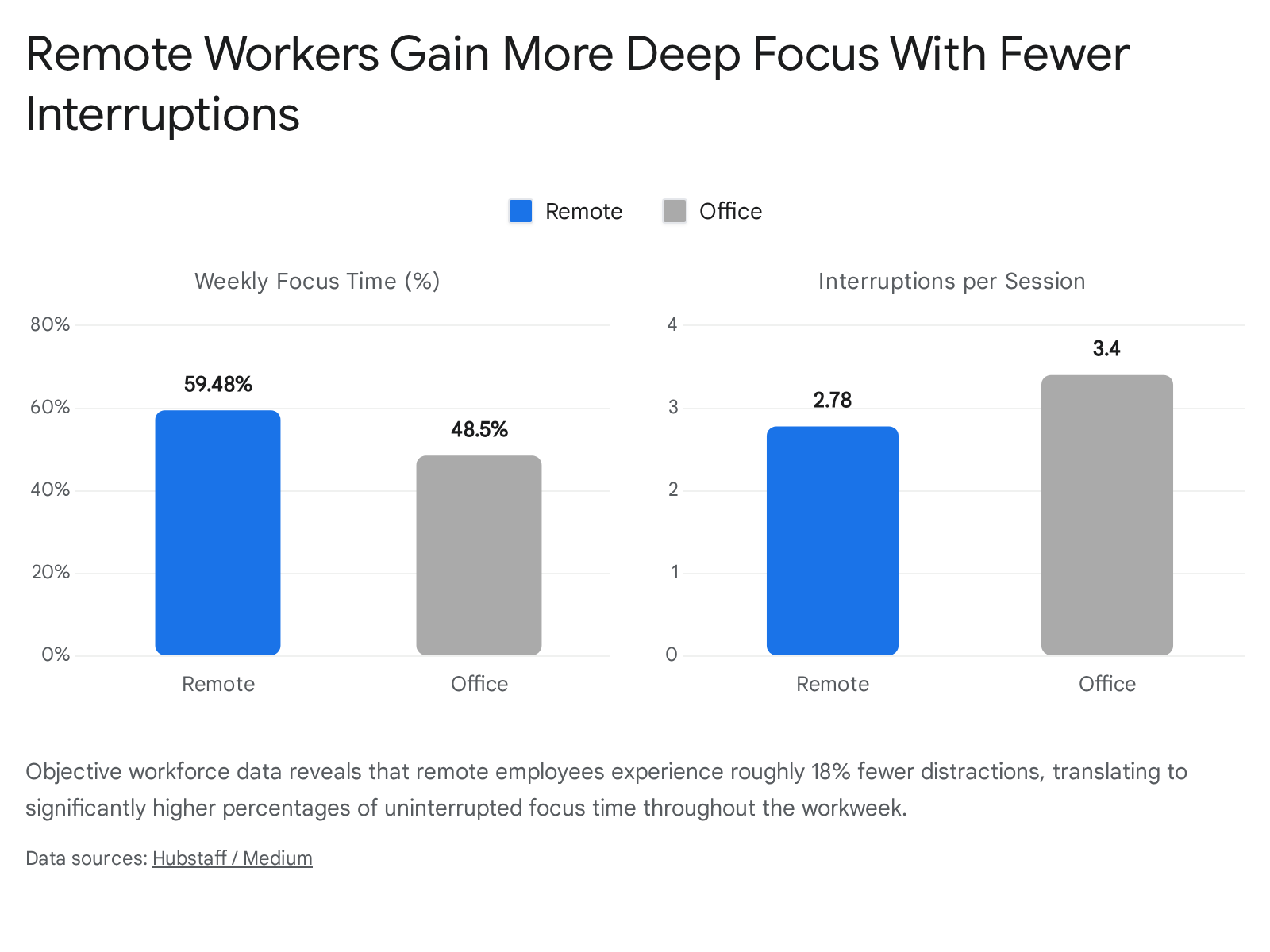
In actual minutes, remote workers average 4.55 hours of deep focus time per day, versus 3.72 hours for their office-bound peers 6. Over a standard workweek, this equates to roughly 22% more time spent in a flow state 6.
The reason for this discrepancy lies in the architecture of the modern open-plan office, which is rife with distractions. Research indicates that it takes a knowledge worker an average of 23 minutes to cognitively refocus after an interruption 6. Because office workers face higher rates of disruption - having their concentration broken an estimated 884 times a year compared to 723 times for remote workers - they lose roughly 6.5 hours a week simply trying to get back on track 6. Fully remote employees, facing fewer of these ambient disruptions, effectively gain back 62 hours of productive work time annually 6.
The Innovation Penalty and Collaboration Taxes
Despite the massive gains in individual focus, full-time remote work comes with a measurable "collaboration tax." While routine execution improves at home, complex, ambiguous, and highly collaborative tasks can suffer without physical proximity.
A 2023 working paper from the National Bureau of Economic Research (NBER) synthesized various data sets and concluded that fully remote work could reduce overall output by 10% to 20% for specific roles that require high collaboration, or for newly hired employees who rely on hands-on mentoring and onboarding 2.
Furthermore, an exhaustive 2024 analysis of patent filings across more than 4,000 technology companies indicated that heavily remote firms produced 8% to 12% fewer breakthrough patents compared to firms utilizing hybrid policies 2. The researchers attributed this innovation gap to the reduction in serendipitous interaction. Historically, breakthrough innovation often arises from novel combinations of ideas across disciplinary boundaries - the kind of spontaneous conversations that happen in hallways or before and after formal meetings, which are exceedingly difficult to replicate over scheduled video calls 2.
Digital communication channels are excellent for transmitting explicit knowledge and tracking project statuses, but they lack the full, four-dimensional immersion of nonverbal human communication required to build deep trust rapidly . Remote workers often compensate by attending 50% more meetings than their office counterparts, leading to communication overload and calendar bloat 4.
Working Fewer Hours, Achieving the Same Output
One of the most fascinating discoveries in recent labor economics is the paradox of remote work hours: remote workers are logging less total time on the clock, yet macroeconomic productivity remains steady.
Data from the American Time Use Survey (ATUS), analyzing trends from 2019 to 2023, shows that full-time employees in heavily remote-capable roles work about an hour less per day than they did prior to the pandemic 1. Demographic breakdowns reveal that men, unmarried adults, and those without children showed the steepest declines in hours worked. For example, single men over 45 who work remotely clocked over two hours less per day on work activities in 2022 than they did in 2019 1. Overall, the average U.S. employee reported working 44.1 hours per week in 2019, which fell to 42.9 hours by 2024 1.
Instead of precipitating an economic slump, this reduction in working hours correlated with a slight increase in macro-level output per worker 18. Rather than logging off early and neglecting duties, remote workers are redirecting their saved time - specifically the time reclaimed from not commuting, which averages 55 minutes a day globally - into personal wellbeing, exercise, and family life 486.
Economists theorize that the traditional 40-hour office workweek naturally contained significant wasted time, and that remote workers are simply completing the same required output in a compressed timeframe without pretending to look busy 4. Furthermore, remote work allows for better "sorting" in the labor market. Employees are able to match into roles that perfectly suit their skills regardless of geographic constraints, meaning the overall talent pool is utilized more efficiently, offsetting any individual drop in hours worked 1.
Wellbeing, Mental Health, and the Isolation Problem
When surveyed on a surface level, an overwhelming 99% of professionals claim that flexible work positively impacts their mental health, with 79% of remote professionals reporting lower overall stress levels than when they worked on-site 613. However, clinical data, biometric tracking, and behavioral health studies reveal a much more complex reality. Flexibility solves several long-standing occupational health issues while creating entirely new vulnerabilities.
The Healthiest Work Model: A Data Comparison
A comprehensive 2024 study of UK workplaces, conducted as part of Vitality's "Britain's Healthiest Workplace" initiative, analyzed the tangible physical and mental health outcomes of different work models. The findings clearly demonstrated that hybrid workers are physiologically and psychologically healthier than both their office-bound and fully remote counterparts 7.
| Health & Productivity Metric | Hybrid Workers | Fully Remote Workers | Full-Time Office Workers |
|---|---|---|---|
| Productive Days Lost to Health (Annual) | 47.8 days | 50.8 days | ~49.0 days |
| Formal Absence (Sick Days) | 4.9 days | 9.6 days | Data unverified |
| Clinical Depression Risk | 8.1% | 12.1% | 10.4% |
| Obesity Rate | 20.0% | 25.2% | Data unverified |
| Musculoskeletal Conditions | 79.9% | 87.4% | 78.3% |
| Meeting 5-a-Day Diet Goal | ~46.0% | 37.5% | ~46.0% |
Data source: Vitality's 'Britain's Healthiest Workplace' study (2024) 7.
The data in the table highlights a critical and often overlooked reality: working from home full-time takes a severe toll on the physical body. Remote workers suffer the absolute highest rates of musculoskeletal problems (87.4%), likely due to a combination of poor ergonomic setups at home (working from couches or dining tables) and a drastic reduction in incidental movement 7. The daily commute, walking to meeting rooms, and leaving the building for lunch naturally break up sedentary behavior in office workers.
Furthermore, full-time home workers have higher obesity rates and poorer diets compared to hybrid and office workers, potentially due to the proximity of the home kitchen and a lack of structured meal breaks 7. Hybrid workers, conversely, hit the optimal physiological balance. They utilize the ergonomic benefits and structured movement of the office a few days a week while maintaining the stress-reducing autonomy and sleep benefits of remote days. They also show the highest engagement (31%) with corporate wellness and healthcare interventions 7.
The Remote Work Mental Health Paradox
While remote workers praise the elimination of the daily commute, they are currently facing a silent epidemic of isolation. Gallup's comprehensive 2025 analysis identified what they term the "remote work paradox": fully remote workers report being highly engaged in their specific day-to-day tasks, yet they are significantly less likely to describe their lives as "thriving" compared to hybrid peers 158.
In fact, employees working entirely remotely report feeling more stress, anger, sadness, and loneliness throughout the workday than those who work on-site 15. Roughly 25% of fully remote employees report meaningful, chronic loneliness - a rate 56% higher than their on-site counterparts 417. Remote work drastically shrinks an individual's social network, degrading the weak-tie relationships and social capital that naturally form in shared physical spaces 5.
Generational Divides in Remote Well-being
The mental health impacts of remote work are not distributed equally; they heavily depend on an employee's stage of life and career. Survey data from CoworkingCafe in 2026 revealed stark generational divides regarding the psychological toll of isolation 17.
Gen Z workers appear to struggle the most with the remote environment. Having entered the workforce during or shortly after the pandemic, many lack established professional networks and the confidence to navigate corporate politics digitally. Fully 20% of Gen Z remote workers experience high-frequency loneliness (feeling isolated one to two times a week or more), double the rate reported by Millennials 17. Furthermore, one in three employees experienced burnout in the prior year, with Gen Z disproportionately affected 17.
In contrast, Gen X employees report the highest overall wellbeing scores in remote setups 17. Older workers typically possess established professional networks, greater job autonomy, larger homes with dedicated office spaces, and caregiving responsibilities that make geographic flexibility a massive psychological relief. A staggering 69% of Gen X workers report feeling lonely less than once a month or never 17.
The Flexibility Advantage for Women and Caregivers
While isolation is a genuine risk, the mental health benefits of remote work for specific demographic groups cannot be overstated. For women and individuals with primary caregiving responsibilities, flexible work functions as a critical pressure release valve.
In the Stanford Trip.com study, researchers noted that women, non-managers, and employees with long commutes were particularly unlikely to resign when granted hybrid flexibility 6. Over 75% of women report feeling less stressed while working remotely, compared to roughly two-thirds of men 17. Because women statistically carry a disproportionate share of domestic and childcare duties globally, the ability to eliminate commute times and sequence work around household rhythms dramatically reduces the friction of balancing a career and a family 517.
The Rise of Digital Presenteeism
In the traditional corporate world, "presenteeism" referred to the phenomenon of employees showing up to the office despite being physically ill, or staying late at their desks simply to be seen by senior management, regardless of whether actual productive work was occurring 9. Experts estimated that traditional presenteeism cost the U.S. economy over $150 billion annually in lost productivity and compounded health issues 1910.
The mass transition to remote work did not kill presenteeism; it simply digitized it. As technology allowed for constant, omnipresent connectivity, the pressure to prove one's worth morphed from physical visibility to digital responsiveness.
Replicating the Toxic Water Cooler
Executives who mandate a strict return to the office frequently cite the "water cooler effect" - the idea that casual, spontaneous run-ins in the break room spark innovation and drive business outcomes 10. However, organizational researchers point out that the physical water cooler was often a prime vector for traditional presenteeism. When work is measured by hours sat at a desk rather than by tangible output, lingering at the water cooler effectively masks unproductivity. It creates the illusion of engagement 10.
Without this physical visibility, remote workers often feel immense paranoia regarding how their managers perceive their work ethic. This anxiety has given rise to "digital presenteeism," where employees maintain a constant online presence to demonstrate commitment and loyalty 1911.
Evidence shows that remote workers engage in performative digital labor. They will swiftly reply to non-urgent messages, attend virtual meetings they do not need to be in, or literally tap their keyboards periodically during breaks just to keep their availability indicator "green" on platforms like Microsoft Teams or Slack 1911. A survey by Catalog and GitLab found that 54% of remote individuals feel pressured to maintain an online presence at specific times of the day rather than being evaluated on their actual output 19.
This paranoia is not entirely unfounded. A 2024 Owl Labs report indicated that 46% of workers said their company added or increased the use of employee productivity or activity monitoring software in the past year 22. When companies use surveillance software to count keystrokes rather than evaluating deliverables, employees naturally optimize for looking busy rather than doing deep work.
The "Always On" Culture and Burnout
Digital presenteeism is a silent, creeping productivity killer. Because the spatial and physical boundaries between the home and the office have been erased, remote workers easily fall into the trap of allowing work to bleed into their evenings and weekends 911.
Over 76% of remote employees admit to working overtime, working late, or checking messages outside of standard working hours at least once in the past week 1312. Research utilizing GitHub data showed that the transition to remote work resulted in an initial 15% increase in working hours, largely driven by work drifting into the weekends and late evenings 13.
Working in a state of digital presenteeism mirrors the fatigue of working while physically sick. It leads to diminished quality of work, emotional exhaustion, higher error rates, and eventual burnout 919. In the UK technology sector, a comprehensive HealthTech report by YuLife and Bupa quantified this damage: for every single day an employee takes off sick, 3.4 days of productivity are lost due to employees working while unwell, mentally depleted, or fatigued by the "always-on" culture 25.
Solutions: Virtual Water Coolers That Actually Work
To combat the isolation of remote work without falling into the trap of digital presenteeism, some organizations have experimented with structured "virtual water coolers." However, simply throwing employees into an unstructured Zoom room often results in awkwardness and wasted time.
A randomized field experiment conducted by Harvard Business School on remote summer interns revealed how to engineer digital socialization correctly. The researchers found that scheduling virtual, small-group interactions significantly boosted job performance, career outcomes, and organizational commitment - but only under specific conditions 14. The virtual water coolers were highly effective when they facilitated a demographic match between junior interns and senior managers, and when they occurred at regular, predictable intervals 14. Conversely, unstructured intern-only virtual hangouts or asynchronous Q&A forums provided no measurable boost to productivity 14.
The lesson is clear: digital socialization must be intentional, structured, and carefully time-boxed to provide value without draining an employee's energy.
Global Remote Work Trends in 2026
The adoption and success of remote work are not globally uniform. The viability of distributed work is heavily influenced by regional labor laws, digital infrastructure, real estate markets, and deeply ingrained cultural norms regarding hierarchy and visibility.
The Cultural Divide: Americas, Europe, and Asia
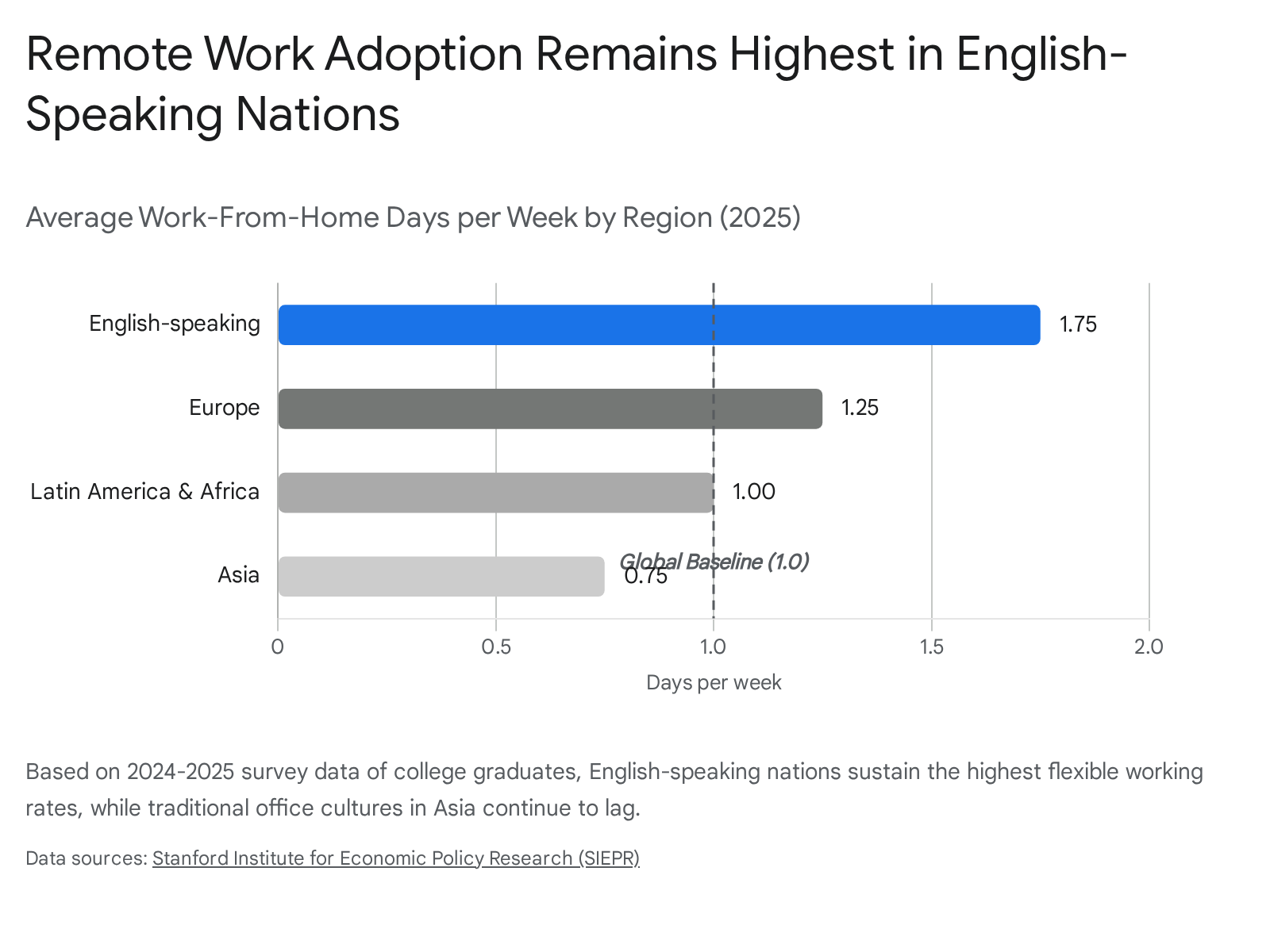
Data collected from over 16,000 college and university graduates across 40 countries in late 2024 and early 2025 reveals stark geographic contrasts in how post-pandemic work is structured 2. Globally, remote work has stabilized at roughly 1.27 days per week on average for educated knowledge workers, but the regional variations are massive 213.
Why English-Speaking Nations Lead
English-speaking markets - specifically the United States, the United Kingdom, Canada, and Australia - lead the world in remote work adoption, averaging 1.5 to 2 remote days per week 2. In the U.S. alone, an estimated 32.6 million Americans (roughly 22% of the workforce) work remotely in 2025, and work-from-home days account for a full quarter of all paid workdays 271516.
Despite highly publicized return-to-office (RTO) mandates from mega-corporations like Amazon, AT&T, and JPMorgan Chase, the broader U.S. market has quietly normalized flexibility. A 2025 Stanford/Federal Reserve survey found that only 12% of executives intend to mandate full-time office returns in the coming year, and researchers calculate that headline-grabbing mandates will reduce overall U.S. work-from-home days by less than half a percentage point 17. American workers have made it clear that flexibility is a form of compensation; nearly 50% state they would accept an 8% pay cut to keep remote work, and 65% of Gen Z and Millennials say they would actively look for a new job if forced back to the office full-time 1331.
Europe's Durable Hybrid Equilibrium
Continental Europe averages 1 to 1.5 remote days per week, cementing a highly durable hybrid model that balances employee autonomy with strong institutional protections 232.
| European Nation | 2025 Remote Work Adoption Metrics |
|---|---|
| United Kingdom | 28% of working adults report hybrid working arrangements 32. |
| Germany | 24.4% work from home at least some of the time; degree holders average 1.6 days 32. |
| France | 18.2% telework at least one day per week, averaging near two days 32. |
| Spain | 19.8% of employees telework regularly, averaging 2.4 days per week 32. |
| Netherlands | Over 50% work from home sometimes or most of the time 32. |
Data source: Eurostat and regional labor surveys (2024-2025) 32.
Europe's adoption is heavily shaped by its legislative environment. Many European nations are actively implementing the "right to disconnect" into labor law, explicitly preventing employers from demanding email responses after hours 33. Furthermore, 66% of European respondents in a recent Owl Labs survey stated they believe working from home should be a fundamental legal right 18. Because European labor laws aggressively protect mental health and prevent the "always-on" culture, hybrid work functions smoothly without degrading into digital presenteeism.
Asia's Structural Resistance
Asian countries report the lowest global levels of remote work, averaging just 0.5 to 1 day per week 2. While the pandemic forced a rapid digital transformation - compressing decade-long IT roadmaps into mere months in tech hubs across India and manufacturing centers in South Korea - the cultural resistance to decentralization remains immense 19.
In nations like Japan and South Korea, deeply entrenched hierarchical corporate structures place a massive premium on visible, in-person dedication and collective harmony 1920. An employee leaving before the boss, or not being physically present to demonstrate loyalty, carries significant career risk. Consequently, when Asian firms attempt to implement remote work, it often backfires into severe micromanagement. A staggering 60% of South Korean employees reported experiencing "technostress" from digital overload and surveillance as managers attempt to maintain strict hierarchical control through virtual channels 19. In Asia, the barrier to remote work is not technological; it is fundamentally sociological.
Actionable Takeaways for the Future of Management
The overwhelming wealth of data from 2023 to 2026 points to a singular, undeniable conclusion: remote work itself is neither inherently good nor bad for productivity. Rather, remote work acts as a neutral amplifier of existing corporate practices.
A staggering 70% of the variance in team engagement and performance can be traced directly to management quality 3. Poor managers who rely on badge swipes and line-of-sight to ensure work gets done will watch their remote teams crumble into inefficiency and burnout. Conversely, managers who operate with clarity, trust, and empathy will see remote teams exceed office-bound productivity 3. The companies that will dominate the late 2020s are those that stop debating where work happens and focus entirely on how distributed teams are managed .
Transitioning to Asynchronous Communication
The most destructive default behavior in remote and hybrid teams is attempting to replicate the synchronous, real-time office environment through continuous video calls and instant messaging 2139. Remote employees currently attend 50% more meetings than in-office staff, which leads directly to Zoom fatigue, destroys the deep-focus advantage of working from home, and leaves employees with no time to actually execute their tasks 440.
High-performing distributed teams have solved this by shifting radically toward asynchronous (async) communication 4142. Asynchronous communication happens when a message is sent without the expectation of an immediate reply - such as a heavily detailed project brief in Asana, a recorded Loom video, or a structured Google Doc 4243.
This practice allows team members to digest information and respond at their peak cognitive hours, accommodating different time zones and childcare schedules 4143. Implementing strict async practices can replace over 40% of standard status-update meetings, saving the average team up to six hours a week 40. To make async work, managers must train their teams to "over-communicate" in writing, providing massive context so a recipient can understand a request without needing to schedule a follow-up call 42. Furthermore, leadership must establish clear Service Level Agreements (SLAs) for internal responses, guaranteeing employees that they do not need to reply to a Slack message within five minutes 3940.
Focusing on Outcomes, Not Attendance
To prevent the toxicity of digital presenteeism, leadership must undergo a fundamental paradigm shift: transitioning from measuring inputs (hours spent visibly online) to measuring outputs (actual work delivered) 1044.
When expectations are mathematically clear, and deliverables are tracked transparently through project management software, the need for keystroke surveillance vanishes 2145. In a properly managed hybrid or remote team, if an employee finishes their required tasks efficiently in 30 hours instead of 40, they should be rewarded with personal time and autonomy, rather than punished with additional busywork simply because the clock has not struck 5:00 PM . Autonomy built on trust drives retention far more effectively than rigid control.
Intentional Culture Building
Finally, organizations must redesign the physical office itself. The office is no longer a default container where all work occurs; it is a specific tool to be utilized for specific tasks. Employees deeply resent commuting 45 minutes simply to sit at a desk and answer emails on Zoom - a phenomenon known as "coffee badging," where employees show up just to swipe their badge, grab a coffee, and leave 18.
Managers should coordinate hybrid schedules so that when a team is in the office, the day is actively engineered for high-bandwidth collaboration, complex problem solving, mentorship, and social bonding 45. If the office is treated as a collaborative destination rather than a mandatory holding pen, employees will naturally want to return.
Bottom line
The empirical evidence unequivocally crowns hybrid work as the optimal setup, offering the deep-focus productivity of remote work alongside the collaborative, social, and ergonomic benefits of the traditional office. Fully remote setups provide incredible execution advantages but require highly intentional, asynchronous management to prevent severe employee isolation, innovation loss, and the burnout associated with digital presenteeism. Ultimately, the future of work relies less on policing physical geography and more on trusting employees to manage their outcomes within well-designed digital and physical frameworks.