
Global trial results for the four-day work week
The structural organization of working time is undergoing its most profound re-evaluation since the industrial standardization of the five-day, forty-hour week in the twentieth century. While the concept of a four-day work week was championed by labor activists as early as the 1950s, the exogenous shock of the COVID-19 pandemic catalyzed unprecedented experimentation with flexible working arrangements 12. High rates of occupational burnout, shifting employee expectations regarding work-life balance, and demographic challenges have driven both private enterprises and public sector entities to pilot reduced-hour schedules 134.
What began as localized organizational perks has matured into a series of coordinated, multinational trials analyzed by leading academic institutions. Empirical data generated across North America, Europe, Australasia, and emerging markets reveals a complex but highly consistent landscape. For the overwhelming majority of organizations, the implementation of a shortened work week yields profound improvements in psychological well-being, employee retention, and overall productivity 567. However, the success of the model is highly conditional. It is not an organizational panacea, but a forcing function for rigorous workflow redesign; when applied without structural adaptation, or in sectors requiring continuous operational coverage, the model can precipitate operational failure and intensified worker exhaustion 8910.
Typology of Reduced Working Time Models
Discussions surrounding the four-day work week frequently conflate distinct operational frameworks, leading to misinterpretations of trial data and conflicting administrative outcomes. The current labor research landscape strictly differentiates between two primary scheduling paradigms.
The Compressed Work Week
The compressed work week requires employees to fulfill their standard forty hours over four days, typically structured as four ten-hour shifts. While this provides an additional day of rest, historical meta-analyses and recent longitudinal studies highlight significant limitations. A 1999 meta-analysis found that while compressed schedules improved initial job satisfaction, they yielded no substantive improvements in objective productivity or long-term absenteeism 3. More recent evaluations, including a 2024 study in the European Journal of Work and Organizational Psychology, noted that while compressed weeks can improve work-life harmony under highly specific conditions, they carry substantial risks of severe end-of-day fatigue 3. Furthermore, ten-hour shift requirements are frequently incompatible with the demands of employees possessing primary caregiving responsibilities, exacerbating gender inequities in the workforce 3.
The Reduced-Hour Framework
Conversely, the dominant framework utilized in contemporary global trials is the reduced-hour model, codified by advocacy groups and researchers as the "100:80:100" principle. Under this paradigm, employees receive 100% of their historical compensation for working 80% of their standard hours, provided they maintain 100% of their baseline productivity 3101112.
This model rests on the macroeconomic premise that the final hours of a standard forty-hour week yield rapidly diminishing marginal returns 1314. By aggressively restructuring workflows and eliminating low-value administrative tasks, organizations theorize that equivalent output can be condensed into a thirty-two-hour timeframe without triggering the fatigue associated with compressed schedules 913.
| Operational Model | Weekly Hours Worked | Compensation | Productivity Expectation | Primary Trade-off and Risk Factors |
|---|---|---|---|---|
| Standard 5-Day Week | 40 hours | 100% | Baseline | Established cultural norm, but highly vulnerable to endemic burnout and high turnover. |
| Compressed 4-Day Week | 40 hours (4 x 10hr shifts) | 100% | Baseline | Offers an extra rest day but risks severe daily fatigue and limits caregiving flexibility. |
| Reduced Hours (100:80:100) | ~32 hours (4 x 8hr shifts) | 100% | 100% of Baseline | Requires aggressive, continuous workflow redesign and elimination of non-essential tasks to sustain output. |
Methodological Evolution in Working Time Research
The academic legitimacy of the four-day work week has historically been challenged on methodological grounds. Early pilot programs, largely coordinated by the non-profit organization 4 Day Week Global alongside researchers from Boston College, the University of Cambridge, and University College Dublin, generated highly favorable data 715. However, these initial datasets were subject to intense scrutiny regarding systemic selection bias.
Early Criticisms and Selection Bias
In a position paper evaluating trial methodologies, the Malta Employers Association noted that early participants were strictly volunteers. These organizations were predominantly progressive, knowledge-based firms inherently predisposed to flexible arrangements and structurally motivated to ensure the trial's success 816. Because these companies self-selected into the experiments, extrapolating their success to the broader, non-volunteer economy - particularly to blue-collar or continuous-operation sectors - presented severe validity risks 3516. Additionally, measuring objective productivity across diverse industries proved methodologically complex, leading early studies to rely heavily on subjective, self-reported survey data 317.
The 2025 Randomized Controlled Trial
In response to these limitations, working time research matured into more rigorous academic frameworks. In July 2025, the journal Nature Human Behaviour published the results of a landmark randomized controlled trial. Led by sociologists Wen Fan and Juliet Schor, this study evaluated 2,896 employees across 141 companies in six countries: the United States, the United Kingdom, Australia, Canada, Ireland, and New Zealand 56918.
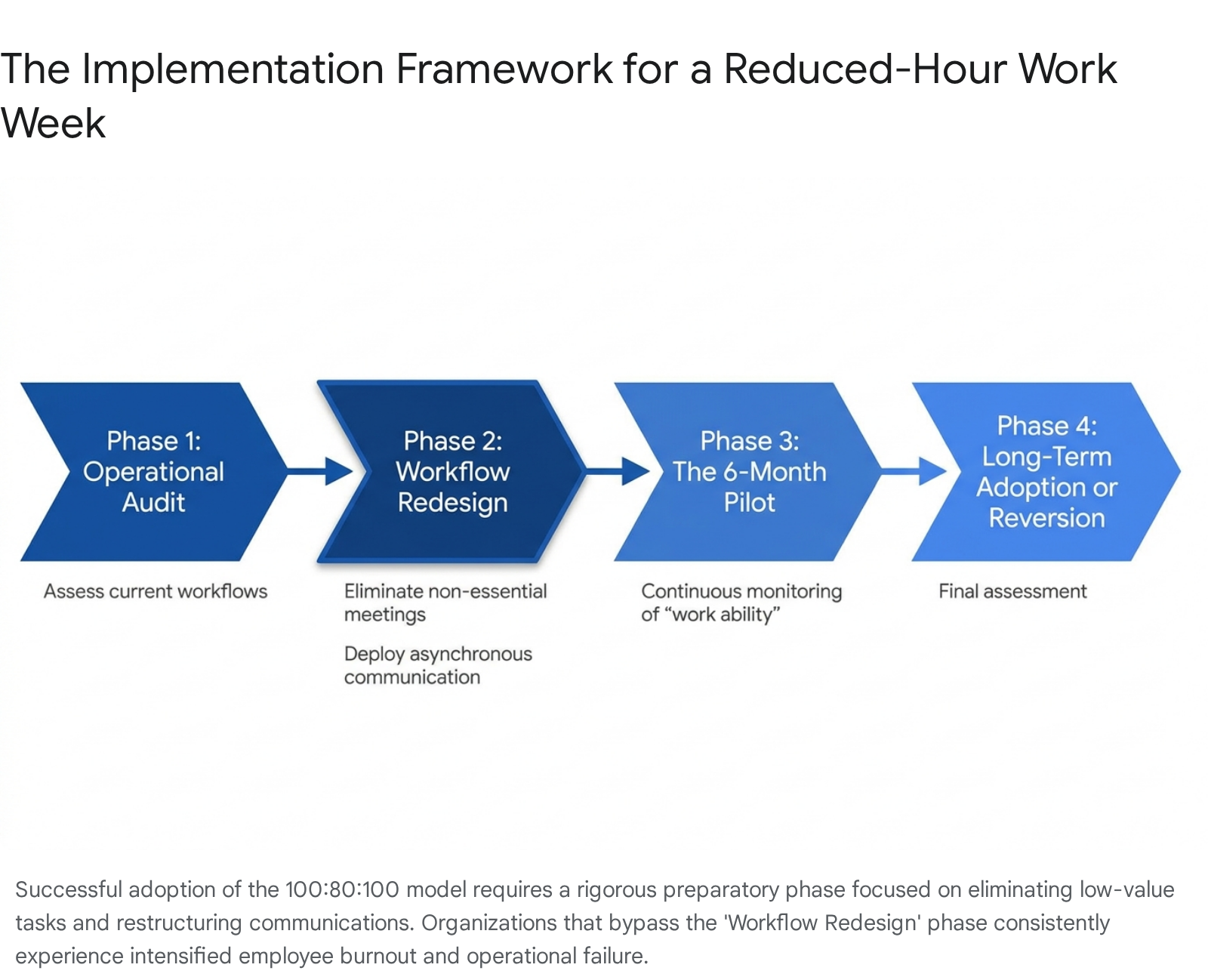
Crucially, the 2025 Nature study incorporated a control group of 300 employees working a traditional five-day schedule across 12 distinct companies, effectively isolating the psychosocial and operational impacts of the reduced-hour intervention 6181920. The study required all participating organizations to engage in an eight-week preparatory phase to restructure workflows, ensuring the intervention was a genuine operational redesign rather than a superficial scheduling shift 69.
The findings from this highly controlled environment corroborated the outcomes of earlier, opt-in pilots, providing robust empirical validation that the 100:80:100 model yields sustainable outcomes without the confounding variables of unmitigated self-selection 59.
Psychosocial Impacts and Employee Well-being
The most consistent and statistically significant findings across all global datasets relate to employee well-being. The traditional forty-hour week, particularly when combined with ubiquitous digital connectivity, has been heavily correlated with chronic stress, emotional exhaustion, and occupational burnout 2. Reductions in working time address these foundational pathologies of the modern workplace directly.
Burnout, Mental Health, and the Dose-Response Relationship
In the 2025 Nature Human Behaviour study, participants reported substantial improvements across nearly all monitored psychological domains. After six months on a reduced-hour schedule, 67% of workers reported lower levels of burnout, 41% experienced improved mental health, and 38% noted a reduction in sleep-related issues 61819. These gains were not fleeting; longitudinal follow-ups conducted at 12 and 24 months indicated that improvements in well-being were sustained long after the initial novelty of the schedule had normalized 1317.
Researchers identified a clear, statistically significant dose-response relationship between the magnitude of time reduction and the scale of psychological benefit. Employees who successfully eliminated eight or more hours from their weekly schedules demonstrated the most pronounced decreases in burnout, the highest increases in job satisfaction, and the clearest improvements in mental health 16918. Conversely, changes in physical health, while registering positive statistically significant gains, were less dramatic than mental health improvements. Researchers hypothesize that physiological changes require longer time horizons to manifest fully than the six-month trial windows permit 118.
Job Crafting and Subjective Work Ability
A critical mechanism driving these psychosocial benefits is the enhancement of what organizational psychologists term "work ability" - an employee's subjective assessment of their own competence, efficiency, and capacity to meet job demands 19.
Initial hypotheses from executive leadership frequently suggested that condensing five days of output into four would inherently elevate stress, as employees rushed to complete identical workloads in restricted timeframes 59. However, the empirical data revealed the opposite effect. Because organizations engaged in systemic workflow reorganization - eliminating redundant meetings, streamlining communications, and adopting asynchronous workflows - employees reported feeling substantially more capable and less fatigued 16921.
The four-day week acted as a catalyst for "job crafting," empowering employees to optimize their tasks 1. Consequently, the reduction in working hours did not replicate the stress of a looming deadline; rather, it fostered a more focused, uninterrupted work environment that actively reduced emotional exhaustion and increased a collective sense of performing jobs effectively 122.
Economic Viability and Organizational Performance
For organizational leadership and corporate boards, the viability of a four-day work week is ultimately judged by its economic sustainability. The global trials demonstrate that when reduced hours are paired with operational redesign, baseline business metrics are not only maintained but frequently enhanced.
Productivity Maintenance and Revenue Trajectories
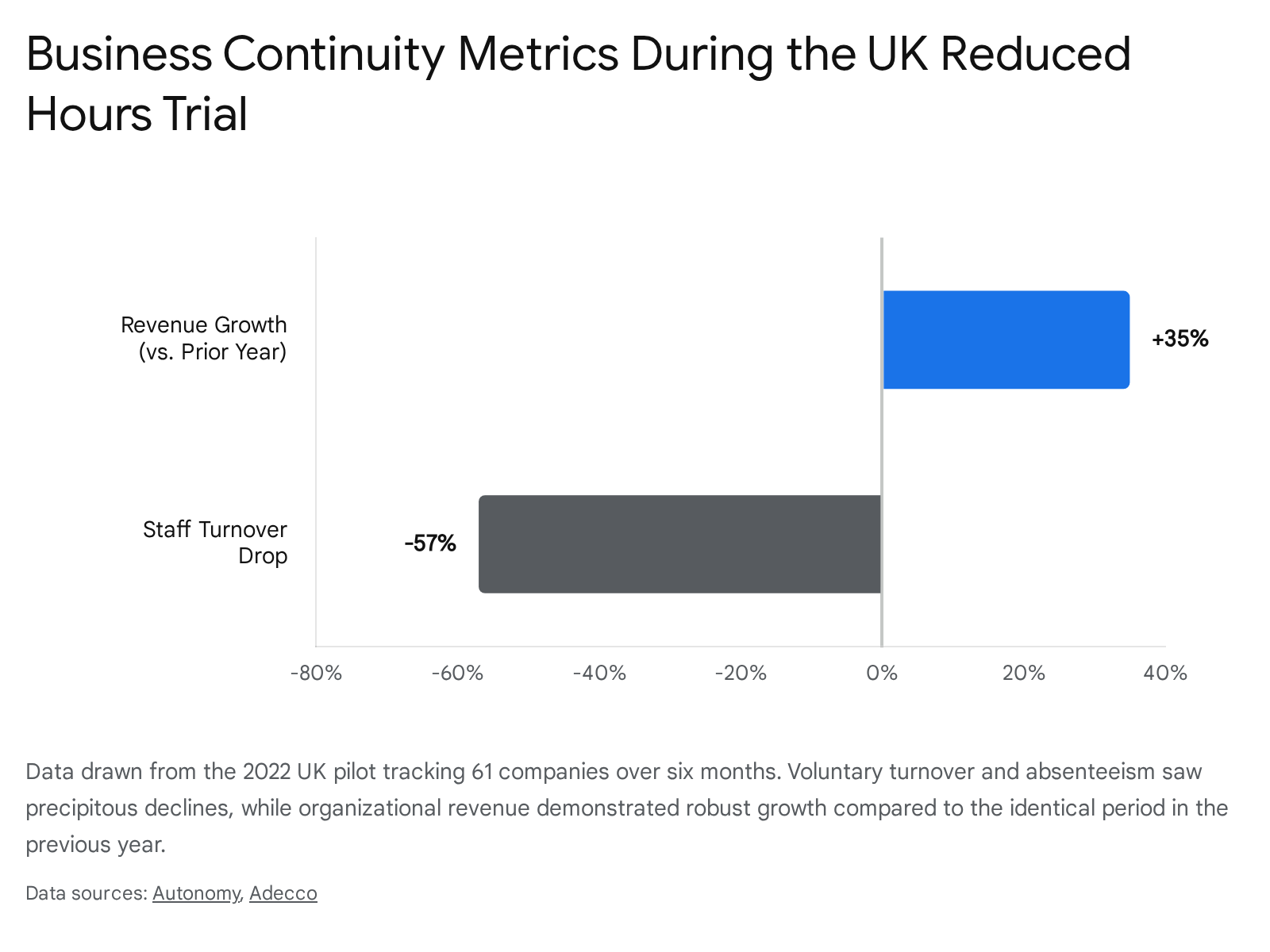
Across the UK pilot conducted in 2022, which involved 61 companies and approximately 2,900 workers, organizational revenue remained broadly consistent, growing by an average of 1.4% during the trial period 7917. When compared to the identical six-month period from the previous year, company revenue was approximately 35% higher, indicating robust financial health despite a 20% reduction in labor hours 7172325. Similar revenue stabilities or increases were documented in trials across South Africa, which noted a 10.5% average revenue increase across participating firms 2425.
These macro-level revenue indicators are supported by micro-level productivity data. Microsoft Japan's pioneering 2019 trial, which closed offices on Fridays and strictly halved meeting times, resulted in a highly publicized 40% gain in labor productivity alongside a 23% reduction in facility electricity consumption 91726. Across global trials coordinated by 4 Day Week Global, participating employers rated their overall productivity and performance during the pilots at an average of 7.7 out of 10, confirming that output expectations were met without expanding payroll expenditures 2527.
Human Capital Retention and Absenteeism
The most profound economic advantage realized by participating firms relates to human capital retention and acquisition. In the wake of post-pandemic labor market volatility, employee turnover and localized absenteeism represent massive capital drains on corporate balance sheets. During the UK trials, participating companies recorded a 57% drop in staff resignations and a 65% reduction in sick days and absenteeism 782628.
These retention benefits alter the fundamental economics of workforce compensation. Survey data indicates that the flexibility of a four-day week holds immense financial equivalent value for workers. Over 51% of participants in the South African trial indicated they would require a 21% to 50% base pay increase to voluntarily return to a five-day schedule at a new employer 242529. Furthermore, 13% to 15% of global participants stated that absolutely no feasible amount of money would induce them to revert to standard hours 7242530. Consequently, organizations utilizing the 100:80:100 model have effectively weaponized scheduling as a highly potent, non-monetary retention strategy that stabilizes workforce volatility without expanding total payroll liabilities 4.
Public Sector Implementation and Civic Outcomes
While private enterprises focus primarily on revenue optimization and talent retention, public sector entities have tested the four-day week to resolve systemic civic service delivery issues, reduce taxpayer burdens, and influence broader demographic trends.
The South Cambridgeshire District Council Longitudinal Study
The most comprehensive longitudinal study of a public sector trial occurred at the South Cambridgeshire District Council in the United Kingdom, which evaluated operations from early 2023 through 2025. Analyzed independently by the universities of Cambridge, Salford, and Bradford, the trial tracked performance across administrative desk staff, housing benefit processors, planning departments, and municipal refuse collectors 31323334.
The empirical data defied initial political skepticism. Of the 24 municipal services monitored, 21 improved or strictly maintained their pre-trial performance levels 323435. Major planning application decisions were processed roughly 15% faster, the speed of answering public contact center calls increased, and the percentage of household bins collected on time remained effectively perfect at over 99% 313335.
Most crucially for local governance, the council faced severe, pre-existing recruitment shortfalls prior to the trial, frequently filling only five to eight out of every ten advertised roles 3233. The implementation of the four-day week increased job applications by over 120% and reduced staff turnover by nearly 40% 323334. By filling positions with permanent staff rather than relying on expensive agency contractors and consultants, the council realized an annual taxpayer saving of £399,263 31323435. Based on these operational outcomes, the council formally voted to permanently adopt the model in July 2025 3334.
The Icelandic Precedent and National Scaling
The South Cambridgeshire outcomes mirror the pioneering public sector trials conducted in Iceland between 2015 and 2019. Initiated by the Reykjavík City Council and the national government, these trials transitioned 2,500 public sector workers - representing over 1% of the total national workforce - to a 35-to-36-hour week without pay reductions 152336.
The Icelandic trials maintained service provision efficiency across highly complex operations, including 24-hour hospitals, social service centers, and municipal schools. Stress and burnout indicators plummeted, while objective productivity metrics, such as the time taken to process government certificates, remained stable or accelerated 2336. The success of these public sector trials subsequently led to widespread union negotiations that ultimately secured shorter working hour rights for 86% of the national workforce, effectively redefining the country's macroeconomic labor standard 2337.
Demographic Policy in Japan and the UAE Flexible Summer
In other regions, public sector adoption is explicitly driven by unique macro-societal pressures and demographic engineering goals.
Confronting the cultural phenomenon of karoshi (death by overwork) alongside a severe demographic crisis stemming from declining birth rates, the Tokyo Metropolitan Government in Japan implemented a 100:80:100 four-day option for its civil servants beginning in April 2025 438. The explicit policy goal articulated by Tokyo Governor Yuriko Koike is to provide women and families with the temporal flexibility necessary for child-rearing without forcing them to sacrifice career progression 438.
Similarly, the United Arab Emirates has integrated reduced working hours into its governance strategies to address climate realities and foster a human-centric civil service. In Dubai, the government initiated the "Our Flexible Summer" program 3739. Following a successful 2024 pilot spanning 21 government entities that saw employee happiness and task completion rates jump by 98% and 87% respectively, the 2025 rollout offers flexible scheduling 37394041. From July 1 to September 12, public sector employees may choose to work an eight-hour Monday-to-Thursday schedule with Fridays entirely off, or a seven-hour schedule with a half-day Friday 373941. This initiative aims to align public sector work with school holidays, reduce peak-hour traffic during extreme heat, and improve family cohesion 3739.
Adoption Trajectories in Emerging Markets
The feasibility of the four-day work week in emerging economies has historically been questioned, under the assumption that the model relies inherently on the high-margin, knowledge-economy structures of the Global North. However, recent data from pilot programs in South America and Africa suggests significant adaptability, albeit with unique socioeconomic caveats.
The Brazilian Innovation Ecosystem Pilot
In Brazil, an initial cohort of 21 companies across five states - including startups like Winnin and consulting firms like Vockan - engaged in the nation's first structured trial beginning in September 2023 2544. Overseen by Reconnect Happiness at Work and 4 Day Week Global, participating firms adopted the 100:80:100 model, primarily utilizing synchronized Fridays off 101144.
Mid-trial data collected in 2024 showed remarkable operational resilience. Specifically, 61.5% of companies reported a boost in project execution, while meeting deadlines improved by 44.4% 44. Psychosocially, 62.7% of employees cited reductions in work-related stress, and 41.9% of workers reported an increased focus on their physical and mental health 4445. The success of these trials is shifting expectations within the Brazilian labor market, where startup surveys indicate that 84% of jobseekers view shorter work weeks as a determining factor in employment selection 45.
South Africa and the Inequality Debate
South Africa hosted the first four-day week trial on the African continent in 2023, encompassing 28 companies and nearly 500 employees 242529. The macroeconomic results were broadly consistent with global peers: participating companies experienced a 10.5% average revenue increase, a 57% reduction in occupational burnout, and a 9% decrease in absenteeism 242542. As a result, 92% of participating organizations stated their intention to continue the policy post-trial 242942.
However, regional economists, such as Dieter von Fintel of Stellenbosch University, warned that the model risks exacerbating deep-seated economic inequality 43. The South African trial successfully captured white-collar sectors - including professional services, IT software companies, and marketing agencies - but lacked substantive participation from the country's foundational labor sectors, such as mining, agriculture, and blue-collar manufacturing 242543. For workers earning at or near the minimum wage, reducing hours without sophisticated productivity offsets is economically inviable. This structural limitation suggests that, without targeted policy interventions, the four-day week may presently function as an exclusive luxury for a privileged minority in highly stratified developing economies 43.
Sectoral Friction and Trial Failures
While advocacy data often portrays a near-universal success rate, rigorous analysis of the global trials reveals distinct failure vectors. Approximately 8% to 10% of companies that trial a reduced-hour model ultimately abandon it, reverting to the standard five-day baseline 91744.
Operational Rigidity and the Allcap Case Study
Failures occur predominantly when organizations attempt to impose a calendar reduction without addressing the underlying mechanics of production, or when they operate in highly customer-centric environments with rigid, inflexible headcounts 945.
The UK-based engineering and industrial supplies firm Allcap provides a definitive case study in trial failure. Operating across five distributed sites with a strict customer-facing mandate, the company attempted to offer employees one day off per fortnight 104651. Because the baseline headcount was already lean, providing time off to one employee immediately and disproportionately displaced their workload onto colleagues 4551. The managing director, Mark Roderick, noted that instead of ten normal workdays, employees endured "nine extreme ones," leading to rapid and unsustainable exhaustion 1045. Without the financial capacity to increase the wage bill by hiring additional staff to build necessary redundancy, Allcap was forced to abandon the trial prior to its conclusion 454647.
Reversions in Large Multinational Enterprises
Similarly, larger global entities have encountered friction scaling the model across complex divisions. While Unilever successfully trialed the model in New Zealand, the company ultimately walked away from implementing it as a universal standard, citing the structured four-day model as too "rigid" to accommodate complex, multi-national operational timelines across diverse time zones 13364849. The Australian arm of health insurer Bupa echoed this sentiment, abandoning their pilot after determining that a one-size-fits-all reduction in days did not suit their highly varied workforce, opting instead for individualized flexible working policies 3648.
Failures in these instances point to a fundamental structural reality: an organization cannot compress a 40-hour workload into 32 hours via simple administrative mandate. If low-value tasks cannot be aggressively stripped from the workflow, or if the role requires constant physical presence, a four-day week inevitably accelerates burnout by drastically increasing the intensity of the remaining work hours 8104550.
Adapting the Model in High-Intensity Sectors
Sectors requiring 24/7 continuous operations present the highest structural barriers to reduced-hour models. In healthcare and heavy manufacturing, where shift work, physical presence, and strict safety ratios govern operations, simple hour reductions without corresponding headcount increases risk compromising critical output 895152. However, targeted interventions and process engineering have demonstrated that adaptation is possible.
Healthcare Leadership and Administrative Silos
In the healthcare sector, bedside nursing and emergency care are largely incompatible with blanket hour reductions. However, at the Children's Hospital of Orange County (CHOC), administrators successfully piloted a four-day week specifically targeted at nursing and respiratory leadership teams to combat soaring attrition rates 5354.
Utilizing the Institute for Healthcare Improvement's "Joy in Work" framework, the four-month pilot drastically altered leadership outcomes. Burnout among the 38 participating healthcare leaders collapsed from 61% to 4%, while self-reported job satisfaction surged from 71% to 96% 535455. Notably, the hospital observed no negative deviations in patient safety, satisfaction, or hospital-acquired conditions 5455. This trial proves that strategic application of the model within administrative and leadership silos can successfully stabilize management pipelines without destabilizing frontline clinical care 5455.
Manufacturing, Construction, and Blue-Collar Paradigms
In manufacturing and construction, firms that successfully adapt rely on profound process engineering rather than simple scheduling shifts. Advanced RV, an Ohio-based custom vehicle manufacturer, experienced an initial dip in output as technicians adjusted to shorter 32-hour schedules 61. Yet, by standardizing workflows, stripping out inefficiencies, and leveraging better physical rest to improve cognitive concentration, the firm recovered its production baseline within eighteen months 61. Despite working fewer hours, the firm maintained a higher quality of craftsmanship, minimizing costly physical errors and reducing localized employee turnover 61.
Similarly, in construction, researchers emphasize that expectations dictate outcomes. A 2024 study of 247 construction workers found that transitions to compressed or reduced schedules improved work-life harmony without increasing fatigue, provided the workforce was actively engaged in the redesign process 3. When workers possess agency over how their additional time off is structured, morale improvements directly offset the loss of raw labor hours 12.
Structural Prerequisites and Policy Horizons
Beyond internal workflow redesign, the permanent adoption of the four-day work week requires navigating rigid legislative environments and integrating emerging technologies.
Labor Law Compliance and Overtime Constraints
In the United States, human resources departments face complex compliance hurdles regarding the Fair Labor Standards Act (FLSA). While a true 32-hour week circumvents federal weekly overtime thresholds, state laws add layers of difficulty. California, for example, strictly requires overtime compensation for any hours worked beyond eight in a single day 5. This effectively renders the compressed four-day schedule (four ten-hour days) financially prohibitive without complex base pay restructuring, legally pushing progressive companies toward the genuine 32-hour reduced-hour model 5. Without broader legislative reform to support flexible work arrangements, multinational companies face a patchwork of compliance risks that slow universal adoption.
Artificial Intelligence and the Time Dividend
Looking to the immediate future, the integration of generative artificial intelligence represents the most significant catalyst for working time reduction. As AI automates vast swaths of administrative, coding, and cognitive labor, organizations face a strategic divergence in how they allocate the resulting productivity gains 4448.
Entities focused purely on cost extraction may utilize AI to reduce overall headcount while maintaining standard five-day schedules for remaining employees 4462. However, progressive organizations are actively exploring the concept of the "time dividend" - utilizing AI-driven productivity gains to fund a transition to a four-day week 1948. By returning the time saved by AI back to the human workforce, companies can alleviate widespread anxieties regarding technological displacement, foster higher engagement, and secure elite talent in a highly competitive market 1948. For companies adopting this paradigm, the four-day work week becomes a mechanism for sharing the economic benefits of automation with the workforce.
Conclusion
The global trial data unequivocally demonstrates that the four-day work week - specifically the 100:80:100 reduced-hour model - is a highly effective organizational intervention for the modern economy. When executed with methodological rigor, it fundamentally restructures the psychosocial contract between employer and employee. The data proves it is possible to virtually eliminate occupational burnout, slash voluntary turnover, and maintain corporate revenue without relying on the exhaustion of the workforce.
However, the assertion that the four-day week is the inevitable and immediate future for all sectors requires significant qualification. The empirical evidence reveals a fundamental truth: working fewer hours is not the cure; rather, the deliberate process of redesigning work to allow for fewer hours is the actual intervention 9. For knowledge-based industries, the transition is an increasingly obvious competitive advantage. Yet, for industries constrained by continuous operational needs, rigid customer-facing coverage requirements, and lean minimum-wage staffing models, the 100:80:100 model remains structurally prohibitive without an accompanying expansion in headcount and labor costs. As global markets continue to grapple with technological disruption, AI integration, and shifting demographic priorities, the four-day work week serves as a powerful testament to the fact that modern productivity is governed not by the sheer volume of hours logged, but by the strategic optimization of human energy and operational efficiency.