International work-life balance models and worker happiness
The regulation of working hours and the structuring of labor environments have profound effects on macroeconomic productivity, corporate operational resilience, and the subjective well-being of populations. As labor markets globally undergo structural shifts - driven by post-pandemic normalization, demographic aging, the integration of artificial intelligence, and evolving worker expectations - policymakers and corporate entities are increasingly forced to re-evaluate the traditional five-day, forty-hour baseline. The mechanisms through which different countries attempt to regulate work-life balance vary considerably, ranging from strict statutory maximums and mandatory right-to-disconnect laws to the implementation of experimental four-day workweeks.
Measuring the efficacy of these models requires analyzing the intersection of statutory frameworks, actual hours worked, and self-reported life evaluations. Data from the Organisation for Economic Co-operation and Development (OECD) and the World Happiness Report (WHR) provide a foundational baseline for this comparative analysis. However, evaluating work-life balance on a global scale also requires accounting for distinct regional phenomena, including uncompensated overtime in East Asia, phased statutory hour reductions in Latin America, and the realities of developing nations where the informal economy dictates labor conditions rather than formal legislation.
Macroeconomic Drivers of Work-Life Balance
The relationship between subjective well-being and labor output is a central focus of modern labor economics. Historically, corporate models operated under the assumption that maximizing working hours directly translated to maximized output. However, empirical evidence increasingly contradicts this linear correlation. Peer-reviewed research indicates that increased worker happiness has a direct, measurable impact on productivity 12.
The Relationship Between Work Intensity and Happiness
In experimental settings analyzed by the Journal of Labor Economics, individuals subjected to treatments designed to increase happiness demonstrated an approximate 12% increase in productivity, primarily measured through increased speed and accuracy in assigned tasks 12. Conversely, real-world exogenous shocks that lower happiness, such as bereavement or family illness, are systematically associated with decreased labor output 2. This combination of laboratory and real-world data firmly establishes a causal link between human well-being and economic performance.
This dynamic is further complicated by the specific type of labor being performed. The reduction of working hours does not yield uniform efficiency gains across all sectors. A comprehensive study utilizing a meta-frontier approach analyzed 514 South Korean companies, categorizing them into labor-intensive and knowledge-intensive industries 3. The researchers investigated changes in technical efficiency following the implementation of a national working hour reduction policy. The findings demonstrated that while the efficiency of labor-intensive industries improved following a reduction in working hours, knowledge-intensive industries actually experienced a decrease in technical efficiency 3. This suggests that the relationship between work intensity and happiness requires tailored, sector-specific approaches rather than blanket, uniform reductions.
Furthermore, worker happiness and job satisfaction are heavily influenced by compensation equity and internal perceptions of external labor markets. Research from the Massachusetts Institute of Technology (MIT) indicates that workers consistently misjudge wage markets, incorrectly anchoring their expectations for external compensation on their current salaries 4. This phenomenon of wage compression limits job mobility; workers who could achieve a 10% wage increase by switching firms frequently expect only a 1% increase, causing them to remain trapped in lower-paying, potentially less satisfying environments 4. Providing correct information regarding industry salary structures immediately increases an employee's intention to leave their current job 4. While absolute pay levels do not strictly dictate employee engagement, pay equity is highly correlated with overall workplace satisfaction, proving up to seven times more impactful on engagement than total compensation 5.
At the macroeconomic level, wage growth and labor market tightness are deeply intertwined with employee turnover. Analysts at the Federal Reserve Bank of New York have developed the Heise-Pearce-Weber (HPW) Tightness Index, which models wage inflation primarily through quit rates and vacancies per job searcher 6. Because most new hires transition from existing jobs rather than from unemployment, high quit rates signal a hyper-competitive market where firms must improve both wages and work-life balance conditions to attract and retain talent 6.
Global Happiness Rankings and Labor Correlation
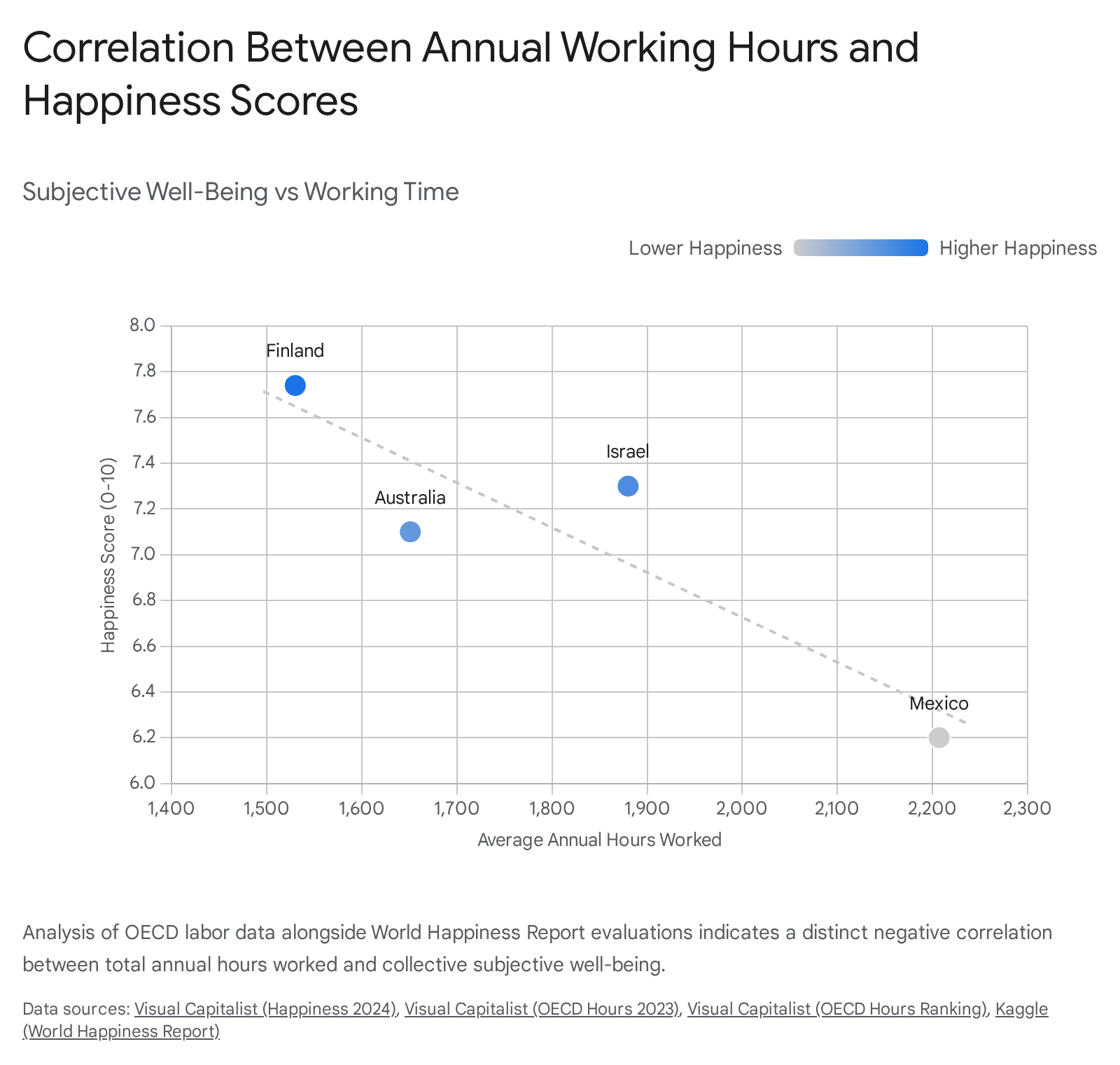
The most direct mechanism governments use to influence work-life balance is the establishment of statutory working hours. The OECD tracks actual annual hours worked per employed person, which aggregates regular work hours for full-time, part-time, and part-year workers, as well as paid and unpaid overtime 7. When cross-referenced with data from the World Happiness Report 2024, a distinct pattern emerges regarding the correlation between total hours worked and national happiness scores 89.
The World Happiness Report utilizes data from the Gallup World Poll, asking approximately 1,000 respondents per country to evaluate their current life on a scale from 0 to 10. The final rankings are based on a three-year average (2021 - 2023) 8. In 2024, Nordic nations continued to dominate the top tier of the WHR, with Finland (7.74), Denmark (7.6), Iceland (7.5), and Sweden (7.3) recording the highest life evaluations globally 810. These nations simultaneously record some of the lowest annual working hours in the OECD 1011.
Conversely, nations with the highest working hours systematically record lower life evaluations. The United States ranked 23rd in the WHR, heavily impacted by declining happiness among workers under 30 58. In emerging economies with high labor burdens, happiness scores dip further. At the absolute bottom of the OECD hours ranking is Mexico, where the average worker clocks over 2,200 hours per year - equivalent to 276 eight-hour workdays 9.
Statutory Working Hours and Economic Realities
The structural factors driving the disparity between high-hour and low-hour OECD nations are diverse, encompassing labor laws, cultural norms, and the composition of the workforce itself.
The OECD Working Hours Spectrum
The following table summarizes the disparity between extreme ends of the OECD working hours spectrum, cross-referenced with their 2024 WHR scores and generalized regional attributes.
| Country | Average Annual Hours Worked (OECD) | Equivalent 8-Hour Workdays | WHR 2024 Happiness Score | Labor Market Context |
|---|---|---|---|---|
| Mexico | 2,207 | 276 | 6.2 (Estimated regional) | High informal sector; historical 48-hour six-day workweek standard. |
| Costa Rica | 2,171 | 271 | 7.27 | Exception to the rule; high subjective well-being despite long hours. |
| Chile | 1,953 | 244 | 6.3 | Currently implementing phased reductions from 45 to 40 hours. |
| South Korea | 1,872 | 234 | 6.0 | Strict statutory caps severely undermined by inclusive wage systems. |
| United States | 1,799 | 225 | 6.7 | High baseline productivity; declining youth happiness. |
| Australia | 1,651 | 206 | 7.1 | Balanced statutory protections; recent right-to-disconnect adoption. |
| Denmark | 1,380 | 172 | 7.6 | Strong social support systems; extensive collective bargaining. |
| Germany | 1,343 | 168 | 6.7 | High productivity via advanced manufacturing; robust part-time labor market. |
89101112
While the correlation between reduced hours and increased happiness is clear, the exact causal mechanisms are highly complex and occasionally misinterpreted. Because the OECD dataset aggregates both full-time and part-time workers, countries with robust part-time labor markets naturally record lower average annual hours per capita 1413. For instance, Germany records the lowest annual hours worked in the OECD (1,343), but this figure is heavily influenced by a high proportion of part-time employees working less than 30 hours per week 111213.
Furthermore, high-income nations benefit from advanced technological infrastructure, robotics, and automation, allowing workers to generate higher GDP per capita within fewer hours 1014. In developing or newly industrialized economies, longer working hours are frequently a structural necessity to compensate for lower per-capita productivity, lower baseline wages, and a reliance on agricultural or labor-intensive manufacturing sectors 1112.
Overtime Regulation in East Asian Economies
The approach to work-life balance in East Asia is defined by historical cultures of intense labor, high rates of uncompensated overtime, and recent, aggressive state interventions attempting to reverse these trends. Despite achieving high-income status and advanced economic development, both Japan and South Korea continue to struggle with deeply entrenched workplace norms that equate excessive physical presence with dedication and productivity.
South Korea and the Comprehensive Wage System
In 2018, the South Korean government introduced a nationwide 52-hour workweek system, capping regular hours at 40 with a strict maximum of 12 allowable overtime hours per week 1614. The policy was implemented in phases, initially applying strictly to large conglomerates before expanding to businesses with 5 to 49 employees by 2021 1614. A 2024 government survey indicated that the policy succeeded in modestly reducing the aggregate time spent at work; the average daily working hours for salaried workers aged 15 and older fell to 6 hours and 8 minutes, down 15 minutes from 2019 levels 14.
However, the efficacy of the 52-hour cap is severely undermined by South Korea's "comprehensive wage system" (inclusive wage system) 1516. Originating in 1976, this wage structure legally permits companies to bundle assumed overtime, night work, and holiday pay into a fixed monthly base salary, regardless of the actual hours an employee works 1516. This system inherently disincentivizes employers from managing or limiting hours, as marginal labor beyond the standard 40-hour threshold incurs zero additional payroll costs 16.
The cultural stigma against reporting labor violations further exacerbates this issue. South Korea suffers from extraordinary levels of uncompensated labor. In 2024, unpaid wages in South Korea amounted to approximately 2.04 trillion won ($2.77 billion USD), a figure roughly 22 times higher than the equivalent unpaid wages in Japan (9.8 billion yen) and seven times higher than those in the United States, despite South Korea possessing a labor force only a fraction of the size of the US 17. Workers who suffer from wage arrears are often ostracized or criticized for causing disruption, frequently hesitating to file formal complaints until after they have resigned from their positions 17.
In response to this systemic issue, the South Korean Labor Ministry deployed new guidelines in 2024 to restrict the abuse of the inclusive wage system 16. The guidelines mandate that employers compensate workers based on actual hours recorded at a minimum premium rate of 1.5 times the ordinary wage if the fixed allowance falls short 16. The government also established anonymous complaint mechanisms designed to trigger ad hoc inspections by regional labor offices 16.
Japan and the Work Style Reform
Japan shares a similar legacy of extreme labor hours, culminating in the globally recognized socio-medical phenomenon of karoshi (death from overwork) 18. Among G7 nations, Japan historically maintained the highest share of workers logging 49 or more hours per week (15.3% as of 2022) 18. To address this public health and productivity crisis, the Japanese government enacted the Work Style Reform (WSR) in 2018, which introduced the country's first legally binding statutory limits on overtime 18.
The WSR fundamentally limited overtime to 45 hours per month and 360 hours per year 1819. Certain sectors experiencing chronic, severe labor shortages - including construction, transportation, and healthcare - were granted a five-year grace period to adapt. These grace periods expired in April 2024, establishing strict upper limits of 720 annual overtime hours for construction workers and 960 hours for physicians and commercial drivers 19. The macroeconomic impact has been measurable; Cabinet Office data issued in early 2026 indicated that average annual working hours per person decreased to 1,654.2 in fiscal 2024, marking a drop of over 250 hours from the 1995 peak 19.
However, analyzing the microeconomic effects reveals highly calibrated, and occasionally contradictory, outcomes. Difference-in-difference analyses using payroll and survey data demonstrate that the WSR successfully reduced average monthly overtime by 5 hours (a 25% reduction) and compressed the overtime distribution across firms 18. Total worker earnings subsequently decreased by 2% due to the loss of lucrative overtime premiums, while baseline hourly wages remained stagnant 18.
Crucially, the subjective well-being gains generated by the reform were unevenly distributed across demographics. The reform improved life and leisure satisfaction almost exclusively among female workers, alongside a corresponding decline in precarious, nonstandard female jobs as firms restructured to offer more stable employment 18. Conversely, among male workers, the reduction in legally permissible paid overtime was partially offset by a silent increase in unpaid, unrecorded overtime 18. Because the reform curtailed legal hours without necessarily reducing the aggregate workload demanded by corporate management, male employees largely absorbed the excess labor off the books, neutralizing potential gains in their overall life satisfaction 18.
Comparative Wage and Purchasing Power Dynamics
Understanding the overtime crisis in East Asia requires contextualizing the baseline economic compensation of these workers. Both Japan and South Korea are high-income economies with comparable standard statutory workweeks (40 hours), but their wage structures display notable divergence.
| Metric | Japan | South Korea | Difference (USD terms) |
|---|---|---|---|
| Minimum Wage (Hourly) | ¥1,121 ($7.08) | ₩10,320 ($6.86) | Japan +3.2% |
| PPP-Adjusted Minimum Wage | $12 | $13 | South Korea +8.3% |
| Average Gross Salary (Monthly) | ¥381,667 ($2,410) | ₩3,960,000 ($2,631) | South Korea +9.1% |
| Standard Overtime Premium | 25% (50% over 60 hrs/mo) | 50% | South Korea higher baseline premium |
| Late Night Work Premium | Adds 25% | Adds 50% | South Korea higher baseline premium |
16
While Japan maintains a nominally higher minimum wage in direct currency conversion, South Korean workers possess slightly higher purchasing power parity (PPP) and achieve higher average gross monthly salaries 16. South Korea's statutory baseline for overtime compensation is also significantly higher (a flat 50% premium compared to Japan's tiered 25% to 50% premium) 16. However, as noted previously, the widespread exploitation of the comprehensive wage system frequently negates these statutory premiums in practice, resulting in the massive disparity in unpaid wage statistics between the two nations 1617.
Reduced Workweek Models in Advanced Economies
Beyond enforcing statutory maximums on total hours, the specific distribution of hours across the week has become a primary target for systemic labor reform in advanced economies. The four-day workweek has transitioned from a theoretical concept to a rigorously tested model. The most prominent framework utilized by advocates is the "100-80-100" model, wherein employees receive 100% of their standard compensation for working 80% of their traditional hours, under the strict expectation that they will maintain 100% of their historical productivity 2024.
Efficacy of the Four-Day Workweek in Professional Services
The largest structured pilot of the four-day workweek took place in the United Kingdom between June and December 2022, encompassing 61 companies and approximately 2,900 workers 21. The trial was explicitly designed to resist a "one-size-fits-all" mandate. Participating companies were permitted to implement the reduction flexibly to suit their operational needs, utilizing staggered days off, decentralized scheduling across departments, annualized averaging, or a strict Friday-off policy 21.
The results of the trial indicated profound, measurable benefits for worker well-being. Following the six-month pilot, 71% of employees reported reduced levels of burnout, and 39% reported feeling significantly less stressed 2122. Mental health, physical health, sleep duration, and overall life satisfaction all registered measurable improvements 2122. The trial also demonstrated a positive secondary effect on gender equality in the domestic sphere; male participants increased the time spent on childcare by more than double the rate of female participants, pointing to the structural benefits of reduced working hours for familial balance .
From an organizational perspective, the compressed schedule proved highly sustainable for the majority of participants. Revenues across the participating companies did not decline; rather, they rose by an average of 35% when compared to similar periods in previous years 2123. Retention improved dramatically, with staff turnover decreasing by 57% and sick days falling by 65% 2224. One year post-trial, 54 of the original 61 organizations had maintained the four-day schedule, with 31 confirming the policy as a permanent structural change to their operating models 2123. Furthermore, 15% of employees surveyed stated that "no amount of money" would convince them to revert to a five-day schedule 21.
Sectoral Limitations and Work Intensification
Despite the high-profile successes documented primarily in professional services, marketing, and tech, the four-day workweek faces massive structural limitations when applied to client-facing, industrial, and care-based sectors. Critics assert that reducing the workweek without simultaneously reducing the aggregate volume of work or extending deadlines merely compresses the same labor into a shorter timeframe, precipitating severe work intensification 2526.
A rigorous follow-up analysis investigating the negative outcomes of the UK trial highlighted these specific operational hurdles. An engineering and industrial supply company, Allcap, withdrew from the trial two months early 26. Operating as a trading business with a continuous demand for manufacturing and construction components, the company found it impossible to implement a universal day off 26. They attempted a staggered schedule, granting employees one day off per fortnight. However, because the company was already operating on a reduced headcount, covering for absent employees became untenable 26. The managing director noted that rather than experiencing improved balance, employees endured "nine extreme workdays" leading up to their rest day, resulting in severe physical and mental exhaustion 26.
Similar failures were recorded in the marketing sector. Alter Agents, an LA-based marketing firm, tested a 32-hour, four-day week for ten weeks 27. At the end of the trial, employee satisfaction had actually decreased 27. The strict compression of client deadlines meant that employees experienced heightened anxiety on their designated days off, constantly checking emails and worrying about accumulating workloads 27. The blurring of boundaries paradoxically increased stress, as the organization failed to adjust external client expectations to match internal scheduling changes 27.
These case studies highlight the structural barriers inherent in healthcare, emergency services, education, and retail, where continuous consumer access and 24/7 service delivery are mandatory 2528. In these sectors, reducing the standard workweek requires proportional increases in overall headcount to maintain continuous shift coverage. This imposes substantial wage burdens that small and medium-sized enterprises (SMEs) often cannot absorb in high-inflation environments 2529. Consequently, labor economists caution that transitioning to a four-day workweek without corresponding macroeconomic support or operational restructuring merely shifts the logistical burden onto frontline employees, ultimately degrading customer service and accelerating burnout 25.
Statutory Reductions in Latin America
While East Asia attempts to enforce existing statutory caps and European nations experiment with condensed schedules, several emerging economies in Latin America are actively lowering their baseline legal working hours to align with international norms. Latin America historically records some of the highest working hours globally, driven by institutionalized six-day workweeks and broad thresholds for overtime 9.
The Phased Implementation of the 40-Hour Week in Chile
In April 2023, the Chilean Congress passed Law No. 21,561, a landmark reform mandating a reduction of the ordinary workweek from 45 hours to 40 hours, explicitly stipulating that employers cannot proportionally reduce employee remuneration 3031. To mitigate severe economic shocks to productivity, particularly for small and medium-sized enterprises, the government designed a five-year phased implementation schedule that commenced in 2024 3032.
The Chilean reform is notable for actively introducing substantial scheduling flexibility alongside the reduction in hours. Under the new legal framework, employers and employees can mutually agree to distribute the 40 hours over four days instead of five (e.g., implementing a four-day, 10-hour shift model without requiring authorization from the Labour Inspectorate) 3233. Additionally, working hours can be averaged over a four-week cycle, provided that no single week exceeds 45 hours and that two consecutive 45-hour weeks do not occur within the cycle .
The legislation also addresses overtime compensation in a novel manner, allowing parties to agree in writing to exchange accumulated overtime hours for additional vacation days, capped at five extra days per year 33. Furthermore, the law tightly restricts the classification of "exempt" employees (those not subject to statutory hour limits), narrowing the exemption primarily to senior managerial roles operating without direct supervision, forcing companies to re-evaluate their entire payroll structure 3032.
Overtime Restructuring and Electronic Tracking in Mexico
Mexico ranks first in the OECD for annual working hours (2,207) and has operated under a constitutional 48-hour standard limit for decades, typically structured across six eight-hour working days 93441. In response to growing pressure regarding occupational health, stagnant wages, and low productivity metrics relative to hours worked, the Mexican Congress initiated an amendment to Article 123 of the Constitution to establish a 40-hour weekly ceiling 3441.
Similar to Chile, the Mexican reform incorporates a phased rollout to prevent macroeconomic disruption. The legislation establishes a regulatory preparation year in 2026, followed by reductions of two hours annually: 46 hours in 2027, 44 in 2028, 42 in 2029, and finally reaching 40 hours in 2030 3441. However, the Mexican approach goes much further by fundamentally restructuring the financial penalties associated with overtime.
| Year | Statutory Workweek Limit | Maximum Permitted Overtime |
|---|---|---|
| 2026 | 48 Hours | 9 hours double-time, 4 hours triple-time |
| 2027 | 46 Hours | 9 hours double-time, 4 hours triple-time |
| 2028 | 44 Hours | 10 hours double-time, 4 hours triple-time |
| 2029 | 42 Hours | 11 hours double-time, 4 hours triple-time |
| 2030 | 40 Hours | 12 hours double-time, 4 hours triple-time |
34
By 2030, allowable overtime will be capped at 12 hours per week. These hours are strictly limited to a maximum of four hours per day across no more than four days per week, and must be paid at a 200% premium (double time) 34. Any hours exceeding this hard cap must be compensated at a 300% premium (triple time) and cannot exceed four total hours 34.
The most disruptive mechanism in the Mexican reform, however, is not the reduction in hours, but the enforcement mechanism: mandatory electronic time tracking. Secondary legislation drafted by the Ministry of Labor and Social Welfare (STPS) will require all employers to utilize verifiable electronic attendance systems to record start and end times by January 1, 2027 344135. This legal requirement shifts the burden of proof entirely onto employers during labor inspections and effectively eliminates the informal, spreadsheet-based time tracking that previously facilitated widespread unpaid overtime 44. Noncompliance with the electronic tracking mandate risks severe administrative fines ranging up to $586,550 MXN (approximately $33,500 USD), and systemic failure to pay statutory overtime may now escalate to criminal liability under expanded anti-exploitation statutes 34.
Emerging Markets and Statutory Adjustments
The push to modernize labor laws is not confined to the Americas or East Asia. In 2024 and 2025, South Africa initiated its most significant overhaul of labor market frameworks in recent years, attempting to strike a balance between worker protection and employer flexibility in an economy grappling with extreme unemployment rates 4536.
South Africa's recent legislative updates fundamentally acknowledge the changing nature of work by extending basic protections to the gig economy. Over two million South Africans earn income through gig platforms (such as ride-hailing and delivery services), historically operating without minimum wage guarantees or dismissal protections 4536. The 2025 amendments to the Labour Relations Act and the Basic Conditions of Employment Act seek to bring these workers under the ambit of the law, extending minimum wage requirements and statutory fund contributions to platform and on-call workers 453637. The legislation also introduces robust protections against sudden shift cancellations, requiring employers to pay workers for canceled hours if proper notice is not provided 37.
Simultaneously, the reforms attempt to reduce the barrier to hiring for small businesses. The introduction of a three-month probationary "run-in" period relaxes procedural dismissal obligations for new hires, encouraging hesitant employers to take on staff 4536. However, for established employees, the statutory severance pay entitlement in retrenchment scenarios has been doubled from one week to two weeks' remuneration per completed year of service, significantly increasing the financial cost of corporate restructuring 3637.
The Informal Economy and Regulatory Disconnect
Evaluating work-life balance based strictly on statutory limits, paid overtime premiums, and reduced workweek pilots relies on a critical macroeconomic assumption: that the majority of a nation's workforce participates in the formal, regulated economy. In vast regions of the developing world, this assumption is structurally invalid.
Labor Realities in Sub-Saharan Africa
In Africa, approximately 83% of all employment exists entirely within the informal economy 38. The International Labor Organization (ILO) notes that this immense scale of informality has barely shifted over the past two decades, representing between 30% and 40% of the continent's gross domestic product 38.
The situation is particularly acute in Nigeria. As of 2024, the informal employment rate in Nigeria reached 93% of the total workforce 3940. This informality is deeply stratified by geography and demographics, with rates spiking to 97.5% in rural areas and reaching a staggering 99.1% among young women 3940. In this environment, statutory working limits, minimum wage laws, and mandatory leave policies are functionally nonexistent. Self-employment, unregistered street vending, and subsistence agriculture dominate the labor landscape 39.
Consequently, work-life balance in the informal economy is dictated entirely by daily subsistence needs and immediate macroeconomic pressures rather than legislative frameworks. High inflation, which reached 26.3% in Nigeria in 2024, rapidly erodes purchasing power, forcing informal workers to maximize their labor hours simply to afford basic food staples 39. In this context, theoretical reductions in working hours are viewed not as an improvement in subjective well-being, but as a catastrophic reduction in survivability. The ILO estimates that 60% of Nigerian workers live in extreme or moderate poverty despite being employed, highlighting the severe lack of high-productivity, wage-paying jobs 39.
Formal Versus Informal Dualism in Vietnam
Similar dynamics dictate the labor markets of Southeast Asia. In Vietnam, the standard statutory workweek is set at 48 hours, typically structured as six eight-hour days 4152. While proposals regularly circulate to lower the threshold to 44 or 40 hours, these statutory debates primarily affect the minority of the population engaged in formal, contract-based employment 4142.
As of mid-2024, informal labor accounts for 65.2% of total employment in Vietnam, encompassing over 33.5 million workers 544344. Even within the formal Vietnamese manufacturing and export sectors, baseline wage constraints mean that workers readily accept, and frequently depend upon, maximum legal overtime (up to 40 hours per month and 300 hours annually in designated sectors) to supplement low starting salaries 5758. Until emerging economies undergo significant structural transformations to increase the capitalization of enterprises, expand industrial value chains, and transition labor into the formal tax base, global indexes evaluating work-life balance will fail to capture the daily reality of these workforces.
Digital Boundary Enforcement and the Right to Disconnect
As advanced economies transition away from physical manufacturing and toward digital, knowledge-based services, the geographic and temporal separation between the workplace and the home has effectively dissolved. The ubiquity of smartphones and collaborative remote work software ensures that employees are perpetually reachable, leading to an insidious form of passive work intensification.
This phenomenon is quantifiable. A 2026 survey of South Korean office workers revealed that two out of three respondents received work-related communications via messaging applications after hours or on holidays 15. Crucially, 30.5% of those contacted reported executing work instructions from home as a direct result of these messages, while 30.8% reported receiving communications after 10:00 PM 15. In response to this erosion of private time, 80.5% of surveyed workers supported legislation to ban after-hours work contact 15.
To combat the psychological toll of continuous connectivity, a growing coalition of nations has codified the "right to disconnect," legally empowering employees to ignore work-related communications outside of normal working hours without fear of professional reprisal or disciplinary action 5945.
Statutory Frameworks in the European Union and Australia
France pioneered the right to disconnect in 2017, enacting labor laws requiring companies with over 50 employees to negotiate specific usage charters regarding digital tools to ensure rest periods are respected 5945. Belgium followed suit with the 2022 Labour Deal, extending the mandate to companies with 20 or more employees 4647. If Belgian employers and union representatives fail to reach a collective agreement, the employer is legally obligated to unilaterally codify a fallback company policy detailing strict instructions on the use of communication devices 454647. Ireland adopted a slightly different approach in 2021, implementing a comprehensive Code of Practice that, while not strictly legislative, is admissible as evidence in employment tribunals 454647.
In August 2024, Australia enacted comprehensive right-to-disconnect legislation applying to all businesses with over 15 employees, with a phased rollout scheduled for smaller enterprises in August 2025 5946. The Australian law explicitly protects workers who refuse unreasonable out-of-hours contact not just from direct managers, but also from clients, suppliers, and third parties 59. Violations of this right carry strict financial penalties for non-compliant businesses 59.
Efficacy of Disconnection Policies on Subjective Well-Being
Data compiled by Eurofound across Belgium, France, Italy, and Spain indicates that formalized right-to-disconnect policies yield tangibly positive outcomes regarding overall job satisfaction, mental health, and work-life balance 4748. Among surveyed nations, 76% of Spanish employees evaluated the impact of disconnection policies positively, followed by 74% in France, 70% in Italy, and 69% in Belgium 48.
However, the legislation does not completely sever the digital tether, particularly for remote employees. Eurofound data shows that eight out of ten remote workers - even in companies possessing strong disconnection policies - continue to regularly receive communications outside their contracted hours 48. Furthermore, remote workers remain highly susceptible to working longer hours than contractually required, driven by internal pressure or project deadlines 48. Therefore, while statutory rights provide vital legal protection against overt retaliation, transforming workplace connectivity requires deep cultural shifts initiated by executive management regarding acceptable response-time expectations.
Conclusion
The global analysis of working hours, statutory frameworks, and subjective well-being demonstrates that there is no singular optimal model for structuring labor. However, cross-referencing OECD labor data and World Happiness Report outcomes firmly establishes that the highest levels of worker happiness and societal well-being are consistently found in nations enforcing lower statutory working hours, strong social safety nets, and strict legal protections against unpaid labor.
The regulatory models that successfully generate happier workers share three distinct operational characteristics. First, they focus on absolute hour reduction rather than mere schedule compression. The success of the four-day workweek hinges entirely on the 100-80-100 model where the aggregate workload is managed down, avoiding the intense physical and psychological stress of packing forty hours of required output into thirty-two hours of available time. Second, successful models aggressively target and penalize uncompensated overtime. As demonstrated by Japan's Work Style Reform, merely altering the legal limit is insufficient if corporate culture simply shifts the excess labor off the official books. Meaningful reform requires robust enforcement mechanisms, such as Mexico's pivot toward mandatory electronic time tracking and South Korea's regulatory crackdown on inclusive wage systems. Finally, successful frameworks establish rigid, legally defensible boundaries around digital communication. Utilizing right-to-disconnect laws prevents formal labor reductions from bleeding into private hours via remote connectivity. For emerging economies currently dominated by the informal sector, these nuanced statutory balances remain secondary to the primary, monumental challenge of broad economic formalization, poverty reduction, and the establishment of basic wage stability.