
What the Evidence Says About the Four-Day Workweek
Global trials overwhelmingly show that reducing the workweek to 32 hours without cutting pay drastically lowers employee burnout, reduces turnover, and maintains or even boosts company revenue in knowledge-based sectors. However, scaling this model to 24/7 industries, healthcare, and manufacturing remains highly complex, with economists warning that widespread adoption requires massive technological investment and sweeping cultural shifts to prevent detrimental work intensification.
The concept of work-time reduction is not a modern anomaly, but rather the continuation of a century-long labor trend. In 1866, the central plank of the American trade union movement was a demand for an eight-hour workday, encapsulated by the slogan: "Eight hours for work, eight hours for rest, and eight hours for what you will" 1. The push for shorter hours incrementally gained traction, leading to President Woodrow Wilson signing legislation in 1916 that established an eight-hour day for railroad workers 1. A decade later, Henry Ford instituted a 40-hour, five-day workweek for autoworkers upon realizing that capping hours optimized factory productivity and gave workers the leisure time required to purchase and drive the automobiles they manufactured 123. By 1940, the Fair Labor Standards Act formally enshrined the 40-hour workweek as the American standard 145.
For more than eight decades, that standard has remained largely static, even as the global workforce has undergone profound transformations. Modern workers are over 400% more productive today than they were in the 1940s, driven by monumental advances in computing, robotics, and artificial intelligence 46. Despite this surge in productivity, real weekly wages for the average worker have stagnated or declined after adjusting for inflation, while the wealth generated by these efficiencies has increasingly concentrated at the top of the corporate hierarchy 147.
In the wake of the COVID-19 pandemic, which shattered long-held assumptions about where and how work must be done, a global movement has emerged demanding a new work-time paradigm. The four-day workweek is rapidly transitioning from a progressive fringe concept into a mainstream corporate strategy and legislative battleground, promising to return a dividend of technological progress to the workforce in the form of time. However, analyzing the vast troves of data generated by recent global pilot programs reveals that successfully decoupling hours worked from value generated requires meticulous organizational redesign, and the model is far from universally applicable.
Defining the Terms: Reduced Hours vs. Compressed Shifts
A fundamental source of confusion in discussions about the four-day workweek is the conflation of two entirely different operational models. Organizations implementing a shorter week generally adopt either the 100:80:100 model or a compressed work schedule, and these two approaches yield vastly different outcomes for employee wellbeing.
The modern four-day workweek movement advocates almost exclusively for the 100:80:100 model. Under this framework, employees receive 100% of their standard pay for working 80% of their standard hours (typically 32 hours instead of 40), in exchange for a commitment to maintain 100% of their previous productivity and output 27. This model operates on the principle of Parkinson's Law, an economic adage stating that work naturally expands to fill the time available for its completion 10. By artificially restricting the time available, proponents argue that employees instinctively ruthlessly prioritize their workloads, work more efficiently, and eliminate low-value activities 710. Organizations achieve this by significantly shortening meetings, adopting asynchronous communication tools, and cutting out administrative redundancies 111213.
Conversely, the Compressed Workweek (often referred to as a 4/10 schedule) is a long-standing practice in sectors like manufacturing, law enforcement, and nursing. Under this arrangement, the traditional 40-hour workload is not reduced; it is merely condensed into four 10-hour days 714. While employees benefit from an additional day off each week or a nine-day fortnight, their total working time remains unchanged 89.
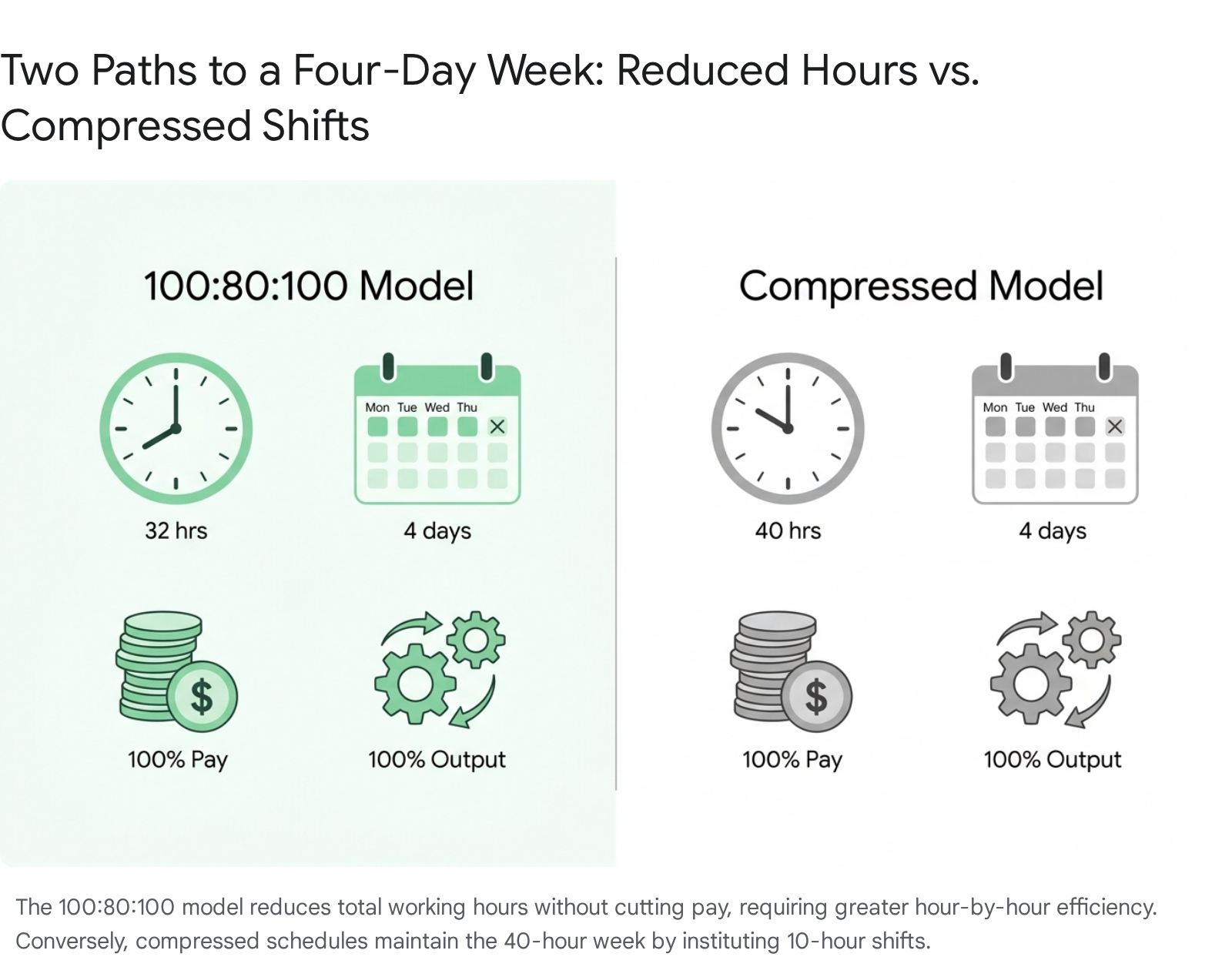
The data indicates that while compressed schedules offer scheduling flexibility, they carry severe risks regarding worker fatigue. Extending the workday to ten or more hours frequently leads to diminished cognitive performance in the final hours of the shift, resulting in higher error rates and increased physical exhaustion 17. For workers with caregiving responsibilities, such as picking children up from school, a 10-hour workday is often functionally impossible 210. Furthermore, research has shown that extending the intensity of the workday can offset the restorative benefits of the extra day off, ultimately leading to equivalent or higher rates of burnout over the long term 317. As a result, the vast majority of modern pilot programs and advocacy efforts focus strictly on genuine work-time reduction through the 100:80:100 framework.
Comparing Workweek Structures
| Metric | 100:80:100 Model | Compressed Workweek |
|---|---|---|
| Total Weekly Hours | 32 hours (typically) | 40 hours |
| Standard Daily Shift | 8 hours | 10 hours |
| Compensation | 100% of previous full-time salary | 100% of full-time salary |
| Output Expectation | 100% of previous productivity | 100% of previous productivity |
| Primary Drawback | Requires severe workflow optimization to prevent dropped tasks | High risk of daily exhaustion and end-of-day cognitive decline |
| Typical Adopters | Tech, marketing, professional services, non-profits | Healthcare, law enforcement, continuous manufacturing |
The Global Evidence: A Wave of Pilot Programs
To transition the four-day workweek from a theoretical ideal to an empirical reality, the non-profit organization 4 Day Week Global has orchestrated a series of coordinated, six-month trials across multiple continents over the past several years. Conducted in partnership with independent researchers from Boston College, the University of Cambridge, and University College Dublin, these trials provide the most extensive scientific data available on work-time reduction 111213.
The United Kingdom: The Largest Single-Country Trials
The United Kingdom hosted the most closely watched trial to date, running from June to December 2022. The pilot involved 61 companies and approximately 2,900 employees, representing a broad swath of the economy, from office-based software developers and financial services to animation studios and local fish-and-chip shops 714.
The results were described by researchers as a resounding success on virtually every dimension. Of the 61 participating organizations, 56 elected to continue the four-day week after the pilot concluded - a 92% continuation rate - with 18 confirming the policy as an immediate, permanent structural change 1415. Business metrics remained remarkably stable; company revenue actually rose by an average of 1.4% during the trial period itself, and when compared to similar periods from previous years, revenues were up an average of 35%, indicating robust organizational growth despite the reduction in hours 161718.
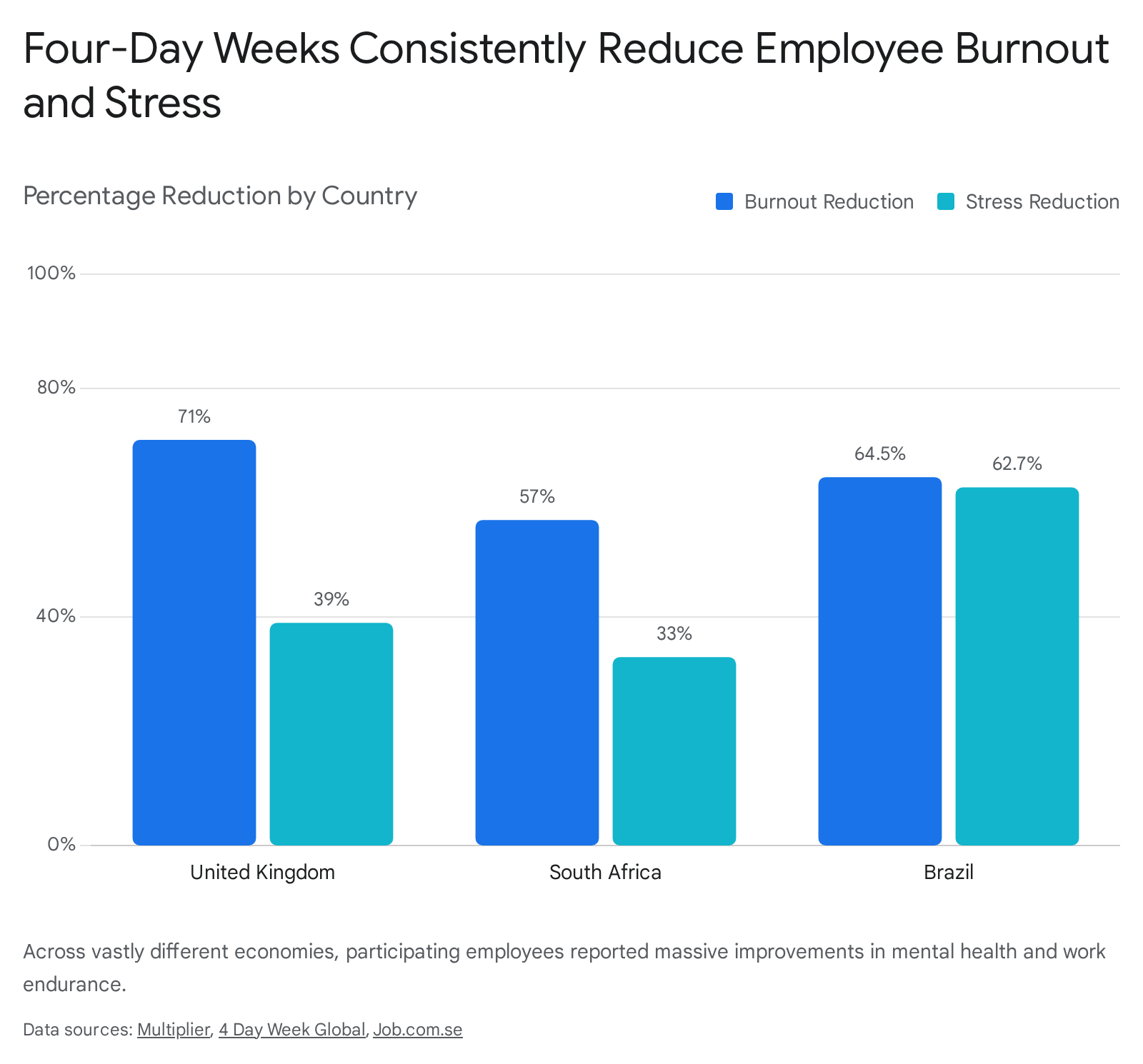
The impact on human resources was profound. Participating companies experienced a 65% reduction in sick days and a 57% plunge in staff turnover, a particularly striking finding as the trial coincided with the height of the "Great Resignation" 171928. Employee surveys conducted before and after the intervention revealed that 71% of staff noticed reduced levels of burnout, 39% felt significantly less stressed, and 60% reported an increased ability to combine their paid employment with caregiving responsibilities 1415.
These findings were validated by a subsequent UK follow-up trial spanning 2024 to 2025. This second wave involved nearly 1,000 workers across 17 businesses. At the conclusion of the six-month period, the pilot reported a 100% success rate, with all 17 companies opting to make the four-day week permanent 929. In this cohort, 62% of employees reported reduced burnout, and 45% reported enhanced overall life satisfaction, further solidifying the premise that shorter working hours yield compounding psychological benefits 29.
The United States, Ireland, and Early Pioneers
Similar outcomes were recorded in a joint trial spanning the United States and Ireland, which included 33 companies and 903 employees 1119. At the trial's conclusion, organizations rated their overall experience an average of 9.0 out of 10, and 97% of the participating employees expressed a desire to continue the four-day schedule 19. When employers were asked to rate employee productivity on a 10-point scale, the average score was an encouraging 7.7 1920.
These modern corporate trials stand on the shoulders of earlier, public-sector experiments. Between 2015 and 2019, the national government and the city council of Reykjavik in Iceland conducted massive trials involving 2,500 workers - more than 1% of the country's entire working population 1211. The trials were hailed as an overwhelming success, leading to national union negotiations that ultimately resulted in over 50% of the Icelandic workforce moving to shorter hours or gaining the right to do so 1121. Similarly, in 2023, the Spanish city of Valencia piloted a month-long four-day week by scheduling local holidays on four consecutive Mondays for 360,000 workers. Independent health commissions noted that the reduced commuting traffic led to a measurable drop in nitrogen dioxide emissions and improved air quality, alongside heightened self-perceived health statuses among residents 20.
Developing Economies: Dispelling the Western Luxury Myth
Skeptics of work-time reduction frequently argue that a 32-hour workweek is a luxury policy, viable only in wealthy, highly developed Western economies that can afford to absorb the costs of lower productivity. However, recent trials in emerging markets have fundamentally challenged this assumption.
In 2023, South Africa hosted the first 4 Day Week Global pilot in a developing nation. The trial encompassed 28 companies (and one in neighboring Botswana) across sectors including tax, finance, IT software, and marketing 2223. Contrary to initial skepticism, the trial was highly successful. Organizations reported a 10.5% average increase in revenue over the trial period and an 11% decrease in resignation rates 2335. Employee burnout dropped for 57% of participants, while 49% reported a measurable increase in their own productivity and workability 2324.
Notably, South African businesses demonstrated high operational creativity. Because completely shutting down an office on Friday was culturally or logistically unfeasible for many, companies achieved the 20% hours reduction by offering Wednesdays off, establishing a nine-day fortnight, or allowing staff to take two half-days throughout the week 2337. This flexibility proved particularly beneficial for working mothers, who comprised 70% of the pilot's sample 37.
A similar narrative unfolded in Brazil in 2024. A pilot program involving 21 small and medium-sized enterprises across five states yielded transformative results 25. Mid-trial data showed that 71.5% of companies reported an overall productivity increase, and execution metrics for internal projects skyrocketed by 61.5% 2540. Employees reported a 62.7% reduction in work-related stress and a 50% reduction in clinical insomnia 40. A deeper analysis conducted by the Fundação Getulio Vargas (FGV) noted that the companies that succeeded in Brazil were those that shifted their management culture away from rigid rules and strict control metrics, toward flexible environments governed by mutual trust and autonomy .
The Nuance of Sector Applicability
Despite the glowing data presented by trial coordinators, a nuanced reading of the underlying demographics reveals a heavy bias. The vast majority of companies that volunteer for and succeed in these pilot programs are situated in professional services, IT, digital marketing, public relations, and administrative sectors 1926. These are roles where output is largely tied to knowledge creation, problem-solving, and project delivery - tasks that are highly susceptible to efficiency gains through better time management and the elimination of redundant meetings 1127.
Applying a 20% reduction in working hours to industries that require continuous physical presence, mandatory staffing ratios, or manual production presents severe operational and economic challenges.
Healthcare and Emergency Services
In the healthcare sector, a transition to a shorter workweek is desperately needed. Current polling indicates that an alarming 76.8% of medical providers experience severe fatigue and stress 43. Small-scale localized trials have shown promise; for example, the introduction of a four-day workweek at the behavioral health center 4C Health resulted in a 75% reduction in staff burnout while maintaining patient care ratings at 4.2 stars 43.
However, scaling this model to major hospital networks is extraordinarily difficult. Hospitals cannot close their doors on Fridays. To maintain 24/7 patient care while reducing individual staff hours to 32, healthcare facilities must implement highly complex, staggered scheduling - such as splitting staff into alternating Monday-Thursday and Tuesday-Friday cohorts 1043.
If a hospital attempts to maintain a 100:80:100 model without hiring additional staff, it risks dangerously understaffing critical shifts 1317. Conversely, hiring additional staff to cover the missing 20% of hours significantly increases overhead costs. An analysis by the FNV trade union in the Netherlands estimated that while implementing a four-day workweek in Dutch hospitals would save €23.3 million annually through reduced absenteeism and employee turnover, it would simultaneously require an estimated €163.3 million in new staffing costs to maintain coverage 43.
Manufacturing and Blue-Collar Production
In the manufacturing sector, productivity is intrinsically tied to the physical operation of machinery over a set period. If a factory line runs for 20% less time, it generally produces 20% fewer goods 27.
To bridge this output gap without extending operating hours, the manufacturing industry must rely heavily on massive capital investments in automation and technology 27. If software and robotics can be deployed to handle repetitive, low-value tasks, human workers can shift to a four-day schedule focused entirely on complex problem-solving, machine maintenance, and quality control 27. Without significant technological upgrades, manufacturers adopting a reduced workweek face the grim choice of either accepting lower production yields, missing client deadlines, or absorbing the hefty cost of hiring a secondary shift of workers to keep the lines moving 1328.
Furthermore, partial or poorly planned implementations can fracture company culture. If office-based corporate staff are granted a four-day week while customer-facing retail staff, call-center operators, or warehouse workers are forced to maintain five-day schedules to keep the business operational, it creates deep resentment and workplace division 1329.
Operational Hurdles by Sector
| Sector | Primary Challenge to 4-Day Week | Potential Mitigation Strategy |
|---|---|---|
| Knowledge & Professional Services | Eliminating time-wasting tasks to fit work into 32 hours | Aggressive meeting audits, asynchronous communication, AI tools |
| Healthcare & Emergency Responders | Maintaining 24/7 critical coverage and patient safety | Staggered shift rotations, expanded hiring, floating coverage pools |
| Manufacturing & Construction | Physical output is tied directly to hours on the floor | Heavy investment in automation, robotics, and process engineering |
| Retail & Hospitality | Customer expectation of standard operating hours | Alternative scheduling (e.g., Wednesdays off), localized branch closures |
Cultural Roadblocks and Government Interventions
The feasibility of the four-day workweek is also heavily dictated by regional business cultures and the willingness of governments to intervene in labor markets. In some regions, progress is driven by desperation, while in others, cultural norms present insurmountable resistance.
Japan's Battle with Overwork
In Japan, the push for a four-day workweek is being heavily promoted top-down by the national government to combat two interlinked existential crises: karoshi (death by overwork) and a collapsing demographic pipeline 3047. In 2022, nearly 3,000 people in Japan died by suicide attributed to extreme working hours, with government white papers noting that 10.1% of men work over 60 hours a week 30. Furthermore, the national fertility rate has sunk to an unprecedented 1.2, largely because exhausting corporate schedules leave citizens with no time, energy, or financial flexibility for family planning 2131.
To break this cycle, the Tokyo Metropolitan Government recently announced it will begin allowing its 160,000 public employees to work four-day weeks starting in April 2025 4731. In the private sector, Microsoft Japan famously tested a four-day week as early as 2019, seeing a massive 40% boost in productivity and a 23% reduction in electricity costs 1213.
Yet, despite government subsidies and free consulting services to help transition workflows, broader adoption in Japan has been stagnant. Currently, only about 8% of Japanese companies offer three or more days off a week 2130. Cultural expectations surrounding workplace loyalty, presenteeism, and attending long company dinners make the transition exceedingly difficult 30. When Panasonic - one of the nation's largest employers - offered an optional four-day workweek in 2022, only about 150 out of 63,000 eligible workers opted in, fearing that taking the extra time off would signal a lack of dedication and severely damage their career prospects 1330.
Singapore's Highly Competitive Resistance
In highly competitive Asian markets like Singapore, employee enthusiasm clashes sharply with employer pragmatism. A 2024 poll conducted by Robert Walters found that 93% of Singaporean employees wanted their employers to run a four-day workweek trial 3250.
However, a subsequent survey conducted by the Singapore National Employers Federation (SNEF) in late 2024 revealed a stark disconnect: 95% of employers stated they have no plans to adopt a four-day schedule, and 79% were outright opposed to the very concept 5133. Employers cited the inability to increase productivity enough to offset the 20% reduction in capacity, the prohibitive costs of hiring additional manpower to plug scheduling gaps, and the strict necessity of maintaining continuous business operations for regional clients as primary deterrents 33. In a tight labor market and a fiercely competitive regional economy, Singaporean business leaders widely view the four-day week as an unacceptable operational liability 5133.
The Middle East's Top-Down Shift
Conversely, the United Arab Emirates has taken decisive legislative action to normalize shorter hours. In early 2022, the UAE federal government transitioned the public sector to a 4.5-day workweek, with Fridays functioning as a half-day to respect the day's cultural and religious significance 1134. The neighboring Emirate of Sharjah took the initiative a step further, legislating a full four-day workweek (Monday to Thursday) and a three-day weekend for government employees 3454.
Because doing nothing was "not an option" under the new mandates, companies were forced to rapidly adapt their software, payroll, and operational compliance 54. The results of this forced adaptation were overwhelmingly positive. A report by the Department of Statistics and Community Development in Sharjah recorded astronomical improvements: a 90% increase in job satisfaction, an 86% boost in productivity, and a 69.7% increase in social wellbeing, proving that aggressive, top-down legislative mandates can successfully force rapid organizational adaptation even in traditional business environments 3455.
The Scientific Critique: What the Advocates Miss
While advocacy groups and progressive corporate leaders paint the four-day workweek as a universally triumphant concept, independent economists and academic researchers have pointed out significant methodological flaws in the much-publicized pilot studies.
Volunteer Bias and the Lack of Control Groups
The most severe criticism leveled against the headline-grabbing global trials relates to selection bias. Daniel Hamermesh, a prominent labor economist at the University of Texas at Austin, points out that the trials run by groups like 4 Day Week Global lack rigorous, randomized control groups 35. The companies that volunteer for these trials are generally highly progressive, already possess strong management teams, and are deeply motivated to make the experiment work 3536.
Hamermesh argues that the highly publicized surveys merely demonstrate that a self-selected group of willing participants enjoyed the experience, not that a four-day week is an economically sound policy for the broader market. "There is no way of evaluating how beneficial it is or, if beneficial, how widespread its benefits could be," he noted, suggesting that a policy claiming to organically increase human productivity by 25% overnight to cover the lost hours is "impossibly great" and merits deep skepticism 35. In his own peer-reviewed research analyzing long-term work patterns in the U.S. from 1973 to 2018, Hamermesh found that workers on permanent four-day weeks actually earn less than demographically identical workers working five days in the same industry, implying a long-term economic hit to productivity that short-term pilot studies fail to capture 3558.
Furthermore, the stated mission of 4 Day Week Global is explicitly to "support the idea of the 4 day week as a part of the future of work" 3536. While they partner with respected academic institutions to process the data, critics warn that the very design of the trials is fundamentally geared toward generating positive public relations and momentum for the movement, rather than conducting objective, neutral scientific inquiry 3637.
Work Intensification and Transferred Burnout
A chronological systematic review of academic literature on the four-day workweek, conducted in 2023 and 2024, revealed a much more ambiguous and complicated picture than the media portrays 1037. While morale, job satisfaction, and retention reliably improved across the board, researchers consistently noted a negative secondary effect: severe work intensification 373839.
Condensing 40 hours of output into 32 hours requires relentless, uninterrupted focus. For some workers, this intense pressure strips the workday of any breathing room, casual socialization, or creative downtime, leading to heightened anxiety and fatigue during the hours they are actually in the office 283839. If managerial expectations regarding total output are not realistically adjusted, the shorter week simply feels like a frantic cramming session. As one business psychologist noted regarding poorly implemented schedules, cramming five days of expectations into four days "helps no one" 11.
The "Mere Urgency" Effect
This intensification can also warp a company's strategic focus. Researchers from Harvard Business School studying corporate implementations of the four-day week observed a phenomenon they dubbed the "mere urgency effect" 40. Because time becomes so acutely scarce under a 32-hour model, employees become hyper-focused on completing urgent, short-term tasks just to clear their immediate queues 40.
Consequently, they systematically neglect important, long-term strategic planning and deep, creative thinking 40. In one company studied, sales teams actually altered their behavior entirely to fit the new schedule; they began prioritizing small, easy-to-close accounts to hit their quotas quickly, rather than investing the time necessary to nurture larger, more complex strategic accounts that would yield higher long-term value for the business 40. This strongly indicates that successfully implementing a four-day week requires a fundamental redesign of corporate incentive structures, performance metrics, and governance, not just a simple adjustment to the calendar 40.
The Legislative Horizon: The Thirty-Two Hour Workweek Act
As the private sector continues to experiment, the movement for work-time reduction has formally entered national politics. In the United States, Senator Bernie Sanders (I-VT) and Senator Laphonza Butler (D-CA) introduced the Thirty-Two Hour Workweek Act 46.
The proposed legislation aims to amend the Fair Labor Standards Act, phasing in a mandatory reduction of the standard American workweek from 40 hours to 32 hours over a four-year period 56. Crucially, the bill prohibits employers from reducing workers' total pay or benefits to match the lost hours, effectively mandating a 20% increase in hourly wages 56. To enforce the new standard, the bill requires employers to pay overtime (time-and-a-half) for any work exceeding 32 hours in a week or 8 hours in a day, and double-time for any shifts extending past 12 hours 46.
Proponents of the bill argue that the legislation is a necessary corrective measure for decades of economic imbalance. During a Senate Health, Education, Labor, and Pensions (HELP) Committee hearing, advocates highlighted that while worker productivity has skyrocketed due to technology, the resulting financial windfalls have overwhelmingly enriched corporate executives and shareholders, leaving the working class with stagnant wages and high stress 167. A federally mandated 32-hour week is viewed as a systemic mechanism to force corporations to share the dividends of artificial intelligence and automation with the labor force in the form of guaranteed leisure time 1410.
Opponents of the bill, largely comprising business lobbies and conservative lawmakers, argue that a federally mandated 32-hour week without corresponding pay cuts would be economically devastating, particularly for small and medium-sized enterprises operating on razor-thin margins 56. Critics argue that the mandate would essentially force businesses to either slash output or hire additional staff to cover operational hours. Those increased labor costs would inevitably be passed onto consumers, driving up inflation and accelerating the replacement of human jobs with cheaper automated systems 56.
Given the deep partisan divide in Washington, the bill is highly unlikely to pass in the immediate future. However, its introduction has successfully shifted the Overton window, bringing the debate over work-time reduction out of progressive think tanks and into mainstream political discourse 56.
Bottom line
The available evidence confirms that a four-day workweek - specifically the 100:80:100 model - is a highly effective strategy for boosting employee mental health, reducing turnover, and maintaining productivity in knowledge-based and professional sectors. Workers explicitly prioritize this flexibility, and progressive companies are increasingly using it as a competitive weapon to attract top talent and lower operational overhead.
However, the "miracle" results widely promoted by pilot studies often rely on highly motivated, self-selected companies and lack rigorous control groups. Translating this perk into a universal standard remains fraught with uncertainty; scaling the model to blue-collar manufacturing, healthcare, and customer-facing sectors will require massive capital investments in automation, creative scheduling, or expanded payrolls to offset the 20% reduction in human working hours.