
What Happens in Your Brain When You Read a Story
The brain treats reading a story not as a simple deciphering of text, but as a full-sensory simulation that mirrors real-life experiences. As you read, billions of neurons across both hemispheres synchronize to unscramble time, map semantic meaning, and trigger intense emotional responses. Over a lifetime, this intense neural workout physically reshapes your cortex, building a cognitive reserve that can protect against neurological decline and fundamentally alter how you process the world.
Dismantling the Left-Brained Reader Fallacy
For decades, popular psychology promoted a rigidly compartmentalized view of human cognition: the left hemisphere of the brain was deemed the exclusive domain of logic, mathematics, and language, while the right hemisphere was celebrated as the seat of creativity, emotion, and intuition 113. Under this paradigm, the act of reading text - a structured, rule-based deciphering of symbols - was largely categorized as a strictly left-brain activity.
This conceptual framework originated from a misinterpretation of fascinating split-brain studies conducted in the 1960s. Surgeons severed the corpus callosum - the thick bundle of nerve fibers connecting the two hemispheres - in patients with severe epilepsy to prevent seizures from spreading across the brain 11. Researchers studying these patients, including Dr. Michael Gazzaniga, noticed that certain functions, such as basic speech production and language mechanics, were highly lateralized to the left hemisphere. However, as the findings filtered into the mainstream media during the 1970s and 1980s, the science was vastly oversimplified 11. This birthed an entire industry of personality tests and educational tools that falsely categorized individuals and their learning styles as either "left-brained" or "right-brained" 113.
Modern neuroimaging has thoroughly dismantled this myth. Using functional magnetic resonance imaging (fMRI), neuroscientists have scanned thousands of individuals and found no evidence of overarching hemispheric dominance 12. A definitive 2013 study from the University of Utah analyzed the brain scans of over 1,000 young people between the ages of 7 and 29, dividing the brain into 7,000 distinct regions to measure network activity 2. The researchers found no evidence of "sidedness"; the brains of highly logical thinkers and highly creative artists showed similar bilateral network activity 2.
While it is true that specific micro-tasks show lateralization - for instance, the physical mechanics of speech often lean toward the left hemisphere, and certain spatial tasks activate the right - complex cognitive feats like mathematical reasoning, artistic creation, and reading a novel require constant, high-speed collaboration across both hemispheres 112.
When a person reads a novel, the brain does not merely process vocabulary in isolated left-hemisphere language hubs like Broca's or Wernicke's areas. Instead, the brain behaves as a vast, interconnected simulator. Reading a descriptive passage about a character running through a forest activates the reader's sensory and motor cortices as if they were physically moving 56. Processing the emotional weight of a tragedy stimulates the limbic system across the brain, flooding neural pathways with neurochemicals like dopamine, which heightens memory encoding 6. Far from a localized, logical deciphering task, reading a story is a whole-brain phenomenon that demands the synchronized firing of neural networks from the frontal lobes down to the visual processing centers at the back of the head 373.
Decoding Words: The Brain's Semantic Atlas
To understand how the brain transforms black symbols on a white page into a rich, immersive universe, researchers have utilized advanced computational models to map the cerebral cortex. The process of deriving meaning from words - semantics - has historically been difficult to measure because language is inherently fluid, deeply reliant on context, and spans a massive variety of concepts.
In a landmark series of experiments, researchers at the Gallant Lab at the University of California, Berkeley, managed to create highly detailed, interactive semantic maps of the human brain 945. The methodology involved placing subjects in an fMRI machine and having them listen to hours of narrative storytelling from programs like The Moth Radio Hour 46.
The researchers computationally divided the fMRI brain scans into roughly 60,000 tiny three-dimensional cubes called voxels 47. By tracking blood oxygen levels - a proxy for measuring spikes in neural metabolic rate and activity - in each individual voxel as the subjects processed different words, the scientists built a "voxelwise encoding model" 78. This sophisticated regression framework allowed them to map exactly how 985 distinct semantic concepts were physically represented across the cerebral cortex 49.
The resulting brain atlas revealed that the brain is divided into approximately 140 distinct semantically selective areas 7.
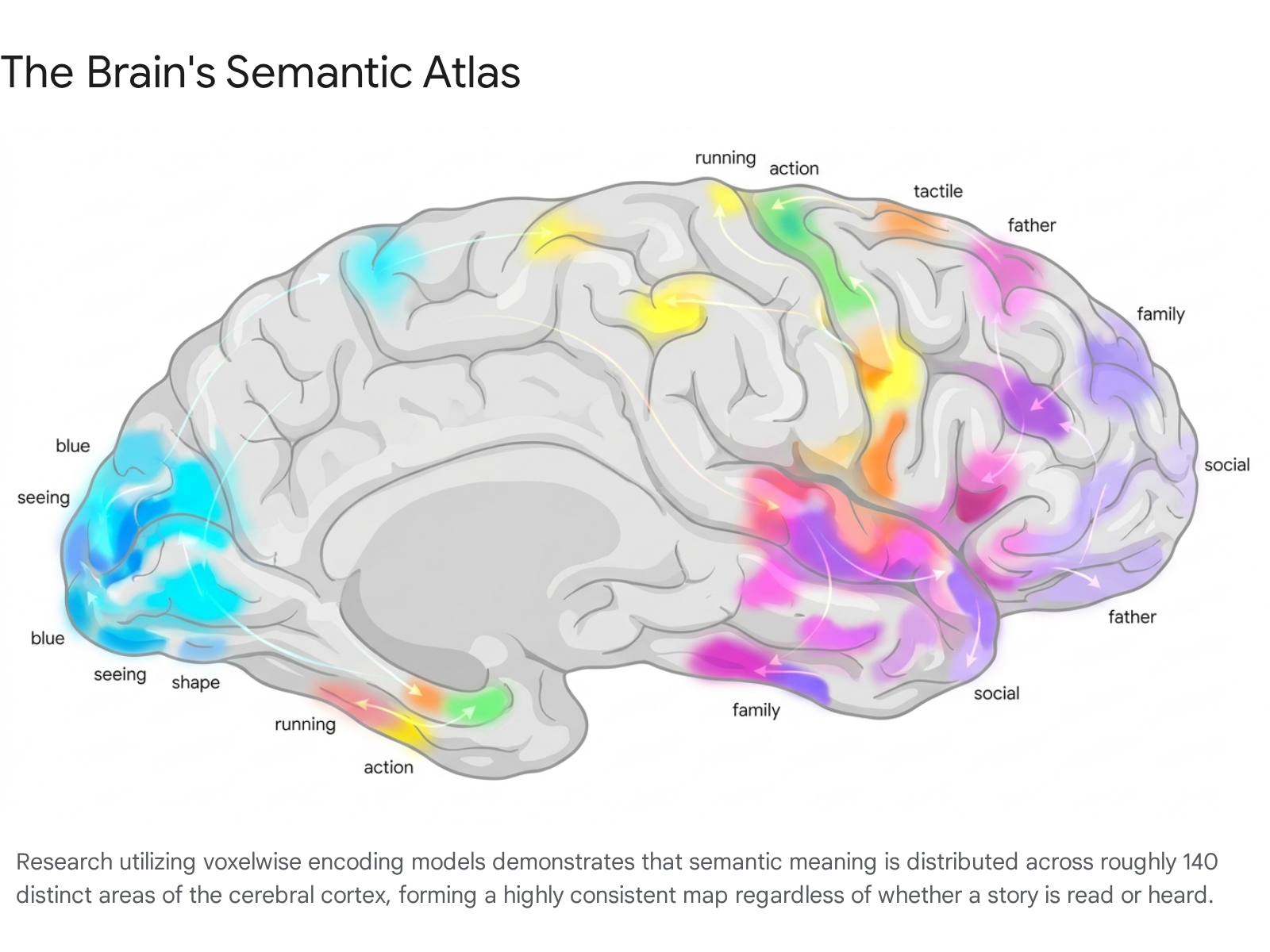
Rather than processing meaning in one central "dictionary" hub, the brain scatters meaning across its entire surface based on category. Words related to visual elements light up regions near the occipital visual cortex, while words describing social interactions, drama, and time (such as "father," "refused," and "remarried") activate areas associated with emotional regulation and theory of mind 47.
Subsequent research has shown that these semantic maps transcend single languages. A 2026 study published in the Proceedings of the National Academy of Sciences (PNAS) utilized fMRI scans of participants fluent in both English and Chinese 89. By analyzing their brain activity while reading natural narratives in both languages, researchers found that semantic brain representations in bilinguals are largely shared across languages. The brain builds a unified underlying map of meaning, which is then slightly modulated by the specific linguistic nuances of each language 89.
Audiobooks vs. Print: Does the Medium of Intake Matter?
A common debate among literary enthusiasts is whether listening to an audiobook is cognitively "cheating" compared to reading a physical book. From a neurobiological standpoint, when measuring how the brain derives profound semantic meaning, the evidence suggests that the brain makes virtually no distinction between the two modalities 45.
Follow-up studies utilizing the Gallant Lab's voxelwise encoding models compared the brain activity of participants who listened to stories against those who read the exact same transcripts silently on a screen 510. The initial sensory processing is undeniably different: reading relies heavily on the visual cortex to interpret the geometry of shapes and letters, while listening relies on the auditory cortex to process the frequency and pitch of sound waves 511.
However, once the sensory data moves past the initial intake regions and is converted into meaning, the neural maps become virtually indistinguishable 45. Fatma Deniz, the lead author of the 2019 study published in the Journal of Neuroscience, noted that semantic tuning during listening and reading is highly correlated across most semantically-selective regions of the cortex 45. In fact, the models estimated from the listening modality were so accurate that researchers could use them to perfectly predict the brain's voxel responses when the subject was reading 510.
This phenomenon reveals that the representation of language semantics is independent of the sensory modality through which the information is received 510. Whether the word "dog" is heard through headphones or read in paperback, the exact same complex network of cognitive and emotional regions fires with the exact same intensity 45.
Further supporting this, a 2024 study published in Communications Biology demonstrated that the cortical representation of language "timescales" is shared between reading and listening 79. Language comprehension requires the brain to integrate low-level sensory inputs (like syllables or letters) into increasingly high-level features (words, sentences, overarching plot points). The researchers mapped these intrinsic timescales across the cerebral cortex and found that, after low-level sensory processing, language integration proceeds identically regardless of the stimulus 78.
Navigating Nonlinear Time and Causality
Stories are rarely presented as simple, chronological lists of facts. They weave back and forth through time, utilize flashbacks, shift perspectives, and require the reader to hold multiple threads of information simultaneously. Comprehending a narrative requires the brain to act as an active architect, continuously accumulating incoming information, storing it as a dynamic situational model, and updating that model as new causal links are revealed 12.
Unscrambling Timelines on the Fly
To investigate how the brain processes time during a complex narrative, cognitive neuroscientists analyzed fMRI data from subjects engaging with the film 500 Days of Summer - a narrative famous for jumping erratically back and forth through a 500-day romantic relationship 1913. This structure provided an ideal stress test for the brain's temporal processing abilities.
The findings revealed that the brain does not passively record events in the order they are presented. Instead, it actively "unscrambles" them on the fly 13. When a narrative cues a jump through time, regions within the medial parietal lobe - particularly the precuneus and the posterior cingulate cortex (PCC) - exhibit a unique spatial signature of activity 13. These regions calculate the magnitude of the time jump and work in tandem with the brain's memory centers to reorder the events into a chronological timeline inside the mind 13.
The hippocampus, traditionally known as a primary hub for episodic memory, plays a critical role in this narrative construction 21. Rather than simply memorizing overlapping, disjointed experiences, the hippocampus works to link distant events to form a single, coherent overarching story 21. When a reader encounters a new plot point that references an earlier event, the hippocampus reaches back, retrieves the earlier memory, and embeds it into the current context, solidifying the causal chain of the narrative 21.
The Dynamic Role of the Default Mode Network
As the brain connects these chronological and causal dots, it relies heavily on the Default Mode Network (DMN) 12. Historically, the DMN was thought to be a background system, active only when the brain was "at rest," daydreaming, or wandering 3. However, modern research shows that the DMN is intensely active and critical during narrative comprehension 12.
When a reader experiences a moment of profound narrative integration - the "aha" moment when a twist makes sense or two disparate story threads finally connect - the DMN increases its activation and begins communicating across large-scale functional brain modules 12. This network is essential for internal reflection, theory of mind, and understanding how a story relates to one's own lived experience and identity 1222.
Conversely, during periods of confusion or low narrative comprehension (such as reading a highly dense, poorly written, or confusingly scrambled text), the brain shifts its reliance away from the DMN. Instead, it leans on the dorsal attention network (DAN) to strain for contextual clues, re-establish focus, and force logical connections 12.
Emotional Simulation and Neural Coupling
A compelling story does more than deliver chronological information; it induces a state of "neural coupling," or "mirroring," between the storyteller and the audience 6. When a narrative is rich in sensory detail, the neurons in the reader's brain fire in patterns that closely resemble the neural activity of the author who conceived the story, or the characters experiencing it 6.
This emotional resonance is driven by the brain's capacity to simulate reality. If a character experiences a threat, the reader's amygdala - the brain's threat-detection and fear center - activates 14. If a narrative resolves a tense conflict, the brain receives a reward via dopamine pathways, which in turn enhances the accuracy and vividness with which the story is stored in long-term memory 6.
The Diluted Emotion of Second Languages
The depth of this emotional simulation, however, can be heavily influenced by the language in which the story is consumed. Unbalanced bilinguals (individuals who learned a second language later in life and are not equally proficient in both) often report feeling less emotional resonance when reading in their non-native language, a phenomenon neuroscientists have recently begun to map 14.
A 2025 fMRI study published in Bilingualism: Language and Cognition investigated this by having late Spanish-English bilinguals silently read happy, fearful, and neutral fiction passages in both their native language (L1) and their second language (L2) 1424. The study uncovered a significant biological discrepancy in how the brain synchronizes meaning and emotion depending on the language context 1424.
When reading fearful narratives in their native language, participants showed highly integrated functional coupling between the left anterior temporal lobe (a region critical for semantic processing and meaning) and the left amygdala (the limbic center governing fear and emotion) 14. The hippocampus also showed a significantly stronger limbic response in L1 14.
Conversely, when reading the exact same emotional narratives in a second language, this neural synchronization diminished 14. The semantic areas still successfully processed the meaning of the words, but the coupling with the emotional limbic system was substantially weaker 14. This supports the "weaker links" hypothesis, which posits that because unbalanced bilinguals have less lifelong exposure and fewer deeply rooted cultural associations with their second language, the emotional impact of the text is biologically blunted 14. The brain understands the tragedy on a cognitive level but fails to fully simulate the emotional weight, providing neurological evidence for why fiction often feels more visceral and resonant in a reader's mother tongue 14.
The Medium is the Message: Print vs. Screen vs. VR
While the brain may not differentiate between the semantic meaning of an audiobook and a printed novel, the physical medium used for reading visually severely impacts cognitive processing, comprehension, and long-term retention. As society rapidly transitions from physical books to digital screens, neuroscientists have documented a widespread phenomenon known as the "screen inferiority effect" 251516.
The Screen Inferiority Effect
A comprehensive 2024 meta-analysis encompassing 49 studies and over 160,000 participants confirmed that individuals who read on digital screens consistently score lower on reading comprehension and retention tests than those who read the exact same material on paper 2528. This effect holds true across various age groups and educational levels, but it becomes particularly pronounced when readers engage with complex, expository texts or operate under time constraints 2516.
There are three primary neurobiological and psychological mechanisms driving this digital deficit:
- Cognitive Overload and Multitasking: Digital devices inherently promote a state of continuous partial attention. The physical mechanic of scrolling, combined with the presence of hyperlinks, notifications, and the backlit glare of a screen, taxes the brain's working memory 2529. The brain expends subtle energy maintaining orientation in a digital space and resisting distraction, leaving fewer cognitive resources available for deep semantic integration and critical analysis 25.
- Loss of Spatial Mental Mapping: The human brain relies heavily on spatial navigation to anchor memories. When reading a physical book, the reader unconsciously tracks their progress through the weight of the pages in their left versus right hand. A reader can often recall that a specific plot point occurred "at the bottom left of the page, about a third of the way through the book" 2515. This tactile and spatial scaffolding provides vital cues that aid memory retrieval 15. Digital screens, characterized by a seamless, infinite scroll or flashing digital pages, strip away these physical spatial landmarks, making it harder for the brain to build a robust structural model of the text 2515.
- The Shallowing Hypothesis: Habitual screen use trains the brain to adopt a "skimming" strategy. Because social media and digital content algorithms reward rapid, surface-level consumption with frequent dopamine hits, readers subconsciously approach digital text expecting quick, easily digestible answers 2515. This encourages a passive intake of information, bypassing the deep, analytical reading networks required to comprehend long-form literature 153031.
Reading Text vs. Virtual Reality Simulation
The cognitive limitations of digital immersion are further highlighted when reading text is compared to highly advanced visual mediums like Virtual Reality (VR). As VR technology advances, educators have hypothesized that fully immersive environments could accelerate learning. However, recent neurological studies suggest the opposite may be true for unfamiliar concepts.
A 2026 study tested cognitive processing by having college students learn complex, unfamiliar science concepts (related to Mars) through either reading text on a PC or experiencing a full VR simulation 2932. Surprisingly, the VR group performed significantly worse on memory tests 32. Furthermore, single-channel EEG recordings revealed that the VR group exhibited lower levels of meditation (theta band) and heightened cognitive stress (beta band) compared to the reading group 32.
The sensory saturation of the VR environment triggered cognitive overload. The brain was so busy processing the novel visual and spatial inputs of the virtual world that it struggled to encode the underlying educational concepts into memory 3233. Reading, by contrast, relies on a leaner external visual input stream, forcing the brain to internally generate the imagery. This process of active, internal generation ultimately leads to deeper encoding and better memory retention 293032.
| Reading Medium | Cognitive Load | Spatial Mapping | Comprehension Outcome |
|---|---|---|---|
| Physical Print | Low (allows focus on text generation) | High (tactile weight, physical page layout) | High (optimal for deep reading, critical analysis, and long-term retention) |
| Digital Screen (Scroll/Tablet) | Moderate (multitasking, backlighting strain) | Low (infinite scroll removes spatial landmarks) | Reduced (the documented "screen inferiority effect") |
| Virtual Reality (VR) | High (sensory saturation and immersion processing) | Irrelevant (environment is simulated externally) | Lowest (visual processing overrides memory encoding of new facts) |
The Goldilocks Effect in Developing Brains
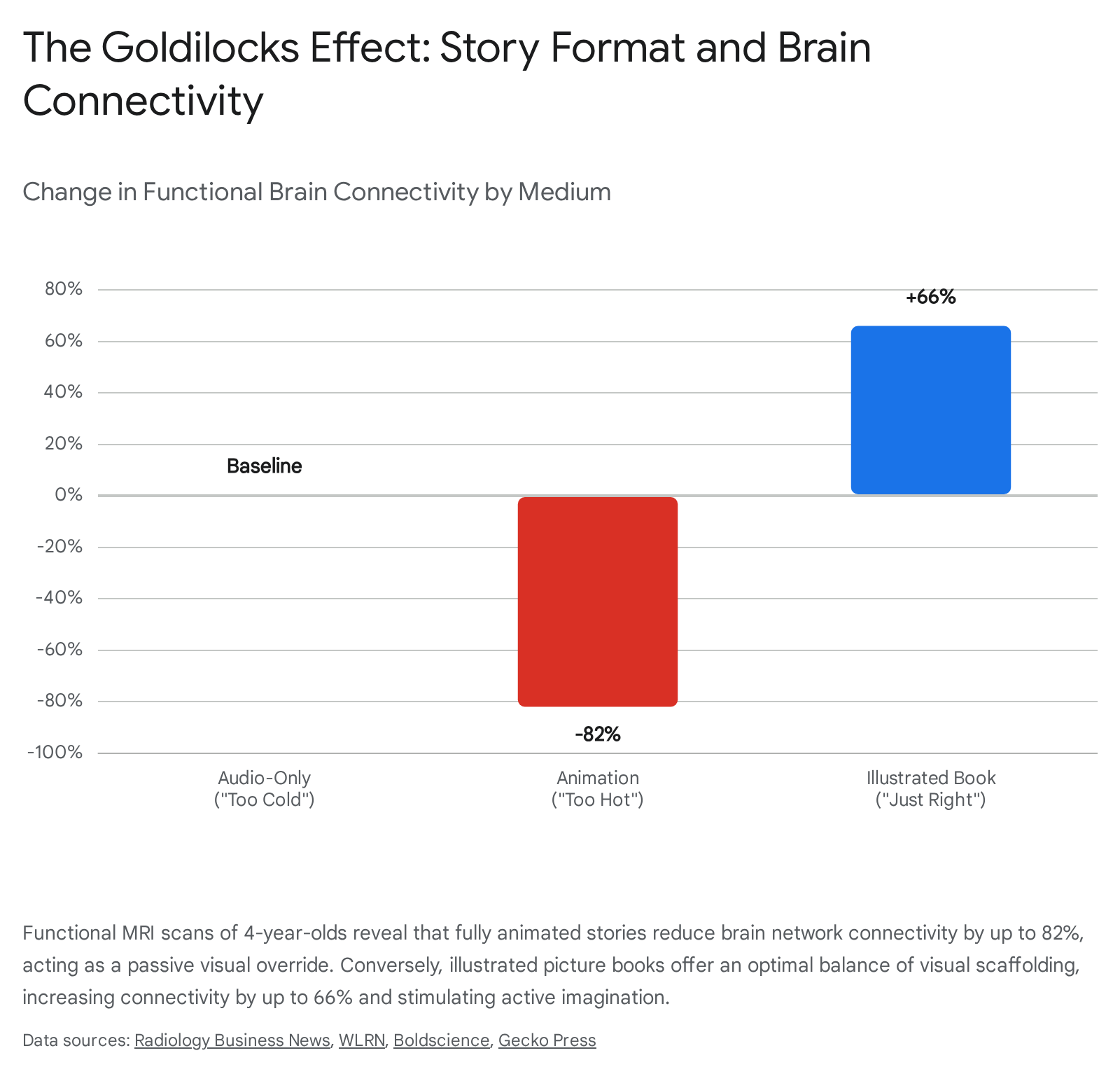
The impact of the storytelling medium is most acute during early childhood, a period characterized by explosive neurodevelopment and brain plasticity. Researchers at Cincinnati Children's Hospital utilized fMRI to study the brains of four-year-olds as they engaged with stories in three different formats: audio-only, an animated cartoon, and a traditional illustrated picture book with an audio voiceover 3435.
The results revealed a phenomenon the lead researchers dubbed the "Goldilocks effect," demonstrating that the developing brain requires a highly specific balance of input to optimize learning and network connectivity 3436.
- Audio-Only ("Too Cold"): When children listened to the story without any visual aids, fMRI scans showed massive bilateral activation in the language networks, but significantly less overall connectivity across the rest of the brain 2237. The brain was working incredibly hard, straining to translate the auditory words into mental images 37. For young children who lack a vast repository of real-world visual memories to draw upon, this format proved too demanding, resulting in cognitive strain and a bottleneck in comprehension 3637.
- Animation ("Too Hot"): When children watched the fully animated version, the audio and visual perception networks were highly active, but the language network struggled to keep pace 34. Most strikingly, functional connectivity across the broader active brain networks dropped by up to 82% 35. The animation provided so much visual scaffolding that it did all the work for the child. Because the external screen was supplying every detail in rapid succession, the child's internal imagery and default mode networks essentially shut down, leading to passive consumption rather than active imagination 223437.
- Illustrated Picture Book ("Just Right"): The traditional picture book format provided the optimal ecosystem for brain development 3537. The static illustrations offered just enough visual scaffolding to anchor the language network, preventing cognitive strain 37. Simultaneously, because the images did not move, the child's brain was forced to actively stitch the scenes together to understand the narrative progression, deeply stimulating the imagery, visual perception, and default mode networks 3437. This format increased functional connectivity across brain regions by up to 66%, effectively "turbo-charging" healthy brain integration 35.
Cultural Wiring and Storytelling Structures
The human brain is not a static, universally identical organ; its architecture is continuously sculpted by the cultural environment in which it develops. This continuous feedback loop between biology and culture is known as biocultural theory 38. Because stories are the primary vehicles for transmitting cultural norms and historical knowledge, the structural architecture of the narratives a person consumes actually dictates how their brain learns to process information, expect outcomes, and construct reality 383917.
Western literature and media are overwhelmingly dominated by linear structures, most notably the Aristotelian three-act structure 3839. Western narratives typically feature a clear chronological beginning, a conflict driven by individual heroism or psychological struggle, a climactic peak, and a definitive, cause-and-effect resolution 3839. Consequently, brains raised heavily in Western cultures become exceptionally adept at processing straightforward sequences and prioritizing individualistic psychological exploration 3941.
However, cross-cultural neurobiology and narratology reveal that this linear, conflict-driven arc is not a universal human default. Indigenous storytelling traditions across North America, Australia, and other global regions operate on entirely different narrative architectures, which in turn train the brain to process information non-linearly and communally 38411843.
For example, many American Indian narratives do not begin at a fixed "beginning." Instead, the storyteller enters a non-linear web of relationships that is already existing and ongoing 38. The Winter Count of the Plains Nations records tribal history spiraling outward from a center point on a buffalo hide, representing time cyclically rather than as a straight line progressing forward 38. Similarly, Australian Aboriginal storytelling has preserved complex cultural knowledge and ecological maps for over 60,000 years without resolving into a standard linear arc 38.
In Eastern literary traditions, structural variations like the Japanese kishotenketsu (a four-act structure) rely on a midpoint twist and the harmonization of forces rather than individualistic conflict and conquest 3941. In these cultures, narratives prioritize collective experiences, societal roles, and the interconnection of all beings 41.
When researchers and neuroscientists force Indigenous or non-Western populations to conform to Western narrative expectations - such as taking standardized neurological cognitive tests that rely heavily on linear recall - they often fail to capture accurate measures of cognitive health or capability 1819. Recognizing these profound structural differences, initiatives like the Canadian Brain Research Strategy and advocates of "Two-Eyed Seeing" (learning to see with the strengths of both Indigenous and Western knowledges) are working to integrate Indigenous ways of knowing directly into neuroscience 2021.
For instance, a $24 million grant at Laurentian University is currently funding a six-year, community-led research initiative to develop culturally safer brain health and dementia assessment tools 19. By co-developing holistic brain health assessments that honor cyclical, relational storytelling and oral traditions, researchers can accurately measure cognitive function without the bias of Western linear frameworks 192021.
Clinical Implications: ADHD and Biological Subtyping
Understanding how the brain is structured and how it processes narrative and information has profound implications for clinical psychology, particularly concerning neurodevelopmental conditions like Attention-Deficit/Hyperactivity Disorder (ADHD). For decades, ADHD has been categorized behaviorally into three types: Inattentive, Hyperactive, and Combined. However, these labels were based on observational checklists rather than underlying brain biology, which explains why the same reading intervention or medication might work perfectly for one patient but fail entirely for another 4722.
A major 2026 study published in JAMA Psychiatry is radically shifting this paradigm. By analyzing structural MRI brain scans from 1,154 children with ADHD and comparing them against healthy controls, researchers constructed "morphometric similarity networks" - maps showing how different brain regions resemble one another in their structural properties and cellular architecture 474923.
The research revealed that ADHD is not a single biological condition, but rather comprises three distinct neurobiological subgroups, or "biotypes," based on how the brain is physically wired 4722.
| Biological ADHD Biotype | Neurological Profile & Real-World Implication |
|---|---|
| Type 1: Severe-Combined with Emotional Dysregulation | Characterized by profound deviations in serotonin and dopamine pathways. Patients struggle heavily with emotional self-regulation, mood comorbidities, and interpreting social cues. Often labeled the "Overwhelmed Control Center." 472223 |
| Type 2: Predominantly Hyperactive/Impulsive | Structural variations primarily impact motor and action-oriented networks. Often labeled the "Impulse Circuit Jam," leading to classic restlessness and inability to physically settle during tasks like reading. 2223 |
| Type 3: Predominantly Inattentive | Structural challenges centered in working memory and sustained attention networks. Often labeled the "Quiet Attention Struggle," presenting as forgetfulness or spacing out without outward hyperactivity. 2223 |
This transition from behavioral observation to biological subtyping marks a massive step toward personalized medicine. By understanding the specific structural deviations in a patient's brain, clinicians hope to eventually prescribe targeted therapies and educational interventions - whether that involves specific reading strategies, dopamine-targeting medications, or cognitive-behavioral routines - that match the individual's unique neurobiology 224923.
Long-Term Brain Health and Cognitive Reserve
The brain's ability to forge new neural pathways and reorganize itself in response to experience is known as neuroplasticity 5152. Because reading a complex narrative requires sustained attention, continuous memory retrieval, and emotional regulation, it serves as one of the most rigorous and effective neuroplastic exercises available 3153.
When an individual swaps passive digital scrolling - which feeds the brain fragmented, fast-paced information that degrades sustained attention - for deep reading, the brain is forced to stick with one continuous thought 3153. This sustained focus lowers stress levels by regulating the hypothalamic-pituitary-adrenal axis, reduces chronic cortisol exposure, and induces a state of calm similar to meditation 532455.
The Adolescent Reading Window
Building a reading habit early in life has measurable physical effects on brain structure. A 2026 study published in Psychological Medicine analyzed brain scans and cognitive tests from over 10,000 young adolescents across the United States 56. The researchers discovered that children who started reading for pleasure by age nine entered adolescence with larger total brain cortical areas and volumes compared to non-readers 56.
These structural enhancements were specifically located in the temporal, frontal, and insula cortices - regions that govern language processing, attention control, and sensory integration 56. Behaviorally, this translated to significantly higher scores in "crystallized cognition," which measures accumulated verbal knowledge and problem-solving abilities 56. Interestingly, the researchers identified a biological "sweet spot" for cognitive development: the benefits of reading peaked at approximately 12 hours per week 56. Reading beyond this threshold led to a plateau and gradual decline in cognitive scores, likely because excessive reading encroached on time needed for physical exercise and in-person socialization, which are also vital for holistic brain development 56.
Staving Off Cognitive Decline
The neurological dividends of a lifelong reading habit extend well into old age, serving as a powerful shield against dementia and Alzheimer's disease. As the brain ages, it naturally accumulates physical damage. However, engaging in mentally stimulating activities like reading, writing, and learning languages builds what neuroscientists call "cognitive reserve" 245525.
Cognitive reserve acts as a neurological buffer. It is the brain's capacity to flexibly reroute signals and compensate for age-related tissue damage 24. Because reading forces multiple brain networks to fire simultaneously - language, memory, visual perception, and emotion - it physically fortifies the density of these pathways 24.
A major 2026 study published in Neurology, which tracked 1,939 older adults over eight years, found that individuals with the highest levels of lifelong cognitive enrichment (including reading and writing) delayed the onset of Alzheimer's disease by five years and mild cognitive impairment by seven years compared to those with low enrichment 2526. Remarkably, autopsy results from a subset of the study showed that readers maintained significantly better memory and thinking skills prior to death even if their brains showed severe physical signs of Alzheimer's pathology, such as the buildup of amyloid and tau proteins 25. The disease was present in the tissue, but the brain's dense, reading-built network allowed the individual to continue functioning normally 2425.
Furthermore, a landmark 12-year longitudinal study out of Yale University following 3,635 adults over the age of 50 found that individuals who read books regularly lived an average of 23 months longer than those who did not read 2459. This longevity effect remained robust even after controlling for wealth, education, baseline health, and depression 24. By engaging the brain while gently regulating the nervous system, reading effectively mitigates the physiological inflammation and cardiovascular strain caused by chronic stress, proving that a good story is not just a mental escape, but a biological imperative for a long, healthy life 2455.
Bottom line
Reading a story is not a localized, passive deciphering of text, but a whole-brain simulation that intensely synchronizes sensory processing, emotional regulation, and memory integration. Through the continuous chronological unscrambling of events and the coupling of semantic and limbic pathways, narratives physically reshape cortical networks. While the medium heavily influences the quality of this process - with traditional printed books offering superior spatial scaffolding and deep comprehension compared to digital screens or animations - the underlying cognitive workout fundamentally builds lifelong resilience, significantly slowing cognitive decline and buffering the brain against neurological disease.