
The Science of Cognitive Dissonance
Cognitive dissonance is the psychological discomfort that arises when an individual holds conflicting beliefs, values, or behaviors simultaneously. To alleviate this deeply unsettling mental tension, the human brain instinctively deploys a suite of subconscious defense mechanisms - such as rationalizing poor decisions, ignoring contradictory evidence, or altering long-held attitudes - to restore a sense of internal harmony. Understanding this psychological phenomenon explains why otherwise rational people frequently cling to debunked theories, double down on failing investments, and consistently struggle to break self-destructive habits.
The Origins of a Psychological Breakthrough
For over six decades, the theory of cognitive dissonance has stood as one of the most influential, rigorously tested, and fiercely debated frameworks in the behavioral sciences 123. Prior to its introduction in the mid-20th century, traditional behavioral models suggested that human beings act purely rationally, adjusting their beliefs cleanly as new empirical information arrives, or reacting mechanically to behavioral rewards and punishments. Cognitive dissonance theory dismantled this assumption, proposing instead that humans are driven primarily by a powerful, innate desire for internal psychological consistency 14.
The Doomsday Cult and "When Prophecy Fails"
The foundational observations of the theory were forged in the early 1950s when American social psychologist Leon Festinger, along with colleagues Henry Riecken and Stanley Schachter, infiltrated a Chicago-based doomsday cult. The secretive group, led by a woman named Marion Keech, fervently believed that a catastrophic global flood would destroy the world on December 21, 1954, but that true, devoted believers would be rescued at the last moment by a flying saucer 566.
Festinger was not interested in the UFOs; rather, he was fascinated by what would happen to the psychology of the deeply committed followers when the world inevitably did not end. When the appointed apocalyptic hour passed and neither a flood nor a spaceship materialized, the cult members faced an agonizing psychological crisis. They had quit their jobs, given away their life savings, and alienated their families for a belief that had just been demonstrably and publicly disproven 66.
Rather than admitting they were wrong - a realization that would have devastated their self-esteem and social identities - the most devoted members engaged in massive psychological rationalization. Keech announced that she had received a new message: the group's steadfast faith and light had spared the earth from destruction. The followers enthusiastically embraced this new narrative, instantly transforming from secretive recluses into zealous proselytizers trying to recruit new members to validate their beliefs 66. This profound real-world observation formed the basis of the researchers' seminal 1956 book, When Prophecy Fails, which demonstrated that when people are deeply invested in a belief, encountering undeniable proof that they are wrong often causes them to intensify their original conviction rather than abandon it 68.
The Core Premise of the 1957 Theory
In 1957, Festinger formalized his field observations into A Theory of Cognitive Dissonance. He postulated that the human mind holds countless "cognitions" - pieces of knowledge about our environment, our personalities, and our past behaviors 147. These cognitions can relate to each other in three distinct ways: they can be irrelevant to one another, they can be consonant (logically consistent), or they can be dissonant (inconsistent) 14.
When two cognitions are dissonant - meaning the obverse of one cognition follows from the other - a state of psychological tension arises 1. Festinger argued that this tension is not merely a fleeting cognitive annoyance. It acts as a powerful motivational drive, biologically akin to hunger or thirst. Just as physiological hunger drives a person to desperately seek food, cognitive dissonance drives a person to seek cognitive consistency by altering their beliefs, modifying their behaviors, or inventing new rationalizations to relieve the mental discomfort 710. The magnitude of this dissonance is calculated by the importance of the conflicting beliefs and the ratio of dissonant to consonant cognitions present in the mind 13.
The Neurological and Physiological Mechanisms
Understanding cognitive dissonance requires looking beyond behavioral outcomes to the internal biological and neurological mechanisms that drive them. Modern psychological science views dissonance not just as an abstract philosophical concept, but as a deeply rooted physiological state intertwined with human emotion regulation and survival instincts 8.
Brain Regions and Somatic Markers
Cognitive dissonance manifests as a measurable state of physiological and emotional arousal. Individuals experiencing cognitive dissonance reliably report feelings of anxiety, guilt, shame, and frustration, alongside physical somatic markers such as elevated heart rates, increased galvanic skin response (sweating), and sleep disruption 121314. The discomfort is particularly intense when a behavior conflicts with a person's core identity, such as an environmentalist discovering their daily habits produce high carbon emissions, or someone who views themselves as scrupulously honest telling a self-serving lie 1215.
Neuroscientific research utilizing functional magnetic resonance imaging (fMRI) and electroencephalogram (EEG) technology has successfully mapped these feelings to specific neural pathways. The posterior medial frontal cortex (pMFC) is highly activated during states of cognitive dissonance 917. The pMFC is a region historically associated with conflict monitoring, survival instincts, and detecting when things go wrong in our immediate environment 917. In recent studies utilizing transcranial direct current stimulation (tDCS), researchers found that applying cathodal (inhibitory) stimulation to the pMFC significantly decreased a participant's drive to change their preferences after making a difficult choice, establishing a causal neurological link between this brain region and the dissonance resolution process 9.
When actions and beliefs clash, the pMFC flags the inconsistency as a cognitive error. This signal is then routed to the anterior insula and the dorsolateral prefrontal cortex (DLPFC). The insula is responsible for processing negative emotions and physical pain, which explains why severe cognitive dissonance often feels akin to visceral, physical discomfort 17. To shut off this neural alarm bell, the brain immediately deploys cognitive defense mechanisms.
Emotion Regulation and Dissonance Reduction
Recent literature reviews argue that dissonance-reduction strategies are fundamentally emotion-regulation strategies 8. When the brain detects a conflict, it evaluates the surrounding stimuli (an appraisal process) and generates negative emotions 810. Because changing past behavior is impossible and adopting new habits requires high mental effort, the human brain typically takes the path of least resistance to restore consonance and alleviate the negative emotional state.
These psychological resolution pathways generally flow from a central node of tension outward into four primary strategies: changing the behavior to match the belief, completely changing the belief to justify the action, adding new consonant cognitions to outweigh the conflict, or trivializing the entire situation to strip it of its emotional weight 419.
The table below outlines how these strategies function clinically, utilizing the framework of engaging versus disengaging psychological responses 819.
| Resolution Strategy | Clinical Categorization | Psychological Mechanism | Real-World Example (Dietary Conflict) |
|---|---|---|---|
| Behavior Change | Engaging (Restructuring) | Altering the conflicting action directly to align with the core belief or new empirical information. | An individual accepts that processed sugar is harmful and successfully halts their consumption of junk food. |
| Attitude/Belief Change | Engaging (Restructuring) | Dismissing the conflicting information entirely or altering the original core belief to match the behavior. | The individual decides the scientific evidence linking sugar to metabolic disease is exaggerated or deeply flawed. |
| Adding Consonant Cognitions | Disengaging (Self-forgiving) | Finding new information, utilizing self-affirmation, or generating rationalizations that outweigh the dissonant thought. | The individual justifies the habit by claiming that eating junk food relieves severe workplace stress, protecting their mental health. |
| Trivialization | Disengaging (Denial) | Minimizing the overall importance of the conflict so the dissonance no longer feels neurologically threatening. | The individual concludes that "everyone dies of something eventually," rendering the dietary risks irrelevant. |
In almost all cases, the strategy chosen is the one that encounters the least psychological resistance 1. Changing deeply ingrained behaviors or foundational beliefs requires immense cognitive load. Therefore, adding consonant cognitions (rationalization) or trivialization are the most frequent human responses to cognitive dissonance 119.
Classic Experimental Paradigms
Following Festinger's initial publications, social psychologists spent the next several decades designing clever laboratory experiments to isolate cognitive dissonance and study how people resolve it. Four distinct experimental paradigms became the bedrock of cognitive dissonance research, each highlighting a different facet of human rationalization 234.
The Induced-Compliance Paradigm
The most famous cognitive dissonance experiment was conducted by Festinger and James Carlsmith in 1959. In this foundational study, university students were asked to perform an excruciatingly boring and repetitive task for an hour, such as repeatedly turning wooden pegs on a board 46. Afterward, the experimenter asked the participant for a favor: to lie to the next participant in the waiting room and tell them the peg-turning task was incredibly fun and exciting 6.
Participants were divided into three groups. One group was paid $20 to lie (a significant sum in 1959). Another group was paid only $1 to lie. A control group was not asked to lie at all 46. Later, all participants were asked by a supposedly unrelated researcher to secretly rate how much they actually enjoyed the peg-turning task.
Standard economic theory at the time would predict that the participants paid $20 would rate the task most favorably, as they were rewarded the most. Festinger predicted the exact opposite. He argued that the participants paid $20 had a strong external justification for lying (the money). They experienced no dissonance because they could easily tell themselves, "I lied because I was paid a lot of money." Consequently, their actual negative attitude toward the boring task remained unchanged 26.
However, the participants paid only $1 lacked sufficient external justification to lie. For them, the cognition "I am a moral, honest person" clashed violently with the cognition "I just lied to a stranger for a measly dollar." To resolve this intense internal dissonance, their brains unconsciously altered their past perception of the event. They convinced themselves that they hadn't really lied at all - that the task was actually quite enjoyable 46. When surveyed, the $1 group rated the boring task significantly higher than both the $20 group and the control group, cementing the theory of induced compliance and internal justification 46.
The Free-Choice Paradigm
A second pillar of the theory is the free-choice paradigm, pioneered by Jack Brehm in 1956 4. When individuals are forced to make a difficult choice between two equally attractive options, they almost always experience post-decision dissonance. The positive aspects of the rejected option and the negative aspects of the chosen option create an uncomfortable psychological conflict 1.
To resolve this, people engage in what psychologists call the "spreading of alternatives" 611. Immediately after making a choice, individuals will retroactively elevate the desirability of the item they chose while heavily scrutinizing and devaluing the item they rejected. By widening the subjective gap between the two options, they justify their decision and eliminate the lingering dissonance 69.
The Effort Justification Paradigm
The effort justification paradigm examines how human beings assign value to goals based on the amount of suffering endured to achieve them 22. If an individual exerts immense physical effort, endures emotional pain, or pays a high financial cost to achieve something that turns out to be mediocre, they experience severe dissonance. The cognition "I suffered heavily for this" directly contradicts the cognition "This outcome is worthless" 22.
In a classic 1959 experiment by Elliot Aronson and Judson Mills, female college students were invited to join a discussion group about the psychology of sex. To gain entry, one group had to undergo a severe and highly embarrassing initiation, while another group underwent a mild initiation. When the actual discussion group turned out to be intentionally boring and trivial, the students who endured the severe initiation rated the group as highly interesting and valuable 12. They justified their effort by inflating the objective value of the outcome. This psychological loop perfectly explains the devotion binding people to brutal military boot camps, college fraternity hazing, and highly demanding corporate workplaces 22. Furthermore, modern EEG studies investigating the "Reward Positivity" (RewP) neural response demonstrate that the subjective experience of higher effort directly correlates with stronger neurological reward valuation, confirming that effort justification operates at a deeply implicit biological level 22.
The Induced-Hypocrisy Paradigm
While early paradigms focused on retroactively justifying bad behavior, the induced-hypocrisy paradigm, developed by Elliot Aronson in the early 1990s, harnesses cognitive dissonance to promote future positive behavior 1314.
This protocol uses a person's desire for internal consistency to encourage pro-social acts through two sequential steps 131426: 1. Normative Salience (The Preach): Individuals are asked to publicly advocate for a socially desirable behavior (e.g., delivering a speech to high schoolers about the importance of using condoms to prevent HIV) 15. 2. Transgression Salience (The Confession): Immediately afterward, the individuals are forced to mindfully recall recent instances where they personally failed to practice that exact behavior 15.
This procedure traps the individual in a state of blistering cognitive hypocrisy. They have just told others to do something they do not do themselves. To resolve this intense dissonance, they cannot easily change their belief (they just publicly advocated for it), and they cannot trivialize it. The only psychological escape hatch is to actually change their future behavior 15. Extensive meta-analyses confirm that the induced hypocrisy paradigm is highly effective in increasing behavioral intentions and actual behaviors 1326.
The Replication Crisis and Modern Scrutiny
For over fifty years, the findings of Festinger, Brehm, and Aronson were treated as indisputable facts in psychology textbooks. However, in the 2010s, the psychological and social sciences were rocked by a "replication crisis." When independent laboratories attempted to recreate classic 20th-century studies using modern, larger sample sizes and stricter statistical controls, many famous effects vanished or diminished significantly 2829. Cognitive dissonance theory was not immune to this methodological scrutiny.
The 2024 Multilab Replication on Induced Compliance
In 2024, an unprecedented consortium of 39 laboratories across 19 countries, encompassing 4,898 participants, set out to rigorously test the induced-compliance paradigm. Led by David Vaidis and colleagues, this Registered Replication Report aimed to recreate a classic 1983 dissonance experiment originally conducted by Croyle and Cooper 22816.
In the replication, participants were asked to write a counterattitudinal essay (an essay arguing against their own beliefs, specifically arguing in favor of a university tuition increase) under either "high choice" conditions (they were told they could refuse) or "low choice" conditions (they were ordered to do it) 22817. The original 20th-century studies claimed that only participants in the high-choice condition would change their attitudes, because being forced to do something provides external justification and entirely prevents the formation of dissonance 2.
The 2024 results stunned the academic community. While writing the essay did indeed cause participants to change their attitudes (confirming the baseline premise that behavior influences belief), the researchers found no significant difference between the high-choice and low-choice groups 22817.
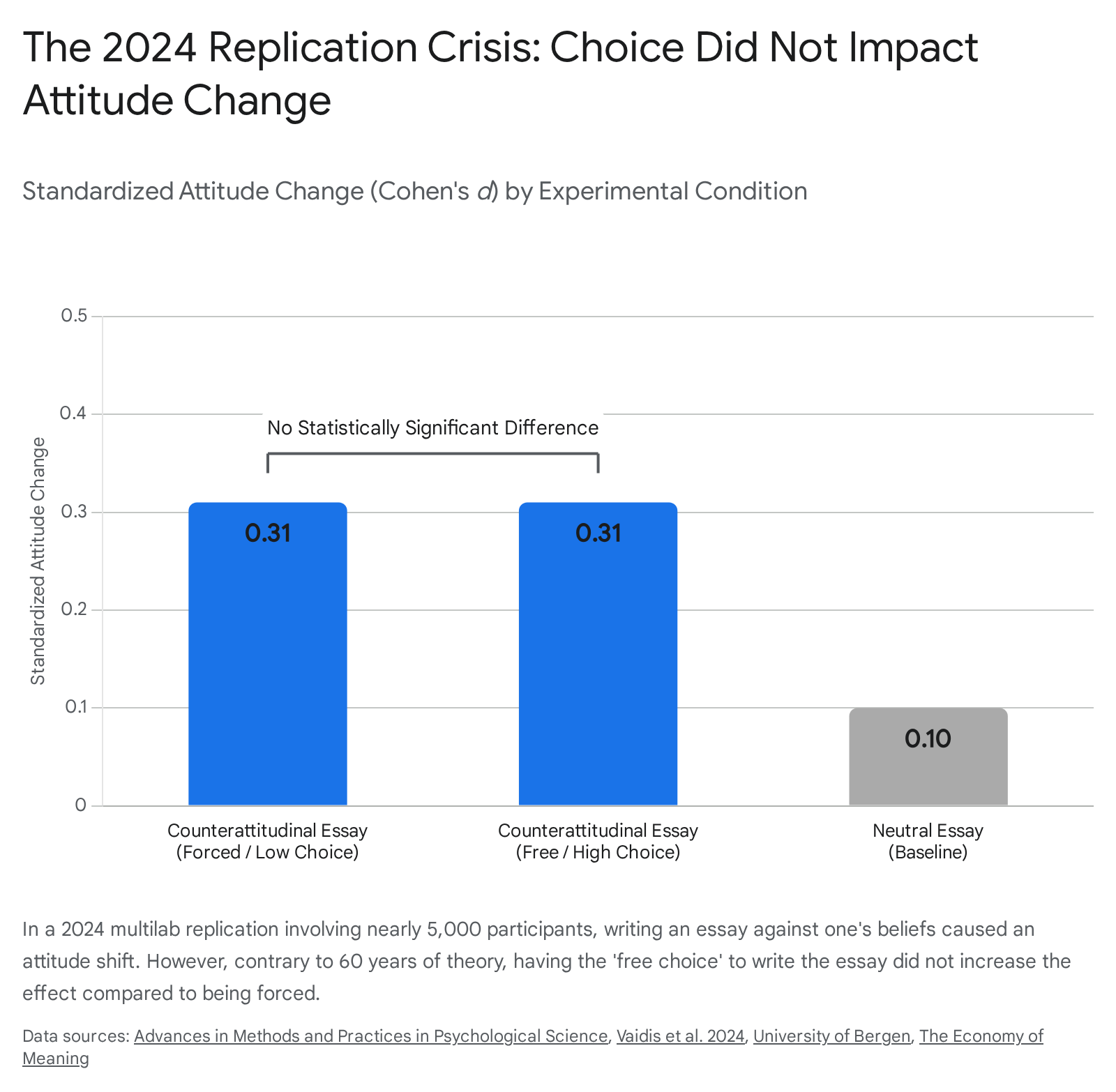
The core hypothesis regarding freedom of choice fundamentally failed to replicate. Secondary analyses confirmed that the failure was robust across different languages, cultural lab settings, and data exclusion criteria 228.
Methodological Debates: Context and Perceived Choice
Does this operational failure mean cognitive dissonance is a myth? Most research psychologists argue absolutely not 1632. Science is iterative, and a failed replication often points to methodological issues and historical shifts rather than a flawed underlying theory.
Critics of the 2024 replication, including prominent dissonance researchers Eddie and Cindy Harmon-Jones, argue that manipulating "perceived choice" in a modern, heavily regulated university laboratory is incredibly difficult 833. Modern Institutional Review Boards (IRBs) require participants to sign extensive informed consent forms explicitly stating that their participation is completely voluntary and can be withdrawn at any time. Therefore, even participants assigned to the "low choice" condition likely felt they had a high degree of choice, functionally neutralizing the experimental manipulation and contaminating the data 833.
Supporting this defense, independent re-analyses of the 2024 data revealed that participants who subjectively reported feeling a high degree of free choice did, in fact, show greater attitude change, aligning perfectly with Festinger's original theory 816. Furthermore, cognitive dissonance relies on far more evidence than the induced-compliance paradigm alone. As noted by analysts of the replication crisis, reasoning backward from an operational failure to conclude that an entire psychological mechanism is invalid is an unscientific fallacy 32.
Critiques of the Free-Choice Paradigm
The free-choice paradigm has also faced severe methodological scrutiny, most notably through mathematical modeling rather than behavioral replication. In 2010, behavioral economist Keith Chen published a highly influential critique demonstrating a foundational mathematical flaw in how the "spreading of alternatives" is measured .
Chen proved mathematically that the free-choice paradigm will produce the illusion of "spreading" even if a person's attitudes remain perfectly unchanged. According to Chen's theorem, if a participant's initial ratings are an imperfect measure of their true preferences, the mere act of forcing them to choose reveals additional information about their pre-existing hierarchy of desires . Therefore, the subsequent divergence in ratings is a statistical artifact of revealed preferences, not evidence of choice-induced attitude change . While this mathematical critique does not disprove dissonance, it forced researchers to redesign free-choice experiments to isolate true psychological shifts from statistical noise.
Cross-Cultural Variations in Cognitive Dissonance
For decades, cognitive dissonance was presumed to be a universal human absolute, functioning identically across all demographics. However, early research relied almost exclusively on Western, Educated, Industrialized, Rich, and Democratic (WEIRD) populations - specifically North American college students 1118. As cross-cultural psychology matured, researchers discovered that while the mechanism of dissonance is universal, the situational triggers for it vary wildly depending on a culture's underlying values and self-construal 1035.
Individualist vs. Collectivist Frameworks
In individualistic cultures (such as the United States, Canada, and Western Europe), the self is viewed as independent, autonomous, and defined by internal attributes 11118. Consequently, dissonance is triggered when an individual's behavior threatens their personal competence or internal consistency 36. If a Westerner makes a poor personal choice, they experience dissonance and engage heavily in rationalization (e.g., spreading of alternatives) 1118.
In collectivist cultures (such as Japan, China, and many East Asian nations), the self is heavily interdependent, defined primarily by social roles, relationships, and group harmony 353637. Early cross-cultural studies famously showed that East Asian participants rarely displayed standard cognitive dissonance when making choices for themselves 18. Some researchers initially hypothesized that collectivists simply did not experience cognitive dissonance, pointing to dialectical philosophical traditions (like Daoism) that promote holistic thinking and a higher tolerance for logical contradictions 3638.
However, groundbreaking research by Hoshino-Browne and colleagues in 2005 proved this assumption false. They demonstrated that East Asians experience intense cognitive dissonance, but only when their actions threaten their interpersonal relationships or group harmony. In a restaurant menu experiment, when asked to make a difficult choice on behalf of a close friend, Asian Canadian and Japanese participants engaged in massive dissonance reduction and rationalization, whereas European Canadians did not 1835. Dissonance exists globally, but it is deeply tethered to what a culture considers a threat to the self.
Emerging Contexts: Africa and the Middle East
This culturally nuanced understanding is currently expanding into emerging global contexts, revealing new guises of cognitive dissonance.
In the Middle East, anthropological and psychological research indicates that socio-cultural systems prioritize "personalism" - a framework that locates cause and accountability in social relationships and interpersonal hierarchy rather than isolated abstract rules 19. Dissonance in these cultures is frequently tied to disruptions in social obligations, honor, and public standing rather than isolated logical inconsistencies 19.
In Africa, recent studies highlight how cognitive dissonance heavily influences educational achievement and technological integration. For instance, a 2024 study on IT adoption among undergraduate students in Ghanaian universities found that students who recognized the absolute necessity of IT skills for their future, yet lacked the physical resources and prior training to succeed, experienced crippling cognitive dissonance. This psychological discomfort led directly to intense anxiety and, ultimately, a defensive disengagement from technology as a dissonance-reduction strategy 40. Similarly, in Zambian secondary schools, students who are structurally forced to take academic subjects they dislike experience severe cognitive dissonance due to the lack of perceived free choice, which correlates strongly with lower academic achievement 20.
To conceptualize these global variations, the following table summarizes how different cultural archetypes experience and resolve cognitive dissonance:
| Cultural Archetype | Primary Focus of the Self | Primary Trigger for Cognitive Dissonance | Typical Resolution Strategy |
|---|---|---|---|
| Individualist (e.g., USA, Western Europe) | Independent, autonomous, focused on personal internal consistency. | Behavior directly contradicts personal beliefs, abstract values, or self-image. | Rationalizing the personal choice; altering private attitudes to match independent behavior. |
| Collectivist (e.g., Japan, East Asia) | Interdependent, focused on group harmony, social roles, and dialectical reasoning. | Behavior threatens social relationships, group norms, or a peer's outcome. | Rationalizing choices made for others; adjusting behavior to restore group harmony. |
| Relational/Personalist (e.g., Middle East, Emerging Markets) | Networked, focused on honor, interpersonal obligations, and hierarchy. | Behavior disrupts relational obligations, familial expectations, or public standing. | Reaffirming social connections; attributing causes to external social actors rather than internal flaws. |
Real-World Applications and Behavioral Economics
While academics debate the statistical margins of laboratory replications and cultural nuances, cognitive dissonance continues to shape human behavior in the real world every single day. Its effects ripple aggressively through our financial decisions, our digital lives, and our political ecosystems.
Marketing, Buyer's Remorse, and Woke Advertising
In the realm of behavioral economics, cognitive dissonance is the driving force behind post-purchase regret, commonly known as "buyer's remorse." When consumers make significant financial investments - such as buying a car, luxury items, or engaging in impulsive online shopping - they inevitably face the reality that their chosen product has flaws and that the alternatives they rejected had benefits 424321.
This post-purchase cognitive dissonance generates anxiety, increasing the likelihood that the consumer will return the product, cancel the service, or leave a negative review 4321. Research utilizing the Stimulus-Organism-Response (S-O-R) model indicates that impulsive buying heavily triggers this dissonance, though the intensity is highly moderated by a consumer's price sensitivity and inherent neuroticism 2145. Modern marketers are keenly aware of this psychological trap and actively design post-purchase journeys to provide consonant information. Welcome emails validating the smart choice, responsive customer service, and social proof (showing millions of others bought the same item) are behavioral nudges designed to help the consumer rationalize their purchase and reduce dissonance 424622.
Furthermore, recent management research highlights the role of dissonance in "woke advertising" and Corporate Social Responsibility (CSR). When a brand known for corporate misconduct abruptly launches a social justice campaign, consumers experience severe cognitive dissonance regarding the brand's true identity, often resulting in toxic online speech and boycotts to resolve the perceived corporate hypocrisy 23.
The Privacy Paradox in the Digital Age
A uniquely modern manifestation of cognitive dissonance is the "privacy paradox." In survey after survey, the vast majority of digital consumers state that data privacy is highly important to them and express outrage at corporate data harvesting 2450. Yet, these same individuals continuously click "Accept All Cookies," use invasive social media platforms, and surrender sensitive personal data in exchange for minor conveniences, like a small discount code or access to a mobile app 2450.
Behavioral economists argue that this is not a true paradox, but rather a classic case of cognitive dissonance heavily manipulated by digital choice architecture. Tech platforms utilize "dark patterns," default biases, and hyperbolic discounting (where immediate minor rewards outweigh distant abstract risks) to ensure that withholding data requires significant mental and physical effort 245051. Confronted with the dissonance between valuing privacy and the massive effort required to protect it, users deploy the trivialization strategy ("They already know everything about me anyway") rather than undergoing the effortful task of reading terms of service or abandoning the platform 5051.
Political Polarization and Echo Chambers
Perhaps the most consequential arena for cognitive dissonance today is global politics. Over the past decade, political polarization has surged to levels that threaten democratic self-governance and institutional stability 5253. Cognitive dissonance theory offers a vital lens for understanding why presenting factual information rarely changes the minds of ardent political partisans.
Political affiliations are rarely just about policy preferences; they are deeply intertwined with an individual's core sense of identity, morality, and group belonging 52. When a voter encounters objective evidence that their preferred candidate has lied, acted unethically, or implemented failed policies, they experience severe cognitive dissonance. The cognition "I am a smart, moral person" violently clashes with the cognition "I voted for a corrupt or incompetent leader" 1252.
To resolve this psychological pain, voters rely on confirmation bias and motivated reasoning 1252. Rather than admitting a mistake - which would damage their self-esteem and risk alienating them from their social ingroup - they attack the source of the dissonant information. They label objective journalism as fake news, dismiss the opposing side as traitors, and retreat into digital echo chambers where their beliefs are constantly validated 5253.
This process creates a dangerous feedback loop of political extremism. A comprehensive analysis of social media behavior between the 2016 and 2020 US elections revealed a sharp increase in cognitive distortions - absolutist, black-and-white thinking typically associated with clinical anxiety disorders - linked directly to political polarization 53.
This phenomenon scales to macro-geopolitical levels. During periods of collective trauma, such as the ongoing conflicts in the Middle East, cognitive dissonance ensures that individuals predominantly register facts that validate their ingroup's historical righteousness while subconsciously filtering out the suffering of outgroups 54. Similarly, researchers analyzing the devastating HIV denialism championed by former South African President Thabo Mbeki in the early 2000s attribute its persistence to macro-level cognitive dissonance. Mbeki and his supporters, deeply entrenched in ideological skepticism, utilized structural denialism to rationalize ignoring orthodox scientific consensus, fueling a public health catastrophe to protect a consonant political worldview 25. As social psychologists note, shouting one-sided slogans within an echo chamber serves to alleviate internal tension, but it fundamentally prevents the objective analysis required for conflict resolution 1254.
Psychological Strategies for Overcoming Dissonance
While cognitive dissonance is frequently associated with negative behaviors, the psychological tension it creates can be powerfully harnessed as an engine for positive behavioral change.
In therapeutic settings, clinical psychologists actively utilize cognitive dissonance to break patients out of destructive thought loops. By gently highlighting the gap between a patient's stated life values (e.g., "I want to be a present father") and their current actions (e.g., "I spend all evening drinking"), therapists induce a controlled level of discomfort 1956. Because the patient is in a supportive environment, they are guided away from maladaptive reduction strategies (like denial or trivialization) and encouraged to use the dissonance as fuel for genuine behavioral change 1956.
Furthermore, research published by the American Psychological Association indicates that "self-affirmation" is a vital tool for overcoming dissonance-induced defensiveness. When individuals are given the opportunity to bolster their general self-worth and integrity before encountering contradictory information, they are significantly less likely to engage in irrational defensive posturing and more likely to accept the truth 1826.
According to clinical guidelines, individuals can actively train themselves to recognize and constructively manage cognitive dissonance rather than falling prey to subconscious rationalizations 2759:
- Practice Mindfulness and Detect Somatic Markers: Learn to recognize the physical symptoms of dissonance. When confronted with new information, if you feel a sudden spike of anxiety, defensiveness, or a visceral desire to justify your actions, pause. Acknowledge that your brain is attempting to protect your ego 565960.
- Articulate the Conflict: Clearly define the two conflicting cognitions. Ask yourself, "What value do I hold, and what specific action did I take that contradicts it?" 1959.
- Base Decisions on Objective Data: Resist the urge to cherry-pick information that makes you feel better. Actively seek out credible, peer-reviewed, and objective sources that challenge your pre-existing beliefs, bypassing digital echo chambers 2761.
- Embrace Being Wrong: Cultivate an identity where being wrong is viewed as a stepping stone to learning rather than a catastrophic threat to your competence. Changing your stance in light of new evidence is the ultimate, healthiest resolution to cognitive dissonance 275960.
Bottom line
Cognitive dissonance is a fundamental, biologically rooted psychological mechanism that drives humans to alleviate the mental anguish caused by conflicting beliefs, values, and actions. While the theory has faced modern methodological scrutiny regarding how easily it is triggered in sterile laboratory environments, decades of cross-cultural, neuroscientific, and behavioral economic evidence confirm its immense power over human decision-making. By understanding our subconscious urge to rationalize poor choices and ignore contradictory facts, we can build conscious resistance to political echo chambers, manipulative digital choice architecture, and self-destructive habits, ultimately aligning our actions closer to our true values.