
Neuroscience and psychology of belief formation
Belief constitutes the psychological and neurobiological mechanism by which human beings cognize reality, construct internal models of their environment, and guide goal-directed behavior. Far from being a passive repository of objective facts, the architecture of human belief is a dynamic, metabolically constrained biological process driven by probabilistic inference and affective valuation. In cognitive neuroscience and psychology, a belief is defined as a propositional attitude assigning a truth value to a mental representation. The study of belief formation spans the initial acquisition of information, the continuous updating of internal models via predictive processing, the profound influence of motivated reasoning, and the overarching large-scale neural networks that adjudicate between internal priors and external sensory evidence.
Foundational Psychological Models of Belief
The cognitive mechanics of how a novel proposition transitions from an external sensory stimulus into an internalized belief have been a subject of theoretical debate for centuries. Historically, this debate was polarized between Cartesian and Spinozan frameworks, which empirical psychology has systematically tested to uncover the default operational state of human comprehension.
The Cartesian and Spinozan Frameworks
The dominant theoretical construct in the contemporary psychology of belief acquisition is the Spinozan model, extensively tested and validated by Daniel Gilbert in the early 1990s. The Cartesian model, derived from René Descartes, posited that the human mind comprehends a proposition in a neutral, unassessed state. Subsequently, the mind engages a separate, effortful cognitive mechanism to either accept or reject the proposition 122. In sharp contrast, the 17th-century philosopher Baruch Spinoza argued that the act of comprehension and the act of acceptance are cognitively identical. According to the Spinozan model, to understand a statement is to automatically and instantaneously believe it. Doubt and rejection are secondary, retroactive, and resource-intensive cognitive operations 143.
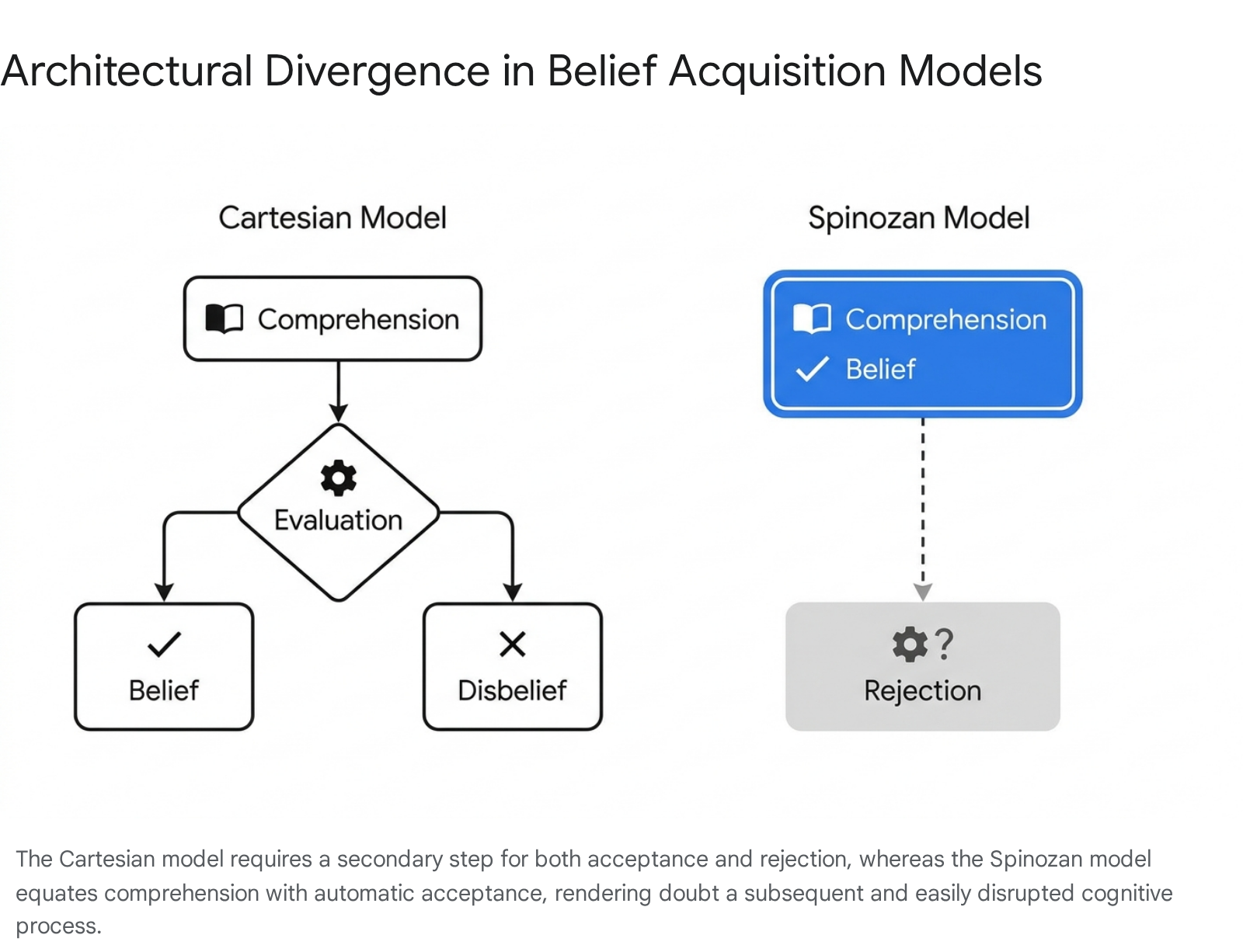
Empirical validation for the Spinozan model relies heavily on dual-task paradigms utilizing cognitive resource depletion. In Gilbert's foundational "Hopi Language Experiment," subjects were exposed to novel assertions - such as learning the translations of a fictitious language - and were informed whether the assertions were true or false. Simultaneously, subjects were subjected to cognitive load or time pressure, forcing a disruption in higher-order processing. A distinct asymmetry emerged: distracted subjects reliably misidentified false statements as true, but did not misidentify true statements as false 345. This "truth bias" indicates that when the secondary, effortful process of evaluation is disrupted by cognitive load, the mind defaults to its initial state of acceptance.
Developmental psychology corroborates this timeline; young children typically accept what they are told by default, as the cognitive capacity to "unaccept" information matures later alongside higher-order executive functions 12. From an evolutionary perspective, the Spinozan architecture is highly economical. Given the reliable accuracy of baseline sensory perception in natural environments, it was metabolically advantageous for early hominid cognition to evolve a direct pipeline from perception to belief, bypassing intermediating analysis to facilitate rapid motor responses 12.
Philosophical Underpinnings and Dual-Aspect Monism
The revival of the Spinozan model in cognitive psychology aligns intricately with Spinoza's original philosophical architecture, particularly his concept of dual-aspect monism. In his seminal work Ethics, Spinoza rejected Cartesian substance dualism (the separation of mind and body), proposing instead that mind and body are two attributes of a single, universal substance 67. This non-dualistic framework has found significant resonance in modern affective neuroscience. Prominent neuroscientists studying affective experience and the free energy principle utilize Spinoza's monism as a philosophical backbone, positing that subjective mental states (beliefs) and objective physical states (brain activity) are parallel expressions of the same underlying biological reality 7. Spinoza's assertion that human beings strive to persevere in their being - a doctrine of psychological egoism - maps closely onto modern homeostatic and allostatic models of brain function, where the organism seeks to minimize surprise and maintain internal equilibrium 67.
Modulation by Plausibility and Epistemic Risk
While the Spinozan model elegantly explains generalized truth biases, recent conceptual replications suggest that this automaticity is modulated by the plausibility of the proposition. Re-evaluations of Gilbert's foundational studies indicate that while the truth bias holds for novel or neutral statements, highly implausible statements may not undergo automatic acceptance 5. If a statement contradicts heavily weighted prior knowledge to an extreme degree, the initial encoding may bypass automatic acceptance. This indicates that a rapid, pre-conscious plausibility filter operates simultaneously with linguistic comprehension, signaling that Spinozan acceptance is contingent upon the epistemic risk associated with the novel information 5.
Cross-Cultural Variances in Cognitive Processing
The architecture of belief formation is not uniform across the human species. Cultural psychology severely complicates the universality of attributional biases and the mechanics of cognitive dissonance. The vast majority of foundational psychological research has been conducted on WEIRD (Western, Educated, Industrialized, Rich, and Democratic) populations, obscuring deep cultural variances in how evidence is evaluated and beliefs are maintained 108910.
Analytic Versus Holistic Cognition
A primary axis of cross-cultural difference lies in visual attention and causal attribution. Western cultures, characterized by high individualism, promote analytic cognitive styles. Westerners exhibit a pronounced dispositional attribution bias, automatically attributing behaviors to the personal traits of the actor while largely ignoring situational context 8101112. Eye-tracking studies, such as those conducted by Richard Nisbett, reveal that American participants focus significantly earlier and longer on foreground focal objects in visual scenes 11.
Conversely, East Asian populations exhibit greater cognitive holism, rooted in collectivist cultural matrices. Chinese and Japanese participants demonstrate visual attention patterns that frequently dart between the focal object and the background, reflecting a cognitive priority given to relationships and contextual variables 11. Consequently, East Asian populations are significantly more likely to attribute outcomes to situational factors rather than personal dispositions. This variance challenges the premise that dispositional bias is an innate, universal mechanism of human perception, framing it instead as a culturally conditioned heuristic 101112.
Motivation Profiles and Cognitive Dissonance
Cultural frameworks dictate not only how information is perceived but also the motivational drivers that facilitate learning and belief updating. In Western educational settings, motivation is highly correlated with personal autonomy and intrinsic mastery-goal orientations - the drive to understand a topic for personal competency 1314. In contrast, students from Confucian-heritage cultures demonstrate complex integrations of extrinsic motivation and performance-approach goals. Collectivist matrices encode social solidarity, family expectations, and external regulation as high-value rewards, indicating that the dichotomy between intrinsic and extrinsic motivation is culturally relative 131418.
Furthermore, the conditions that trigger cognitive dissonance - the psychological discomfort arising from contradictory beliefs - are culturally distinct. Westerners experience significant distress when their personal actions contradict their internally held attitudes, rapidly altering their beliefs or behaviors to resolve the inconsistency 1920. Easterners, however, are less likely to experience dissonance from personal attitude-behavior mismatches. Instead, they exhibit severe cognitive dissonance when their actions threaten important social relationships or violate communal norms 1920.
| Cognitive Dimension | Western (WEIRD) Populations | East Asian / Interdependent Populations |
|---|---|---|
| Visual Attention | Analytic; early and sustained focus on focal/foreground objects. | Holistic; frequent saccades between objects and background context. |
| Causal Attribution | Strong dispositional bias; attributes outcomes to personal traits. | Situational bias; attributes outcomes to environmental and social context. |
| Motivational Drivers | High reliance on intrinsic motivation, autonomy, and mastery-goals. | High integration of extrinsic motivation, social solidarity, and performance-goals. |
| Cognitive Dissonance Triggers | Triggered by mismatch between personal attitudes and individual behavior. | Triggered by mismatch between behavior and social expectations or group norms. |
Neuroanatomical Correlates of Belief Formation and Updating
The transition from psychological models to neurobiological architecture requires localizing how the brain constructs, evaluates, and updates beliefs. Recent coordinate-based meta-analyses of functional magnetic resonance imaging (fMRI) data reveal that belief is not a monolithic neural event, but a series of overlapping and dissociable networks 2115.
Functional Dissociation Between Formation and Updating
Belief formation (the initial development of an individual's belief) and belief updating (the revision of existing beliefs in response to contradictory evidence) rely on partially distinct neural pathways. Activation Likelihood Estimation (ALE) meta-analyses encompassing numerous fMRI studies demonstrate that the Temporo-Parietal Junction (TPJ) - particularly the right TPJ - is critically engaged during the initial formation of beliefs 211516. The TPJ acts as a neural template, assessing incoming environmental information for congruence with existing schemas. It is highly active in social belief formation, such as in False Belief tasks where individuals utilize Theory of Mind (ToM) to infer the beliefs and intentions of others 211617. In contrast, non-social belief formation heavily recruits the left dorsolateral prefrontal cortex (DLPFC), an area associated with executive function, working memory, and logical evaluation 1516.
Belief updating, however, introduces the metabolic and cognitive necessity of perspective-shifting. When sensory evidence contradicts an established internal model, the precuneus (PCu) - a region deep in the medial parietal lobe - is strongly activated. The precuneus facilitates the required shift in viewpoint necessary to adapt beliefs and integrate novel, discordant information. Meta-analyses identify the precuneus as a critical shared node active in both the initial formation and the subsequent updating of beliefs, highlighting its role as a core hub in the doxastic (belief-related) network 211516.
Pre-Linguistic Belief Precursors
The formation and updating of beliefs are not strictly bound to higher-order linguistic processing. Rapidly evolving neural processes encompassing perception, valuation, and sensorimotor control operate pre-linguistically to form "primal beliefs" or belief precursors 1819. These foundational, pre-linguistic states do not depend on language functions; rather, language serves only to articulate the belief once the subject becomes conscious of it. The neural substrates for these rapid valuations include the amygdala, cingulate cortex, orbitofrontal cortex, and the mid-ventral prefrontal cortex, which integrate perceptive data with affective tone outside of conscious awareness 181927.
The Triple Network Model Dynamics
Complex cognitive states, such as evaluating the validity of a proposition, do not arise from isolated brain regions. Instead, they emerge from the coordinated activity of large-scale, intrinsically organized neural networks. The Triple Network Model provides a robust framework for understanding the neurobiology of belief evaluation, conflict detection, and psychopathology. The model is built upon the interactions of three core networks: the Default Mode Network (DMN), the Central Executive Network (CEN, also referred to as the Frontoparietal Network), and the Salience Network (SN) 17202122232425.
Architecture of the Triple Network
- The Default Mode Network (DMN): Anchored in the medial prefrontal cortex (mPFC) and the posterior cingulate cortex (PCC), the DMN governs self-referential thought, introspection, autobiographical memory, and the maintenance of internal priors (existing beliefs). The DMN is typically active during rest and deactivated during cognitively demanding external tasks 2021222425.
- The Central Executive Network (CEN): Anchored in the dorsolateral prefrontal cortex (DLPFC) and the posterior parietal cortex (PPC), the CEN regulates external goal-directed behavior, working memory, evaluation, and logical reasoning 20212425.
- The Salience Network (SN): Anchored in the anterior insula (AI) and the dorsal anterior cingulate cortex (dACC), the SN acts as the critical dynamic switch between the DMN and the CEN. It continuously monitors the internal and external environments for highly relevant, novel, or conflicting information 2021242526.
The Salience Network as the Doxastic Switch
The interaction of these networks is fundamental to belief updating. When an individual encounters a piece of information that directly challenges a deeply held belief - generating a high-salience prediction error - the SN detects this conflict. To process the challenge, the SN issues inhibitory signals to disengage the internally focused DMN and excitatory signals to activate the externally focused CEN to assess the new evidence 17202122.
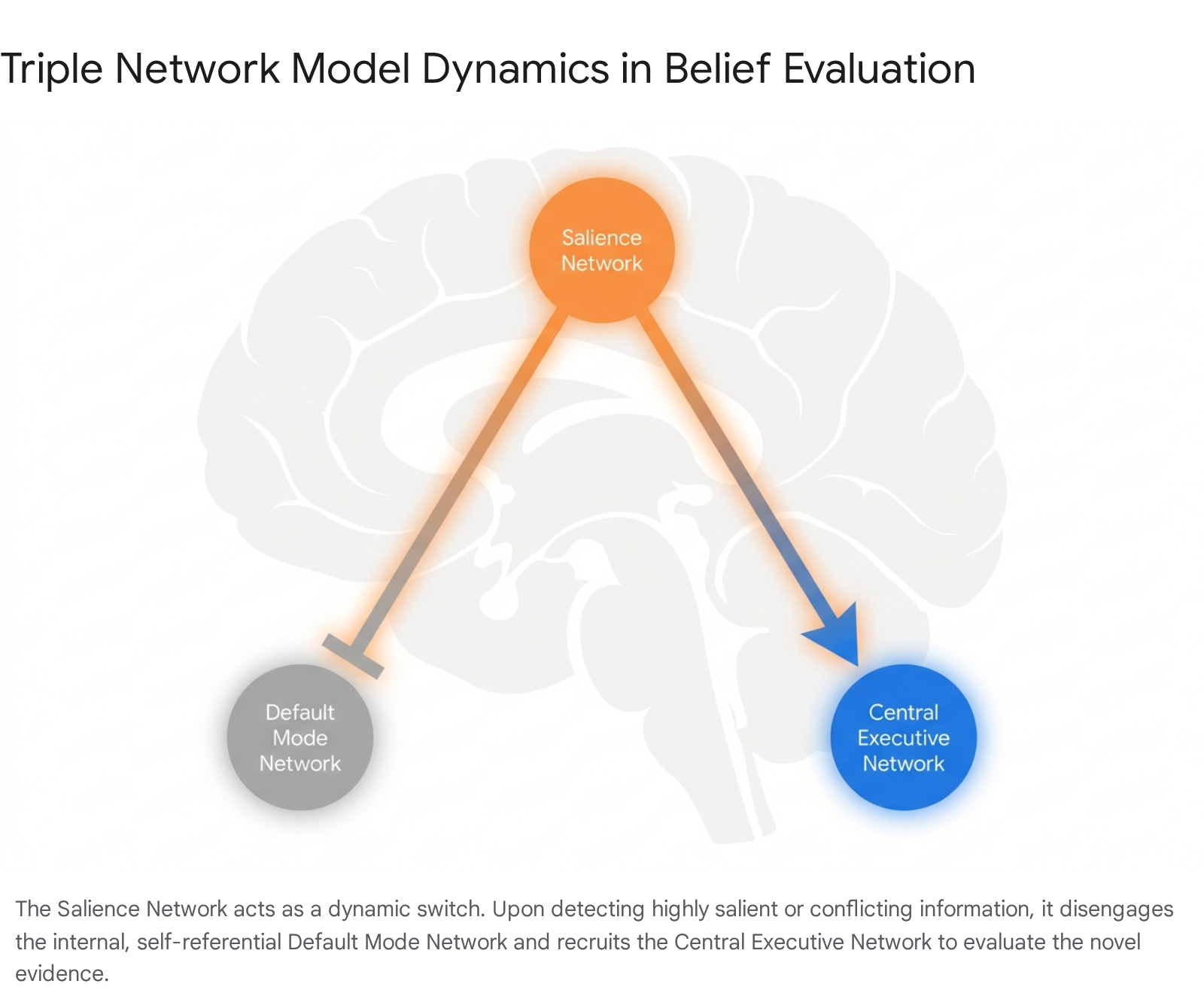
The anterior insula's involvement in the SN is critical for what Spinoza identified as the "rejection" phase of belief. Formal predictive coding models demonstrate that the anterior insula encodes trial-by-trial belief updating, tracking statistical dependencies and error signals within the environment 352728. Furthermore, the SN is intimately involved in processing morally laden information. When subjects evaluate implicit moral vs. immoral statements, core regions of the SN activate, modulating downstream interactions to service complex moral reasoning and identity preservation 26. Aberrations in Triple Network interactions are implicated in a spectrum of conditions, ranging from the amplification of suffering in chronic pain to the dysregulated belief updating seen in substance addiction (as modeled by the impaired response inhibition and salience attribution, or iRISA, framework) 2529.
Predictive Processing and Active Inference
In contemporary theoretical neuroscience, the acquisition, maintenance, and updating of beliefs are formalized most comprehensively by the predictive processing (PP) framework and its generalization, active inference, largely pioneered by Karl Friston and Andy Clark 3031323334.
Generative Models and Variational Free Energy
The predictive processing framework argues that the brain does not passively receive bottom-up sensory information to build a model of the world. Instead, the brain operates as a hierarchical inference engine that continuously generates top-down probabilistic predictions - beliefs - about the causes of sensory signals 303133. These internal structural predictions constitute a "generative model." When incoming bottom-up sensory data mismatches the top-down prediction, a "prediction error" is generated.
Under the Free Energy Principle (FEP), all self-organizing biological systems must resist the tendency toward entropy by minimizing "variational free energy," which is psychologically equivalent to minimizing surprise or prediction errors 3033. Active inference posits that the brain minimizes this free energy in two distinct ways: by updating internal beliefs to match the sensory evidence (perceptual inference), or by executing physical actions to change the external world so that sensory evidence aligns with prior beliefs (motor control and action) 303435. Under this paradigm, beliefs are not static files retrieved from a neural archive; rather, they are continuous, active, and mathematically formal distributions of probabilities that govern interaction with reality.
Precision Weighting and Belief Maintenance
Not all prediction errors result in a belief update. The deciding factor in whether a belief changes is "precision weighting." Precision weighting is the mechanism by which the brain assigns confidence (represented mathematically as inverse variance) to either its prior beliefs or the incoming sensory evidence 31333536. Precision weighting acts as a synaptic gain control mechanism, widely understood to be mediated by neuromodulators such as dopamine, acetylcholine, and serotonin 293335.
If the brain assigns high precision to sensory evidence, prediction errors are heavily weighted, and the generative model (the belief) is rapidly updated. Conversely, if the brain assigns low precision to sensory errors and high precision to its prior beliefs, new evidence is effectively ignored, and the prior belief is maintained despite glaring contradictory data 3536.
Pathological Belief States and Psychosis
The dynamic of precision weighting is crucial for understanding pathological belief formation. In psychiatric conditions characterized by delusions, paranoia, or psychotic-like experiences (PLEs), precision weighting is fundamentally dysregulated. Research indicates that individuals experiencing PLEs may initially exhibit lower belief precision during early evidence accumulation, making them highly vulnerable to adopting abnormal, sudden prior beliefs to rapidly resolve states of profound uncertainty 293637.
Once established, however, these pathological beliefs are granted disproportionately high precision. This results in severe belief perseverance, where conflicting environmental evidence is systematically down-weighted and ignored 293637. The predictive processing model characterizes hallucinatory states as an extreme over-weighting of top-down predictions relative to bottom-up sensory inputs, resulting in "controlled hallucinations" that the subject perceives as absolute, incontrovertible reality, disconnected from the constraints of the physical environment 3336.
Motivated Reasoning and Affective Valuation
While predictive processing provides a mathematically optimal Bayesian framework for belief updating, human belief formation in practice frequently deviates from strict rationality. The psychological mechanism by which individuals buttress their sense of self plays a decidedly non-Bayesian role in belief acquisition 13839. Motivation and affect profoundly skew the evaluation of evidence, leading to motivated reasoning.
The Role of Reward Circuitry in Belief Endorsement
Motivated reasoning occurs when the desire to reach a particular conclusion biases the processing of information. Neuroimaging demonstrates that the brain evaluates information not strictly for objective truth, but for subjective value and affective reward 3839. The ventromedial prefrontal cortex (vmPFC) and the ventral striatum (including the caudate and lentiform nucleus) are critical nodes in the brain's valuation system. These regions encode the desirability of an outcome or a piece of information 394041.
When individuals encounter information that confirms desirable beliefs, the striatum and vmPFC activate strongly. This signals a reward response that facilitates the rapid acceptance - often an overendorsement - of the information, lowering the threshold for belief formation. Conversely, when confronted with undesirable information, activation in these valuation networks is suppressed, and areas associated with error detection and cognitive conflict (such as the ACC and anterior insula) are recruited to heavily scrutinize, discount, or reject the data 262939. Transcranial magnetic stimulation (TMS) studies have demonstrated that temporarily disrupting the left inferior frontal gyrus (IFG) can actually improve a person's ability to incorporate bad news into their beliefs, eliminating the engrained "good news/bad news effect" by disabling the brain's identity-protection filters 42.
Political and Ideological Polarization
This valuation dynamic is overtly evident in political and ideological polarization. The mentalizing network (including the TPJ and mPFC) activates heavily to protect identity-congruent beliefs. It evaluates the credibility of a source through the lens of group affiliation rather than objective accuracy 3943. During political motivated reasoning, activation of prediction error detection regions tracks the degree to which an individual under-endorses out-group messages. Consequently, the brain processes the rejection of deeply held identity-beliefs similarly to physical pain or existential threat, utilizing overlapping distress-regulation networks to bias decision-making toward short-term emotional relief - namely, ignoring the contradictory evidence to maintain the integrity of the social identity 262939.
| Belief Category / Function | Associated Neural Regions | Neurocognitive Role |
|---|---|---|
| Desirability Bias / Reward | Ventromedial PFC (vmPFC), Ventral Striatum (Caudate) | Encodes affective value; triggers reward response upon encountering belief-confirming evidence. |
| Identity-Protective Cognition | Temporo-Parietal Junction (TPJ), Medial PFC (mPFC) | Engages mentalizing networks to evaluate source credibility based on in-group/out-group status. |
| Cognitive Conflict / Bad News | Anterior Cingulate Cortex (ACC), Anterior Insula, IFG | Detects epistemic risk; mounts cognitive defense against undesirable or contradictory information. |
Domain-Specific Beliefs and the Supernatural
A prominent question in the neuroscience of belief is whether specific categories of belief - particularly religious, spiritual, or supernatural convictions - utilize dedicated neural hardware, or if they rely on the same domain-general mechanisms used for ordinary factual processing.
Content-Independent Mechanisms of Assent
Foundational fMRI studies conducted by Sam Harris and colleagues directly compared the neural evaluation of factual propositions (e.g., mathematical, ethical, or geographic statements) with religious propositions 3544454656. The findings established that the neurobiological difference between belief and disbelief is entirely content-independent.
For both devout religious believers and nonbelievers, judging any statement as "true" was associated with increased signal in the ventromedial prefrontal cortex (vmPFC), the area regulating hedonic processing, reward, and self-representation 3544. Judging a statement as "false" engaged the anterior insula (an area associated with disgust, fear, and bad smells) and dorsal executive structures 35274446. The state of uncertainty - judging a statement as "undecidable" - differentially activated the anterior cingulate cortex (ACC) and the dorsomedial prefrontal cortex (dmPFC), tracking the subjective epistemic risk of the proposition 354456.
The engagement of the vmPFC during belief acceptance suggests that affirming a proposition as true is inherently rewarding, relying on primitive hedonic processing. As researchers noted, the neural response to false propositions suggests that they may quite literally elicit a form of neurobiological disgust, activating the same pathways responsible for recoiling from physical contaminants 352746.
Deconstruction of the Localized Spiritual Module
Early hypotheses in neurotheology frequently posited the existence of a "God Spot" - a distinct, localized neural structure uniquely responsible for spiritual and religious cognition. This was primarily driven by observations of hyperreligiosity in patients with temporal lobe epilepsy 57474860495063. However, comprehensive functional neuroimaging and large-scale lesion mapping have thoroughly debunked this reductionist view.
Religious and supernatural beliefs do not possess a unique neural network. Instead, they are processed by co-opting domain-general systems built for social cognition, theory of mind, and semantic memory 175152. Researchers analyzing the psychological dimensions of religious belief identified three core factors: perceived level of God's involvement, God's emotion, and doctrinal/experiential knowledge 515253. When individuals process statements regarding God's intent or emotions, they heavily recruit the TPJ, mPFC, and precuneus - the exact neural network used to infer the mental states of other human beings 17195152.
Lesion Studies and Mystical Experiences
Lesion studies provide critical causal evidence regarding the architecture of religious belief. Damage to the dorsolateral prefrontal cortex (dlPFC) often results in a measurable increase in mysticism and a higher incidence of spiritual experiences. This suggests that the dlPFC normally exerts an inhibitory, down-regulating top-down control over unusual sensory perceptions or magical thinking 5254. Furthermore, damage to the right vmPFC alters an individual's perceived relationship with God, often intensifying authoritarian concepts of the divine and altering empathetic responses 54. Therefore, religious cognition is an emergent property of complex, distributed networks encompassing executive inhibition, social mentalizing, and emotional salience, rather than an isolated neurobiological module 172054.
Methodological Constraints in Neuroimaging Research
While neuroimaging has revolutionized the understanding of belief formation, interpreting functional magnetic resonance imaging (fMRI) data requires calibrated uncertainty regarding its inherent methodological limitations.
Neurovascular Coupling and the BOLD Signal
The foundational premise of fMRI is neurovascular coupling - the assumption that changes in the blood-oxygen-level-dependent (BOLD) signal accurately reflect localized neuronal spiking activity. Recent analyses challenge the universality of this assumption. In certain cognitive tasks and specific brain regions (particularly within the Default Mode Network), researchers have observed that up to 40% of voxels exhibiting significant BOLD signal changes actually demonstrate reversed oxygen metabolism 5556.
In these discordant instances, brain tissue meets energy demands by increasing its oxygen extraction fraction without a commensurate increase in cerebral blood flow. This leads to a profound mismatch where a heightened fMRI signal may correlate with reduced neural activity, or a decreased signal may appear in an area with heightened neural spiking 56. This disparity is particularly problematic in studies of higher-order processing, psychiatric disorders, aging populations, or patients with vascular disease, where altered fMRI readings may reflect vascular pathology rather than true neural deficits 555657.
Precision Brain-Wide Association Studies
Additionally, the replicability of Brain-Wide Association Studies (BWAS) - which attempt to correlate inter-individual differences in complex behavioral traits (such as specific belief tendencies or mental health phenotypes) with brain function - has historically been extremely poor 715873. Studies using standard task-based fMRI on small sample sizes (e.g., under 100 participants) with minimal scan times per individual often yield low test-retest reliability, producing intraclass correlation coefficients (ICC) around 0.29 5859.
When fMRI is utilized to make predictions about individual beliefs or future behaviors, image-based blood flow measurements are rarely consistent across short timeframes for the same individual 5859. To overcome these limitations, the field is increasingly shifting toward "precision neuroimaging." This approach necessitates gathering massive amounts of individual-level data (thousands of trials per participant) and expanding overall consortium sample sizes into the tens of thousands to reliably detect the subtle, spatially distributed network differences that govern complex psychological phenomena like belief formation and updating 715873.