
What Happens Inside a College Admissions Committee
Inside elite college admissions committee meetings, regional officers act as passionate advocates, pitching "bubble" applicants to a panel of senior deans who vote on final decisions. Rather than strictly ranking students by grades and test scores, the committee operates like a casting director, evaluating how each applicant fulfills shifting institutional priorities such as geographic diversity, specialized majors, or extracurricular needs. Ultimately, high-stakes admission decisions are driven as much by the university's internal demographic and financial goals as by an individual applicant's academic merit.
The Staggering Scale of Selective Admissions
To understand what happens inside the highly secretive college admissions committee room, one must first grasp the sheer scale of the modern application funnel. The ecosystem of highly selective higher education is defined by an extreme imbalance between supply and demand. The United States produces roughly 25,000 high school valedictorians annually, but the most elite universities combined have only a fraction of that number in available freshman seats 1. If an Ivy League institution admitted only domestic valedictorians, it would still be forced to reject the vast majority of them 1.
Because academic perfection is remarkably common within this top tier of applicants, the baseline metrics of grade point averages and standardized test scores do not guarantee admission; they merely punch a ticket for an applicant's file to be read 12. When a highly selective university receives over 50,000 applications for a class of 2,000 students, the admissions office is forced to implement a grueling, multi-stage triage system to whittle down the pool before the committee ever convenes 23.
The First Pass: Reading Season and Initial Bins
The foundation of the committee process is laid during "reading season," a multi-month marathon where admissions officers evaluate thousands of files 4. The initial review of an application is shockingly brief. Driven by the sheer volume of submissions, admissions officers typically spend between five and fifteen minutes reading a single application 56. During this rapid evaluation, officers review transcripts, extracurricular lists, test scores, and personal essays, summarizing the candidate's strengths and weaknesses into a tight, standardized internal report 57.
At this stage, applications are generally sorted into distinct pathways. The initial review acts as a sanity check. Applicants whose academic records fall significantly below the university's historical benchmarks - without compelling contextual explanations - are typically filtered into a denial pool early on 289. Conversely, a small percentage of students who are universally recognized as exceptional "consensus admits" may be flagged for acceptance without requiring prolonged debate 2.
This leaves a massive middle ground: the "bubble." These are applicants who are undeniably qualified to succeed academically but do not instantly stand out in a pool of thousands of similarly qualified peers. It is these edge cases that are sent to the admissions committee for rigorous, holistic debate 210. By the time the sorting is complete, a pool of 50,000 applications might be reduced to just 1,000 highly competitive files slated for committee review, where only half of them will ultimately secure an offer of admission 2.
The Rise of Artificial Intelligence in the Reading Phase
The overwhelming volume of applications has recently prompted universities to integrate artificial intelligence into this initial reading phase. While AI is not making final decisions, it is increasingly used to organize data and verify human evaluations 1. For example, Virginia Tech has implemented an AI-powered essay reader that operates as a secondary scorer alongside a human admissions officer; a third human reader is only brought in if the AI and the first human disagree by more than two points 1.
Other institutions leverage AI for specific contextual tasks. The University of North Carolina at Chapel Hill uses AI software to generate data points regarding the writing style and grammatical proficiency of applicant essays, while Stony Brook University utilizes AI to summarize lengthy recommendation letters and highlight specific personal hardships, ensuring human readers do not miss crucial context during their rapid reviews 1. The California Institute of Technology has even begun using an AI video chatbot to interview students about their submitted research projects, allowing faculty to gauge the authenticity of the student's work before the committee makes a final call 1. These tools are designed to streamline the pipeline, ensuring that by the time a file reaches the physical committee room, the data is verified and easily digestible.
The Architecture of the Committee Room
As reading season concludes, the admissions office transitions into the committee phase. The physical and psychological environment of these meetings reflects the gravity of the decisions being made. Committee review is not a feature of every college; it is a mechanism primarily utilized by the nation's most selective institutions to conduct highly individualized, subjective evaluations 12.
The typical committee room is an intimate but intense space. It frequently consists of a senior admissions leader serving as the chair, the regional admissions officer presenting the file, and two or three other colleagues or faculty members to provide diverse perspectives 82. They are often holed up in conference rooms for ten to twelve hours a day, engaging in back-to-back deliberations for weeks leading up to the final notification deadlines 12.
Technological integration plays a central role in these meetings. The days of passing around physical paper files have largely ended. Instead, the committee gathers around a large, horseshoe-shaped table facing a digital projection screen 214.
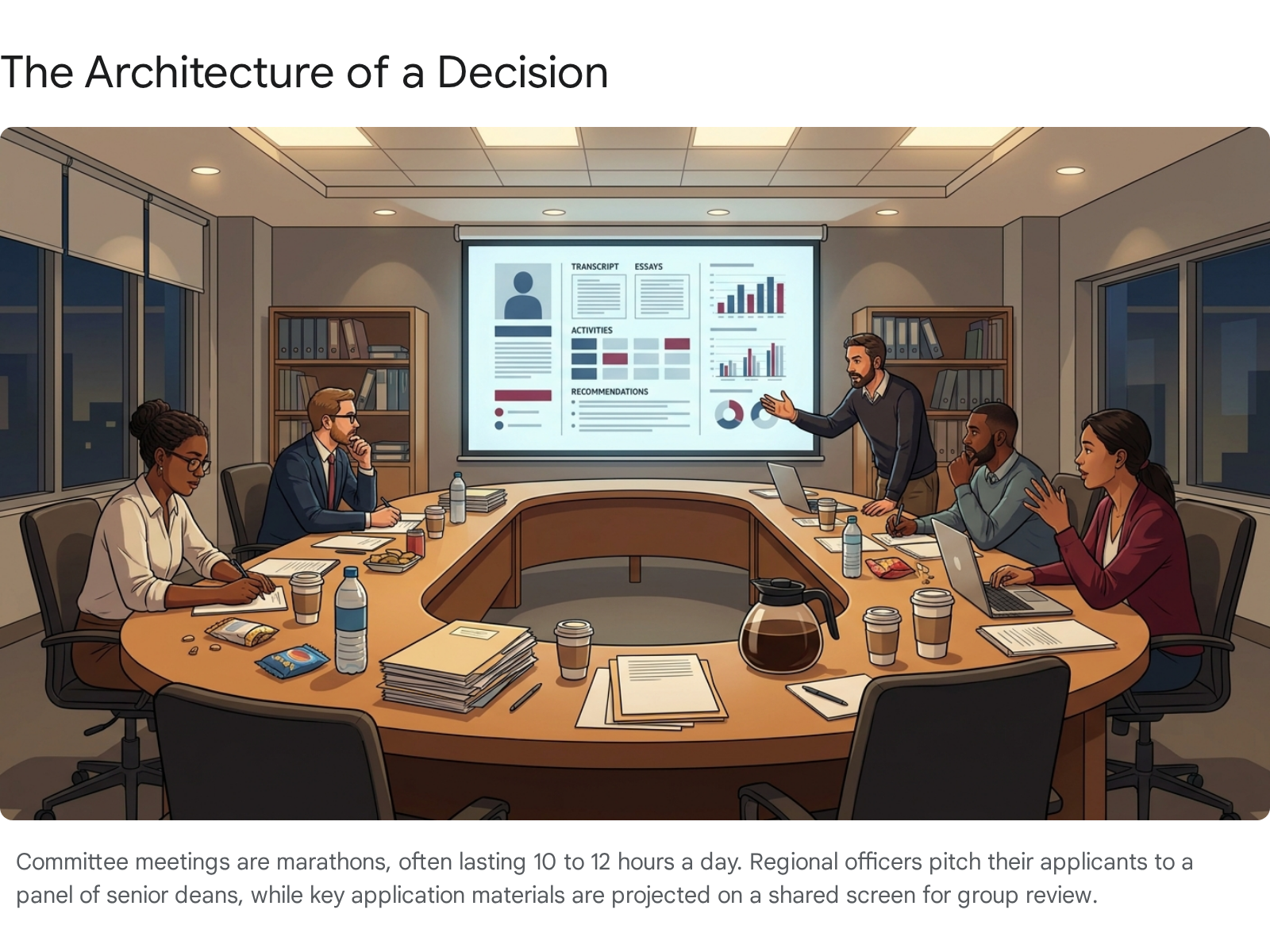
As an applicant's case is introduced, their transcripts, essay excerpts, and interview notes are projected onto the wall, allowing the entire room to evaluate the raw materials of the student's life simultaneously 2. The atmosphere is a blend of high-stakes corporate boardroom and academic seminar, fueled by an endless supply of coffee and snacks to maintain focus through thousands of consecutive micro-decisions 122.
The Pitch: The Regional Officer as Advocate
When an application is brought to the committee, the floor is handed over to the regional admissions officer. Universities typically divide the country and the world into geographic territories, assigning specific officers to become experts in those regions 23. A regional officer knows the nuances of the high schools in their territory; they know which schools suffer from extreme grade inflation, which offer robust Advanced Placement programs, and which neighborhoods face systemic educational hurdles 24.
Because the regional officer has already conducted the primary read of the file, their role in the committee room is to serve as the applicant's advocate. They must deliver a concise, compelling pitch to the rest of the room, essentially answering the question: why should this specific student be admitted? 212.
This pitch is an exercise in storytelling. The officer will extract the nuances of the application, moving beyond the raw GPA to highlight compelling personal anecdotes, intellectual vitality, or demonstrated resilience 7812. They might read a particularly powerful sentence from a teacher's recommendation letter or highlight how an applicant's independent coding project demonstrates exceptional self-direction 74. The goal is to make the applicant memorable, transforming a digital file into a living, breathing community member in the minds of the voting committee. However, no single officer has the unilateral authority to admit a student. If an officer wants a candidate to succeed, they must successfully persuade their peers 812.
The Philosophy: Casting a Play, Not Grading a Test
To comprehend why certain students are admitted while ostensibly stronger candidates are rejected, one must understand the underlying philosophy of the committee room. Admissions officers do not view their task as rewarding the students who have amassed the most impressive resume. They are not looking to fill a trophy case with isolated high achievers 4.
Instead, admissions deans frequently compare the committee process to "casting a play" or "building a choir" 1718195. In theater, a director does not cast a play by simply selecting the fifty most talented leading actors; doing so would result in a production with no supporting cast, no stagehands, and no lighting technicians. A college class requires a similar balance. The university needs researchers, community organizers, writers, athletes, and artists to create a functional, vibrant micro-society 121.
This sociological approach to admissions means that an applicant is rarely evaluated in a vacuum. They are evaluated based on how their specific background, interests, and talents fit into the broader mosaic of the incoming freshman class 46. This concept is formalized in the room under the banner of "institutional priorities."
Understanding Institutional Priorities
Institutional priorities are the strategic, shifting goals that dictate a university's needs in any given year. These priorities are fluid and largely invisible to the applicant pool, making the admissions process feel incredibly unpredictable from the outside 42123. A committee may be instructed by the university provost or board of trustees to shape the class around specific demographic, academic, or financial targets 624.
One of the most visible institutional priorities involves specialized talents. If the university orchestra is graduating its first-chair French horn player, the committee will actively seek out a replacement. While a world-class pianist may be technically brilliant, piano players are statistically common in elite applicant pools. A talented bassoonist or French horn player, however, fulfills a pressing and rare institutional need, granting that applicant a significant structural advantage in committee debates 2125. The same logic applies to athletic recruitment; a university needing a goalie for the field hockey team will prioritize a qualified student-athlete who fits that exact physical and strategic requirement 12325.
Academic balancing is another major priority. Elite universities strive for intellectual diversity across their departments. If an institution experiences a massive surge in applications from aspiring computer science and pre-medical students, the committee will actively look for students who demonstrate a genuine, undeniable passion for the humanities, linguistics, or ancient history 825. Admissions officers are trained to be skeptical of the "art history but lurking English major" or the applicant who feigns interest in an obscure subject merely to gain entry, looking instead for deep, substantiated engagement 8.
Geographic and socioeconomic diversity also heavily influence committee votes. Selective colleges desire a student body that represents all fifty states and various global backgrounds. Consequently, a highly qualified applicant from an underrepresented rural region like Wyoming or the Dakotas may receive more enthusiastic committee advocacy than a mathematically identical applicant from a heavily overrepresented suburb in New Jersey or the California Bay Area 1824. Financial priorities play a role as well; while many elite schools are need-blind, the institution ultimately has to balance its budget, meaning the enrollment management team models the ratio of full-pay students alongside ambitious goals to increase first-generation and Pell Grant-eligible populations 2426.
The Mechanics of Deliberation and Voting
Once the regional officer has made their pitch and the institutional priorities have been debated, the committee must reach a decision. The mechanics of this vote vary significantly depending on the university's governance structure and the selectivity of the institution.
In some admissions offices, decisions are finalized through a simple majority vote 78. After a brief discussion, the chair will ask the room to vote to admit, waitlist, or deny. If a quorum is present and a simple majority raises their hands in favor of admission, the applicant is accepted 789. This system allows committees to move through high volumes of applications relatively quickly, preventing the room from becoming bogged down in endless philosophical debates over a single polarizing applicant 910.
Conversely, some of the most highly selective institutions, such as Columbia University, operate on a strict consensus model 8. In these environments, simple majorities are insufficient. If the regional officer advocates for admission, they must defend the case in real-time while a senior chair and another officer simultaneously review the file. The chair has the authority to interrupt, verify details, and challenge assumptions 8. Under this model, consensus is absolutely required for a student to be admitted. If the presenting officer cannot persuade the room, or if the senior chair issues a definitive "no," the deliberation typically ends and the file is denied 8.
Committee Voting Structures: Majority vs. Consensus
| Feature | Simple Majority Voting | Consensus / Unanimous Voting |
|---|---|---|
| Voting Threshold | A strict mathematical count (e.g., 50% + 1) determines the outcome. | All voting members of the committee must agree on the decision. |
| Pace of Deliberation | Generally faster. Allows committees to process high application volumes efficiently. | Generally slower. Requires prolonged, intensive debate to resolve disagreements. |
| Role of the Chair | The chair manages the flow of the room, ensures fairness, and votes to break ties. | The chair holds significant veto power and must guide the room toward a unified stance. |
| Applicant Impact | A deeply polarizing applicant (loved by some, disliked by others) can still be admitted if they secure enough votes. | Polarizing applicants are more likely to be denied, as a single strong, principled objection can block admission. |
Breaking Ties: The Search for Character
When acceptance rates hover in the single digits, committees frequently face the dilemma of choosing between multiple candidates who possess identical, flawless academic records. When grades and test scores fail to differentiate applicants, the committee turns to qualitative tie-breakers.
These tie-breakers are heavily reliant on evidence of character, maturity, and self-awareness 431. For programs that require interviews, the exact phrasing used by an interviewer can make or break a tied decision 3132. Committees are highly sensitive to how students discuss their peers and their failures. When asked about a team conflict or a challenging project, the applicants who win the tie-breaker are those who take responsibility for their role in the conflict, give credit to their teammates unprompted, and avoid portraying themselves as the lone hero of every story 31. Conversely, students who provide canned, overly polished answers or who throw their peers under the bus are quickly flagged for denial 31.
Legacy status - being the child or relative of an alumnus - is another structural tie-breaker. While highly controversial, university leadership frequently defends legacy preference not as a primary driver of admissions, but as a secondary mechanism used strictly when two applicants are deemed equally qualified 2633. Committees utilize this tie-breaker to foster long-term alumni loyalty, tradition, and sustained donor support, acknowledging that it operates at the margins of the holistic review process 2633.
Early Decision vs. Regular Decision Dynamics
The atmosphere and strictness of the committee room change depending on the time of year. Admissions offices generally operate in two major cycles: Early Decision/Early Action in the late fall, and Regular Decision in the winter and spring 1234.
During the Early Decision committee rounds, the volume of applications is significantly smaller, affording the committee the luxury of spending more time debating the nuances of each file 1234. Because Early Decision is a binding contract - meaning the student is legally obligated to attend if admitted - the committee knows that every offer extended will result in an enrolled student 135. Consequently, universities often use the early round to securely lock in their most pressing institutional priorities, such as recruited athletes, legacy students, and exceptional academic standouts, sometimes filling up to half of the incoming class before the regular round even begins 3536. If the committee is unsure about an applicant in the early round, they will issue a "deferral," moving the application to the regular pool to be re-evaluated within the context of the broader applicant base 1034.
By the time the Regular Decision committee convenes, the pressure is immense. The volume of applications is astronomically higher, and the remaining number of seats is drastically reduced. The regular round is disproportionately competitive, and the committee must move with ruthless efficiency 35. The conversations are shorter, and the margin for error is non-existent.
Early Decision vs. Regular Decision Committee Focus
| Committee Round | Application Volume | Strategic Focus in the Room | Common Outcomes |
|---|---|---|---|
| Early Decision (ED) | Lower volume. Allows for deeper, longer discussions per file. | Locking in core institutional priorities, athletes, and high-yield candidates. Shaping the foundation of the class. | Admit, Deny, or Defer (postponed for review in the regular pool). |
| Regular Decision (RD) | Massive volume. Requires rapid, highly efficient decision-making. | Filling remaining demographic gaps, balancing academic majors, and finalizing yield models. | Admit, Deny, or Waitlist. (Deferrals are not used in this round). |
The Strategic Function of the Waitlist
Not every applicant debated in the committee room receives a definitive "yes" or "no." The waitlist is a third, highly strategic tool used heavily during the Regular Decision round to protect the university's enrollment goals 1034.
The primary purpose of the waitlist is yield management 3437. Universities utilize complex predictive algorithms to estimate exactly how many of their admitted students will accept the offer and enroll. However, human behavior is inherently unpredictable. To ensure they do not accidentally over-enroll and run out of dormitory space, admissions committees are intentionally conservative with their initial acceptance offers 34. They place a large buffer of fully qualified students on the waitlist as a hedge. If May arrives and enrollment falls short of the target, the committee reconvenes to pull students from the waitlist to fill the exact demographic or academic gaps that materialized 3234.
Furthermore, the waitlist serves a diplomatic function inside the committee room. When an applicant has powerful institutional ties - such as the child of a university faculty member, a mid-tier donor, or a highly connected high school - the committee may feel it is politically unwise to issue a flat rejection 34. By placing these "tagged" students on the waitlist, the committee acknowledges that the student is academically qualified while letting them down gently, preserving the university's relationship with the family without sacrificing a coveted freshman seat 3437.
The 2024-2026 Paradigm Shifts in the Room
The conversations occurring inside admissions committee rooms today look remarkably different than they did a decade ago. Between 2024 and 2026, two massive paradigm shifts forced committees to completely overhaul how they evaluate talent: the Supreme Court's ban on affirmative action and the messy reversal of pandemic-era standardized testing policies.
Navigating the Post-SFFA Landscape
In June 2023, the U.S. Supreme Court issued a landmark ruling in Students for Fair Admissions (SFFA) v. Harvard, effectively striking down the use of race-conscious admissions policies in higher education 3811. For decades prior to this ruling, an applicant's race was openly acknowledged and discussed in the committee room as one of many holistic factors used to curate a diverse and representative student body 2511.
Following the SFFA decision, admissions committees were legally required to pivot to race-neutral strategies to maintain campus diversity 1140. The dialogue in the room has subsequently shifted heavily toward socioeconomic proxies and environmental context. Committees now rely on neighborhood data, evaluating applicants based on the socioeconomic characteristics of their census tracts or zip codes 12.
When a regional officer presents a file today, they spend significantly more time contextualizing the applicant's achievements against the resources available in their specific high school 94. The committee is actively searching for evidence of resilience and upward mobility, rewarding students who have maximized limited local opportunities 812. Despite these race-neutral adjustments, early data from the 2024 and 2025 enrollment cycles indicated severe drops in underrepresented minority enrollment at several elite institutions, fundamentally altering the demographic reality of the classes these committees are building 13.
The Return of Standardized Testing
Simultaneously, the committee room is wrestling with the chaotic return of the SAT and ACT. During the onset of the COVID-19 pandemic, virtually all selective universities adopted "test-optional" policies, leading to an unprecedented surge in application volume as students felt emboldened to apply to reach schools without the barrier of a test score 43.
However, without standardized testing, committee members found themselves struggling to accurately assess academic readiness 44. rampant grade inflation at high schools across the country meant that straight-A transcripts were no longer a reliable indicator of college preparedness 44. In response, between 2024 and 2026, a cascade of highly selective institutions - including Dartmouth, Yale, Brown, Harvard, and Caltech - announced they were reinstating mandatory testing requirements 431446.
Counterintuitively to the public narrative that standardized tests strictly benefit the wealthy, the admissions committees at these institutions argued that bringing test scores back actually helped them identify disadvantaged talent 1446. Internal studies, such as those conducted by Dartmouth, revealed that under test-optional policies, many low-income students were actively withholding test scores because they fell slightly below the university's published medians 14. What those students failed to realize was that an SAT score of 1400 might be slightly below an Ivy League average, but if it was achieved by a student attending an under-resourced high school where the average score was 1000, that score was a massive indicator of exceptional potential 14. By requiring the tests again, committees restored a universal metric that, when evaluated strictly within a student's socioeconomic context, allowed regional officers to better identify and advocate for "hidden gems" in the room 4314.
Bottom line
The college admissions committee is far from a cold, formulaic sorting machine; it is a highly human, deeply subjective deliberative body. Officers spend grueling hours evaluating applicants not just on their individual academic merit, but on how their unique talents and backgrounds serve the overarching demographic, financial, and strategic priorities of the institution. While exceptional test scores and grades provide the essential baseline required to get an application into the room, it is ultimately an applicant's character, their contextual resilience, and the passionate storytelling of a regional officer that secures the final vote.