
How Colleges Shape Their Incoming Class
To shape an incoming freshman class, colleges rely on strategic enrollment management - a highly orchestrated process utilizing predictive algorithms, financial aid leveraging, and strategic recruiting to maximize net tuition revenue and yield rates. Rather than functioning as a pure meritocracy rewarding the highest grades, admissions offices act as data-driven architects, assembling a specific community that meets the institution's financial, demographic, and operational needs.
The Evolution of Strategic Enrollment Management
To understand how a modern college shapes its incoming class, one must first abandon the antiquated notion that admissions is a straightforward reward system for high school academic achievement. Historically, college admissions was largely a gatekeeping function. An admissions office reviewed applications, selected the most academically qualified candidates, and mailed acceptance letters.
Today, universities operate on a sophisticated model known as Strategic Enrollment Management (SEM) 123. This paradigm shift views student recruitment not as a singular, localized task within the admissions office, but as an institution-wide philosophy. SEM weaves together recruitment marketing, financial aid optimization, academic programming, and student success initiatives into a cohesive, long-term strategy designed to secure the institution's financial and academic health 13.
The Financial Catalyst
The shift toward SEM began in the 1980s and 1990s when the cost of attending private colleges and universities began to soar at a rate vastly outpacing inflation 41. As sticker prices climbed, institutions realized that relying solely on students capable of paying full tuition was mathematically unsustainable. If they discounted tuition too heavily, they risked depriving their campuses of the operating revenue required to provide a high-quality educational experience 41.
This era also saw heightened scrutiny of college pricing, famously captured by the "Bennett Hypothesis." In 1987, then-U.S. Secretary of Education William Bennett posited that the availability of federal subsidized loans provided "cover" for colleges to raise their prices, as students could offset price increases with federal borrowing 6. While the direct causal linkage remains debated among economists, the environment of rising costs and changing state appropriations forced public and private institutions alike to adopt corporate revenue-management practices 67. Thus, the modern enrollment manager was born - tasked not just with admitting a class, but with calculating exactly how much revenue that class would generate.
Deconstructing the Enrollment Funnel
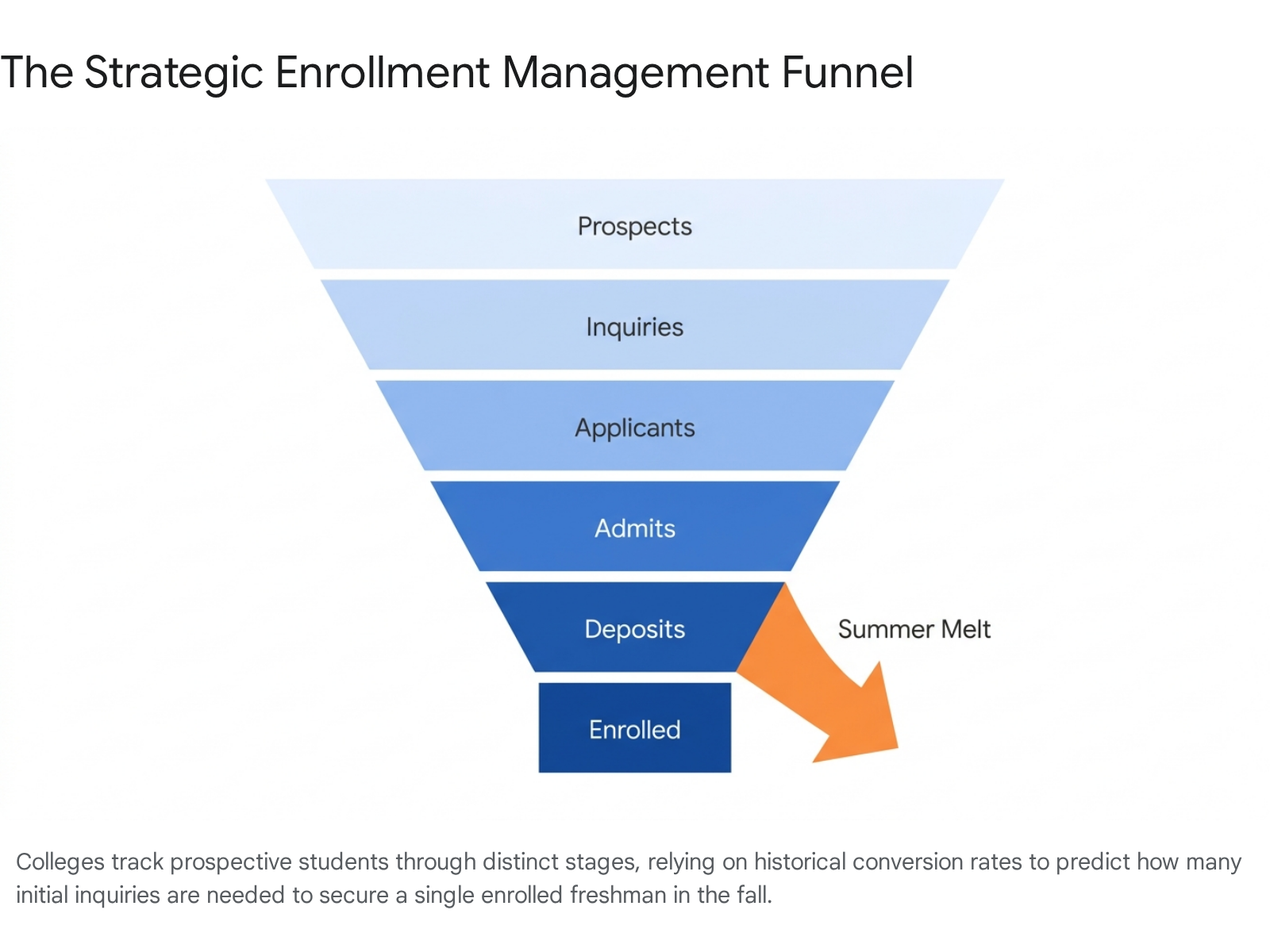
At the core of strategic enrollment management is the "enrollment funnel." Colleges do not view high school seniors simply as applicants; they track them as moving targets progressing through a highly structured pipeline spanning 18 to 24 months 8910.
The top of the funnel consists of "prospects." These are often names purchased in bulk from standardized testing agencies like the College Board, or sourced through digital advertising and AI-driven platforms 212. A prospect becomes an "inquiry" when they actively engage with the university - perhaps by clicking a link, registering for a campus tour, or requesting a brochure 81314.
The funnel then narrows to "applicants," followed by "admits," and finally, "enrolled" students who submit a tuition deposit 814.
The Mathematics of Conversion
The mathematics governing this funnel are unforgiving. Conversion rates shrink dramatically at each stage, meaning universities must cast a massive net at the top of the funnel to secure a relatively small number of enrolled students at the bottom 1214. For instance, it is common for the conversion rate from an initial inquiry to a completed application to hover around 30 percent, depending on the institution's marketing effectiveness 14.
To maximize these conversions, colleges deploy sophisticated multi-source marketing efforts. Data demonstrates that students who encounter a school through multiple distinct channels - such as email campaigns, digital search platforms, and in-person campus events - are substantially more likely to deposit than those who only engage via a single source 215. While digital innovation and personalized video outreach are rising, face-to-face interactions remain the most effective recruitment tool for four-year institutions, proving that the human touch is critical in finalizing an enrollment decision 1516.
Combatting Summer Melt
Even after a student pays their deposit in the spring, the funnel has one final, perilous leak known as "summer melt" 17. Summer melt refers to students who commit to a university but ultimately fail to matriculate in the fall, often due to financial hurdles, shifting family circumstances, or aggressive late-stage recruitment from competing schools 1718.
Institutions track melt rates obsessively and deploy targeted interventions, such as personalized onboarding and retention grants, to combat it 819. Crucially, data indicates that filing the Free Application for Federal Student Aid (FAFSA) is one of the strongest buffers against melt. According to industry benchmarks, students who complete a FAFSA yield at a rate five times greater than those who do not, and their melt rate is substantially lower (averaging around 11 percent compared to over 30 percent for non-filers) 18.
Predictive Analytics: The Algorithm Behind the Curtain
Decades ago, admissions decisions relied heavily on human intuition, manual file reading, and qualitative judgment calls. Today, the process is heavily augmented - and often pre-sifted - by machine learning models and predictive algorithms 20.
Higher education has fully embraced predictive analytics to answer one central question: "What is the mathematical likelihood that this specific student will enroll if admitted?" 10. Vendors such as Othot, EAB, Ruffalo Noel Levitz (RNL), and Technolutions (Slate) provide universities with sophisticated models that analyze vast datasets of historical applicant behavior to forecast future outcomes 103224.
Ingesting the Data
These predictive models ingest a dizzying array of data points to generate an applicant's "Likelihood to Enroll" score 910. The algorithms analyze demographic attributes, financial backgrounds, high school academic performance, geographic proximity to the campus, and digital engagement logs 35.
Every interaction a prospective student has with an institution is captured in the university's Customer Relationship Management (CRM) system. When a high school junior opens a marketing email, clicks a link to view a specific academic major, attends a virtual information session, or visits the campus in person, that data is scored 36. The predictive algorithm compares the current applicant's behavioral fingerprint against the profiles of students who have enrolled in previous cycles, utilizing models like logistic regression or decision trees 37.
If an applicant's profile mirrors the behavior of a student who deposited two years ago, their score rises 10. This allows admissions teams to prioritize their outreach. Instead of sending expensive direct mailers to 100,000 prospects, they can focus their marketing budget on the 30,000 students whose scores indicate they are highly receptive, saving vital operational resources and optimizing the admissions team's workload 10322.
The Reality of Yield Protection (Tufts Syndrome)
The integration of tracking technology and predictive modeling has fueled widespread anxiety among applicants regarding a phenomenon known as "yield protection" - colloquially nicknamed "Tufts Syndrome" 206. Yield protection is the theory that colleges will intentionally reject or waitlist highly qualified applicants because the predictive model assumes the student will ultimately attend a more prestigious university, thereby protecting the school's yield rate from taking a hit 206.
Admissions experts clarify that the reality of yield protection is nuanced. The "hard" version of this theory - that a university maliciously punishes an objectively superior applicant simply to manipulate its rankings - is largely exaggerated, particularly at elite, highly selective institutions that have no trouble filling their seats. All else being equal, a top-tier school will accept a 1580 SAT score over a 1480 6.
However, the "soft" version of yield protection is very real and actively practiced 6. Schools that track demonstrated interest heavily utilize likelihood-to-attend scores when making close-call decisions on borderline candidates 627. If an admissions committee is choosing between two applicants with similar academic profiles, they will almost always admit the student whose data footprint (campus visits, email engagement, early application status) signals a genuine intent to enroll 627.
The Early Decision Multiplier
To secure their yield rates against uncertainty, institutions lean heavily on Early Decision (ED) programs. Because ED is a binding contract - meaning the student guarantees they will enroll and withdraw all other applications if admitted - it functionally provides the university with a 100 percent yield rate for that cohort 2829.
For colleges positioned just outside the ultra-elite tier (e.g., schools with yield rates below 40 percent that routinely lose cross-admitted students to higher-ranked competitors), Early Decision is an operational lifeline 2829. To protect their enrollment numbers, many of these highly selective private universities now fill upwards of 40 to 60 percent of their incoming freshman class before the Regular Decision round even begins 282930.
By locking in half the class early, the university guarantees its baseline net tuition revenue 29. Furthermore, this strategy allows the institution to be far more selective during the Regular Decision phase. Rejecting a higher percentage of Regular Decision applicants mathematically lowers the school's overall acceptance rate while inflating its overall yield rate - metrics that historically boost an institution's prestige and national rankings 282930.
| Yield Tier | Average Yield Rate | Estimated Class Filled via ED | Importance of Demonstrated Interest | Example Institutions |
|---|---|---|---|---|
| Ultra-high | 70%+ | N/A (Non-binding Early Action) | Not considered | Harvard, Stanford, MIT |
| High | 50-70% | 35-45% | Not considered or lightly considered | Princeton, Columbia, Duke |
| Medium | 35-50% | 40-50% | Considered | Vanderbilt, Rice, Emory |
| Lower | 25-35% | 45-60% | Important to Very Important | Tulane, WashU, Tufts |
| Low | Below 25% | 50-65% | Very Important | Case Western, some Liberal Arts |
Data synthesis representing general strategic behaviors based on institutional yield rates. Institutional strategies vary year-to-year 28.
For the applicant, applying Early Decision carries a significant statistical advantage. Predictive models factor in ED as the ultimate indicator of demonstrated interest 27. Depending on the specific college's yield model, applying Early Decision can function as a multiplier on a student's baseline chances of admission, sometimes more than doubling their acceptance odds compared to the Regular Decision pool 2931.
Financial Aid Leveraging: The Airline Pricing Analogy
Perhaps the most misunderstood component of how a college shapes its class is how it expects students to pay for it. The published "sticker price" of a private university is rarely the actual price paid by the majority of its students 4. Instead, colleges utilize a complex strategy known as "financial aid leveraging" or "financial aid optimization" 433.
In higher education economics, financial aid leveraging is frequently compared to the airline industry's dynamic pricing model 334353637. When you board a commercial flight, the passenger sitting in the window seat likely paid a vastly different fare than the passenger in the aisle seat, despite consuming the exact same product and arriving at the exact same destination 35. The airline's goal is not to sell every seat at the maximum possible price - which would result in a half-empty plane - but to utilize algorithms to fill every seat at varied price points that yield the highest possible aggregate revenue before takeoff 3536.
Colleges operate on an identical premise. A university's financial goal is not to collect full tuition from every student, but to maximize "Net Tuition Revenue" (NTR) 4536. NTR is the actual cash the institution collects after all institutional grants, scholarships, and tuition discounts have been applied 436.
The Matrix of Merit Aid
In the past, institutional financial aid was primarily awarded based on a student's objective financial need . Today, leveraging transforms financial aid into a strategic recruitment tool, often disguised as "merit aid" 33.
Working with enrollment management firms, colleges build complex awarding grids or matrices that cross-reference an admitted student's academic profile against their family's ability to pay and their algorithmic "price sensitivity" 1953738. The algorithm tests how different award amounts will impact the incoming class size, running "what-if" scenarios (prescriptive analytics) to identify the optimal combination of awards 1938.
The goal of the algorithm is to pinpoint the exact dollar amount required to incentivize a specific student to enroll, without giving away a dollar more than necessary 419. For example, the model might determine that offering an upper-middle-class student a $15,000 "Presidential Scholarship" will successfully convince them to enroll, bringing the university $40,000 in net tuition revenue. If the school offered that same student $20,000, they would needlessly lose $5,000 in revenue. If they offered only $5,000, the student might enroll at a competing college, resulting in zero revenue for the institution 4195.
This aggressive use of tuition discounting has skyrocketed. According to industry benchmarking, the average tuition and fee discount rate for first-year students at private colleges has surged, reaching nearly 59 percent 18.
The Ethical Debate
Financial aid leveraging is highly controversial. Critics argue that the practice fundamentally alters the equity of higher education by redistributing institutional wealth away from the neediest students 3437. In some models, the poorest prospects may receive only a fraction of the grants they actually need, while more affluent prospects are offered generous "merit" packages simply because the algorithm dictates they require a financial enticement to choose that specific school 3437.
However, enrollment managers defend leveraging as an economic necessity. They argue that without optimizing net tuition revenue, the institution would fail to generate the operating budget required to keep the university functional, ultimately jeopardizing their ability to fund the education of the high-need students they do enroll 43839. Furthermore, predictive algorithms can be programmed with bias constraints to intentionally increase access for historically underserved groups while still meeting the university's baseline revenue targets 38.
Institutional Priorities: The "Tuba Player" Principle
When families approach college admissions, they naturally view the process through the lens of individual meritocracy. They assume that a student with a 1580 SAT and a 4.0 GPA has "earned" a seat and should intrinsically be admitted over a student with a 1480 SAT and a 3.8 GPA 640. This fundamental misunderstanding causes widespread frustration during decision season.
Colleges do not view admissions as a reward for past behavior; they view it as the assembly of a highly specific, functional community 4041. Admissions officers evaluate how an applicant fulfills institutional priorities - often explained through the "tuba player" analogy 4184344.
Assembling a Class, Not a Hierarchy
Imagine a university's marching band is graduating its senior sousaphone player 4546. The band director informs the admissions office that to field a functional band next year, they absolutely must secure a talented tuba player 4144.
In the applicant pool, there are thousands of brilliant, straight-A students who play the flute, but only one very good student who plays the tuba 44. The tuba player will be admitted, even if their objective academic statistics are slightly lower than those of the flute players. The flute players were not rejected because they lacked merit or intelligence; they were rejected because the institution simply did not need another flute player that cycle 4144.
This principle applies to every facet of the incoming class. A university requires a meticulously balanced ecosystem to operate. They need starting athletes for the NCAA sports teams, theater set designers, physics majors to populate under-subscribed departments, legacy students to appease the alumni donor base, full-pay international students to balance the budget, and students from rural states to maintain geographic diversity 4043.
When highly selective institutions practice "holistic review," they are essentially evaluating what specific "hook" an applicant provides to solve an institutional problem 4043. Therefore, a well-rounded student who is "pretty good" at everything is often less appealing to a selective college than a "spiky" student who demonstrates an exceptional, niche talent that the university currently lacks 439.
Demographic Shaping in the Post-Affirmative Action Era
The calculus of how colleges shape their classes experienced a seismic shock in June 2023. In the landmark cases Students for Fair Admissions v. Harvard and Students for Fair Admissions v. UNC, the U.S. Supreme Court effectively banned the consideration of an applicant's race in college admissions, ruling that such practices violate the Equal Protection Clause of the Fourteenth Amendment 481050.
For decades, selective institutions had utilized race-conscious admissions to build diverse student bodies, treating an applicant's racial background as a "plus factor" within the holistic review process 105011. Stripped of this explicit tool, enrollment managers were forced to radically pivot their strategies for the Fall 2024 incoming class 1012.
The Immediate Data Impact at Elite Universities
As the enrollment data for the Class of 2028 (the first cohort admitted under the post-ruling restrictions) materialized, the demographic shifts at the top of the market were stark. Highly selective private universities saw significant compressions in racial diversity 48101354.
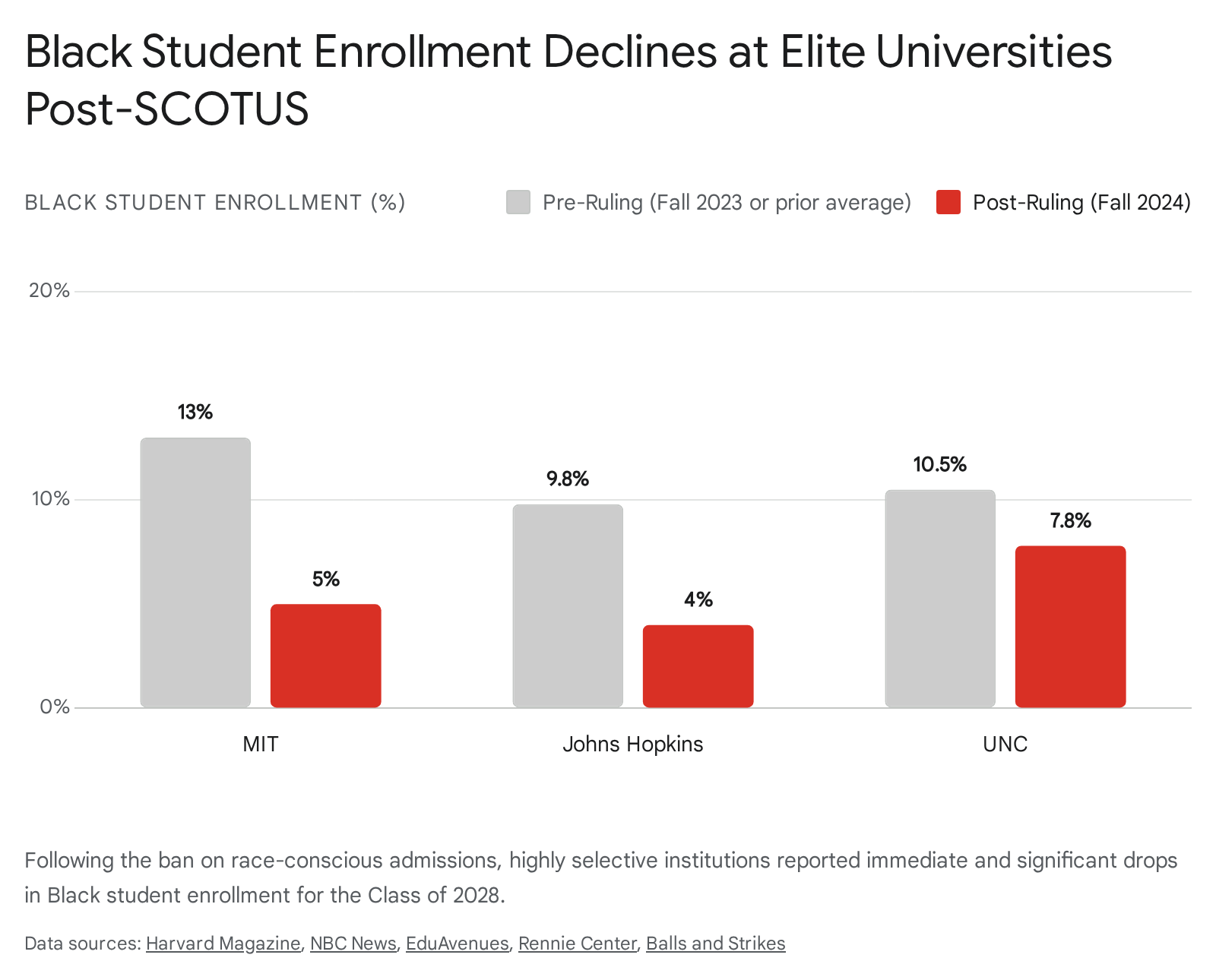
At the Massachusetts Institute of Technology (MIT), Black student enrollment plummeted from a recent historical average of 13 percent down to just 5 percent 481314. Similarly, Johns Hopkins University reported that its Black enrollment fell from 9.8 percent to roughly 4 percent, while its Asian American enrollment surged from 25.6 percent to over 45 percent 10. The University of North Carolina at Chapel Hill, a defendant in the Supreme Court case, saw its Black student enrollment drop from 10.5 percent to 7.8 percent 481113.
The Cascade Effect Across the Ecosystem
While the media focused intently on the Ivy League and highly selective private universities, the broader higher education ecosystem experienced a different phenomenon altogether, known as the "cascade effect" 5415.
Highly qualified students of color who historically might have been admitted to elite, highly selective institutions under race-conscious policies were instead admitted to slightly less selective institutions, such as state flagship universities 5415. Consequently, Black and Hispanic enrollment actually increased at many large public universities. For example, federal enrollment data from 2024 revealed that Black freshman enrollment surged by 30 percent at Louisiana State University (LSU) and 50 percent at the University of Mississippi 54.
This cascading demographic shift effectively displaced diversity downward. It increased the diversity of student bodies at a broader spectrum of public institutions, but simultaneously stripped representation from the most heavily resourced, elite universities at the top of the hierarchy 5415.
Pivoting to Socioeconomic Proxies
To offset these losses and continue promoting diversity without violating the Supreme Court's mandate, enrollment algorithms and admissions offices rapidly shifted to socioeconomic and geographic proxies 481050.
Because race and class are deeply intertwined in the United States, universities have aggressively increased their recruitment of first-generation college students and Pell Grant-eligible applicants, which serves as a federal marker of low income 4812. At Duke University, the proportion of Pell-eligible freshmen doubled over a two-year span, and Yale University increased its share of Pell-eligible students to 25 percent for the fall cohort 48. Furthermore, colleges are placing greater emphasis on geographic diversity, targeting students from rural areas or under-resourced high schools to naturally shape a more diverse incoming class without explicitly utilizing race checkboxes 1012.
While the ruling prohibited the consideration of racial status as a categorical input, it did not ban applicants from discussing their lived experiences in their essays 105057. However, data from the Common Application indicates that the percentage of Asian, Black, and Latinx students referencing race or ethnicity-related phrases in their essays actually decreased slightly in the first application cycle following the decision 16.
The Test-Optional Illusion
Another major variable that has heavily influenced how colleges shape their classes over the past half-decade is the role of standardized testing. During the onset of the COVID-19 pandemic, the vast majority of colleges went "test-optional," allowing applicants to decide whether or not to submit SAT or ACT scores 1718.
The immediate result was a massive surge in total application volume. With the barrier of a low test score removed, applications at some moderately selective institutions rose by 26 percent, heavily inflating applicant pools with students from low-income and underrepresented backgrounds who had previously self-selected out of applying 17.
However, emerging studies reveal that this application surge was largely a mirage when it came to actually shaping the enrolled class. While test-optional policies successfully broadened access at the application stage, they failed to remove the underlying structural and financial barriers that dictate which students ultimately enroll 17.
Furthermore, a comprehensive study analyzing over one million Common Application users found that application rates among Black, Latino, and first-generation students to the most selective colleges actually declined during the test-optional period if those students possessed below-median academic profiles 61. At the elite level, students who chose to submit high test scores were still admitted at significantly higher rates and often received better financial aid packages than their peers who withheld scores 1761. The demographic makeup of the enrolled student bodies remained largely unchanged, and average SAT scores submitted actually rose, as students strategically withheld lower scores 1761.
Recognizing that test-optional policies did not inherently solve equity challenges - and seeking reliable, standardized data to feed their predictive algorithms and assess academic readiness - many highly selective institutions, including MIT, Harvard, Yale, and Dartmouth, have recently reversed course and reinstated standardized testing requirements for incoming classes 61.
Bottom line
A college's incoming class is not a serendipitous gathering of the smartest applicants, but a carefully engineered cohort designed to sustain the institution. Enrollment managers rely heavily on predictive analytics to forecast yield, utilize financial aid as a dynamic pricing tool to maximize net tuition revenue, and balance objective academic merit against highly specific institutional needs like athletic rosters and program diversity. While recent disruptions like test-optional policies and the Supreme Court ban on race-conscious admissions have violently shifted the tactical landscape, the core objective remains unchanged: colleges will continue to leverage data and dollars to shape the exact class they need to survive.