
What Happens to Your College Application After You Submit
After you hit submit, your application is routed into a digital management system where it is sorted geographically and evaluated by regional admissions officers, often in fifteen minutes or less. At selective institutions, the most competitive files are then pitched to a larger admissions committee, where staff debate the applicant's academic merits, personal narrative, and fit for institutional priorities before casting a final vote. In recent years, this traditionally human-driven process has been heavily augmented by artificial intelligence screening tools and fundamentally reshaped by new legal bans on race-conscious admissions.
The Volume Crisis and the Digital Sieve
The modern college admissions landscape is defined by sheer volume and intense logistical pressure. As higher education has become the primary pathway to economic mobility, and as standardized testing requirements have increasingly shifted to optional models following the COVID-19 pandemic, application numbers have surged to historic highs 123. The most selective four-year colleges receive more than a third of all first-time freshman applications nationwide, despite enrolling only a fraction of those students 3. The National Association for College Admission Counseling (NACAC) reports that a significant percentage of first-time freshmen now apply to seven or more colleges, creating massive applicant pools that universities must process within a matter of months 4.
When a student presses "submit" on the Common Application, the Coalition Application, or a university-specific portal, the file does not land on a physical desk. It is ingested into a Customer Relationship Management (CRM) platform, the most prominent of which is Slate by Technolutions 57. The CRM creates an electronic file under the applicant's name, acting as the digital home for the application itself, teacher recommendations, transcripts, and standardized test scores 6.
Regional Sorting and the Initial Screen
The CRM serves as the initial organizational sieve. Applications are immediately categorized and routed to specific admissions officers based on geographic territories 97. This regional sorting is a critical element of holistic review because high schools vary wildly in their grading scales, course offerings, and resources. By assigning officers to specific regions, universities ensure that the person reading the application understands the local context. A regional manager knows, for example, if a particular high school limits the number of Advanced Placement (AP) classes a student is allowed to take, or if a 3.8 GPA is exceptionally high for a specific public school district 118.
At larger, less selective institutions, this initial digital screening may carry the bulk of the decision-making weight. Algorithms and automated academic record systems can instantly generate an academic profile based on quantifiable data, flagging students who meet strict GPA or test score cutoffs and weeding out those who fall below institutional benchmarks 111314. For these high-volume universities, the process is largely a formulaic calculation of academic readiness 15. At highly selective private institutions, however, this digital sorting is merely the prelude to an intensive, multi-layered human review 910.
The Reality of the Reading Season
One of the most persistent myths in college admissions is that a panel of seasoned scholars spends hours poring over every essay, recommendation letter, and extracurricular activity. The mathematical reality of modern admissions makes this impossible. The reading season - typically stretching from November through March - is a grueling period for admissions staff, characterized by relentless quotas and severe time constraints.
Workload and Time Constraints
The average public university admissions officer reads nearly 800 applications per cycle, while their counterparts at private colleges read over 400 3. However, at universities receiving tens of thousands of applications, individual readers are often tasked with reviewing up to 100 files per day 11. To meet these demands, officers must work at a staggering pace. A single application - containing a high school transcript, a detailed school report, a primary personal statement, multiple supplemental essays, an activities list, and letters of recommendation - rarely receives more than ten to fifteen minutes of attention during its first read 11121321. In many instances, the review time is closer to eight minutes 13.
Within this compressed window, officers are reading with intense focus but undeniable speed. The personal statement, which a high school student may have spent months drafting and refining, is typically consumed in roughly three minutes 11. The reader's goal is not to savor the prose, but to rapidly extract the applicant's academic strengths, personal passions, family background, and community engagement 21. Based on this rapid assessment, the reader synthesizes the data and assigns preliminary rubric scores, leaving detailed notes in the CRM to inform the next stages of the process 912.
The Psychological Toll: Decision Fatigue
The repetitive nature of evaluating thousands of similar academic profiles and reading countless essays takes a severe cognitive toll on admissions professionals. Researchers studying the higher education workforce note that the sheer volume of work leads to significant burnout, exhaustion, and cynicism 2214. This exhaustion manifests directly in the evaluation process through a psychological phenomenon known as decision fatigue.
Social psychologists define decision fatigue as the deterioration in the quality of decisions made by an individual after a long session of decision-making 24. Research famously demonstrated this effect in the judicial system, showing that parole boards were significantly more likely to grant parole early in the morning, with approval rates plummeting as the day wore on and cognitive resources were depleted 24. This exact dynamic applies to the college admissions office. When reviewing files late into the evening or on weekends, a depleted admissions officer is more likely to rely on mental shortcuts. Rather than appreciating the nuanced, unique combination of credentials that define an individual applicant, a fatigued reader may unconsciously assign heavier weight to easily comparable, standardized metrics like test scores and grade point averages 2415.
This psychological reality also explains the phenomenon of "essay fatigue." As officers read their fiftieth essay of the day, generic topics - such as recounting a sports injury or writing an extended resume in paragraph form - become tedious 2226. Admissions veterans frequently advise applicants to avoid overly complex metaphors, convoluted syntax, or "weaponized trauma" intended to shock the reader. Instead, students are urged to focus on profound clarity and authenticity, ensuring that a tired reader can immediately grasp the student's core values and character traits without stumbling over the writing 132226.
The Innovation of Committee-Based Evaluation (CBE)
To combat extreme burnout and efficiently process skyrocketing application volumes, a growing number of highly selective colleges - including the University of Pennsylvania, Swarthmore College, Bucknell University, and Georgia Tech - have abandoned the traditional solitary reading model 5915. In its place, they have adopted a collaborative system known as Committee-Based Evaluation (CBE).
Committee-Based Evaluation fundamentally re-engineers the review workflow. Instead of one person spending fifteen minutes on a file and writing a long, solitary summary, two admissions officers sit together - either physically or virtually - to review the exact same application simultaneously on split screens 5915. This system relies on a strict division of labor between two distinct roles, often referred to colloquially as the "Driver" and the "Passenger."
The first reader, or the Driver, assumes responsibility for the academic evaluation. This officer analyzes the student's high school transcript, standard test scores, the rigor of the chosen curriculum, the specific context provided by the high school profile, and the teacher recommendations that speak to the applicant's intellectual curiosity and classroom performance 515. Their primary objective is to determine if the student possesses the academic stamina required to succeed at the institution.
Simultaneously, the second reader, or the Passenger, focuses entirely on the qualitative components of the application. This officer evaluates the "student voice," reading the main personal statement, college-specific supplemental essays, the extracurricular activities list, and any honors or awards 515. Their role is to gauge the applicant's character, leadership potential, and overall fit for the campus community.
As they read, the two officers discuss the applicant aloud, contextualizing achievements and comparing notes in real-time 59. By dividing the labor and eliminating the need to write exhaustive summary paragraphs, the pair can thoroughly evaluate an application and assign initial rubric ratings in just four to eight minutes 515. This collaborative approach not only dramatically increases efficiency - allowing teams to process hundreds of applications a day - but it also acts as an immediate check on individual bias. If one reader is experiencing decision fatigue or fails to notice a crucial detail in the file, the second reader is there to provide balance, ensuring a more humane and consistent evaluation process 59. Based on this rapid dual-review, the pair reaches a consensus to either recommend the student for admission, deny them, waitlist them, or push the file forward to the full committee 59.
Public vs. Private: Divergent Admissions Models
While the mechanical act of hitting "submit" is identical for every student, the subsequent journey of the application depends entirely on the type of institution receiving it. The philosophical and operational differences between large public universities and highly selective private colleges dictate the depth of the review and how much of an applicant's "whole person" is actually considered 81415.
Scholars of higher education categorize holistic review into different methodologies. A "whole file" review considers all elements of an application but may not weigh them equally, while a "whole context" review actively accounts for the socioeconomic and environmental factors of the student's high school and neighborhood 8. Public and private universities deploy these methodologies very differently.
Comparative Review Methodologies
| Feature | Large Public Universities | Selective Private Colleges |
|---|---|---|
| Primary Evaluation Criteria | Heavily weighted toward quantitative, easily measurable metrics: high school GPA, class rank, and standardized test scores 81415. | Emphasizes holistic evaluation: Academics serve as a baseline threshold, but essays, extracurricular depth, and recommendations drive final decisions 14159. |
| Mechanics of Application Review | Frequently utilizes a "coarse sieve" approach. Formulaic cut-offs and automated algorithms are common to manage massive application volumes efficiently 8141527. | Relies on multiple human reads, often utilizing Committee-Based Evaluation (CBE), followed by extensive full-committee debates for borderline cases 59928. |
| The Role of the Essay | May be scanned briefly, used merely to verify basic writing competency, or outsourced to artificial intelligence for initial screening 141529. | Viewed as critically important. Used by human readers to gauge character, maturity, "institutional fit," and the potential for positive community impact 111428. |
| Admissions Deadlines and Structure | Often utilize Rolling Admissions, accepting and reviewing applications continuously throughout the year until the incoming class is full 14. | Rely on strict Early Decision (ED), Early Action (EA), and Regular Decision deadlines. The entire freshman class is shaped and selected all at once 1416. |
| The Final Decision-Making Authority | Often finalized during the initial reading phase by a small number of officials based on established institutional thresholds, rarely using a committee room 151231. | Determined by collective voting in a committee room setting, sometimes requiring a unanimous consensus among multiple admissions officers 731. |
As the landscape becomes more competitive, even large public institutions - particularly highly sought-after systems like the University of California - are attempting to incorporate more holistic elements, placing greater emphasis on personal statements and course rigor in context 15. However, due to legislative mandates, funding structures, and the sheer mathematical reality of receiving over 100,000 applications, public university admissions remain fundamentally more numbers-driven and formulaic than their private counterparts 1527.
The Committee Room: Where the Class is Shaped
For students applying to highly selective and elite institutions (those accepting fewer than 20 to 30 percent of applicants), surviving the initial reading rounds means their file advances to the admissions committee. This is the stage where the theoretical concept of "holistic admissions" is practically executed, and it is arguably the most subjective phase of the entire process 71031.
The admissions committee is typically composed of a mix of regional admissions counselors, senior admissions directors, deans, and occasionally faculty members, particularly in specialized disciplines or medical school programs 71217. It is important to note that not every applicant makes it into this room. Students who clearly fall below the university's academic thresholds are denied during the preliminary reads, while truly exceptional candidates may be flagged as automatic admits. The committee spends the vast majority of its time debating the "edge cases" - the highly qualified applicants who sit on the bubble, competing fiercely for a strictly limited number of seats 3133.
The Art of Storytelling and Advocacy
Because the full committee has not read every word of the applicant's file, the regional admissions officer who conducted the initial read must act as the student's primary advocate. This officer presents the applicant's quantitative ratings - for example, noting that the student scored a "3" on the internal academic scale and a "5" on the extracurricular scale - and then essentially pitches the student to the room 71028.
This presentation is an exercise in strategic storytelling. The regional officer must extract the nuances of the application to answer a single question: Why should this specific university admit this specific student? 7. The officer might highlight how a student overcame a localized academic hurdle, detail their tangible impact on their hometown, or explain how their unique niche interest fills a cultural gap on the campus 710. If an applicant possesses slightly lower standardized test scores but took on massive family caretaking responsibilities, the regional officer provides that vital context to the group, ensuring the student is evaluated fairly against more privileged peers.
Institutional Priorities and the Ecosystem
A critical, and often deeply misunderstood, reality of the committee phase is that colleges are not simply attempting to admit the most intellectually gifted individuals in a vacuum. Instead, they are actively trying to curate a balanced, multifaceted ecosystem 71133. This highly calculated process, known internally as "shaping," is heavily influenced by overarching institutional priorities 1133.
A university does not just need biology majors; it needs a specific number of engineering students, a geographic distribution that covers all fifty states, a diverse socioeconomic profile, athletes for specific varsity rosters, and even musicians for the campus orchestra 3133. For example, a STEM-focused institution like Harvey Mudd College - which typically receives significantly more applications from men than women - actively prioritizes maintaining a balanced gender ratio. To achieve this, the college may review male and female applicants in different sub-committees, resulting in notably different acceptance rates based on institutional needs 31. These macro-level institutional priorities frequently serve as the ultimate tiebreaker for applicants who are otherwise identical on paper, introducing factors into the decision-making process that are entirely outside of the student's control 11.
The Final Vote and Shaping the Class
Following the presentation and debate, the committee votes. The mechanical rules governing this vote vary widely by institution. Some colleges require a simple majority to move a student into the "admit" pool, others utilize a predetermined numerical cutoff point, and some elite institutions demand unanimous, sudden-death agreement among all committee members to formally accept a student 9731.
Even after a successful vote, the "admit" pile remains tentative. As the final deadline for mailing decision letters approaches, senior enrollment directors will review the aggregate data of the tentatively admitted class. If the group leans too heavily toward one intended major, lacks geographic diversity, or exceeds the university's financial aid budget, directors will make final, sweeping tweaks - moving some tentatively admitted students to the waitlist and pulling others up - to ensure the university's holistic goals are met perfectly before the decisions are locked and sent to the financial aid office 9933.
The Algorithmic Shift: AI in the Admissions Office
While human debate remains the romanticized core of selective admissions, the crushing administrative burden of processing millions of applications has forced institutions to embrace artificial intelligence. AI is no longer a futuristic, theoretical concept in higher education; it is actively sorting, screening, and evaluating applications today 3435. Recent surveys of higher education professionals indicate that over half of educational admissions departments are currently utilizing AI, with adoption rates expected to exceed 80 percent in the near future 1318.
Machine Screening and Essay Evaluation
Colleges are increasingly deploying machine learning algorithms to automate the most tedious aspects of application review. AI tools are routinely used to scan complex transcripts, standardize GPA calculations across different high school grading scales, and review letters of recommendation for key sentiment indicators 31318. Furthermore, predictive analytics platforms are heavily utilized behind the scenes to calculate "yield" - the statistical probability that a specific admitted student will actually choose to enroll and pay tuition. Colleges rely on these predictive models to protect their yield rates, forecast revenue, and efficiently manage their waitlists 3537.
More controversially, AI has crossed into the qualitative realm of reading personal statements. Large public universities, overwhelmed by application volume, are utilizing natural language processing to evaluate student writing. Virginia Tech, for instance, recently implemented an AI-powered essay reader to evaluate approximately 250,000 short-answer essays submitted by applicants. The AI system scores the writing for grammar, sentence structure, vocabulary, and length simultaneously alongside a human reader. If the human and the machine disagree on the assigned score, a second human is brought in to review the discrepancy. This hybrid technological approach saves the university an estimated 8,000 hours of staff time per admissions cycle 32919. Similarly, the University of North Carolina at Chapel Hill has acknowledged utilizing AI to conduct basic evaluations of grammar and writing during initial screening phases 2935.
Authenticity Checks and the Technological Arms Race
As generative AI tools like ChatGPT and Claude have become ubiquitous and accessible, high school students are increasingly utilizing them to brainstorm, draft, or heavily polish their personal statements 1335. In response to this influx of machine-generated prose, admissions offices find themselves locked in a technological arms race. Elite universities are quietly experimenting with sophisticated AI-detection software designed to flag essays that appear overly formulaic, heavily processed, or devoid of authentic human voice 35.
Some forward-thinking institutions are deploying AI in novel ways to verify student authenticity beyond the written essay. The California Institute of Technology (Caltech), for instance, has piloted an AI chatbot designed to conduct video interviews with applicants who submit advanced research projects as part of their portfolio. The AI system peppers the student with complex, adaptive questions about their methodology and findings - functioning much like an academic thesis defense. The recorded video exchange is subsequently reviewed by Caltech faculty to ensure the student actually possesses the intellectual depth and foundational knowledge to claim the research as their own 319.
While AI is currently heavily utilized for data entry, initial screening, and authenticity verification, university officials universally stress a critical caveat: AI does not have the final say on who gets admitted. Institutions maintain that the ultimate, nuanced decisions regarding acceptance and denial remain firmly in the hands of the human committee 3519.
The Legal Shift: Navigating the Post-Affirmative Action Reality
The mechanical, human, and algorithmic elements of application review underwent a seismic disruption in June 2023. In a landmark decision encompassing Students for Fair Admissions v. Harvard and SFFA v. University of North Carolina, the United States Supreme Court struck down decades of legal precedent (including Grutter v. Bollinger), ruling that colleges and universities could no longer consider an applicant's race as a factor in admissions decisions. The Court determined that race-conscious admissions policies violated the Equal Protection Clause of the Fourteenth Amendment and Title VI of the Civil Rights Act of 1964 202141. This ruling immediately and fundamentally altered how applications are routed, read, and evaluated.
Technological Suppression in the CRM
To comply with the new constitutional mandate, universities had to immediately change their software infrastructure. In CRMs like Slate, the standard demographic fields where students previously checked boxes to indicate their race and ethnicity were universally suppressed from the application "Reader" view as of July 2023 7. When admissions officers open a file today, they can no longer see the applicant's racial checkboxes on their digital dashboard, profile tab, or PDF printouts 722.
However, Chief Justice John Roberts' majority opinion left a narrow, highly scrutinized caveat: colleges are still legally permitted to consider how race has affected an applicant's life, provided that context is shared organically through the student's personal essays 212243. Consequently, admissions committees are pivoting heavily toward a "whole context" review model. To build diverse classes without running afoul of the law, universities are increasingly scrutinizing race-neutral proxies for adversity. Admissions officers are trained to look closely at socioeconomic status, first-generation college status, high school zip codes, and the specific lived experiences of grit and perseverance detailed in personal statements 82244.
The Cascade Effect on Enrollment Demographics
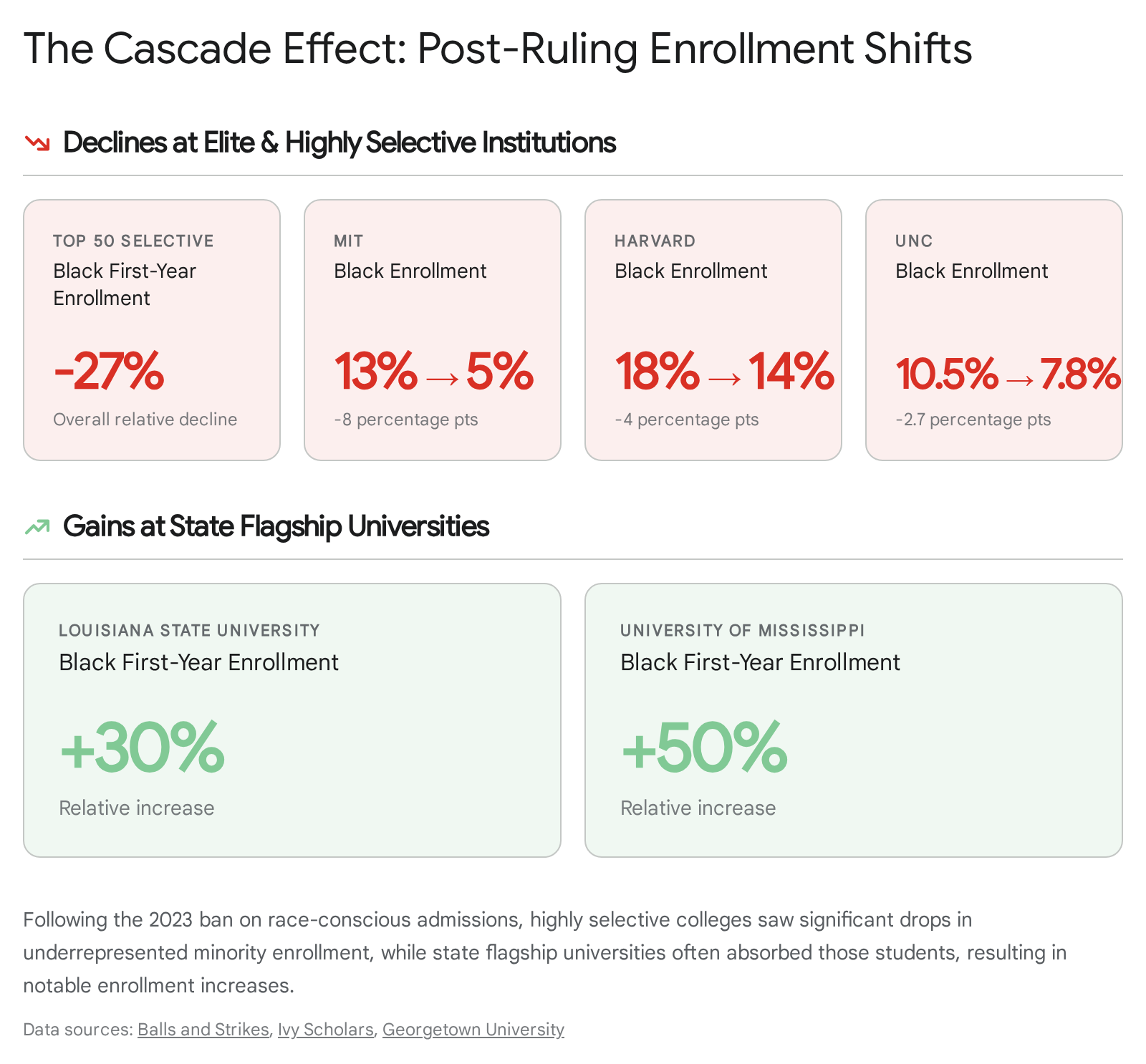
The initial enrollment data released in the years following the Supreme Court ban reveals what higher education researchers refer to as a "cascade effect" 23. Without the legal ability to explicitly consider race as a balancing factor during the committee shaping phase, highly selective colleges saw noticeable drops in the enrollment of underrepresented minority students 24.
For example, the Massachusetts Institute of Technology (MIT) reported that its proportion of incoming Black students fell sharply from 13 percent to 5 percent in the first post-ruling cycle, while Amherst College saw a drop to just 3 percent 4143. Across the 50 most selective colleges in the United States, Black and Latine first-year enrollment declined by 27 percent and 10 percent, respectively 23.
Conversely, this highly qualified talent pool "cascaded" to other sectors of higher education. State flagship universities and less-selective public four-year institutions saw dramatic increases in minority enrollment as students who might have previously attended Ivy Plus institutions enrolled elsewhere. For instance, Black first-year enrollment rose by 30 percent at Louisiana State University and by a staggering 50 percent at the University of Mississippi following the ruling 23.
The transition to this new legal reality remains fraught. The political battles over diversity have expanded into disputes over data collection itself. Efforts by the federal government to mandate the reporting of multi-year admissions data to track compliance with the affirmative action ban have been met with fierce resistance, resulting in lawsuits from state attorneys general who argue the rushed data collection risks invading student privacy and penalizing institutions 2526. As the courts continue to adjudicate these policies, college admissions offices remain in a state of continuous operational flux.
International Context: The U.S. vs. U.K. Pipeline
For students exploring educational options beyond the United States, it is highly instructive to understand how deeply the American holistic review process contrasts with international university systems. The United Kingdom's Universities and Colleges Admissions Service (UCAS) provides the clearest, most structured counter-example to the American model 27.
While the Common Application allows American students to market their diverse personalities to an unlimited number of schools, the British system demands immediate academic specialization and imposes strict boundaries on applicant behavior 2728.
Systemic Differences in Higher Education Admissions
| Feature | U.S. Admissions (Common App) | U.K. Admissions (UCAS) |
|---|---|---|
| Academic Focus | Broad and exploratory. Students often apply undeclared, taking diverse general education requirements before formally choosing a major 2728. | Highly specialized and immediate. Students apply directly to a specific academic course (major) and begin studying only that subject from the first term 2728. |
| Evaluation Criteria | Holistic and personal. Emphasizes extracurriculars, character growth, leadership, and personal essays that may not relate to academics at all 272853. | Strictly academic. Focuses almost entirely on predicted test scores (A-Levels or IB), rigorous academic references, and subject-specific aptitude 2853. |
| Application Limits | Expansive. Students can apply to virtually unlimited schools using the Common App, tailoring supplements to each specific college 27. | Highly restricted. Hard cap of five university programs per year via one centralized application. Students cannot apply to both Oxford and Cambridge in the same cycle 2728. |
| Who Reads the File? | Administrative staff. Applications are evaluated by professional admissions officers trained to assess the "whole person" 2153. | University faculty. Applications are evaluated directly by academic professors who assess subject suitability and intellectual rigor 53. |
This philosophical divergence is most obvious in the application essay. In the U.K., the personal statement must be a fiercely academic defense of why the student is suited for a specific intellectual discipline, demonstrating independent reading and subject mastery 2728. In the U.S., the essay is a narrative tool designed to win over a fatigued administrative officer in a crowded committee room by showcasing personality, resilience, and core values 262853.
Bottom line
After a college application is submitted, it faces a highly structured gauntlet defined by massive volume and strict time constraints. Files are systematically sorted by digital CRMs, quickly evaluated for baseline academic competence by fatigued readers, and then - at selective institutions - championed by regional officers in complex committee debates that prioritize the overarching demographic and institutional needs of the university. While human judgment remains the ultimate arbiter in shaping a class, the mechanics of these decisions are rapidly evolving, shaped increasingly by AI-driven efficiency tools and the ongoing legal recalibration of how race and adversity can be considered in higher education.