
How Do Holistic College Admissions Work
Holistic admissions is an evaluation process used by universities to assess an applicant's complete profile - including their academic records, extracurricular depth, character traits, and personal context - rather than relying exclusively on quantifiable metrics like grades and test scores. The goal is to curate a diverse, dynamic campus community by identifying students who will contribute unique perspectives and leadership potential. However, while the process is designed to be deeply human and context-aware, it is also highly systematized, heavily influenced by institutional enrollment priorities, and increasingly scrutinized for implicit biases.
The Philosophy Behind Holistic Review
The college admissions landscape in the United States operates on a fundamentally different philosophical premise than much of the rest of the world. At its core, the holistic review process is designed to treat the applicant as a complete individual, recognizing that raw intelligence and academic capability do not exist in a vacuum. The system acknowledges that a student's achievements must be measured against the opportunities and challenges present in their specific environment.
In highly selective U.S. admissions, institutions are tasked with selecting a small cohort from a massive pool of exceptionally qualified applicants. If admission were based purely on academic merit, many elite universities could fill their incoming freshman classes several times over with students who boast perfect grade point averages and flawless standardized test scores 12. Because academic excellence is often viewed as a baseline rather than a distinguishing factor, the holistic model introduces subjective variables. Admissions officers evaluate an applicant's background, the socioeconomic hurdles they have overcome, their capacity for empathy, their leadership trajectory, and their personal values to answer a broader question: how will this student enrich the campus community and the education of their peers? 125.
Contrasting Systems: The United States versus the United Kingdom
The distinct nature of the American holistic system is best understood when contrasted with the university admissions process in the United Kingdom, which is heavily centralized through the Universities and Colleges Admissions Service (UCAS) 673.
British admissions are almost entirely academic and subject-focused. Universities in the U.K. operate under the assumption that a student has already determined their academic path. They want concrete evidence that an applicant is prepared to dive deeply into a specific field of study from their first day on campus. Consequently, the evaluation hinges heavily on predicted grades in rigorous qualifications like A-levels or the International Baccalaureate (IB) 679. British applicants are permitted to apply to a maximum of five courses (or four if applying to highly competitive fields like medicine or veterinary science) using a single online form. They submit one academic reference and one personal statement that reads much like an academic cover letter, proving extensive independent reading and subject mastery 679.
By contrast, the U.S. system is rooted in the liberal arts tradition, which encourages intellectual exploration across the humanities, sciences, and social sciences before a student formally declares a major, usually in their second year 67. American admissions essays purposefully lean away from strictly academic topics, focusing instead on character development, personal growth, resilience, and unique life experiences 73. In the U.S., admissions officers are known to ask themselves whether they would want the applicant as a roommate, a question that would be entirely irrelevant to a British admissions tutor 6.
| Admissions Component | United States (Holistic Review System) | United Kingdom (Academic Review System) |
|---|---|---|
| Primary Platform | Common Application, Coalition Application, Direct Apply | UCAS (Centralized National System) |
| Application Volume | Broad strategy; students typically apply to 10 - 20+ universities | Targeted strategy; maximum of 5 universities/courses |
| Core Evaluation Focus | GPA, course rigor, test scores, essays, extracurricular depth | Predicted grades, final exam results, subject-specific reading |
| Academic Flexibility | Exploratory liberal arts model; majors usually declared in year 2 | Immediate specialization; specific courses selected at application |
| Personal Statement | Focuses on personal narrative, character, values, and adversity | Focuses on academic passion, subject mastery, and readiness |
| Letters of Recommendation | Multiple letters required; emphasizes holistic qualities and character | One academic reference required; emphasizes predicted grades |
| Testing Philosophy | SAT/ACT used to predict general first-year success (policies vary) | Subject-specific entrance exams (e.g., BMAT, LNAT) |
The Mechanics of Evaluation: Behind Closed Doors
While the term "holistic" suggests a fluid, qualitative, and somewhat unstructured evaluation, the actual execution inside university admissions offices is highly systematized. Colleges process tens of thousands of applications within a span of a few months, necessitating a streamlined, highly regimented approach to subjective grading 4.

When an application is submitted, it is usually assigned to a primary reader, often an admissions officer responsible for the applicant's specific geographic region 5. Because these regional officers are intimately familiar with the high schools in their territory, they can evaluate an applicant within their specific local context. They understand, for example, that a 3.8 GPA at a school known for strict grading standards may be significantly more impressive than a 4.0 at a school with rampant grade inflation 5. Furthermore, they know which schools offer Advanced Placement (AP) or International Baccalaureate (IB) courses and which do not, ensuring students are not penalized for lacking access to advanced curriculum 56.
Despite the profound importance of the admissions decision, the initial review is incredibly rapid. Due to the sheer volume of applications and limited staff, a primary reader may spend fewer than ten minutes skimming the entire file, which includes the transcript, school profile, essays, recommendations, and extracurricular lists 4513. Admissions officers simply do not have the time to do guesswork; an application must present a clear, easily digestible narrative 5.
The Standardized Rating System
During this brief evaluation window, the reader assigns the applicant a series of numerical ratings. While exact rubrics vary by institution, they generally fall into a standardized set of categories graded on scales (often 1 to 5 or 1 to 6) 45137.
| Rating Category | Evaluation Focus | Key Data Sources |
|---|---|---|
| Academic Rating | Course rigor, grade trends, performance relative to high school context, standardized test scores. | Transcripts, School Profile, SAT/ACT scores, AP/IB scores. |
| Extracurricular Rating | Depth of involvement, leadership positions, sustained commitment, impact on community. | Activity lists, supplemental essays, resume. |
| Personal Rating | Character traits, emotional intelligence, grit, empathy, integrity, intellectual vitality. | Personal statement, counselor and teacher letters of recommendation. |
| Athletic/Special Talent | Recruited athlete status, exceptional musical or artistic ability, debate championships. | Coach communications, portfolios, national awards. |
| Overall Composite | A comprehensive score synthesizing all previous metrics to determine the applicant's priority level. | All application materials combined. |
Applications that pass this initial threshold typically move to a secondary reader to ensure consistency and mitigate individual bias 513. The strongest candidates - or those possessing specific institutional priorities - are then forwarded to a full admissions committee. In these committee meetings, officers present and debate the merits of borderline candidates. A massive data sheet, sometimes stretching dozens of columns wide, tracks applicant demographics, socioeconomic status, and predicted yield to help the university sculpt the final class 138. Those who do not meet the threshold are often placed on a "lop list" and quietly rejected without reaching the full committee floor 7.
The Subjective Edge: Assessing Character and Extracurricular Distinction
Because of widespread grade compression and shifting legal landscapes, character attributes - once viewed as secondary soft skills - have evolved into primary differentiators. The holistic review process attempts to systematically measure traits like resilience, empathy, integrity, curiosity, and civic responsibility 917.
Colleges actively seek out students who will foster cooperation, build community, and support their peers. As admissions paradigms have shifted away from praising self-centered career ambitions, institutions are increasingly prioritizing collaborative team members who aspire to improve their environments 917. Initiatives like Harvard's Graduate School of Education's "Making Caring Common" project have encouraged colleges to create formalized rubrics to assess these personal qualities, ensuring that traits like compassion and community service carry distinct, quantifiable weight in the admissions process 91019.
Admissions officers rely on two primary tools to gauge character and extracurricular distinction:
The Extracurricular Profile: Angularity over Well-Roundedness
For decades, high school students were advised to become "well-rounded" by participating in a disparate array of activities - sports, student government, band, and volunteer work. However, the modern holistic ideal is the "angular" student or "specialist" 120. Elite colleges are not looking for well-rounded students; they are looking to build a well-rounded class composed of experts in various niches 120.
Admissions officers evaluate whether a student demonstrates profound, sustained commitment and leadership in one or two specific areas of interest, creating a tangible impact on their local community 51720. For example, a student interested in an engineering major stands out far more if they pursue advanced calculus, take dual-enrollment physics courses, participate in First Robotics, and learn coding languages independently, rather than participating in ten unrelated clubs 111223. This deep engagement proves to the university that the student is taking full advantage of the opportunities available to them and possesses the grit to pursue long-term goals 517.
The Application Essay: The Trap of Over-Engineering
The personal essay is the primary vehicle for applicants to demonstrate their values, morals, and principles 517. However, students frequently fall into the trap of "over-engineering" their writing. In an effort to impress admissions committees, applicants often polish their essays to the point of stripping away all human vulnerability, utilizing corporate buzzwords like "synergy," "impact," and "global leadership" 24.
Admissions officers read these essays as public relations statements rather than genuine reflections. The most successful personal statements are grounded in highly specific, sometimes messy realities that highlight genuine growth and a true teenage voice 24. By writing about authentic interactions - even mundane settings like a fast-food restaurant after a volunteering event - students humanize their applications, providing a clearer window into their cultural intelligence and capacity for self-reflection 924.
The Standardized Testing Reversal
One of the most consequential components of the academic rating is the standardized test score (SAT or ACT). Historically an anchor of college admissions, testing policies underwent a massive disruption during the COVID-19 pandemic. Between 2020 and 2021, the inability of students to safely access testing centers forced nearly every university to adopt temporary "test-optional" policies 132627.
For several years, advocates praised this shift, arguing that test-optional policies were inherently more equitable. Research had long suggested that standardized test scores heavily correlate with household income, as wealthier families can afford expensive test preparation, tutoring, and multiple examination attempts 1328. Educational experts pointed out that Black and Latino students generally scored lower on these exams due to systemic resource disparities. By removing the requirement, universities hoped to level the playing field and foster unprecedented socioeconomic diversity 1328.
However, as the pandemic receded, internal data from elite institutions began to tell a contradictory story. Between 2022 and 2024, highly selective universities such as the Massachusetts Institute of Technology (MIT), Dartmouth College, Yale University, Brown University, and the University of Texas at Austin abruptly reversed course, reinstating mandatory testing requirements for incoming freshmen 2628143031.
Data-Driven Policy Reversals
The decision to reinstate the SAT and ACT was driven by institutional research revealing three critical realities about holistic admissions in a test-optional world:
- The Problem of Grade Inflation: Admissions officers reported increasing difficulty in distinguishing between top candidates using high school grade point averages alone. Widespread grade inflation across secondary education has made perfect or near-perfect transcripts ubiquitous, stripping the GPA of its historical utility as a primary differentiator between candidates who are truly prepared for elite academic rigor and those who are not 2814.
- The Predictive Power of Tests: Universities found that standardized test scores remained one of the strongest, most objective predictors of a student's academic success during their first year of college. The University of Texas at Austin conducted a review of admitted students and found that those who opted to submit their test scores had a median SAT of 1420, compared to a median of 1160 among those who withheld their scores. Crucially, the students who submitted scores had a GPA 0.86 points higher in their first fall semester and were estimated to be 55% less likely to have a failing college GPA 14.
- Unintended Harm to Disadvantaged Students: Paradoxically, internal economic analyses revealed that test-optional policies were harming the very demographics they were intended to protect. In a test-optional environment, students frequently withheld their scores unless they hit the absolute top percentiles - a phenomenon known as "test score inflation" 1314. For instance, a lower-income student from an under-resourced high school with an SAT average of 1000 might score a 1400. In their local context, that 1400 demonstrates exceptional academic talent, resilience, and college readiness 30. Yet, seeing that an elite college's median SAT was 1500, the disadvantaged student would mistakenly withhold the score, depriving admissions officers of vital contextual information that would have strongly supported their admission 131430.
By reinstating testing requirements, highly selective colleges argue they are restoring a crucial data point that actually increases diversity. Standardized tests allow admissions committees to identify and admit highly capable students from underrepresented backgrounds who might otherwise be lost in a sea of inflated GPAs 261430. Yale University recognized this nuance by updating its policy to be "test-flexible," requiring scores but allowing applicants to submit Advanced Placement (AP) or International Baccalaureate (IB) exam results in lieu of the SAT or ACT 1326.
The Affirmative Action Ban and Demographic Shifts
The holistic admissions landscape experienced a seismic structural shift in June 2023 when the U.S. Supreme Court issued its ruling in Students for Fair Admissions (SFFA) v. Harvard and a companion case against the University of North Carolina. The Court ruled that race-based admissions policies violate the Equal Protection Clause of the Fourteenth Amendment and Title VI of the Civil Rights Act of 1964, effectively banning the explicit consideration of an applicant's race as an independent factor in college admissions 715161718.
For decades, universities had relied on the precedent set by Regents of the University of California v. Bakke (1978) and later affirmed by Grutter v. Bollinger (2003). These rulings permitted the use of race as one of many "plus factors" in a holistic review process to achieve the educational benefits of a racially diverse student body 15161719. The Supreme Court's 2023 prohibition of this practice forced institutions to radically adjust their holistic rubrics for the high school graduating classes of 2024 and beyond, leading to immediate demographic consequences.
The Personal Rating Controversy
The SFFA litigation brought unprecedented transparency to the inner workings of elite holistic review, particularly regarding the highly subjective "Personal Rating." During the trial, plaintiffs representing Asian American students presented statistical models demonstrating that Harvard's admissions office consistently assigned Asian American applicants the lowest scores on the personal rating, despite those same applicants scoring the highest on objective academic and extracurricular metrics 2038.
The plaintiffs argued that this subjective scoring system functioned as a covert penalty, stereotyping Asian American applicants as "bland" or lacking in leadership, likability, and maturity, effectively creating an unstated racial ceiling 20. Although Harvard vehemently denied the allegations and defended the personal rating as a necessary measure derived from teacher recommendations and interviews, the revelation fueled arguments that holistic review is fundamentally inconsistent. It suggested that admissions readers, skimming files in mere minutes, could easily fall back on implicit biases when forced to quantify a candidate's personality 42038.
The "Cascade Effect" on Enrollment
Federal enrollment data from the fall of 2024 - the first incoming class entirely subject to the Supreme Court's ruling - revealed sweeping demographic shifts across the higher education sector 214022.
The most pronounced impacts were felt at the nation's most selective colleges (institutions admitting fewer than 25% of applicants), particularly the "Ivy Plus" cohort, which includes the Ivy League, Stanford, MIT, Duke, and the University of Chicago 2223. According to a comprehensive 2026 analysis of federal enrollment data by Class Action, a higher education accountability nonprofit, Black freshman enrollment at the 50 most selective universities plummeted by 27%, while Hispanic enrollment dropped by 10% 212224. MIT, specifically, saw its Black freshman enrollment drop from 16% to just 6% in a single year 18. At the same time, enrollments of White and Asian American students at these highly selective institutions remained largely stable or increased slightly 402324.
However, this steep decline at elite institutions did not equate to a total collapse of minority participation in American higher education. Instead, it triggered what higher education researchers term a "cascade effect" 21402324. Highly qualified students of color who might have previously gained admission to an Ivy League university enrolled instead at highly regarded public flagship universities and mid-tier selective private schools.
Consequently, public flagship universities saw an 8% overall increase in the enrollment of underrepresented minority groups 2122. Specific institutions reported massive surges; for example, Black freshman enrollment jumped by 30% at Louisiana State University and 50% at the University of Mississippi, while Hispanic freshman enrollment increased by 35% at the University of Tennessee at Knoxville and 50% at the University of South Carolina 2224.
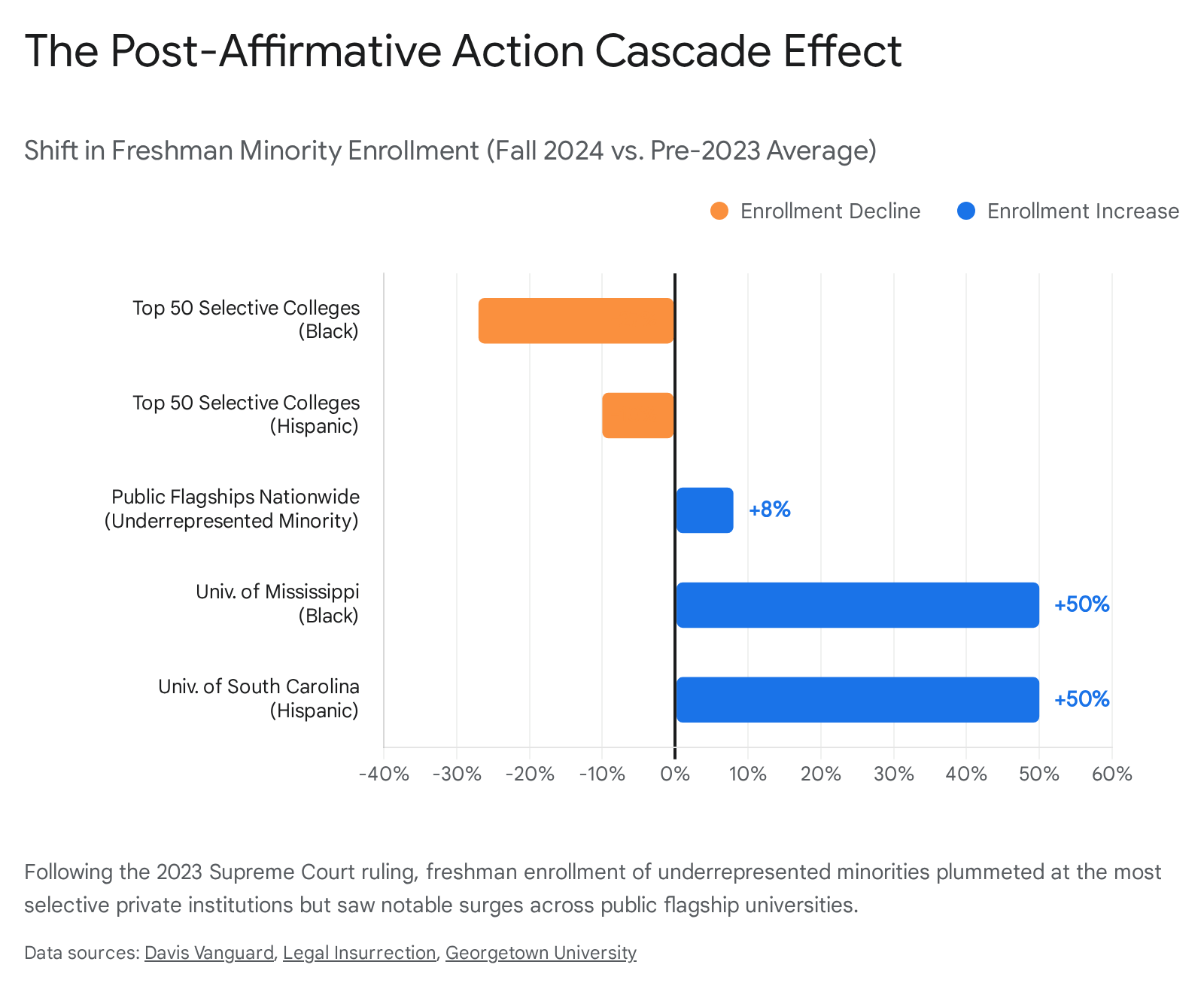
| Institutional Tier | Black Freshman Enrollment (Fall 2024 vs. 2023) | Hispanic Freshman Enrollment (Fall 2024 vs. 2023) |
|---|---|---|
| Top 50 Most Selective Universities | Decreased by 27% | Decreased by 10% |
| Public Flagship Universities | Increased by ~8% (Overall Underrepresented) | Increased by ~8% (Overall Underrepresented) |
| Public Four-Year Universities (Overall) | Increased by 4% | Increased by 7% |
| University of Mississippi | Increased by 50% | N/A |
| University of South Carolina | N/A | Increased by 50% |
| Massachusetts Institute of Technology | Decreased from 16% to 6% | N/A |
While overall minority enrollment at four-year institutions held relatively steady, the redistribution shifted underrepresented students toward universities that historically report lower average graduation rates and lower post-graduate earnings than the most elite tier, prompting ongoing debates about long-term socioeconomic equity and the future of workforce diversity 15214023.
New Avenues for Diversity: Socioeconomics and Essays
Deprived of race as a direct demographic checkbox, institutions are leaning heavily on other holistic mechanisms to build diverse cohorts. Universities are placing a renewed emphasis on socioeconomic status, first-generation college student status, and regional zip codes to construct their classes 141516. Duke University and Yale University, for instance, have significantly increased the proportion of incoming freshmen who are eligible for federal Pell Grants, signaling a pivot toward prioritizing economic diversity 15.
Furthermore, Chief Justice John Roberts' majority opinion explicitly noted that universities could still consider "an applicant's discussion of how race affected his or her life, be it through discrimination, inspiration, or otherwise" 17. As a result, the application essay has taken on unprecedented importance. Institutions immediately adjusted their supplemental essay prompts to invite narratives about culture, identity, and personal background, functionally shifting the burden of establishing diversity away from admissions office checkboxes and onto the applicant's storytelling capabilities 1738.
The Hidden Factors: Yield, Tags, and the Z-List
While holistic review is championed for its human-centric approach to academics and character, universities are ultimately businesses concerned with institutional viability and enrollment management. Holistic admissions inherently accommodates these operational needs, sometimes in ways that contradict the narrative of purely merit-based selection.
Demonstrated Interest and AI Predictive Modeling
One major operational concern is "yield" - the percentage of accepted students who actually choose to enroll. Predicting yield accurately is vital for institutional financial stability, housing logistics, and national prestige rankings 4445. To protect their yield, many institutions utilize a holistic factor known as "demonstrated interest."
Demonstrated interest refers to the measurable actions a student takes to show a college they genuinely intend to attend if admitted 44. While the most elite universities (like the Ivy League or Stanford) do not officially track demonstrated interest because their yields are already astronomically high, the practice is standard at mid-sized private universities and increasingly competitive public flagships 4446. Institutions rely on sophisticated customer relationship management (CRM) software and artificial intelligence models to track applicant engagement. They monitor data points ranging from whether a student opens promotional emails and clicks on internal links, to whether they attend virtual information sessions or visit the physical campus 444625.
Applying Early Decision (ED) - a binding agreement to attend the university if accepted - is the ultimate form of demonstrated interest. It signals to the university that they have a guaranteed enrollment, allowing admissions offices to lock in a significant portion of their freshman class early in the cycle. Consequently, applying Early Decision significantly boosts an applicant's chances of admission at many institutions 4446. As these predictive models become more pervasive, the National Association for College Admission Counseling (NACAC) has continuously updated its ethical guidelines to mandate that universities remain transparent with families regarding how Early Decision agreements function and how artificial intelligence is deployed in the admissions review process 262728.
Institutional Tags and the Z-List Controversy
Holistic admissions also accommodates "institutional priorities," allowing universities to grant immense, systemic advantages to specific subsets of applicants. These advantages are often referred to as "tags" or "hooks," which identify a student as a high priority for the institution. Typically, tagged students include recruited athletes, children of university alumni (legacies), and the children of major financial donors or faculty members 1638. Legacy applicants, for example, have historically been admitted at rates up to four times higher than their non-legacy peers 3829.
Nowhere is the intersection of institutional priority and holistic maneuvering more evident than in the "Z-list," a highly secretive deferred admissions program utilized by Harvard University 525330. The Z-list represents a tiny group of applicants - roughly 50 to 60 annually - who are offered guaranteed admission on the strict condition that they first take a gap year before enrolling 5253.
Data unearthed during the SFFA trial, alongside insights from college admission consultants, indicates that the Z-list is predominantly composed of white, legacy students or those with significant political or financial connections 293055. Because Z-list students often possess lower GPAs and standardized test scores than the standard admitted class, forcing them to defer enrollment for a year means their academic statistics are classified differently and are not reported to entities like U.S. News & World Report for the current incoming class. This statistical loophole allows the university to quietly admit the children of powerful alumni and mega-donors without diluting its pristine academic averages or threatening its national ranking 3055.
Debunking Common Admissions Myths
The opaque nature of holistic review inevitably breeds anxiety and rampant misinformation among applicants and parents. Understanding the realities of the system helps debunk several persistent, counterproductive myths:
- Myth 1: A perfect GPA or SAT score guarantees admission. Academic perfection is surprisingly common among applicant pools at selective colleges. Thousands of high school valedictorians with unblemished 4.0 GPAs and perfect 1600 SAT scores are routinely rejected annually. Holistic review demands more than grades; applications fail when they lack character depth, extracurricular angularity, or the specific institutional "hooks" a college is seeking that year 1238.
- Myth 2: Students must be perfectly well-rounded. The old paradigm of participating in sports, marching band, student council, and random volunteering to appear perfectly balanced is actively discouraged today. Elite colleges are not looking for well-rounded students; they are looking for specialized students who can combine to form a well-rounded class. Attempting to do everything often results in a "monolithic" profile lacking genuine passion 120.
- Myth 3: Picking a bizarre major increases your chances. Applicants sometimes select unpopular majors (e.g., obscure languages, niche historical studies) hoping for an easier admissions path. However, holistic review evaluates the narrative arc of the application. If a student's transcript and extracurriculars show heavy involvement in robotics and physics, suddenly declaring a passion for Renaissance poetry appears inauthentic. Admissions officers spot this tactic easily, and it frequently results in rejection due to poor institutional fit and lack of genuine demonstrated interest in the field 2.
Bottom line
Holistic college admissions represents a profound balancing act, attempting to weigh objective academic rigor against subjective human qualities, institutional financial needs, and rapidly shifting legal frameworks. While it offers a valuable pathway for personal context and character to shine beyond mere test scores, the system's reliance on subjective evaluation also opens the door to implicit bias, opaque advantages for well-connected families, and intense anxiety for applicants. Ultimately, the students who navigate this complex system most effectively are those who pursue deep, authentic intellectual interests and communicate their personal narratives with clarity, rather than those who simply chase an impossible standard of well-rounded academic perfection.