
What Do College Admissions Officers Actually Look For
Admissions officers prioritize an applicant's high school transcript and the rigorousness of their selected coursework above all other factors, increasingly utilizing standardized test scores to validate these academic achievements in an era of unprecedented grade inflation. Beyond the quantitative data, highly selective universities are actively seeking "angular" applicants with deep, specialized expertise rather than generalized, well-rounded backgrounds. Furthermore, every single achievement, grade, and extracurricular activity is evaluated within the precise context of the student's specific high school, geographic region, and socioeconomic environment.
The Academic Foundation: Grades, Rigor, and Context
The modern college application is evaluated holistically, but academic performance remains the absolute, non-negotiable gatekeeper. Before an admissions officer considers an applicant's extracurricular impact or personal narrative, they must first answer a fundamental question: can this student survive the academic rigor of our institution? The high school record is the primary vehicle used to answer that question.
Unpacking the High School Transcript
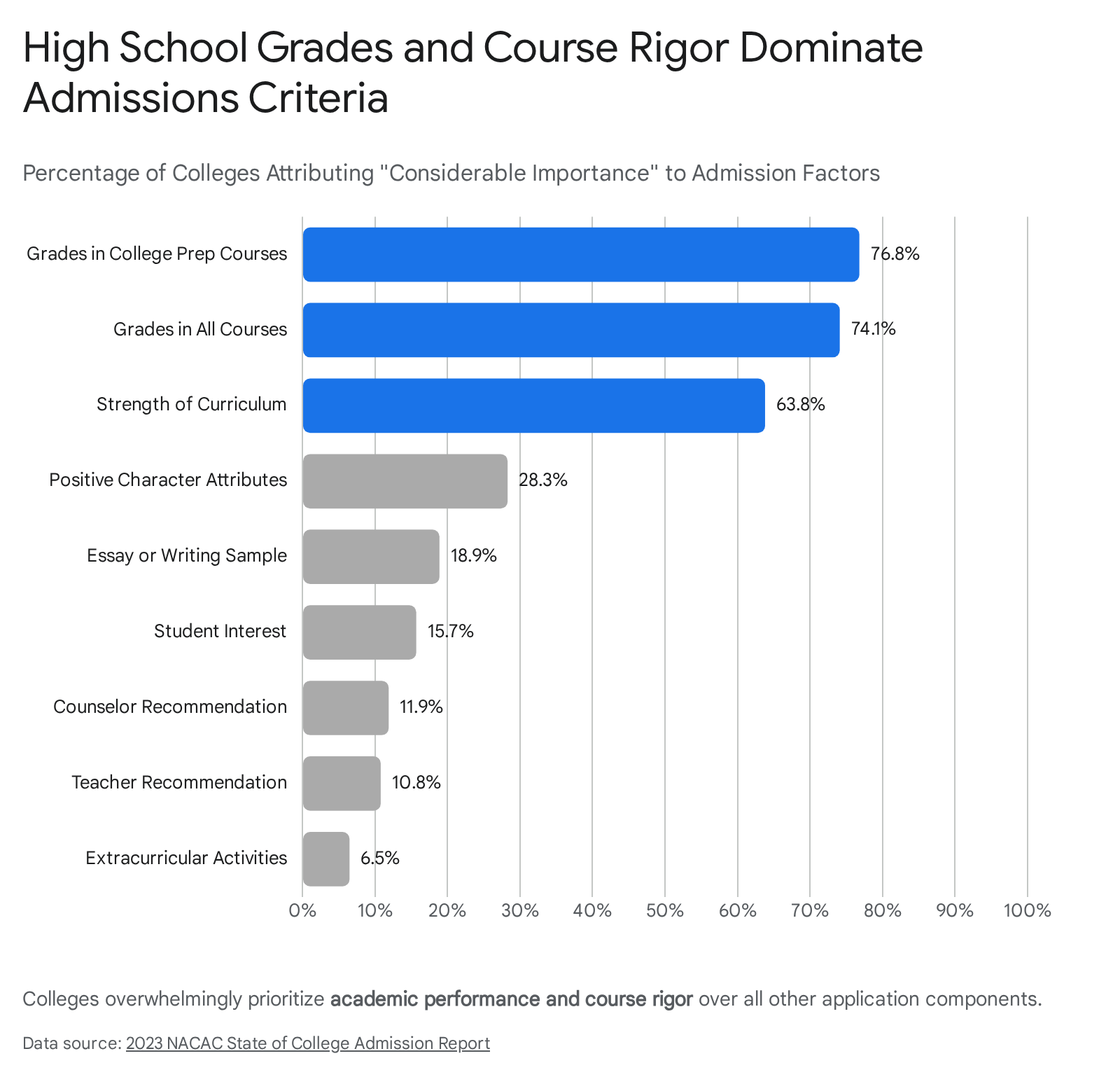
According to the National Association for College Admission Counseling (NACAC), grades in college preparatory courses and the overall strength of a student's high school curriculum are uniformly rated as the most critical factors in admission decisions across both public and private institutions 112. In the NACAC's 2023 survey, an overwhelming 76.8% of colleges attributed "Considerable Importance" to grades in college preparatory courses, and 74.1% attributed the same level of importance to grades in all courses 13.
Admissions officers do not simply look at a final, cumulative Grade Point Average (GPA) and take it at face value. Instead, they dissect the transcript line by line to see if a student took the most rigorous courses available at their specific high school 145. A high GPA achieved exclusively through standard-level classes is frequently viewed less favorably than a slightly lower GPA achieved in highly rigorous, advanced courses.
The Role of Course Rigor and High School Context
Students aiming for selective colleges are expected to enroll in Advanced Placement (AP), International Baccalaureate (IB), or dual-enrollment college classes if their high school offers them 14. Consistent high performance across these core subjects demonstrates a strong work ethic and validates a student's readiness to handle college-level materials 15.
Crucially, admissions committees evaluate this academic rigor entirely within the context of what the student's high school actually provides 46. If a rural high school only offers two AP classes, a student who takes both will not be penalized for failing to take ten AP classes. Regional admissions officers are trained to evaluate students relative to the specific educational opportunities available in their local environment, utilizing high school profiles that detail the exact curriculum limitations, grading scales, and historical matriculation data of each school 678.
Divergence Between Public and Private Evaluation Models
While academic rigor is universally paramount, there are notable differences in how public and private institutions weigh secondary admissions factors. According to the NACAC 2023 survey, public and private universities diverge significantly on the importance of subjective application components 13.
| Application Component | Public Universities | Private Universities | Evaluation Mechanism |
|---|---|---|---|
| High School GPA & Curriculum Rigor | Top priority | Top priority | Uniformly standard baseline for both. 13 |
| Class Rank | Often highly important | Generally less important | Publics use it for state mandates (e.g., Texas top 5% rule). Privates view it as an outdated metric. 139 |
| Positive Character Attributes | Lower importance | High importance | Privates utilize subjective essays and interviews to build specific campus cultures. 13 |
| Demonstrated Interest | Rarely tracked | Frequently tracked | Privates use software to track email opens and campus visits to protect yield rates. 31112 |
| Extracurricular Activities | Moderate importance | Considerable importance | Privates look for "angularity" to fill specific institutional needs (orchestra, athletics, debate). 313 |
The Standardized Testing Renaissance
In the immediate aftermath of the COVID-19 pandemic, thousands of colleges and universities throughout the United States switched to test-optional admissions policies 141516. This shift was initially a pragmatic response to canceled test dates and closed testing centers. However, many institutions quickly embraced the test-optional model, believing it reduced student anxiety and increased accessibility for disadvantaged applicants 1415. As a result, the reported importance of standardized testing plummeted in national surveys during the 2021-2023 application cycles 110.
However, a major paradigm shift has begun shaping the 2024, 2025, and 2026 admissions cycles.
The Pivot Away from Test-Optional Policies
Highly selective institutions have sharply reversed course, reinstating mandatory SAT or ACT requirements. Harvard, Yale, Dartmouth, Brown, MIT, Caltech, Georgetown, and the entire public university systems of Florida and Georgia are among the growing list of institutions demanding test scores once again 16181120.
This policy reversal is rooted in comprehensive internal data analysis. As universities studied the outcomes of their test-optional cohorts, they discovered that standardized test scores are a substantially stronger predictor of first-year college academic success than high school GPA alone 181120. A study conducted by Opportunity Insights, a research initiative based in the Harvard Department of Economics, concluded that students with higher ACT or SAT scores consistently achieved higher college GPAs than those with lower scores, regardless of their socioeconomic backgrounds 18.
Combating Widespread Grade Inflation
The return to standardized testing is heavily driven by the need to combat severe grade inflation in American high schools. Admissions officers are currently dealing with application pools where an overwhelming majority of candidates possess mathematically perfect academic records. Data from 2016 indicated that 47% of high school seniors graduated with an "A" average, up from 38.9% in 1998, and this trend has only accelerated in recent years 1415.
With over half of all college applicants presenting unblemished GPAs, admissions offices struggle to differentiate truly exceptional scholars from highly capable students who benefit from lenient grading curves 1411. Standardized tests provide a uniform, objective metric that cuts through the noise of varying high school grading standards, allowing universities to accurately assess academic capability across diverse educational backgrounds 1511.
The Equity Debate in Testing
Historically, standardized tests were criticized for favoring wealthy students who could afford expensive test preparation services. Research from Harvard in 2023 noted that children from the top 1% of the income distribution were 13 times more likely to score above a 1300 on the SAT than children from low-income families 18.
Paradoxically, institutions like Dartmouth discovered that removing the testing requirement actually harmed disadvantaged students. Dartmouth's President, Sian Leah Beilock, noted that standardized tests were highly effective at identifying brilliant students from under-resourced high schools 1611. When an admissions officer reads a transcript from an unknown, underfunded rural high school, a 4.0 GPA might be difficult to contextualize. However, if that same student submits a 1500 on the SAT, the admissions officer immediately has objective proof of their capability. By going test-optional, colleges inadvertently removed the very tool that allowed these hidden gems to prove their merit on a national scale 1611.
Extracurriculars: The Death of the Well-Rounded Student
For decades, guidance counselors advised high school students to build a "well-rounded" resume. Students were encouraged to play a varsity sport, learn a musical instrument, volunteer at a soup kitchen, join the debate club, and participate in student government 2112. The logic was that colleges wanted well-rounded individuals who could do a little bit of everything. Today, presenting a generic, well-rounded profile to a highly selective college is a distinct disadvantage 131223.
Why Colleges Want "Angular" Specialists
Admissions officers at top-tier universities no longer seek well-rounded students; instead, they seek to build a well-rounded class composed of highly specialized, "angular" students 13211223.
As acceptance rates at elite universities have plummeted - dropping from roughly 30% a few decades ago to single digits today - the definition of an impressive extracurricular profile has fundamentally shifted 13. The traditional "jack of all trades" profile now reads as unfocused, generic, and lacking in true intellectual passion 2112. Students who bounce from activity to activity to fill up their resumes often demonstrate shallow engagement and limited true impact 21.
Colleges prefer applicants who have discovered a specific, defining interest and taken a deep, obsessive dive into it, achieving excellence or uniqueness in that singular domain 1321. These specialized students are referred to in admissions circles as "angular" or "spiky" 131223.

Filling the Institutional Buckets
An angular student might be an Olympic-level athlete, a published science researcher, the founder of a revenue-generating nonprofit, or a highly skilled classical musician 1321.
Admissions committees favor these specialists because universities operate with highly specific institutional needs. They must fill seats in their orchestras, recruit for their athletic teams, populate specialized humanities seminars, and find leaders for student government 1213. It is significantly easier for an admissions committee to predict exactly how a specialist will contribute to the campus ecosystem than it is to predict the impact of a generalist 1223. When an admissions officer reviews a spiky application, they immediately know the applicant's "angle" and can accurately slot them into the precise demographic bucket the university needs to fill for that incoming class 132313.
The Personal Essay and the Threat of AI
The college essay remains the primary vehicle for an applicant to showcase their personality, emotional resilience, and unique voice. It bridges the gap between cold numerical statistics and human character, acting as a crucial differentiator among highly qualified applicants 2514.
The GPA Salvation Myth
A pervasive myth among applicants is that a brilliant, deeply moving personal statement can entirely rescue an application burdened by a very low GPA. In the context of highly selective college admissions, this is a mathematical impossibility 251427.
The primary concern of an admissions committee is predicting academic survival. If a student's grades and test scores do not cross a baseline threshold of competence, the application is frequently rejected or filed away before the essay is ever read in detail 2527. While a stellar essay can explain extenuating life circumstances or edge out an otherwise identical applicant in a head-to-head comparison, it cannot magically compensate for a lack of foundational academic ability 251415. Exceptional writing demonstrates communication skills and personality, but the student must still prove they can handle the university's academic workload 1415.
How Admissions Offices Handle Generative AI
The rapid proliferation of Generative Artificial Intelligence (AI) tools, such as ChatGPT, has vastly complicated the essay evaluation process for the 2024, 2025, and 2026 application cycles 163031.
Currently, university policies regarding AI in college admissions are a fractured, inconsistent patchwork. According to a late 2025 survey conducted by Kaplan among over 200 college admissions officers, the vast majority of institutions remain entirely in the gray area: * 68% of colleges have absolutely no official policy regarding AI use in essays. * 30% of colleges have official policies banning its use entirely. * Only 2% of colleges explicitly allow students to use Generative AI to write their application essays 16.
For brainstorming and outlining, colleges are slightly more lenient, with 27% permitting AI for idea generation, though the majority still lack formal guidelines 16.
At the institutional level, policies vary wildly. The California Institute of Technology (Caltech) and Cornell University have adopted specific ethical AI guidelines, allowing applicants to use AI for researching schools, brainstorming topics, and checking basic grammar, but strictly forbidding the use of AI to outline or draft the actual essay text 3132. Vanderbilt University explicitly warns applicants against using AI to replace independent thinking, noting that the essay must reflect the student's authentic life experiences 32. Duke University, recognizing that they can no longer trust essay prose as a true reflection of a student's unassisted writing ability, has entirely stopped scoring admissions essays based on writing style, shifting their focus purely to the content and specific insights provided 32.
The Danger of the "Polished" AI Essay
Beyond ethical violations, admissions officers possess a deep professional disdain for AI-generated essays because they fundamentally flatten a student's authentic voice 1630.
Generative AI produces polished, structurally perfect, and grammatically flawless prose that is ultimately generic. It strips away the individual quirks, emotional depth, and highly specific vulnerabilities that make a personal statement memorable 163033. Admissions officers review thousands of essays; they are highly trained to detect writing that feels formulaic, soulless, or uncharacteristically sophisticated for a high school senior 3031.
Furthermore, many universities have integrated AI detection software, such as Turnitin's AI module or GPTZero, directly into their application processing systems 303133. While these detection tools are imperfect - often suffering from false positive rates between 5% and 10% - triggering a detector can lead to intense scrutiny, committee holds, or immediate rejection 3133. The highest risk in using AI is not necessarily getting caught by an algorithm, but rather submitting an essay that sounds so artificially perfect that it completely fails to connect with the human admissions officer reading it 3033.
Inside the Reading Room: How Decisions Are Made
Understanding what admissions officers want requires understanding how they physically process tens of thousands of applications within a severely compressed timeframe. The workflow at selective universities is highly structured, relying on regional expertise and collaborative deliberation 634.
Territory Management and the First Read
Applications are not thrown into a massive pile and evaluated by a faceless committee reading files at random. Instead, college admissions offices divide the country and the world into highly specific geographic territories, assigning individual regional admissions officers to manage them 673435. Your regional officer is almost always the very first person to open and read your file 734.
This regional approach, often referred to as "territory management," is vital because context is the most important lens in college admissions 678. A regional officer deeply understands the nuances of the applicants in their territory. They know exactly how competitive a specific high school is, they know if a school district recently cut its AP curriculum, they understand the local grading curves, and they recognize the prestige of specific regional awards 6735.
When evaluating international students, these regional officers are familiar with foreign grading systems, national exams, and specific local educational constraints. They understand that a lack of extracurricular activities on an application from a specific country might be due to a systemic lack of opportunity rather than a lack of student motivation 3536. The regional officer acts as a translator, framing the applicant's achievements perfectly within their local context 7.
Committee-Based Evaluation (CBE)
After the initial read, many selective colleges, including the University of Pennsylvania, Rice, Caltech, and Emory, utilize a rapid processing method known as Committee-Based Evaluation (CBE) 3437.
Pioneered by the University of Pennsylvania in 2013, CBE involves two admissions officers reading an application simultaneously to form a rapid, collaborative consensus 3437. Because application volumes have skyrocketed, admissions officers operate under extreme time constraints, typically spending an average of only 6 to 8 minutes evaluating a single file 3437. During a CBE session, one officer might review the academic transcript, test scores, and school profile, while the second officer simultaneously reads the personal essays, extracurricular list, and letters of recommendation 34. They discuss their findings in real-time and make an immediate decision to either deny the applicant or move them forward to the final committee stage 3437.
If an applicant survives this initial CBE screening, their regional officer becomes their primary advocate. The officer presents the student's case to the broader, senior admissions committee, summarizing their academic ratings, personal qualities, and unique narrative. The senior committee then votes on whether to admit, waitlist, or deny the applicant 63839.
The Ivy League Rating System
Legal filings from the landmark Students for Fair Admissions v. Harvard Supreme Court case provided the public with an unprecedented, highly detailed look at how elite colleges quantify human potential behind closed doors 40. Harvard, and many of its peer Ivy League institutions, score applicants on a strict 1 to 6 scale (with 1 being the absolute best) across four primary dimensions: Academic, Extracurricular, Personal, and Athletic 4041.
Achieving a "1" in any category is exceptionally rare and significantly boosts a candidate's admission odds. For instance, a student with an Academic rating of 1 (and no other 1s) historically possessed a 68% chance of admission, a staggering advantage compared to the university's overall single-digit acceptance rate 4117. Conversely, applicants who fail to secure at least a "2" in multiple categories have virtually no mathematical chance of admission 17.
| Rating Scale | Academic Evaluation | Extracurricular Evaluation | Personal Evaluation |
|---|---|---|---|
| 1 (Exceptional) | Genuine scholar displaying unusual creativity. Near-perfect scores, often with published original research or prestigious national awards. (Awarded to top 0.5% of applicants) 4117 | Truly unusual strength. National-level achievement, professional experience, or massive impact. (Awarded to top 0.3% of applicants) 4117 | Outstanding. Displays truly remarkable character traits. (Extremely rare, awarded to under 50 applicants total per year) 4117 |
| 2 (Very Strong) | Excellent student with superb grades and high standardized test scores (e.g., 33+ ACT). (Awarded to 42.3% of applicants) 4117 | Major school or regional accomplishments. E.g., Student Body President or captain of multiple major clubs. (Awarded to 23.8% of applicants) 4117 | Very strong personal qualities, highly positive letters of recommendation. (Awarded to 20.8% of applicants) 4117 |
| 3 (Solid) | Very good student with excellent grades but slightly lower test scores (e.g., mid-600s SAT, 29-32 ACT). 4117 | Solid participation in multiple clubs but lacking special distinction, high-level leadership, or deep impact. 4117 | Generally positive character, but lacks uniquely memorable traits. 4117 |
| 4 (Adequate) | Respectable grades and adequate preparation, but lower standardized test scores. 4117 | Little or no meaningful participation in extracurricular activities outside of class. 4117 | Bland, somewhat negative, or immature personality traits reflected in essays or recommendations. 4117 |
The University of California's 13-Point Comprehensive Review
The University of California (UC) system operates on a vastly different admissions model than the Ivy League or small private liberal arts colleges. Because they process an astronomical number of applications and are strictly bound by state law, the UC system does not conduct interviews, does not accept letters of recommendation for initial review, and is entirely test-blind (meaning they completely ignore SAT and ACT scores, even if submitted) 5818.
To evaluate students fairly without these traditional metrics, the UC system relies on a formalized process known as "Comprehensive Review," which utilizes 13 specific criteria 581819.
The Core Factors of UC Admissions
When evaluating a UC application, readers focus heavily on academic performance within the context of the state's required "A-G" courses. The primary factors include: * GPA in A-G Courses: The foundational metric. The UC calculates its own specific GPA based solely on approved high school courses, granting additional weight for UC-certified honors, AP, and IB classes 51820. * Performance Beyond the Minimum: UCs look favorably upon students who take significantly more academic courses than the bare minimum required for graduation 520. * Eligibility in the Local Context (ELC): This is a critical metric for California residents. If a student ranks in the top 9 percent of their specific high school class at the end of their junior year, they receive a massive boost in the evaluation process, ensuring top students from under-resourced schools are recognized 51820. * Life Experiences and Special Circumstances: The UC system heavily weighs the context of a student's achievements. Admissions readers look closely at accomplishments achieved despite low family income, first-generation college status, disability, the need to work to support family, or refugee status 51820. * Special Talents and Geographic Location: Significant achievements in athletics, performing arts, or leadership are heavily weighed, alongside the geographic location of the student's secondary school 51820.
To communicate these subjective elements, applicants must answer four Personal Insight Questions (PIQs) 18. Unlike the Common Application essay, which often encourages creative, narrative storytelling, UC readers expect PIQs to read like straightforward interview answers. They want direct, factual explanations of leadership, resilience, and specific life context 1819.
The Invisible Metric: Demonstrated Interest and Big Data
A highly influential, yet often hidden metric that can tip the scales at certain universities is "Demonstrated Interest." This refers to how genuinely and proactively an applicant engages with a university before applying.
In the modern digital age, colleges do not merely track physical campus visits; they meticulously track an applicant's entire digital footprint. The vast majority of selective universities utilize a sophisticated admissions backend CRM (Customer Relationship Management) platform called Slate, developed by the company Technolutions 11464748.
Tracking the Digital Footprint
Slate features a powerful, integrated analytics tool called "Ping." This software allows university admissions offices to silently track almost every digital interaction a prospective student has with the institution 4648. When a student receives a marketing email from a college, the system logs whether the email was opened, exactly how long it was kept open, and which specific hyperlinks within the email were clicked 4648. Furthermore, using UTM codes and embedded tracking pixels, the software monitors how much time a prospective student spends browsing specific pages on the university's website 4648.
All of this interaction data is compiled into a "Demonstrated Interest" score and attached directly to the student's final application file, visible to the admissions officer during the reading process 114748.
Yield Protection and the Mid-Tier Squeeze
Why do colleges invest in tracking whether a high school junior clicked a link in an email? The answer lies in "yield protection." Yield is the percentage of admitted students who ultimately choose to enroll at the university 1112. A high yield rate improves a college's national ranking, boosts its perceived prestige, and stabilizes its financial forecasting 1247.
However, the importance of demonstrated interest varies drastically depending on the tier of the institution: * The Ultra-Selective Tier: Elite universities like Harvard, Princeton, MIT, Stanford, and Caltech explicitly do not track demonstrated interest 1112. Their yield rates are already astronomically high; they know that if they accept a student, that student is almost guaranteed to attend. Tracking email opens offers them no strategic value 1112. * The Mid-Tier Selective Schools: Universities with acceptance rates generally hovering between 20% and 50% (such as Washington University in St. Louis, Tufts, Boston University, and Boston College) care deeply about demonstrated interest 111246. These institutions are frequently used as "safety" or "target" schools by top-tier applicants aiming for the Ivy League. To protect their yield rates and avoid under-enrollment, these schools want to ensure they are admitting students who genuinely view their institution as a first choice, rather than as a backup plan 12. At these schools, attending virtual info sessions, quickly opening emails, and writing a highly specific, researched supplemental essay can literally be the deciding factor for a borderline applicant 1112.
Post-Affirmative Action and the Squeeze on Out-of-State Students
The landscape of college admissions experienced a tectonic legal shift in June 2023 when the U.S. Supreme Court (in the landmark Students for Fair Admissions v. Harvard and UNC cases) ruled that race-conscious admissions violate the Equal Protection Clause of the Fourteenth Amendment, effectively banning the practice of traditional affirmative action 215022.
Shifting Enrollment Data
In the immediate aftermath of the ruling, widespread application behaviors remained surprisingly stable. Data from the Common App representing nearly six million applications during the 2023-2024 cycle showed no meaningful changes in how students self-reported their race or ethnicity 2324. Furthermore, there was no drastic, systemic spike in students using their essays to explicitly focus on their racial backgrounds, aside from slight increases among specific underrepresented minority groups 232425.
However, early enrollment data has shown highly tangible impacts at the institutional level, particularly at elite, highly selective universities. Following the implementation of the ban, the Massachusetts Institute of Technology (MIT) reported a massive 14-percentage-point drop in Black, Hispanic, and Indigenous first-year student enrollment compared to the prior year 21. Similarly, the University of North Carolina at Chapel Hill, one of the primary defendants in the Supreme Court case, saw its Black student enrollment drop from 10.5% to 7.8% 21.
In direct response to the ban on race-based preferences, a massive public, academic, and legislative spotlight has rapidly turned toward legacy admissions (institutional preferences granted to the children of alumni). Because legacy preferences disproportionately benefit wealthy, white applicants, a growing number of colleges and state legislatures are currently moving to eliminate legacy preferences entirely in an attempt to level the admissions playing field in the post-affirmative action era 5526.
Legislative Caps on Out-of-State Enrollment
For students applying to out-of-state public universities, the mathematical odds of admission are becoming increasingly prohibitive. Historically, many public universities heavily recruited out-of-state and international students because these demographics pay significantly higher tuition rates. This influx of out-of-state capital was routinely used to subsidize the cost of education for in-state residents 5758.
Recently, state legislatures across the country have pushed back aggressively against this practice, arguing that taxpayer-funded universities exist primarily to serve and educate local citizens, not to act as profit centers relying on out-of-state tuition 57. As a result, strict enrollment caps are being implemented, dramatically reducing the available seats for non-resident applicants.
| State / University System | Out-of-State Acceptance Policy or Cap Constraint | Primary Legislative Driver |
|---|---|---|
| University of Texas at Austin | Auto-admits the top 5% of in-state graduates for Fall 2026 (tightened from 6%). Law caps auto-admits at 75% of the total class. | Forced adjustment to manage a record-high application volume exceeding 73,000 students. 92728 |
| North Carolina Public System | Strictly enforces an 18% cap on out-of-state freshman enrollment across campuses. | State mandate specifically designed to prioritize seats for in-state taxpayers. 57 |
| Florida Preeminent Universities | Pending legislation attempting to force a 95% in-state enrollment floor (effectively capping out-of-state at 5%). | Aggressive legislative push to ensure Florida residents are not displaced by wealthy non-residents. 5861 |
In Texas, state law mandates that public universities provide automatic admission to top-ranking high school graduates. Due to a staggering, record-breaking surge of over 73,000 undergraduate applications, the University of Texas at Austin was forced to significantly tighten its automatic admission threshold. For the fall 2026 admissions cycle, only Texas students ranking in the absolute top 5% of their graduating class (down from the previous 6%) will be automatically admitted 92728. Because the university is legally required to fill 75% of its incoming class with these auto-admits, the remaining spaces available for out-of-state students and students subjected to holistic review are shrinking to unprecedented lows 929.
Similarly, Florida is advancing highly contested legislation that would require at least 95% of new, first-time students at its preeminent state research schools (such as the University of Florida and Florida State University) to be in-state residents 61. While currently, over 20% of the students at these institutions come from outside Florida, this proposed legislation would effectively crush out-of-state and international acceptance rates, prioritizing state taxpayers at the expense of national geographic diversity 5861.
Bottom line
Admissions officers are ultimately looking for applicants who maximize their specific high school opportunities through rigorous coursework and top-tier grades, a metric increasingly validated by the return of standardized test scores. Beyond academics, elite institutions are searching for "angular" students with deep, specialized passions who can fulfill specific institutional needs and bring a unique, localized perspective to a carefully curated campus community. While authentic personal essays and high levels of demonstrated interest can serve as vital tie-breakers at mid-tier universities, they cannot overcome a weak academic foundation, and attempting to shortcut the essay process with Generative AI only strips away the vital human qualities that admissions committees are desperately trying to find.