
What to Expect From Alzheimer's Blood Tests in 2026
New FDA-cleared and CE-marked blood tests can now identify Alzheimer's disease pathology with an accuracy rivaling expensive brain scans and invasive spinal taps. As researchers prepare for the 2026 Alzheimer's Association International Conference in London, the medical focus has shifted from validating these biological markers to fighting for Medicare coverage and implementing them safely in primary care.
The End of Diagnostic Guesswork
For most of the last forty years, diagnosing Alzheimer's disease has been a process of exclusion and clinical inference 1. A patient and their family would describe subtle memory changes, and a primary care physician would run basic cognitive screens, order an MRI to rule out tumors or strokes, check for vitamin deficiencies, and eventually arrive at a probabilistic label 1. Confirming the underlying biology - the microscopic amyloid plaques and tau tangles that definitively identify Alzheimer's disease - has historically required a lumbar puncture to sample cerebrospinal fluid or an amyloid positron emission tomography (PET) scan 121.
Because of the high cost, specialized infrastructure requirements, and invasiveness of these traditional methods, the majority of people living with Alzheimer's disease never receive a confirmed biological diagnosis 1. In the United States alone, an estimated 7.4 million Americans are living with clinical Alzheimer's dementia, yet fewer than 10% of people experiencing mild cognitive impairment ever receive a timely diagnosis that could alter their care trajectory 4.
That era of diagnostic uncertainty is coming to a close. Over the past twelve months, the diagnostic landscape has undergone a seismic shift. In May 2025, the U.S. Food and Drug Administration (FDA) cleared the Lumipulse G pTau217/ß-Amyloid 1-42 Plasma Ratio test by Fujirebio, marking the first time a blood test was authorized in the U.S. to aid in the diagnosis of the disease 123. This breakthrough was quickly followed in October 2025 by Roche receiving FDA clearance for its Elecsys pTau181 test, which was specifically designed for primary care settings 45. Most recently, in May 2026, Roche's next-generation Elecsys pTau217 assay received a CE Mark in Europe, positioning it for rapid and widespread implementation across the continent 67.
How Brain Proteins Enter the Bloodstream
To understand the mechanics of these new blood tests, one must look at the physical damage Alzheimer's inflicts on the human brain. The disease is characterized by two main biological culprits: amyloid-beta proteins that clump together to form sticky extracellular plaques between neurons, and tau proteins that detach from cellular microtubules to form neurofibrillary tangles inside the neurons themselves 8.
For decades, scientists believed these pathological proteins remained firmly locked inside the central nervous system, barricaded by the blood-brain barrier. This barrier is a tightly packed wall of specialized cells designed to keep external hazards out of the brain while keeping delicate brain chemistry perfectly isolated 910. However, recent clinical research has demonstrated that as the brain becomes overwhelmed with these misfolded proteins, or as the blood-brain barrier naturally deteriorates with age, a predictable biological leakage occurs 1011.
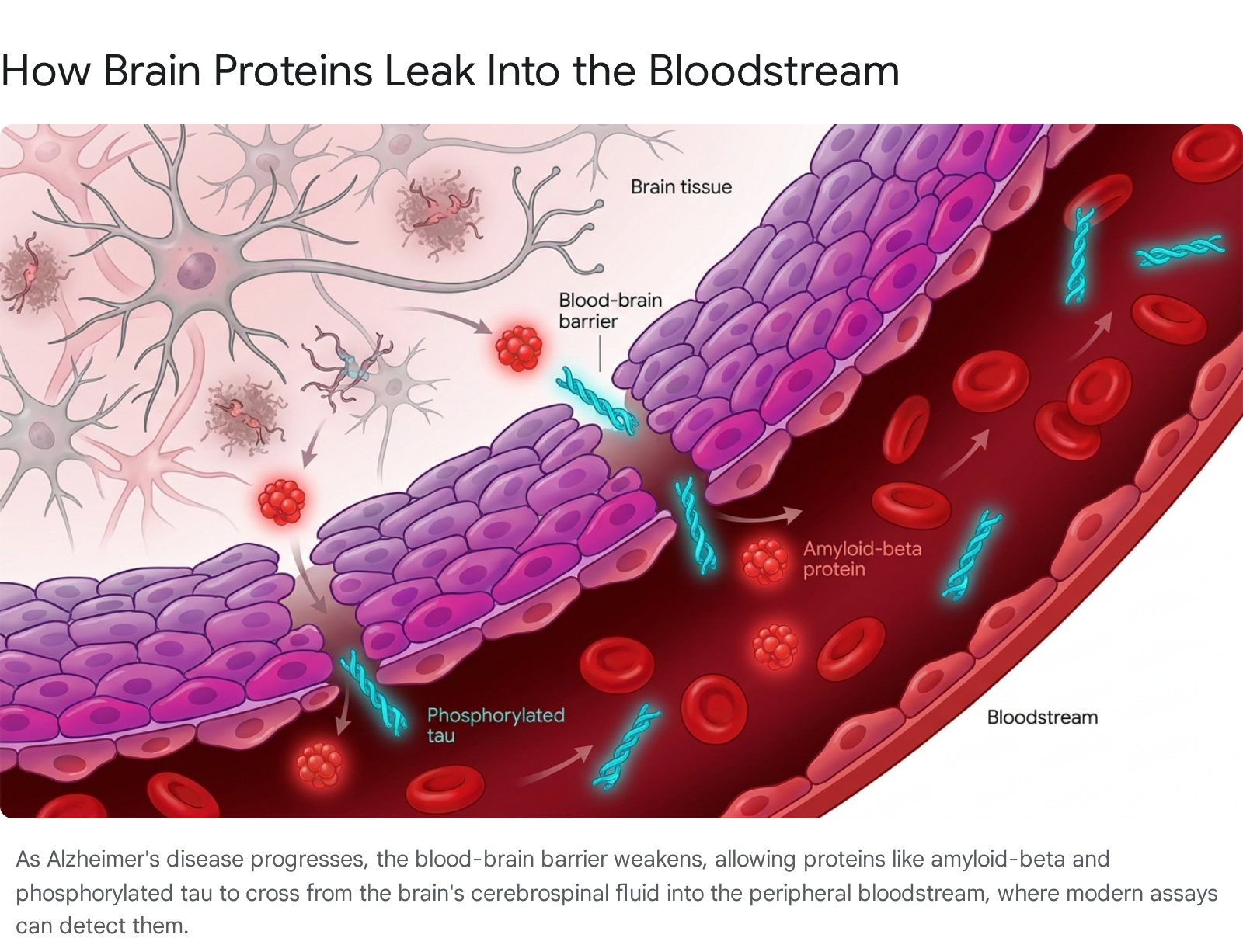
By extracting plasma from a standard arm vein and utilizing highly sensitive mass spectrometry or advanced automated immunoassays, commercial laboratories can now detect these microscopic protein fragments in the peripheral bloodstream. The concentrations of these proteins mirror the silent buildup of amyloid and tau in the brain years, and sometimes decades, before outward symptoms like memory loss or severe confusion become obvious to the patient or their family 111213.
Comparing the Diagnostic Arsenal
The arrival of blood-based biomarkers does not render traditional neurological scans obsolete, but it fundamentally reorganizes the diagnostic workflow for physicians. To appreciate the magnitude of this shift, it is helpful to compare the currently available tools based on their target, invasiveness, and cost.
| Diagnostic Method | Primary Biological Target | Invasiveness & Patient Burden | Estimated Healthcare Cost | Primary Clinical Setting |
|---|---|---|---|---|
| Amyloid PET Scan | Brain amyloid plaques | Low (requires radioactive tracer injection) | $3,000 - $6,000+ 117 | Specialized Imaging Center |
| Lumbar Puncture (CSF) | Amyloid and Tau in spinal fluid | High (needle insertion into spinal canal) | $1,000 - $3,000 1415 | Specialist/Neurology Clinic |
| Blood Biomarker | Plasma p-tau and amyloid ratios | Low (standard venous blood draw) | $130 - $500 120 | Primary Care or Specialist |
| Cognitive Assessment | Memory, executive function, behavior | None (verbal and written examinations) | Covered by routine insurance | Primary Care |
The Triage Revolution in Primary Care
One of the most immediate and profound impacts of blood testing in 2026 is its utility as a triage tool at the primary care level. Currently, patients presenting with early memory complaints are routinely placed on massive waiting lists - sometimes up to 18 months - simply to see a neurologist or secure an appointment at a dedicated memory clinic 21.
Tests like Roche's Elecsys pTau181 have been specifically cleared by the FDA for use in primary care to "rule out" the presence of amyloid pathology 45. In multi-center clinical trials, this specific test demonstrated a 97.9% negative predictive value among adults 55 and older showing signs of cognitive impairment 1617. This high statistical threshold means that if a patient's blood test comes back negative, a primary care physician can confidently inform them that their cognitive issues are stemming from a non-Alzheimer's cause. By ruling out Alzheimer's pathology early, doctors can immediately pivot to investigating other treatable causes of memory loss - such as sleep apnea, severe vitamin deficiencies, thyroid disorders, or clinical depression - sparing the patient months of anxiety and preventing unnecessary referrals for $6,000 brain scans 418.
The Biomarker Battle: Why p-tau217 is Winning
As the commercial market for diagnostics has exploded, not all blood tests are created equal. Over the last few years, an intense scientific race has unfolded to determine which specific protein fragment is the most reliable proxy for what is actually happening deep inside the brain cortex. The global consensus in 2026 has overwhelmingly crowned a specific variant of the tau protein: phosphorylated tau 217 (p-tau217).
Under healthy conditions, tau proteins act as stabilizing structural support for neurons 8. In the pathology of Alzheimer's, these proteins become hyperphosphorylated - meaning abnormal chemical phosphate tags attach to the protein structure, causing them to misfold, clump together, and destroy the neuron from the inside out 819. Researchers can measure different tagged locations on the tau protein, primarily focusing on positions 181, 217, and 231 20.
According to comprehensive 2026 meta-analyses evaluating over 4,700 participants across the entire Alzheimer's continuum, plasma p-tau217 significantly outperforms older markers like p-tau181 2122.
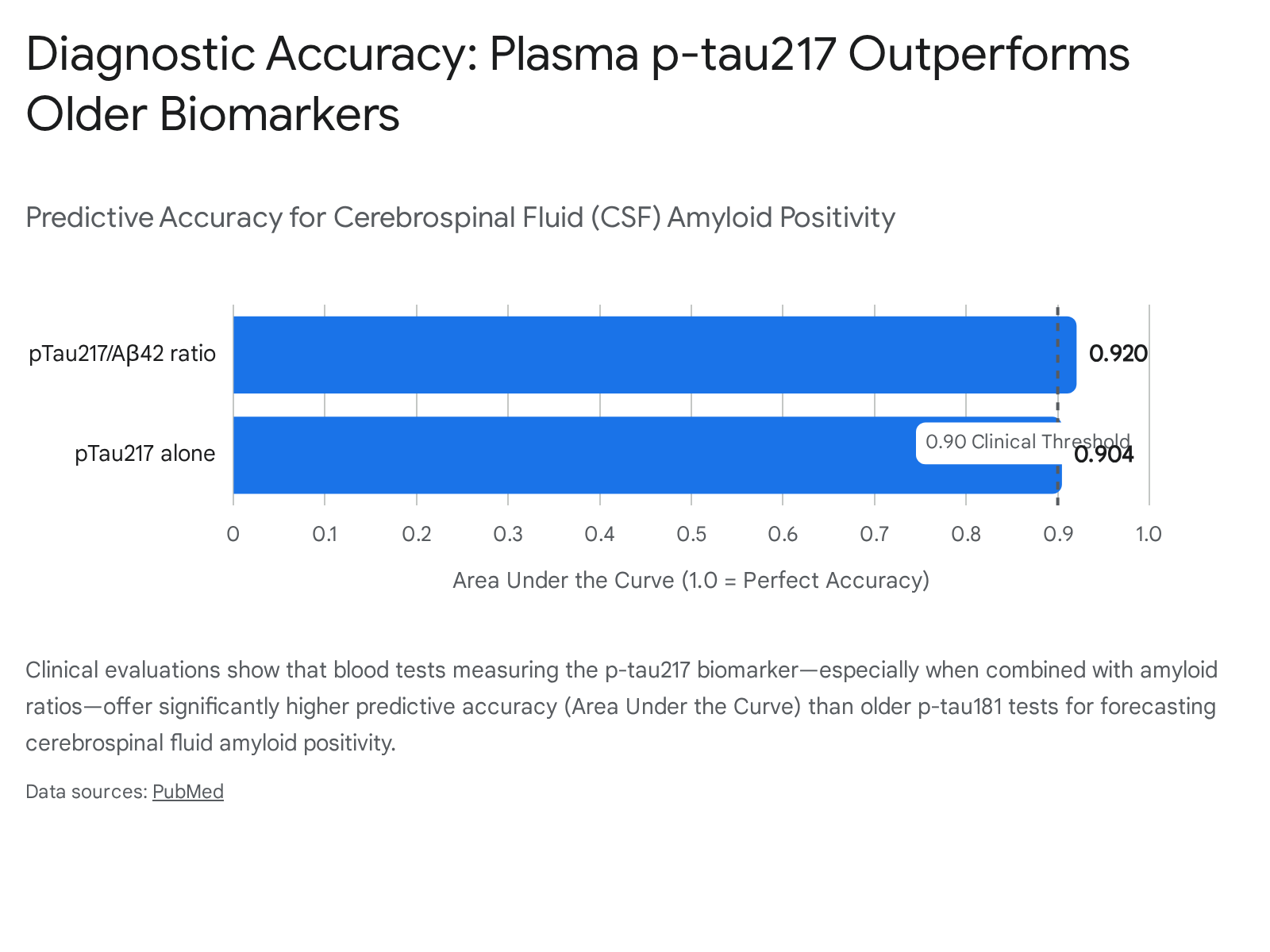
When analyzed using highly sensitive mass spectrometry or automated platforms, p-tau217 provides the highest diagnostic accuracy for detecting amyloid pathology, identifying advanced tau-PET pathology, and predicting the conversion from mild cognitive impairment to full clinical dementia 2122.
In real-world memory clinics, utilizing a precise "two-cutpoint" diagnostic model with the p-tau217 biomarker allows up to 86% of patients to receive a definitive positive or negative result based solely on a single blood draw 23. This efficiency drastically streamlines the diagnostic process and reduces the reliance on follow-up imaging. However, physicians must still interpret these results alongside patient health data, as chronic conditions like reduced kidney function can artificially inflate p-tau217 levels in the blood due to decreased renal filtration, regardless of Alzheimer's status 2324.
New Clinical Practice Guidelines
To enforce rigorous quality control in a rapidly exploding and highly lucrative diagnostics market, the Alzheimer's Association released highly anticipated Clinical Practice Guidelines (CPGs) for blood-based biomarkers during the Alzheimer's Association International Conference in 2025 192526.
These guidelines established strict accuracy thresholds to ensure patient safety in specialized care settings. For a blood test to be used for triaging - where a negative result rules out Alzheimer's pathology - the test must demonstrate at least 90% sensitivity and 75% specificity 202527. A positive result at this triage level still requires confirmation via PET imaging or cerebrospinal fluid analysis. Conversely, for a blood test to serve as a definitive, standalone substitute for expensive PET scans or invasive lumbar punctures, it must achieve at least 90% for both sensitivity and specificity 2025.
The Alzheimer's Association strongly cautioned the medical community that while top-tier diagnostic assays meet these rigorous criteria, significant performance variability exists across the industry, and many commercially available, laboratory-developed blood tests currently fall short of the 90% threshold 1925.
Global Regulatory Approvals and Rollouts
The integration of Alzheimer's blood diagnostics into routine medical care is progressing at vastly different speeds globally, shaped by varying national healthcare structures, regulatory philosophies, and cultural attitudes toward medical testing.
In the United States, the FDA has paved the way with landmark clearances, beginning with Fujirebio's Lumipulse test in mid-2025 and followed by Roche's Elecsys platforms 1334. The European market reached a critical milestone in May 2026 when Roche announced that its Elecsys pTau217 blood test had received a Conformité Européenne (CE) mark 67. This certification allows the test to be used for both ruling in and ruling out amyloid pathology across primary and secondary care settings within the European Economic Area, leveraging Roche's existing massive installed base of laboratory instruments 7.
In Asia, regulatory bodies like China's National Medical Products Administration (NMPA) and Japan's Pharmaceuticals and Medical Devices Agency (PMDA) have been equally active. In China, where lumbar punctures are historically met with high cultural reluctance by patients, the market for less invasive blood diagnostics is expanding rapidly 20. While international assays from Roche operate as the gold standard in major Chinese tertiary hospitals, domestic innovations are emerging to meet demand 20. For instance, the low-cost Mike Bio serum panel offers broad risk stratification, and Maozhi Biotechnology is currently pushing a novel TRPC6 blood testing product through multi-center clinical trials to provide highly localized diagnostic options 2028.
The Cautious UK NHS Approach
The United Kingdom's National Health Service (NHS) is taking a more structured, evidence-gathering approach before authorizing widespread systemic implementation. The UK is driving the "Blood Biomarker Challenge," a multimillion-pound research initiative heavily supported by Alzheimer's Research UK, the Alzheimer's Society, and government funding 362930.
As part of this initiative, the Alzheimer's disease diagnosis and plasma p-tau217 (ADAPT) team, led by researchers at University College London, is conducting trials across 20 specialist NHS memory clinics involving over 1,000 patients 2930. Half of the participants will receive a blood test result within three months of their assessment, while the other half will wait twelve months 29. The goal is to rigidly assess whether earlier blood testing genuinely speeds up diagnosis, alters clinical decision-making, and proves cost-effective for the NHS 29. Currently, highly expensive amyloid PET scans are offered to only about 2% of people diagnosed with Alzheimer's in the UK 29. If the ADAPT trials succeed and meet National Institute for Health and Care Excellence (NICE) guidelines, researchers aim to make blood-based dementia diagnosis routinely available across the entire NHS by 2029 363132.
The Medicare Bottleneck and the ASAP Act
Despite massive scientific leaps in assay accuracy, the actual real-world rollout of Alzheimer's blood tests in the United States in 2026 is severely hindered by a tangled web of insurance coding disputes, rigid Medicare rules, and legislative gridlock.
While brain PET scans can cost patients and insurers between $3,000 and $6,000, the new blood tests cost between $130 and $500 to run 11721. Logically, one might expect insurers and government payers to enthusiastically embrace the exponentially cheaper option. However, the U.S. Centers for Medicare & Medicaid Services (CMS) operates under strict statutory limitations regarding preventative diagnostics.
The Reimbursement Rate Fight
A fierce economic battle is currently raging over exactly how much commercial laboratories should be paid to perform these complex tests. In late 2024, CMS released preliminary rate determinations for the clinical laboratory fee schedule covering neurological blood biomarker tests, routing them through a bureaucratic pricing process known as "gapfill." CMS controversially proposed reimbursing laboratories a mere $17 per test 4142.
This figure sparked immediate outrage among medical advocacy groups, including the Global Alzheimer's Platform Foundation and UsAgainstAlzheimer's. Advocates argue that $17 is barely 10% of the $130 baseline rate recommended by expert advisory panels, and falls well below the actual overhead cost of operating the advanced mass spectrometry equipment required to analyze the plasma 214142. Setting the national reimbursement rate too low threatens to make it financially unviable for commercial laboratories to offer the test, which could effectively destroy access for rural and lower-income Americans who rely exclusively on Medicare 42.
Bipartisan Legislation to Allow Screening
A larger structural problem exists beyond just the pricing of the laboratory tests. Under current federal law, Medicare is generally prohibited from paying for preventive screening tests unless explicitly authorized by an act of Congress or formally recommended by the U.S. Preventive Services Task Force 1743. Currently, Medicare only covers Alzheimer's diagnostic testing - such as cognitive assessments or brain scans - if a patient is already showing significant, outward symptoms of cognitive decline 1733. Medicare will not pay to screen an asymptomatic 60-year-old for Alzheimer's biomarkers 17.
To fix this legislative barrier, lawmakers introduced the bipartisan Alzheimer's Screening and Prevention (ASAP) Act (H.R. 6130 / S. 3267) 454634. If passed, the ASAP Act would grant the Department of Health and Human Services the legal authority to cover FDA-approved, blood-based screening tests for Alzheimer's disease in asymptomatic populations, mirroring the way Medicare currently covers routine cholesterol checks or cancer screenings 343536.
The pressure to pass this legislation reached a boiling point recently. In April 2026, HHS Secretary Robert F. Kennedy Jr. testified before the House Energy & Commerce Health Subcommittee, calling the lack of early Medicare screening "regulatory malpractice" 37. Noting that early treatment of Alzheimer's is the only proven way to postpone its devastating onset, advocacy groups are loudly calling this the "mammogram moment" for Alzheimer's disease. They point out that when Congress finally mandated Medicare coverage for routine mammograms, national screening rates soared and breast cancer deaths plummeted, predicting a similar public health victory if the ASAP Act becomes law 453738.
Insurance Risks and the Psychological Toll
As the science of blood biomarkers moves from the controlled environment of research laboratories into the reality of local primary care clinics, a profound ethical and psychological debate is emerging alongside it.
The newest generation of tests can identify the biological pathology of Alzheimer's disease years, if not decades, before a person forgets where they placed their keys or struggles with daily tasks 11121339. A highly publicized 2026 study from Washington University demonstrated that analyzing plasma p-tau217 levels acts as a highly accurate biological "clock," capable of predicting the clinical onset of outward Alzheimer's symptoms within a tight three to four-year margin 1353.
But is the general public ready for that level of biological foresight?
Medical ethicists and neurologists warn of the unintended risks of widespread, routine testing. Learning one's positive biomarker status while completely asymptomatic can trigger severe anxiety, depression, and psychological distress 24. Furthermore, a positive biomarker test does not guarantee a patient will develop clinical dementia in the near term; it only indicates a significantly elevated risk profile based on underlying pathology 40.
There are also severe practical and financial risks for patients. An early positive test result entered into a medical record could affect a patient's employment stability, their eligibility for certain life insurance policies, or their ability to secure long-term care insurance 2455. Long-term care insurance underwriters closely monitor electronic medical records, and simply having notations of "memory impairment" or an ordered Alzheimer's blood test on file can result in an immediate denial of coverage, even if the patient does not yet have a formal dementia diagnosis 55. Because of this, financial advisors currently recommend that aging adults secure long-term care insurance policies well before undergoing any advanced biomarker testing 55.
Looking Ahead to AAIC 2026 in London
When the global dementia research community convenes at the ExCeL center in London for the Alzheimer's Association International Conference (AAIC) from July 12 to 15, 2026, the thematic conversation will have noticeably shifted from previous years 4142.
In years past, scientists passionately debated if blood tests actually worked. In 2026, the focus is squarely on implementation. Thousands of scheduled abstracts and podium presentations will explore the logistical realities of integrating these blood tests alongside the new wave of highly publicized disease-modifying therapies, such as Leqembi (lecanemab) and Kisunla (donanemab) 345859.
Because these revolutionary infusion drugs carry high costs and potential side effects, Medicare and private insurers require strict biological confirmation of amyloid pathology before they will cover the prescriptions 2060. Consequently, blood tests are no longer just an academic curiosity or a tool for predicting the distant future; they are the necessary, practical gatekeepers to receiving active medical treatment today 160.
Bottom line
Blood-based biomarkers, particularly those measuring p-tau217, have fundamentally solved the scientific challenge of diagnosing Alzheimer's disease pathology accurately, cheaply, and non-invasively. The roadblocks remaining in 2026 are no longer biological, but rather economic and legislative, as global healthcare systems struggle to determine appropriate reimbursement rates, manage the psychological impact on patients, and update outdated preventative screening laws. While patients today can access these tests through specialty clinics, the passage of legislation like the ASAP Act in the U.S. and the results of national trials in the UK will ultimately determine how quickly this life-changing technology reaches the general public.