
Is 2026 Really the Year of Tau in Alzheimer's Research
Yes, 2026 is widely recognized as the year of tau in Alzheimer's disease research due to an unprecedented wave of clinical trial readouts testing tau-targeting therapies. While first-generation amyloid-clearing drugs established that disease modification is possible, the pharmaceutical industry is now aggressively pursuing genetic silencing and advanced antibodies aimed directly at tau, the protein most closely correlated with active cognitive decline.
The Core Mechanics: Amyloid as the Trigger, Tau as the Driver
To understand why the Alzheimer's disease research field has shifted so heavily toward tau therapeutics in 2026, it is necessary to examine the cascade hypothesis of the disease. For decades, drug development was almost exclusively focused on amyloid-beta, a naturally occurring peptide that misfolds and clumps together to form hard, insoluble plaques in the extracellular space between neurons 122. The prevailing theory was that removing these plaques would cure the disease.
However, while amyloid plaques are a defining hallmark of Alzheimer's disease, their presence alone does not perfectly correlate with a patient's immediate cognitive decline. Epidemiological and imaging studies have shown that many individuals harbor significant amyloid buildup in their brains for ten to twenty years before displaying any overt symptoms of memory loss or dementia 3. In the clinical and research fields, experts frequently rely on a specific analogy to explain this biological disconnect: amyloid is the "trash" that accumulates in the brain, creating a highly toxic, inflammatory environment, but it is the tau protein that acts as the "railway tracks" inside the neurons themselves 1.
In a normal, healthy brain, the tau protein plays a vital structural role. It binds to and stabilizes microtubules, which act as the internal transport network - or railway tracks - of the cell, allowing essential nutrients and signaling molecules to travel down the long axons of neurons 1. In Alzheimer's disease, the toxic environment created by amyloid plaques and neuroinflammation causes abnormal chemical changes to tau, specifically hyperphosphorylation. This causes the tau proteins to detach from the microtubules and stick to one another, forming long, twisted threads that eventually aggregate into dense neurofibrillary tangles inside the neurons 14.
Once the tau railway tracks collapse, the neuron's transport system is blocked. The cell effectively starves, swells to a critical point, ruptures, and dies, leaving behind a hallmark late-stage "ghost tangle" 1. Crucially, the anatomical pattern and physical spread of these tau tangles throughout the neocortex and hippocampus - the brain regions that control memory and executive function - directly and accurately mirror the real-time loss of cognitive function observed in patients 12. Because tau spread correlates so tightly with actual symptomatic decline, researchers have concluded that while amyloid may pull the trigger, it is tau that drives the neurodegeneration.
The 2026 Landscape: A Pipeline Diversifying Beyond Amyloid
Because tau spread represents the active destruction of neuronal networks, the global pharmaceutical industry is currently betting billions of dollars that stopping tau will stop the progression of Alzheimer's disease. The drug development pipeline in 2026 is the largest and most diverse in medical history, featuring 192 active clinical trials assessing 158 novel drugs 5.
An analysis of this pipeline reveals a massive shift in therapeutic priorities. Disease-modifying therapies now account for 73% of all agents in clinical trials, dwarfing symptomatic treatments 5. More importantly, the specific biological targets of these drugs have evolved. Over the last decade, the proportion of the clinical pipeline dedicated exclusively to amyloid-targeted agents has decreased from 33% to roughly 20% 5. Simultaneously, tau-targeted agents have surged, increasing from just 6% a decade ago to account for 20% of all experimental therapies in 2026 5.
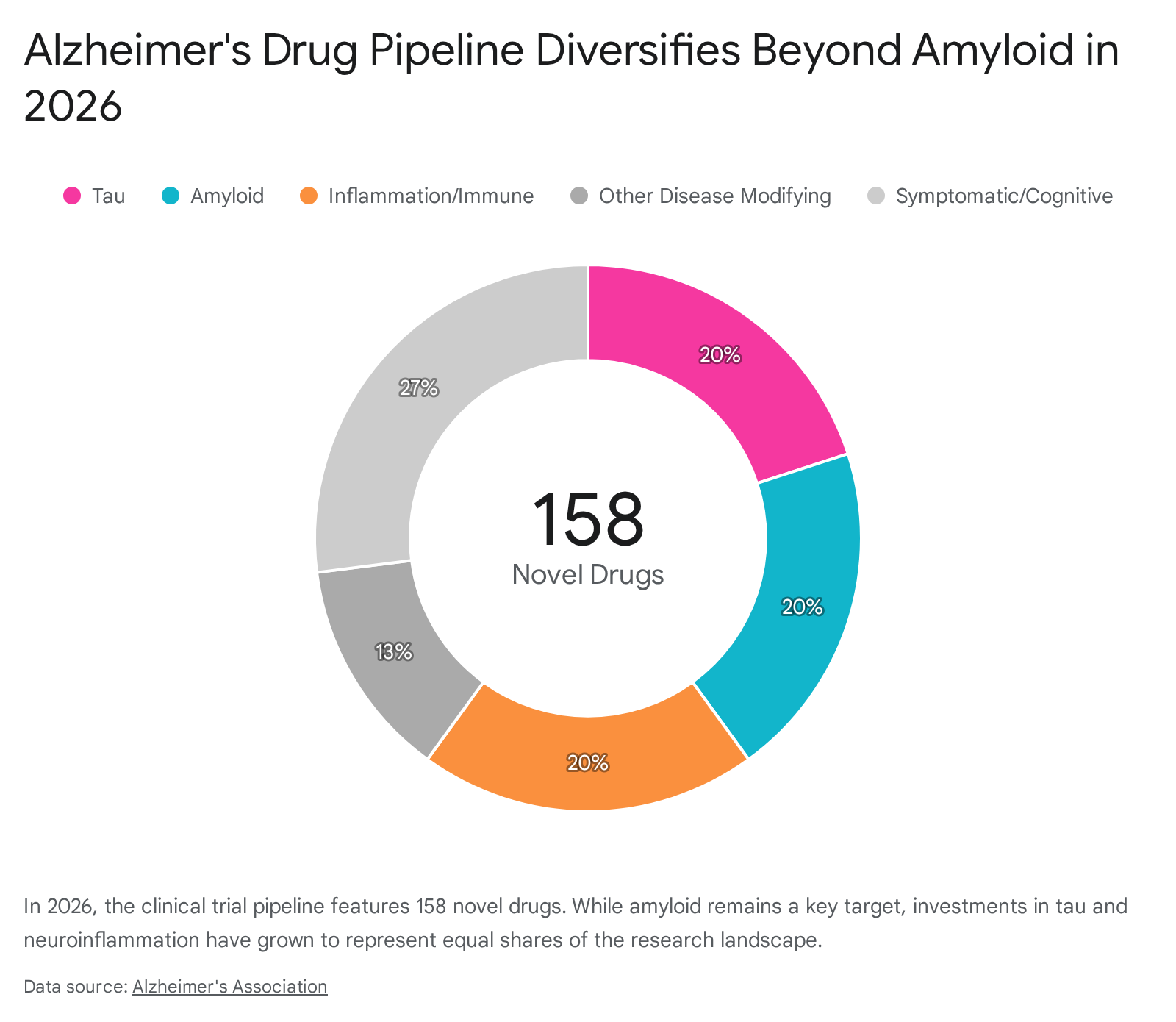
Financial analysts estimate that tau-focused research now commands approximately 31% of the total financial investment in the Alzheimer's pipeline 6. This massive reallocation of capital and clinical resources is why multiple industry analysts, key opinion leaders, and neurodegeneration researchers have officially dubbed 2026 "the year of tau" 479. The field is no longer looking for a single silver bullet; it is exploring complex, multi-modal interventions.
The intense anticipation surrounding 2026 is driven by a convergence of major data readouts across the competitive landscape. Pharmaceutical companies are attacking tau from multiple angles, testing everything from traditional monoclonal antibodies to cutting-edge genetic silencing therapies.
| Drug Candidate | Sponsoring Company | Therapeutic Modality | Primary Target / Mechanism | 2026 Clinical Status |
|---|---|---|---|---|
| Diranersen (BIIB080) | Biogen | Antisense Oligonucleotide (ASO) | MAPT mRNA reduction | Phase 2 (CELIA) top-line results released May 2026; advancing to Phase 3 468. |
| ARO-MAPT | Arrowhead Pharmaceuticals | RNA interference (siRNA) | MAPT mRNA knockdown | Phase 1/2a initial data expected H2 2026; testing subcutaneous delivery 47. |
| Etalanetug (E2814) | Eisai | Monoclonal Antibody | MTBR tau clearance | Advancing in Phase 2/3 combination trials with lecanemab 3. |
| VY1706 | Voyager Therapeutics | Gene Therapy | Tau silencing | First-in-human dosing expected H2 2026 following successful IND clearance 91210. |
| Posdinemab | Johnson & Johnson (Janssen) | Monoclonal Antibody | Extracellular tau spread | Phase 2b failed to slow clinical decline; program widely considered terminated 911. |
| ASN51 | Asceneuron | Small Molecule (OGA Inhibitor) | Prevention of tau aggregation | Phase 2 trial halted in early 2025/2026 due to strategic realignment 121314. |
| LY3372689 | Eli Lilly | Small Molecule (OGA Inhibitor) | Prevention of tau aggregation | Phase 2 trial failed to meet primary cognitive endpoints 1214. |
Genetic Silencing: Taking a "Sledgehammer" to Tau Production
The most highly anticipated and closely watched tau data of 2026 belongs to the gene-silencing category. Traditional methods of targeting tau, such as antibodies and small molecule drugs, have historically struggled to achieve meaningful clinical results because they face a massive physical barrier: tau neurofibrillary tangles form intracellularly, meaning they are locked inside the neurons themselves 415. Antibodies are large proteins that have immense difficulty crossing cell membranes to reach these toxic aggregates.
To bypass this cellular barrier, companies are utilizing advanced genetic technologies - specifically RNA interference (siRNA) and antisense oligonucleotides (ASOs) - to target tau at its absolute biological source. Rather than trying to clean up the tau tangles after they have formed, these therapies act upstream. They bind to and degrade the messenger RNA (mRNA) that carries the genetic instructions telling the cell to produce tau in the first place 4. By destroying the blueprint, the cell stops manufacturing the protein, drastically reducing the total pool of tau available to misfold and aggregate 415. Analysts frequently liken this mechanism to taking a "sledgehammer" to tau pathology, compared to the "chisel" of traditional antibodies 4.
Biogen's Diranersen (BIIB080) Phase 2 Breakthrough
The validation of the gene-silencing approach arrived in May 2026, when Biogen released highly anticipated top-line results from its Phase 2 CELIA trial for diranersen (formerly known as BIIB080) 68. Granted Fast Track designation by the FDA, diranersen is a tau-targeting ASO administered via intrathecal injection (directly into the spinal canal) to bypass the blood-brain barrier 46.
The Phase 2 trial enrolled 416 patients with mild cognitive impairment or early-stage Alzheimer's disease to test multiple dosing levels 28. The results were complex, fascinating, and largely viewed as a massive breakthrough for the field. On a purely biological level, diranersen performed exceptionally well. The drug achieved roughly a 60% reduction in soluble tau protein in cerebrospinal fluid (CSF), and PET scans confirmed robust reductions of tau pathology across multiple brain regions compared to baseline 246916.
However, the trial formally missed its primary endpoint because it failed to demonstrate a standard dose-response curve. In pharmacology, researchers typically expect higher doses of a drug to produce stronger clinical benefits. Surprisingly, patients receiving the lowest doses of diranersen showed significantly better cognitive outcomes and a slower rate of clinical decline than those on the higher doses 2816. While scientists are still working to understand this unusual dose-response pattern, the overarching signal was undeniably positive. The drug proved it could safely and significantly reduce tau in the human brain while simultaneously slowing memory loss 26. Based on these encouraging metrics, Biogen immediately announced plans to advance diranersen into massive global Phase 3 trials, cementing it as a leading candidate in the neurodegeneration space 268.
Arrowhead's ARO-MAPT and the Subcutaneous Revolution
While Biogen proved that tau-silencing works, the intrathecal administration of diranersen - requiring a lumbar puncture into the spine - presents significant logistical challenges for widespread commercial adoption in aging populations. Consequently, the industry is closely monitoring Arrowhead Pharmaceuticals, which is developing a competing tau-silencing drug called ARO-MAPT 47.
ARO-MAPT is an investigational RNA interference (siRNA) therapeutic that achieves the same mRNA knockdown as Biogen's drug but utilizes a novel subcutaneous delivery mechanism 47. Arrowhead has engineered the drug to be injected just under the skin, much like an insulin pen or common weight-loss medications. In preclinical non-human primate studies, this subcutaneous delivery achieved highly translatable and staggering results: a 70 - 80% knockdown of MAPT mRNA across all brain regions, including difficult-to-reach deep brain structures, and up to an 85% knockdown in the cortex 7. When translated to human equivalents, this suggests ARO-MAPT could achieve a 40 - 55% reduction in CSF total tau via a simple injection 7.
Arrowhead is currently conducting a Phase 1/2a trial in 64 healthy volunteers and 48 patients with early Alzheimer's disease, with initial human data expected in the second half of 2026 7. Industry analysts suggest that Arrowhead does not need to cure Alzheimer's outright in this early trial; it simply needs to prove that its subcutaneous delivery system works safely in humans 7. If ARO-MAPT successfully demonstrates robust tau knockdown without the need for spinal injections, it will represent a monumental shift in patient accessibility. Financial models indicate that positive data in late 2026 could validate the platform to such an extent that Arrowhead becomes a prime strategic acquisition target, with estimated Stage 1 acquisition valuations ranging from $55 billion to $90 billion - roughly six to nine times its pre-readout market capitalization 20.
Other significant players in the genetic silencing arena include Alnylam, which is advancing its own siRNA therapies (mivelsiran and ALN-5288), and Voyager Therapeutics, which recently completed toxicology studies for its tau-silencing gene therapy, VY1706, and expects to achieve first-in-human dosing in the second half of 2026 491210.
The "Chisel" Approach: Antibodies and Small Molecules Face Headwinds
While genetic silencing has dominated the 2026 narrative, other traditional modalities for targeting tau have faced severe headwinds, forcing the industry to reassess its strategies.
The Disappointment of Posdinemab
The difficulty of using monoclonal antibodies to clear intracellular tau was starkly highlighted by the failure of Johnson & Johnson's (Janssen) highly anticipated anti-tau drug, posdinemab 911. Posdinemab was designed to bind to tau proteins that had escaped dead neurons, theoretically preventing them from spreading to and infecting neighboring healthy cells.
In a robust Phase 2b trial for early Alzheimer's disease, posdinemab completely failed to meet its primary clinical endpoint. After 104 weeks of treatment, there was no statistically significant difference between the drug and a placebo in slowing clinical decline, as measured by the integrated Alzheimer's Disease Rating Scale for Mild Cognitive Impairment (iADRS-MCI) 11.
The tau-PET imaging data from the trial provided a fascinating, albeit disappointing, biological explanation. The scans showed that while posdinemab successfully slowed the increase of neurofibrillary tangles in regions of the brain that already had a high burden of tau, it failed to prevent the spread of tau into tau-naive regions of the brain 11. The drug essentially contained the fire where it was already burning but failed to stop the sparks from igniting new areas. Given the lack of clinical benefit, J&J terminated the posdinemab program, leading analysts to question the viability of standalone tau antibodies in late-stage trials 911.
Eisai's Etalanetug Offers Antibody Hope
Despite the posdinemab setback, researchers have not entirely abandoned tau antibodies. The key to success may lie in targeting specific, highly toxic fragments of the tau protein rather than the whole molecule. Eisai is currently advancing etalanetug (E2814), an anti-tau antibody specifically engineered to target the microtubule-binding region (MTBR) of tau 3.
Preliminary data has been highly encouraging, showing that etalanetug reduced CSF MTBR-tau243 levels by 75 - 89% in dominantly inherited Alzheimer's disease while stabilizing tau-PET signals 3. Rather than testing it as a standalone therapy, Eisai has moved etalanetug into massive Phase 2 and Phase 3 combination trials, pairing it directly with their approved anti-amyloid drug, lecanemab, in hopes of achieving a synergistic effect 3.
The Stumbling of OGA Inhibitors
Another highly anticipated class of tau drugs, O-GlcNAcase (OGA) inhibitors, has also suffered major defeats in the lead-up to 2026. OGA inhibitors are oral small molecules designed to interfere with the post-translational modification of tau. In healthy brains, sugar molecules (O-GlcNAc) attach to tau to help keep it stable and prevent it from tangling 1722. OGA is the enzyme responsible for removing these protective sugars. Therefore, OGA inhibitors are designed to block the enzyme, theoretically keeping tau glycosylated, stable, and unable to form toxic aggregates 1722.
Despite the elegant biology, clinical reality has been harsh. In August 2024, pharmaceutical giant Eli Lilly disclosed that its oral OGA inhibitor, LY3372689, failed to meet its primary cognitive endpoints in a Phase 2 trial for early symptomatic Alzheimer's disease 1214.
The ripple effects of Lilly's failure were immediate. Swiss biotech Asceneuron had recently secured a massive $100 million Series C funding round - led by Novo Holdings - to advance its own next-generation oral OGA inhibitor, ASN51, into a Phase 2 trial involving 123 patients 1213. The drug had shown promise in Phase 1 trials, demonstrating complete uptake in the brain and high enzyme binding 1223. However, in early 2025/2026, just months after the trial kicked off, Asceneuron abruptly halted the study. In updates to federal clinical trial databases, the company cited a "strategic decision" to terminate the program, adding another massive blow to the OGA inhibitor drug class 121323.
While the OGA mechanism struggles, other small molecules are advancing. Oligomerix recently completed a Phase 1a study for OLX-07010, an oral small molecule designed to directly inhibit tau self-association, showing a favorable safety profile in healthy volunteers 18. Furthermore, LM11A-31, a small molecule that modulates the p75 neurotrophin receptor to block tau acetylation and protect synapses, has shown enough biomarker promise in early trials to advance toward Phase 3 testing for progressive supranuclear palsy, a primary tauopathy 816.
Synergy: The Era of Combination Therapies
As researchers analyze the mixed results of standalone tau and amyloid therapies, a new medical consensus has rapidly formed in 2026: Alzheimer's disease is too complex to be cured by a single biological target. Future treatment protocols will likely mirror the approach used in oncology and HIV, utilizing a cocktail of therapies that simultaneously clear amyloid, halt tau spread, and suppress neuroinflammation 46.
The trailblazer for this new paradigm is the Alzheimer's Tau Platform (ATP) clinical trial. Co-led by researchers at UCSF and Harvard Medical School, and funded by a massive $151 million grant from the National Institute on Aging, the ATP trial is actively recruiting 900 participants 19. The study represents the next era in Alzheimer's treatment by formally evaluating the synergistic effects of combination therapy 19. Patients in the trial receive a baseline anti-amyloid therapy (such as lecanemab) to clear the existing "trash" from the brain, combined with one or two distinct anti-tau therapies designed to repair the internal "railway tracks" of the neurons 419. Researchers believe this multi-pronged approach will yield compounding clinical benefits, vastly outperforming the efficacy of either drug class administered in isolation.
The Next Generation of Amyloid Clearance
Even as tau dominates the headlines in 2026, amyloid-targeted therapies are evolving at a breakneck pace. The first-generation FDA-approved drugs - Leqembi (lecanemab) and Kisunla (donanemab) - proved that clearing amyloid plaques slows cognitive decline by roughly 27% to 35% 1920. However, these early drugs are heavily burdened by clinical logistics. They require patients to visit clinics for biweekly or monthly intravenous (IV) infusions, and they carry a significant risk of Amyloid-Related Imaging Abnormalities (ARIA) - a dangerous side effect involving brain swelling (ARIA-E) and micro-bleeding (ARIA-H) 202122.
In 2026, the focus has shifted entirely to improving patient convenience and mitigating the risk of ARIA through subcutaneous delivery and advanced blood-brain barrier transport mechanisms.
Moving from IV Infusions to Subcutaneous Injections
To alleviate the burden of hospital infusions, the FDA is currently reviewing a supplemental biologics license application from Eisai and Biogen for a weekly subcutaneous (SC) autoinjector formulation of Leqembi. The agency granted the application priority review, with a target action date set for mid-2026 32930.
Simultaneously, Eli Lilly is advancing remternetug, a next-generation monoclonal antibody positioned as the direct successor to Kisunla 2332. Like its predecessor, remternetug targets a specific pyroglutamated form of amyloid-beta (N3pG) 2324. However, remternetug has been engineered from the ground up for subcutaneous delivery. In a recently presented analysis from the massive Phase 3 TRAILRUNNER-ALZ 1 trial, which enrolled over 1,600 participants, researchers demonstrated that self-administration of remternetug via an autoinjector is highly feasible and well-tolerated by patients in the early stages of Alzheimer's 24252627. The TRAILRUNNER-ALZ 1 trial is expected to reach primary completion in early to mid-2026, with analysts anticipating an FDA submission shortly thereafter 24252628.
Roche's Trontinemab and the Blood-Brain Barrier "Shuttle"
While subcutaneous injections solve the convenience problem, they do not inherently solve the ARIA problem. ARIA occurs because traditional antibodies bind heavily to amyloid deposits coating the walls of the large cerebral arteries, causing inflammation and fluid leakage 22. Furthermore, traditional antibodies are massive proteins with poor permeability; less than 1% of an administered IV dose naturally crosses the blood-brain barrier (BBB) to reach the deep brain tissue where plaques reside 2930.
Roche has engineered a groundbreaking solution with its investigational drug, trontinemab. Trontinemab marries a standard anti-amyloid antibody to a proprietary "Brainshuttle" Fab fragment 2230. This shuttle module acts like a biological key, binding directly to transferrin receptors that naturally exist on the endothelial cells of the blood-brain barrier 2230. When the cell internalizes the receptor, it actively ferries the massive trontinemab molecule across the barrier and deposits it directly into the central nervous system 2230.
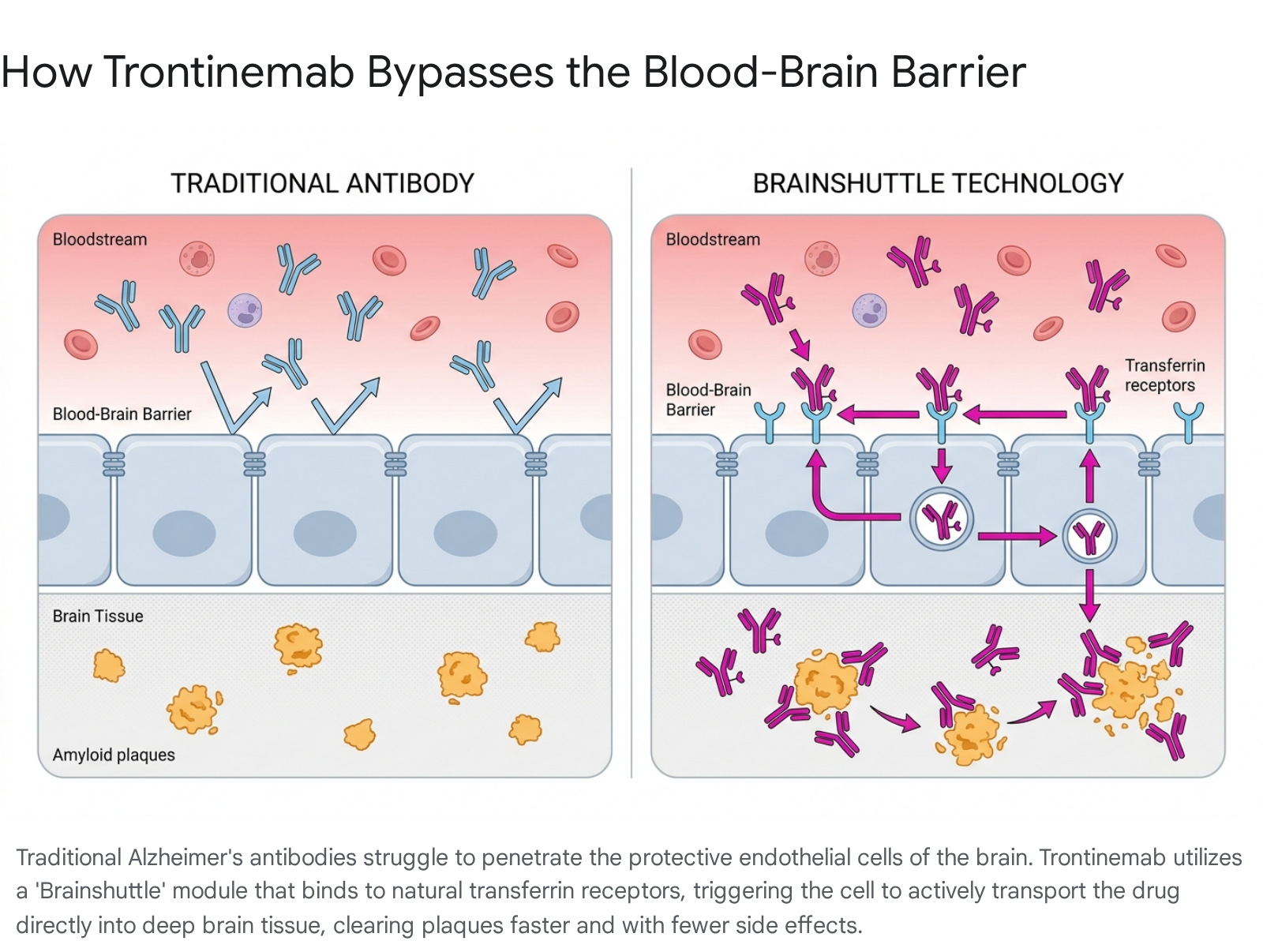
The clinical data generated by this mechanism is unprecedented. At the Clinical Trials on Alzheimer's Disease (CTAD) conference, Roche presented Phase 1b/2a data showing that a staggering 92% of patients treated with the highest dose of trontinemab achieved amyloid levels below the 24-centiloid threshold - rendering them completely "amyloid-negative" - in just 28 weeks 293031. Furthermore, because the drug enters the brain through capillary transcytosis rather than pooling in the large arteries, the rate of ARIA-E (brain swelling) remained under 5%, compared to the 12 - 16% rates seen with older drugs 222932. Based on these stellar safety and efficacy profiles, Roche has accelerated trontinemab into two massive Phase 3 trials (TRONTIER 1 and 2), aiming to enroll 1,600 participants across 18 countries 293031.
Repurposing Drugs and Exploring Novel Targets
Beyond the dominant amyloid and tau pathways, the 2026 pipeline features several large-scale trials investigating whether existing medications can be repurposed to combat the neuroinflammation and metabolic dysfunction associated with Alzheimer's.
One of the most highly anticipated non-traditional readouts of 2026 comes from the POLARIS-AD trial, a Phase 3 global study evaluating AR1001 (mirodenafil) 242533. Originally approved in South Korea as an oral pill for erectile dysfunction, observational data suggested that patients taking similar PDE5 inhibitors had significantly lower rates of Alzheimer's 25. Researchers hypothesize that AR1001's ability to profoundly improve cerebral blood flow protects delicate neurons from the toxic effects of amyloid oligomers 242533. The trial has enrolled over 1,500 participants across 13 countries, with topline results expected to shape alternative treatment protocols in 2026 2433.
Similarly, Annovis Bio is advancing buntanetap, a novel oral therapy that eschews targeting a single protein. Instead, buntanetap limits the cellular translation of multiple neurotoxic proteins simultaneously. The Phase 3 trial features an innovative dual-readout design, with a 6-month symptomatic analysis expected in late 2026, followed by an 18-month assessment of long-term disease modification 23243334.
However, the strategy of repurposing metabolic drugs has not been universally successful. Early in 2026, researchers reported the failure of a massive Phase 3 trial testing oral semaglutide (the GLP-1 agonist behind diabetes and weight-loss drugs like Ozempic and Wegovy) in early-stage Alzheimer's patients. Despite immense optimism that reducing systemic and metabolic inflammation would protect cognitive function, the trial showed no significant benefit over placebo 2535.
The Diagnostic Revolution Powering 2026 Clinical Trials
The sheer volume and speed of the 192 clinical trials operating in 2026 would be impossible without a quiet, parallel revolution in diagnostics. Historically, enrolling a single patient in an Alzheimer's trial was a grueling, expensive process. It required confirming the presence of amyloid or tau pathology using radioactive PET scans - which cost thousands of dollars and are geographically limited - or via painful, invasive lumbar punctures to extract cerebrospinal fluid 2330.
The Era of Blood-Based Biomarkers
Today, highly accurate blood tests have completely transformed the logistical landscape. In May 2025, the FDA cleared the Lumipulse G pTau217/β-Amyloid 1-42 Plasma Ratio test as the first in vitro diagnostic to aid in the assessment of Alzheimer's disease in symptomatic patients 3.
By measuring the precise ratio of phosphorylated tau-217 (pTau217) to amyloid-beta 42 in the blood, the test acts as a highly sensitive mirror for brain pathology. In clinical validation, the blood test demonstrated a 92% positive concordance rate and a 97% negative concordance rate when compared directly to traditional PET scans or CSF assays 3. Consequently, pharmaceutical companies can now pre-screen thousands of potential trial participants cheaply and efficiently with a simple blood draw, reserving expensive PET scans only for final confirmation or for the 20% of patients who fall into an "indeterminate" range 330.
Advanced PET Imaging and Spatial Distribution
When PET scans are required, the technology has also vastly improved. A recent head-to-head comparative study published in The Lancet demonstrated that a next-generation radiotracer, F-18 MK-6240, can detect tau neurofibrillary tangles more than twice as often in cognitively unimpaired patients when compared to the older clinical standard, F-18 flortaucipir 2. Because the new tracer binds to tau tangles with approximately sixfold greater affinity, clinicians can now identify patients on the Alzheimer's trajectory years, or even decades, before severe memory loss begins, allowing for much earlier therapeutic intervention 2.
Furthermore, researchers are moving beyond simply measuring how much tau is in the brain, to analyzing how it is physically distributed. At the 2026 Global Tau Conference, bioinformatics researchers presented groundbreaking data utilizing "Shannon entropy" - a mathematical metric borrowed from information and physics theory - to quantify the spatial organization of tau on PET scans 36. By analyzing over 1,500 scans, they discovered that patients with highly concentrated, focal tau patterns suffered significantly worse cognitive outcomes and faster future accumulation than those with widely dispersed tau, even when the overall volume of tau was identical 36. This discovery opens entirely new avenues for patient stratification, allowing doctors to predict individual disease trajectories with unprecedented accuracy.
Scaling the Search: Global Trial Networks and Cohorts
The ultimate bottleneck in Alzheimer's drug development is the acquisition of eligible, willing human participants 3738. To process the 158 novel drugs currently in the 2026 pipeline, the medical community relies on massive, internationally coordinated trial registries 53738.
In the West, networks like the ALZ-NET registry, the Alzheimer's Prevention Registry, and the DIAN-TU (Dominantly Inherited Alzheimer Network) have compiled databases of hundreds of thousands of biomarker-screened volunteers 383940. However, the most profound shift in global trial logistics in 2026 is the rapid emergence and integration of the CTAD China Clinical Trial Center Network.
China possesses the world's largest population of dementia patients. Approximately 15 million citizens are currently affected, and due to rapid demographic aging, that number is projected to surge past 66 million by the year 2050 5051. Recognizing the impending societal crisis, the Chinese government launched state-led initiatives aiming to conquer the disease by 2030, establishing a massive clinical network that links 32 elite research hospitals and universities 5051.
These unified centers have amassed community cohorts of staggering size. For instance, Fudan University alone tracks a community cohort of over 20,000 deeply characterized participants, generating multimodal biomarker and genetic data at an unprecedented scale 5152. Western pharmaceutical giants, including Eli Lilly, Eisai, and Roche, are now actively leveraging this network to run their global Phase 3 trials 51. Chinese regulations mandate that to receive domestic drug approval, global trials must include at least 10% Chinese participation 51. By tapping into these massive, trial-ready cohorts, international drug developers are significantly accelerating the enrollment timelines for the next generation of Alzheimer's therapies.
Bottom line
The year 2026 represents a historic inflection point in Alzheimer's disease research, characterized by a massive reallocation of resources toward targeting the tau protein. While clearing amyloid plaques remains a critical, foundational step in treatment, highly anticipated clinical trial readouts for gene-silencing drugs like diranersen and ARO-MAPT offer the medical community its best hope yet for actively halting cognitive decline at its biological source. However, the path forward remains highly complex; recent failures of standalone tau antibodies and OGA inhibitors prove that defeating this disease will ultimately require precision combination therapies, aided by advanced subcutaneous delivery systems, BBB-penetrating shuttles, and highly accurate blood diagnostics.