
What Emotional Intelligence Is and How to Improve It
Emotional intelligence is the capacity to accurately perceive, understand, and manage both your own emotions and the emotions of others. Extensive scientific research confirms that while baseline emotional processing is tied to innate personality traits, emotional intelligence acts as a highly malleable skill set that can be significantly improved through targeted practice. Developing these capabilities leads to measurably better stress management, stronger interpersonal relationships, and enhanced professional success.
Decoding Emotional Intelligence: Beyond the IQ Myth
For much of the 20th century, cognitive intelligence (IQ) was viewed as the singular metric of human capability and the primary predictor of success. Schools, militaries, and corporations designed their hierarchies around standardized logic and reasoning tests. However, psychologists consistently observed a puzzling phenomenon: 70% of the time, individuals with average cognitive intelligence outperformed those with exceptionally high IQs in leadership, teamwork, and overall life satisfaction 1.
This missing link was formalized in 1990 when psychologists Peter Salovey and John D. Mayer introduced the concept of "emotional intelligence" (EI) to the academic literature. They defined it as a subset of social intelligence involving the ability to monitor feelings, discriminate among them, and use this information to guide thinking and action 123. The concept then exploded into mainstream consciousness in 1995 with Daniel Goleman's bestselling book, which controversially argued that emotional intelligence could matter more than IQ in the workplace 124.
Today, emotional intelligence is not viewed as a single, uniform trait, but rather a complex constellation of abilities and competencies. Researchers generally divide the study of emotional intelligence into three foundational frameworks, each emphasizing a different aspect of human psychology.
The Big Three: Core Models of Emotional Intelligence
The scientific and corporate communities approach emotional intelligence through different lenses, generally categorized as "ability" models and "mixed" models 56.
The Mayer-Salovey-Caruso Ability Model
Developed by John Mayer, Peter Salovey, and David Caruso, this framework treats emotional intelligence strictly as a cognitive ability - a "hot intelligence" analogous to verbal or spatial reasoning 57. In this model, emotions are not irrational disruptions to be ignored; they are highly structured data carrying adaptive signals that inform judgment, attention, and memory. The model strictly separates emotional processing from personality traits like optimism or sociability, focusing on four distinct branches 256: 1. Perceiving Emotions: The foundational ability to identify emotions in physical states, facial expressions, vocal tones, and environmental cues 56. Accurate perception is the prerequisite for all other emotional processing. 2. Facilitating Thought: The capacity to generate and use emotions to enhance cognitive tasks. For example, recognizing that a slightly anxious state can help you hyper-focus on finding errors in a financial report, or that a positive mood enhances creative brainstorming 56. 3. Understanding Emotions: The cognitive ability to comprehend emotional language, trace the complex progression of emotions (e.g., how irritation evolves into anger), and understand the nuanced causes behind emotional shifts 56. 4. Managing Emotions: The highest-order skill, involving the ability to stay open to feelings and consciously regulate them to promote personal and intellectual growth, rather than acting impulsively 56.
Daniel Goleman's Performance-Based Competency Model
Goleman's "mixed" model integrates emotional abilities with learned behaviors and personality traits that directly drive workplace performance 7. Goleman posited that raw emotional intelligence provides the bedrock for "emotional competencies" that dictate professional success 7. His framework is heavily utilized in corporate leadership training and encompasses four domains containing 12 specific, learnable competencies 16: * Self-Awareness: Emotional self-awareness and an accurate, ongoing self-assessment. * Self-Management: Emotional self-control, adaptability, achievement orientation, and a resilient positive outlook. * Social Awareness: Empathy and organizational awareness (the ability to read the emotional currents and power dynamics of a group). * Relationship Management: Conflict management, coaching and mentoring, influence, teamwork, and inspirational leadership.
Reuven Bar-On's Emotional-Social Intelligence Model
Reuven Bar-On conceptualized emotional intelligence as a cross-section of interrelated emotional and social competencies that determine how well individuals understand themselves, relate to others, and cope with daily demands 56. His model focuses heavily on psychological well-being and adaptation, broken down into five meta-factors: Intrapersonal (self-expression), Interpersonal (empathy and social responsibility), Stress Management (tolerance and flexibility), Adaptability (problem-solving and reality testing), and General Mood 58.
Comparing the Major Frameworks
| Feature | Mayer-Salovey-Caruso (Ability) | Daniel Goleman (Performance) | Reuven Bar-On (Emotional-Social) |
|---|---|---|---|
| Core Definition | A cognitive ability to process and reason with emotional information. | A collection of learned competencies that drive professional and leadership success. | A set of traits and skills determining psychological well-being and stress adaptation. |
| Model Type | Ability Model (Strictly intelligence-based). | Mixed Model (Blends abilities with workplace behaviors). | Mixed Model (Blends abilities with personality traits). |
| Overlap with Personality | Low overlap with Big Five personality traits; measures a distinct cognitive skill. | High overlap with Big Five traits (especially extraversion and agreeableness). | High overlap with Big Five traits and general psychological well-being metrics. |
| Standard Assessment | MSCEIT (Performance tasks with objective correct/incorrect answers). | ESCI (Emotional and Social Competency Inventory; 360-degree feedback). | EQ-i 2.0 (Self-report questionnaire). |
Emotional Intelligence vs. IQ: What's the Difference?
The debate over the relative importance of Intelligence Quotient (IQ) versus Emotional Quotient (EQ) often misses a crucial point: they are entirely different, complementary operating systems. IQ measures a person's working memory, analytical thinking, and logical reasoning - the capacity to acquire external knowledge and apply it to abstract problems 1112. EQ measures a person's ability to navigate internal and interpersonal data, such as reading nonverbal cues, regulating physiological stress responses, and navigating complex social hierarchies 1112.
In high-stakes environments, such as healthcare, engineering, or corporate management, IQ gets an individual through the door, but EQ determines their trajectory 13. Consider a scenario where a project falls behind schedule. An employee responding purely with cognitive intelligence (IQ) might analyze the workflow, identify the operational bottleneck, and provide a logical step-by-step fix. This is necessary, but often insufficient. An employee utilizing emotional intelligence (EQ) recognizes that the team is experiencing high levels of frustration and burnout. They regulate their own anxiety about the deadline, offer a supportive listening ear, and then deploy the logical fix in a manner that restores psychological safety and team cohesion 12.
Furthermore, traditional IQ is considered relatively fixed, stabilizing in early adulthood 1114. Emotional intelligence, however, operates like a muscle. Our innate level of EQ gradually rises in our late teens, continues developing through our twenties and thirties, and typically peaks in our mid-fifties 14.
The Measurement Problem: How Do We Test EQ?
If emotional intelligence is a critical skill, measuring it accurately is paramount. However, the scientific community remains divided over the best methodology, leading to a distinct split between "Trait EI" and "Ability EI."
Trait Emotional Intelligence (Self-Report Measures)
Trait EI views emotional intelligence as a cluster of personality traits and self-perceived abilities, typically measured by questionnaires like the Bar-On EQ-i or the Trait Emotional Intelligence Questionnaire (TEIQue) 910. Participants rate themselves on a Likert scale in response to statements like, "I am highly aware of the emotions of others" or "I recover quickly from emotional setbacks."
The glaring flaw with self-report measures is self-perception bias. Research shows a massive discrepancy between how people rate their own emotional intelligence and their actual behavior. For instance, roughly 95% of people believe they possess strong self-awareness, but objective psychological measurements reveal only 10% to 15% genuinely do 17. Furthermore, a phenomenon known as "CEO disease" illustrates that the higher a leader climbs in an organization, the more inaccurately they tend to rate their own emotional behavior, often overestimating their empathy and social awareness 11. Additionally, Trait EI scores correlate heavily with standard personality tests (the Big Five), leading some critics to argue that self-report EQ tests are simply measuring extraversion, emotional stability, and agreeableness under a new branded name 71920.
Ability Emotional Intelligence (Performance Tasks)
To solve the self-report bias, Mayer, Salovey, and Caruso developed the MSCEIT, an objective test that measures "Ability EI." Instead of asking respondents if they think they are good at reading faces, the test presents actual photographs of faces or artistic designs and asks them to identify the correct emotion 712. It requires participants to solve emotionally laden scenarios with objectively scored right and wrong answers, grading them on their actual capacity to facilitate thought and manage complex feelings 722.
Studies comparing the two methods find that they do not correlate highly with one another, suggesting they are measuring different constructs 1314. While self-report measures effectively capture a person's general confidence, subjective well-being, and self-concept, ability-based tools more consistently predict observable behaviors, actual workplace conflict resolution, and cognitive reasoning regarding emotions 1516. The consensus among researchers is that while self-report tests are useful for personal reflection and coaching conversations, ability-based performance tests hold far greater psychometric validity 101517.
Can You Actually Improve Your Emotional Intelligence?
One of the most persistent myths surrounding emotional intelligence is that it is an innate, fixed trait - you are either born a "people person" or you aren't. The scientific literature decisively refutes this. While certain neurological baselines exist (such as the brain's biological reactivity to stress or the density of oxytocin receptors), emotional intelligence is fundamentally a set of learned skills 32818.
What the Latest Meta-Analyses Reveal
Extensive meta-analyses evaluating the effectiveness of emotional intelligence training programs confirm that EI can be intentionally improved across diverse populations, and these improvements stick 1730.
A 2024 meta-analysis encompassing 17 longitudinal studies on healthcare workers - an environment notorious for severe emotional demands and burnout - found that all included studies demonstrated an increase in emotional intelligence following targeted interventions 1920. These gains translated directly to improved resilience, enhanced capacity for patient care, and better interpersonal support among colleagues 19.
However, researchers note that not all training is created equal. The most effective programs share specific, rigorous parameters: * Duration and Pacing: Emotional intelligence cannot be learned in a single afternoon seminar. A systematic review of educational interventions for medical and nursing students found that the greatest improvements occurred when training was delivered over 10 to 15 hours, spaced out across 8 to 12 weeks 21. This allows time for neural pathways to adapt and for participants to practice skills in real-world environments. * Experiential Learning: Traditional lectures filled with data are largely ineffective, as they often trigger defensiveness and fail to engage emotional processing centers 22. Effective programs prioritize group-based activities, role-playing, mindfulness practices, active listening exercises, and peer feedback 21222324. * Model Alignment: Meta-analytic data shows that training programs based on "ability" models (focusing on the cognitive processing of emotion) yield significantly better and longer-lasting results than those based strictly on personality trait models 17.
Evidence-Based Frameworks for Emotional Growth
Because emotional intelligence is a broad concept, psychologists have developed specific, actionable frameworks to help individuals train these skills in daily life. Two of the most highly regarded evidence-based methodologies are the RULER framework and Emotional Agility.
The RULER Approach
Developed by Dr. Marc Brackett at the Yale Center for Emotional Intelligence, the RULER framework is an evidence-based approach used globally to teach emotional literacy in both schools and corporate environments.
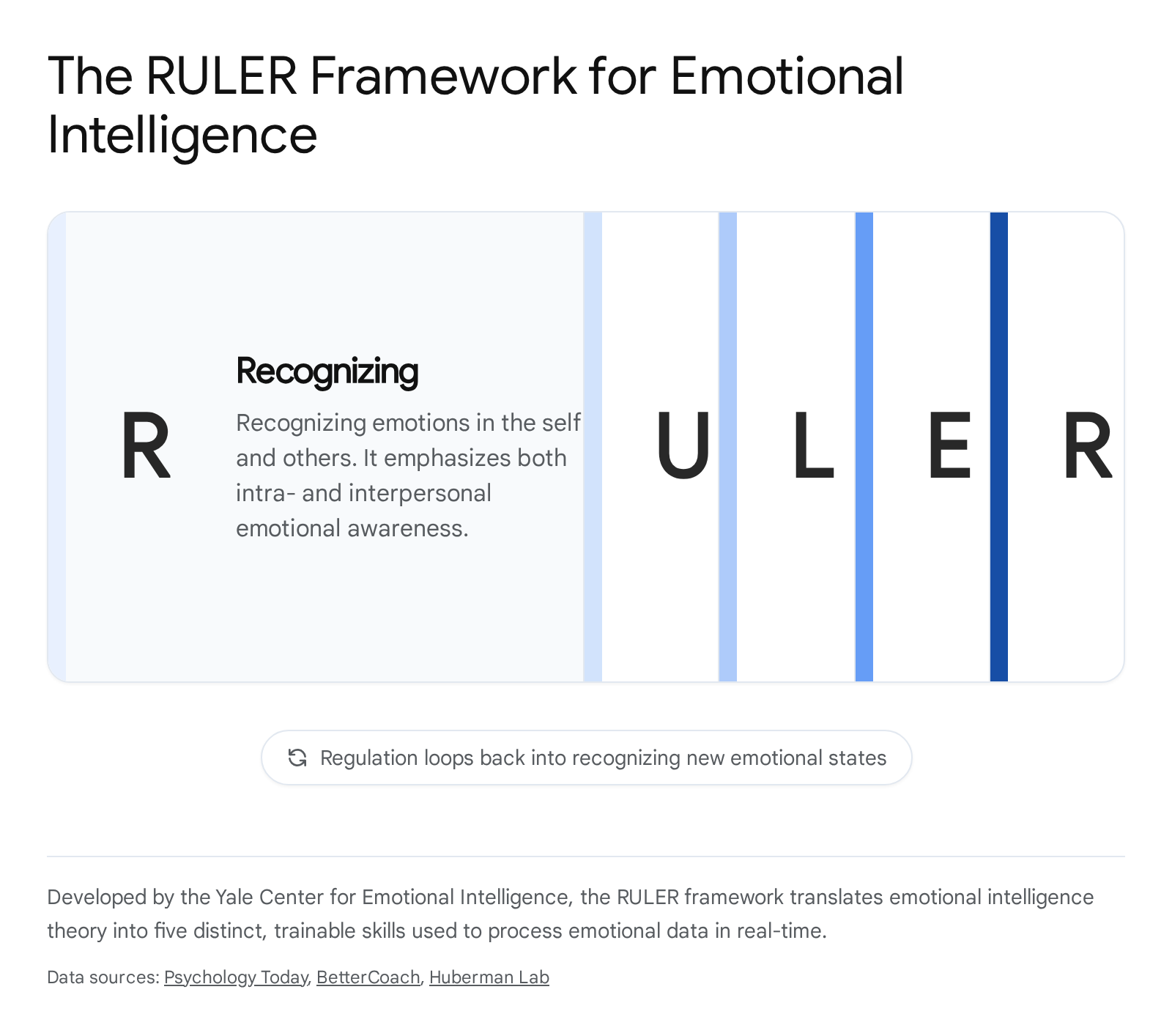
It breaks the abstract concept of emotional processing into five sequential, actionable steps 33738:
The RULER process moves from raw somatic perception to complex cognitive management. For instance, an individual might first Recognize a tightening in their chest, Understand it is caused by an impending deadline, Label it specifically as "anxiety" rather than general "stress," Express it appropriately by asking a colleague for help, and Regulate it through deep breathing to return to baseline performance 33738.
Emotional Agility
Harvard Medical School psychologist Susan David introduced the concept of "Emotional Agility," which focuses heavily on the regulation and management branches of EI. Neuroscience reveals that the primal, emotional centers of the brain activate 195 milliseconds faster than the rational, thinking brain 25. Because of this delay, impulse easily overtakes intention.
Emotional agility is the practice of creating distance between a stimulus and a response. Many individuals respond to difficult emotions by either bottling them up (suppression) or brooding over them (rumination) 41. Emotionally agile individuals instead "unhook" from the emotion. By reframing internal language - shifting from "I am angry" (which identifies the entire self as the emotion) to "I am noticing that I feel anger" - individuals can view their emotions as data rather than directives 42. This objective distance allows them to step out of the emotional struggle and act in alignment with their core values, rather than reacting blindly to a 195-millisecond impulse 2542.
Fact vs. Fad: Debunking Common EQ Myths
As emotional intelligence became a massive corporate buzzword, it spawned a cottage industry of pseudoscientific hacks and dangerous misconceptions. Examining the empirical evidence helps separate scientifically validated emotional skills from popular fads.
Myth 1: High EQ Means Being "Nice" and Empathetic
A pervasive misconception is that high emotional intelligence equates to being endlessly agreeable, compliant, or an indiscriminate people-pleaser 1443. In reality, individuals who constantly try to please others by acting against their own best interests are at a higher risk for burnout and possess low emotional self-regulation 43.
True empathy involves understanding what makes someone tick and recognizing their emotional state; it does not require agreeing with them or shielding them from necessary reality 14. High emotional intelligence frequently requires engaging in highly unpleasant conversations, establishing firm boundaries, and delivering difficult feedback 4344. An emotionally intelligent leader uses their awareness to navigate a tough conversation constructively, not to avoid the conflict entirely 1.
Myth 2: "Venting" Reduces Emotional Distress
Conventional wisdom suggests that venting negative emotions (like anger or frustration) acts as a pressure release valve, providing catharsis and clearing the mind. Psychological research actively contradicts this. Simply venting without attempting cognitive reappraisal acts as an avoidance-oriented coping strategy 4526. Rehearsing a grievance often reinforces the negative emotion, amplifying the neural pathways associated with anger and prolonging the physiological stress response 4547. Emotionally intelligent individuals utilize active emotion-regulation techniques - such as mindfulness, cognitive restructuring, or active problem-solving - which actually de-escalate the nervous system rather than keeping it trapped in a loop of frustration 326.
Myth 3: "Power Poses" Are a Biological Shortcut to Confidence
In the early 2010s, "power posing" - the idea that standing in expansive, dominant postures for two minutes could drastically alter hormones and behavior - gained immense popularity as a quick hack for emotional confidence and stress management 2749. Initial studies claimed these poses physically increased testosterone and decreased the stress hormone cortisol 27.
However, subsequent large-scale replication attempts across the scientific community failed to confirm these hormonal effects 28. While adopting an open posture can lead to a temporary, subjective feeling of confidence through embodied cognition, it is not a biological shortcut to true emotional intelligence. Real emotional presence and somatic awareness require deeper cognitive work to align one's inner emotional life with their outward physical expression. Treating posture as a standalone hack is merely a "fake it 'til you make it" illusion that crumbles under sustained pressure 4928.
Myth 4: Women Are Naturally More Emotionally Intelligent
It is widely assumed that women possess innately higher emotional intelligence than men. Broadly speaking, men and women have roughly equal overall levels of emotional intelligence 14. However, differences emerge in specific sub-competencies due to distinct gender socialization. Research indicates that women generally score higher on empathy and interpersonal relationship skills, while men frequently score higher on self-reliance, straightforwardness, and stress tolerance 14. These variances are largely attributed to cultural conditioning and societal expectations regarding emotional expression, rather than innate biological superiority 14.
The Global Lens: Cross-Cultural Differences in EQ
A significant challenge in emotional intelligence research is that much of the foundational theory and assessment tools - including the MSCEIT and EQ-i - were developed in Western, educated, industrialized democracies 2229. Emotional intelligence is deeply contextual; what constitutes an "intelligent" emotional response in a New York boardroom may be viewed as entirely inappropriate in a Tokyo office.
Arousal Levels: Western Expression vs. Eastern Restraint
Research demonstrates profound physiological and behavioral differences in the types of emotions preferred and expressed across cultures. In individualistic Western cultures, high-arousal emotions (such as excitement, enthusiasm, and assertive anger) are highly valued and promoted. These cultures encourage open emotional expression and self-assertion as markers of authenticity, competence, and leadership 3031.
Conversely, in collectivist Eastern cultures, low-arousal emotions (such as calmness, serenity, and emotional restraint) are prized. In these societies, adjusting to others, suppressing disruptive individual emotions, and maintaining social harmony are paramount 3132. A leader expressing high-arousal frustration in a Western context might be viewed as passionate and commanding; in an Asian context, that same display may be viewed as a profound lack of emotional regulation and a humiliating loss of "face" 3233.
Individualism, Power Distance, and TEIQue Scores
A massive 2025 meta-analysis examining 176 cross-cultural studies (comprising nearly 68,000 observations) utilizing the Trait Emotional Intelligence Questionnaire (TEIQue) highlighted exactly how national culture influences EQ scores. The analysis found that societies characterized by individualism, low power distance (flatter, more egalitarian hierarchies), and high indulgence tend to report significantly higher baseline levels of Trait EI 9.
However, anthropologists and psychologists caution that this does not mean non-Western cultures are actually less emotionally intelligent. Instead, it suggests that standard, globally exported EQ questionnaires measure an explicitly Western conceptualization of emotional competence 9. In high power-distance or heavily collectivist societies, individuals deliberately and intelligently suppress personal emotional expression to respect hierarchy and maintain group cohesion 9. Scoring low on a Western test of "emotional expression" may actually indicate high emotional attunement to Eastern cultural norms.
Non-Western Relational Frameworks: Guanxi and Ubuntu
Furthermore, non-Western cultures rely on highly sophisticated, indigenous relational frameworks that govern emotional intelligence in ways Western models fail to capture. For example, the concept of Guanxi in Chinese culture requires complex, long-term affective and normative commitments that dictate interpersonal trust, reciprocity, and the saving of "face" 3334. To navigate Guanxi requires an intensely tuned social radar.
Similarly, the philosophy of Ubuntu in Sub-Saharan Africa (roughly translating to "I am because we are") shifts the focus of emotional intelligence entirely away from individual emotional autonomy toward extreme social inclusiveness, tolerance, and communal empathy 575859. In Latin American cultures, Personalismo dictates similar relationship-first emotional dynamics 34. To be truly emotionally intelligent on a global scale requires the cultural agility to adapt to these varying socio-emotional dialects, recognizing that there is no single universal language of emotion 35.
The ROI of Emotional Intelligence in the Future of Work
As we look toward the future, the economic and organizational value of emotional intelligence is accelerating rapidly. As artificial intelligence and machine learning take over routine analytical, data-processing, and purely logical tasks, uniquely human skills are commanding a massive premium. The World Economic Forum lists emotional intelligence, resilience, and self-awareness among the most critical skills for the modern workforce 3662.
The statistics surrounding this shift are stark. Research indicates that emotional intelligence accounts for roughly 58% of overall job performance across all professions 63. Furthermore, 90% of top workplace performers possess better-than-average emotional intelligence, and individuals with high EQ reportedly earn an average of $29,000 more annually than those with low EQ 6364.
The shift to hybrid work environments has only amplified this need. Managing distributed teams requires a higher degree of virtual empathy, active listening, and deliberate relationship-building to prevent employee detachment - which currently affects up to 60% of the global workforce 636566. Organizations with empathetic, emotionally intelligent leaders report 76% higher employee engagement and 61% higher creativity, leading to massively improved retention and revenue growth 63.
Bottom line
Emotional intelligence is an essential, multi-dimensional cognitive and behavioral skillset that dictates how effectively we navigate our internal experiences and interpersonal relationships. Far from being a fixed personality trait or a fleeting management fad, decades of empirical evidence confirm that emotional abilities can be systematically measured and improved through targeted, experiential practice. While debates continue regarding the precise validity of self-report tests versus performance-based assessments - and how Western definitions of EQ apply across global cultures - the fundamental conclusion is clear: investing the effort to understand and regulate your emotions yields massive dividends in psychological resilience, relationship quality, and long-term professional success.