
Proactive emotional fitness
Theoretical Foundations and Evolution
The construct of proactive emotional fitness represents a significant paradigm shift in both clinical psychology and organizational behavior. Historically, the prevailing models of mental health operated on a reactive basis, focusing on symptom management and therapeutic intervention only after the onset of psychological distress or pathology. Proactive emotional fitness, by contrast, conceptualizes psychological well-being through a preventative lens. Drawing a direct parallel to physical fitness, this framework posits that emotional regulation and psychological resilience are not fixed traits but dynamic capacities that require continuous, deliberate cultivation through habit formation, cognitive conditioning, and environmental engagement [2, 30, 88].
The intellectual origins of proactive emotional fitness are deeply entwined with the late-twentieth-century emergence of emotional intelligence (EI) theory. While early models of EI - most notably the ability model proposed by Peter Salovey and John Mayer in 1990 - defined the construct strictly as the cognitive capacity to perceive, appraise, and facilitate thought through emotion [68, 71, 111], subsequent mixed models sought to apply these concepts to leadership and organizational performance. It was within this applied context that Robert K. Cooper and Ayman Sawaf formally introduced the concept of emotional fitness in their 1997 publication, Executive EQ: Emotional Intelligence in Leadership and Organizations [111, 114]. Cooper and Sawaf's "Four Cornerstone Model" categorized emotional intelligence into four distinct pillars: emotional literacy, emotional fitness, emotional depth, and emotional alchemy [69, 115].
Within this foundational framework, emotional literacy provided the baseline vocabulary necessary to identify internal states, while proactive emotional fitness supplied the behavioral endurance required to navigate complex interpersonal stressors without resorting to emotional suppression [114, 115]. Cooper and Sawaf characterized emotional fitness through specific sub-traits, including emotional hardiness, cognitive flexibility, trustworthiness, and the capacity for constructive discontent [111, 115]. This framework suggested that while cognitive insight (intelligence) is necessary for emotional health, it is insufficient without the behavioral conditioning (fitness) required to consistently execute adaptive responses under pressure [70, 87].
As the study of affective science matured, academic discourse increasingly differentiated between emotional intelligence and proactive emotional fitness. Researchers noted that individuals capable of accurately identifying emotions on psychometric assessments frequently failed to regulate their own affect during acute stress [87]. Emotional intelligence is largely recognized as an assessment of cognitive competency, whereas proactive emotional fitness emphasizes continuous action - the commitment to a regimen of exercises such as mindfulness, cognitive reappraisal, and boundary setting that fortify psychological resilience over time [87, 88].
The proliferation of related terminology within affective science has prompted rigorous scrutiny regarding construct validity. Critics frequently cite the "jingle-jangle fallacy," a psychological principle articulated by Kelley in 1927, which warns against the assumption that two constructs are identical simply because they share a label (jingle), or that they are entirely distinct because they possess different names (jangle) [97, 98, 116, 117]. The academic debate surrounding emotional fitness often centers on its differentiation from psychological resilience and mental toughness. Psychometric evaluations utilizing instruments such as the Trait Emotional Intelligence Questionnaire (TEIQue) and the Global Assessment Tool (GAT) reveal substantial covariance among these constructs, as all heavily index self-efficacy, adaptability, and positive coping styles [48, 49, 117].
Despite this statistical overlap, distinct theoretical boundaries separate the constructs. Psychological resilience is predominantly defined as the maintenance or swift recovery of normal functioning following acute adversity, trauma, or significant systemic disruption [50, 51, 57]. Mental toughness emphasizes goal orientation, competitive drive, and the maintenance of high performance under intense pressure [55, 56]. Proactive emotional fitness, conversely, is conceptualized as a continuous, preventative maintenance protocol. It operates during periods of homeostasis to build the psychological capital necessary to buffer against future stressors, emphasizing the proactive expansion of emotional capacity rather than merely the reactive recovery from a deficit [30, 80].
| Construct | Core Focus | Primary Mechanism | Representative Measurement Tools |
|---|---|---|---|
| Emotional Intelligence | Cognitive recognition, appraisal, and utilization of emotions in the self and others. | Insight, accurate perception, and emotional literacy. | MSCEIT, TEIQue, EQ-i [16, 71, 111]. |
| Psychological Resilience | Returning to baseline physiological and psychological functioning following acute trauma. | Rebounding, stress buffering, and adaptive recovery. | CD-RISC, Resilience Scale for Adults [51, 52, 54]. |
| Mental Toughness | Maintaining high performance and unwavering goal orientation under intense environmental pressure. | Self-efficacy, commitment, and competitive drive. | MTQ-48, OMSAT-RS [55, 56]. |
| Proactive Emotional Fitness | Preventative, continuous maintenance of emotional health and regulation capacity during homeostasis. | Habitual practice, stress inoculation, and proactive boundary setting. | GAT 2.0, EQ-MAP [49, 111, 117]. |
Neurobiological Mechanisms of Emotion Regulation
The behavioral expression of proactive emotional fitness is inextricably linked to the neurobiology of emotion regulation. The capacity to remain composed under pressure, accurately appraise environmental threats, and process negative affect relies on the dynamic interplay between primitive limbic structures responsible for threat detection and higher-order cortical regions responsible for executive control and inhibition.
A primary mechanism utilized by emotionally fit individuals is cognitive reappraisal. As an antecedent-focused emotion regulation strategy, cognitive reappraisal involves the deliberate alteration of the semantic meaning of an emotion-eliciting stimulus to modify its affective impact before a full physiological response is triggered [25, 26, 29]. The frequent and effective deployment of cognitive reappraisal is a hallmark of emotional fitness, correlating with enhanced psychological well-being, improved interpersonal functioning, and a measurable reduction in depressive symptomatology [26].
Functional magnetic resonance imaging (fMRI) studies reveal that successful cognitive reappraisal relies heavily on top-down inhibitory control. When an individual actively engages in reappraisal, neuroimaging demonstrates increased activation in the medial and lateral prefrontal cortical regions (PFC) - specifically the ventromedial prefrontal cortex (vmPFC) and dorsolateral prefrontal cortex (dlPFC) [26, 29]. This heightened cortical engagement is accompanied by a corresponding attenuation of activation within the amygdala and the insula, which are central to emotional arousal and the processing of salient threats [25, 26]. Populations exhibiting clinical dysregulation, such as individuals diagnosed with Social Anxiety Disorder (SAD) or Post-Traumatic Stress Disorder (PTSD), frequently display both amygdalar hyperactivity and diminished prefrontal top-down control [92]. This neurobiological profile results in an inability to successfully down-regulate the physiological alarm system once it has been activated by trauma reminders or environmental stressors [92, 94].
A highly effective, micro-intervention utilized within the paradigm of proactive emotional fitness is "affect labeling" - the practice of explicitly putting feelings into words. While behaviorally simplistic, affect labeling exerts a profound and measurable neurobiological impact. Research demonstrates that the act of verbally identifying an emotional state triggers a specific neural inhibitory loop: activation within the right ventrolateral prefrontal cortex (RVLPFC) signals the medial prefrontal cortex (MPFC), which subsequently projects inhibitory signals to the amygdala [93, 95].
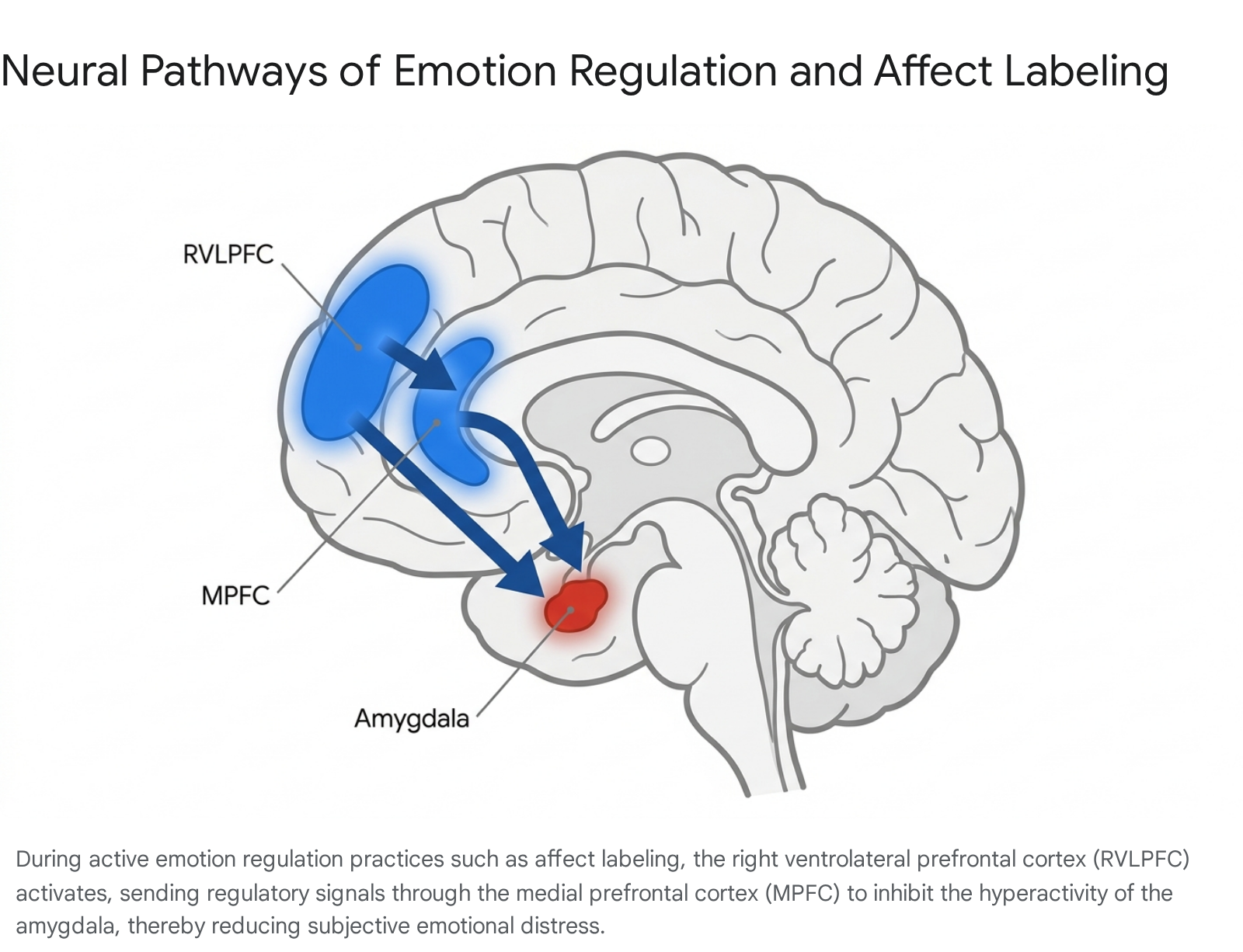
The RVLPFC operates as a critical neural hub for various domains of self-control, encompassing cognitive, emotional, and motor inhibition [93, 94]. Neurological studies reveal an inverse correlation between RVLPFC and amygdala activity during affect labeling tasks; as RVLPFC activity increases to process and assign the semantic label, the reactivity of the amygdala diminishes concurrently [95, 96]. Research examining patients undergoing cognitive behavioral therapy (CBT) and acceptance and commitment therapy (ACT) indicates that baseline amygdala-prefrontal functional connectivity during affect labeling serves as a robust predictor of treatment response [94]. Individuals who possess the neural architecture to effectively engage this regulatory circuitry demonstrate a stronger foundation of emotional fitness, rendering them significantly more receptive to advanced psychological interventions [94].
Deficits in proactive emotional fitness leave individuals highly vulnerable to the physiological consequences of chronic stress. Prolonged exposure to emotional distress constitutes a systemic stressor that continuously activates the hypothalamic-pituitary-adrenal (HPA) axis, resulting in the sustained secretion of cortisol, the primary glucocorticoid involved in stress regulation [85]. While acute cortisol spikes serve an adaptive function by mobilizing energy for fight-or-flight responses, sustained secretion generates "allostatic load" - the cumulative, systemic physiological strain across multiple regulatory systems [85]. Proactive emotional fitness interventions, including consistent mindfulness practices, cognitive restructuring, and physical exercise, actively enhance parasympathetic nervous system activity. This parasympathetic engagement facilitates the body's return to physiological homeostasis, thereby mitigating the long-term somatic and neurotoxic damage associated with high allostatic load [84, 85].
Psychological Mechanisms and Behavioral Application
The translation of neurobiological potential into measurable emotional fitness requires the deliberate acquisition and application of specific psychological skills. Central to this application is the capacity for interpersonal boundary setting and the systematic management of cognitive resources.
In contemporary psychological literature, boundary setting is conceptualized not merely as a defensive interpersonal posture, but as a critical regulatory mechanism necessary for the protection of psychological well-being [33, 34]. This conceptualization is heavily informed by the Conservation of Resources (COR) theory, which posits that individuals are fundamentally driven to obtain, retain, and protect their resources - encompassing time, emotional energy, and self-esteem. According to COR theory, psychological stress emerges directly when these resources are threatened, depleted, or fail to yield anticipated returns [59].
Individuals exhibiting high proactive emotional fitness utilize boundary setting to prevent temporal and emotional exhaustion, preserving their cognitive bandwidth for complex problem-solving and adaptive functioning [59]. This aligns with Self-Determination Theory (SDT), which identifies autonomy, competence, and relatedness as fundamental psychological needs [34]. Boundaries serve as the mechanism through which individuals protect their autonomy against external demands. A failure to establish robust boundaries frequently leads to severe role-blurring - particularly prevalent in modern contexts of digital connectivity and remote work - where the demands of the workplace or extended family subsume the individual's psychological space. This dynamic predictably triggers heightened anxiety, emotional fatigue, and systemic burnout [34, 59, 62].
The application of boundary setting is particularly crucial in navigating complex familial and interpersonal dynamics. Research on family systems, such as studies analyzing cross-generational coalitions in Chinese families, indicates that enmeshed relationships and blurred parent-child boundaries significantly correlate with decreased self-differentiation and increased rates of depression [61]. Self-differentiation - the capacity to maintain emotional independence while remaining intimately connected to others - is a core tenet of emotional fitness. High self-differentiation allows individuals to remain composed in emotionally charged environments without absorbing the anxiety of others [61].
Furthermore, proactive emotional fitness equips individuals to differentiate between normative relational conflict and psychological abuse. Functional relationships, even when characterized by conflict, maintain a capacity for repair through emotional attunement, negotiation, and mutual boundary setting [85]. In contrast, chronic emotional abuse involves systemic patterns of coercive control, intimidation, and invalidation that actively erode a victim's self-concept and cognitive defenses, often leading to internalized self-blame and learned helplessness [83, 85]. Developing emotional fitness involves the cultivation of assertiveness and self-efficacy, enabling individuals to accurately assess interpersonal threats, reject maladaptive coping strategies like emotional withdrawal or dissociation, and enforce boundaries that prevent the internalization of external toxicity [83, 85].
The Comprehensive Soldier Fitness Model
One of the most rigorous, large-scale empirical applications of proactive emotional fitness exists within the United States Army's Comprehensive Soldier and Family Fitness (CSF2) program. Developed in collaboration with leading positive psychology researchers, the CSF2 program was instituted to enact a paradigm shift in military mental health: moving from the reactive, deficit-based treatment of post-traumatic stress disorder toward the proactive inoculation of psychological strength prior to deployment and combat exposure [48, 50, 56, 57].
The CSF2 program mandates annual evaluations for all active-duty soldiers using the Global Assessment Tool (GAT), a comprehensive psychometric instrument designed to measure psychosocial wellness across multiple domains: emotional, social, family, and spiritual fitness [17, 48, 49]. Within the GAT framework, emotional fitness is quantified through the aggregation of variables such as adaptability, the presence of constructive coping mechanisms, the absence of catastrophic thinking, and character strengths [48, 49, 117].
Longitudinal analyses evaluating the efficacy of the GAT and the subsequent Master Resilience Training (MRT) modules indicate that higher baseline emotional fitness scores correlate positively with highly desirable objective performance metrics. Officers possessing higher emotional and social fitness are significantly more likely to receive early promotions and demonstrate superior work engagement, organizational trust, and operational adaptability [49]. This extensive dataset empirically supports the hypothesis that preventative emotional conditioning directly enhances operational capacity and mitigates the risk of psychological injury in high-stakes, high-stress environments [49, 50].
Cross-Cultural Conceptualizations of Preventative Mental Health
An exhaustive analysis of proactive emotional fitness requires examining the construct beyond the limitations of Western psychological paradigms. Historically, global mental health initiatives have been heavily biased toward WEIRD (Western, Educated, Industrialized, Rich, and Democratic) populations, frequently applying standardized Western criteria to diverse cultural groups [10]. The Western paradigm predominantly views mental health through a highly individualized, clinical lens. It prioritizes personal autonomy, focuses on the diagnosis of specific individual pathologies utilizing tools like the DSM-5, and relies heavily on medicalized interventions or one-on-one psychotherapeutic models [13, 14].
In stark contrast, many non-Western cultures conceptualize preventative mental health and emotional fitness through holistic, collectivist, and spiritually integrated frameworks. In these contexts, mental distress is rarely viewed as an isolated individual pathology, but rather as a disruption of social harmony, spiritual equilibrium, or ancestral connection [10].
In Eastern and South Asian paradigms, proactive emotional fitness is maintained through philosophy and daily ritual. In Japan, preventative mental well-being is deeply intertwined with the concept of Ikigai, which loosely translates to a "reason for being." Rather than waiting for psychological distress to prompt intervention, Japanese cultural frameworks encourage the proactive, mindful pursuit of purpose. By aligning passion, vocation, and societal contribution, individuals build intrinsic emotional resilience that serves as a protective buffer against existential despair [6]. Similarly, ancient Indian philosophical traditions approach mental health through the continuous, proactive integration of mind, body, and spirit. Emotional fitness is sustained through practices such as mindfulness meditation (dhyana), physical postures (yoga), and breathwork (pranayama). These practices are specifically designed to regulate the autonomic nervous system, manage the flow of life energy (prana), and maintain internal psychological balance (sattva) [6, 13].
Across the African continent, emotional fitness is frequently approached collectively rather than individually. The philosophy of Ubuntu - "I am because we are" - dictates that mental health is a communal responsibility rooted in interconnectedness [6, 77]. Preventative emotional fitness is maintained through community rituals, communal storytelling, and peer support systems. Initiatives such as the Friendship Bench in Zimbabwe leverage this collectivist approach by training community health workers to provide problem-solving therapy and peer-led support in highly accessible, stigma-free environments, demonstrating profound efficacy in reducing depressive symptoms through social connection [8].
A parallel collectivist approach is evident in Indigenous Australian cultures through the practice of Dadirri. Defined as a practice of "deep inner listening" and quiet, still awareness, Dadirri represents a culturally grounded, preventative mental health practice that nurtures patience, profound connection to the land, and intergenerational healing [105, 107, 109]. Organizations in Australia, such as the Highway Foundation operating in collaboration with the Miriam Rose Foundation, have increasingly advocated for the integration of Dadirri into mainstream preventative mental health programs. These initiatives aim to teach young Australians self-awareness and resilience while providing culturally safe mechanisms for emotional regulation that honor First Nations wisdom [107].
In Latin American cultures, which place a high premium on familial bonds and expressive social engagement, proactive emotional fitness often involves overt emotional catharsis and spirituality. Practices such as curanderismo blend traditional folk healing with community and religious support networks [6, 7]. Unlike some Western models that implicitly value emotional restraint or view intense emotional displays as symptomatic of dysregulation, these cultural frameworks view the overt, collective expression of grief, anxiety, or joy as a necessary and healthy mechanism for maintaining psychological equilibrium [6, 14].
| Cultural Context | Core Philosophy or Practice | Primary Mechanism of Emotional Fitness |
|---|---|---|
| Western / WEIRD | Individualism, Clinical Medicalization. | Psychotherapy, pharmaceutical intervention, personal autonomy, and boundary setting [13, 14]. |
| Japan | Ikigai (Reason for being). | Proactive pursuit of purpose, societal contribution, and mindful engagement [6]. |
| India | Dhyana, Pranayama, Sattva. | Mind-body-spirit integration, autonomic nervous system regulation, detachment from destructive emotions [6, 13]. |
| Africa | Ubuntu (I am because we are). | Collective responsibility, community rituals, peer-led problem solving (e.g., Friendship Bench) [6, 8, 77]. |
| Indigenous Australia | Dadirri (Deep inner listening). | Quiet stillness, spiritual connection to land, intergenerational communal healing [105, 107]. |
| Latin America | Curanderismo, Expressive Catharsis. | Spiritual support, deep familial ties, and the overt, unsuppressed processing of emotion [6, 7]. |
Organizational Application and Burnout Prevention
In the contemporary corporate ecosystem, emotional fitness has transitioned from an individual therapeutic pursuit to a critical organizational imperative. The rapid acceleration of digital connectivity, heightened performance pressures, and complex global macroeconomic factors have precipitated a mental health crisis within the workforce. Global data from 2025 indicates that nearly half of the workforce experiences symptoms of burnout severe enough to impact engagement and performance [38]. Surveys further reveal that up to 80% of workers report exposure to toxic workplace environments, a significant increase from previous years [63].
The financial implications of this psychological deficit are profound. In Canada, recent data demonstrates that employee burnout costs employers between $5,500 and $28,500 per employee annually due to absenteeism, presenteeism, and turnover [40]. Conversely, organizations that prioritize proactive prevention strategies experience a significantly lower burnout rate (27% versus 47% in organizations taking no action), resulting in potential savings of roughly $3,400 per employee per year [40]. Consequently, organizational psychology is shifting its focus away from reactive Employee Assistance Programs (EAPs) - which intervene only after an employee reaches a state of crisis - toward the implementation of proactive emotional fitness infrastructures. These include comprehensive leadership training in emotional regulation, the integration of digital wellbeing tools, and the deliberate construction of psychological safety [38, 41, 46].
Toxic Positivity and the Erosion of Psychological Safety
A primary structural obstacle to organizational emotional fitness is the pervasive culture of "toxic positivity." Defined in psychological literature as the excessive and mandatory promotion of positive thinking at the direct expense of acknowledging genuine difficulties, toxic positivity forces employees to suppress authentic emotional responses [20, 22, 24, 63]. In the workplace, this phenomenon frequently manifests as "surface acting," an intense form of emotional labor wherein employees continuously display manufactured emotions that contradict their internal state [64].
At the leadership level, toxic positivity often takes the form of "glossing" - a management behavior where leaders minimize critical issues, ignore negative feedback, or artificially spin dire situations in an attempt to maintain a superficial facade of corporate harmony [67]. While frequently deployed with the intention of preserving morale, glossing is psychologically destructive. Research confirms that the active suppression of negative affect requires immense cognitive load, leading to elevated physiological stress and the rapid depletion of emotional resources [63, 64, 66].
Over time, surface acting systematically degrades interpersonal trust. When a workplace culture signals that the expression of difficulty is unacceptable, problems that could have been resolved through early intervention compound into major organizational crises [63]. The continuous dissonance between an employee's genuine experience and the mandated corporate disposition acts as a robust predictor of emotional exhaustion, cynicism, and ultimately, clinical burnout [64, 65].
Proactive emotional fitness serves as the direct psychological antidote to toxic positivity. Emotionally fit leadership does not require relentless cheerfulness or the denial of reality. Instead, it involves the capacity to acknowledge complex and difficult truths, validate employee frustration, and foster an environment characterized by genuine psychological safety [20, 46, 67]. Emotionally fit leaders maintain their own regulatory capacity, allowing them to process team anxieties without reacting defensively, thereby building sustainable trust and operational resilience [46, 66].
| Metric | Proactive Emotional Fitness | Toxic Positivity ("Glossing") |
|---|---|---|
| Response to Adversity | Acknowledges difficulty, validates emotional responses, and collaboratively engages in realistic problem-solving [64, 67]. | Dismisses difficulty, demands superficial optimism, and ignores underlying structural problems [63, 67]. |
| Emotional Expectation | Accepts the full spectrum of human emotion; utilizes frustration and anxiety as informative data points [47, 63]. | Enforces mandatory cheerfulness; labels negative emotions as inherently "bad," "weak," or "unproductive" [23, 64]. |
| Psychological Impact | Builds deep interpersonal trust, preserves cognitive bandwidth, and increases overall organizational resilience [46, 66]. | Increases physiological stress, triggers rapid emotional exhaustion, and drives systemic burnout [63, 64, 65]. |
| Communication Style | Transparent, authentic, and firmly grounded in reality, even when delivering unfavorable news [66, 67]. | Avoidant, cliché-driven (e.g., "Good vibes only"), disingenuous, and heavily reliant on surface acting [64]. |
Psychometric Measurement and Assessment
As the theoretical construct of proactive emotional fitness has matured, efforts to accurately quantify it through psychometric validation have accelerated. However, because emotional fitness encompasses a complex synthesis of state (temporary and context-dependent) and trait (enduring personality) characteristics, establishing highly precise, universally applicable measurement scales presents significant methodological challenges.
The most widely utilized and heavily validated instrument explicitly measuring aspects of this construct is the Global Assessment Tool (GAT), developed for the US Army's CSF2 program. The GAT aggregates items from numerous pre-existing, peer-reviewed psychological scales to assess resilience across emotional, social, family, and spiritual dimensions [17, 48, 49]. The Emotional Fitness sub-index of the GAT specifically measures adaptability, coping mechanisms, character strengths, and the propensity for depression and catastrophic thinking [48, 117]. Extensive longitudinal analyses of GAT data have demonstrated strong predictive validity, successfully correlating higher emotional fitness scores with objective indicators of psychological health and superior operational performance [49, 50].
Within civilian and corporate sectors, the psychometric landscape is more fragmented. The EQ-MAP, introduced alongside Cooper and Sawaf's 1997 framework, utilized over 250 items to assess the four cornerstones of emotional intelligence and fitness [111]. While pioneering in its corporate application, it initially faced academic criticism regarding the public availability of its reliability and construct validity data [111]. Since that time, a variety of instruments have emerged to capture the sub-components of emotional fitness.
In developmental psychology, tools like the Emotion Knowledge and Awareness Test (EKAT) have been designed to measure foundational emotion regulation skills and emotional fluency in early educational settings (Kindergarten through second grade) [15]. In broader adult populations, trait models utilizing the Trait Emotional Intelligence Questionnaire (TEIQue) effectively capture the self-efficacy, stress management, and adaptability dimensions that are central to the emotional fitness construct [16, 18, 97]. Additionally, specialized scales such as the Caregiving Health Engagement Scale (CHE-s) have been developed to measure the specific psychosocial and emotional fitness of family caregivers navigating the healthcare system [102].
Despite these advancements, researchers continue to caution against the over-reliance on standardized self-report measures. The primary limitation of current psychometric assessments is that emotional fitness is heavily context-dependent; an individual may exhibit high emotional fitness and superior cognitive reappraisal when managing professional deadlines, yet display severe emotional dysregulation during intimate familial conflicts [119]. Furthermore, cultural variations in the expression, suppression, and somatization of emotion complicate the universal application of Western psychometric scales. Implementing these tools across diverse global populations requires rigorous cross-cultural validation and the adaptation of measurement frameworks to account for local social norms, spiritual beliefs, and collectivist values [10, 14, 16, 52].
Conclusion
Proactive emotional fitness represents a necessary evolution in the understanding of human psychological well-being. By moving beyond the reactive, deficit-based treatment models of mental illness and expanding upon the cognitive insights of emotional intelligence, emotional fitness establishes a framework of continuous, deliberate action. Through the habitual practice of mechanisms such as cognitive reappraisal, affect labeling, and rigorous interpersonal boundary setting, individuals can neurologically and psychologically inoculate themselves against the compounding effects of chronic stress and physiological allostatic load.
Furthermore, integrating diverse cross-cultural methodologies - from the community-centric healing practices of Ubuntu and the deep spiritual listening of Dadirri to the proactive purpose-finding of Ikigai - provides a far more robust and holistic framework for human resilience than isolated Western clinical models can offer alone. Within the modern workplace, dismantling the destructive, superficial norms of toxic positivity and replacing them with environments that foster authentic emotional fitness is no longer optional. It is a fundamental operational necessity that preserves the mental health of the workforce while driving sustainable organizational performance. Ultimately, proactive emotional fitness is not a static destination, but the ongoing commitment to building and maintaining the psychological infrastructure required to thrive in an increasingly complex and demanding world.