
Science of Emotion Regulation
Emotion regulation represents one of the most critical psychological and neurobiological functions of the human brain. It encompasses the diverse physiological, cognitive, and behavioral processes through which individuals influence the emotions they experience, the precise timing of these emotional states, and the manner in which they are both internally felt and externally expressed 12. Efficient emotion regulation is indispensable for psychological resilience, optimal social functioning, and long-term physical well-being. Conversely, the chronic inability to appropriately modulate affective states - referred to clinically as emotion dysregulation - is a core transdiagnostic feature across a vast spectrum of psychiatric conditions, including Borderline Personality Disorder (BPD), Attention-Deficit/Hyperactivity Disorder (ADHD), and Major Depressive Disorder (MDD) 345.
Over the past decades, the scientific understanding of how humans govern their emotions has undergone a profound evolution. Early conceptualizations that viewed emotions as disruptive, hardwired animalistic reflexes have been supplanted by sophisticated cognitive-evaluative frameworks and predictive processing models 6. Contemporary affective science integrates subjective behavioral reporting, high-resolution neuroimaging, cross-cultural comparative analyses, and ecological momentary assessment (EMA) to map the exact mechanisms of emotional control.
Theoretical Frameworks of Emotion and Regulation
The psychological literature is predominantly anchored by two distinct, yet complementary, theoretical paradigms regarding the nature of emotion and its regulation: the Process Model of Emotion Regulation and the Theory of Constructed Emotion. To understand emotion regulation, one must first distinguish it from adjacent psychological constructs. Coping typically refers to the management of long-term negative affect and stress, whereas defense mechanisms are generally unconscious processes studied as stable individual differences primarily regulating anxiety . Mood regulation is distinguished from emotion regulation by its predominant focus on altering broad, subjective feeling states rather than specific behavioral response tendencies 2. Emotion regulation, therefore, operates as a specific, dynamic mechanism modifying the trajectory of discrete emotional episodes.
The Process Model of Emotion Regulation
Developed by James Gross, the Process Model of Emotion Regulation originates from the classical appraisal perspective 27. This model conceptualizes emotion generation as a sequential trajectory: an individual encounters a situation, attends to it, appraises its meaning, and yields a multisystemic response involving loosely coupled changes in subjective experience, behavior, and peripheral physiology 28.
Because emotions unfold over time, the Process Model posits that regulation can intervene at five discrete junctures in the emotion-generative process 28. The first of these interventions is situation selection, which involves approaching or avoiding certain people, places, or objects to regulate emotional impact preemptively. If a situation cannot be avoided, an individual may utilize situation modification, actively altering the physical or social environment to change its emotional resonance. Once situated, an individual can engage in attentional deployment, which involves redirecting cognitive focus within a given situation through mechanisms such as distraction or rumination 7.
The fourth juncture is cognitive change, frequently operationalized as cognitive reappraisal. This involves modifying the cognitive evaluation of the situation to alter its emotional significance before the emotional response fully materializes 78. Finally, response modulation, such as expressive suppression, involves inhibiting or altering ongoing experiential, behavioral, or physiological responses after the emotion is fully generated 1. The first four strategies are classified as antecedent-focused, occurring before the emotional response is fully crystallized, while the fifth is response-focused, aimed at managing the downstream physiological outputs 1.
The Theory of Constructed Emotion
Challenging the assumption that emotions are fixed, biologically hardwired circuits triggered by external stimuli, Lisa Feldman Barrett's Theory of Constructed Emotion proposes a predictive coding and psychological construction approach 68910. This model suggests that the science of emotion has historically relied on folk psychology categories derived from philosophy, erroneously searching for dedicated biological "emotion circuits" 610.
According to this framework, the brain does not possess dedicated neurological fingerprints for specific emotions like fear or anger 6. Instead, the brain continuously runs an internal model of the world to manage allostasis, the proactive regulation of the body's energy and physiological resources 910. Emotions are constructed predictions generated when the brain makes meaning of internal interoceptive sensations (affect) in relation to external contextual data, utilizing learned concepts and past experiences 68910.
From the constructivist perspective, emotion regulation is not a secondary control mechanism that subdues an automatic reflex. Rather, the processes responsible for "emotion regulation" are the exact same neurological networks that construct emotional experiences in the first place 79. To regulate an emotion is to update the brain's predictive models by enhancing interoceptive awareness and expanding emotional granularity - the ability to specifically define and categorize one's emotional state 913.
| Feature | Process Model of Emotion Regulation | Theory of Constructed Emotion |
|---|---|---|
| Nature of Emotion | Discrete, functional states triggered by appraisals of the external world. | Constructed mental states built from interoception, context, and past concepts. |
| Mechanistic Basis | Specific stimulus-appraisal-response evaluations; sequential generation. | Predictive coding, continuous allostatic regulation, no hardwired emotion circuits. |
| Target of Regulation | The appraisal of the external stimulus or the downstream behavioral response. | The internal predictive model, emotional granularity, and meaning-making. |
| Regulatory Sequence | Five discrete stages (Situation selection to response modulation). | Continuous recalibration of bodily predictions and conceptual categorization. |
Neurobiological Mechanisms of Emotion Control
The capacity to self-regulate emotions is contingent upon the structural and functional integrity of complex cortical-subcortical networks. High-powered functional magnetic resonance imaging (fMRI) and transcranial magnetic stimulation (TMS) studies have delineated the specific pathways through which the prefrontal cortex (PFC) modulates affective responses generated in subcortical structures.
Cortical and Subcortical Network Architecture
The generation of emotional arousal is heavily mediated by subcortical and paralimbic structures, including the amygdala, insula, and ventral striatum 111213. To modulate these regions, the brain recruits a network of domain-general cognitive control regions. The dorsolateral prefrontal cortex (dlPFC) and posterior parietal cortex (PPC) are vital for selective attention and working memory, functioning to hold reappraisal strategies in mind 121314. The ventrolateral prefrontal cortex (vlPFC) is implicated in response selection and the inhibition of predominant, goal-inconsistent appraisals 111214. Furthermore, the dorsomedial prefrontal cortex (dmPFC) is recruited to assist in monitoring and reflecting on the meaning of changing emotional states, while the anterior cingulate cortex (ACC) aids in identifying when active regulation is required 121314.
Direct Versus Indirect Prefrontal-Subcortical Pathways
Historically, affective neuroscientists debated whether cognitive control regions of the lateral PFC directly or indirectly down-regulate the amygdala. Recent multi-modal research utilizing combined TMS-fMRI has provided compelling evidence for an indirect pathway model of emotion regulation 11.
During cognitive reappraisal, executive control signals do not travel directly from the vlPFC to the amygdala. Instead, TMS-induced facilitation of the right vlPFC reveals a cascading sequence whereby the vlPFC enhances excitatory connectivity to the ventromedial prefrontal cortex (vmPFC) 111315. The vmPFC, which has vast structural connectivity to both lateral prefrontal areas and subcortical regions, serves as a crucial anatomical hub. Once activated by the vlPFC, the vmPFC exerts strong inhibitory signals onto the amygdala, successfully attenuating the emotional response 11121315.
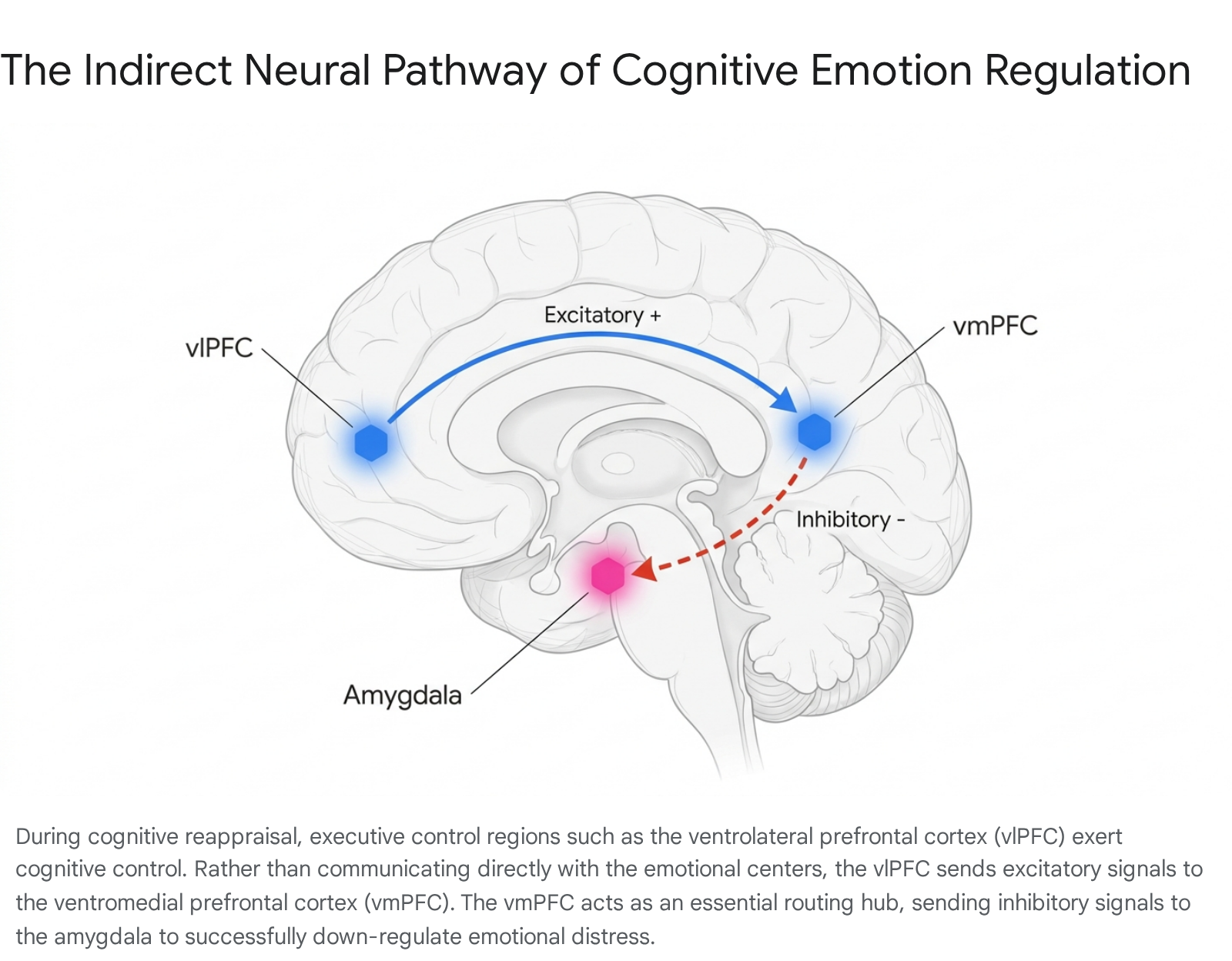
Pathway-mapping analyses of aversive image reappraisal confirm that interactions through the nucleus accumbens predict greater reappraisal success, while direct paths through the ventral amygdala predict reduced success and higher negative affect 16.
Successful emotion regulation is definitively marked by this physiological signature: enhanced activation in the vlPFC and vmPFC coupled with attenuated activity in the amygdala and insula 11.
Developmental Trajectories of Emotion Regulation
The prefrontal-amygdala circuitry required for advanced emotion regulation is not fully formed at birth. Its maturation follows a protracted developmental trajectory that heavily influences an individual's emotional reactivity and control from childhood through emerging adulthood 14171819.
Maturation of Prefrontal-Amygdala Connectivity
In infancy and early childhood, subcortical emotional processing structures, particularly the amygdala and hippocampus, mature relatively quickly, granting young children the capacity for intense emotional reactivity and salience detection 1418. Neurogenesis and neural migration establish these basic circuits, which are active even in very young infants responding to affective stimuli 18. Conversely, the prefrontal cortical regions responsible for executive control mature at a significantly slower rate. Prefrontal areas undergo extended periods of synaptic pruning and myelination well into adolescence and early adulthood 141718.
This asynchronous maturation creates a structural imbalance during adolescence - a developmental period characterized by heightened emotional reactivity, mood instability, and a vulnerability to anxiety and depression 1417. During typical development, resting-state functional connectivity between the amygdala and the medial PFC undergoes a phase shift. In early childhood, the amygdala and mPFC are positively coupled, meaning activation in one excites the other. However, as the brain transitions into adolescence and adulthood, this connectivity shifts to a mature, negative coupling, enabling the mPFC to reliably inhibit amygdala arousal 20. Furthermore, developmental imaging comparing responses to positive and negative feedback indicates that younger children (eight to nine years old) rely heavily on distinct neural circuitry for positive feedback, requiring more frequent deployments of regulation to manage their heightened responsiveness to rewards compared to adults 14.
Impact of Early Life Stress on Neural Circuitry
Genetic vulnerabilities and environmental conditions profoundly shape this developmental trajectory. Notably, exposure to early life stress (ELS), maternal deprivation, or chronic neglect drastically alters functional connectivity across the emotional brain 182021.
Research indicates that early adversity accelerates the maturation of the amygdala-mPFC circuit. Human youths exposed to institutionalization or maternal deprivation exhibit an early emergence of the mature, negative amygdala-mPFC coupling typically reserved for adults 20. This acceleration is hypothesized to be an ontogenetic adaptation - a biological pivot to cope with an adverse environment, mediated by elevated levels of the stress hormone cortisol interacting with neuromaturational genes 2021.
While this accelerated maturation may confer short-term survival benefits by enhancing immediate threat-detection and basic emotion regulation, longitudinal studies reveal severe long-term physiological and psychological costs. In particular, prospective tracking of females demonstrated that higher childhood cortisol triggered by ELS predicts an atypically steep decrease in adolescent amygdala-vmPFC connectivity 14 years later. This specific connectivity phenotype correlates strongly with severe anxiety and depressive symptoms at age 18 21. Thus, early neural adaptations to stress ultimately compromise access to flexible emotion regulation strategies in adulthood, fundamentally rewiring the baseline thresholds for emotional stability 17.
Efficacy of Distinct Emotion Regulation Strategies
The mechanisms through which individuals attempt to modulate their emotions dictate their subsequent psychological, physiological, and social outcomes. The scientific literature predominantly contrasts two distinct strategies: cognitive reappraisal (an antecedent-focused strategy) and expressive suppression (a response-focused strategy) 22262324.
Cognitive Reappraisal
Cognitive reappraisal involves actively modifying one's interpretation of an emotion-eliciting stimulus to alter its affective impact before the emotional response fully crystallizes 7262425. Reappraisal acts to change the emotional trajectory early in the generative process, essentially disarming the emotional trigger before it cascades into a full physiological response.
Behaviorally, cognitive reappraisal is widely established as a highly adaptive strategy 222626. It effectively down-regulates negative subjective experiences, accelerates emotional recovery following stress exposure, and acts as a significant buffer against psychopathology, protecting against occupational burnout and clinical depression 262325. Different forms of reappraisal engage distinct prefrontal regions: distancing oneself from a situation relies heavily on right-lateralized prefrontal and parietal networks focused on spatial and attentional control, whereas reinterpreting the semantic meaning of an event recruits left-lateralized semantic memory and cognitive switching hubs 1215.
Physiologically, the use of cognitive reappraisal is associated with increased High-Frequency Heart Rate Variability (HF-HRV), an indicator of adaptive parasympathetic nervous system functioning that promotes autonomic flexibility in the face of stress 27. Furthermore, electroencephalogram (EEG) analyses demonstrate that cognitive reappraisal successfully diminishes the late positive potential (LPP) wave, confirming that the brain is expending less energy processing the emotional stimulus 25.
Expressive Suppression
Expressive suppression entails the conscious inhibition of outward emotional behaviors, such as masking facial expressions of anger or sadness, after the emotion has already been elicited 242528.
While suppression successfully hides the emotion from external observers, it consistently fails to diminish the internal subjective experience of negative affect 2232425. Because the emotional arousal is actively fought rather than resolved, suppression carries a heavy physiological and cognitive cost. Individuals employing suppression exhibit exacerbated stress-induced physiological arousal. This is characterized by increased sympathetic nervous system activation, elevated skin conductance responses, shorter pre-ejection periods (PEP), and intense heart rate deceleration, which reflects the immense cognitive effort exerted in the attempt to suppress natural physiological responses 232428. Facial electromyography (EMG) of the zygomaticus major and corrugator supercilii muscles indicates that even when suppression is attempted, micro-expressions of distress often persist 23. Furthermore, chronic suppression disrupts emotional processing, delaying stress recovery and contributing to prolonged anxiety and somatic tension 2628.
Interestingly, in interpersonal settings, both reappraisal and suppression implemented by a regulator can increase physiological synchrony (such as aligned heart rate variations via ECG) between a regulator and a target individual. This suggests that even a physiologically costly strategy like suppression can possess important relational and communicative utility during acute interpersonal distress 2930.
The Up-Regulation of Positive Emotions
While clinical research has historically fixated on the down-regulation of negative affect, modern affective science emphasizes the regulation of positive emotions. Up-regulating positive emotions - through strategies such as savoring, positive refocusing, and positive reappraisal - acts as a vital buffer against psychopathology, particularly depression 3531.
In occupational settings, such as education, the modulation of positive emotions directly influences professional well-being. A 2025 meta-analysis on teachers demonstrated that "deep acting" - a form of cognitive reappraisal where the individual genuinely attempts to align their internal feelings with the required positive display - significantly enhances job satisfaction, environmental mastery, and general well-being 263233. Conversely, "surface acting," which is synonymous with expressive suppression where positive feelings are faked without internal cognitive change, yields mixed to negative outcomes, correlating with exhaustion and ineffective teaching practices 3233.
Mindfulness as a Regulatory Catalyst
Mindfulness, characterized by nonjudgmental acceptance and present-moment awareness, serves to augment adaptive emotion regulation 222739. Meta-analytic evidence spanning over 12,000 subjects across 36 studies confirms a stable, positive correlation between trait mindfulness and the spontaneous use of cognitive reappraisal 22244034. Individuals trained in mindfulness display enhanced prefrontal cognitive flexibility, allowing them to tolerate unpleasant sensations as transitory mental events, thereby creating the necessary cognitive distance to reappraise an event rather than react automatically 2740.
Notably, this meta-analysis revealed that mindfulness shows no significant correlation with expressive suppression, further reinforcing its role in promoting antecedent-focused over response-focused regulation 222434. The moderating effect analysis within these studies also indicated that the adaptive link between mindfulness and cognitive reappraisal is statistically stronger in males than in females, highlighting demographic nuances in regulatory training efficacy 222434.
| Regulatory Strategy | Temporal Focus | Primary Neural Mechanism | Physiological Impact | Psychological Outcome |
|---|---|---|---|---|
| Cognitive Reappraisal | Antecedent (Pre-emotion) | vlPFC/vmPFC inhibition of Amygdala | Increased HF-HRV; reduced sympathetic arousal. | Adaptive; reduces depression/anxiety; improves recovery. |
| Expressive Suppression | Response (Post-emotion) | High executive effort without amygdala down-regulation | Increased skin conductance; prolonged sympathetic arousal. | Maladaptive; retains subjective distress; delays recovery. |
| Mindfulness | Continuous (Present moment) | Increased tolerance for interoceptive signals | Lower resting cortisol; better respiratory parameters. | Adaptive; directly enhances spontaneous reappraisal capability. |
Cross-Cultural Variances in Emotion Regulation
A critical paradigm shift in emotion regulation science recognizes that the efficacy, prevalence, and outcomes of regulation strategies are heavily dependent on cultural context. The dichotomy between Western individualistic cultures and East Asian collectivistic cultures reveals profound differences in how emotional suppression is utilized and internalized by the brain.
Suppression in Western Versus East Asian Contexts
According to Western psychological frameworks, expressive suppression is deemed highly maladaptive due to its robust correlations with depression, anxiety, and diminished social support 353637. Western cultures place a high premium on independent self-construal, valuing personal autonomy, assertiveness, and authentic emotional self-expression 383940. Consequently, suppressing one's true feelings creates cognitive dissonance and violates fundamental cultural norms of authenticity, leading to immediate psychological distress and fractured interpersonal relationships 3941.
Conversely, East Asian cultures are anchored in interdependent self-construal, prioritizing interpersonal harmony, group cohesion, and the accommodation of situational needs over individual desires 394042. Recent systematic reviews and meta-analyses (2023-2024) confirm that East Asian individuals utilize expressive suppression and avoidance at significantly higher frequencies than Western individuals, demonstrating a medium effect size for both suppression ($d = -0.29$) and avoidance ($d = -0.57$) 43.
Crucially, the negative psychological toll associated with suppression in the West is significantly attenuated, or completely absent, among East Asian populations 3536374251. For individuals endorsing Eastern values, suppression is viewed not as a failure of authenticity, but as an act of social intelligence and empathy. For example, research demonstrates that East Asian individuals frequently engage in the "empathic suppression" of positive emotions to avoid causing envy or discomfort in others, a prosocial behavior that is virtually absent in Western samples 42.
Cultural Moderation of Psychological Outcomes
Empirical data highlights severe disparities in how suppression correlates with well-being across cultures. In studies assessing the impact of anger suppression on life satisfaction, Japanese participants exhibited significantly lower detriment to their well-being ($r = 0.47$) compared to American participants ($r = 0.33$) 4251. In fact, uncontrolled expression of emotions was found to be uniquely harmful to the somatic and depressive symptoms of East Asians, while distress disclosure (venting) provided immense mental health benefits to Westerners 4251.
This buffering effect observed in East Asian demographics is mediated by specific cultural cognitive frameworks, such as the Confucian concept of Zhong Yong (the Doctrine of the Mean). Zhong Yong promotes a holistic, moderate, and harmonious approach to conflict and emotional extremes. Studies of Chinese young adults indicate that high endorsement of Zhong Yong thinking significantly weakens the association between emotional suppression and negative adjustment outcomes, effectively transforming a potentially harmful restriction into a culturally syntonic mechanism of self-control and social preservation 36.
| Cultural Context | Self-Construal Focus | Frequency of Suppression Use | Mental Health Outcomes of Suppression | Reappraisal Use Frequency |
|---|---|---|---|---|
| Western (e.g., USA, Canada) | Independent (Authenticity, Autonomy) | Lower | Highly Maladaptive (Depression, Anxiety) | High |
| East Asian (e.g., Japan, China) | Interdependent (Harmony, Secondary Control) | Higher | Attenuated/Neutral (Adaptive for Social Cohesion) | High |
(Note: Meta-analytic comparisons reveal no significant disparity in the frequency of cognitive reappraisal usage between Western and East Asian populations, indicating it is a universally adopted strategy regardless of overarching cultural orientation 394351).
Ecological Momentary Assessment in Daily Life
While laboratory settings provide tightly controlled environments to study the physiological correlates of emotion regulation, they inherently lack ecological validity. To capture how humans authentically manage emotions in real-world contexts, modern researchers utilize Ecological Momentary Assessment (EMA) and Experience Sampling Methods (ESM) 4445464748.
Ambulatory Assessment Methodologies
EMA methodologies involve repeatedly prompting subjects via mobile devices to self-report their affective states (often using tools like the PANAS-X scale) and their regulation strategies throughout their daily routines 46. This approach overcomes retrospective recall bias, where individuals erroneously estimate their emotional histories, and allows researchers to map dynamic, within-person temporal interactions 48. In some advanced studies, EMA is paired with an Electronically Activated Recorder (EAR), an unobtrusive audio methodology that periodically collects short acoustic snippets from the participant's environment, capturing an objective auditory diary of their social interactions, sighs, and arguments 46.
Temporal Dynamics of Emotion Regulation
Meta-analyses of ESM studies reveal the profound day-to-day impact of emotion regulation choices. There are large contemporaneous relationships between the use of cognitive reappraisal and immediate spikes in positive affect, and correspondingly large associations between the use of rumination or suppression and severe negative affect 4445.
EMA proves particularly invaluable in clinical settings by establishing how state emotion regulation mediates the relationship between trait psychopathologies and diminished daily functioning. For example, a 14-day EMA study on adolescents revealed that trait social anxiety is significantly associated with a higher daily suppression of negative emotions and increased rumination. Acceptance of positive emotions mediated the link between social anxiety and positive affect, proving that daily, momentary regulatory choices dictate the severity of chronic anxiety disorders 47. Furthermore, longitudinal EMA research highlights the severe physical stakes of daily emotion regulation: individuals displaying low positive affective reactivity (the inability to up-regulate positive mood) following a stressful life event face a 132% increased mortality risk over a ten-year period 48.
Clinical Manifestations of Emotion Dysregulation
When the neurobiological and cognitive systems supporting emotion regulation fail or become structurally compromised, individuals experience emotion dysregulation. Characterized by heightened emotional reactivity, poor temper control, and a severe inability to return to baseline arousal, emotion dysregulation is a central, transdiagnostic vulnerability observed across multiple psychiatric diagnoses 3451749.
Borderline Personality Disorder
In Borderline Personality Disorder (BPD), emotion dysregulation is not merely an associated feature; it is the fundamental core diagnostic symptom 34. Individuals with BPD suffer from extreme affective instability driven by a profound hyper-reactivity of mood 358.
Clinical assessments indicate that BPD patients experience both a higher frequency and a higher intensity of negative affect compared to healthy controls and individuals with other psychiatric disorders 3. Additionally, they exhibit a severe emotional recall bias, consistently overestimating past emotions with negative valence and underestimating those with positive valence 3. Crucially, BPD is characterized by an extended duration of "aversive tension" - the biological inability to self-soothe causes negative emotions to linger exponentially longer, preventing a return to baseline 3. To escape this unbearable internal tension, individuals with BPD frequently resort to extreme behavioral response-modulation strategies, engaging in self-mutilation, impulsive spending, or excessive substance abuse as desperate attempts to artificially reset their nervous system 358.
Attention-Deficit/Hyperactivity Disorder
Emotion dysregulation is highly prevalent in ADHD, affecting between 72% and 90% of adults diagnosed with the disorder, and serves as an independent predictor of severe social, educational, and occupational impairment 358. In ADHD, dysregulation manifests primarily as impulse control deficits: severe temper outbursts of short duration, high frustration intolerance, and emotional over-reactivity to minor daily stressors, leaving the individual frequently feeling overwhelmed 359.
While BPD and ADHD share symptoms of impulsivity and emotional lability, their underlying cognitive profiles differ substantially. ESM studies comparing the two disorders reveal that while patients with ADHD experience similarly intense levels of anger and irritability in daily life, they retain a significantly higher capacity to utilize adaptive cognitive strategies (like reappraisal) and rely less on maladaptive strategies than patients with BPD 450. Furthermore, dysregulation in ADHD is frequently linked to "novelty-seeking" behaviors intended to stimulate an under-aroused prefrontal cortex, rather than the frantic attempts to alleviate the chronic inner emptiness seen in BPD 358.
Mood Disorders: Major Depressive Disorder and Bipolar Disorder
In affective disorders such as Major Depressive Disorder (MDD) and Bipolar Disorder (BD), emotion dysregulation is predominantly marked by rigid, maladaptive cognitive habits 559515253.
MDD is heavily characterized by pervasive negative rumination (obsessively focusing on the causes and consequences of distress) and a generalized dampening of positive affect, rendering the individual incapable of savoring rewards 552. Bipolar Disorder shares a nearly identical profile of emotional dysregulation with MDD during its depressive episodes, which frequently leads to diagnostic confusion and mistreatment in primary care 55253.
However, systematic reviews and meta-analyses comparing the two conditions indicate that individuals with BD exhibit specific, distinguishing regulatory failures. Patients with BD engage in significantly more positive rumination (fixating obsessively on elevated moods) and impulsive risk-taking behaviors 55152. These specific dysregulation patterns act as potent catalysts, exacerbating hypomanic states and propelling the individual into full manic episodes 55853. Furthermore, functional MRI comparisons between MDD and BD patients reveal that emotion dysregulation in BD is highly mood-state dependent; even during periods of clinical remission, individuals with BD exhibit impaired emotion regulation accompanied by hyperactive dorsolateral PFC activity, a deficit not observed in remitted MDD patients 52.
| Clinical Condition | Primary Manifestation of Emotion Dysregulation | Prevalent Maladaptive Regulation Strategies |
|---|---|---|
| Borderline Personality Disorder | Extreme affective instability, chronic aversive tension, slow baseline recovery. | Self-mutilation, severe suppression, total lack of adaptive cognitive strategies. |
| ADHD | Emotional over-reactivity, poor temper control, high frustration intolerance. | Externalizing behaviors (outbursts), novelty-seeking; adaptive strategies remain partially accessible. |
| Major Depressive Disorder | Pervasive sadness, lack of positive affect response. | Negative rumination, dampening of positive emotions, behavioral avoidance. |
| Bipolar Disorder | Mood state-dependent dysregulation, manic euphoria to deep depression. | Positive rumination, severe risk-taking, impulsivity during elevated states. |
Contemporary Misconceptions and Paradigmatic Shifts
As modern affective science translates into clinical practice and the public domain, several pervasive, long-held myths regarding emotion regulation have been empirically debunked by neuroscience.
The most prominent fallacy is the myth of hardwired emotion circuits. A common assumption is that emotions, such as fear or anger, are innate, uncontrollable animalistic reflexes housed in dedicated brain regions (e.g., the amygdala serving exclusively as the "fear center"). Extensive neuroimaging data absolutely refutes this notion. No human brain contains dedicated biological "emotion circuits" 610. Emotions are actively constructed by domain-general brain networks managing prediction, memory, and bodily resources 610. Recognizing that emotions are not unstoppable reflexes but constructed cognitive guesses empowers individuals to leverage cognitive control, rather than feeling entirely at the mercy of their biology.
A secondary misconception involves overestimating the power of cognitive reframing. While cognitive reappraisal is heralded as an elite regulatory tool, its efficacy is strictly bound by neurological limits. Under conditions of intense acute stress or severe trauma, the brain's cognitive control systems - specifically the lateral prefrontal cortex - become overloaded, drastically narrowing working memory bandwidth 13. Attempting to cognitively "reason" or reframe an individual out of a state of panic is neurologically impossible if their prefrontal bandwidth is exhausted. In such hyper-aroused states, simple distraction or body-focused parasympathetic down-regulation, such as controlled breathing to alter interoception, must precede any attempt at complex cognitive reframing 1327.
Finally, empirical research has thoroughly debunked the catharsis myth. Popular psychology often advocates for "venting" - such as shouting, punching a pillow, or expressing uninhibited rage - to release pent-up emotion. However, evidence demonstrates that venting is entirely counterproductive; expressing uncontrolled aggression actively increases sympathetic nervous system arousal and solidifies the neural pathways associated with anger, ultimately exacerbating emotional dysregulation rather than relieving it 64.
The science of emotion regulation reveals a dynamic, highly integrated system where neurobiology, cognitive framing, and cultural context converge. Regulating human emotion is not an act of stifling an inner beast, but a complex computational process where prefrontal cortices iteratively update and modulate the subcortical affective predictions of the brain. When this circuitry is optimal, cultivated through adaptive strategies like cognitive reappraisal and mindfulness, humans display remarkable psychological flexibility. When impaired by early life stress, genetic vulnerability, or maladaptive habits, the resulting emotional dysregulation forms the bedrock of debilitating psychiatric conditions. Ultimately, understanding that emotions are constructed - rather than passively triggered - provides a profound paradigm shift: while humans cannot control every environmental stressor, they possess the innate neurobiological machinery to rewrite the emotional meaning of their experiences.