
How to Have Difficult Conversations According to Science
Effective conflict resolution requires shifting from a mindset of absolute certainty and blame toward curiosity and joint problem-solving. Research demonstrates that pairing assertive communication with emotional validation, while strategically adapting your approach to the medium and cultural context, significantly improves outcomes. By understanding the underlying identity threats that make conversations difficult, individuals can de-escalate tension and transform adversarial debates into collaborative dialogue.
Difficult conversations are an inescapable reality of human interaction. Whether negotiating a salary increase, confronting a colleague about taking credit for a project, navigating a marital dispute, or discussing deeply polarizing political issues, the ability to communicate under pressure is a defining factor in both personal and professional success. Despite the ubiquity of these interactions, human beings are neurologically and psychologically predisposed to handle them poorly. When faced with a perceived threat - even a social or emotional one - the brain's amygdala triggers a fight, flight, or freeze response 12. We speak without thinking, fall back on deeply ingrained defense mechanisms, and prioritize self-preservation over mutual understanding 3.
However, communication research, organizational psychology, and decades of empirical data from negotiation experts demonstrate that effective conflict resolution is a learned skill, not an innate talent. This report synthesizes current research on interpersonal conflict, examining the underlying psychological structures of difficult conversations, the efficacy and limitations of established communication tactics, the evolving challenges of digital communication, and the critical role of cross-cultural awareness in a globalized world.
The High Cost of Unresolved Conflict
Before examining the mechanics of difficult conversations, it is essential to understand the stakes. In the workplace, conflict is far more than a minor inconvenience; it represents a massive drain on organizational resources, productivity, and human wellbeing.
According to research from CPP Inc., U.S. employees spend an average of 2.8 hours every week dealing with conflict 1. This lost time equates to an estimated $359 billion in paid hours annually across the United States alone 1. Furthermore, a survey of 400 major companies revealed that poor communication habits cost each organization an average of $62.4 million per year due to project delays, errors, and lost opportunities 5.
The human cost is equally staggering. Nearly 88% of employees report that poorly managed conflict lowers overall morale, and two-thirds of U.S. workers have recently experienced or witnessed incivility in the workplace 1. According to the Society for Human Resource Management (SHRM), 67% of respondents identify poor communication as the primary catalyst for these workplace conflicts 6.
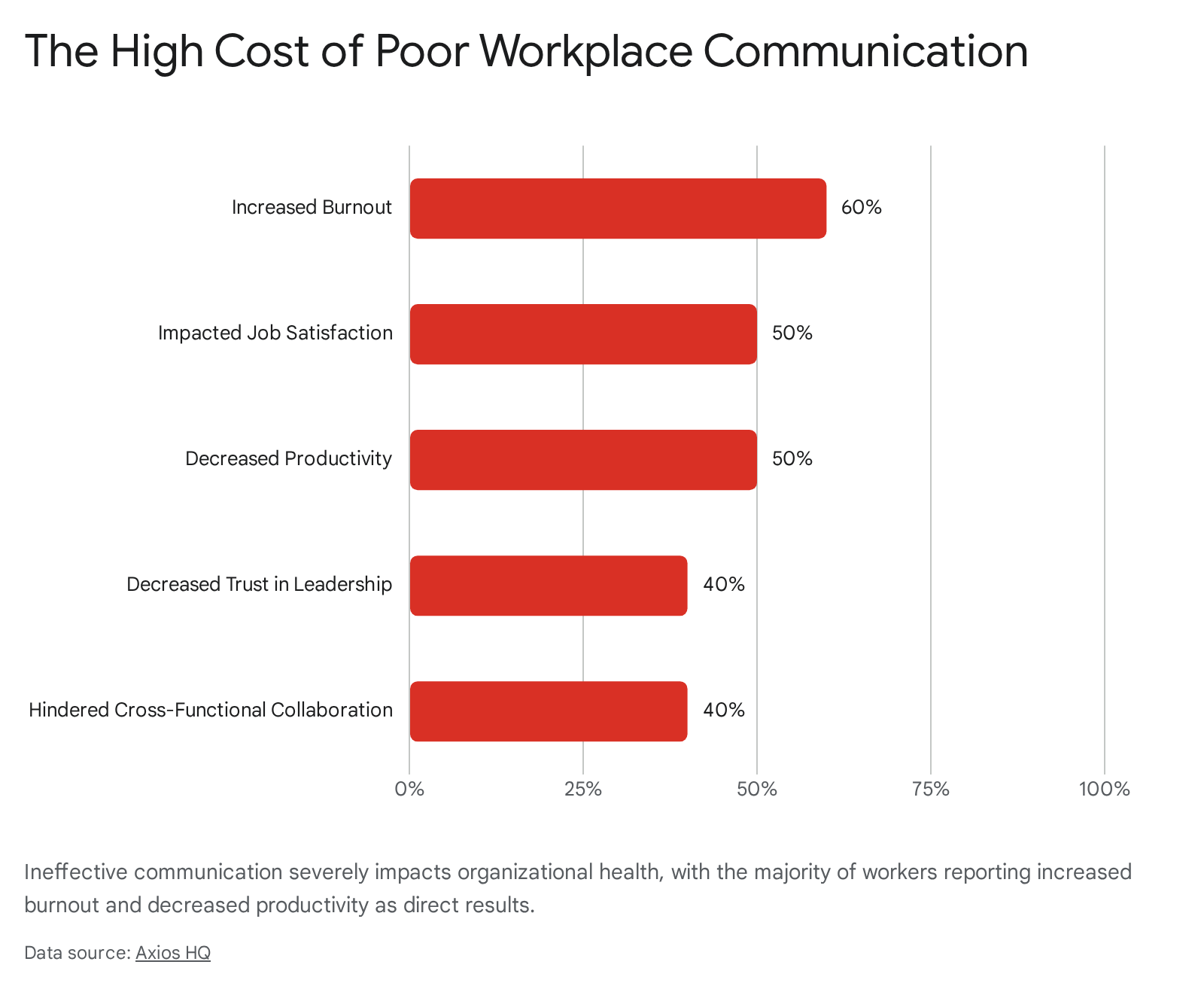
When leaders avoid difficult conversations, hoping tensions will resolve themselves, minor interpersonal disagreements routinely escalate into team silos, high turnover rates, and severe reputational damage 729.
The Hidden Structure: Three Conversations in One
To navigate a difficult conversation, one must first understand its architecture. According to the Harvard Negotiation Project - the research consortium behind the seminal text Difficult Conversations: How to Discuss What Matters Most - every difficult conversation is actually three distinct conversations happening simultaneously 11. Our anxiety and frustration typically stem from focusing entirely on the surface-level facts while failing to recognize and manage the emotional and psychological layers beneath 123.
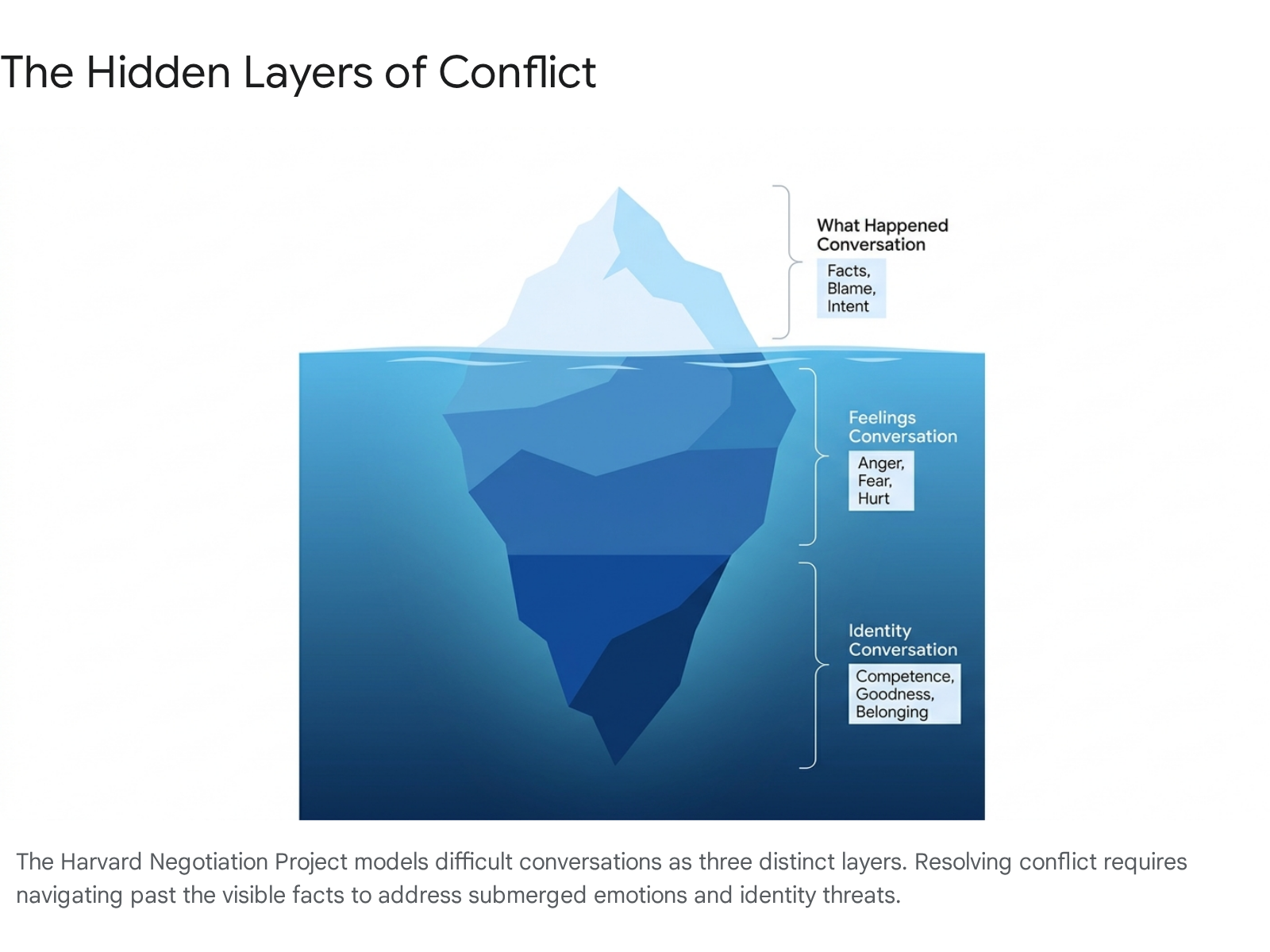
The "What Happened" Conversation
The most visible layer of any conflict is the dispute over the facts: who said what, who did what, and who is to blame 3. In this layer, communicators typically fall into three predictable cognitive traps:
First, communicators operate under the "Truth Assumption." We enter the conversation absolutely certain that our perception is the objective reality, assuming the other person is either lying, irrational, or misinformed 12. Research consistently shows that conflicts are rarely about objective facts; rather, they stem from differing interpretations, access to different information, and divergent baseline values 144.
Second, humans engage in "Intention Invention." We observe another person's behavior and automatically invent an assumption about their underlying motivations 3. If a colleague interrupts during a meeting, we may assume they intend to disrespect us or assert dominance. This cognitive bias often leads us to judge ourselves by our best intentions while judging others purely by their negative impacts 123.
Third, the default human instinct is to establish the "Blame Frame." When things go wrong, we immediately ask, "Whose fault is this?" 3. Focusing on blame triggers instant defensiveness and halts all productive problem-solving. Effective communicators shift from a blame frame to a "contribution system," analyzing how both parties interacted and contributed to producing the negative outcome 123.
The Feelings Conversation
Beneath the surface of the facts lies the emotional reality of the dispute. Every difficult conversation asks fundamental questions about how to handle strong emotions like anger, guilt, disappointment, resentment, and fear 1112.
Often, individuals in professional settings attempt to suppress the Feelings Conversation entirely, operating under the assumption that the workplace requires strict rationality and that emotions are a distraction 3. However, unexpressed emotions do not simply disappear; they leak into the conversation through abrasive tones, passive-aggressive behavior, or abrupt withdrawal 12. Acknowledging emotions is not merely a therapeutic exercise; it is a strategic necessity. If the root of a problem is emotional, attempting to solve it purely with factual, logistical arguments will fail 113. Effective communication requires identifying and validating the other party's feelings to clear the cognitive space required for rational discourse 11.
The Identity Conversation
The deepest, most volatile, and most frequently ignored layer of conflict is the Identity Conversation. This is an internal debate regarding what the situation means to us and our self-worth 114.
A difficult conversation has the profound potential to disrupt our sense of who we are in the world 5. If a manager receives negative feedback from a subordinate, it threatens their identity as a competent, fair leader. If a partner is accused of being unsupportive, it threatens their identity as a loving spouse. This perceived threat to our core identity is what causes the physiological symptoms of anxiety during a conflict - the sweating, the racing heart, and the inability to formulate a coherent thought 5.
Recent updates to conflict resolution literature emphasize that the Identity Conversation is deeply intertwined with systemic factors. The 2023 third edition of Difficult Conversations, alongside emerging research, highlights how identities linked to race, gender, sexuality, generation, and power dynamics fundamentally alter the stakes of a conversation 456. Discussions touching on diversity, equity, and inclusion are inherently difficult because they brush against systemic advantages and historical marginalization, triggering profound identity threats for all parties involved 7.
Managing this layer requires moving away from fragile, absolute identities (e.g., "I am a flawless manager") to more robust, nuanced self-assessments (e.g., "I have good intentions, but I have blind spots and room to learn") 7. By building resilience around our identity, we become less defensive when our actions are challenged.
Diagnosing Communication Styles
How an individual expresses themselves during these three simultaneous conversations largely dictates the outcome. Communication research generally categorizes default conflict behaviors into four primary styles: passive, aggressive, passive-aggressive, and assertive 119.
Passive communicators consistently avoid expressing their thoughts, needs, and desires, prioritizing the comfort of others over their own boundaries 1. While this temporarily avoids immediate friction, it breeds deep-seated resentment, leads to personal burnout, and ensures the root problem remains unsolved 119. In professional settings, passive communicators may struggle to advance because they fail to advocate for their ideas or address structural inefficiencies.
Aggressive communicators dominate conversations, prioritizing their own needs at the direct expense of others 1. They utilize loud tones, commanding body language, and direct accusations. While this may yield short-term compliance out of fear, it destroys psychological safety, triggers severe defensiveness, and escalates minor disputes into major systemic fractures 119.
Passive-Aggressive communicators express resistance and frustration indirectly rather than addressing issues openly 1. Driven by a fear of direct confrontation coupled with unexpressed anger, they rely on sarcasm, subtle sabotage, malicious compliance, and procrastination 1. This creates a highly toxic environment, as the hostility is palpable but cloaked in plausible deniability, making it exceedingly difficult to address constructively 1.
The Assertive Advantage
Research overwhelmingly supports assertive communication as the single most constructive style for conflict resolution 119. Assertiveness is the precise balance of honesty and respect. Assertive communicators express their needs, thoughts, and boundaries confidently while equally valuing the perspectives and rights of the other party 1.
This style relies on steady eye contact, a calm and even tone, and open body language 11920. The benefits of assertiveness extend beyond immediate conflict resolution. A 2025 study found that professionals who consistently utilize assertive communication have a 12% higher chance of promotion 20. The style demonstrates emotional resilience, leadership, and the ability to navigate complex social dynamics without burning bridges or compromising core values 20.
Evidence-Based Frameworks and Scripts
Transitioning from an ineffective style to an assertive one requires the application of specific, evidence-based tactics. While there is no universal script that dissolves all tension, researchers and negotiators have identified several linguistic frameworks that significantly increase the probability of a productive outcome.
Rethinking the "I" Statement
Perhaps the most ubiquitous piece of conflict resolution advice is the use of "I" statements 2189. When we are upset, the default human reaction is to use "You" statements ("You never listen to me," "You always miss deadlines"). This language acts as a direct accusation, immediately putting the recipient on trial and triggering a defensive posture 21810.
An "I" statement reframes the issue around the speaker's internal experience. Instead of "You never include me," the assertive alternative is, "I feel frustrated when I am not included in financial decisions" 19209.
This formula is effective because an "I" statement is subjectively true and difficult to counter-argue 10. The listener cannot reasonably debate how the speaker feels. It separates the person from the problem, reducing the threat to the listener's identity and opening the door for collaborative problem-solving 1921.
The CHOW formula for challenging conversations provides a highly effective template for structuring these statements: "I feel [emotion] when you [specific behavior]. I need you to [specific need]" 11. By limiting the statement strictly to observable behavior and internal emotion - without inserting judgments about the other person's character - it dramatically lowers the conversational temperature.
Tactical Empathy and Negotiation Strategies
Techniques drawn from high-stakes negotiations offer profound insights into everyday conflict. Chris Voss, former lead international kidnapping negotiator for the FBI and author of Never Split the Difference, advocates for strategies grounded in tactical empathy 26.
One of the most effective tools is the use of calibrated questions - specifically questions beginning with "How" or "What" rather than "Why." Asking someone "Why did you do that?" inherently sounds accusatory and forces them to defend their actions 3. Asking "What challenges were you facing when you made that decision?" or "How can we solve this moving forward?" invites the other person to collaborate and gives them the illusion of control, making them more receptive to your influence 26.
Voss also highlights the psychological power of correction as an "emotional lubricant" 26. Often, the fastest way to uncover what someone truly wants is not to ask them directly, but to make a deliberate, educated guess about their position (e.g., "It seems like you feel undervalued on this project"). People possess an innate, satisfying drive to correct others. By inviting them to correct your assumption, they will often candidly reveal their true feelings and underlying interests, accelerating the resolution process 26.
The Soft Startup and De-escalation
When a conflict must be raised, the first three minutes of the conversation generally dictate its entire trajectory. Relationship researchers, notably John Gottman of the Gottman Institute, strongly advocate for the "soft startup" 927. This involves initiating the conversation with a positive or neutral observation, expressing appreciation, and taking responsibility for one's own minor contributions to the issue before addressing the primary problem 9.
Furthermore, controlling one's own physiological response is critical. Jefferson Fisher, a trial lawyer and communication expert, advises that when defensiveness rises, taking a deep breath and pausing creates vital mental space between the trigger and the response 219. Pausing prevents the amygdala hijack and shifts control back to the prefrontal cortex, allowing for rational thought rather than emotional reaction 319.
Comparison: Ineffective vs. Effective Conflict Phrases
Transitioning from adversarial to collaborative communication requires a deliberate shift in vocabulary. The following table contrasts common ineffective reactions with evidence-based assertive alternatives designed to defuse tension and foster collaboration 38112829.
| Ineffective Phrase (Avoid) | Evidence-Based Alternative (Use) | Psychological Mechanism |
|---|---|---|
| "You never listen to my ideas." | "I feel frustrated when my ideas aren't considered during meetings." | Shifts from an accusatory "You" statement to an unarguable subjective "I" statement. |
| "This is all your fault." | "I think we got off track. How can we fix this together?" | Shifts from the "blame frame" to joint problem-solving (us vs. the problem). |
| "I don't care what you think!" | "I see your point, and I believe we can find a compromise that addresses both concerns." | Validates the other person's perspective, lowering defenses before asserting one's own needs. |
| "You're clearly wrong." | "Help me understand your perspective on this." | Replaces the "Truth Assumption" with genuine curiosity and active listening. |
| "I can't deal with this right now." | "Let's take a break and get back to this issue when we've cooled down a bit." | Pauses the conversation to prevent emotional flooding, while setting a boundary that the issue will still be addressed. |
| "Whose stupid idea was this?" | "Let's figure out what went wrong so we can make sure it doesn't happen again." | Focuses on systemic contributions and future prevention rather than individual fault-finding. |
The Active Listening Debate: Benefits and Burnout
Active listening is frequently heralded as the cornerstone of effective communication. It goes beyond merely hearing words; it is the deliberate process of receiving, constructing meaning, and responding to spoken and nonverbal messages to foster mutual understanding 1213. Techniques include maintaining open body language, refraining from premature judgment, and paraphrasing ("What I'm hearing you say is...") 81332.
Paraphrasing serves two vital functions: it ensures the listener actually comprehended the message accurately, and it proves to the speaker that their emotions are recognized, which inherently de-escalates intensity 1132. In interpersonal and marital contexts, the data is clear. Research published in The Journal of Social and Personal Relationships indicates that couples who engage in empathetic listening report significantly better conflict management and higher emotional intimacy 33.
When Active Listening Fails to Persuade
However, recent research reveals that active listening is not a universal panacea, and its effects are highly dependent on the context and the ideological stakes of the conflict.
A 2025 field experiment published in the Proceedings of the National Academy of Sciences (PNAS) tested the limits of active listening in highly polarized political conversations 14. Researchers trained political canvassers to use high-quality active listening behaviors - nodding, paraphrasing, and asking pertinent questions - while discussing unauthorized immigration via Zoom with voters 14.
Surprisingly, while the active listening techniques successfully improved the participants' perception of the canvasser (they liked the person more), it did not increase persuasion or change minds regarding the policy, either immediately or five weeks later 14. Researchers hypothesized that in deep, personal conversations about sensitive topics, individuals slow down their thinking and focus heavily on the substance of the argument and their own deeply held values, rather than relying on their affinity for the person delivering the message 14. While active listening builds rapport, it does not magically override entrenched factual disagreements or ideological beliefs.
The Emotional Toll of High-Quality Listening
Furthermore, active listening carries a measurable psychological cost. A 2024 field study involving 106 middle and high school teachers in Israel investigated the relationship between effortful listening and occupational health 35. The study found that teachers' perceptions of their own high-quality listening significantly and positively predicted job burnout 35. The cognitive and emotional effort required to continuously absorb, process, and validate others' emotional states can lead to profound fatigue if not balanced with appropriate personal boundaries and organizational support 35.
The Contextual Nuance of Direct Opposition
Another finding in recent communication research challenges the blanket assumption that we must always be cooperative and accommodating during a conflict.
Studies by researchers McNulty, Overall, and colleagues have shown that the effectiveness of directness versus indirectness depends entirely on the severity of the problem 15. When dealing with serious relationship or workplace problems - where change is absolutely necessary for the relationship to survive - direct opposition (explicitly stating that a behavior is unacceptable and demanding change) is actually highly beneficial, provided the partner has the capacity to change 15.
Conversely, indirect cooperation (being affectionate, validating, and tactfully downplaying the issue) can be profoundly harmful when facing severe problems. It signals to the offending party that no behavioral change is necessary, leaving the core issue to fester and breed resentment 15. Soft and cooperative communication is best reserved for minor problems, or situations where the problem truly cannot be changed and acceptance is the only realistic path forward 15.
Navigating Conflict in Salary and Business Negotiations
The principles of difficult conversations apply directly to high-stakes business environments, particularly salary negotiations and contract disputes. In these arenas, the objective is to secure a favorable outcome without fracturing the ongoing professional relationship.
Research indicates that individuals who negotiate their salary secure starting offers that are, on average, $5,000 higher than those who do not 37. However, only 30% of employees attempt to negotiate, largely due to fear of conflict and uncertainty regarding how to communicate their value 37.
Effective salary negotiation relies on mastering distinct communication styles, balancing assertiveness with collaboration. An Assertive style focuses on confidence and clarity, using market data and concrete achievements to back up requests (e.g., "Based on the market research and my delivery of X results, I am seeking compensation in the range of Y") 37. A Collaborative style focuses on mutual benefit, proposing alternatives like signing bonuses or extra PTO if base salary budgets are rigid 37.
However, tone remains critical. Interestingly, studies suggest that individuals who use an overly warm or accommodating communication style during negotiations can end up paying up to 15% more for identical items compared to those who maintain a firm, professional, and emotionally neutral tone 37. The goal in business negotiation is not to be liked as much as it is to be respected and understood.
Digital Conflict: Navigating the Hybrid Workplace
In the modern professional landscape, the complexity of difficult conversations is magnified by the digital mediums through which we communicate. The rise of hybrid and remote work has forced teams to navigate nuanced interpersonal dynamics over text-based platforms like Slack, Microsoft Teams, and email.
Without the benefit of nonverbal cues - facial expressions, vocal intonation, and body language - which convey the vast majority of emotional intent, digital communication is uniquely vulnerable to misinterpretation 1323839. An unpunctuated message, a brief reply, or a delayed response can easily be interpreted by the recipient as hostility, passive-aggressiveness, or disregard 38. The speed of these platforms also exacerbates the "Three A's" of poor conflict management: we attack, avoid, or accommodate without thinking through the consequences 3.
Slack vs. Email: The L-N-O Framework
Much of digital conflict arises from utilizing the wrong tool for the wrong conversation 40. Teams frequently treat synchronous chat (Slack) and asynchronous messaging (email) as competing rather than complementary utilities 404142.
Slack and Instant Messaging are optimized for real-time coordination, spontaneity, and speed 404116. They are best suited for urgent queries requiring a response within an hour, and for casual, transparent team dialogue 4016. However, over-reliance on Slack for complex problem-solving leads to shallow responses, cognitive fragmentation, and information overload 4041. Resolving a complex interpersonal dispute over Slack is highly discouraged; the rapid-fire nature of the tool encourages reactive, emotional impulsivity and fosters echo chambers rather than nuanced understanding 141.
Email, conversely, is inherently asynchronous and formal 404116. It is superior for deliberation, long-form documentation, official record-keeping, and conveying complex nuances that require the recipient to reflect before responding 4041. While email lacks the immediacy of chat, it protects deep focus time and allows for measured, structured arguments 4117.
To minimize digital friction, communication experts recommend the L-N-O (Leverage, Neutral, Overhead) framework 42: * High-Leverage tasks (complex project feedback, strategy overviews, or delivering difficult news) require deep focus and should be handled via email, dedicated project management software, or a live meeting 42. * Neutral tasks depend on urgency and context, requiring judgment on whether a chat or email is more appropriate 42. * Overhead tasks (quick scheduling questions, simple binary approvals) take almost no cognitive energy and are perfect for a quick Slack ping 42.
When a digital conversation begins to escalate into a conflict - whether via email or chat - the single most effective resolution strategy is to recognize the escalation, halt the text-based exchange, and transition to a richer communication medium 391718. Moving the conversation to a video call or an in-person meeting restores visual and vocal cues, resetting the emotional baseline and humanizing the interaction 1718.
AI and the Future of Digital Conflict Resolution
As remote work solidifies its place in the global economy, technology is evolving to assist in managing digital disputes. Emerging research highlights the integration of Artificial Intelligence (AI) in virtual team dynamics 3846. AI-powered tools are being developed to perform real-time sentiment analysis, identifying the early markers of conflict in written communications before they escalate 46. Furthermore, these tools can provide objective, data-driven insights into team communication imbalances, offering a scalable layer of mediation 46. However, the integration of AI in sensitive human disputes raises ongoing ethical considerations regarding privacy, emotional nuance, and the limitations of algorithmic empathy 46.
Cross-Cultural Conflict: The Importance of "Saving Face"
A significant blind spot in Western communication research is the assumption that its findings are universally applicable. In reality, what constitutes "effective communication" is deeply bound by cultural norms 47481950. The standard Western advice to be direct, assert your needs, and use "I" statements can be disastrous if applied rigidly in a globalized workplace.
High-Context vs. Low-Context Cultures
Anthropologist Edward T. Hall fundamentally categorized global communication styles along a spectrum from high-context to low-context 5051.
Low-Context Cultures (e.g., the United States, Germany, Scandinavia) value explicit, direct, and unambiguous communication 5051. The meaning of the message is contained almost entirely in the words spoken. In these cultures, conflict is often viewed as a natural, sometimes necessary, clash of ideas that should be addressed head-on and transparently.
High-Context Cultures (e.g., Japan, China, and much of the Arab world) rely heavily on implicit communication, shared history, and non-verbal cues 5051. The meaning of a message is heavily derived from how it is said, who is saying it, and the social setting, rather than just the spoken words 51. In these cultures, direct confrontation is frequently viewed as aggressive, rude, and a profound threat to social harmony 512021.
Mianzi and East Asian Dynamics
Central to navigating conflict in East Asian cultures is the concept of "face," or mianzi in Chinese 202122235657. Face is a sociological construct representing an individual's dignity, prestige, reputation, and social standing within their network 202223. It is not merely about individual ego; it is about maintaining the delicate balance of the collective hierarchy and group harmony 2256.
In a difficult conversation, "saving face" (preventing humiliation) and "giving face" (showing deference to status) are paramount objectives 202122. Westerners entering a conflict in a high-context culture must fundamentally alter their tactical approach:
- Avoid Direct Refusals: Giving a blunt "no" to a proposal causes a severe loss of face for the requester 20. Instead, skilled communicators use softening language such as, "We will research this further," or "That may be difficult." These phrases are universally understood within the culture as polite rejections that preserve the requester's dignity 2021.
- Criticize Privately, Praise Publicly: Public criticism is highly detrimental and can irreparably damage working relationships. Disagreements must be handled privately and indirectly to protect the dignity of all involved 202124.
- The Strategic Use of Intermediaries: When a conflict is severe, high-context cultures often rely on trusted third parties (intermediaries) with established relationships (guanxi) to shuttle messages back and forth 20. This allows both primary parties to negotiate terms and express displeasure without engaging in a direct, face-threatening confrontation 20.
Arab Communication Norms
Similarly, Arab societies are traditionally high-context cultures where shame avoidance and approval-seeking play broad roles in communication styles 51. However, the expression of conflict differs slightly from East Asian norms. The Arab communication style is known for utilizing exaggeration, over-assertion, and repetition 59. While a Westerner might interpret a loud, repetitive conversation in Arabic as an aggressive fight, it is often simply an impassioned discussion where repetition is used to ensure the point is not ignored 59. In these contexts, prioritizing honor, respecting seniority, and adhering to strict traditions of hospitality are essential mechanisms for keeping conflict productive 515960.
Understanding these cultural dimensions is vital. A Western manager who insists on "clearing the air" through a blunt, public airing of grievances will rarely resolve the conflict in a high-context setting; instead, they will likely damage the relationship permanently by demonstrating a lack of respect for cultural harmony and mianzi 482056.
Formalizing Resolution: When Interpersonal Tactics Fail
Even with exceptional communication skills, some conflicts reach an impasse. When interpersonal tactics fail, organizations and individuals frequently turn to Alternative Dispute Resolution (ADR) methods to settle disagreements without resorting to the immense financial, temporal, and emotional costs of formal litigation 6125.
The two primary ADR mechanisms represent different philosophies of conflict management:
- Mediation: In mediation, a neutral third party guides the disputants through a structured conversation to help them find a voluntary, mutually agreeable solution 6125. The mediator does not decide the outcome; they manage the communication process, ensuring both sides are heard. Mediation relies heavily on the active listening and emotional management skills discussed earlier, making it the ideal choice when preserving the long-term relationship between the parties is a high priority 25.
- Arbitration: If parties cannot reach an agreement, or if the trust is entirely broken, they may submit their case to an arbitrator 6125. Unlike a mediator, an arbitrator acts as a private judge. After listening to both sides argue their case and present evidence, the arbitrator renders a binding, confidential decision 25. Arbitration is preferred when the relationship is irrevocably fractured, when parties harbor deep distrust, or when a definitive legal or technical ruling is required to move forward 25.
Bottom line
Resolving difficult conversations effectively requires moving past the human instinct to assign blame and assert absolute truth. Instead, success relies on engaging with the underlying emotional and identity threats that truly drive conflict. Research clearly supports the use of assertive communication, the strategic application of "I" statements, and joint problem-solving techniques. However, the efficacy of specific tools - like active listening and direct opposition - can vary significantly based on the severity of the problem, the ideological stakes, and the emotional toll on the participants. Ultimately, mastering conflict is not about finding a universal script, but about cultivating the emotional intelligence to adapt your communication approach to the specific medium, the systemic power dynamics, and the cultural background of the person sitting across from you.