
How to Raise Emotionally Intelligent Kids
Raising emotionally intelligent children requires caregivers to actively validate a child's difficult feelings while maintaining firm, consistent boundaries regarding their behavior. Developmental research shows that this approach, known as emotion coaching, physically wires a child's brain for resilience, academic success, and long-term psychological health. While genetics provide a biological starting point for temperament, it is the quality of the surrounding emotional environment that ultimately determines how a child learns to navigate stress, empathize with others, and regulate their internal world.
What Is Emotional Intelligence in Children?
Emotional intelligence in children refers to the developing capacity to identify, understand, express, and manage one's own emotions, as well as the ability to recognize and respond empathetically to the emotions of others 12. In the context of child development, it is not a static personality trait but a dynamic, malleable set of skills that evolve sequentially from infancy through late adolescence.
Historically, childhood development metrics focused heavily on cognitive milestones and raw intellectual quotient (IQ), often treating emotional outbursts simply as behavioral problems to be managed or disciplined. However, long-term developmental research demonstrates that emotional intelligence is frequently a much stronger predictor of a child's future life outcomes, including academic achievement, career success, physical health, and relationship stability 14. A child with high emotional intelligence possesses the psychological scaffolding necessary to self-soothe during moments of profound distress, delay short-term gratification for long-term goals, navigate complex social peer dynamics, and bounce back from inevitable failures 52.
The scientific consensus in modern psychology views emotional intelligence as a measurable, trainable skillset. It is intimately tied to executive functioning and the physical maturation of the brain's prefrontal cortex, which governs impulse control and higher-order emotional regulation 3. To thoroughly understand how caregivers can foster these vital skills, it is necessary to examine the biological foundations of emotion, the specific parenting practices that build regulatory neural pathways, the stages of emotional development, and the environmental stressors that can either stunt or accelerate this growth.
Nature vs. Nurture: The Biological Starting Point
The question of whether emotional intelligence is innate or learned has evolved from a polarized, binary debate into a highly nuanced understanding of gene-environment interactions. Today, developmental psychologists, behavioral geneticists, and neuroscientists agree that nature and nurture are deeply entwined, continuously altering and building upon one another throughout a child's lifespan 910.
The Role of Genetics and Innate Temperament
Research in behavioral genetics indicates that complex human traits, including personality functions, innate temperament, and general intelligence, carry a heritability rate of approximately fifty percent 911. Some children are born with a naturally resilient, easygoing temperament, while others are biologically predisposed to higher emotional reactivity from their first days of life. Temperament in early childhood is generally categorized into specific observable factors. For example, some infants are easily overwhelmed by sensory input and express intense distress to limitations - a trait researchers classify under "Negative Affectivity" 4. Other infants exhibit high "Surgency," meaning they are naturally exuberant, highly active, and approach new situations with intense enthusiasm, while a third group may naturally display higher "Effortful Control," allowing them to focus their attention and self-soothe more easily 4.
Twin studies, which compare identical twins who share all of their genes with fraternal twins who share half, have been instrumental in isolating these biological variables. These longitudinal studies confirm that while genetics provide a biological baseline that dictates how quickly a child might anger or how intensely they feel fear, the genetic code is merely a starting point, not an unchangeable destiny 913.
Epigenetics and the Amplifying Power of the Environment
While genes provide the physiological starting point, the environment profoundly influences how those genetic traits are expressed, a concept known in molecular biology as epigenetics. A naturally shy, highly reactive child raised in a highly supportive, gently encouraging environment may develop strong social confidence and excellent emotional regulation. Conversely, the exact same child, if raised in a harsh, neglectful, or chaotic environment, may develop severe social anxiety and depressive disorders 13.
Recent neuroimaging studies have provided concrete evidence of this biological and environmental interplay. A large-scale 2024 study from Northwestern University involving children aged nine to eleven found that specific variations in brain structure dictate exactly how sensitive a child is to their social environment. Children born with a larger left hippocampal volume showed amplified neural responses to their social surroundings 14. When these children were placed in difficult, high-conflict environments, they experienced significantly greater increases in depressive symptoms over a two-year period compared to their peers. However, when these same highly sensitive children were placed in positive, warm environments, they thrived exceptionally well, suggesting that their neuroanatomy made them not inherently fragile, but rather highly receptive to environmental inputs 14.
This dynamic supports the "orchid and dandelion" hypothesis of child development. Some children are emotional "orchids" - highly sensitive to their environment, wilting in poor conditions but blooming spectacularly in highly nurturing ones. Other children are "dandelions," capable of surviving and maintaining a baseline level of emotional regulation regardless of the quality of their surroundings.
Neuroplasticity: The Brain's Emotion Regulation Muscle
To understand how caregivers can practically teach emotional intelligence, it is highly beneficial to view the developing brain's emotion regulation systems as a muscle that requires targeted, repetitive training. Neuroplasticity is the brain's capacity to adapt structurally and functionally in response to life experiences, creating new neural pathways or pruning unused ones 56.
When a child experiences a strong, immediate emotion - such as fear from a loud noise or anger over a stolen toy - that emotional response is generated rapidly in older, subcortical areas of the brain, most notably the amygdala. However, the ability to manage, reframe, suppress, or soothe that raw emotion relies heavily on the prefrontal cortex, a higher-level cortical area located behind the forehead that is responsible for executive functions, impulse control, and abstract thought 78.
A 2024 neuroimaging study from Dartmouth College was among the first in the field to successfully isolate the specific neural activity related to generating an emotion versus regulating an emotion. Using advanced computational methods, the researchers found that successful emotion regulation - such as cognitively reframing a negative event into a more neutral or positive light - involves highly specific areas of the anterior prefrontal cortex that had not previously been mapped with such precision 8. Because these regions are also involved in high-level cognitive functions and long-term representations of the future, the research implies that emotional regulation relies on a child's developing ability to pause, step back from immediate sensations, and process the broader context of an event. Like a physical muscle, these specific neural pathways between the prefrontal cortex and the amygdala can be strengthened through explicit practice and supportive coaching 8.

The Dangers of Chronic Stress on Brain Architecture
If emotional regulation acts as a neurological muscle, chronic stress acts as a toxin that causes that muscle to atrophy. When a child is exposed to chronic, unbuffered stress - often termed "toxic stress" in developmental literature - their body remains in a prolonged state of physiological arousal 19.
Research spanning molecular biology and psychology confirms that chronic stress leaves a measurable biological fingerprint on the brain. It causes dendritic atrophy, which is the physical shrinking of the connective branches between neurons, and spine loss in the prefrontal cortex. Simultaneously, toxic stress alters critical neurotransmitter systems, disrupting both glutamatergic and GABAergic signaling mechanisms 3. Over time, this stress-induced neuroplasticity severely impairs a child's working memory, decision-making capabilities, and emotional regulation, leaving them highly vulnerable to developing psychiatric disorders such as generalized anxiety and major depression 3.
The timing of these environmental stressors also dictates how the brain wires itself. A 2024 longitudinal study from the University of Michigan tracked children over twenty-one years, exploring how parenting styles impacted neuroplasticity at different developmental stages. The researchers found that exposure to harsh, highly critical parenting during the early preschool years negatively affected the global organization of the brain's communication networks during adolescence. Furthermore, harsh parenting specifically during late childhood directly impaired the corticolimbic circuit - the specific pathway connecting the amygdala and frontal cortex 7. This structural impairment directly predicted higher rates of clinical anxiety and depression fifteen years later. Conversely, the study found that warm, responsive parenting during middle childhood physically strengthened the connectivity of the amygdala to the rest of the brain, acting as a profound protective buffer against future mental health crises 7.
Breathing and the Neural Pathways of Calm
Emerging research also highlights how physical interventions can directly influence emotional neuroplasticity. A 2024 study conducted by the Salk Institute discovered a specific neural pathway in mice connecting the dorsal anterior cingulate cortex to the brainstem. The researchers found that conscious, deliberate slow breathing directly activates this pathway, sending gamma-aminobutyric acid (GABA) signals to inhibit brainstem respiratory centers while simultaneously projecting into forebrain regions involved in emotion regulation 9. This mechanism provides a biological explanation for why teaching children deep breathing exercises is not merely a psychological distraction, but a physical override that slows the heart rate and alleviates anxiety-like behaviors at a structural level 9.
Foundational Parenting Frameworks: The Gottman Styles
A child's most important emotional training ground is their own home, and the daily interactions they share with primary caregivers shape their baseline emotional intelligence. For over four decades, Dr. John Gottman and his research colleagues have conducted extensive observational studies on parent-child interactions to determine precisely which adult behaviors yield the highest emotional intelligence in children. They discovered that parents generally fall into one of four distinct "meta-emotion" parenting styles based on their underlying beliefs about feelings and how they react to their child's negative emotions, such as anger, sadness, and fear 22110.
The Four Styles of Meta-Emotion Parenting
| Parenting Style | Core Belief About Negative Emotion | Typical Parental Response | Long-Term Impact on the Child |
|---|---|---|---|
| Dismissing | Emotions are trivial, temporary, or a demanding nuisance that needs to be fixed quickly. | Ignores, distracts, or minimizes feelings (e.g., saying "Just get over it," or tickling a crying child to cheer them up rather than addressing the sadness). | Child learns their feelings are inherently invalid or wrong. They frequently struggle to self-soothe or regulate emotions independently. 52111 |
| Disapproving | Emotions are a sign of weakness; negative emotions are manipulative, unproductive, and must be controlled. | Judges, criticizes, or punishes the child for expressing anger or sadness. Demands emotional toughness and conformity. | Child internalizes shame, develops low self-esteem, and is at a significantly higher risk for anxiety and severe behavioral issues. 22111 |
| Laissez-Faire | All emotional expression is perfectly fine and should be accepted unconditionally; "anything goes." | Accepts all feelings but offers no guidance, sets no behavioral boundaries, and teaches no problem-solving strategies. | Child struggles heavily with impulse control, social boundary setting, and lacks the ability to calm down when upset or frustrated. 221 |
| Emotion Coaching | Negative emotions are a natural fact of life and serve as an opportunity for intimacy, connection, and teaching. | Empathizes, validates the feeling, helps the child label the emotion, and sets firm limits on bad behavior while problem-solving. | Child develops high emotional intelligence, profound resilience, better academic performance, and significantly stronger peer relationships. 5211011 |
The Mechanics of Emotion Coaching
Emotion Coaching is the only parenting style consistently linked by empirical research to raising highly emotionally intelligent children. According to Gottman's longitudinal research, children raised by caregivers who utilize Emotion Coaching experience profound, measurable benefits. They calm themselves down much more quickly after distressing events, exhibit fewer behavioral problems, can delay gratification longer, and even experience fewer infectious illnesses due to the fact that they operate with much lower baseline levels of chronic stress 510.
A critical distinction must be made regarding Emotion Coaching: it is not about agreeing with a child's misbehavior, nor is it about letting a child rule the household. It is fundamentally about acknowledging the biological reality of the child's internal emotional state before attempting to correct their external actions. The clinical process involves five distinct, sequential steps that parents can practice until they become second nature 52110.
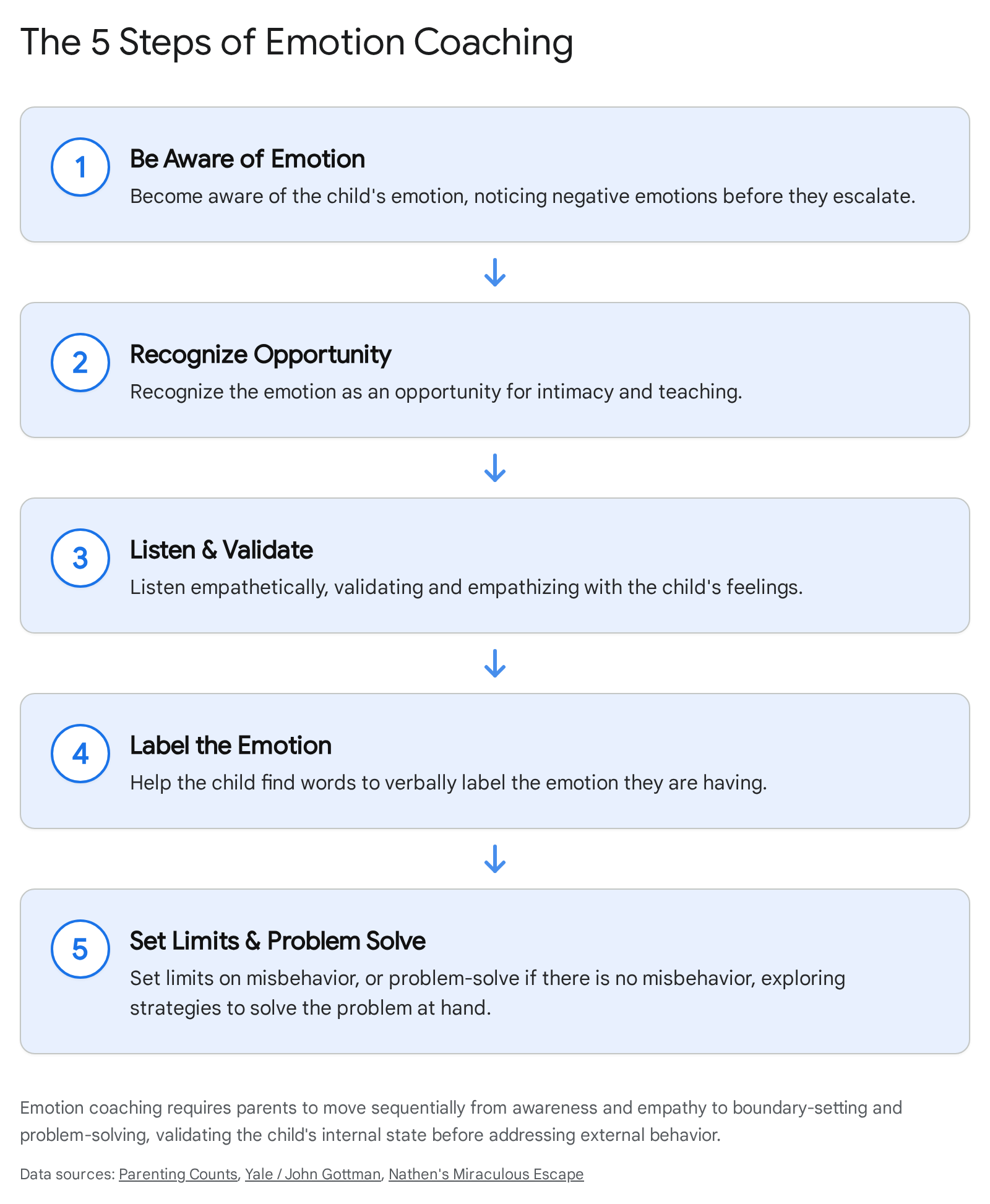
The first step requires the parent to become intimately aware of the child's emotion at a low level of intensity, rather than waiting for the emotion to escalate into a full-blown behavioral crisis or tantrum. The second step requires a paradigm shift in the parent's mindset: they must recognize the negative emotion not as an inconvenient nuisance or an act of defiance, but as a critical opportunity for intimacy, bonding, and teaching.
The third step is empathetic listening. The parent must listen to the child's perspective and validate their feelings, communicating clearly that the child's emotional reaction makes logical sense to the parent given the situation, even if the parent disagrees with the child's subsequent actions. The fourth step involves helping the child find words to verbally label the emotion they are experiencing. Building an emotional vocabulary helps the child move the processing of the event from the highly reactive amygdala to the rational prefrontal cortex.
The fifth and final step is setting limits while actively exploring strategies to solve the problem at hand. The parent validates the internal emotion but strictly corrects the external behavior. For example, an Emotion Coaching parent might say, "I know you are absolutely furious that your brother took your favorite toy without asking. It makes sense that you feel so angry. However, hitting is not allowed in this house. What else can we do to solve this problem right now?" This approach honors the child's internal reality while maintaining a safe, structured environment 52110.
Debunking Common Emotional Parenting Myths
Applying modern developmental neuroscience to parenting often requires caregivers to intentionally unlearn generational habits and cultural clichés. Several pervasive myths actively hinder a child's emotional development by encouraging parents to suppress, ignore, or punish complex feelings.
Myth 1: Shielding kids from negative emotions protects them.
For decades, well-meaning parents have operated under the assumption that they should hide their own stress, sadness, or marital conflict from their children to protect their innocence. A fascinating 2018 study from Washington State University fundamentally debunked this "not in front of the kids" philosophy.
Researchers brought mothers and fathers into a laboratory and placed them in a highly stressful public speaking scenario to artificially elevate their heart rates. Afterward, the parents were reunited with their seven-to-eleven-year-old children and asked to assemble a complicated Lego project together. Some parents were explicitly instructed to suppress their stress and act as though everything was perfectly fine, while others were told to act naturally. The study revealed that children easily picked up on the hidden "emotional residue" of their parents. When parents actively suppressed their emotions, the quality of the parent-child interaction plummeted; the parents offered less guidance, and the children physically responded by becoming less responsive, less warm, and less positive themselves 1213.
Hiding emotions creates a state of profound cognitive dissonance for children. They can physically sense the tension in the room, but the adults are explicitly telling them nothing is wrong, which teaches the child to doubt their own emotional intuition. Furthermore, a 2023 neuroimaging study demonstrated that when adults or children "keep the peace" by actively avoiding uncomfortable feelings, the brain's executive control systems are forced to work incredibly hard to inhibit those emotions, leaving fewer cognitive resources available for actual problem-solving 26. Researchers advise that it is far healthier for children to witness healthy, respectful conflict and emotional struggle, followed by a clear, healthy resolution, so they learn that negative emotions are not world-ending catastrophes 1213.
Myth 2: Validating an emotion means excusing bad behavior.
A remarkably common misconception is that if a parent validates a child's anger, they are implicitly condoning the tantrum, screaming, or physical aggression that followed the anger. Psychological research clearly separates the two phenomena. Emotions are internal, uncontrollable biological states; behaviors are external, controllable actions.
Validating an emotion simply means acknowledging the reality of the child's internal experience. A parent can easily say, "It makes complete sense that you are frustrated," while simultaneously enforcing a strict behavioral boundary: "But it is absolutely not okay to throw things" 2714. Rather than increasing bad behavior, addressing the emotion positively and accurately actually reduces the duration of the misbehavior. Clinical research indicates that validating a child's feelings diffuses psychological tension and can reduce power struggles within family settings by up to twenty-five percent 27.
Myth 3: "Tough love" and strict discipline build resilience.
The cultural idea that harsh punishment builds character and emotional toughness is widely discredited by decades of developmental psychology. Extensive data sets show that punitive measures, including physical spanking, excessive verbal criticism, or rigid authoritarianism, do not teach children how to navigate difficult situations or regulate their internal states. Instead, harsh parenting deeply damages the foundational parent-child bond, increases the likelihood of future aggressive behavior, and leads to poor emotional regulation and heightened anxiety later in life 29. Resilience is not forged in an environment of fear; true psychological resilience grows in an environment where a child feels profoundly supported and understood, even when they make significant mistakes 29.
Developmental Milestones of Emotional Intelligence
Emotional intelligence does not appear overnight; it develops in highly predictable, sequential stages that mirror the physical maturation of the brain. The Centers for Disease Control and Prevention (CDC) and the American Academy of Pediatrics (AAP) outline specific social and emotional milestones that caregivers can expect. Understanding these stages is critical, as it prevents parents from punishing behavior that is entirely developmentally appropriate for a specific age. In 2022, the CDC updated these milestone guidelines, shifting the benchmarks so that they reflect what 75 percent or more of children can be expected to achieve at a given age, rather than the previous 50th percentile, to help identify potential developmental delays earlier 30.
Early Childhood: Infants and Toddlers (Ages 0 - 3)
In the first year of life, emotional development is largely centered around establishing secure attachment and basic social reciprocation. By two months, infants begin to smile spontaneously at people and can briefly calm themselves by bringing their hands to their mouths. By four to six months, babies begin to closely scan faces, interpret the emotional expressions of familiar adults, and respond to the emotions of others with joy 153216.
Between ages one and three, children enter a highly turbulent period characterized by intense physical reactivity and burgeoning independence. Because the prefrontal cortex is entirely unformed at this stage, toddlers have virtually no reliable impulse control. Temper tantrums, hitting, and biting over seemingly minor issues are incredibly common and represent developmentally normal expressions of frustration 1735. During this phase, toddlers engage heavily in parallel play - playing alongside other children rather than cooperatively with them. However, by age two, foundational empathy begins to emerge. Toddlers may pause or look visibly sad when another child cries, and they actively look to adults' faces for emotional cues on how to react to novel or frightening situations 321718.
Early School Age: Preschoolers (Ages 3 - 5)
During the preschool years, children begin the complex transition from parallel play to cooperative play. They develop a simplistic, binary understanding of right and wrong, and they can share toys and take turns with adult assistance 35. At this stage, cognitive abilities mature rapidly, allowing children to engage heavily in make-believe and imaginative role-play, which helps them process social scenarios. While their frustration tolerance is noticeably increasing compared to toddlerhood, their behavior remains highly inconsistent. They can accurately interpret emotions from facial expressions and tone of voice, but they still require heavy, consistent emotion coaching from adults to navigate peer conflicts and self-regulate 3518.
Middle Childhood: Grade Schoolers (Ages 6 - 12)
The elementary school years represent a critical window for social expansion and the development of self-concept. Children this age begin to understand their place in the broader world and pay increasing attention to friendships, teamwork, and societal rules 219.
By age six, children can clearly distinguish between the real and the imaginary and begin to grasp complex cause-and-effect relationships regarding their behavior 20. Around ages nine to eleven, peer relationships become emotionally paramount. Children become increasingly self-conscious, seek immediate gratification, and may experience rapid, dramatic shifts in their friend groups. Importantly, they begin to develop the capacity for more complex empathy and metacognition - the ability to think critically about their own thoughts and emotional reactions 352122. Mood swings and irritability become incredibly common as they approach puberty, largely due to a combination of hormonal changes, increased academic pressure, and inadequate sleep 22.
Adolescence: Teens (Ages 13 - 18)
Adolescence is defined psychologically by the intense drive for independence and identity formation. Teens develop highly abstract thinking abilities and begin to grapple with complex concepts like morality, future societal roles, and personal values 2241.
During this phase, adolescents often experience a phenomenon known as "adolescent egocentrism," which profoundly affects how they regulate their emotions. This egocentrism manifests in two primary ways: the "imaginary audience," which is the teen's intense belief that everyone is constantly watching and judging their appearance and actions; and the "personal fable," which is the profound belief that their emotional experiences are entirely unique to them and impossible for anyone else - especially parents - to understand 22. Due to these cognitive shifts, teens may heavily test boundaries, act moody, and prioritize peer validation over family time. Emotion coaching during this stage requires a delicate balance: parents must respect the teen's increasing need for privacy and autonomy while remaining a steady, non-judgmental sounding board when emotional crises inevitably occur 2122.
Summary of Emotional Milestones by Age
| Developmental Stage | Key Emotional Characteristics | Primary Social Focus | Regulatory Capacity |
|---|---|---|---|
| Infants (0-12m) | Develops social smile; mimics facial expressions; separation anxiety emerges. | Securing attachment to primary caregivers. | Highly dependent on adults for soothing; basic self-soothing (e.g., thumb sucking). 1516 |
| Toddlers (1-3y) | Intense frustration; tantrums normal; basic empathy emerges (noticing others crying). | Safe-base exploration; parallel play with peers. | Minimal impulse control; requires adult intervention to manage high arousal. 321735 |
| Preschool (3-5y) | Imaginative play; understands basic right/wrong; inconsistent behavior. | Cooperative play begins; sharing with assistance. | Increasing frustration tolerance but still needs active emotion coaching. 3518 |
| Grade School (6-12y) | Metacognition develops; highly self-conscious; mood swings begin near puberty. | Friendships become paramount; peer pressure increases. | Can label complex emotions and understand cause/effect of behavior. 352122 |
| Adolescence (13-18y) | Abstract thinking; identity formation; adolescent egocentrism (imaginary audience). | Independence from family; intimate peer networks. | High capacity for regulation, but often overridden by hormonal and social stressors. 2241 |
Cross-Cultural Perspectives on Emotional Development
When examining the scientific literature on emotional intelligence, it is crucial to recognize that the vast majority of traditional psychological research is heavily biased toward WEIRD (Western, Educated, Industrialized, Rich, Democratic) populations. These populations represent only a tiny fraction of the global population, yet their developmental metrics are often presented as universal human standards 23. In reality, emotional intelligence, moral judgment, and healthy child development look remarkably different across varying cultural contexts 2324.
The Divide: Individualism vs. Collectivism
In highly individualistic Western cultures, such as the United States and parts of Western Europe, child-rearing heavily emphasizes personal achievement, independence, and the open, verbal assertion of one's feelings. Emotional intelligence in these cultures is frequently equated with high self-esteem, self-reliance, and the ability to articulate individual boundaries and needs 4445.
Conversely, in collectivist cultures, such as many Asian, African, and Latin American societies, emotional development prioritizes group harmony, interdependence, and strict family obligation. Children in these cultures are taught to read subtle non-verbal cues, anticipate the needs of others without being asked, and often practice emotional restraint or suppression to avoid burdening the group or causing social friction 444525.
Research shows these deeply ingrained cultural values fundamentally alter how children process moral judgments and emotional cues from a very young age. A cross-cultural psychological study integrating visual attention tracking and verbal evaluation found that Western children are socialized to focus heavily on a person's internal personality traits when evaluating behavior. In contrast, Asian children are socialized to immediately consider the emotional states and reactions of those surrounding the actor 26.
The African Philosophy of Ubuntu
In Sub-Saharan Africa, child development is deeply influenced by the traditional philosophy of Ubuntu, which translates roughly to "I am because we are." Ubuntu defines humanity entirely through interconnectedness, compassion, and reciprocity 2749.
Under Ubuntu parenting models, a child does not belong solely to their biological parents but to the entire extended community. Child-rearing is a collective responsibility, providing children with a vast network of mentors, disciplinarians, and caregivers. If a child behaves poorly, the action reflects on the entire family unit; if the child succeeds, the community succeeds 442750. Recent developmental studies show that incorporating Ubuntu principles into educational and psychological frameworks gives adolescents a profoundly stronger sense of belonging. This collective approach to emotion regulation builds robust emotional resilience against severe systemic challenges, such as poverty and social alienation, providing a protective buffer that individualistic approaches often lack 5128.
The Japanese Concept of Amae
In Japan, infant and child emotional development is largely anchored by the cultural concept of Amae, which describes a deep, presumed sense of interdependence and the innate desire to be loved, indulged, and cared for by an authority figure. While Western attachment theory pushes children toward early autonomy and views prolonged dependence cautiously, Japanese child-rearing views Amae as a vital, highly adaptive expression of trust and emotional oneness between mother and child 295455.
Cross-cultural observational studies show that Japanese mothers are generally highly tolerant of a child's Amae behaviors - such as clinging, whining, or seeking physical comfort - compared to British or American mothers. This high tolerance fosters a deeply relational style of emotion regulation, where the child relies on the caregiver as a lifelong secure base, rather than rushing toward the total emotional independence valued in the West 5556.
Modern Environmental Stressors: The Digital Landscape
While human biology and cultural frameworks provide the foundation for emotional intelligence, the modern landscape of childhood has been radically altered by the advent of smartphones, tablets, and social media. As child psychologists and pediatricians shift toward a preventive, whole-child approach to mental health, the impact of digital media on a child's ability to regulate their emotions has emerged as a primary, global concern 3031.
Early Childhood: Screen Overload and Technoference
In early childhood, the risks associated with digital media are primarily developmental and neurobiological. The first three years of life are a sensitive period of rapid brain development, requiring rich multisensory experiences and responsive human interaction. A comprehensive 2025 meta-analysis published by the American Psychological Association, encompassing data from over 292,000 children globally, confirmed a strong bidirectional relationship between screen time and emotional dysregulation 32.
The study found that high screen exposure in infants and toddlers displaces vital face-to-face interactions and physical play, leading directly to difficulties with attention, increased fatigue, and impaired self-regulation 323334. Furthermore, researchers have identified a phenomenon known as "technoference" - the disruption of parent-child interactions due to the parent's own use of digital media. When parents are distracted by their smartphones, they exhibit reduced emotional responsivity. This deprives the child of the exact micro-interactions and emotion coaching they desperately require to build neural resilience and learn self-soothing techniques 3435.
Adolescence: Social Media Algorithms and Anxiety
For older children and adolescents, the primary digital stressor is social media. Platforms like Instagram and TikTok expose teens to algorithmically driven, hyper-stimulating content and relentless opportunities for social comparison. This digital environment can lead to increased loneliness, fear of missing out (FOMO), and severe sleep disturbances, all of which cripple the brain's biological ability to regulate negative emotions 3664.
Recent functional brain imaging studies reveal that anxious youth, when watching emotionally negative content on screens, experience distinct brain activity states that plunge them deeper into negative internal thoughts and rumination, a process heavily exacerbated by algorithmic "doom-scrolling" 37. The addictive nature of these platforms creates dopamine loops that make it incredibly difficult for adolescents to disengage, leading to emotional exhaustion and irritability when access is restricted 64.
However, despite these alarming trends, the scientific and psychological community is actively moving away from advocating for absolute, severe bans on social media. Emerging research, including a 2024 viewpoint paper in the Journal of Medical Internet Research, suggests that outright bans are not only largely ineffective but also strip away the protective benefits of social media. For many adolescents, particularly those in marginalized groups like LGBTQ+ youth, social media provides vital peer connections, a sense of belonging, and avenues for learning 3138.
Instead of total restriction, experts strongly recommend that parents focus on teaching "digital emotion regulation." Parents with high "digital parenting awareness" who actively co-navigate media with their children, enforce healthy sleep boundaries, curate positive content, and maintain warm family harmony successfully buffer their children against the negative impacts of the digital world, allowing them to reap the benefits of connection without succumbing to algorithmic anxiety 3564.
The Long-Term Outcomes of Emotional Intelligence
The sustained effort required for caregivers to consistently emotion-coach a child, set healthy digital boundaries, and model emotional regulation yields profound, lifelong dividends. Children who develop high emotional resilience are demonstrably better equipped to navigate the complex demands of academic, professional, and social life.
Academic and Psychological Success
A recent latent profile analysis of children revealed that early emotional and behavioral resilience predicts significant academic success years later. The study found that children with strong emotional regulation abilities scored significantly higher in basic reading skills, reading comprehension, and math reasoning compared to peers who lacked these skills. Astonishingly, these academic advantages held true even when baseline cognitive abilities were controlled for, suggesting that the ability to manage frustration and focus attention is just as vital to learning as raw intelligence 39.
In adolescence, high emotional intelligence serves as a critical protective buffer against the inevitable vicissitudes of life. It acts as a psychological mediator, allowing teens to process trauma, academic failure, and social rejection without falling into maladaptive coping mechanisms like substance abuse or severe self-harm 168. Emotionally intelligent teens report greater positive affect, stronger social support networks, and higher levels of prosocial behavior 1.
The Generational Transmission of Empathy
Perhaps the most compelling evidence for the supreme importance of emotion coaching comes from a landmark 25-year longitudinal study conducted by researchers at the University of Virginia. Starting in 1998, the research team tracked 184 teenagers, meticulously observing how their parents handled their emotional struggles and interpersonal conflicts. The researchers then tracked these individuals well into adulthood and, eventually, observed how they parented their own children 4.
The results, published in the journal Child Development in 2024, proved that empathy and emotional intelligence are literally contagious across generations. The teens whose parents were engaged, sympathetic, and understanding when they struggled grew up to be highly empathetic adults who expertly supported their friends through difficulties. Crucially, when these individuals became parents themselves, they naturally passed these emotion-coaching behaviors down to their own children 4.
The study concluded with a powerful takeaway for caregivers: simply telling children to be kind, or lecturing them on the importance of good behavior, is ultimately ineffective. To raise an emotionally intelligent, empathetic child, the child must have consistent, firsthand experience of being deeply understood, validated, and supported by their own caregivers 4.
Bottom line
Raising an emotionally intelligent child is an active, highly intentional process that relies heavily on a caregiver's willingness to validate difficult feelings and coach a child through them, rather than dismissing or punishing negative emotions. While genetics provide a baseline temperament, developmental neuroscience clearly proves that an empathetic, boundaried environment physically shapes the brain's capacity for resilience and self-regulation. What remains less certain is how rapidly evolving digital stressors and algorithmic media will impact these neurological processes long-term, requiring parents to continuously adapt their coaching strategies to help children safely navigate both the physical and digital worlds.