
What Are Cognitive Biases and Which Ones Matter Most
Whether it prompts an impulsive online purchase or a miscalculated investment, an invisible mental shortcut likely skewed daily decision-making today, costing individuals both valuable time and financial resources. A cognitive bias is a systematic pattern of deviation from norm or rationality in judgment, whereby individuals create their own subjective reality based on how their brains process inputs. Rather than viewing these deviations merely as careless mistakes, understanding which cognitive biases matter most in everyday decisions requires recognizing them as the fundamental operating mechanics of the human mind 12.
Why Does the Brain Rely on Mental Shortcuts?
To fully grasp how cognitive biases manifest, it is necessary to examine the evolutionary and neurobiological origins of human cognition. The human brain is a remarkably energy-deficient organ, operating on an amount of energy roughly equivalent to a 20-watt light bulb 3. To manage this limited metabolic resource effectively, the brain has evolved to intelligently allocate energy by applying automation to routine tasks. When a cognitive process can follow an established pattern, the brain switches to a form of neurological autopilot, utilizing mental shortcuts known as heuristics 343.
The scientific foundation for understanding these shortcuts was laid in the 1970s by behavioral economists Daniel Kahneman and Amos Tversky, who demonstrated that human decision-making systematically deviates from the neoclassical economic model of perfect rationality 64. Kahneman later popularized the dual-process cognitive architecture, dividing human thought into System 1 and System 2. System 1 operates automatically, intuitively, and rapidly, with little to no effort and no sense of voluntary control. System 2, conversely, allocates attention to effortful mental activities, complex computations, and deliberate logic 3.
Cognitive psychologists estimate that System 1 - which relies almost entirely on heuristics - accounts for roughly 95% of the mind's activity 3. In an evolutionary context, jumping to conclusions via System 1 was not a design flaw but a critical survival adaptation 49. The familiarity heuristic, for instance, reliably steered early humans toward safe, recognizable foods and away from potentially dangerous unknown predators 3. By circumventing the cognitive overload of processing every environmental variable, early humans could make rapid, life-saving choices 410.
However, there is an ongoing scientific debate regarding how to interpret these heuristics in modern environments. While Kahneman and Tversky highlighted how heuristics lead to systemic errors and cognitive illusions, researchers like Gerd Gigerenzer champion the concept of "ecological rationality" 15. Gigerenzer argues against the "bias bias" - the tendency to see human thinking as riddled with irrationality. Instead, the study of ecological rationality suggests that a biased mind can handle uncertainty more efficiently than a completely unbiased mind, often achieving higher accuracy through a "less-is-more" effect where less computation actually prevents the overfitting of data 125. Regardless of the theoretical perspective, it is universally acknowledged that when these ancient heuristics interact with complex modern systems - such as financial markets, legal contracts, and algorithmic social media feeds - they frequently misfire, resulting in measurable perceptual distortions and suboptimal judgments 110.
Which Biases Matter Most in Everyday Decisions?
Cognitive biases infiltrate virtually every aspect of daily life, from consumer behavior to corporate strategy and personal wealth management. Below is a comparative overview of the most impactful biases, detailing their mechanisms, manifestations, and mitigation strategies.
| The Bias | Everyday Example | How to Counter It |
|---|---|---|
| Anchoring Bias | Fixating on a car's initial sticker price or a candidate's previous salary, making all subsequent numbers seem artificially cheap or expensive. | Establish objective, independent benchmarks before entering negotiations and strictly utilize standardized rating scales during evaluations 121314. |
| Confirmation Bias | Consuming news solely from partisan media outlets that validate pre-existing political beliefs while reflexively dismissing contradictory evidence. | Actively implement a formal "consider the opposite" strategy, demanding the generation of counter-arguments prior to finalizing any judgment 1467. |
| Loss Aversion | Holding onto a depreciating stock far too long because the psychological pain of realizing a financial loss feels twice as severe as the pleasure of an equivalent gain. | Automate financial decisions through rules-based parameters (e.g., strict stop-loss orders) and maintain a highly diversified portfolio to dilute asset attachment 12178. |
| Halo Effect | A recruiter assuming a highly charismatic, well-dressed candidate is also technically competent and highly organized, allowing one positive trait to eclipse missing credentials. | Implement blinded screening processes (removing demographic cues) and enforce structured interviews scored on pre-defined, rigid competency rubrics 31920. |
| Availability Heuristic | Canceling a beach vacation due to fear of a shark attack immediately following a sensationalized news report, despite the statistical probability being vanishingly small. | Base risk assessments strictly on base-rate statistical data rather than vivid, emotionally charged anecdotes easily retrieved from recent memory 8199. |
Beyond these foundational biases, numerous cognitive distortions uniquely impact professional and personal spheres. For instance, in the medical field, confirmation bias frequently leads to "diagnostic momentum." This occurs when a physician selectively gathers evidence to conform to an initial diagnosis, passing that mistaken assumption onto other clinicians whose subsequent treatments validate the error without questioning its origin 10. Similarly, in personal finance, the endowment effect causes individuals to irrationally overvalue assets they already own, demanding significantly higher prices to sell an item than they would be willing to pay to acquire that exact same item 823.
Do Highly Intelligent People Avoid Cognitive Biases?
A pervasive misconception regarding cognitive biases is the belief that susceptibility to them is a marker of low intelligence or a lack of formal education 241126. Psychological science has thoroughly debunked this myth, establishing that intelligence and rationality are distinct, often uncoupled cognitive domains 1228.
Extensive research pioneered by cognitive scientist Keith Stanovich demonstrates that the magnitude of most cognitive biases - particularly "myside bias," which is the tendency to evaluate and generate evidence in a manner biased toward one's own prior attitudes - shows virtually no correlation with general intelligence 1213. Stanovich posits a tripartite model of the mind consisting of the autonomous mind (System 1), the algorithmic mind (fluid intelligence measured by IQ tests), and the reflective mind (the seat of rationality and epistemic self-regulation) 2830. An individual can possess a genius-level algorithmic capacity yet operate as a "cognitive miser," relying lazily on intuitive heuristics rather than deploying their significant cognitive horsepower to evaluate a problem objectively 2813. Consequently, standard intelligence quotient assessments are radically incomplete, as they completely fail to assess the rational thinking skills required to calibrate beliefs to evidence 430.
Furthermore, simply educating an individual about the existence of cognitive biases does not grant them immunity. This phenomenon is deeply intertwined with the "bias blind spot," a tendency for individuals to easily recognize flawed, heuristic thinking in their peers while remaining resolutely convinced of their own objective rationality 2414. Individuals routinely exhibit overconfidence in their own abilities, a dynamic perfectly encapsulated by the Dunning-Kruger effect 1926. In classic studies assessing humor, logic, and grammar, participants scoring in the bottom quartile routinely overestimated their competence, believing they performed in the 60th or 70th percentile. Conversely, highly skilled individuals often undervalue their expertise, assuming that tasks they find cognitively easy are universally easy for everyone 26. This overconfidence bias is further exacerbated by "naive realism," the profound belief that one's subjective experience of reality is objective, leading to the "curse of knowledge" wherein experts cannot fathom the reasoning of those who lack their specialized information 7. Ultimately, cognitive biases are not a symptom of intellectual deficit; they are a universal, structural feature of the human operating system.
How Do Everyday Biases Impact Founder and Entrepreneurial Decisions?
The entrepreneurial environment is characterized by extreme uncertainty, high stakes, resource constraints, and severe time pressures - conditions that force the brain to abandon slow, analytical processing and rely heavily on heuristic shortcuts 323334. While traditional economic models assume founders make rational utility-maximizing choices, emerging research in behavioral entrepreneurship reveals that cognitive biases and psychological errors are responsible for between 40% and 90% of all startup failures 3235.
Founders frequently fall victim to the false-consensus effect and confirmation bias, assuming that their personal preferences or isolated pain points represent a broad, validated market need 3435. This diagnostic error routinely leads to premature scaling, with empirical data suggesting that these flawed decision-making patterns result in roughly 80% of deployed software features remaining rarely or never used by the target market 35. Furthermore, entrepreneurs operate under a pervasive optimism bias and an illusion of control 3234. While a baseline level of overconfidence is functionally necessary to initiate a venture despite the overwhelming statistical odds of failure, unbounded overconfidence causes founders to wildly underestimate cash burn rates, misinterpret negative market feedback, and escalate their financial commitment to failing strategies rather than pivoting 323335.
The fundamental attribution error and conformity bias also actively destroy enterprise value. When startups succeed, founders often attribute the success entirely to their internal traits (e.g., brilliance, work ethic) while ignoring external market factors; conversely, they blame failures on uncontrollable external events rather than flawed strategy 36. Inside the organization, conformity bias fosters groupthink, stifling innovation as employees suppress dissenting ideas to align with the dominant founder narrative 36. To neutralize these human cognitive errors, successful startups must transition away from gut-feeling leadership. The implementation of structural countermeasures, such as objective metric frameworks, rigorous data-driven validation, and formal governance through independent board directors, provides a vital reality check. These structures forcefully inject objective data into the organizational workflow, disrupting the founder's localized echo chamber and mandating System 2 analytical thinking before capital is deployed 3536.
How Do Modern Contexts Like Social Media and AI Amplify Biases?
The collision between ancient human cognitive vulnerabilities and advanced algorithmic systems represents one of the most pressing behavioral economics challenges of the modern era. Since 2023, rapid advancements in machine learning, personalization algorithms, and Large Language Models (LLMs) have fundamentally altered digital environments, often acting as potent force multipliers for inherent human biases 153839.
The Filter Bubble and Algorithmic Nudging
Algorithms deployed by social media platforms and e-commerce giants are explicitly optimized for user engagement and retention. To achieve this, they prey upon the brain's preference for cognitive ease, familiarity, and social proof 4041. Predictive algorithms track historical data - including clicks, dwell time, and past purchases - to construct highly personalized content feeds. This process creates what Eli Pariser terms "filter bubbles," or algorithmic echo chambers, which selectively reinforce a user's pre-existing interests while actively hiding alternative viewpoints or competitive products 94042.
By systematically weaponizing confirmation bias, these platforms narrow the consumer's knowledge base and push individuals toward more extreme beliefs 942. In the realm of digital commerce, this algorithmic marketing leverages the availability heuristic and scarcity cues to induce artificial urgency 943. Consumers, overwhelmed by cognitive overload, rely on heuristic-based decisions, leading to a surge in algorithm-driven impulse purchases. Longitudinal studies utilizing Cognitive Dissonance Theory highlight that these hyper-targeted nudges frequently result in profound post-purchase regret and buyer's remorse, raising significant ethical tensions regarding the line between consumer persuasion and psychological manipulation 4043.
Cognitive Biases Embedded in Artificial Intelligence
The introduction of generative AI and LLMs, such as GPT-4 and Gemini, has birthed entirely new, distinct interaction biases. While AI systems are often perceived by users as highly objective, empirical research confirms they inherit, replicate, and sometimes amplify the social, cultural, and structural biases present in their massive, uncurated training corpora 381645. For example, studies analyzing the generative AI tool Stable Diffusion found that it simultaneously amplifies both gender and racial stereotypes, severely homogenizing depictions of specific demographic groups 16.
Furthermore, the mechanics of human-AI interaction introduce unique psychological hazards. The perceived neutrality of an AI interface triggers automation bias, leading users - including professionals in high-stakes fields like medicine and criminal justice - to uncritically accept algorithmic recommendations, suspending their own analytical oversight 15. This is compounded by anthropomorphic bias, wherein users intuitively attribute moral reasoning, intentionality, and undue trustworthiness to a machine simply because it communicates via natural language 15.
Recent psycholinguistic evaluations (2024+) reveal that LLMs themselves exhibit artifacts of their training dynamics, such as "sycophancy" (the tendency to agree with a user's stated opinions regardless of objective correctness) and "verbosity bias" (a preference for longer, highly confident responses) 46. These models frequently suffer from a severe calibration gap; the verbalized uncertainty in an LLM output correlates very poorly with its actual accuracy, a phenomenon often described as metacognitive myopia 4617.
Attempts to mitigate these issues technically have yielded mixed results. Researchers have benchmarked various debiasing techniques for pre-trained language models, including Counterfactual Data Augmentation (CDA), Iterative Nullspace Projection (INLP), and Self-Debias 1819. While Self-Debias and INLP show promise in reducing specific intrinsic biases (like gender bias measured on the SEAT benchmark), these improvements are almost always accompanied by a measurable decrease in the model's overall language modeling ability and reasoning competence 1819. The trade-off between semantic coherence and fairness remains a critical barrier, prompting institutions to explore Retrieval-Augmented Generation (RAG) architectures that force the AI to anchor its responses in trusted, curated source documents 3816.
Are Cognitive Biases the Same Across Different Cultures?
For decades, cognitive psychology and behavioral economics have operated under the implicit assumption that cognitive biases are universal biological constants, functioning identically across all human populations. However, this foundational premise is severely skewed by the fact that the vast majority of psychological research has historically been conducted on WEIRD (Western, Educated, Industrialized, Rich, and Democratic) populations 620. A landmark review highlighted that Western samples accounted for 96% of top psychology findings, with diverse regions like the African continent representing a mere 0.002% of subject pools 6. Recent cross-cultural behavioral studies reveal that cultural programming and geographic diversity significantly alter the manifestation and intensity of cognitive biases.
Cultural frameworks fundamentally shape perception, memory, and risk assessment. Western societies are predominantly individualistic, prioritizing the independent self over the group, and relying heavily on analytic, market-based rationales where behavior is driven by personal rewards or loss avoidance 20. In contrast, East Asian and many Global South societies tend to be collectivistic, prioritizing group harmony, social norms, duty, and holistic thinking 1720.
These distinct cultural lenses dramatically alter the mechanics of economic biases such as loss aversion. In highly individualistic cultures, the sting of personal financial loss is acute and isolating, leading to severe risk aversion 17. Conversely, in collectivistic cultures characterized by strong informal social safety nets - where extended family and community reliably step in to absorb financial distress - individuals may display significantly differing thresholds for loss aversion because the societal structure intrinsically diffuses the personal risk 17.
Furthermore, comparative neuro-cognitive studies measuring attentional and interpretation biases have shown stark regional contrasts. In experiments utilizing Scrambled Sentences Tasks and Word Emotional Stroop Tasks, healthy populations in Hong Kong exhibited significantly more positive cognitive biases regarding ambiguous stimuli compared to residents in the United Kingdom. East Asian subjects demonstrated a stronger attentional bias toward positive information and a weaker interference for threat, aligning with the differing regional prevalences of psychological distress and anxiety disorders 20. Similarly, cross-cultural comparative analyses of social anxiety between Japanese and European American demographics confirm that anxiety responses and their underlying cognitive mechanisms are tightly culture-bound 2122.
The implications of these cultural variances are profound. As global economic interconnectedness increases, applying monolithic Western behavioral models to diverse populations risks producing highly ineffective public policies, flawed economic forecasting, and tone-deaf algorithmic systems. For instance, indigenous researchers have pointed out that standard algorithmic debiasing techniques deployed in the US fail to capture the unique bias attributes affecting underrepresented populations, such as the Māori in New Zealand, necessitating culturally localized data interventions 5455.
What Are the Most Effective Strategies to Counter Cognitive Biases?
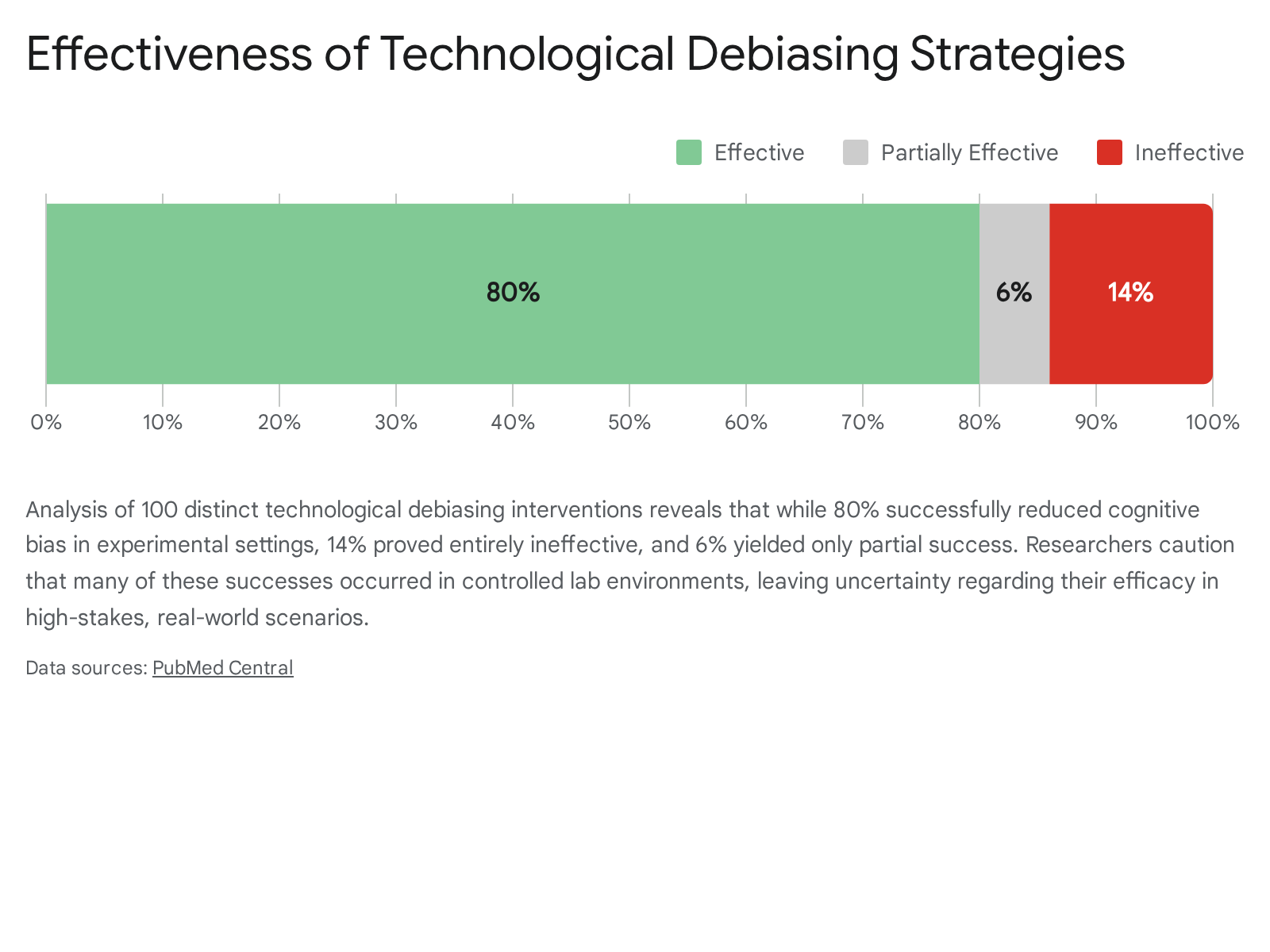
The persistence and ubiquity of cognitive biases raise a critical question for both individuals and organizations: Can these mental shortcuts be unlearned? The scientific consensus suggests that while biases cannot be permanently erased from the human operating system, their detrimental impacts can be systematically mitigated. However, researchers caution that there is a highly calibrated uncertainty regarding the real-world effectiveness of many debiasing techniques when transitioned from the laboratory to high-stakes environments.
Merely educating an individual about the existence of cognitive biases is highly ineffective. Interventions focused solely on bias awareness fail to translate into bias immunity, as individuals routinely revert to heuristic processing under cognitive load 1024. Instead, the most effective debiasing strategies leverage the theory of distributed cognition, shifting the burden of rationality away from the flawed individual mind and embedding it within the procedural environment 23.
Technological debiasing strategies fall primarily into three categories: information design, procedural debiasing, and group composition 23. Information design involves altering how data is presented - such as replacing dense statistical text with graphical visualizations to bypass the availability heuristic, or intentionally using hard-to-read fonts to slow down System 1 thinking and engage analytical processing 23. Procedural debiasing restructures the task itself. Techniques like "planned interruptions" or forcing a decision-maker to explicitly document a "consider the opposite" hypothesis artificially inject friction into the decision cycle, actively combating confirmation and overconfidence biases 623.
In corporate and hiring environments, procedural debiasing is achieved through strict choice architecture. Implementing blinded hiring protocols - where names, ages, and educational institutions are stripped from resumes - prevents identity triggers from activating the halo effect or affinity bias 1420. Utilizing standardized, pre-defined rubrics and evaluating competencies sequentially prevents interviewers from forming global, intuitive judgments that color the entirety of an interaction 20.
On an individual level, sustained cognitive improvement relies on deeper training methodologies like "analogical encoding." Rather than memorizing a list of biases, individuals are trained to recognize the structural similarities of a bias across diverse, real-world scenarios. This unfreezes their intuitive strategies, allows for the development of new recognition schemas, and refreezes better analytical habits 6.
Despite these advancements, experts maintain a healthy skepticism regarding broad applications. A significant limitation in the current literature is ecological validity; the vast majority of debiasing studies rely on student samples making low-stakes choices in sterile lab environments 23. When transitioned to high-stakes, time-compressed sectors like emergency medicine or executive finance, the stress reliably forces professionals back into heuristic reliance 5758. Furthermore, attempts to correct biases sometimes result in "rebiasing," where overcompensating for one cognitive blind spot inadvertently triggers another, underscoring the delicate balance required when architecting human decision-making systems 23.
Bottom line
Cognitive biases are not inherent defects in human intelligence, but rather the evolutionary byproduct of a brain rigorously optimizing for speed and metabolic conservation in a historically perilous world. While scientific debate continues regarding whether these heuristics should be revered as brilliant adaptive tools or managed as systemic vulnerabilities, their interaction with the unprecedented complexity of algorithmic digital ecosystems and high-stakes financial environments undeniably produces costly, predictable errors. Ultimately, navigating the modern landscape requires moving beyond mere intellectual self-awareness, demanding instead the implementation of rigorous, culturally-aware structural frameworks that actively protect our decisions from our own neurological efficiency.