
Attribute substitution and systematic errors in consumer judgment
Theoretical Foundations of Attribute Substitution
The mechanics of human decision-making and judgment under uncertainty are foundational to consumer psychology, behavioral economics, and strategic management. At the core of this discipline lies the concept of attribute substitution, a psychological process formally articulated by Daniel Kahneman and Shane Frederick in 2002 123. Attribute substitution serves as the unifying cognitive mechanism underlying a broad family of heuristics and systematic biases observed in human behavior 34. It posits a model of bounded rationality wherein individuals tasked with making complex, computationally demanding judgments unconsciously replace the difficult question with a simpler, more easily resolvable one 23.
The historical and theoretical underpinnings of this concept trace back to psychophysics research conducted by Stanley Smith Stevens in 1975. Stevens demonstrated that the intensity of a stimulus - such as the physical brightness of a light or the abstract severity of a crime - is neurally encoded in a modality-independent manner 23. Building upon this psychophysical framework, Kahneman and Frederick hypothesized that human cognition routinely executes cross-modal substitutions, permitting a target attribute (the intended object of evaluation) to be replaced by a heuristic attribute (the substitute) that is vastly different in nature but more rapidly accessible to the mind 23.
Attribute substitution relies heavily on the dual-process architecture of human cognition, frequently partitioned into System 1 and System 2 56. System 1 operates automatically, intuitively, and rapidly, generating immediate impressions and feelings. System 2 is deliberate, analytical, and computationally slow, responsible for complex calculations and rule-based logic 56. When faced with a complex target attribute, System 1 automatically retrieves a highly accessible heuristic attribute. If System 2 fails to detect and correct this substitution, a systematic evaluation error occurs in the final judgment 34.
For attribute substitution to occur and subsequently manifest as a judgment error, three distinct cognitive conditions must be met simultaneously within this dual-system framework 47. First, the target attribute must be relatively inaccessible. Substitution does not occur for simple factual questions directly retrievable from memory, but rather in response to complex calculations, abstract probabilities, or multi-variable optimizations 4. Second, an associated heuristic attribute must be highly accessible. This accessibility can be chronic, stemming from evolutionary adaptations or extensive personal experience, or it can be acute, triggered by immediate environmental priming or visual salience 47. Finally, the reflective System 2 must fail to detect the substitution and correct the output 4. System 2 is easily burdened by cognitive load, time pressure, or information overload; when exhausted or inherently lazy, it defaults to the outputs provided by System 1 5.
When these three conditions align, the consumer effectively answers a difficult question by substituting the answer to a related but different question, often remaining entirely unaware that the substitution has taken place 34. This lack of conscious awareness explains why systematic biases are persistent and difficult to eradicate even when individuals are explicitly educated about them 3.
Differentiation from Related Cognitive Mechanisms
Because attribute substitution operates as a foundational computational mechanism, it is frequently conflated with the specific heuristic outcomes it produces, as well as with parallel cognitive biases. Disaggregating these phenomena clarifies how specific consumer evaluations are distorted across varying retail and digital environments 88.
| Cognitive Mechanism | Defining Characteristic | Relationship to Attribute Substitution | Consumer Environment Example |
|---|---|---|---|
| Attribute Substitution | The overarching process of replacing a complex target assessment with a simpler heuristic assessment. | The foundational mental operation driving various heuristics 2. | A buyer assesses the technical superiority of a vehicle by substituting their emotional affinity for the brand 9. |
| Affect Heuristic | Utilizing immediate emotional reactions or feelings to evaluate risk and benefit. | A specific subtype of substitution where affect (emotion) serves as the heuristic attribute for a complex variable 1810. | Purchasing an expensive, high-risk financial product because the sales representative elicited feelings of comfort and warmth 18. |
| Availability Heuristic | Judging the frequency or probability of an event by the ease with which instances come to mind. | A subtype of substitution where recall fluency is the heuristic attribute substituted for objective probability 811. | Overestimating the likelihood of a plane crash because vivid news reports are highly accessible in memory 48. |
| Representativeness Heuristic | Judging probabilities on the basis of resemblance or similarity to a prototype. | A subtype of substitution where similarity is the heuristic attribute substituted for statistical likelihood 288. | Assuming a rugged-looking truck is inherently more durable due to its visual resemblance to an archetype of toughness 11. |
| Halo Effect | The tendency for a single positive or negative trait to spill over and contaminate the evaluation of unrelated traits. | Provides the highly accessible cue (e.g., attractiveness) that is then substituted for a complex target (e.g., competence) 81013. | A consumer perceives a physically attractive brand spokesperson to also be highly intelligent and socially responsible 131213. |
In classic psychological studies mapping these effects, researchers have documented the "Beautiful-is-Familiar" effect, demonstrating how the halo of physical attractiveness operates explicitly through attribute substitution. When subjects were asked to identify if they had seen a face previously (a complex memory retrieval task), they systematically misidentified attractive faces as familiar 316. The subjects substituted the "warm glow" of positive affect generated by beauty for the target attribute of objective memory familiarity 316. Similar dynamics occur in financial evaluations, where the aesthetic appeal of an annual report or a digital application acts as a halo, prompting investors to substitute visual fluency for underlying fundamental asset quality 513.
Manifestations of Systematic Evaluation Errors
The failure of System 2 to override intuitive substitutions results in systematic, predictable evaluation errors in consumer and organizational behavior. Two of the most structurally profound errors driven by this mechanism are base-rate neglect and scope neglect, both of which severely distort risk assessment and financial valuation.
Base-Rate Neglect and Incorrect Mental Models
Base-rate neglect occurs when individuals ignore the a priori probability (the base rate) of an event, instead overutilizing specific, localized case information or prototypes 1415. This is a direct consequence of the representativeness heuristic. In the seminal Kahneman and Tversky experiments, subjects were given personality descriptions drawn from a pool containing a known ratio of engineers to lawyers (e.g., 30% engineers, 70% lawyers). When presented with a description resembling the stereotype of an engineer, subjects overwhelmingly predicted the individual was an engineer, completely neglecting the underlying 30% base rate 16. The subjects substituted the accessible attribute of stereotypical resemblance for the computationally demanding target attribute of Bayesian probability 16.
Recent experimental data indicates that base-rate neglect is exceptionally persistent in consumer and organizational learning environments, even when individuals are provided with ample opportunities to learn from direct feedback 171819. In laboratory studies spanning hundreds of rounds of decision-making, subjects facing a canonical updating problem consistently failed to correct their suboptimal behaviors 1819. For example, when presented with a disease possessing a 15% population prevalence and an 80% test accuracy, the objective Bayesian probability of a patient being sick given a positive test is 41%. However, more than half of the subjects initially substitute the test accuracy (80%) for the posterior probability, a phenomenon termed perfect base-rate neglect (pBRN) 1819.
This persistence is driven by the formation of incorrect mental models that misrepresent the structural parameters of the environment 1719. These intuitive models induce a false sense of confidence in initial judgments, which suppresses engagement with subsequent corrective feedback 171819. Subjects displaying pBRN are significantly less responsive to both immediate and cumulative feedback, spend less time analyzing their choices, and demonstrate poorer recollection of past outcomes 19. Attempts to mitigate base-rate neglect through increased financial incentives or extended learning periods have largely failed 20. However, research demonstrates that presenting information through simultaneous, aggregated signals - or providing unequivocal, summarized tables of past feedback that directly challenge the incorrect mental model - can successfully force System 2 engagement. This forces the individual to override the heuristic substitution, aligning consumer behavior closer to optimal Bayesian benchmarks 1920.
Scope Neglect and Magnitude Insensitivity
Scope neglect (also known as extension neglect or scope insensitivity) represents a cognitive failure to proportionally scale the valuation of a problem or product in relation to its mathematical size or magnitude 101621. It occurs when an individual substitutes a prototypical image or an affective emotional response for a proper extensional calculation 2122.
The seminal demonstration of this phenomenon was conducted by Desvousges et al. (1993) using contingent valuation surveys. Respondents were asked to state their willingness to pay to prevent migratory birds from drowning in uncovered oil ponds. The subjects were split into three groups, tasked with saving 2,000 birds, 20,000 birds, or 200,000 birds 1623.
The results revealed a severe insensitivity to sample extension. Participants were willing to pay roughly $80 to save 2,000 birds, and only $88 to save 200,000 birds 152127.
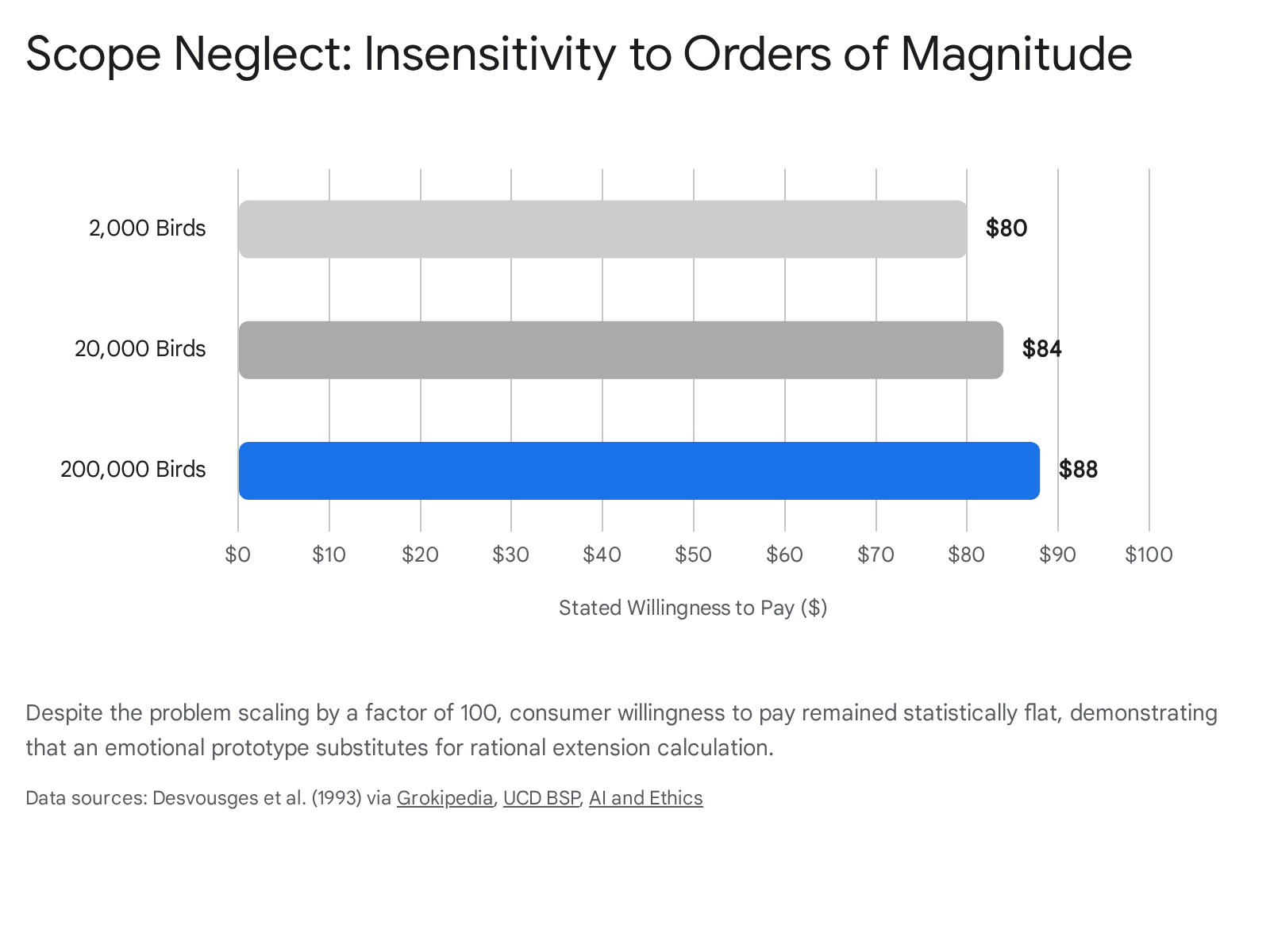
The emotional resonance of the prototype - the mental image of a single exhausted, oil-soaked bird - drove the valuation. The affective heuristic completely substituted for the mathematical reality of the scale 1527. Humans do not inherently feel 100 times worse when encountering a tragedy 100 times larger; therefore, when valuation is driven by feeling (System 1) rather than calculation (System 2), the monetary output reflects the flat emotional state rather than the linear numeric scale 2224.
In consumer markets, scope neglect deeply influences pricing architectures and retail strategies 2526. Consumers exhibit severe insensitivity to the aggregate costs of micro-transactions, subscription models, and dynamic hidden fees (drip-pricing), substituting the low initial anchor price for the mathematically complex total lifetime cost 27. Furthermore, scope insensitivity dictates responses to package deals and bulk purchasing. When acquiring non-market goods or evaluating bundles, manipulating the scope magnitude rarely yields proportional increases in perceived consumer utility 24. In business-to-business and agribusiness environments, scope neglect manifests as executive teams agonizing over small operational decisions with the same intensity applied to strategic decisions that are orders of magnitude more financially consequential 27.
The Price-Quality Heuristic and Cross-Cultural Dynamics
One of the most pervasive instances of attribute substitution in retail environments is the price-quality heuristic 2829. Evaluating the intrinsic quality of a complex product prior to consumption - particularly experience and credence goods such as electronics, fine wines, or professional services - requires exceedingly high cognitive effort and domain-specific knowledge 34. To circumvent this effort, consumers routinely substitute an easily accessible, concrete attribute (the retail price) for the inaccessible target attribute (product quality) 2830.
This heuristic operates on the implicit, albeit occasionally flawed, associative logic that higher production costs equate to higher market prices, and thus superior quality 28. Meta-analyses of laboratory studies indicate that the price-quality relationship is statistically significant and widely applied across global markets 2831. Research surveying diverse demographic segments confirms that this heuristic exhibits no substantial cross-cultural differences in its foundational application; consumers in both Eastern and Western markets inherently link higher prices to better performance 28.
However, cultural variances profoundly modulate the intensity and interaction of related heuristics, such as brand familiarity, companionship effects, and Country of Origin (COO) signaling 3132. Consumers in emerging markets often substitute the origin of a brand (specifically preferring Western or developed-market origins) as a heuristic cue for prestige, social power, and product reliability 32. This substitution allows global brands to implement premium pricing strategies, effectively stacking the COO heuristic atop the price-quality heuristic to maximize perceived consumer value 32. Furthermore, social dynamics alter heuristic reliance. For instance, consumers in highly collectivist cultures demonstrate altered price-quality inferences when shopping with companions, modifying their heuristic evaluations based on social proof and group harmony, an effect less pronounced in highly individualistic cultures 31.
The price-quality heuristic also generates paradoxical market behaviors. When the price of a premium category item drops too low, it triggers an inverse evaluation. For high-value perishable goods, such as beef, a severely discounted price signals inferior freshness and heightened safety risk, dampening consumer trust and purchase intention despite the objective financial saving 29. In sequential product introductions (e.g., iterative versions of smartphones or electric vehicles), strategic pricing leverages this heuristic. Introducing a newer version at a premium price signals a massive quality improvement over the previous generation, inducing consumers to upgrade based on price divergence rather than objective technical analysis of the new components 28.
Simultaneously, the modern consumer is subject to the "pain of paying" - an affective discomfort associated with expenditure that rises dramatically during periods of economic constraint and high inflation 33. This creates a high-friction decision environment where multiple heuristics are activated concurrently. Consumers must balance the affective pain of paying against the cognitive substitution of price-for-quality, leading to complex, non-linear demand curves 33. In contemporary markets, over 80% of consumers actively compare prices across retailers, yet a substantial segment remains willing to pay premiums if the brand successfully activates secondary heuristics, such as emotional attachment or values alignment 33.
Digital Interfaces, Review Richness, and E-Commerce Cues
The digital ecosystem is an environment defined by extreme information overload and rapid cognitive depletion, rendering it a uniquely fertile ground for attribute substitution. When human information processing is constrained by limited working memory and choice fatigue, the reliance on visual cues and heuristic shortcuts intensifies 51234.
Review Richness and Authenticity as Heuristic Attributes
In modern e-commerce, consumers face an overwhelming volume of user-generated content and star ratings 35. Attempting to aggregate and critically evaluate thousands of textual reviews to accurately determine product quality is computationally impossible for System 2 35. Consequently, consumers engage in attribute substitution by relying on "review richness" 3536.
Reviews containing multimedia elements (images, videos) or subsequent follow-on comments act as powerful heuristic cues 35. Consumers substitute the visual presence of a video review for objective evidence of product utility, particularly for utilitarian products and experience goods 3537. The inclusion of visual elements significantly reduces cognitive load, allowing consumers to bypass extensive text processing; this visual fluency directly increases perceived review helpfulness and subsequent purchase intention 538.
Furthermore, rating-sentiment dissimilarity heavily influences substitution mechanics. When the quantitative star rating contradicts the qualitative text sentiment (e.g., a five-star rating accompanied by a negative textual review), it disrupts processing fluency and undermines the perceived credibility of the review 37. However, negative reviews are paradoxically treated as carrying higher diagnostic value 39. Through the lens of attribution theory, consumers substitute the emotional arousal and perceived "prosocial motive" of a negative reviewer for an objective product risk assessment 39. For high-involvement, expensive purchases, consumers anchor their initial judgments on reviews characterized by moderate negative emotional intensity, interpreting them as the most authentic and helpful 39.
Algorithmic Recommendations and Process Substitution
The integration of Artificial Intelligence (AI) and recommender systems into e-commerce represents a literal outsourcing of the attribute substitution process 1340. Algorithms replace human memory generation and significantly reduce decision noise by substituting a curated, highly limited choice set for the vast, unmanageable reality of market options 40.
Consumers evaluate these algorithms based on technology affordance theory and perceived value 41. An AI recommender system that accurately tracks user behavior and dynamically adapts results provides high functional value by minimizing search costs. More importantly, it provides high emotional value by reflecting "self-consistency." When an algorithm recommends a product that closely aligns with the consumer's self-concept, the consumer substitutes this feeling of personalization for an objective evaluation of the product's quality, leading to higher adoption rates and brand loyalty 41.
However, consumers exhibit differing tolerances for algorithmic intervention based on the cognitive domain 4142. In purely utilitarian tasks, such as finding the lowest price for a commodity, algorithmic speed is highly prized 42. Conversely, recent empirical studies reveal an intriguing phenomenon in contexts requiring moral judgments or complex human trade-offs: the "Slower is Better" effect 42. When AI systems make rapid decisions regarding resource allocation or moral dilemmas, consumer evaluation of the AI plummets 42. Consumers substitute their intuitive human models of moral deliberation - which require time, hesitation, and visible effort - for the algorithm's unobservable computational logic. If the AI executes a moral decision instantaneously, the consumer heuristic signals that the decision is careless or unethical, regardless of the objective fairness of the outcome 4042.
Sustainability, Greenwashing, and Ethical Consumption
As global awareness of climate change accelerates, consumers increasingly seek to align their purchasing behaviors with pro-environmental intentions 4344. Yet, measuring the objective environmental impact of a product (e.g., total greenhouse gas emissions, lifecycle water usage, supply chain carbon footprints) is a profoundly opaque and computationally complex task 2744. Because the target attribute (ecological impact) is inaccessible to the average shopper, the domain of sustainable consumption is heavily governed by attribute substitution.
The Green Halo and Localness Substitution
Due to target attribute inaccessibility, consumers rely heavily on peripheral cues, rendering them highly vulnerable to greenwashing 43. Eco-labels, organic certifications, and even vague aesthetic cues of "naturalness" serve as highly accessible heuristic attributes 434546. The naturalness bias operates strictly through the representativeness heuristic: a product is judged to be healthier, safer, or more sustainable based entirely on its visual similarity to an idealized prototype of nature (e.g., earth-tone packaging, rustic fonts), completely divorced from objective biochemical reality 46.
Recent studies into consumer carbon competence demonstrate that individuals systematically misjudge emissions 2744. A dominant heuristic observed in this domain is "localness." Consumers routinely substitute the geographic proximity of a product's origin for its total carbon footprint 44. The intuitive logic dictates that shorter transportation distances automatically equal lower emissions. However, this heuristic ignores the massive carbon expenditures involved in out-of-season agricultural production or inefficient local manufacturing, leading consumers to frequently select higher-emission local options over highly efficient imported alternatives 2744.
The Negative Footprint Illusion
The reliance on heuristic averaging in sustainability contexts produces severe mathematical paradoxes, most notably the Negative Footprint Illusion (NFI) 47. In standard extensional logic, the environmental impact of a basket of goods is strictly additive. Adding any manufactured item, regardless of its eco-friendly credentials, must theoretically increase the total carbon footprint 47.
However, behavioral experiments show that when consumers are asked to evaluate the environmental impact of a conventional product (e.g., a standard building or a fleet of gasoline cars) paired with a "green" product (e.g., a building with solar panels or a fleet of electric cars), they rate the combined impact as lower than the conventional product alone 47. The cognitive mechanism responsible is vice-virtue averaging 47. Instead of employing an additive mathematical model (System 2), consumers substitute an intuitive averaging of the moral and environmental valence of the items (System 1) 47. This bias severely limits the efficacy of sustainable interventions, as consumers erroneously believe they can literally offset or erase the impact of their conventional consumption simply by adding "green" products to their overall basket 47.
The Ecological Rationality Counter-Paradigm
While the Heuristics and Biases tradition - spearheaded by Kahneman and Tversky - frames attribute substitution as an engine of systemic error and deviation from normative logic, a prominent alternative paradigm challenges this perspective: Ecological Rationality 484950.
Developed prominently by Gerd Gigerenzer and the Adaptive Behavior and Cognition (ABC) Research Group, ecological rationality posits that heuristics are not flawed shortcuts born of cognitive limitation, but rather sophisticated, evolutionary adaptations designed to intelligently exploit the statistical structures of real-world environments 48495152. In this framework, the human mind operates using an "adaptive toolbox" of fast-and-frugal heuristics 648.
| Paradigm Characteristic | Heuristics and Biases (Kahneman & Tversky) | Ecological Rationality (Gigerenzer) |
|---|---|---|
| View of Heuristics | Cognitive shortcuts that produce systematic, predictable errors and biases 3448. | Adaptive tools that exploit environmental structures for optimal decision-making 648. |
| Definition of Rationality | Constructivist Rationality: Adherence to formal logic, probability calculus, and Bayesian updating 124850. | Ecological Rationality: The degree of fit between a cognitive mechanism and the specific environment 4849. |
| Accuracy-Effort Trade-off | Heuristics save cognitive effort but inherently sacrifice accuracy 4953. | The "Less-is-More" effect: Ignoring information can actually increase predictive accuracy 495354. |
| Experimental Focus | Artificial laboratory settings designed to expose logical fallacies and cognitive illusions 4850. | Real-world, uncertain environments where predictive validity is tested against complex outcomes 5055. |
Gigerenzer explicitly rejects the accuracy-effort trade-off - the assumption that heuristics necessarily sacrifice accuracy for speed 4953. Instead, ecological rationality demonstrates a "less-is-more" effect 5354. In environments characterized by high uncertainty, low predictability, and sparse data, simple heuristics routinely outperform complex, compensatory algorithms (like multiple regression models) by avoiding the overfitting of noise 495153.
Two primary fast-and-frugal heuristics illustrate the power of this paradigm in consumer markets: 1. The Recognition Heuristic: If one of two objects is recognized and the other is not, the mind infers that the recognized object has the higher value with respect to the criterion 545556. In consumer markets, choosing a known brand over an unknown one via attribute substitution is highly ecologically rational, as widespread brand recognition correlates strongly with market survival, corporate accountability, and quality assurance 5354. Studies have shown that laypeople utilizing the recognition heuristic can predict the outcomes of Wimbledon matches and national elections with accuracy rates rivaling or exceeding domain experts 5455. 2. The Take-The-Best Heuristic: A non-compensatory strategy that searches through cues in order of validity, stopping at the very first cue that discriminates between options, and deciding entirely on that single cue while ignoring all subsequent data 5456.
Proponents of ecological rationality emphasize that a heuristic is only "irrational" when applied outside the environment to which it is adapted 3448. The biases documented in traditional psychological laboratory experiments often arise because the artificial, probabilistically rigid testing environments intentionally strip away the natural ecological cues that these heuristics evolved to navigate 5055. Therefore, while attribute substitution may lead to formal logical errors on a mathematics test, it remains a highly robust mechanism for navigating the complex, uncertain reality of human consumption.
Conclusion
Attribute substitution remains a central pillar in understanding why consumer behavior persistently deviates from the classical economic models of rational maximization. By mapping the transition of complex target attributes to highly accessible heuristic attributes, researchers can predict and model systematic failures in consumer judgment, ranging from base-rate and scope neglect to distorted sustainability evaluations and price-quality inferences.
The digital proliferation of e-commerce exacerbates these cognitive vulnerabilities. In high-friction, data-saturated environments, consumers rely increasingly on visual review richness, algorithmic recommendations, and heuristic signaling to manage cognitive load. While the Ecological Rationality paradigm rightfully points out that fast-and-frugal heuristics are often highly adaptive and successful in natural environments, modern market architectures frequently weaponize them. AI recommender systems, dynamic drip-pricing, and greenwashed marketing intentionally hijack these substitution mechanisms to obscure objective realities and drive consumption.
For choice architects, regulatory bodies, and market designers, acknowledging the supremacy of System 1 processing is paramount. Interventions aimed at improving consumer decision-making cannot rely on mere disclosure mandates or the provision of increasingly complex data, as this only further exhausts System 2 and triggers deeper reliance on attribute substitution. Instead, successful behavioral design must carefully structure the choice environment so that the highly accessible heuristic attributes naturally align with objective, beneficial target outcomes, ensuring that the consumer's intuition leads to fundamentally sound judgments.