
Unconscious bias and behavioral prediction
Fundamentals of Implicit Social Cognition
Implicit social cognition, frequently conceptualized in public discourse as unconscious bias, represents the study of how interpersonal beliefs, attitudes, and behaviors are influenced by psychological processes that operate automatically and frequently outside of conscious awareness or intentional control 123. The construct emerged prominently in the late 1990s from dual-process models of cognition. These models draw a theoretical distinction between relatively spontaneous, difficult-to-control associative processes and deliberate, consciously controlled evaluative judgments 345. The scientific imperative for studying implicit bias is rooted in the widely observed dissonance between individuals' self-reported egalitarian values and the persistent manifestation of systemic discrimination across employment, healthcare, and legal domains 567.
Within this psychological framework, implicit biases are understood as cognitive networks of associations between specific social categories - such as race, gender, age, or disability - and specific valences (good versus bad) or stereotypical attributes (such as competence or danger) 89. The identifying feature of implicit cognition is that prior experiences and long-term cultural socialization influence judgment in a manner that is not introspectively known by or accessible to the actor 810. Consequently, the science of implicit bias posits that even individuals who explicitly disavow prejudice may harbor and act upon deeply ingrained, culturally transmitted associations 61011.
The Aversive Racism Framework
The interaction between explicit motivation and implicit cognition is frequently analyzed through the Aversive Racism framework, originally developed by Gaertner and Dovidio 6. Aversive racists are defined as individuals who genuinely endorse egalitarian values, explicitly report low levels of prejudice, and believe themselves to be entirely unbiased, yet possess nonconscious, negative implicit feelings toward stigmatized groups 6.
Due to a lack of conscious awareness regarding their underlying biases, individuals operating under aversive racism are paradoxically highly likely to manifest discrimination, provided the environmental context allows for ambiguity 56. If a biased decision - such as rejecting a minority job applicant - can be rationally justified by a socially acceptable, non-racial rationale (e.g., a lack of exact cultural fit or insufficient professional experience), the implicit bias is permitted to govern the decision 6. In these ambiguous environments, the predictive validity of implicit measures increases substantially, whereas explicit self-report measures lose their predictive power 612.
Methodological Paradigms in Implicit Measurement
Because implicit attitudes cannot be reliably captured through traditional self-report questionnaires - which are highly susceptible to social desirability bias and the natural limits of human introspection - researchers developed specialized indirect measurement paradigms 61314. These instruments bypass conscious deliberation by relying on chronometric (reaction time) methodologies or misattribution-based responses 315.
Chronometric Measurement Tools
The most prominent implicit measure is the Implicit Association Test (IAT), introduced in 1998, which assesses the strength of automatic associations by measuring the speed with which participants can categorize paired concepts 91617. For instance, a race-attitude IAT measures response latencies when participants sort images of Black or White faces alongside positive or negative words 1618. The underlying assumption is that highly associated concepts (e.g., White and Good) will be sorted faster than less associated concepts (e.g., Black and Good) 916. The IAT demonstrates relatively high internal consistency and outperforms other implicit measures in test-retest reliability (median r = 0.50), establishing it as the standard instrument in social cognition research 161719.
Despite its widespread adoption, the standard IAT relies on a relative measurement constraint; it calculates a difference score between two categories 3. A comprehensive analysis of over 100,000 participants demonstrated that associations toward non-stigmatized group members often dilute the predictive strength of relative measures 3. To address this, the Single-Category IAT (SC-IAT) was developed, focusing exclusively on associations toward a single stigmatized group without requiring a contrast category 3. The SC-IAT routinely demonstrates superior predictive and incremental validity compared to standard relative IATs, highlighting the methodological limitations of relative scoring 3.
Another chronometric instrument is the Evaluative Priming Task (EPT). In an EPT assessing implicit racial attitudes, Black and White faces briefly flash before participants quickly categorize valenced stimuli as "Good" or "Bad" 2021. While rooted in established models of sequential priming, the EPT is highly susceptible to task-related noise and variations in baseline reaction time, leading to lower internal reliability compared to the IAT 32122.
Misattribution-Based Measurement
To bypass the error introduced by reaction time paradigms, researchers developed the Affect Misattribution Procedure (AMP). The AMP flashes an affect-laden prime (such as a social ingroup or outgroup member) followed briefly by an ambiguous target, typically a Chinese ideograph 222324. The participant is instructed to judge the target dichotomously as relatively pleasant or unpleasant 1524. Bias is inferred from the degree to which the affect generated by the prime is unconsciously misattributed to the neutral target 1525.
The AMP produces strong effect sizes and demonstrates excellent internal consistency (Cronbach's alpha = 0.88) 2224. However, recent preregistered studies and meta-analyses analyzing the AMP have challenged its status as a purely "implicit" measure. Research indicates that AMP effects and their predictive validity are strongly moderated by influence awareness; participants are frequently aware of the prime's influence on their evaluations, suggesting that the AMP may measure a hybrid of implicit affect and explicit intentionality 26.
| Measurement Paradigm | Core Mechanism | Target Construct | Psychometric Profile |
|---|---|---|---|
| Implicit Association Test (IAT) | Response latency mapping | Relative associative strength between two competing categories. | High internal consistency; moderate test-retest reliability; susceptible to recoding and cognitive load 161926. |
| Single-Category IAT (SC-IAT) | Response latency mapping | Absolute associative strength for a singular stigmatized group. | Mitigates outgroup dilution effect; superior predictive and incremental validity in large samples 3. |
| Affect Misattribution Procedure (AMP) | Affective projection / misattribution | Unintentional affective evaluation of neutral targets. | Non-chronometric; high internal reliability; potentially confounded by participant influence awareness 222426. |
| Evaluative Priming Task (EPT) | Response latency (post-prime) | Semantic and evaluative priming pathways. | Lower internal reliability; highly sensitive to baseline reaction time variations 32122. |
Meta-Analytic Evaluations of Predictive Validity
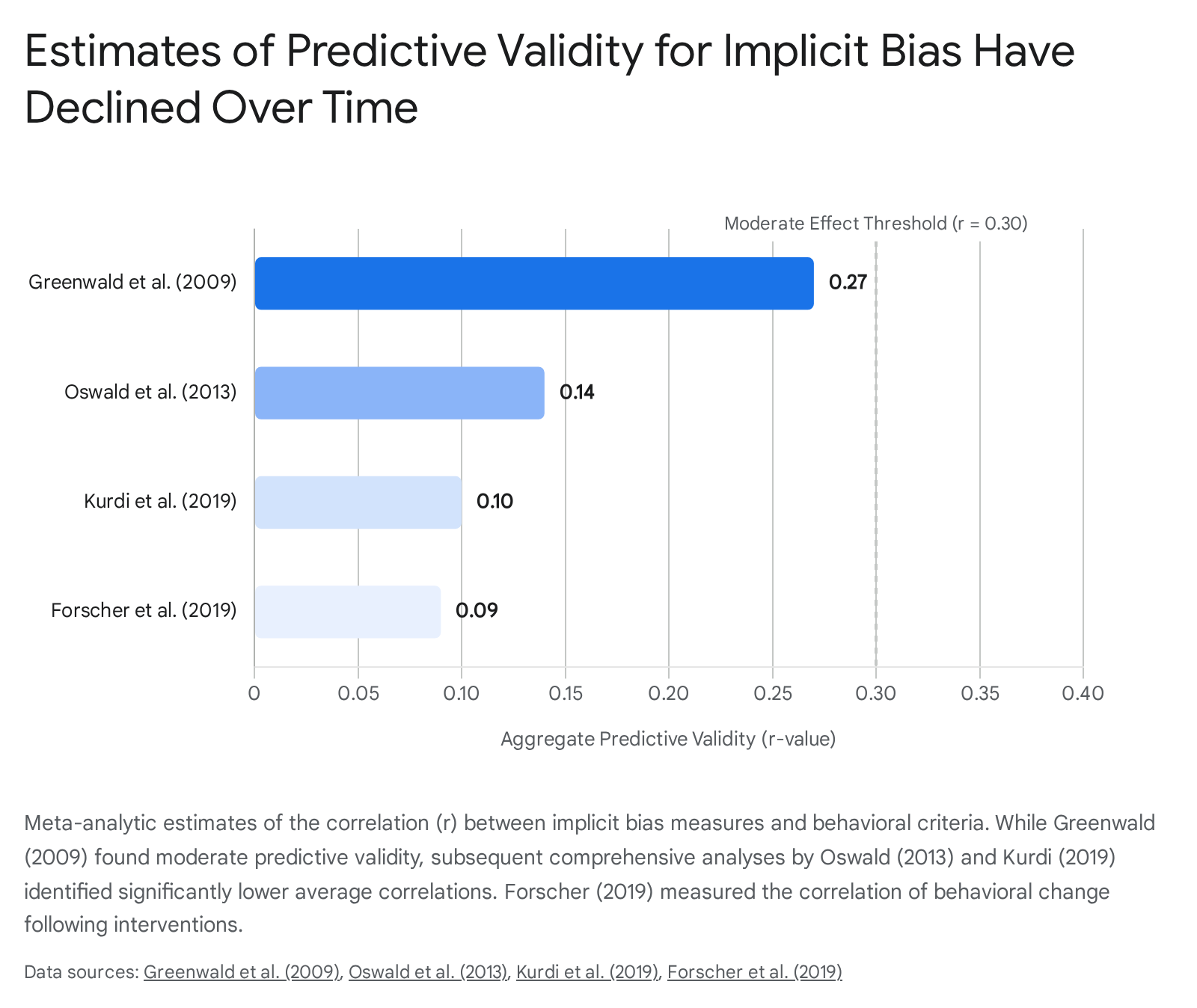
The most contested debate in the science of unconscious bias surrounds its predictive validity - the degree to which scores on implicit measures accurately forecast real-world behavior, social judgments, and physiological responses 4517. Over the past two decades, four major meta-analyses have attempted to quantify the Implicit-Criterion Correlation (ICC), yielding disparate estimates and fueling significant theoretical debate regarding the applied utility of the implicit bias construct 192128.
The Greenwald Synthesis
The first comprehensive meta-analysis of the IAT's predictive validity, conducted by Greenwald, Poehlman, Uhlmann, and Banaji (2009), analyzed 122 research reports encompassing nearly 15,000 subjects 121927. This synthesis found an average predictive correlation of r = 0.27 across all behavioral, judgment, and physiological domains 121927. The analysis concluded that the IAT possesses predictive validity independent of explicit measures, and specifically in the domain of Black-White interracial behavior, the IAT significantly outperformed explicit self-report measures 1228. This suggested robust incremental validity for the IAT when addressing socially sensitive topics where impression management distorts explicit reporting 1227.
The Oswald Re-evaluation
A subsequent independent meta-analysis by Oswald, Mitchell, Blanton, Jaccard, and Tetlock (2013) heavily challenged the optimism of the Greenwald findings 282930. Oswald et al. re-examined the literature with a strict focus on macro-and micro-behavioral discrimination, assessing heterogeneity across six specific criterion categories: interpersonal behavior, person perception, policy preference, microbehavior, response time, and brain activity 282931.
Their synthesis yielded a much lower average ICC of r = 0.14 192126. Oswald et al. concluded that IATs were poor predictors of every criterion category except for brain activity 2829. Critically, the researchers determined that the IAT performed no better than simple, ad-hoc explicit measures of bias across these behavioral domains 2829. This finding indicated that the translation from an implicit cognitive association to an active, real-world discriminatory behavior is empirically weak and highly inconsistent 2832.
The Kurdi Synthesis
To resolve the methodological and statistical discrepancies between prior reviews, Kurdi, Seitchik, Axt, Carroll, Karapetyan, Kaushik, and Banaji (2019) conducted a massive meta-analysis utilizing data from 36,071 participants across 217 research reports specifically focused on intergroup behavior 1419. The Kurdi synthesis found that the average correlation between implicit measures and intergroup behavior across all conditions was modest (r = 0.10) 212835.
However, Kurdi et al. identified specific methodological constraints under which predictive validity improved significantly. When studies utilized high-polarity attributes as stimuli, standard IAT configurations, and ensured high structural correspondence between the attitude object and the measured behavior, the estimated correlation rose to r = 0.37 2835. Nevertheless, the aggregate findings of the Kurdi analysis confirmed that, under standard field conditions, both implicit and explicit measures make similarly sized, albeit unique, contributions to predicting intergroup behaviors, and that the baseline predictive validity remains objectively small to moderate 1935.
The Forscher Synthesis on Interventions
In a parallel examination of behavioral prediction, Forscher et al. (2019) conducted a meta-analysis focused not on baseline predictive validity, but on the efficacy of procedures designed to change implicit measures and whether those changes altered behavior 36. Assessing the malleability of implicit bias, the meta-analysis revealed a stark dissociation between cognitive measurement and behavioral output 3633. Changes in implicit measures did not reliably account for changes in explicit measures, and successful reductions in implicit bias scores did not result in comparable behavioral changes 3633. The effect size for behavioral change following an implicit intervention was profoundly weak (r = 0.09) 36.
Methodological and Theoretical Moderators of Predictive Validity
The fluctuating correlations between implicit cognition and behavior have driven researchers to identify structural artifacts and contextual moderators that dictate when bias is successfully expressed as action 4626.
The Correspondence Principle and Measurement Specificity
A primary explanation for the weak average predictive validity of implicit measures is a frequent mismatch between the predictor and the criterion 426. Following the logic of Ajzen and Fishbein's (1977) correspondence principle, cognition and behavior correlate most strongly when they are assessed at identical levels of specificity 1427. Early implicit bias research often attempted to predict highly specific, context-dependent behaviors using generalized attitude measures - such as using a general Black/White evaluation IAT to predict real-world hiring decisions 2627.
Recent psychometric studies demonstrate that tailoring implicit measures to specific aspects of an attitude object drastically improves behavioral prediction 34. In a series of studies examining legal decisions involving 2,552 White American participants, researchers deployed a phenotype-specific IAT designed to index implicit bias favoring Eurocentric (straight) hair over Afrocentric (curly) hair 34. This targeted phenotype IAT significantly and uniquely predicted mock jurors' expressions of support for a Black plaintiff in a hair-discrimination lawsuit 34. Crucially, a standard Black/White race attitude IAT completely failed to predict the same legal judgment 34. This underscores that broad indicators of implicit bias are poorly suited for predicting specific discriminatory acts unless they precisely match the target, context, and semantic parameters of the behavior 41726.
Evaluative Recoding and Construct Mismatch
Structural limitations inherent to chronometric procedures further depress aggregate predictive validity. IAT scores are frequently confounded by extraneous cognitive processes, most notably recoding 2632. Recoding occurs when participants mentally assimilate attributes into superordinate categories - such as general familiarity, perceptual salience, or geometric features - rather than the target social identity to complete the sorting task 2632. Consequently, the IAT captures systematic error variance alongside true associative strength, rendering the final metric an impure reflection of implicit bias 26.
Furthermore, cognitive researchers note a persistent conflation between evaluation ("liking") and motivation ("wanting") in implicit testing. While the IAT expertly measures evaluative associations, actual discriminatory behavior is more frequently driven by motivational states and complex propositional beliefs, which standard implicit tools fail to isolate 172632. Dual-process models suggest that implicit attitudes are better suited to predict affect-infused, spontaneous behaviors (such as nonverbal distancing), whereas implicit stereotypes better predict descriptively specific forms of discrimination, and implicit identification better predicts normative discrimination, such as ingroup favoritism in resource allocation 435.
Executive Control and Cognitive Load
Because implicit cognition operates automatically, its translation into behavior is heavily moderated by an individual's cognitive capacity and their motivation to suppress biased responses 6828. Studies consistently demonstrate that implicit measures exhibit greater predictive and incremental validity among individuals scoring relatively low on executive function tasks 828. When cognitive load is high or time pressure is acute, the deliberative neural processes required to inhibit an automatically activated association are compromised, allowing the implicit bias to dictate the behavioral output 67.
Similarly, the conscious motivation to control prejudiced reactions serves as a critical suppressor variable 6. Statistical analyses that ignore the moderating influence of egalitarian motivation inevitably fail to capture the predictive utility of implicit measures 628. An individual harboring high implicit racial bias may only act in a discriminatory manner when they lack the internal motivation or external institutional accountability required to counter their automatic associations 68.
| Moderating Variable | Mechanism of Influence | Impact on Predictive Validity (ICC) |
|---|---|---|
| Criterion Correspondence | Matching the specificity of the implicit measure (e.g., phenotype IAT) to the specific behavioral outcome 1434. | Significantly increases predictive validity; generalized measures fail to predict specific acts 2634. |
| Executive Control / Cognitive Load | Depletes the deliberative cognitive resources required to override automatic associative responses 78. | High cognitive load or low executive function increases the predictive validity of implicit measures 828. |
| Contextual Ambiguity | Allows individuals to attribute biased decisions to socially acceptable, non-prejudiced rationales (Aversive Racism) 6. | Increases predictive validity of implicit measures while neutralizing explicit self-report measures 56. |
| Evaluative Recoding | Participants utilize non-attitudinal features (e.g., salience, familiarity) to solve the cognitive sorting task 2632. | Introduces systematic error variance, significantly depressing the true predictive validity of the instrument 26. |
Predictive Validity Across Applied Domains
The manifestation of implicit bias varies dramatically depending on the ecological domain and the macro-versus-micro nature of the decision. To quantify how much implicit bias actually predicts behavior, it is necessary to examine specific applied contexts, particularly healthcare, employment, and the legal system.
Medical Decision-Making and Health Disparities
The healthcare sector provides some of the most robust, real-world evidence for the predictive validity of implicit bias 711. Systematic reviews consistently find that primary care physicians exhibit weak to non-existent explicit bias, yet display low-to-moderate levels of implicit bias favoring White patients over Black and Latino patients 711. These implicit biases correlate significantly with divergent treatment decisions, degraded patient-provider interactions, and worsened health outcomes for minority populations 1135.
The clinical consequences of unchecked implicit associations are severe. A 2019 meta-analysis revealed that in U.S. emergency rooms, Black patients were 40% less likely, and Latino patients 25% less likely, to be administered analgesia for acute pain relative to non-Latino White patients presenting with identical symptoms 1136. Implicit biases regarding pain tolerance and compliance directly drive these disparities. Research indicates that healthcare providers possess strong implicit associations linking African American patients with medical non-compliance, despite lacking any objective evidence for such a belief 7. Similarly, women suffering myocardial infarctions were found to be 7.4% more likely to seek medical attention, yet 16.7% less likely to be told their symptoms were cardiac in origin, reflecting deep-seated implicit diagnostic biases 35.
In psychiatric contexts, diagnostic errors are heavily influenced by unconscious bias, with African Americans being three to five times more likely to be diagnosed with schizophrenia than White patients 16. A study utilizing a clinically tailored IAT found that nearly 40% of mental health providers harbored moderate-to-strong implicit associations pairing Black faces with psychotic disorder terminology, and 37.7% exhibited strong implicit associations pairing Black faces with non-compliance words 16. This demonstrates that when implicit measures are strictly tailored to the domain (e.g., using psychiatric diagnostic terms instead of general "good/bad" valence), their predictive validity regarding systemic clinical disparities becomes highly apparent 716.
Employment and Macro-Level Decision Making
In contrast to the medical field, the predictive utility of implicit measures in macroeconomic employment decisions is ambiguous. While correspondence audits (resume studies) conclusively demonstrate that hiring discrimination against ethnic minorities, older candidates, and candidates with disabilities remains pervasive - with candidates possessing disabilities 44% less likely to receive positive responses, and older candidates 40% less likely - the ability of an individual's IAT score to predict their specific hiring behavior is severely limited 1941.
The Oswald et al. (2013) meta-analysis established that implicit measures poorly predicted macro-level organizational decisions such as hiring and policy preferences, finding that self-report measures were frequently more effective predictors 2829. Furthermore, systemic interventions aimed at blinding demographic indicators to mitigate implicit bias have frequently yielded negligible changes in institutional outcomes. An Institute for Defense Analyses (IDA) report evaluating the removal of names and demographic indicators from military promotion files found no evidence that redaction improved selectee diversity, suggesting that structural constraints and formalized evaluation networks often override individual implicit cognitive patterns in strict organizational hierarchies .
Legal Judgments and Micro-Behavioral Interactions
Implicit bias exerts its strongest and most consistent influence on micro-behaviors and interpersonal interactions rather than formalized legal judgments 47. Laboratory studies repeatedly document that implicit racial bias predicts nonverbal hostility, social distancing, diminished eye contact, and slower response times in cross-racial interactions 4710.
In law enforcement simulation contexts, physiological and chronometric analyses yield complex results. Alpha-wave analyses have shown that participants exhibit higher levels of perceived threat when encountering Black individuals compared to White or Hispanic individuals 10. However, this heightened threat perception did not reliably predict increased shooting behavior toward Black subjects in the simulations. In fact, reaction times were frequently slower when participants shot at Black individuals, indicating a conscious, deliberative override triggered by a fear of making a biased error 10. This highlights the complex interaction between implicit threat perception and explicit behavioral regulation.
Neurological and Physiological Correlates
While the ability of behavioral implicit measures (like the IAT) to predict complex social behavior remains heavily contested, the correlation of bias with physiological and neural markers provides strong evidence for the mechanistic reality of unconscious associations 118. In Oswald et al.'s (2013) meta-analysis, brain activity emerged as the singular criterion category where the IAT consistently performed well as a predictor 2829.
Functional Magnetic Resonance Imaging in Bias Detection
Neuroimaging methodologies, particularly functional Magnetic Resonance Imaging (fMRI), have elucidated the neuroanatomical substrates of implicit social cognition and discrimination 1831. Social cognition - the capacity to infer the social beliefs, interpersonal norms, and temporary states of others - heavily engages the medial prefrontal cortex (mPFC) and the temporo-parietal junction (TPJ) 31. Furthermore, studies investigating population-level behavior indicate that value-tracking in the ventromedial prefrontal cortex (vmPFC) correlates strongly with the behavioral impact of social and persuasive stimuli 37.
Critically, direct neural activity frequently outperforms behavioral implicit tests in predicting discriminatory outcomes. In a neurolaw study investigating hypothetical employment discrimination cases, participants' standard Black/White IAT scores failed entirely to predict the monetary damages they awarded to Black victims (r = -0.35, non-significant) 1830. However, whole-brain analyses revealed that the magnitude of differential neural activity when viewing Black versus White faces (paired with neutral adjectives) was highly predictive of the verdict amounts 1830. Specifically, neural activity in the right inferior parietal lobule (BA 40; r = 0.77) and the right superior/middle frontal gyrus (BA 9/10; r = -0.77) correlated heavily with the financial compensation awarded, indicating that physiological neuroimaging captures racial bias with greater practical validity in high-stakes contexts than chronometric behavioral measures 1830.
Malleability, Interventions, and the Bias of Crowds
A vital operational question stemming from the science of unconscious bias is whether these automated associations can be unlearned, and whether debiasing an individual translates into equitable behavior 536. The empirical evidence is decidedly pessimistic regarding the efficacy of individual-level bias training 13.
The Failure of Individual Debiasing
As established by the Forscher et al. (2019) meta-analysis, procedures designed to change implicit measures yield weak, short-term reductions in IAT scores, and these changes are highly transient 103633. Successful reductions in implicit bias scores essentially never result in comparable behavioral changes (r = 0.09) 3633. This evidence undermines the foundational premise of contemporary corporate diversity and antibias training programs, indicating that attempting to surgically reprogram an individual's associative network is a highly inefficient mechanism for altering actual discriminatory behavior 913.
Systemic Frameworks and the Bias of Crowds Model
The failure of individual-level debiasing interventions has prompted a paradigm shift in the theoretical interpretation of implicit social cognition. Moving away from viewing implicit bias as a stable, trait-like property of the individual mind, researchers are increasingly adopting the "Bias of Crowds" model proposed by Payne and colleagues 1344.
This model posits that implicit biases are best understood as cognitive reflections of the systemic inequalities embedded within environments, historical contexts, and cultures 134438. This framework resolves a persistent psychometric paradox in implicit research: while IAT scores possess relatively low test-retest reliability at the individual level (meaning an individual's score fluctuates significantly day to day), implicit bias aggregates show incredibly high test-retest reliability at the regional, geographic, or institutional level 1933.
Under the Bias of Crowds framework, unconscious bias bridges personal and systemic prejudice 44. The individual acts as a cognitive conduit for the cultural environment; if the environment remains saturated with structural inequality, media stereotyping, and occupational segregation, the individual's cognitive associations will continuously re-calibrate to reflect that environment, rendering individual implicit bias training ineffective 134439. Consequently, to predict and alter behavior, interventions must focus on redesigning choice architectures, implementing strict accountability protocols, and altering the institutional environment rather than attempting to alter the unconscious associative networks of employees 13.
Cross-Cultural Perspectives and Non-WEIRD Populations
Finally, the science of implicit bias must contend with the limitations of its sample populations. The vast majority of predictive validity studies rely on WEIRD (Western, Educated, Industrialized, Rich, and Democratic) populations 4041. However, culture operates implicitly, fostering the development of specific motivational propensities and associative links outside of conscious awareness 41.
Extensive psychometric studies attempting to measure implicit attitudes or Big Five personality traits in non-WEIRD populations (spanning Africa, Asia, and Latin America) have found that the validity of these measures fluctuates significantly 4041. The systematic response patterns in these regions demonstrate that chronometric and survey-based measures are highly vulnerable to method bias, enumerator interaction, literacy levels, and culturally specific response patterns 4041. A universally applicable model of how implicit cognition predicts behavior requires extensive cross-cultural validation, ensuring that measurement instruments are sensitive to local associative norms rather than exclusively Western social and racial categories 4041.