Psychological research on self-help and behavior change
1. Introduction
The contemporary pursuit of self-improvement occupies a profoundly paradoxical space within modern psychology, behavioral science, and neurobiology. On one end of the theoretical spectrum exists a multi-billion-dollar mass-market self-help industry predicated almost entirely on the generation of cognitive insight, emotional arousal, and sheer motivation. On the opposite end lies the rigorous domain of clinical psychology, behavioral economics, and neuroscience, which emphasizes structural environmental design, choice architecture, and experience-dependent neuroplasticity. Despite unprecedented global access to self-improvement literature, the failure rates for long-term behavioral change remain starkly and consistently high. Organizational change initiatives, which largely rely on cognitive persuasion and educational training, fail to achieve their stated goals at a consistent rate of approximately 70% 12. Similarly, the vast majority of personal behavioral interventions - ranging from dietary modifications to the cessation of addictive behaviors - collapse within the first few weeks or months of initiation 14.
This exhaustive research report investigates the systemic, neurobiological, and psychological mechanisms behind these pervasive failures. By rigorously differentiating between mass-market motivational self-help and evidence-based clinical bibliotherapy, the analysis explores the profound psychological phenomena that actively, albeit subconsciously, sabotage personal growth. Chief among these are the dopaminergic traps of Vicarious Goal Fulfillment and the cyclical despair of the False Hope Syndrome 52. Furthermore, the report synthesizes post-2023 meta-analytic data on habit formation, behavioral design, and neuroplasticity to illuminate the fundamental "Intent-Behavior Gap" 38. Finally, the analysis contextualizes the self-help industry as a fundamentally Western, individualistic construct, contrasting its underlying philosophies with successful cross-cultural applications of behavioral interventions in diverse global settings 45.
Relying exclusively on peer-reviewed clinical data, psychiatry journals, and behavioral economics literature, this report provides a structural paradigm for understanding human behavior. It argues that the transition from the illusion of achievement to the execution of sustainable change cannot be bridged by emotional motivation, but must instead be engineered through structural choice architecture and behavioral activation.
2. Defining the Spectrum: Mass-Market Motivation vs. Evidence-Based Bibliotherapy
To accurately assess the efficacy of self-guided psychological interventions, it is clinically imperative to define the spectrum that separates mass-market motivational literature from evidence-based bibliotherapy. While both utilize the medium of reading to impart knowledge, they operate on fundamentally different neurocognitive mechanisms, employ divergent methodologies, and yield vastly different behavioral outcomes.
2.1 The Mass-Market Motivational Paradigm
Mass-market self-help is predominantly characterized by its reliance on cognitive restructuring through inspiration, anecdotal evidence, and the deliberate amplification of positive affect 56. Interventions typically found in this category - such as positive affirmations, visualization techniques, outcome-based goal setting, and generic motivational rhetoric - target the user's conscious, rational faculties, often referred to in behavioral economics as "System 2" thinking 1. The underlying, yet scientifically precarious, assumption of mass-market self-help is that if an individual acquires sufficient understanding, generates intense emotional motivation, and applies adequate willpower, behavioral execution will naturally and inevitably follow 412.
However, rigorous empirical data consistently challenges this assumption. Meta-analyses of positive psychology interventions (PPIs) and self-affirmation techniques demonstrate only small to, at best, modest effect sizes. For instance, a comprehensive meta-analysis of 144 experimental tests investigating the impact of self-affirmation interventions on health behavior change revealed highly limited efficacy. While such interventions promote message acceptance (Cohen's d = 0.17), their effect on actual intentions to change is minimal (Cohen's d = 0.14), and their impact on subsequent behavioral execution remains notably small (Cohen's d = 0.32) 7. Additional meta-analyses corroborate these findings, indicating that positive psychology interventions yield standardized mean differences of merely 0.34 for subjective well-being and 0.23 for depression reduction 8.
The critical flaw in the mass-market paradigm is its overreliance on affective states. While positive thinking and emotional arousal create an immediate sense of well-being and psychological relief, they fail to provide the structural scaffolding required to sustain behavior when motivation inevitably wanes due to physiological fatigue, stress, or environmental friction 615. Motivation is fundamentally a transient chemical event; building long-term behavioral change upon it is inherently unstable 15.
2.2 Evidence-Based Clinical Bibliotherapy
In stark contrast, evidence-based bibliotherapy involves the self-administered or minimally guided application of empirically validated psychological treatments - primarily Cognitive Behavioral Therapy (CBT) and Behavioral Activation (BA) - delivered through standardized, peer-reviewed written or digital formats 910. Bibliotherapy moves decisively beyond the mere transfer of philosophical information; it functions as a highly structured behavioral protocol that demands active engagement, meticulous self-monitoring, environmental modification, and progressive exposure 11.
Recent meta-analyses published in leading psychiatric journals, including the Journal of Consulting and Clinical Psychology, confirm the robust efficacy of clinical bibliotherapy when deployed within defined parameters. When utilized to treat mild to moderate depression and anxiety disorders, evidence-based bibliotherapy demonstrates medium to large effect sizes that are frequently comparable to traditional face-to-face psychotherapeutic interventions 101912. Guided self-help programs - where clinical bibliotherapy is supplemented by minimal, highly structured practitioner contact (e.g., brief weekly check-ins) - exhibit pooled within-group effect sizes of up to 1.18 for measures of depression and 0.94 for anxiety in routine care settings 13.
Furthermore, extensive meta-analyses of low-intensity cognitive behavioral therapy (LICBT) confirm its superiority over control conditions. Adjusting for publication bias, LICBT utilizing self-help materials demonstrates sustained, statistically significant reductions in anxiety (Hedge's g = -0.63), depression (Hedge's g = -0.48), and generalized worry (Hedge's g = -0.64) 12. Long-term follow-up studies, including robust variance estimation meta-analyses spanning 154 randomized controlled trials (RCTs) with follow-ups exceeding 12 months, demonstrate that the therapeutic gains achieved through structured i-CBT and bibliotherapy are highly durable, yielding sustained higher remission and reliable improvement rates compared to standard care 1415. This highlights the profound clinical divergence between structured, evidence-based behavioral reading - which actively restructures neural pathways through directed action - and passive motivational consumption, which merely manipulates transient emotional states.
3. The Psychological Architecture of Failure in Mass-Market Self-Help
The persistent commercial appeal of mass-market self-help, despite its low long-term behavioral efficacy, can be elucidated by examining complex neurobiological and psychological mechanisms that actively trap the consumer in a relentless cycle of consumption without execution. Chief among these mechanisms are the dopaminergic illusions of Vicarious Goal Fulfillment, the cyclical despair of the False Hope Syndrome, and the modern phenomenon of Information Bingeing.
3.1 Vicarious Goal Fulfillment and the Dopaminergic Illusion
One of the most insidious and biologically deeply rooted barriers to actual behavioral execution is a neurological phenomenon identified in consumer and behavioral research as Vicarious Goal Fulfillment 5. When an individual sets a highly ambitious, long-term goal, or when they immerse themselves in a compelling narrative regarding another person's success, the brain's reward centers are immediately activated 15. The human brain functions as an incredibly intricate simulation machine; however, it often fails to distinguish adequately between the intense cognitive visualization of an achievement and the actual physical execution of the required tasks 5.
The very act of setting goals and planning for future success triggers a robust release of dopamine - the neurotransmitter fundamentally linked to motivation, pleasure, and the brain's reward prediction error systems 124. This biochemical release creates an acute sensation of warmth, pride, and satisfaction, effectively providing the individual with the psychological reward of achievement before any actual labor has been performed or any friction encountered 516. Consequently, the individual experiences a potent "dopamine high" during the initial planning and reading stages.
However, neuroscientist Dr. Andrew Huberman's research highlights a critical vulnerability in this system: the dopamine system rapidly habituates to expected rewards 24. Because dopamine is driven primarily by the expectation and prediction of rewards rather than solely by their acquisition, the consumer inadvertently becomes neurochemically addicted to the process of goal-setting and the consumption of self-help literature, rather than the arduous, often unglamorous process of execution 24.
Once the initial dopaminergic surge subsides - usually within hours or days of setting the intention - the individual is faced with the stark friction of real-world effort. Lacking the immediate chemical reward that fueled the initial ideation, motivation plummets precipitously, resulting in the rapid abandonment of the goal 1524. This dynamic explains why many consumers become chronic readers of self-help literature; they are endlessly chasing the neurochemical high of fresh intentions and new paradigms, perpetually mistaking the feeling of insight for the reality of progress while remaining behaviorally stagnant 24.
3.2 The False Hope Syndrome and the Genesis of Learned Helplessness
The premature dopaminergic reward of goal-setting directly feeds into and sustains the False Hope Syndrome, a robust psychological framework pioneered by clinical researchers Polivy and Herman 42. The False Hope Syndrome characterizes the highly cyclical nature of failed self-intervention, particularly pervasive in domains such as dieting, addiction recovery, and ambitious productivity resolutions 216. The syndrome operates through four distinct, interrelated cognitive distortions regarding the behavioral change process:
- Overestimation of Amount: Believing one can alter or achieve significantly more than is realistically possible within a given timeframe.
- Overestimation of Speed: Believing the desired change will occur far more rapidly than physiological, environmental, or psychological limits permit.
- Overestimation of Ease: Drastically underestimating the profound environmental friction, psychological discomfort, and systemic barriers inherently involved in altering established habits.
- Overestimation of Collateral Benefits: Harboring the unrealistic expectation that altering one specific behavior (e.g., losing weight) will miraculously resolve unrelated life problems or transform one's overall identity 2.
When individuals set unrealistic, outcome-based goals fueled by the soaring rhetoric of mass-market motivation, they enter an initial phase of extreme overconfidence 1. However, as the daily, unrelenting friction of execution sets in, these distorted expectations inevitably clash with objective reality, leading to rapid behavioral relapse.
The progression of this syndrome creates a distinct behavioral relapse curve over time. This curve maps continuous motivation against successive goal-setting attempts. During the first attempt, the individual experiences a massive dopaminergic spike in motivation, which inevitably crashes against the friction of execution. Crucially, the False Hope Syndrome dictates that rather than critically evaluating the unrealistic strategy or the lack of behavioral design, the individual internalizes the failure. They convince themselves that they simply "did not try hard enough" or lacked sufficient willpower 2. This internal attribution of failure prompts them to seek out a new motivational framework and begin the cycle anew.
However, with each subsequent attempt mapped on the relapse curve, the initial spike in motivation becomes lower, and the subsequent crash is faster and deeper. The most devastating consequence of this cycle is the progressive decline in the individual's baseline self-efficacy. Over time, these repeated cycles result in what clinical psychologists term "learned helplessness" 24. Repeated failures reinforce the subconscious, deeply held belief that the individual is fundamentally incapable of change. Functional MRI studies reveal that repeated goal failure actually triggers activity in the anterior cingulate cortex and insula - the precise brain regions responsible for processing physical pain 24. Consequently, the brain neurologically imprints this defeatist narrative, developing subtle but powerful pain-avoidance mechanisms. This manifests as chronic procrastination, distraction, and an enigmatic loss of motivation that strikes just when effort is most required, actively preventing the individual from attempting future change 24.
3.3 Information Bingeing and the Pathology of Passive Consumption
The rapid proliferation of digital media, ubiquitous internet access, and the gamification of self-help content has given rise to a secondary, highly prevalent psychological trap: Information Bingeing 2617. Individuals increasingly consume endless streams of podcasts, articles, videos, and books on productivity, mental health, and self-optimization as a form of passive, guilt-free entertainment 2628. This passive consumption mimics the acquisition of genuine competence, providing a false sense of productivity while masking a profound lack of behavioral application.
Neurobiologically, digital addictive behaviors - including compulsive information seeking and bingeing - engage the exact same reward and stress pathways as traditional substances of abuse, inducing profound neural adaptations over time 1718. Chronic overuse of these digital self-help mediums alters neurotransmitter systems (notably dopamine regulation) and deeply impacts the neural circuitry involved in mood and impulse control 17. Neuroimaging studies consistently demonstrate that such behavioral addictions are associated with both functional and structural brain changes, particularly reduced activity and connectivity in the dorsolateral and orbitofrontal prefrontal cortex (PFC) - the precise regions critical for impulse control, executive function, and long-term decision making 17.
Consequently, the brain is subjected to what psychologists term "mental overload syndrome," a state characterized by pervasive brain fog, acute decision fatigue, heightened baseline anxiety, and diminished working memory capacity 2630. Because the human brain operates on a strict "use it or lose it" neuroplastic principle, the passive consumption of massive amounts of self-help data without active synthesis, critical analysis, or immediate behavioral application actually degrades memory retention and execution capacity over time 28. The individual is paradoxically left with vast cognitive insight regarding how to change their life, but absolutely zero structural architecture or executive function capacity to translate that insight into sustained action.
4. The Intent-Behavior Gap: A Structural Paradigm
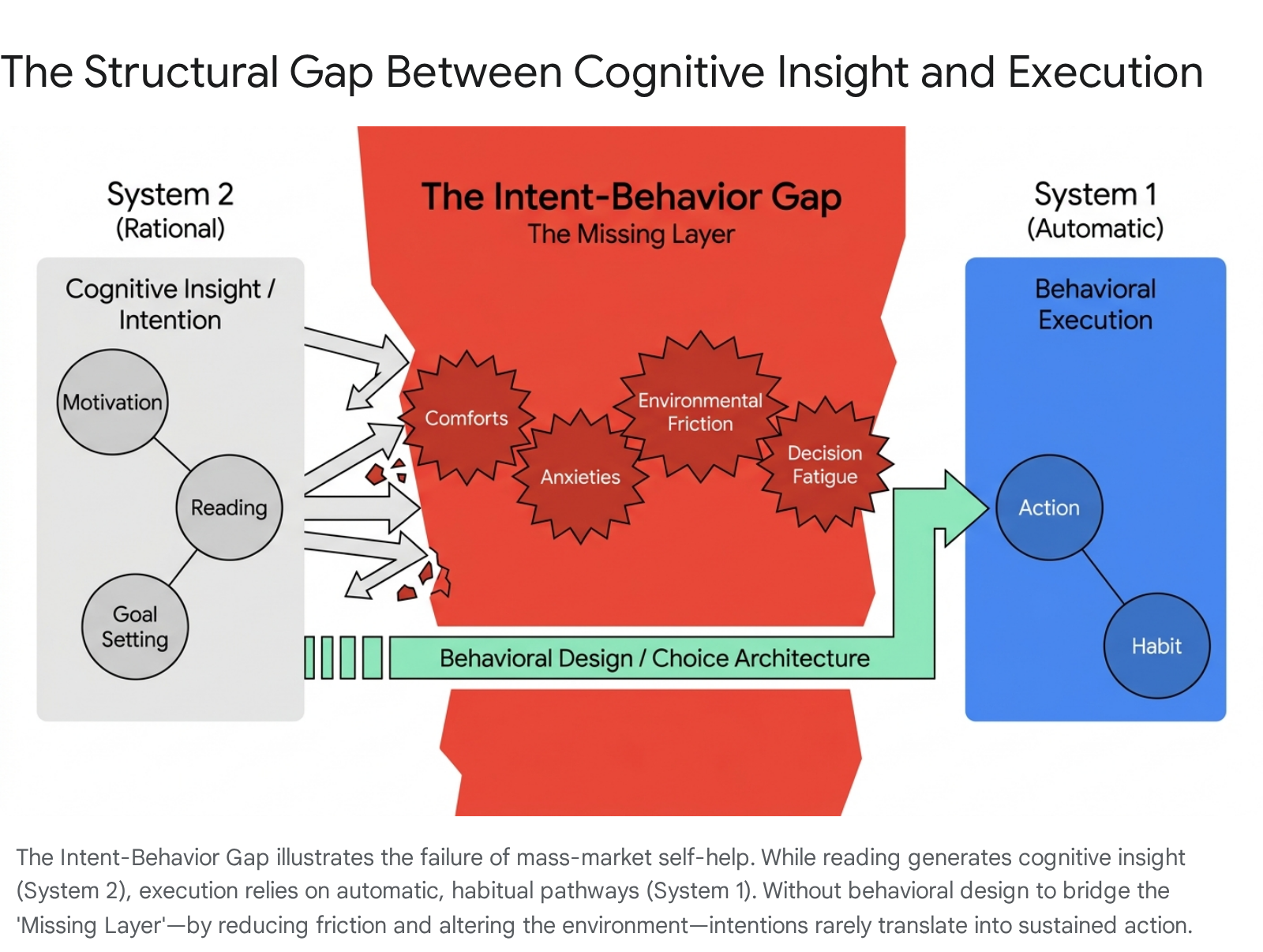
To fully comprehend why profound cognitive insight consistently fails to produce corresponding behavioral change, it is absolutely necessary to examine the theoretical framework known as the "Intent-Behavior Gap" 38. This gap represents the structural and psychological chasm between what individuals rationally, consciously intend to do and what they actually, automatically execute in reality 31.
Behavioral design experts and cognitive psychologists map this systemic failure directly to the dual-process theory of human cognition 119. Traditional self-help literature, corporate change management frameworks (such as Kotter's 8-step model), and standard educational curricula operate almost entirely within the realm of "System 2" - the slow, deliberate, rational, analytical, and highly energy-consumptive part of the brain 1. When an individual reads a self-improvement book, understands a new concept, and consciously decides to alter their life trajectory, System 2 is highly active.
However, empirical experience-sampling studies reveal that upwards of 45% of all daily behaviors are deeply habitual, governed entirely by "System 1" - the fast, automatic, unconscious system driven by immediate environmental cues, established comforts, emotional anxieties, and past conditioning 13334. System 1 operates below the level of conscious choice.
The critical "missing layer" in mass-market self-help and traditional change initiatives is structural behavioral design 1235. Motivation, persuasion, and education successfully address System 2, generating belief and understanding. However, they leave the systemic forces - the deep-seated habits, the environmental triggers, the physical frictions, and the social anxieties - that govern System 1 entirely untouched 134. As long as the individual returns to an unchanged environment that intrinsically rewards old habits and provides immense friction against new behaviors, System 1 will inevitably default to the path of least resistance. The default environment always wins, rendering sustained systemic change practically impossible regardless of the intensity of conscious intention 1234.
4.1 Comparative Analysis of Intervention Strategies
To successfully transition across the intent-behavior gap, one must systematically abandon strategies heavily reliant on affect and willpower, and instead adopt robust strategies rooted in behavioral architecture and evidence-based clinical protocols. The following table contrasts these distinct psychological methodologies, highlighting the fundamental differences in approach and efficacy.
| Dimension | Motivational / Insight-Based Strategies (Mass-Market) | Evidence-Based Behavioral Strategies (Clinical/Architectural) |
|---|---|---|
| Primary Cognitive Target | System 2 (Rational thought, conscious desire, and emotional arousal) 134. | System 1 (Automaticity, environmental cues, habitual routines) 133. |
| Mechanism of Action | Willpower exertion, positive affirmations, broad outcome-based goal setting 17. | Choice architecture, implementation intentions, environmental friction modification 2021. |
| Reward Pathway | Premature dopamine release via Vicarious Goal Fulfillment during the planning phase 524. | Dopamine release delayed until actual behavioral completion and cue-routine-reward loop closure 33. |
| Failure Interpretation | Internalized character flaw ("I lacked discipline or passion") leading directly to learned helplessness 215. | Structural deficiency in the environment or protocol (e.g., intervention window missed, cue not salient) 1215. |
| Underlying Philosophy | The mind controls behavior; changing one's thoughts and beliefs will inherently change one's actions 22. | Behavior precedes motivation; acting despite negative affect physically alters subsequent cognition 1522. |
| Efficacy Profile | Small effect sizes; extremely high susceptibility to the False Hope Syndrome and rapid relapse 27. | Medium to large effect sizes; highly effective in significantly reducing intention-behavior decay 122021. |
5. Post-2023 Meta-Analytic Developments in Behavioral Execution
Recent, exhaustive meta-analyses across the disciplines of behavioral economics, cognitive psychology, and psychiatry provide a definitive, evidence-based blueprint for overcoming the intent-behavior gap. The aggregated data points overwhelmingly toward environmental structuring, specific implementation intentions, and behavioral activation as the vastly superior mechanisms for engineering sustained human change.
5.1 Habit Formation, Implementation Intentions, and the COM-B Model
While motivation determines why an individual wishes to change, environmental friction and capability determine whether they actually will. The COM-B model (Capability, Opportunity, Motivation - Behavior) systematically maps this dynamic, demonstrating that behavior only occurs when all three elements align 23. Meta-analyses of experimental studies demonstrate that forming strong goal intentions (commitment) accounts for, on average, only 28% of the variance in actual behavior, leaving a massive 72% gap entirely unexplained by motivation 20. Furthermore, when examining the translation of intentions to actions, researchers find that people act on their "good" intentions only 53% of the time, highlighting the severe limitations of purely cognitive interventions 20.
The clinically validated solution lies in the formulation of "Implementation Intentions" - highly specific, if-then plans that cognitively link a situational cue directly to a predefined behavioral response, thereby automating action control and bypassing the need for conscious System 2 deliberation 2024. A monumental meta-analysis incorporating 94 independent studies and over 8,000 participants observed that forming implementation intentions possesses a medium-to-large overall effect on goal attainment (Cohen's d = 0.65) 2024. Crucially, in populations dealing with mental health challenges, implementation intentions proved extraordinarily effective, yielding a large-sized effect on goal attainment (Cohen's d = 0.99) across 29 experimental studies 24. By pre-loading the decision ("If situation X arises, then I will initiate behavior Y"), the initiation of the behavior is shifted from the easily fatigued, rational System 2 to the automatic, cue-driven System 1, providing immediacy in action control 24.
Furthermore, post-2023 empirical applications of habit formation - such as the principles validated in educational psychology and pedagogical research - emphasize the absolute necessity of micro-behavioral changes. Research explicitly proves that "habit stacking" - the deliberate pairing of a new, small behavior with an already deeply established daily routine - significantly enhances long-term adherence 2526. By leveraging existing neural pathways and structuring the physical environment to cue the behavior, individuals can bypass the need for daily motivation entirely 2527.
5.2 Choice Architecture, Friction, and Nudge Theory Efficacy
Behavioral economics has successfully operationalized environmental modification through the frameworks of "Choice Architecture" and "Nudging." A nudge is defined as any aspect of the choice architecture that alters people's behavior in a predictable way without forbidding any options or significantly changing their economic incentives 192829.
A highly comprehensive 2022 meta-analysis published in the Proceedings of the National Academy of Sciences (PNAS), which synthesized 447 effect sizes across 212 publications involving over 2.1 million participants, conclusively demonstrated that choice architecture interventions successfully promote behavior change 2130. The analysis revealed a statistically significant, small-to-medium overall effect size (Cohen's d = 0.43), an impact comparable to, or exceeding, traditional and far more expensive intervention approaches like mass education campaigns or direct financial incentives 21.
Subsequent 2023 and 2024 meta-analyses confirm these findings, noting that interventions specifically targeting friction - either by reducing the physical or cognitive effort required for a desirable choice (Nudge) or increasing the effort required for an undesirable choice (Sludge) - are substantially more effective than interventions attempting to change an individual's intrinsic motivation or deeply held beliefs 2931. By strategically altering defaults, manipulating the range of options, and restructuring the physical environment so that the desired behavior genuinely becomes the path of least resistance, individuals execute change without expending their highly limited willpower reserves 3421.
5.3 Behavioral Activation vs. Positive Thinking
Within clinical psychology and the treatment of affective disorders, the paradigm shift from cognition-first to behavior-first modalities is best exemplified by the supremacy of Behavioral Activation (BA) over pure positive thinking. Mass-market self-help often preaches the necessity of cultivating a purely positive mindset or achieving emotional readiness before taking significant action 2232. However, BA is predicated on the inverse principle: action must precede motivation.
BA is a standalone, evidence-based structured therapy aimed at systematically increasing the amount of activity in a person's daily life, specifically targeting activities that bring the individual into contact with sources of environmental positive reinforcement 2233. This process directly breaks the insidious cycle of avoidance, withdrawal, and rumination common in depression and severe anxiety 22. Extensive meta-analyses reveal that BA yields significant improvements in overall well-being (Hedge's g = 0.52), an effect comparable to complex multi-component psychological interventions 33. Furthermore, recent evaluations of digital and smartphone-based BA interventions demonstrate that they effectively and significantly reduce depressive symptoms and improve quality of life at 3-month and 6-month follow-ups, with minimal risk of bias 3435. By focusing rigidly on scheduling overt behaviors based on core values rather than waiting for affective readiness, BA elegantly circumvents the emotional paralysis that plagues individuals relying solely on motivational arousal 1122.
6. Neurobiological Underpinnings: Neuroplasticity and Sustained Behavior Change
The established superiority of behavioral execution strategies over passive motivational reading is not merely a psychological preference; it is strictly dictated by neurobiology. True, enduring behavioral change requires the literal, physical remodeling of the brain's architecture through experience-dependent neuroplasticity 3653.
When individuals engage in passive "information bingeing," scrolling through social media advice, or reading motivational texts, the brain experiences highly transient neurochemical shifts - brief spikes in dopamine and serotonin - but undergoes almost zero structural adaptation 1728. The neural pathways governing their daily habits remain entirely unaltered. Conversely, when individuals utilize implementation intentions, behavioral activation, and friction-reducing environmental design to consistently execute new behaviors in the physical world, they force the brain to adapt structurally 3653.
Recent systematic reviews and meta-analyses from 2023 to 2025 demonstrate conclusively that consistent physical, emotional, and cognitive interventions lead to profound structural and functional brain adaptations 3637. Repeated behavioral execution elevates levels of Brain-Derived Neurotrophic Factor (BDNF), a critical protein that supports the survival of existing neurons and acts as a primary catalyst for the growth of new synapses (synaptic plasticity) 3638.
In robust studies of substance use disorder (SUD) recovery, for example, behavioral interventions targeted at reducing the salience of environmental cues and enforcing new routines successfully induce functional reorganization 38. These interventions reverse states of "hypofrontality" - restoring prefrontal cortex (PFC) executive control - and reduce dysregulation within the amygdala and nucleus accumbens, physically rewiring the neural circuits implicated in emotional regulation, craving, and impulse control 38. Similarly, in older adults with mild cognitive impairment (MCI), structured mind-body behavioral interventions have been shown to increase gray matter volume in the hippocampus and anterior cingulate cortex, while altering functional connectivity in the default mode network 37. This concrete neurobiological reality underscores a fundamental law of human change: an individual cannot merely think their way into a new neural structure; they must consistently act their way into it.
7. Expanding the Context: Cultural Constraints and the Limits of Western Individualism
A critical, yet frequently overlooked, vulnerability of the mass-market self-help industry is its profound and almost exclusive embeddedness in Western cultural and philosophical paradigms. To accurately assess the efficacy of behavioral interventions on a global scale, one must critically dismantle the pervasive assumption that the individual is the sole, unfettered arbiter of their destiny.
7.1 The Individualistic Bias of Mass-Market Self-Help
The philosophical bedrock of the modern self-help industry is built entirely upon the cultural taxonomy of Individualism, a sociometric dimension heavily researched and quantified by scholars such as Geert Hofstede 439. Individualistic societies - predominantly located in North America and Western Europe - prioritize individual achievement, strict autonomy, and the deeply ingrained belief that a person's life trajectory is the direct, unmediated result of their personal choices, mindset, and work ethic 45.
Consequently, Western mass-market self-help actively promotes a relentless ideology where severe structural, economic, and systemic barriers are viewed merely as subjective psychological hurdles to be overcome through sheer willpower and "hustle" 531. This hyper-individualistic rhetoric is not only scientifically flawed - as it completely ignores the power of choice architecture, socio-economic friction, and systemic constraints - but it is also socially corrosive. Cultural critiques argue that by framing success and failure as a purely individual mandate, the self-help industry absolves institutions, governments, and societies of collective responsibility. It effectively erodes the necessary discourse surrounding policy reform, global inequality, and systemic interventions, blaming the individual for failing to overcome insurmountable environmental friction 5.
7.2 Cross-Cultural Efficacy of Adapted Evidence-Based Bibliotherapy
In stark contrast to the ethnocentric, highly individualized nature of mass-market self-help, evidence-based behavioral interventions - such as CBT-based bibliotherapy - have been rigorously tested, analyzed, and adapted across highly diverse cultural and geographic contexts. In collectivist cultures, which constitute the vast majority of the global population across Asia, Africa, South America, and the Middle East, individuals conceptualize the self as fundamentally interdependent 439. In these societies, personal goals are frequently subordinated to group cohesion, familial duty, and collective well-being 439.
When rigid, unadapted Western interventions emphasizing pure autonomy are deployed in these contexts, they often fail to resonate and yield poor clinical outcomes 440. However, recent and highly sophisticated meta-analyses demonstrate that when bibliotherapy and guided self-help interventions undergo "deep cultural adaptation" - a process involving the incorporation of local metaphors, the integration of extended family and community dynamics, and the alignment of the therapy with collectivist values such as social justice and collective harmony - they become highly effective 584142.
For instance, carefully adapted bibliotherapy has been successfully utilized to address severe emotional trauma among refugees in the Middle East, utilizing culturally resonant poetry and storytelling to facilitate communal catharsis rather than isolated individual processing 58. Furthermore, in low-and-middle-income countries (LMICs) where psychiatric resources are scarce, culturally adapted brief psychological interventions have proven highly scalable 42. Meta-regressions analyzing randomized controlled trials in diverse populations explicitly reveal that higher cultural adaptation scores in minimally guided interventions are significantly associated with greater clinical effect sizes (yielding a pooled Standardized Mean Difference of -0.81 for the reduction of depression and anxiety) 41. This robust data proves that while the underlying neurobiological mechanisms of habit formation and behavioral execution (System 1) are universal human traits, the cognitive and cultural frameworks (System 2) required to initiate and sustain them must be highly contextualized and culturally resonant to achieve efficacy 4041.
8. Conclusion
The persistent, often agonizing gap between human aspiration and behavioral realization cannot be bridged by a mere accumulation of motivation, cognitive insight, or transient emotional arousal. The extensive clinical and empirical data overwhelmingly indicates that the mass-market self-help industry, while demonstrably effective at stimulating the brain's dopaminergic reward system through Vicarious Goal Fulfillment, is fundamentally ill-equipped to generate sustained, structural behavioral change 152. By relying almost exclusively on the slow, easily fatigued mechanisms of conscious willpower (System 2) and actively fostering unrealistic expectations via the False Hope Syndrome, these motivational modalities inadvertently trap individuals in a devastating cycle of repeated failure, dopamine depletion, and eventual learned helplessness 22434.
To successfully cross the Intent-Behavior Gap, both personal and organizational interventions must fundamentally shift their focus from cognitive persuasion to structural architectural design 18. Post-2023 meta-analyses spanning clinical psychology, neuroscience, and behavioral economics provide a definitive, evidence-based mandate for execution:
- Abandon Outcome Goals for Implementation Intentions: Utilizing specific, cue-based planning ("if-then" mechanics) automates behavior, removing the heavy burden of constant decision-making from the prefrontal cortex and achieving medium-to-large effect sizes in goal attainment 2024.
- Utilize Choice Architecture and Manage Friction: Altering the physical and digital environment to make desired behaviors functionally frictionless and undesirable behaviors highly difficult is mathematically and empirically more effective than attempting to change intrinsic human beliefs 2129.
- Prioritize Behavioral Activation over Positive Affect: Action must necessarily precede motivation. Engaging in structurally scheduled, value-aligned activities physically alters the brain via experience-dependent neuroplasticity (increasing BDNF and synaptic efficacy), eventually generating the organic motivation that mass-market literature falsely promises at the outset 223653.
Ultimately, true human transformation is an architectural and neurobiological endeavor, not a fleeting emotional state. By systematically dismantling the hyper-individualistic illusions of mass-market motivation and applying rigorous, culturally adapted, and evidence-based behavioral design, individuals and organizations can construct resilient systems where execution becomes the unconscious default, permanently transforming abstract insight into tangible reality.