
Evidence on Deliberate Modification of the Subconscious Mind
Foundational Concepts in Implicit Memory and Neuroplasticity
The conceptualization of the subconscious mind within cognitive neuroscience relies upon the empirical frameworks of implicit memory, non-declarative processing, and experience-dependent neuroplasticity. The deliberate modification of these subconscious networks requires a precise understanding of how the human brain encodes, stores, and retrieves information below the threshold of conscious awareness.
Neurobiological Paradigms of the Subconscious
Historically, the distinction between conscious and subconscious processing was formalized through the study of patients with medial temporal lobe (MTL) damage, most notably Patient H.M., whose condition demonstrated that explicit (declarative) memory for facts and events depends heavily on the MTL, whereas implicit (non-declarative) memory operates independently of this system 12. This foundational dissociation indicated the presence of distinct memory systems capable of operating without conscious awareness 2.
However, contemporary neuroscience refutes the notion that implicit memory exists as a singular, anatomically isolated secondary system. Instead, it is better characterized as an emergent property of experience-dependent neuroplasticity occurring across widespread cortical networks 134. Under this paradigm, all cognitive processing involves continuous, subtle neural reorganization to anticipate and execute future cognitive demands more efficiently 5. The PINNACLE model (Parallel Interacting Neural Networks Competing in Learning) provides a neurocomputational framework for this phenomenon 467. The model illustrates how implicit intuition and deliberate deduction depend on separate interacting networks that compete and cooperate to guide decision-making 478. Implicit learning, therefore, manifests as a continuous principle of functional improvement derived from environmental statistical structures, operating entirely outside of conscious encoding 69.
Cellular Mechanisms of Experience-Dependent Neuroplasticity
At the cellular level, the biological mechanisms underlying the modification of implicit processes extend significantly beyond traditional synaptic long-term potentiation (LTP). Experience-dependent neuroplasticity involves rapid, activity-induced structural state changes 10. Calcium ion (Ca2+) signaling pathways function as universal intracellular messengers that translate transient bodily experiences, motor movements, and environmental stressors into lasting structural modifications within neural circuits 11.
Furthermore, emerging research in epitranscriptomics reveals that RNA modifications, particularly the accumulation of m6A, play a vital role in memory formation 1012. Because these post-transcriptional modifications circumvent the need to signal the cell nucleus, they coordinate seamlessly with the rapid temporal dynamics of learning, allowing neurons to adapt to environmental stimuli in real-time 1012. At the macroscopic level, the acquisition of complex subconscious skills - such as bilingualism or motor sequences - follows an "exploration - selection - refinement" (ESR) model. This involves a nonlinear trajectory characterized by an initial expansion of regional gray matter volume, followed by a subsequent renormalization to baseline volumes once the neural circuits have been optimized and excess synaptic connections pruned 13.
Limitations of the Computer Hard Drive Metaphor
The scientific understanding of these dynamic biological networks invalidates the pervasive "computer hard drive" metaphor routinely applied to the subconscious mind. Within cognitive science, computation refers to abstract information processing 1415. However, equating the brain to commercial computer hardware misrepresents the human nervous system as an embodied, parallel, and active agent governed by fluids, hormones, and emotions 14161518.
The brain does not passively process inputs into outputs via step-by-step algorithms, nor does it possess an isolated storage drive that can be passively overwritten with external data 1416. Arguments positing that brains operate akin to Turing machines or Von Neumann architectures fail to account for the holistic, dynamically emerging nature of neural assemblies 1415. Consequently, deliberate modification of the subconscious requires methods that actively engage neuroplasticity - either through rigorous behavioral repetition or precise physiological timing - rather than the passive insertion of data.
Subliminal Auditory Interventions and Belief Modification
A substantial commercial industry is predicated on the assumption that the subconscious mind can be reprogrammed using subliminal audio tracks. These interventions claim to bypass the critical faculties of the conscious mind to deliver semantic affirmations directly to implicit memory systems, promising outcomes ranging from improved self-esteem to spontaneous wealth generation 1920.
Historical Context and Empirical Refutation
The concept of subliminal persuasion gained widespread public attention following James Vicary and Frances Thayer's infamous study claiming that flashing the phrases "Eat Popcorn" and "Drink Coca-Cola" increased sales by 58% and 18%, respectively 21. While public apprehension regarding subconscious manipulation persists, rigorous controlled neuroscientific and psychological studies consistently demonstrate that subliminal audio is highly ineffective for structural belief modification 211617.
In comprehensive reviews of double-blind experimental tests evaluating subliminal weight-loss and self-esteem tapes, researchers found no objective evidence of therapeutic utility or behavioral modification 1718. For example, a robust empirical evaluation by Merikle and Skanes (1992) found no evidence that subliminal weight loss tapes modified behavior 17. Similarly, Anthony Pratkanis demonstrated that tapes claiming to enhance memory and self-esteem produced zero statistical effect on objective psychological scores 21.
The Expectancy Effect and Decay Constraints
When individuals report positive outcomes from subliminal self-help tapes, the effects are overwhelmingly attributable to expectancy, placebo mechanisms, relaxation, and the ritualistic context of the intervention, rather than the subliminal semantic content itself 211617. The human cognitive system can process basic auditory changes and simple perceptual stimuli below the threshold of awareness; however, there is insufficient evidence that it can execute the deep semantic processing required to encode masked verbal messages 161718.
The primary biological barrier to subliminal audio efficacy is the exceptionally brief longevity of subliminal priming. Behavioral effects of masked primes typically decay within one second, leaving no long-term memory traces capable of influencing delayed decisions or core beliefs 1920.
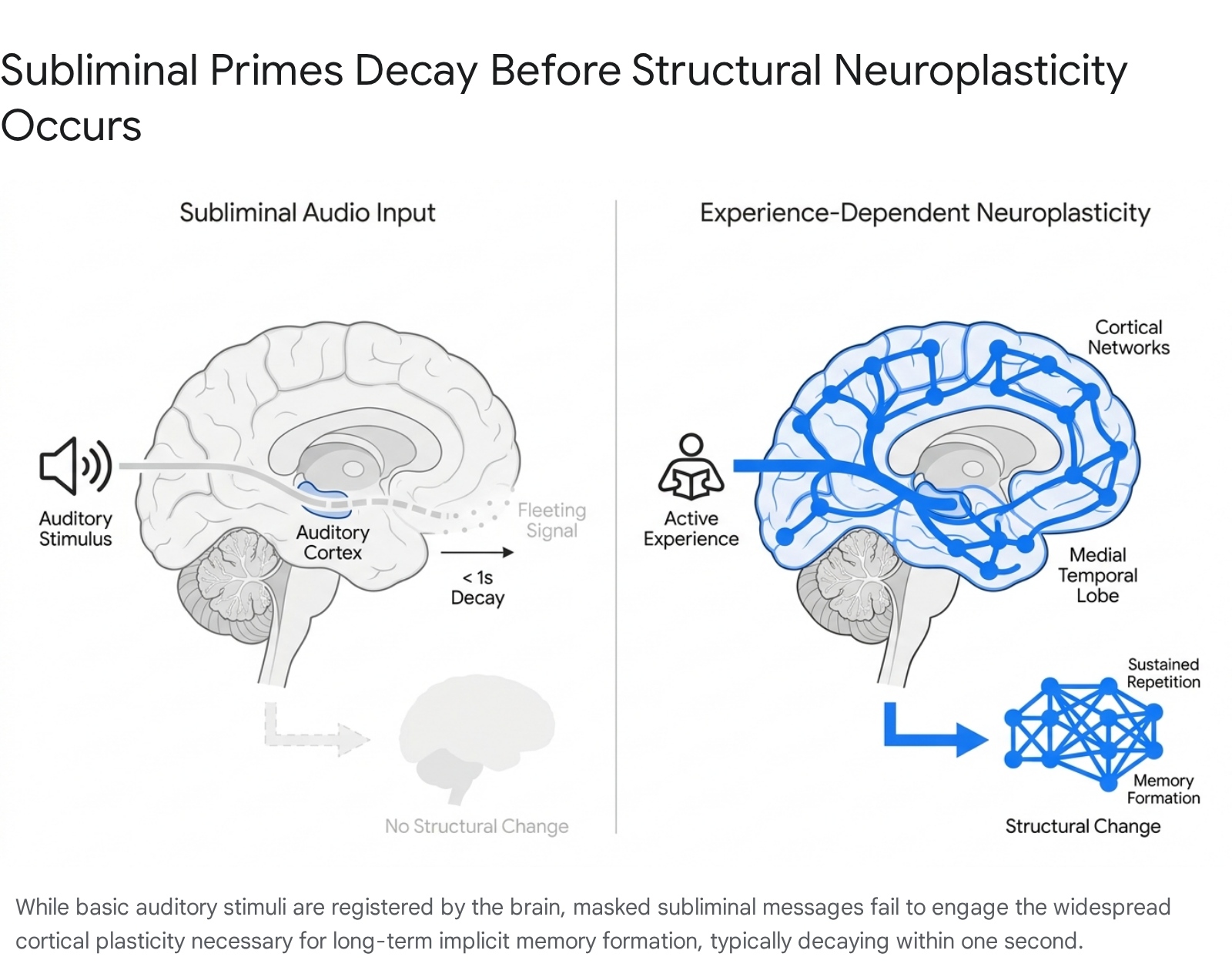
While exceptional laboratory cases have demonstrated that subliminal priming can influence delayed behavior for up to 25 minutes, these instances require the relational binding of highly specific novel information under strict experimental conditions - a mechanism fundamentally absent in commercial self-help audio 19.
Commercial Brainwave Entrainment Programs
Recent commercial iterations of subliminal audio, such as the "Wealth Signal" and "Billionaire Brain Wave," assert that brainwave entrainment can spontaneously attract financial abundance 20272829. The operational premise of these systems is that listening to a short daily audio track layered with binaural beats, isochronic tones, and a proprietary "9-word wealth script" will induce alpha (8 - 13 Hz) and theta (4 - 7 Hz) wave states, thereby enlarging the hippocampus and replacing scarcity mindsets 2027303132.
While the fundamental concept of auditory brainwave entrainment has scientific validity regarding the induction of relaxation and sleep, its extrapolation to wealth generation and anatomical transformation is pseudoscientific 19272832. Neuroimaging studies confirm that theta waves are associated with memory consolidation and relaxed states; however, no empirical evidence supports the claim that altering these frequencies directly influences environmental financial outcomes 192728. Furthermore, assertions that audio frequencies can directly increase hippocampal volume to mimic the neurology of billionaires lack anatomical plausibility. Hippocampal size is dictated by complex interactions of genetics, diet, physical exercise, and rigorous cognitive stimulation, rather than isolated auditory entrainment 2728. Reductions in stress reported by users of these programs are recognized manifestations of guided relaxation, rather than the subconscious absorption of specific financial scripts 192032.
Targeted Memory Reactivation During Sleep
In contrast to the inefficacy of waking subliminal audio, robust empirical evidence supports the deliberate modification of the subconscious mind during sleep through a methodology known as Targeted Memory Reactivation (TMR). TMR leverages the brain's natural offline memory consolidation processes by introducing low-intensity sensory cues - typically sounds or odors - that were previously associated with learning material during wakefulness 212223.
Electrophysiological Correlates of Memory Consolidation
Memory consolidation during sleep is characterized by the spontaneous reactivation of learning-related neuronal patterns, facilitating the transfer of information from the temporary storage of the hippocampus to the long-term storage networks of the neocortex 2124. TMR systematically biases this natural reactivation. The efficacy of TMR is highly dependent on sleep architecture, specifically occurring during non-rapid eye movement (NREM) sleep, encompassing N2 and slow-wave sleep (SWS) 21222526.
Electrophysiological data indicates that successful TMR relies on precise neural timing. Cues presented during the "upstates" of slow oscillations (0.1 - 1.5 Hz) and those that elicit subsequent increases in delta band power (1 - 4 Hz) and sigma power are most strongly associated with subsequent memory strengthening 2426. Notably, the critical physiological processes supporting this memory consolidation conclude rapidly. Reactivation events triggered by sensory cues are highly time-bound, concluding within two seconds of cue onset; extending the duration of the audio cue provides no additional cognitive benefit 20. To translate these laboratory findings into practical applications, researchers have developed automated, closed-loop TMR delivery systems for the home environment, utilizing wearable EEG devices and smartwatch data to deploy audio stimuli precisely during periods of deep sleep 22252740.
Distinctions Between NREM and REM Reactivation
The application of TMR during Rapid Eye Movement (REM) sleep yields divergent results compared to NREM sleep. Machine learning classifiers applied to EEG data can detect the reactivation of task-related motor imagery during REM sleep; however, this cortical reactivation does not consistently translate to improved behavioral performance upon waking 212829.
The disconnection between cortical reactivation and behavioral improvement during REM is hypothesized to stem from elevated levels of acetylcholine, which inhibit hippocampal-neocortical communication during this sleep stage 29. Consequently, while TMR in NREM sleep induces extensive plasticity in the medial temporal lobe to benefit declarative memory, TMR in REM sleep appears to serve a different evolutionary function. Specifically, REM TMR has been shown to selectively enhance late positive potential (LPP) neural responses to previously encountered negative emotional stimuli, indicating a primary role in emotional processing and affective regulation rather than declarative memory enhancement 28.
Applications in Vocabulary and Spatial Memory
The primary evidence for TMR efficacy involves the consolidation of spatial memory and language acquisition. In controlled settings, presenting auditory cues linked to spatial grid locations during NREM sleep reliably improves spatial memory recall upon waking 222740. Crucially, maintaining sleep continuity is paramount; if the sensory cue disrupts the sleep architecture or arouses the participant, the memory benefits are nullified. Therefore, precise, low-intensity stimuli are required to achieve reactivation without inducing arousal 222740.
In the domain of language, sleep actively coordinates brainwaves to facilitate the learning of novel grammatical rules and vocabulary 303132. Studies tracking participants learning artificial languages, such as "Mini Pinyin," demonstrated that those who slept post-instruction improved performance by 19 percentage points compared to those tested after an equivalent waking interval 3031. These benefits were explicitly linked to the coupling of slow oscillations and sleep spindles in NREM sleep 3032. TMR can further enhance this natural process. By playing vocabulary pairs precisely timed to the slow-wave troughs of deep sleep, researchers have facilitated the successful classification of newly introduced pseudo-words, demonstrating that the sleeping brain can encode new associative information, provided the foundational associations were established during prior wakefulness 3347.
Modulation of Implicit Biases and Emotional Memories
TMR has demonstrated a profound capacity for deeper forms of subconscious reprogramming, specifically concerning the unlearning of ingrained implicit social biases and the modulation of aversive emotional memories.
When participants undergo counter-bias training during the day and are subsequently exposed to associated TMR cues during NREM sleep, the reduction in unintentional social biases is significantly enhanced compared to waking training alone 26. This reduction correlates directly with cue-elicited delta power and the clustering of cues within slow-oscillation upstates 26.
Furthermore, TMR can augment clinical psychotherapeutic processes. In studies utilizing imagery rescripting (ImR) to update aversive autobiographical memories, the application of TMR during subsequent NREM sleep resulted in those memories being recalled with significantly less vividness, emotional distress, and arousal compared to control groups 25. These findings indicate that TMR can bias offline reconsolidation toward the integration of adaptively modified memory traces, offering a non-invasive adjunct for treating trauma and conditions like Post-Traumatic Stress Disorder (PTSD) 25.
Meditative Interventions and Autonomic Regulation
Meditative interventions derived from Eastern traditions offer scientifically validated methods for deliberately altering subconscious physiological baselines and automated cognitive patterns. Unlike passive audio processing, these practices require active, repeated engagement to induce structural neuroplasticity and autonomic modulation.
Yoga Nidra and Parasympathetic Dominance
Yoga Nidra, often termed "yogic sleep," is a systematic method of guided mental imagery and body scanning performed in a supine posture 343536. Clinical evidence indicates that Yoga Nidra rapidly facilitates a state of parasympathetic nervous system dominance. Pre-post assessments of single 20-minute sessions in healthy adults reveal immediate improvements in cardiac autonomic regulation, characterized by significant decreases in heart rate and increases in RR intervals 34.
Measurements of heart rate variability (HRV) during and after practice show significant elevations in time-domain indices (SDNN, NN50, pNN50) and high-frequency (HF) power, confirming increased cardiac autonomic flexibility 34. Neurologically, this state correlates with a shift from active Beta brainwaves to resting Alpha and deep Theta waves 35. Over extended protocols, such as 12-week trials, these autonomic shifts consolidate, leading to statistically significant reductions in blood pressure, pulse, and cortisol levels, making it a viable non-pharmacological intervention for hypertension and chronic stress 3536. EEG data indicates that the psychological benefits of Yoga Nidra are optimized through active engagement (characterized by increased alpha and high beta activity) rather than transitioning entirely into unconscious sleep states 37.
Vipassana Meditation and Structural Neuroplasticity
Vipassana meditation emphasizes the development of non-reactive interoception through the continuous, dispassionate observation of bodily sensations and mental states 3853. Systematic reviews and functional MRI studies demonstrate that continuous Vipassana practice induces significant structural and functional neuroplasticity 38545556.
Regular practitioners exhibit increased gray matter density in the prefrontal cortex (associated with attention) and the insula (associated with interoception), alongside enhanced hippocampal topology 545557. These structural changes correlate with decreased amygdala reactivity to emotional stimuli and improved functional connectivity between the amygdala and prefrontal regulatory regions 545639. Behaviorally, this neuroplasticity manifests as moderate to large reductions in trait anxiety, depression, and stress. Specific studies have documented profound improvements; a naturalistic observation study in Muscat found participant anxiety scores dropped from an average of 10 to 3.29 following a retreat, while programs at India's Tihar Jail reported substantial drops in recidivism rates (56% vs 75% in non-meditators) alongside reduced anxiety 57.
Potential Adverse Effects of Intensive Practice
While highly effective, the intensive manipulation of subconscious states carries documented risks. Emerging research highlights that intensive meditation retreats - often characterized by isolation, sleep deprivation, and prolonged hours of continuous practice - can act as severe physical and psychological stressors 40. A survey published in PLOS ONE examining 1,232 individuals with meditation experience found that 25.6% reported having had a "particularly unpleasant" psychological experience they believed was linked to their practice 40. In a minority of vulnerable practitioners, this intensive environment can trigger adverse psychological events, including severe emotional distress, hallucinations, and meditation-induced psychosis, necessitating careful clinical oversight for individuals with prior psychiatric histories 40.
Western Clinical Interventions and Cognitive Restructuring
Eastern mindfulness practices have been heavily adapted into Western clinical frameworks, most notably as Mindfulness-Based Stress Reduction (MBSR), Mindfulness-Based Cognitive Therapy (MBCT), and Acceptance and Commitment Therapy (ACT) 53564142. Western psychological paradigms typically address subconscious distress through top-down cognitive restructuring, whereas Eastern paradigms utilize bottom-up processing, focusing on accepting present-moment sensations without attempting to alter the cognitive narrative 53414262.
Comparative Neural Mechanisms of CBT and Mindfulness
Meta-analyses comparing Mindfulness-Based Interventions (MBIs) to traditional Cognitive Behavioral Therapy (CBT) find comparable efficacy. Both modalities successfully reduce anxiety and depression symptoms, though functional neuroimaging reveals that they recruit distinct neural pathways to achieve these outcomes 564344.
MBSR predominantly decreases amygdala activation and enhances default mode network (DMN) regulation through sustained attention and increased interoceptive awareness 563943. In contrast, CBT heavily recruits lateral prefrontal regions to actively reappraise and alter the valence of negative stimuli 5643. Despite these contrasting mechanisms of therapeutic change, both systems effectively reprogram ingrained subconscious emotional responses, validating both top-down and bottom-up approaches to neuroplastic modification 416243.
The following table synthesizes the distinct mechanisms, physiological targets, and evidentiary basis for the primary modalities of subconscious modification discussed in the literature:
| Intervention Modality | Primary Mechanism of Action | Principal Neurobiological Target | Evidence of Efficacy | Inherent Limitations / Risks |
|---|---|---|---|---|
| Subliminal Audio (Commercial) | Supposed direct subconscious semantic encoding via masked audio. | Hippocampus / Alpha & Theta induction. | None. Effects are driven entirely by placebo and expectancy 161728. | Sunk financial cost; rapid decay of masked primes (<1s) prevents encoding 1927. |
| Targeted Memory Reactivation (TMR) | Reactivation of waking memory traces during offline consolidation. | NREM slow-oscillation upstates; Hippocampal-neocortical dialogue. | High. Significantly enhances spatial/vocabulary memory and diminishes implicit biases 2627. | Requires prior waking exposure; easily nullified by sleep disruption 2022. |
| Yoga Nidra | Guided interoception and autonomic down-regulation (supine posture). | Autonomic Nervous System; Vagal tone; Alpha-Theta synchronization. | High. Induces immediate and sustained parasympathetic dominance (HRV increase) 3435. | Optimal benefits depend on active engagement, not passive transition to sleep 37. |
| Vipassana Meditation | Dispassionate observation and bottom-up interoceptive awareness. | Insula, Prefrontal Cortex, and Amygdala down-regulation. | High. Induces structural gray matter changes; significant anxiety reduction 555657. | Potential for adverse psychological effects (e.g., psychosis) during intensive retreats 40. |
| Cognitive Behavioral Therapy (CBT) | Top-down cognitive restructuring and active stimulus reappraisal. | Lateral Prefrontal Cortex recruitment. | High. Validated reduction in anxiety, depression, and habitual cognitive distortions 5643. | Requires significant conscious effort and sustained clinical engagement 4344. |
Cognitive Bias Modification and Neuromodulation
Ingrained subconscious processing can also be deliberately retrained through repetitive, targeted behavioral tasks that leverage experience-dependent neuroplasticity in the basal ganglia 4546. Cognitive Bias Modification (CBM) leverages this principle to retrain automatic processing biases associated with psychopathology. Attentional Bias Modification (ABM) trains individuals to redirect visual attention away from threatening stimuli and toward neutral or positive stimuli, implicitly restructuring the brain's threat-detection network over repeated sessions 47.
Similarly, Cognitive Bias Modification targeting memory (CBM-M) is designed to systematically enhance the recall of positive autobiographical memories. In randomized controlled trials involving individuals with elevated anxious and depressive traits, CBM-M significantly reduced stress vulnerability and negative explicit memory bias compared to sham training 4849. Functional magnetic resonance imaging (fMRI) demonstrated that CBM-M elicited tangible neural changes, specifically enhancing functional connectivity between the amygdala and the anteromedial orbitofrontal cortex - regions integral to social reward and autobiographical recall 4849.
Further research into implicit bias indicates that deeply ingrained subconscious associations can be overridden through direct conditioning. In proof-of-concept studies utilizing subliminal sensory primes to induce biased decision-making, researchers successfully trained participants to diverge from the subliminal bias via post-choice feedback. This indicates that human decision-making is not inextricably bound to non-conscious information; implicit biases can be identified, targeted, and effectively removed through structured reinforcement training 70.
Emerging frameworks, such as the Tripartite Psychotherapy Model, propose integrating these behavioral interventions with direct neuromodulation. By utilizing technologies like repetitive transcranial magnetic stimulation (rTMS) or transcranial direct current stimulation (tDCS) to create targeted windows of enhanced neuroplasticity, clinicians can optimize the subjective quality of therapeutic experience and accelerate the remodeling of maladaptive subconscious networks 50. Similarly, advanced protocols like NeuroDirectional Transformative Hypnotherapy (NDTH) leverage trance states to systematically shift dominant neural oscillatory activity toward the alpha range, temporarily attenuating the "gatekeeper" role of the dorsolateral prefrontal cortex to facilitate directed neural reorganization with reduced cognitive resistance 51.
Synthesis of Evidence on Subconscious Modification
The evidence overwhelmingly demonstrates that the subconscious mind can be deliberately trained and reprogrammed, provided the intervention aligns with the biological realities of human experience-dependent neuroplasticity.
The prevalent commercial narrative - that the subconscious operates similarly to a computer hard drive capable of passively downloading wealth affirmations or self-esteem boosts via subliminal audio - is empirically unsupported. Subliminal verbal stimuli decay almost instantly and fail to engage the widespread cortical networks required for long-term belief modification or structural neural change. Any perceived benefits from such products are the result of expectancy, placebo, and general relaxation rather than direct subconscious reprogramming.
Conversely, scientifically validated methods of subconscious modification rely on either intense, repetitive waking engagement or the precise manipulation of natural biological states. Targeted Memory Reactivation effectively biases memory consolidation, enhances learning, and diminishes implicit biases when synchronized specifically with the slow-wave oscillations of deep NREM sleep. Meditative practices like Yoga Nidra and Vipassana induce verifiable structural brain changes, down-regulate amygdala reactivity, and establish lasting parasympathetic dominance through active, sustained interoception. Finally, top-down clinical interventions like CBT and targeted cognitive bias modification actively rewire the neural pathways governing automatic threat detection and negative memory recall. Ultimately, "reprogramming" the mind is not an act of passive absorption, but a rigorous process of directed, experience-dependent neurobiological adaptation.