
Implicit Attitudes and Unconscious Priming in Consumer Brand Choice
The discrepancy between stated consumer intentions and actual purchasing behavior constitutes a persistent methodological challenge in behavioral economics and marketing research. Traditional research paradigms, including self-report surveys, semantic differential scales, and focus groups, rely predominantly on conscious, deliberate reasoning. However, empirical evidence indicates that human decision-making relies heavily on automatic processing and heuristic shortcuts, with a vast majority of daily decisions occurring below the threshold of conscious awareness 113. The investigation into how subconscious mental constructs shape consumer behavior has evolved into a robust scientific discipline, integrating cognitive psychology, behavioral economics, and consumer neuroscience. This research evaluates the structural mechanisms of implicit brand attitudes, the efficacy of behavioral priming, the integration of neurophysiological measurement paradigms, and the cross-cultural dimensions that ultimately modulate implicit consumer preferences.
Cognitive Architecture of Brand Associations
Implicit attitudes represent automatic, unconscious evaluations formed through continuous associative learning processes over extended periods. Unlike explicit attitudes, which are highly susceptible to social desirability biases and require deliberate cognitive effort to articulate, implicit attitudes reflect the immediate strength of mental associations between a target concept, such as a corporate brand, and an evaluation or specific attribute 1234. These latent evaluations operate primarily within "System 1" cognitive processing, driving immediate, heuristically guided decision-making without the necessity of active contemplation 15.
The Continuous Trinity Model
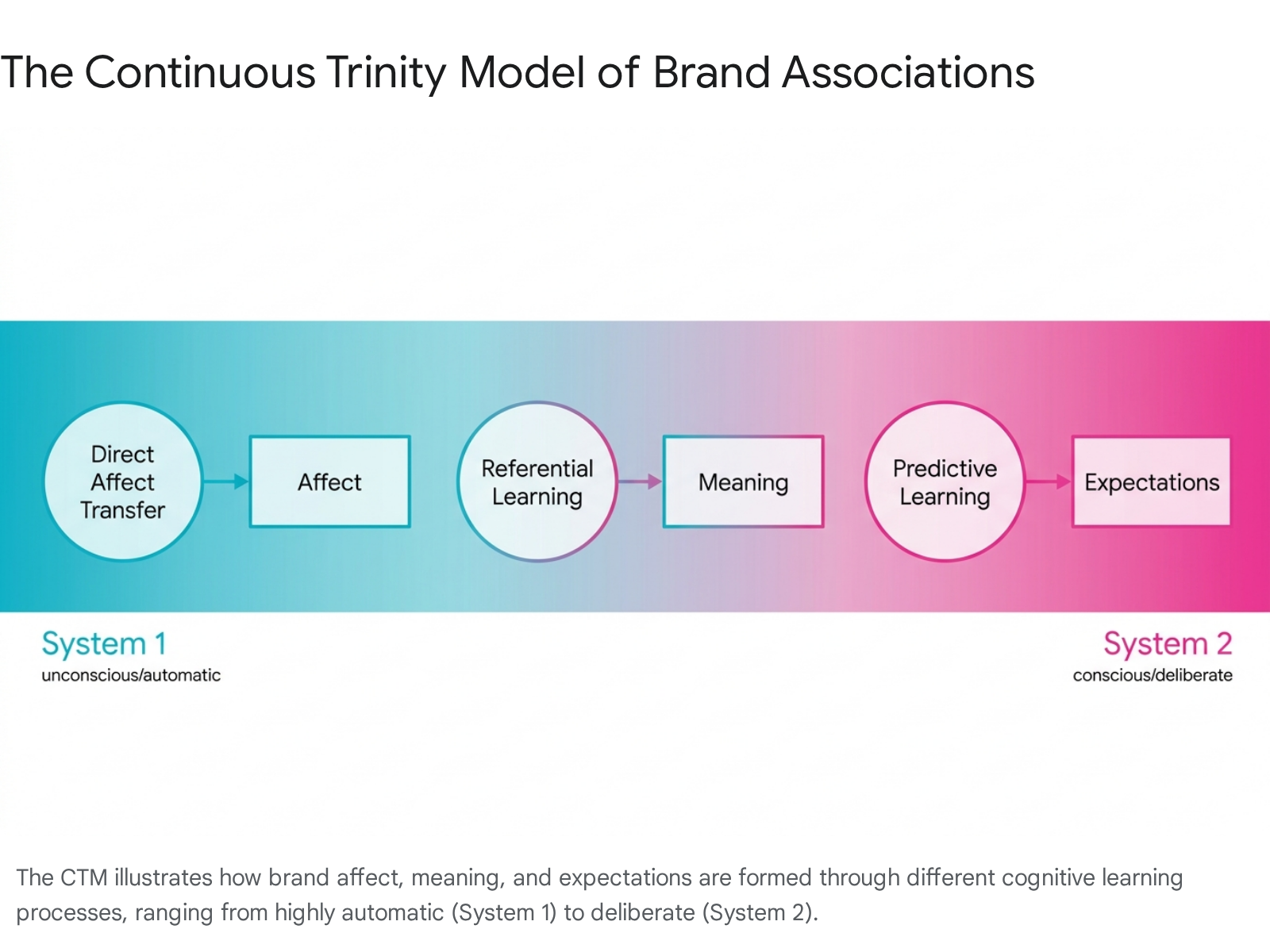
To structure the conceptualization of how brands exist within the human subconscious, recent literature has advanced the Continuous Trinity Model (CTM) of brand associations 69. The CTM organizes half a century of consumer learning research by proposing that brand associations are not monolithic entities. Rather, they exist as three distinct representational types corresponding directly to specific cognitive learning processes 67.
First, brand expectation associations are formed via predictive learning. This process involves a consumer learning to associate a brand with a highly probable physiological outcome or specific functional experience 6. Because predictive learning requires the consumer to comprehend propositional information, encode causality, and recognize sequences, it operates closer to conscious, System 2 processing. It relies heavily on strict stimulus-outcome consistency and statistical contingency 67.
Second, brand meaning associations are generated through referential learning. This mechanism involves linking a brand to broader symbolic concepts, cultural narratives, or semantic categories - for example, associating a specific athletic apparel brand with "perseverance" or a beverage with "youthful energy" 26. Referential learning occupies the middle of the automaticity continuum, utilizing a complex mixture of conscious processing and underlying associative linking 67.
Third, brand affect associations are formed through direct affect transfer. This occurs when the intrinsic emotional valence of an unconditioned stimulus, such as an appealing celebrity endorser or a visually pleasing design aesthetic, transfers directly to the brand without the need for logical comprehension or deep cognitive processing 6. Direct affect transfer operates almost entirely within System 1, relying purely on spatial and temporal contiguity rather than predictive logic or semantic meaning 68. The CTM highlights that the operating conditions of these distinct learning mechanisms dictate when and how durable brand preferences are solidified in the consumer's neural memory network 8.
Psychometric Measurement of Implicit Attitudes
Measuring latent constructs requires instruments engineered to bypass conscious introspection and self-presentation artifacts. The Implicit Association Test (IAT), introduced by Greenwald, McGhee, and Schwartz in 1998, remains the preeminent psychometric tool utilized in this domain 1349.
Implicit Association Test Mechanics
The IAT operates fundamentally as a reaction-time-based categorization task. Respondents are instructed to rapidly sort target concepts (for example, a specific brand versus a primary competitor) and attribute concepts (such as positive versus negative adjectives) using designated computer keys 2310. The underlying psychometric principle is that when two concepts are closely associated in memory, respondents can categorize them more quickly and accurately when they share a single response key than when the pairings are incongruent 2410.
The standard IAT administration protocol comprises seven distinct blocks of trials, with the implicit measure determined predominantly by the latency difference between the critical combined task blocks 910. However, the measurement characteristics of the IAT have been subject to continuous methodological refinement since its inception. Early scoring algorithms were vulnerable to external artifacts associated with general cognitive processing speed, meaning that generally slower individuals might artificially exhibit larger IAT effects 9. Subsequent algorithmic improvements have incorporated data from practice trials, implemented strict latency penalties for erroneous responses, and calibrated metrics based on each respondent's individual latency variability. These modern scoring conventions significantly enhance the test's internal consistency and resistance to procedural artifacts 9.
Reliability and Validity Debates
Despite its widespread application across social psychology and consumer research, the IAT is not without ongoing methodological debate. Systematic reviews and original meta-analyses have reported an average internal consistency of $\alpha = 0.80$, yet a moderate test-retest reliability averaging $r = 0.50$ across numerous studies 10. While this level of reliability is deemed adequate for assessing general correlations with other measures or for testing hypotheses regarding experimental treatment differences in mean scores, it dictates a degree of calibrated uncertainty when utilizing a single IAT observation as definitively diagnostic of an individual consumer's static attitude 10.
Furthermore, the interpretation of the IAT's theoretical zero-point - traditionally viewed as an absolute absence of preference between two targets - is heavily debated 10. Researchers employing complex regression methods suggest the true neutral point may diverge from the standard algorithm's baseline, occasionally shifting by as much as 0.5 standard deviations higher than the calculated zero-point 10. These nuances require researchers to interpret absolute magnitude cautiously, relying instead on relative differences between experimental groups.
Predictive Efficacy in Market Contexts
The ultimate utility of the IAT in consumer research hinges entirely on its predictive validity, particularly in forecasting behavior that explicit measures fail to capture. Research indicates that implicit and explicit attitudes rely on divergent cognitive mechanisms and thus predict entirely different dimensions of consumer choice 1112. In contexts where explicit attitudes are swayed by social desirability, rationality biases, or limited introspective awareness, implicit measures provide necessary, independent predictive power 121113.
Experiments involving direct competitors such as Coca-Cola and Pepsi have demonstrated that implicit attitudes successfully predict actual brand preference, historical product usage, and selection rates in double-blind taste tests 14. When synthesized through meta-analytic review, the integration of IAT metrics alongside traditional explicit measures consistently increases the total variance explained in consumer behavior models relative to explicit attitude measures alone 41415.
| Metric Category | Cognitive Foundation | Susceptibility to Bias | Primary Output | Predictive Focus |
|---|---|---|---|---|
| Explicit Measures (Surveys, Focus Groups) | Propositional, Deliberate (System 2) | High (Social Desirability, Rationalization) | Conscious preferences, stated intentions | Planned purchases, reasoned action 251113 |
| Implicit Measures (IAT, Reaction Latency) | Associative, Automatic (System 1) | Low (Bypasses introspective limits) | Reaction latencies, associative strength | Spontaneous choice, deeply ingrained habits 2451112 |
Implicit testing helps bridge the "truth gap" - the persistent discrepancy between what consumers state in surveys and how they actually behave in retail environments 5. In cases of subtle brand differences or deeply ingrained habits, implicit methodologies reveal baseline associative strengths that self-reports routinely fail to detect, offering organizations a mechanism to avert market share erosion before it manifests in explicit consumer feedback 511.
Behavioral Priming and Goal Activation
Closely related to the measurement of static implicit attitudes is the dynamic phenomenon of unconscious priming, wherein incidental exposure to environmental cues activates mental constructs that subsequently guide emotions, judgments, and behaviors without the individual's conscious awareness or deliberate intent 3161718. Marketing stimuli frequently function as these environmental primes, influencing consumer choice frameworks before rational evaluation can intervene 317.
Mechanisms of Unconscious Influence
The theoretical foundation of priming distinguishes between preconscious processing, postconscious carryover effects, and motivational goal activation 3. A comprehensive meta-analysis by Dai et al. (2023), synthesizing 862 effect sizes derived from 351 independent studies, confirmed a robust, moderate behavioral priming effect ($d = 0.37$) across varying methodological procedures 19202425. This analysis established that the incidental presentation of words or concepts reliably influences overt behavioral outcomes, functioning primarily through associative concept accessibility 1921.
The nature of the specific prime dictates its behavioral persistence. Semantic or social perception priming (for example, priming an elderly stereotype or simple trait concepts) typically decays rapidly after a short temporal delay of merely a few minutes 2122. Conversely, goal priming - where the prime activates a specific motivational state, such as the drive for achievement, thrift, or cooperation - exhibits remarkable persistence. Primed goals can persist and even increase in strength over time until the consumer reaches an opportunity for satiation or accomplishes the task 2122. Theory-testing analyses reveal that the strength of goal priming is moderated predominantly by the subjective value of the goal; highly valued concepts produce significantly stronger priming effects than devalued behaviors 2122. A meta-analysis specifically focused on achievement goal priming found a significant positive impact on performance outcomes ($d = 0.44$), further validating the robustness of motivation-based unconscious influence 252223.
Brand Priming Versus Slogan Priming
In applied consumer contexts, the exact nature of the marketing stimulus dictates the direction and valence of the priming effect. Research demonstrates a distinct asymmetry between brand name priming and slogan priming 17. Exposure to a brand name intrinsically associated with a specific concept (e.g., exposing participants to the brand "Walmart," which is strongly associated with the concept of thrift) reliably primes behavior congruent with that concept, resulting in decreased subsequent spending by the consumer 17.
Conversely, exposure to the brand's explicit slogan (e.g., "Save money. Live better.") frequently triggers a reverse priming effect. Because consumers easily recognize slogans as deliberate persuasion tactics, the exposure activates persuasion knowledge and defensive cognition. This defensive posture results in behavior counter to the slogan's intent, such as increased spending 17. Furthermore, subconscious priming of moral or ethical standards has been shown to successfully mitigate unethical behavior and dishonesty even when participants are unmonitored, emphasizing the powerful role that implicit cues play in establishing situational behavioral boundaries within a market context 1618.
Methodological Scrutiny and Replication Rates
While the influence of goal priming and direct brand activation appears statistically robust, the broader domain of social priming requires careful qualification due to intense methodological scrutiny and widespread replication failures within the behavioral sciences 202224. An exhaustive evaluation of 70 close replication attempts across 49 unique social priming findings revealed that an overwhelming 94% of replications yielded effect sizes substantially smaller than the original published studies 242526. Furthermore, only 17% of the replication attempts reported a statistically significant p-value in the original direction 242526.
The strongest predictor of replication success in these studies was the direct involvement of the original authors. Replications including at least one original author produced a significant meta-analytic average effect size ($d = 0.40$).
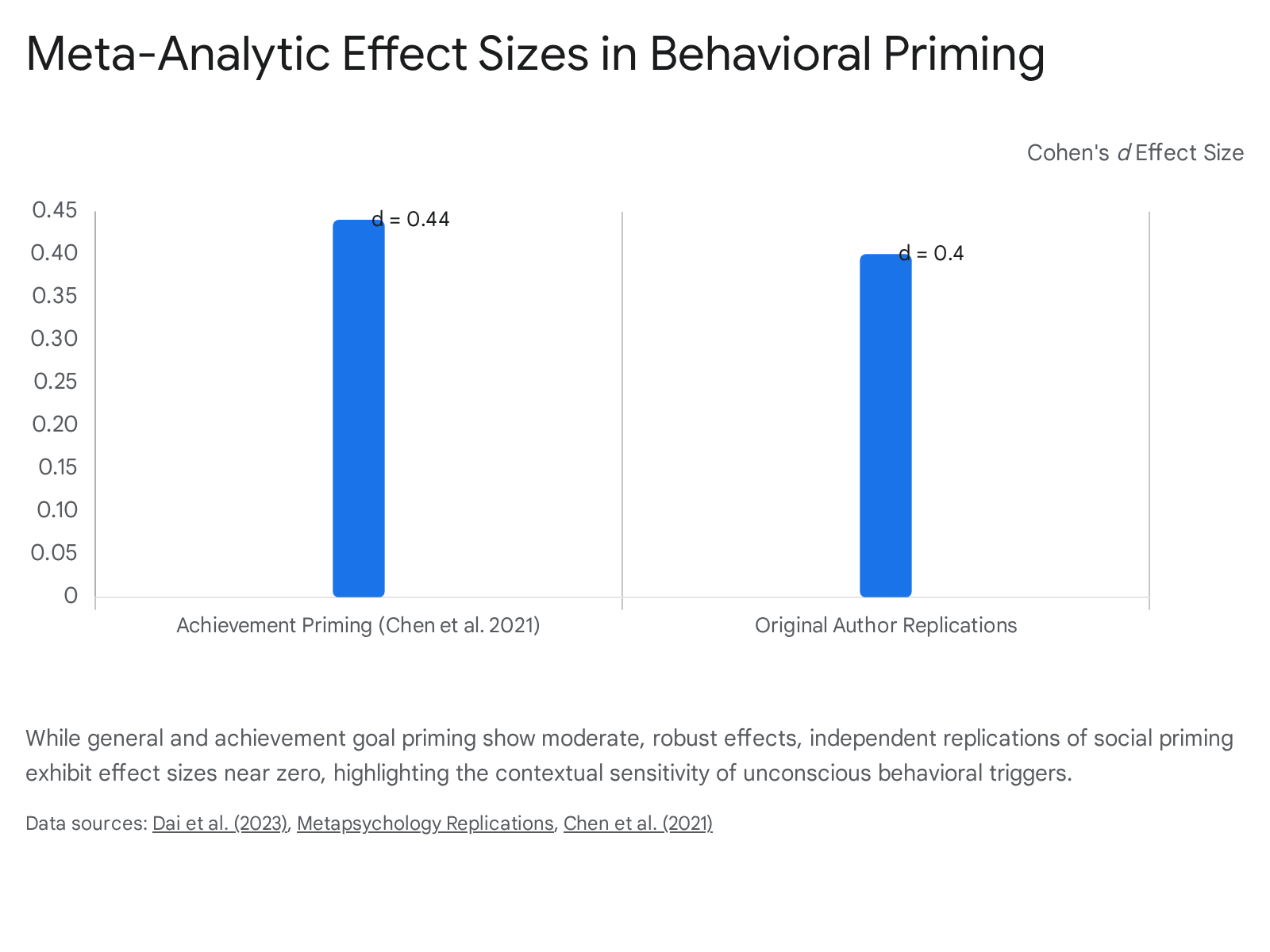
However, replications conducted by entirely independent research teams resulted in a meta-analytic average indistinguishable from zero ($d = 0.002$), shifting the burden of proof back onto proponents of pure social priming 242526.
These findings introduce necessary calibrated uncertainty into the literature. While the overarching concept of concept accessibility and associative networks remains valid, specific instances of dramatic social priming - such as complex behavioral shifts stemming from reading a single, metaphorically related word - are highly sensitive to experimental contexts, boundary conditions, and potential publication biases 222425. Therefore, the application of priming in neuromarketing must rely on robust, goal-oriented mechanisms rather than transient social cues.
Neurophysiological Paradigms in Consumer Choice
To transcend the inherent limitations of both explicit surveys and behavioral reaction times, the modern field of neuromarketing employs direct neuroimaging and biometric tools. These paradigms capture physiological data at the exact moment a consumer interacts with a marketing stimulus, providing objective metrics on attention, memory encoding, and emotional arousal that words cannot express 3227342829.
Electroencephalography and Temporal Dynamics
Electroencephalography (EEG) records the brain's spontaneous electrical activity via sensors placed across the scalp 322730. EEG is characterized by exceptional temporal resolution, capable of capturing neural reactions at the millisecond level. This immediacy makes it the optimal tool for analyzing dynamic stimuli such as video advertisements, television commercials, or interactive web environments where consumer attention shifts rapidly 32313233.
Through advanced signal processing algorithms like the Fast Fourier Transform (FFT), raw EEG data is separated into distinct frequency bands (alpha, beta, theta, delta) and Event-Related Potentials (ERPs) 3134. Systematic reviews of EEG metrics in marketing identify Frontal Alpha Asymmetry (FAA) as the most reliable indicator of approach-withdrawal motivation; greater relative left-frontal activation correlates directly with positive approach behavior and preference toward a brand 31353637. Additionally, the Late Positive Potential (LPP) serves as a reliable ERP component reflecting the magnitude of conscious emotional evaluation of products 31. The theta band, particularly observed in prefrontal regions, is heavily utilized to index cognitive effort, working memory load, and the successful encoding of brand information into long-term memory structures 313536.
Spatial Mapping via Functional Magnetic Resonance Imaging
While EEG excels in speed, Functional Magnetic Resonance Imaging (fMRI) is the premier tool for spatial resolution. fMRI measures the Blood Oxygen Level Dependent (BOLD) signal, tracking the hemodynamic changes that occur as active brain regions consume oxygenated blood 322728324546. Because it captures deep subcortical structures that surface electrodes cannot reach, fMRI allows researchers to map the complex neural circuitry of consumer decision-making. This includes risk assessment, deep emotional resonance, and the activation of the brain's reward centers, such as the striatum 2728323345.
The classic neuromarketing application of fMRI involves the observation of brand loyalty overrides. When consumers evaluate competing products strictly on sensory input during blind taste tests, reward center activation is often equivalent across both preferred and non-preferred products. However, upon revealing the brand identity, fMRI detects secondary activation in memory and emotion centers exclusively for the consumer's favored brand, demonstrating that the implicit brand association literally alters the neural processing of the biological product experience 32. Despite its unparalleled spatial insight, the primary limitations of fMRI remain its extremely high cost, absolute lack of portability, and poor temporal resolution compared to EEG, restricting its use primarily to static evaluations of packaging, pricing, and high-level brand strategy 32283145.
Autonomic Biometrics and Multimodal Integration
Central nervous system data is frequently triangulated with peripheral biometric measurements to generate a holistic, multimodal view of the consumer state 273848394041.
Galvanic Skin Response (GSR), or electrodermal activity, monitors minute changes in skin conductance driven by sweat gland activity, offering a direct metric of sympathetic nervous system arousal 2729353848425343. Crucially, GSR gauges the intensity of an emotion (the degree of physiological arousal) but cannot independently determine its valence (whether the emotion is positive or negative) 3853. Therefore, GSR is almost exclusively paired with other modalities, such as facial coding software to classify specific emotional expressions, or with Eye-Tracking (ET) 384253.
Eye-tracking utilizes infrared technology to map visual fixation points, gaze durations, and saccadic pathways 273045484243. By identifying exactly what visual element a consumer was focusing on at the precise moment of peak physiological arousal detected by GSR or EEG, researchers can isolate the specific drivers of brand engagement on packaging, retail shelves, or digital interfaces 3745384053.
Machine Learning in Predictive Modeling
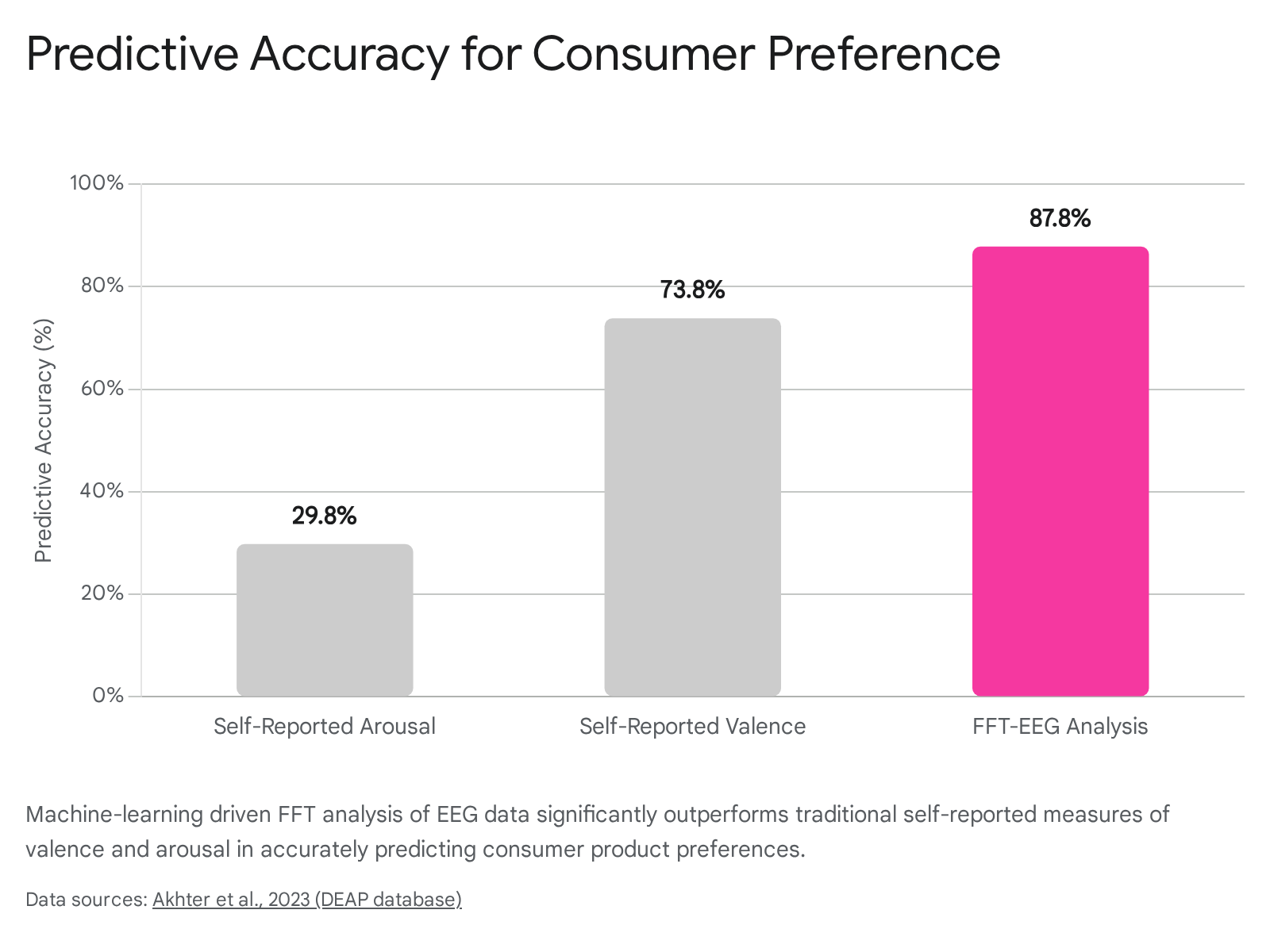
The integration of advanced machine learning algorithms with neurophysiological data has dramatically improved the predictive accuracy of consumer research, far surpassing the capabilities of traditional surveys 314445. Traditional self-reports yield highly volatile predictions of actual market success. For instance, in predictive modeling of consumer liking using the public DEAP database, self-reported arousal exhibited a test accuracy of only 29.8% for predicting product liking, and self-reported valence achieved just 73.8% 34.
In stark contrast, analyzing the exact same participants using FFT analysis of EEG data achieved an accuracy of 87.8% in predicting consumer preference, operating entirely independent of any self-report data 34.
When multimodal approaches are utilized - such as integrating EEG with ET data - predictive performance increases even further. Contemporary studies employing ensembles of Support Vector Machines (SVM), K-Nearest Neighbors (KNN), and Convolutional Neural Networks (CNN-LSTM) have achieved predictive accuracies exceeding 84% to 99% in classifying consumer purchasing intentions based entirely on non-conscious physiological signals 4445.
| Neuroimaging / Biometric Modality | Primary Physiological Mechanism | Core Marketing Application | Limitations |
|---|---|---|---|
| fMRI (Functional MRI) | Blood oxygenation (BOLD signal), spatial mapping | Deep emotional resonance, brand loyalty overrides, risk assessment 273245 | High cost, low temporal resolution, restricted mobility 3228 |
| EEG (Electroencephalography) | Cortical electrical activity, frequency bands | Attention tracking, cognitive load, approach/withdrawal motivation 323135 | Poor spatial resolution, limited to surface cortical activity 3231 |
| Eye-Tracking (ET) | Infrared gaze path and fixation analysis | Visual attention distribution, packaging design optimization 274540 | Indicates attention but not emotional valence or cognitive processing 3853 |
| GSR (Galvanic Skin Response) | Sympathetic nervous system (sweat gland conductance) | Magnitude of emotional arousal and stimulation 293848 | Cannot distinguish between positive and negative emotions 3853 |
Cultural Modulation of Implicit Preferences
The operational dynamics of implicit attitudes are not universally uniform; they are heavily modulated by the macro-cultural frameworks in which a consumer is embedded. The sociological dichotomy of Individualism versus Collectivism serves as a primary axis influencing how brands are processed, categorized, and valued subconsciously 4658.
Individualism and Collectivism Parameters
Individualistic cultures, predominant in Western societies such as the United States and Western Europe, prioritize personal autonomy, self-expression, and inter-group competition 465847484962. Consumers raised in these environments implicitly favor brands that symbolize personal achievement, competence, and sophistication, viewing brand consumption as an extension of unique personal identity and personal utility 465850.
Conversely, collectivistic cultures emphasize interdependence, societal harmony, and strict adherence to group norms, frequently sensing implied competition primarily from intra-group interactions rather than inter-group conflict 5847484962. In these contexts, consumers exhibit a subconscious preference for "sincere" brands that foster a sense of belonging, uphold communal ideals, and prioritize long-term relationship-building over transactional utility 465850.
These foundational cultural orientations dictate the efficacy of emotional priming. For example, experimental manipulation of loneliness yields sharply divergent outcomes based on a subject's cultural background. Among individualistic consumers, priming loneliness causes a significant increase in brand love, as the individual subconsciously utilizes the brand as a surrogate to restore social connection and alleviate isolation 4751. Among collectivistic consumers, however, loneliness does not trigger this compensatory increase in brand attachment, underscoring fundamental differences in how in-groups and broad social constructs are conceptualized psychologically 4751.
Implicit Consumer Ethnocentrism
The intersection of implicit attitudes and culture is prominently visible in the phenomenon of Implicit Consumer Ethnocentrism (ICE). Traditional economic models of consumer ethnocentrism assess conscious, ideologically driven preferences for domestic goods over foreign alternatives, largely through explicit survey methods 5253. However, cross-national research utilizing the IAT reveals complex dissociations between explicit declarations and implicit biases, particularly in emerging or less economically developed markets 155253.
In many emerging markets, consumers explicitly state a strong preference for foreign brands due to established cognitive associations with superior quality, functional competence, and elevated social status 15525354. Despite these explicit claims, IAT measurements frequently uncover a robust, automatic implicit preference for local, domestic brands 525355. ICE operates as a deeply ingrained in-group favoritism that persists independently of objective product superiority 5253. This implicit bias - often termed the "worse but ours" phenomenon - is only mitigated or overridden when the foreign brand achieves overwhelming cognitive associations with high-level competence in specific, narrow product categories 525355.
A corollary to this ingrained implicit bias is observed in global knowledge evaluation. Researchers and health professionals demonstrate a quantifiable implicit association (with an IAT score of $0.57$) linking the concept of "Good Research" to "Rich Countries" as opposed to developing nations 56. This suggests that pervasive geographic heuristics affect subjective valuations of quality across all domains, from consumer goods to evidence-based medicine, demonstrating the pervasive nature of unconscious associations.