
Cognitive Neuroscience of Subconscious Decision-Making
Modern cognitive psychology and neuroscience are currently undergoing a profound paradigm shift. For decades, the study of the human mind was heavily influenced by philosophical intuition, structuralist metaphors, and behavioral paradigms that often outpaced their neurobiological evidence base. However, the advent of advanced neuroimaging methodologies, high-powered computational modeling, and rigorous replication consortiums has systematically dismantled many foundational assumptions of the twentieth-century psychological canon. The discipline is increasingly moving away from reductionist binaries and localized functional assumptions, adopting instead continuous, dynamic, and ecologically valid models of brain function.
This comprehensive report synthesizes the contemporary empirical landscape across five critical domains. First, it addresses the debunking of persistent neuromyths that continue to pervade public consciousness and educational sectors. Second, it explores the refinement and critique of Dual-Process Theory, reevaluating the mechanistic interactions between intuitive and deliberative cognition. Third, it examines the computational refutation of the classic Libet free-will paradigm, utilizing recent literature from leading journals such as Trends in Cognitive Sciences and Nature Neuroscience to illustrate the shift toward stochastic accumulator models of volition. Fourth, it provides a methodological reckoning of the social priming replication crisis, delineating robust cognitive phenomena from historical artifacts. Finally, it outlines the imperative to decenter Western, Educated, Industrialized, Rich, and Democratic (WEIRD) biases in behavioral science, highlighting how implicit cognition and neuroimaging results fundamentally vary across diverse global environments. Through an exhaustive examination of peer-reviewed literature, this document delineates the boundaries between psychological folklore and verifiable cognitive neuroscience.
1. Deconstructing Psychological Folklore: Empirical Refutations of Persistent Myths
The public understanding of the brain remains heavily saturated with misconceptions that lack empirical validation. Cognitive psychology and neurobiology have expended significant effort attempting to correct these entrenched misunderstandings, yet they persist in educational, corporate, and media environments. Two of the most pervasive conceptual errors are the "ten percent brain" myth and the Freudian "iceberg" model of the subconscious. Modern neuroimaging and computational theories of cognition have systematically invalidated both constructs, replacing them with models of dynamic, whole-brain predictive processing.
1.1 The Ten Percent Myth: From Neuromythology to Whole-Brain Dynamics
The assertion that humans utilize only a fraction - typically cited as ten percent - of their cognitive or neural capacity is perhaps the most enduring neuromyth in modern history 112. Despite its prevalence in self-help literature, cinematic narratives, and pseudoscientific marketing programs designed to "unleash" untapped potential, there is absolutely no neuroscientific basis for this claim 123. The origins of the myth are chronologically diffuse, likely stemming from misinterpretations of early neurological research combined with truncated quotes from influential thinkers. In the nineteenth and early twentieth centuries, researchers such as Pierre Flourens and Karl Lashley conducted ablation studies on rodents, observing that animals could sometimes relearn specific tasks even after large portions of the cerebral cortex were surgically removed 14. Furthermore, early pioneers of neurosurgery, such as Wilder Penfield, identified what they termed "silent cortex" areas - regions of the brain that did not produce immediate, observable motor or sensory responses when electrically stimulated during surgery 2.
Additionally, early neuroanatomical observations regarding the high ratio of glial cells to neurons, or elementary misunderstandings of "local" neuronal function by psychologists in the 1930s, may have inadvertently contributed to the numerical fallacy 124. Psychologists like William James and Boris Sidis, who proposed "reserve energy theories" in the 1890s, posited that humans only meet a fraction of their full mental potential - a philosophical claim that was subsequently distorted into a physiological statistic by self-help advocates and science fiction writers in the 1920s and 1930s 134. A 2012 survey surprisingly revealed that approximately 50 percent of primary and secondary teachers across different cultures, and even 6 percent of international neuroscientists surveyed, endorsed some version of this myth 23.
Contemporary neuroimaging techniques, notably functional magnetic resonance imaging (fMRI) and positron emission tomography (PET), have unequivocally demonstrated that the entire brain is continually active 13. A PET scan utilizes a biologically active radioactive tracer, typically a form of glucose, which is metabolized by the brain; the ensuing positron emission is mapped to construct a three-dimensional representation of metabolic demand 3. If the ten percent myth were accurate, a PET scan would reveal massive dark voids of neural inactivity 3. Instead, scans of healthy individuals reveal that baseline metabolism requires the engagement of virtually all neural tissue, even during sleep or periods of rest. For instance, fMRI studies exploring resting-state networks in the brains of full-term newborn infants provide clear evidence that the brain remains constantly active across diverse regions regardless of whether the subject is awake or asleep 1.
Evolutionary biology provides further refutation: the human brain consumes approximately twenty percent of the body's entire energy budget despite accounting for only two percent of its total mass. If ninety percent of this highly expensive tissue were functionally redundant, the evolutionary pressures of natural selection would have rapidly eliminated it, as maintaining useless biological infrastructure presents a massive survival disadvantage 14. Clinical neurology corroborates this evolutionary logic; damage to even minute areas of the brain - whether through stroke, trauma, or neurodegenerative diseases like Alzheimer's or Parkinson's - results in profound, localized deficits in cognition, memory, or motor control 134. For example, studies have shown that damage to specific regions, such as the right frontal lobe, drastically increases a patient's susceptibility to false recognition, highlighting that every region plays a highly specialized and necessary role 1. The regions once deemed "silent cortex" by Penfield are now understood to be the association cortices, which are responsible for the highest levels of human cognition, including language processing, abstract reasoning, and executive planning 2. Therefore, empirical evidence necessitates the total rejection of the ten percent myth in favor of a holistic, distributed model of continuous neural activation.
1.2 Beyond the Freudian Iceberg: The Default Mode Network and Predictive Processing
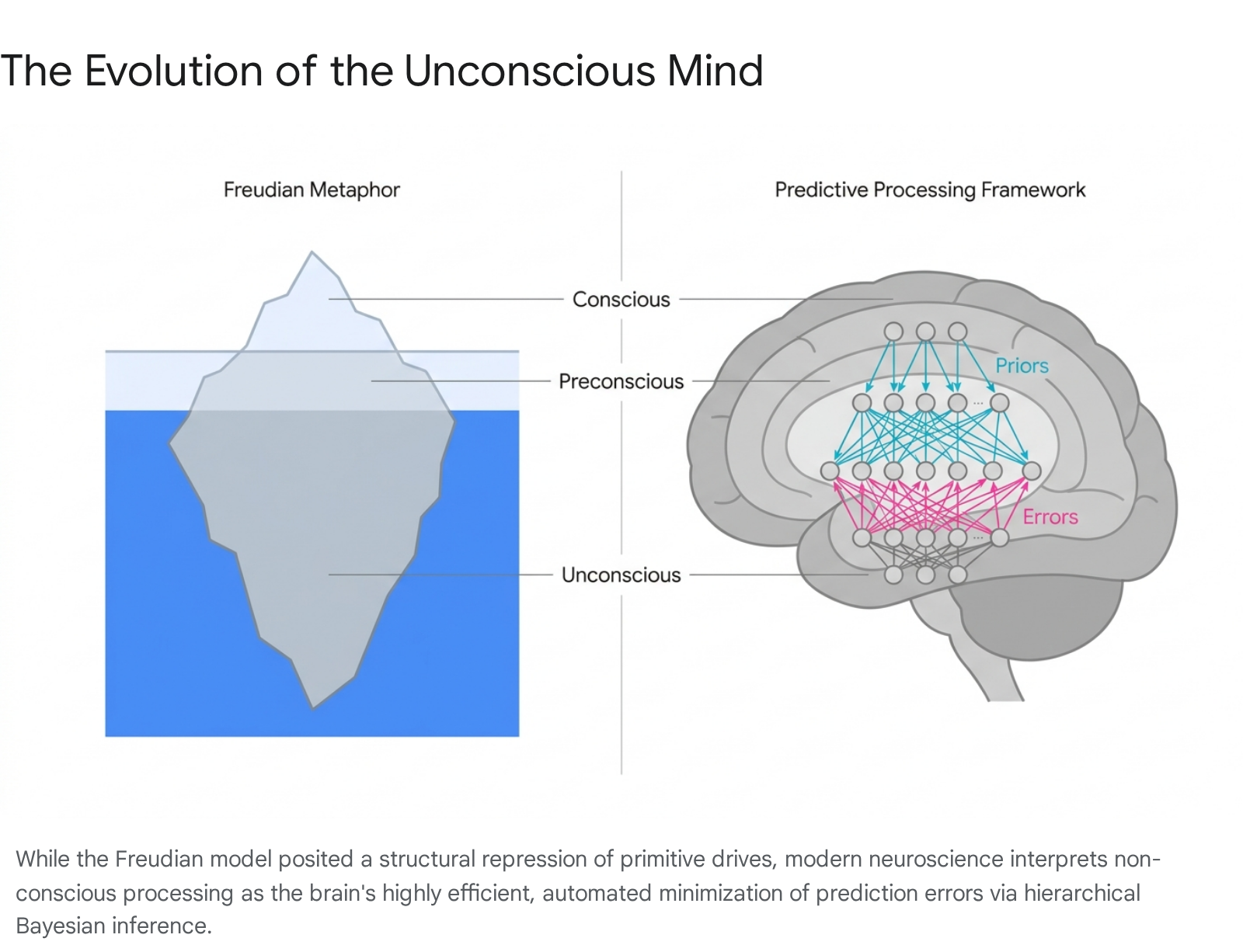
The traditional Freudian "iceberg" model presents the human mind as a tripartite topographical structure divided into the conscious (the visible tip), the preconscious (just below the surface, containing accessible memory), and the vast, inaccessible unconscious (the submerged base) 67. In this classical psychoanalytic framework, the unconscious is conceptualized as a dark repository of repressed memories, primitive drives, and forbidden desires, kept at bay by active psychic defense mechanisms 67. This model heavily emphasizes the role of psychodynamic conflict, suggesting that the primary function of non-conscious operations is the suppression of socially unacceptable impulses to maintain psychic equilibrium 67.
Modern computational neuroscience and cognitive psychology have discarded the topographical and structuralist elements of the iceberg model. While empirical science fully acknowledges that the vast majority of cognitive processing occurs outside of conscious awareness - with estimates suggesting that up to 98 percent of cognitive activity is non-conscious - the mechanisms and functions of these processes bear little resemblance to Freud's seething cauldron of repressed impulses 756. Instead, the modern neuroscientific equivalent of the "unconscious" is understood through the dual lenses of the Default Mode Network (DMN) and Predictive Processing (PP), specifically articulated via the Free Energy Principle (FEP) pioneered by Karl Friston 7812.
The Default Mode Network is a large-scale intrinsic brain network comprising the medial prefrontal cortex, posterior cingulate cortex, and inferior parietal lobule 57. The DMN is highly metabolically active during rest, spontaneous thought, mind-wandering, and self-referential processing, and it deactivates during externally focused, goal-directed tasks 512. Neuropsychoanalytic researchers have posited that the coordinated activity of the DMN serves the functional equivalent of what psychoanalysis termed "ego" processes; it organizes temporal narratives, consolidates memory, and maintains a continuous baseline self-representation without requiring active, conscious deliberation 512.
More fundamentally, the Freudian concept of "projection" and the broader operations of the unconscious mind are now mathematically modeled through Predictive Processing 8914. Rather than passively receiving sensory data, the brain is conceptualized as an active, hierarchical inference engine 712. It continually generates top-down predictions (priors) about the external world and internal somatic states based on past experiences 810. Sensory inputs from the environment provide ascending, bottom-up signals; discrepancies between the brain's top-down prediction and the actual bottom-up sensory input generate a "prediction error" 7810. To maintain biological homeostasis and minimize uncertainty - a state defined mathematically in thermodynamics and information theory as "variational free energy" - the brain must constantly resolve these prediction errors 81210. It does this either by updating its internal models (learning) or by performing active inference, which involves moving the body to change the sensory input so that it matches the internal prediction (action) 810.
In this modern framework, the "unconscious" is not a storage unit for repressed trauma; it is the highly efficient, statistically optimized machinery of the brain automatically resolving prediction errors at lower cortical and subcortical levels 89. Subcortical structures, such as the amygdala and basal ganglia, generate primary affective consciousness and instinctual approach-avoidance behaviors, functioning as innate priors that drive the organism toward homeostasis 57810. Conscious awareness, therefore, only arises when prediction errors are too large, novel, or complex to be resolved automatically by these lower-level non-conscious priors, thereby demanding the allocation of higher-order cortical attention 810. The iceberg metaphor is thus functionally obsolete, replaced by a hierarchical Bayesian inference model where non-conscious processing represents the highly adaptive, continuous minimization of surprise.
2. The Architecture of Cognition: Reevaluating Dual-Process Theory
To explain the continuous interaction between deliberate conscious thought and rapid non-conscious automation, cognitive psychology widely adopted Dual-Process Theory (DPT). Pioneered by researchers such as Daniel Kahneman, Amos Tversky, Jonathan Evans, and Keith Stanovich, this framework maps human cognition onto two distinct processing modes, traditionally labeled System 1 and System 2 161112.
2.1 The Classic Dichotomy: System 1 and System 2
In standard dual-process formulations, System 1 (often referred to as Type 1 processing) is characterized as fast, automatic, intuitive, parallel, and largely non-conscious 161219. It relies heavily on associative memory, heuristic shortcuts, and established emotional patterns to navigate familiar environments 1913. Evolutionarily older, System 1 constantly monitors the environment, processes information that is readily available or frequently repeated, and generates rapid, effortless responses to stimuli 161314. System 1 is highly efficient but prone to systematic cognitive biases and logical fallacies because it prioritizes speed over accuracy 161113.
Conversely, System 2 (Type 2 processing) is described as slow, deliberate, sequential, and computationally expensive, requiring active working memory, conflict monitoring, and conscious effort 161915. System 2 is engaged when resolving complex problems, performing analytical reasoning, considering multiple perspectives, or overriding the immediate, heuristic-driven impulses generated by System 1 161213. Cognitive psychology often frames humans as "cognitive misers" who naturally default to System 1 to conserve neural energy, only activating System 2 when a conflict is detected or a novel task demands high-fidelity attention 1616.
Neuroimaging and neuroanatomical mapping have provided some broad correlates for this distinction. System 1 responses often involve older subcortical structures like the amygdala, which mediates rapid emotional salience, and the basal ganglia, which governs habitual and procedural responding 516. System 2 activation, in contrast, relies heavily on the prefrontal cortex and the anterior cingulate cortex, regions implicated in executive oversight, working memory maintenance, and top-down control 516.
2.2 Modern Critiques and Neuroscientific Complexities
Despite its immense popularity in educational psychology, behavioral economics, and clinical theory, the strict binary of Dual-Process Theory has faced significant critique from cognitive scientists and neurobiologists who argue it fundamentally oversimplifies the true architecture of the brain 16131416. In 2018, researchers Deborah Melnikoff and John Bargh published a devastating critique of the framework, conducting a comprehensive review of over fifty years of cognitive data 16. They demonstrated that the four defining features of System 1 - fast, unconscious, unintentional, and uncontrollable - do not actually cluster together as a unified system in the brain 1624. Real-world empirical data frequently reveals cognitive processes that are fast yet conscious, or slow yet entirely unconscious, indicating that intentionality does not strictly correlate with processing speed 16.
Furthermore, modern researchers argue that the brain does not house two separate, topographically distinct "systems" but rather operates along a highly fluid, interactive continuum 111213. Rather than an absolute dichotomy where System 2 rescues the organism from System 1's errors, modern adaptations suggest a more nuanced framework where intuitive and deliberate characteristics heavily interdepend. For instance, System 2 deliberation is frequently biased by the initial framing provided by System 1, and repeated deliberate actions eventually consolidate into automatic System 1 habits 1324.
The integration of complex cognition into dual-system models requires recognizing that rapid changes in functional neuronal connectivity cannot be explained by a simple binary switch. Some researchers suggest that intuition and deliberation may be better understood not as separate neural mechanisms, but as different operational states of the same predictive processing hierarchy 1112. Under this view, Type 1 cognition represents the automatic processing of conscious representations where prediction errors are low, whereas Type 2 cognition involves the deliberate, load-sensitive manipulation of models when uncertainty is high 11. Ultimately, modern behavioral science views Dual-Process Theory as a highly useful descriptive heuristic for categorizing behavioral outputs and cognitive load, rather than a literal map of discrete, encapsulated neural substrates 161516.
3. The Neuroscience of Volition and the Fall of the Libet Paradigm
The intersection of non-conscious neurobiology and conscious will forms the crux of one of cognitive neuroscience's most enduring and contentious debates. For forty years, the empirical discourse surrounding human free will has been dominated by the experimental paradigm established by Benjamin Libet and his colleagues in 1983 1718. However, recent advancements in computational modeling, machine learning, and high-density neuroimaging have systematically dismantled the deterministic conclusions traditionally drawn from Libet's data, replacing them with probabilistic models of action initiation.
3.1 The Classic Libet Experiment and the Readiness Potential
In the classic Libet experimental paradigm, subjects were instructed to perform a spontaneous, voluntary motor action - such as a simple wrist flexion or a button press - at a moment of their own choosing, with no external temporal cue instructing them when to move 181920. During this task, their brain activity was recorded via electroencephalography (EEG) 18. To measure the subjective timing of volition, subjects monitored a rapidly rotating oscilloscope spot (the clock face) and were asked to report the exact moment they first felt the conscious "urge" or intention to move, an metric referred to as the W-time 182130.
Through this method, Libet identified a highly reliable neural signature known as the "readiness potential" (RP) - a slow, negative-going buildup of electrical activity, generated primarily in the supplementary motor area (SMA) and pre-SMA, which precedes self-initiated movements 18202131. Crucially, the EEG data revealed that the onset of the RP began, on average, several hundred milliseconds (often between 500 to 1000 milliseconds) before the physical execution of the movement (the M-time) 182131. However, participants consistently reported the conscious intention to move (W-time) only about 200 milliseconds before the movement 1819.
Because the neural preparation (the RP) reliably and significantly preceded the conscious awareness of the decision to move, the classic interpretation - often termed the "early-decision account" - posited that the brain initiates voluntary action entirely unconsciously 2032. Under this framework, the conscious experience of volition is merely a delayed post-hoc epiphenomenon, an illusion of agency grafted onto a motor action that was already definitively set in motion by non-conscious neural mechanics 1833. Because causes must precede effects, Libet's temporal ordering presented a formidable challenge to the existence of free will, suggesting that conscious intention does not cause action, but is merely correlated with it 171834.
3.2 The Shift to Neuro-Predictive Models: The Stochastic Accumulator
The early-decision interpretation of the RP dominated discussions of volition and neuroethics for decades. It went largely unchallenged mechanistically until 2012, when Aaron Schurger and colleagues introduced the Stochastic Decision Model (SDM), fundamentally recontextualizing the electrophysiological data 203235. Drawing heavily on "leaky competing accumulator" models traditionally used to explain reaction times in perceptual decision-making tasks, Schurger hypothesized that the RP does not reflect a subconscious decision to move 193222.
Instead, the SDM posits that in a spontaneous action task where the subject is given a weak, general imperative to move but no specific external cue, neural activity in the motor cortex exhibits continuous, spontaneous stochastic fluctuations (random noise) 181931. According to this model, an action is triggered only when this background neural noise happens to accumulate and cross a specific motor initiation threshold 1932.
The defining insight of the SDM addresses how the data is analyzed. Researchers traditionally analyze EEG data in Libet experiments by "time-locking" the epochs to the onset of the physical movement and then averaging the signal backward in time 192031. By only looking at instances that culminated in movement, researchers selectively capture the exact trials where the random fluctuations happened to crest over the threshold 1931. This backward-averaging of autocorrelated pink noise mathematically guarantees the appearance of an exponential, ramping curve - which researchers labeled the readiness potential 192135.
In Schurger's "late-decision account," the RP is an artifact of biased sampling; it is entirely pre-decisional 203237. It reflects the natural ebb and flow of background neural states moving toward a boundary, not an inevitable, committed decision 203322. The actual commitment to move occurs incredibly close to the movement itself, coinciding tightly with the subject's reported conscious urge (W-time) 203322. Thus, the early rise of the RP does not cause the action; it merely facilitates it by bringing the baseline neural state closer to the threshold. This demonstrates that the conscious decision to act and the motor act itself arise concurrently from the same underlying peak in neural activity, preserving a role for conscious agency 3337.
Markdown Table: Classic Libet Interpretations vs. Modern Neuro-Predictive Models
| Feature / Concept | Classic Libet Paradigm (Early-Decision Account) | Modern Neuro-Predictive Framework (Stochastic Accumulator) |
|---|---|---|
| Origin of the Readiness Potential (RP) | The RP reflects a specific, unconscious neural event marking the brain's definitive decision to initiate motor preparation 1822. | The RP is a statistical artifact resulting from backward-averaging spontaneous, autocorrelated stochastic fluctuations in neural noise 192031. |
| Timing of the Decision | The decision to move is made unconsciously at the onset of the RP (up to 1000ms prior to movement) 1837. | The decision is made late, occurring only when accumulated neural noise crosses a specific threshold, closely aligning with conscious awareness (~150-200ms prior) 203337. |
| Nature of the RP Signal | Deterministic and post-decisional. It represents an unstoppable physiological cascade toward action execution 2037. | Probabilistic and pre-decisional. Ramping activity frequently occurs without resulting in any movement if the threshold is not crossed 2037. |
| Role of Conscious Will (W-Time) | Epiphenomenal. The conscious urge is a delayed, post-hoc realization of an action already initiated by the unconscious 1833. | Co-occurrent. The conscious urge reflects the final threshold crossing, indicating that subjective intention is deeply integrated into the action trigger 3322. |
| View of Spontaneous Action | Spontaneous actions are dictated by inaccessible subcortical/cortical determinism, negating true free will 18. | Spontaneous actions represent instances where internal baseline noise breaks the threshold due to a weak external imperative 1819. |
3.3 Recent Neuroimaging Findings and the Late-Decision Account
Recent, highly powered EEG, fMRI, and machine learning studies published between 2023 and 2026 - including prominent features in Trends in Cognitive Sciences and Nature Neuroscience - have robustly corroborated the late-decision account, moving the field past the classic Libet constraints 2021343839. Historically, Libet paradigms only analyzed data epochs that successfully culminated in a physical movement. To test the deterministic hypothesis, contemporary researchers have introduced matched control conditions where participants were continuously monitored via EEG without executing a movement 20. Utilizing powerful machine-learning classifiers, these studies demonstrated that early ramping activity is frequently present even when no movement follows, proving definitively that early RP signals do not inevitably predict an ensuing action 2031.
Furthermore, studies employing "interruptus" or probe-based paradigms provide a more accurate measure of conscious intent than Libet's original rotating clock. In these modern setups, subjects are abruptly interrupted by an auditory or visual cue and asked to execute a movement immediately or report their current cognitive state 1921. These studies reveal that pre-probe RP buildups do not correlate with a reported awareness of motor preparation 21. Metacognitive access to intention only emerges dynamically as the stochastic accumulation nears the absolute threshold 2122. Additionally, research involving complex spatial variables, such as positioning the clock within the subject's peripersonal space, alters both the initiation of action and the subjective awareness of the decision, highlighting that agency is heavily situated in environmental context 30.
Alternative computational frameworks have also emerged recently, such as the Linear Ballistic Accumulator model (Bogler et al., 2023) and spiking neural network extensions of stochastic accumulation (Gavenas et al., 2024) 172140. While these models debate the precise mechanics of the buildup (e.g., whether the drift rate is constant or noisy), they unanimously reject the classic Libet conclusion that the RP represents an early, unconscious decision 212240. Consequently, modern cognitive neuroscience has transitioned to a "spectrum model of agency." This framework situates free will not as a binary condition that is either possessed or disproved, but as a dynamic, continuous construct shaped by the interplay of neural noise, predictive constraints, and metacognitive access 39.
4. The Replication Crisis and the Boundary Conditions of Social Priming
While the cognitive neuroscience of volition has been reformed by advanced computational modeling, the field of experimental social psychology has undergone a far more traumatic methodological reckoning: the Replication Crisis. This crisis has been particularly devastating to the subfield of "social priming," which historically posited that incidental, momentary exposure to environmental cues - such as specific words, symbols, or physical sensations - could dramatically and non-consciously alter subsequent complex human behaviors 232443.
4.1 The Rise and Fall of Unconscious Social Priming
During the late 1990s and 2000s, social priming was hailed as a revolutionary expansion of the dual-process model. It seemingly proved that the human unconscious, operating via System 1 associative networks, utterly dominated daily behavior without the subject's knowledge. Landmark, highly publicized studies claimed extraordinary effects. For example, John Bargh and colleagues (1996) reported that university students who unscrambled jumbled lists of words related to old age (e.g., "Florida," "wrinkle") subsequently walked significantly more slowly down a hallway upon leaving the experiment 232444. Dijksterhuis and van Knippenberg (1998) found that priming participants with the concept of a "professor" caused them to perform 13 percent better on a general knowledge trivia test compared to those primed with the concept of "soccer hooligans" 23. Similarly, Vohs and colleagues (2006) reported that brief exposure to images of money made individuals more selfish, less willing to assist others, and more likely to endorse free-market values 2444.
These findings captivated both the academic community and the general public, entering mainstream pop psychology as profound truths about human malleability. However, as the scientific community pushed for greater transparency, open data, and higher statistical power in the early 2010s, these highly cited effects began to rapidly evaporate when subjected to rigorous, independent scrutiny 2443.
A comprehensive, systematic review of the extant close replication attempts paints a grim reality for social priming. Analyzing 70 close replications targeting 49 unique social priming findings, researchers found that 94 percent of the replications yielded effect sizes smaller than the original studies they sought to reproduce 232546. Furthermore, only 17 percent of these replications reported a statistically significant p-value in the original direction 2325.
Most damningly, the meta-analysis revealed that the strongest predictor of a replication's success was not the methodology, but the presence of the original authors on the replication team. Out of 18 replication attempts that included at least one author from the original published paper, 12 successfully produced a significant effect in the original direction 2325. In stark contrast, out of 52 replication attempts conducted by entirely independent research teams, zero produced a significant effect in the original direction.
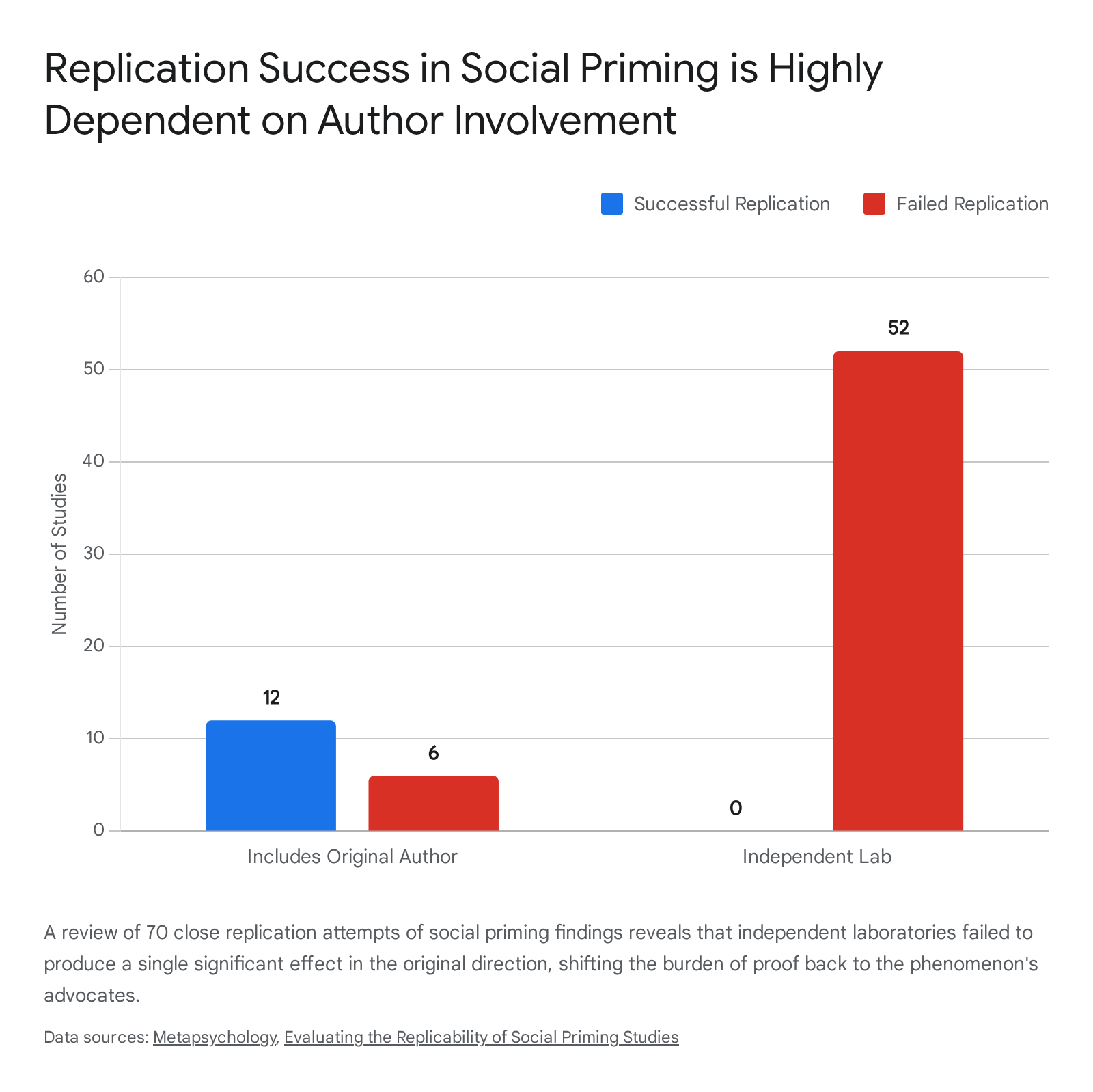
The meta-analytic average effect size ($d$) for independent replications was effectively zero ($d = 0.002$) 232546.
4.2 Large-Scale Replications and Methodological Reforms
The systemic failure of social priming literature is largely attributed to questionable research practices (QRPs) historically prevalent in the field. These included p-hacking (manipulating data or analyses until non-significant results become significant), selective reporting of favorable variables, utilizing vastly underpowered small sample sizes, and a severe publication bias from journals that heavily favored novel, counterintuitive results while refusing to publish null findings 2547. A 2024 replicability report examining the Journal of Experimental Social Psychology utilizing z-curve statistical tools estimated that the Expected Discovery Rate (EDR) for the journal could be as low as 24 percent, justifying severe concerns about the credibility of historic publications in the field 47.
In response to this crisis, initiatives like the "Many Labs" project and the Open Science Collaboration (OSC) engaged dozens of independent laboratories to rigorously re-test these classic effects utilizing massive sample sizes and transparent, pre-registered methodologies 244726. The results were definitive: when gold-standard practices are employed, the dramatic, almost magical behavioral impacts of social priming vanish. For instance, Doyen et al. (2012) demonstrated that the "elderly walking effect" completely disappeared when the experimenters measuring the walking speed were blinded to which condition the participant was assigned, strongly suggesting that the original 1996 findings were artifacts of unintentional experimenter bias rather than unconscious participant priming 4344.
The burden of proof has now shifted entirely back to the advocates of social priming. Counterintuitive claims regarding the non-conscious manipulation of complex behavior via subtle environmental primes are currently treated with profound skepticism by the scientific community unless they are validated by independent, pre-registered, and highly powered trials 434627.
Markdown Table: Replication Status of Highly Cited Social Priming Phenomena
| Social Priming Phenomenon | Original Claim & Landmark Study | Current Replication Status | Methodological Observations |
|---|---|---|---|
| Elderly Walking Priming | Exposure to words associated with the elderly causes participants to walk slower upon leaving [Bargh et al., 1996] 232444. | Failed Replication 244344. | Independent studies (e.g., Doyen et al., 2012) found the effect disappeared when experimenters were blinded to the condition, indicating the original was likely driven by experimenter bias rather than unconscious priming 4344. |
| Intelligence/Professor Priming | Priming the concept of a "professor" increases subsequent performance on general knowledge trivia tests [Dijksterhuis & van Knippenberg, 1998] 23. | Failed Replication 23. | Large-scale, independent replication attempts utilizing massive sample sizes (e.g., Shanks et al., 2013) found effect sizes that were statistically indistinguishable from zero 2325. |
| Money Priming | Exposure to images or concepts of currency increases selfishness, self-reliance, and endorsement of free-market capitalism [Vohs et al., 2006] 2444. | Failed Replication 2444. | The "Many Labs" replication project and independent teams (e.g., Rohrer et al., 2015) attempted multiple highly powered replications; virtually all failed to produce the behavioral effects claimed in the original literature 2444. |
| Power Posing | Adopting expansive physical "power poses" alters neuroendocrine levels (increases testosterone, lowers cortisol) and increases risk-taking [Carney, Cuddy, & Yap, 2010] 24. | Mixed/Failed Replication 24. | While subjective psychological feelings of power sometimes replicate marginally, the core physiological claims (testosterone/cortisol changes) and behavioral shifts have overwhelmingly failed to replicate in large consortium studies 24. |
| Facial Feedback (Smiling Pen) | Forcing a smile-like expression by holding a pen in the teeth increases the subjective funniness of cartoons [Strack, Martin, & Stepper, 1988] 2444. | Failed Replication 2444. | A massive replication attempt by 17 independent labs involving nearly 2,000 participants found an overall null effect, which the team described as "statistically compelling" evidence against the original finding 24. |
5. Overcoming the WEIRD Bias: Implicit Cognition Across Global Contexts
As psychological science grapples with the replicability of its historical findings, it simultaneously faces a profound and pervasive crisis of generalizability. For over a century, the overwhelming majority of behavioral science and neuroimaging literature has relied on samples drawn from populations that are Western, Educated, Industrialized, Rich, and Democratic (WEIRD) 282930. The assumption that data derived from a narrowly defined slice of humanity - predominantly American undergraduate students - represents a universal human cognitive architecture is a critical vulnerability in modern neuroscience 2829.
5.1 The Crisis of Generalizability in Behavioral Science
Analyses of top-tier psychological journals reveal staggering disparities. Studies examining publication trends indicate that between 70 and 95 percent of research participants are drawn exclusively from WEIRD populations, a demographic that represents only about 12 percent of the global population 2829. A recent linguistic analysis of over a thousand article titles exposes a subtle but pervasive form of infra-humanization within the discipline: studies conducted on non-WEIRD populations (e.g., from Africa, Asia, Eastern Europe, or Latin America) almost always explicitly specify the sample's geographical or cultural origin in the title, implicitly framing them as specific deviations from the norm 2830. Conversely, studies conducted on white American samples rarely specify the population, positioning WEIRD cognition as the unquestioned default representative of the human species 30.
This systemic bias is not merely a theoretical concern; it extends directly into the physical methodologies of neuroscience. Artificial intelligence models trained on physiological data, as well as hardware tools like electroencephalography (EEG) and functional near-infrared spectroscopy (fNIRS), frequently exhibit severe racial and phenotypic biases 53. Because neuroimaging hardware was historically optimized and calibrated for individuals with fine, straight hair and light skin pigmentation, modern researchers frequently experience significant signal drop-out or poor data quality when recording from Black participants with coarse hair or darker skin 53. As recently highlighted in Nature Neuroscience, this creates a dangerous methodological feedback loop: populations are systematically excluded from neuroimaging datasets due to hardware limitations, resulting in a cognitive neuroscience whose defined neural correlates of behavior are derived exclusively from a phenotypically constrained demographic 53.
5.2 Implicit Bias and Social Contexts in Diverse Populations
To correct this foundational bias, contemporary researchers are aggressively assessing cognitive phenomena - such as implicit bias, memory, and perception - across culturally and geographically diverse global populations. The Implicit Association Test (IAT), a latency-based measure designed to capture automatic semantic evaluations that operate below conscious deliberation, has generated massive datasets that challenge traditional individualistic interpretations of bias 315556.
Initially, implicit biases were viewed by psychologists as stable, individual cognitive traits resulting from early socialization 3233. However, complex systems modeling and cross-cultural analyses reveal a paradox: implicit biases are highly volatile and unstable at the individual level when tested over time, yet remarkably stable when aggregated at the population level 3233. This suggests that the IAT measures the structural social environment rather than purely internal psychological deficits 3233. An "urban scaling" theory of implicit bias, analyzing data from 2.7 million IAT tests across the United States over a decade, demonstrates that implicit racial biases are systematically lower in cities that are larger, more demographically diverse, and structurally less segregated 3259. This framing treats implicit bias as a "bias of crowds" - an aggregated prediction error generated by the brain's attempt to map historical inequities, social network structures, and systemic segregation in real-time 323359.
Furthermore, cognitive processing, social priming, and the neurological representations of the "self" manifest uniquely across distinct geographic cultures. Cross-cultural research comparing Western (highly individualist) and East Asian (highly collectivist) populations reveals deep neuro-cognitive divergence 60343536. In Western participants, neuroimaging shows that the medial prefrontal cortex (MPFC) activates robustly during judgments regarding the individual self, but significantly less so for others, reflecting the primacy of the independent self-schema 3435. However, in Chinese and other East Asian populations, the MPFC activates with nearly identical intensity when processing judgments about the "relational self" (e.g., thinking about one's mother or close in-group members) as it does for the individual self 343536.
These findings fundamentally challenge the presumed universality of Western cognitive architecture. They prove that the brain's predictive systems - its System 1 heuristics, its implicit associative networks, and its topographical activation patterns - are dynamically wired by the specific sociocultural environment. For instance, studies on the Himba culture in North Namibia reveal unique perceptual biases toward local features, contradicting broad assumptions about global processing trends, while studies comparing Americans to Asians highlight distinct differences in analytical versus holistic visual tracking 36. To accurately understand human cognition, behavioral science must permanently depart from WEIRD-centric convenience sampling, recognizing that the mechanisms of the mind are intrinsically tethered to the diversity of the human experience.
Conclusion
The evolution of cognitive psychology and neuroscience over the last decade represents a vital triumph of rigorous empirical methodology over compelling, yet ultimately flawed, historical narratives. The human brain is not a lazily underutilized engine harboring a dormant ninety percent capacity; it is a highly optimized, fully engaged predictive processor. Non-conscious processing is not a Freudian basement of repressed trauma governed by primitive drives, but rather the continuous, adaptive minimization of informational free energy by networks such as the DMN. Human behavior is not easily hijacked by the subtle reading of "elderly" words or physical power poses, as the replication crisis has laid bare the methodological frailties and extreme boundary conditions of social priming. Volition and free will are not illusions unmasked by the Libet experiment's early readiness potential, but rather complex, late-stage threshold crossings where conscious intent and stochastic neural noise seamlessly integrate to trigger action.
Most importantly, as the scientific community advances into deeper neurobiological inquiry, it must reckon with the fact that the brain does not exist in an isolated, universal vacuum. It is deeply embedded in, and actively shaped by, cultural, geographic, and structural realities. True progress in understanding the architecture of cognition requires a globally inclusive neuroscience - one that designs equitable hardware, demands robust replication, and honors the diverse, situated, and dynamic nature of human thought.