
Uncertainty and probabilistic rewards in surprise product marketing
The integration of probabilistic rewards into consumer markets represents a profound shift in modern commercial strategy. Originating from the structural characteristics of traditional gambling, probabilistic rewards are mechanisms where the exact outcome, product, or virtual item received remains unknown to the consumer until after a financial transaction or commitment is finalized. Over the past decade, this psychological framework has been systematically adapted across diverse sectors, manifesting prominently as digital loot boxes in the video game industry, physical collectible blind boxes in retail, and surprise-curated subscription services in e-commerce. The efficacy of these models relies heavily on the neurobiology of uncertainty, exploiting deep-seated cognitive biases to drive engagement, foster brand loyalty, and maximize consumer expenditure. As these probabilistic markets generate tens of billions of dollars annually, they have also provoked intense scrutiny regarding their psychological impact, their precise parallels to pathological gambling, and the urgent necessity for comprehensive consumer protection frameworks.
Neurobiological Substrates of Reward Processing
The operational success of mystery marketing and randomized rewards rests upon the fundamental architecture of the human brain's reward system. Affective neuroscience and research into behavioral addictions reveal that the anticipation of an uncertain reward is significantly more neurologically stimulating than the actual receipt and consumption of the reward itself.
Incentive Salience and Hedonic Impact
Traditional psychological models of desire historically posited that individuals seek out specific objects or outcomes strictly because they derive pleasure from them; thus, "wanting" a product and "liking" a product were treated as interchangeable constructs 123. However, modern affective neuroscience, largely pioneered through the Incentive-Sensitization Theory, demonstrates that the brain circuitry mediating the psychological process of "wanting" (incentive salience) is entirely dissociable from the circuitry mediating "liking" (hedonic impact) 34.
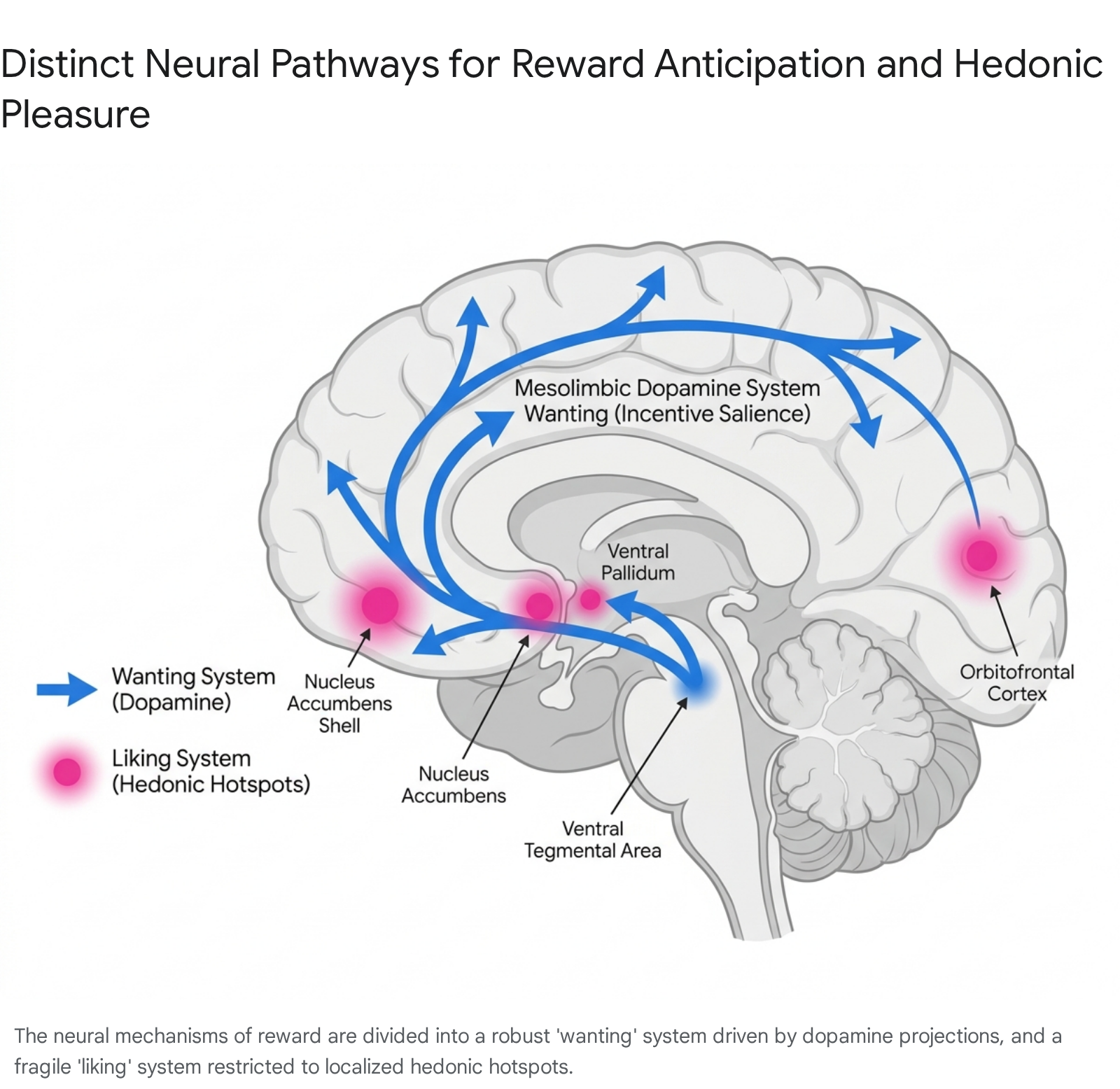
The phenomenon of "wanting" is driven by large, robust neural systems, primarily the mesocorticolimbic dopamine system. This system projects heavily from the ventral tegmental area to forebrain targets, including the nucleus accumbens and the broader striatum 45. The mesolimbic system detects environmental cues, evaluates their significance, and generates the visceral motivation to act. Crucially, dopamine acts not as a pleasure transmitter, but as a modulator of motivation and anticipation 237. Experimental models demonstrate that even when dopamine levels are depleted - which abolishes the motivation to seek out food or rewards - the subject's capacity to experience pleasure ("liking") remains completely intact 4.
Conversely, the experience of "liking" is mediated by a much smaller, fragile, and restricted network of interactive "hedonic hotspots." These hotspots are anatomically minute; for instance, the principal hotspot in the nucleus accumbens shell of a rodent occupies merely one cubic millimeter 45. These regions rely on opioid and endocannabinoid neurotransmitters rather than dopamine to amplify the actual subjective pleasure of consumption 245.
In the specific context of probabilistic rewards, the inherent uncertainty of the outcome hyper-activates the dopaminergic "wanting" system. Consumers experience intense anticipation prior to the reveal 78. In individuals exhibiting vulnerability to behavioral addictions, the "wanting" system becomes sensitized, meaning the incentive salience attached to reward cues - such as the glowing animation of a digital box or the tactile crinkle of blind box packaging - amplifies significantly 467. Simultaneously, the actual subjective pleasure ("liking") of the acquired item often decreases or remains flat due to tolerance 76. This severe dissociation explains why consumers repeatedly engage in surprise-based purchases, compelled by the thrill of the hunt, despite persistent post-purchase disappointment 878.
The Near-Miss Effect and Expectation Trajectories
A specific cognitive manipulation leveraged heavily in probabilistic reward design is the near-miss effect. Formally defined, a near-miss is a failure that visually or conceptually resembles a successful outcome, such as a slot machine reel stopping a fraction of an inch away from a jackpot, or a loot box animation systematically slowing down to display a highly coveted item before resting on a common reward 9101411.
Distinctions exist between chance near-misses and engineered (or artificial) near-misses. In modern digital formats, software algorithms are frequently pre-manipulated by developers to ensure that combinations resembling near-misses occur at a specific, heightened frequency, balancing frustration and hope to maximize player retention 1411. Despite being an objective financial loss, an engineered near-miss triggers psychophysiological responses in the brain that closely mirror those of actual wins. Functional magnetic resonance imaging (fMRI) reveals that near-misses actively recruit the ventral striatum, anterior insula, and midbrain reward networks 12131814.
Behaviorally and physiologically, near-misses induce an initial orienting response characterized by transient heart rate deceleration, where players often report feeling that "time slows down" for a fraction of a second 101115. This is immediately followed by increased skin conductance (arousal) and heightened subjective frustration 101115. The structural design of near-misses manipulates the trajectory of a consumer's expectations. Electroencephalography (EEG) analyses monitoring the deceleration phase of a spinning reel demonstrate that when a player experiences a "Near Win Before" (where the reel approaches the winning symbol but stops just short), their expectation of a reward remains artificially high until the absolute last millisecond prior to the outcome resolution 13. This intense physiological arousal creates a powerful, persistent urge to continue purchasing 101816.
In individuals predisposed to problem gambling, near-misses elicit disproportionately large P300 and feedback-related negativity (FRN) amplitudes in brain activity 1417. These electrophysiological markers indicate that the brain of a vulnerable individual processes the near-miss event as a highly salient motivational cue, reinforcing the behavior rather than processing the event as a discouraging loss 1417.
Cognitive Distortions and the Illusion of Control
The near-miss effect feeds directly into the illusion of control, a pervasive cognitive bias wherein individuals erroneously believe their actions, skills, or rituals can influence outcomes that are fundamentally governed by random chance 9161819. When a consumer narrowly misses a rare reward, the brain frequently misinterprets the event as a form of skill acquisition. The individual rationalizes that they are "getting closer" to the desired outcome and that further investment of time or money will inevitably yield success 91316.
This illusion is heavily compounded by stimulus generalization, the sunk cost fallacy, and the gambler's fallacy 10161920. Having invested significant funds into a sequence of blind boxes or digital loot boxes without obtaining a rare item, consumers routinely assume that their probability of winning increases with each subsequent purchase 161920. In reality, the probabilistic algorithms governing these products operate on independent, variable-ratio reinforcement schedules, meaning previous outcomes possess absolutely no mathematical bearing on future results 1621.
| Psychological Construct | Primary Neurobiological Driver | Behavioral Manifestation in Probabilistic Markets |
|---|---|---|
| "Wanting" (Incentive Salience) | Mesocorticolimbic dopamine system 4 | Compulsive anticipation and approach behavior triggered by packaging or digital cues 378. |
| "Liking" (Hedonic Impact) | Localized hedonic hotspots (opioids, endocannabinoids) 24 | Subjective pleasure during consumption; often blunts over time, resulting in dissatisfaction 237. |
| The Near-Miss Effect | Ventral striatum, anterior insula activation; P300/FRN amplitude spikes 121417 | Heightened arousal, heart rate deceleration, and intense urge to purchase again despite losing 101115. |
| Illusion of Control | Impaired response inhibition, altered reward prediction error 101818 | Erroneous belief that strategy, timing, or persistence influences objectively random algorithmic outcomes 91619. |
Digital Loot Boxes and the Video Game Industry
The monetization architecture of the global video game industry has been fundamentally transformed by the advent of loot boxes. Functioning as digital containers providing randomized virtual items - such as cosmetic character skins, weapons, or playable characters - loot boxes represent a massive economy operating directly at the intersection of interactive entertainment and unregulated games of chance 2022.
Market Scale and Demographic Penetration
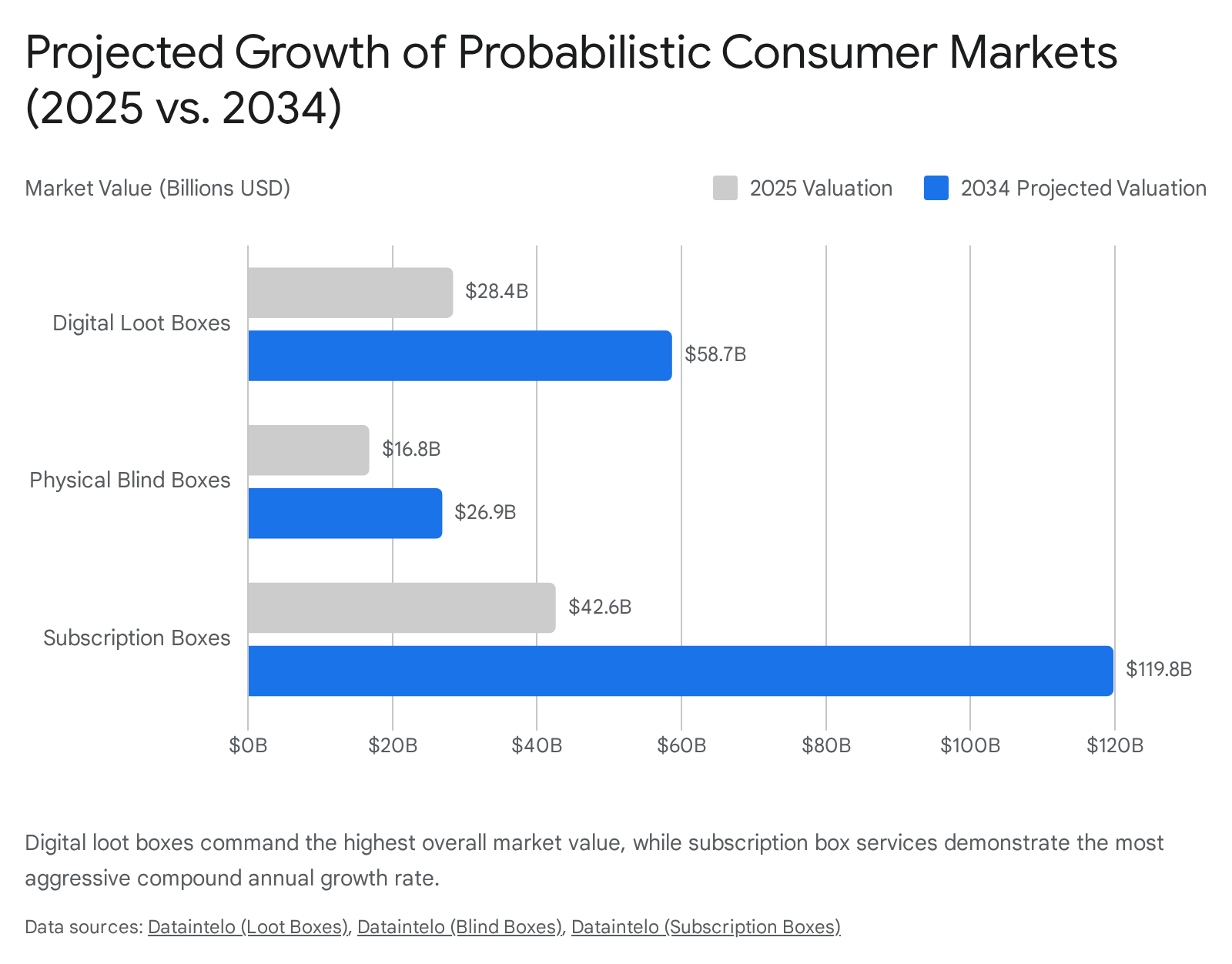
The global market for digital loot boxes commands substantial capital. Analyses valued the sector at approximately $28.4 billion in 2025, with aggressive projections indicating a potential expansion to $58.7 billion by 2034 at a compound annual growth rate (CAGR) of 8.4% 23. Alternative industry forecasts present slightly more conservative figures, estimating revenue around $20.3 billion by 2025, factoring in growing consumer fatigue and the chilling effect of encroaching legislative constraints 2425. Analysts estimate that over 230 million gamers actively purchased loot boxes in 2025, representing roughly 5% of the total global player base 2425.
This growth is disproportionately fueled by the free-to-play mobile gaming sector, which accounted for approximately 48.7% of total loot box revenues globally in 2025 2325. By entirely removing the upfront retail cost of a game, publishers drastically lower the barrier to entry, utilizing loot boxes as the primary, recurring post-sale revenue generator. Geographically, the Asia-Pacific region heavily dominates the market, claiming between a 38.6% and 54.3% revenue share 232526. This dominance is anchored by massive consumer bases in China, Japan, and South Korea, where mobile "gacha" mechanics (derived from physical capsule toy dispensers) are deeply entrenched in the structural design of regional software 232526.
Psychological Parallels to Pathological Gambling
The structural, mechanical, and psychological similarities between digital loot boxes and electronic gambling machines have resulted in significant academic, clinical, and regulatory scrutiny. Loot boxes systematically employ variable-ratio reinforcement schedules, intense audiovisual stimuli upon opening, and near-miss mechanics to maximize continuous user engagement 1416.
A substantial body of empirical research confirms a reliable, positive correlation between expenditure on loot boxes and the severity of problem gambling symptoms 1619202728. A 2025 international study analyzing over 1,400 adult gamers determined that individuals who frequently purchase loot boxes consistently exhibit higher levels of psychological distress, financial instability, and generalized gambling severity 1929. The study further noted that underlying anxiety and impulsivity heavily strengthen the connection between risky loot box purchases and gambling-related behavioral symptoms 1529.
Crucially, the relationship between digital loot boxes and problem gambling is markedly stronger than the relationship involving physical randomized products. In a large-scale 2025 study of 1,961 players in Western nations, spending on digital loot boxes exhibited a strong correlation with problem gambling (r = 0.31), a figure more than twice as potent as the correlation observed for spending on physical trading card packs (r = 0.15) 2830. This disparity suggests that the digital environment's frictionless purchasing, immediate digital delivery, and highly engineered sensory feedback loops actively exacerbate compulsive consumption in ways physical goods do not 2830.
Evolution of Monetization Strategies
Mounting public criticism, class-action lawsuits, and imminent regulatory threats have catalyzed a structural evolution in video game monetization. Recognizing that highly opaque, aggressive loot box systems risk alienating core player bases and inviting severe government intervention, publishers are actively diversifying their revenue models 2224.
The "Battle Pass" system has emerged as the primary, consumer-friendly successor. Battle passes offer fixed, highly transparent rewards in exchange for real-world money and continued playtime, fundamentally eliminating randomness in favor of progress-based unlocks 2236. Direct cosmetic storefronts, where digital items are purchased outright for a clearly stated price, have also regained prominence as a method to establish clear value 22. Concurrently, a legally distinct but functionally identical model known as "sweepstakes casinos" has gained significant traction. These platforms simulate slot machine mechanics using free virtual currencies that can subsequently be redeemed for real-world value, allowing developers to circumvent traditional gambling classifications while maintaining the psychological hooks of uncertainty 22.
Regulatory Frameworks and Consumer Protection
The regulatory landscape governing probabilistic digital goods remains deeply fragmented on a global scale. Governments and legal authorities continually struggle to classify software mechanisms that share precise behavioral characteristics with gambling, but technically lack traditional real-money cash-out features. This fragmentation forces global distributors to navigate a complex, contradictory patchwork of legal precedents and localized prohibitions.
Fragmentation of International Jurisdiction
At the most restrictive end of the regulatory spectrum, nations such as Belgium and the Netherlands formally classified paid loot boxes as illegal gambling in 2018. The Belgian Gaming Commission's landmark ruling forced major international publishers to completely disable real-money loot box mechanics within the territory or withdraw their titles entirely (as seen with games like Pokémon Unite), establishing a legal precedent that virtual items possess real-world value through unofficial secondary trading channels 223631383233. Despite the severity of the ruling, recent audits suggest that ongoing enforcement in these regions is inconsistent, with total bans proving technologically difficult for state regulators to monitor 3133.
Other jurisdictions have pursued narrower approaches aimed strictly at the protection of minors. Brazil enacted federal legislation in 2025 prohibiting the sale of loot boxes to players under 18, scheduled to take full effect in March 2026. However, the precise enforcement mechanisms, such as mandatory digital age verification, remain ambiguous 3233. Australia adopted a classification-based strategy; as of September 2024, any game featuring paid loot boxes must carry an "M" rating (not recommended for under 15), while titles containing highly simulated gambling mandate an "R-18+" classification 3141. Furthermore, Poland drafted amendments in late 2025 requiring formal gambling licenses for games featuring chance-based digital purchases 32.
In stark contrast, the United Kingdom and the United States have largely abstained from enacting blanket federal bans. Following a multi-year review of the Gambling Act 2005, the UK government opted against classifying loot boxes as gambling, citing the specific legal requirement that a prize must constitute "money or money's worth" 3234. Instead, the UK tasked the video game industry with self-regulation. This resulted in the 2023 UK Interactive Entertainment (Ukie) Industry Principles, a set of 11 non-binding guidelines regarding transparency and parental controls that legal critics and consumer advocates deem a failed, unenforceable experiment 3234.
Similarly, the United States maintains no federal ban, relying entirely on the Entertainment Software Rating Board (ESRB) for product labeling 32. Federal intervention in the US has been strictly limited to specific Federal Trade Commission (FTC) settlements targeting deceptive consumer practices rather than the loot box mechanic itself. This includes a landmark $520 million settlement with Epic Games over the use of dark patterns, and a 2025 $20 million settlement with Cognosphere (publisher of Genshin Impact) regarding exaggerated drop rates, doctored influencer videos, and the obfuscation of real-world monetary prices 363233.
Compliance Regimes in Asian Markets
Asian markets, where gacha mechanics are culturally integrated into digital consumption, rely on highly strict, granular operational regulations rather than outright bans. In China, the National Press and Publication Administration (NPPA) enforces rigorous compliance. Developers are legally mandated to disclose the exact mathematical probability of obtaining every potential reward 383235.
Furthermore, comprehensive regulations proposed and enforced through 2024 and 2025 placed hard caps on the sheer volume of loot box interactions. Games operating in China face daily limits, such as permitting no more than 30 single loot box openings per player, restricting bundle purchases (no more than three "10x" bundles), and implementing strict overall spending limits for minors 413536. Crucially, Chinese regulations also explicitly ban common psychological industry incentives, making it illegal to offer rewards for daily logins, first-time purchases, and account top-ups. This directly targets and dismantles the behavioral reinforcement loops that foster compulsive daily engagement 413536. Japan regulates its gacha industry primarily through a combination of industry self-regulation and specific legal prohibitions, most notably the 2012 consumer law ban on "complete gacha" (kompu gacha), a highly predatory mechanic requiring players to spend money to collect a specific set of randomized items to unlock a grand prize 41.
The European Union Digital Fairness Act
The most significant looming regulatory shift is the European Union's proposed Digital Fairness Act (DFA), officially anticipated for legislative proposal in the fourth quarter of 2026 32344647. Following a comprehensive 2024 "Digital Fairness Fitness Check," which determined that EU consumers lose an estimated €7.9 billion annually to harmful online commercial practices, the DFA seeks to unconditionally harmonize consumer protection laws across all 27 member states 463738.
The DFA is expected to target unethical commercial techniques broadly, with specific, severe provisions aimed at the video game industry. Potential legislative measures include an outright, EU-wide ban on paid loot boxes in games accessible to minors 324737. The legislation is also expected to mandate exact odds disclosures, prohibit dark patterns that obfuscate the real-money cost of virtual currencies, and place strict restrictions on addictive design features 324737. Furthermore, the DFA may legally classify virtual items and in-app currencies as digital content subject to standard EU consumer withdrawal rights, a classification that would fundamentally disrupt established monetization models for digital randomized goods 47.
The Efficacy of Mandated Disclosures
A common regulatory compromise utilized by governments attempting to avoid banning loot boxes entirely is the mandated disclosure of "drop rates" - the statistical probability of receiving a specific item. However, extensive behavioral economic research demonstrates that mandated informational disclosures frequently fail to alter actual consumer behavior.
Studies assessing the impact of financial disclosures reveal that unless information is highly salient (e.g., printed prominently on the front page) and immediately relevant to the user, consumers possess a rigid "limited attention" threshold and routinely ignore fine print 394041. For example, a large-scale MIT Sloan study tracking 124,000 banking customers found that providing transparent, mandated disclosures regarding better interest rates increased consumer switching behavior by merely 0.7 percentage points (from 8.7% to 9.5%) 40.
This systemic failure of transparency is exacerbated in gaming environments by cognitive overload and present bias. The immediate, visceral excitement of the probabilistic reward display actively outcompetes the abstract, rational evaluation of a stated 1.5% drop rate 414243. Even in environments with fully transparent odds, consumers often misunderstand probabilities, succumbing to the gambler's fallacy and vastly overestimating their aggregate likelihood of success over multiple attempts 161920. Consequently, relying solely on transparency and self-regulation to mitigate the harm of probabilistic rewards is increasingly viewed by policymakers and consumer advocates as a fundamentally flawed approach 323441.
| Regulatory Jurisdiction | Primary Approach | Key Provisions & Legislative Status |
|---|---|---|
| Belgium & Netherlands | Categorical Ban | Paid loot boxes legally classified as gambling; games frequently withdrawn from market; enforcement remains variable 31383233. |
| China | Strict Compliance | Mandatory exact odds disclosure; daily opening caps (max 50); spending limits; bans on daily login rewards to break behavioral loops 38413536. |
| United Kingdom | Self-Regulation | Relies on 11 non-binding Ukie industry principles (transparency, parental controls) rather than statutory gambling bans 3234. |
| United States | Case-by-Case Enforcement | No federal ban; FTC intervention limited to specific deceptive practices, dark patterns, and COPPA violations (e.g., Epic Games, Cognosphere) 3233. |
| European Union (DFA) | Harmonized Prohibition | Expected Q4 2026; proposed EU-wide bans on loot boxes for minors, dark patterns, and classification of virtual items as digital goods 32464738. |
Physical Blind Boxes and Retail Gamification
The psychological drivers of uncertainty and anticipation are not confined strictly to the digital sphere. Over recent years, the physical retail sector has experienced a massive global surge in the "blind box" economy. In this model, consumers purchase uniformly sealed packages containing one of several possible collectible figures, ensuring the exact contents remain a mystery until the unboxing process is complete.
Market Dynamics and the Pop Mart Phenomenon
The global blind box market demonstrates remarkable financial scale. Valued at $16.8 billion in 2025, economic projections indicate the sector will reach $26.9 billion by 2034 26. This extraordinary growth is heavily centralized in the Asia-Pacific region, which accounts for 54.3% of total global revenue 26. The market is anchored largely by dominant Chinese lifestyle and toy brands such as Pop Mart and MINISO 26.
The meteoric rise of Pop Mart serves as the premier case study illustrating the commercial power of physical probabilistic rewards. By successfully transitioning niche designer art toys into affordable, mass-market blind boxes, the company effectively gamified the physical retail experience. In 2024, Pop Mart reported revenue of 13.04 billion RMB (approximately $1.8 billion USD), representing a staggering 106.9% year-over-year increase 55. This growth is driven by proprietary, highly recognizable Intellectual Properties (IPs) such as Labubu (The Monsters), Molly, Skullpanda, and Crybaby 5544. To distribute these products, Pop Mart operates a vast physical infrastructure, maintaining over 401 brick-and-mortar stores and 2,300 "Roboshops" (automated vending machines) across China 55.
Recognizing eventual saturation in the domestic Chinese market, Pop Mart has aggressively expanded its footprint into Southeast Asia, Europe, and North America. The Southeast Asian market has proven highly receptive to blind box mechanics. In August 2025, Pop Mart opened a massive 760-square-meter global landmark store in Bangkok, Thailand, explicitly integrating local cultural elements to solidify its brand presence 4546. Driven largely by the Labubu IP, Pop Mart's Asia-Pacific regional revenue surged 257.8% year-over-year in the first half of 2025, reaching 2.85 billion RMB 4445. The strategic utilization of high-profile celebrity endorsements - most notably Lisa from the global K-pop group BLACKPINK showcasing Labubu merchandise - has rapidly elevated these blind boxes from niche collectible toys to mainstream fashion accessories and coveted status symbols 464748.
Social Signaling and the Emotional Economy
Unlike digital loot boxes, which frequently face severe legislative backlash for predatory monetization and links to pathological gambling, physical blind boxes are currently benefiting from a broader macroeconomic shift toward the "emotional economy" (often referred to as the "healing economy") 495063. Valued at an estimated 2.3 trillion RMB in China in 2024, and projected to exceed 4.5 trillion RMB by 2029, the emotional economy describes a paradigm where consumers prioritize purchases that yield emotional comfort, stress relief, and "self-pleasing" aesthetic value over strict functional utility 63.
Blind boxes fit perfectly into this framework, providing a low-cost, high-arousal diversion from the monotony of daily routines. The aesthetic appeal of the stylized figures combines seamlessly with the dopamine-driven anticipation of the randomized "pull" to satisfy deep emotional triggers 506451. Furthermore, physical blind boxes foster incredibly robust collector communities. The inherent, engineered scarcity of "secret" or ultra-rare figures drives a highly lucrative secondary market. In these spaces, unboxed items are traded and resold at significant premiums, mirroring the dynamics of traditional art or sneaker collecting 474951.
This economic dynamic effectively transforms basic consumption into complex social signaling. Acquiring and displaying a rare blind box item - or customizing a tote bag with specific plush figures - signals cultural capital, in-group belonging, and a sophisticated awareness of current global trends 4749. The unboxing experience itself becomes a highly shareable social event, blurring the boundaries between purchasing consumer goods and participating in interactive, community-driven entertainment 4951.
Surprise Subscription Services in E-Commerce
The subscription e-commerce market relies heavily on principles of algorithmic curation and deliberate surprise to maintain recurring monthly revenue. The global subscription box service market, valued at $42.6 billion in 2025, uniquely leverages the mechanics of uncertainty to differentiate itself from traditional, highly commoditized transactional retail 52.
Subscription Market Growth and Demographics
Industry projections anticipate the global subscription box market will expand dramatically, reaching $119.8 billion by 2034 at a robust CAGR of 12.2% 52. The market is predominantly sustained by female consumers, who constitute 66.24% of the demographic base, driven by shifting purchasing preferences toward curated convenience in fashion and aesthetics 5267. The industry is dominated by specific product segments, notably beauty and personal care (accounting for a 28.4% market share), followed closely by food and beverage (24.7%), and clothing and fashion (14.2%) 5268. Major industry leaders operating in this space include Stitch Fix, BarkBox, Birchbox, and HelloFresh 526768.
Behavioral Psychology of Subscriptions
Curated subscription boxes explicitly monetize the psychological element of surprise. Rather than allowing the consumer to manually select their specific items, companies utilize proprietary recommendation engines to select a randomized assortment of goods 5253. These services exploit a matrix of established cognitive biases to minimize monthly subscriber churn and maximize long-term customer lifetime value:
- The Endowment Effect: Once consumers successfully integrate a subscription service into their established monthly routine, they rapidly develop a sense of psychological ownership over the service. Consequently, the perceived emotional "loss" of canceling the subscription often vastly outweighs the actual financial cost of maintaining it 4370.
- Temporal Discounting and Present Bias: Consumers consistently and predictably undervalue future, aggregated expenses when compared to immediate, tangible benefits. Subscription models carefully frame costs as low, manageable monthly fees (e.g., $19.99/month) rather than displaying the high annual totals, directly exploiting present bias to drive initial conversions 4371.
- Charm Pricing: The widespread use of prices ending in the number '9' leverages the "left-digit effect," a cognitive phenomenon where the brain processes $19.99 as being significantly cheaper than $20.00. This subtle numerical manipulation reduces the cognitive friction associated with the purchase 707172.
- Reduced Decision Fatigue: By fully automating the curation and physical delivery process, subscription boxes substantially lower the cognitive load required to shop, successfully framing the recurring financial expense as a necessary premium paid for convenience 4370.
Artificial Intelligence Curation and Consumer Retention
To maintain the delicate balance between the thrill of surprise and the necessity of customer satisfaction, subscription services invest heavily in artificial intelligence. In 2025, total investment in personalization technology across the subscription box industry reached approximately $890 million 52. Leading apparel service Stitch Fix, for instance, utilizes proprietary recommendation engines that process over 100 million data points monthly. This massive data integration allows the company to achieve style success rates above 87%, ensuring the randomized items still closely align with the user's specific tastes 5253.
Despite these sophisticated psychological and technological hooks, subscription fatigue is a rapidly growing market reality. Behavioral research indicates that consumers severely underestimate their monthly subscription liabilities. In surveys, consumers estimated they spent an average of $86 per month on subscriptions; however, itemized analyses revealed their actual average monthly spend was $219 - a staggering discrepancy of $133 54. When forced to confront this aggregate cost amid broader macroeconomic inflationary pressures, significant portions of the consumer base report feeling financially overwhelmed, leading directly to abrupt service cancellations 54.
The Role of Unboxing Content
Integral to the sustained commercial success of both physical blind boxes and curated subscription services is the unboxing experience itself. The physical packaging serves not merely as a functional vessel for shipping, but as a primary marketing tool and a critical emotional brand touchpoint 645575.
Unboxing videos, frequently produced by digital influencers and shared virally on platforms like YouTube and TikTok, fundamentally transform the private act of opening a package into a vicarious, communal public event 55565778. From a psychological standpoint, these videos trigger a phenomenon known as "vicarious touch"; when viewers observe an influencer manually unboxing and physically interacting with a product, mirror neurons in the viewer's brain simulate the tactile experience. This neurological simulation demonstrably increases the viewer's product liking and subsequent purchase intent 56.
Furthermore, according to dual coding theory, combining highly stimulating visual information (the intricate packaging, the physical reveal) with specific verbal descriptions (the influencer's live commentary) significantly enhances both memory retention and emotional engagement for the viewer 56. Ultimately, unboxing content validates the consumer's decision to participate in the probabilistic market, providing essential social proof that the inherent risk of the surprise will be fundamentally and emotionally rewarding 647578.