
Psychology of unboxing rituals and perceived product value
The unboxing experience has evolved from a purely functional requirement of product protection and logistics into a highly engineered, multi-sensory marketing touchpoint. Governed by cognitive psychology, neurobiology, and cultural sociology, the interaction between a consumer and a package establishes the baseline for product perception and consumer satisfaction before the core item is physically revealed. The structural design, material composition, and sequential opening mechanics of packaging operate as primary determinants of perceived value, engaging ancient neurological reward systems and cognitive biases to amplify the emotional resonance of modern consumer goods.
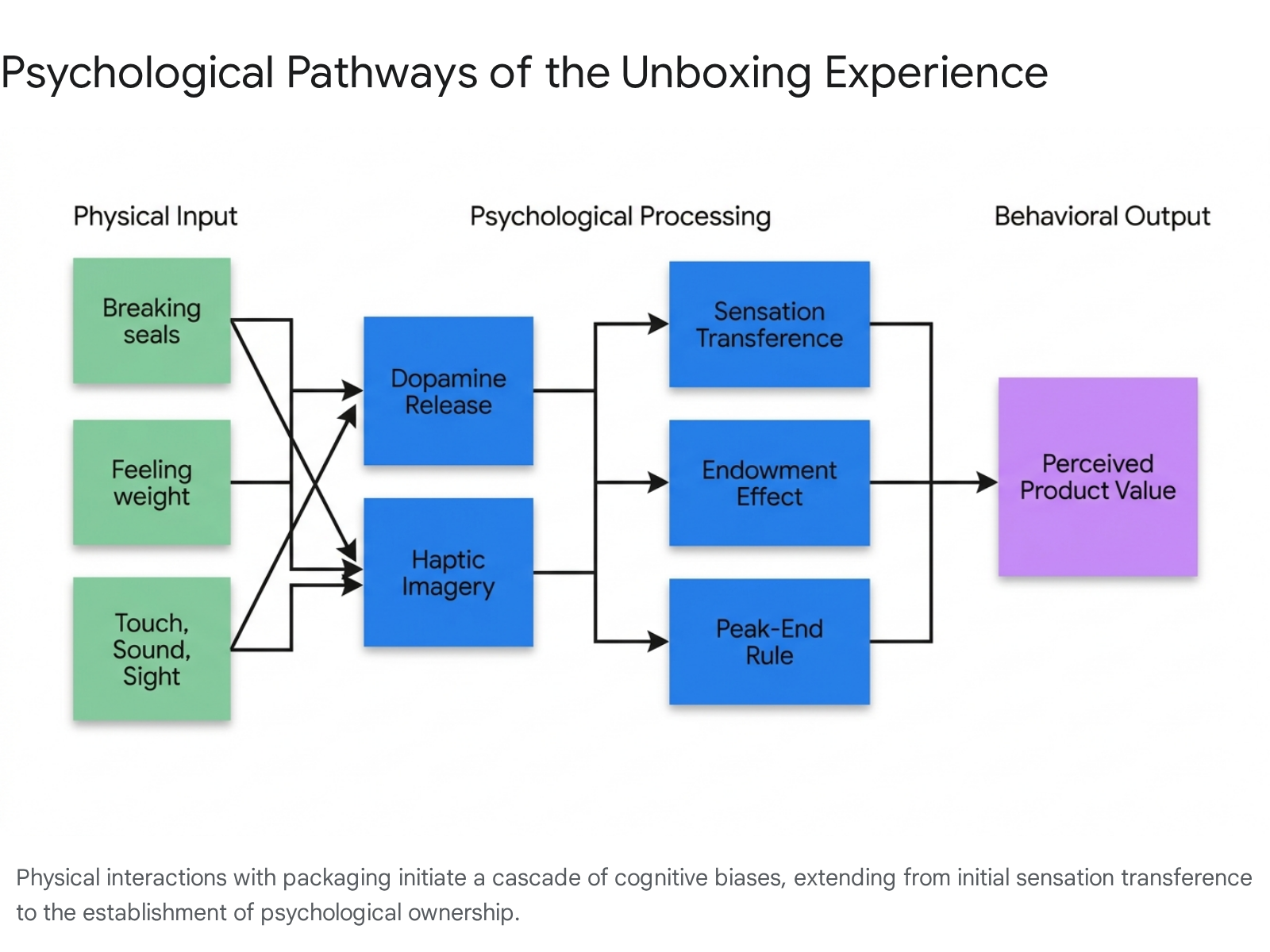
Neurological Foundations of the Unboxing Sequence
The psychological weight of the unboxing experience is rooted deeply in human neurochemistry and physiological arousal. The physical presence of a package initiates a cascade of neurological responses that dictate product evaluation, brand loyalty, and future purchasing behavior.
Dopaminergic Pathways and Reward Anticipation
The act of unboxing is fundamentally linked to the brain's reward architecture, specifically the mesolimbic dopamine pathway. While dopamine is colloquially characterized as a "pleasure molecule," neurobiological analyses reveal that it primarily governs reward anticipation, decision-making, and motivation 123. The visual identification of an unopened package serves as a stimulus that initiates dopamine synthesis in the ventral tegmental area, which subsequently projects to the nucleus accumbens 3. When consumers view desirable products or visually appealing packaging, the nucleus accumbens triggers feelings of excitement and anticipation, while the orbitofrontal cortex concurrently evaluates and integrates the reward value of the available options to assign preference strength 3.
The magnitude of this dopaminergic response is intimately tied to the unpredictability of the reward and the duration of the anticipatory phase. Neuroscientific research examining primate behavior demonstrates that dopamine release begins immediately upon receiving a signal that a reward is imminent and ends when the required work is completed and the reward is dispensed 2. Furthermore, when the reward is unpredictable - such as a 50 percent chance of receiving a treat - the volume of dopamine released doubles 2. In the context of product packaging, the physical effort of breaking seals, lifting friction-fit lids, or peeling back layers functions as the requisite work phase. A strategically delayed revelation sustains dopamine release over a longer temporal window, maximizing psychological arousal 44. Conversely, if an unboxing sequence is entirely frictionless or instantaneous, the anticipatory window is truncated, yielding a lower overall neurochemical reward.
Clinical applications of these principles have been observed in consumer electronics. Electroencephalography (EEG) studies focusing on smartphone consumers in India reveal that enhanced, multi-stage unboxing experiences directly activate brain regions associated with reward and pleasure 56. The data demonstrates a significant correlation between the sensory elements of packaging - such as structural design, tactile engagement, and audio-visual stimuli - and the subsequent cognitive responses that drive post-purchase perception and brand advocacy 56.
Physiological Correlates: Arousal and the Autonomous Sensory Meridian Response
Auditory and tactile stimuli in packaging design are increasingly engineered to trigger specific somatic states, particularly the Autonomous Sensory Meridian Response (ASMR). ASMR is an atypical sensory-perceptual phenomenon characterized by pleasurable, electrostatic-like tingling sensations that typically begin at the scalp and move down the spine, frequently accompanied by profound relaxation 789.
Packaging elements provide highly effective non-vocal auditory and tactile triggers for this response. Sounds such as the crisp crinkling of tinfoil, the tearing of heavy paper, or the acoustic resonance of a vacuum-sealed lid are capable of inducing ASMR in sensitive individuals 79. Research utilizing the 37-item ASMR Trigger Checklist (ATC) indicates that physical touch to the body is the most widely endorsed (98 percent) and most intense ASMR trigger, underscoring the importance of tactile packaging elements 710.
Physiological measurements of individuals experiencing ASMR reveal a complex duality of arousal and relaxation. Studies tracking heart rate and skin conductance level (SCL) show that while heart rate significantly decreases during the experience (indicating relaxation), skin conductance concurrently increases 8. Because skin conductance is a primary indicator of physiological arousal during emotional or cognitive processing, its elevation suggests that the tingling sensations are not merely pacifying but actively engage the autonomic nervous system 8. Additionally, pupil diameter increases during the ASMR experience, further demonstrating that packaging-induced acoustic and tactile feedback generates measurable physiological engagement 8. Lower-pitched, complex sounds and slow-paced, detail-focused visual elements have been identified as the most effective triggers for this neurological state 9.
Cognitive Biases and Behavioral Economics
Beyond neurological arousal, the structural sequence of unboxing leverages deeply ingrained cognitive biases that distort objective product valuation. By mapping physical interactions to heuristic shortcuts, packaging designers effectively inflate the consumer's perception of worth.
The Endowment Effect and Psychological Ownership
A primary mechanism leveraged by tactile packaging is the endowment effect - a cognitive bias first termed by Richard Thaler in 1980, describing the human tendency to overvalue an item simply because they own it, regardless of objective market value 12131112. The effect is fundamentally rooted in loss aversion, a principle of prospect theory formulated by Amos Tversky and Daniel Kahneman, which states that the psychological pain of losing an asset is significantly more powerful than the pleasure of gaining an equivalent asset 1312.
Empirical demonstrations of the endowment effect frequently utilize the ratio of a seller's willingness to accept (WTA) to a buyer's willingness to pay (WTP). In classic experiments involving the exchange of physical objects like mugs, participants given a mug subsequently demand a price (WTA) that is often twice the market value to part with it, while non-owners are unwilling to pay that inflated price (WTP) to acquire it 121113. The disparity frequently exceeds a ratio of two-to-one 13. Furthermore, the duration of ownership directly correlates with the severity of the valuation distortion. In temporal studies, a group initially valued a received item at $2.69; after one minute of possession, the valuation rose to $3.95, and after one hour, the average selling price demanded rose to $4.97 11.
In the context of unboxing, physical touch accelerates psychological ownership. Ownership is not strictly a legal construct but a psychological framework that can develop even before a formal transaction occurs 13. The longer a consumer holds a package, exploring its texture, weight, and structural mechanisms, the more deeply the sense of possession is entrenched 17. Even imagined interaction - known as haptic imagery - can trigger this effect. Studies have demonstrated that participants instructed merely to visualize touching an item reported degrees of perceived ownership comparable to those who actually held the object, a finding with profound implications for digital packaging representations in e-commerce 12. When customized or personalized elements (such as printed names) are applied to packaging, the "for me" effect accelerates the endowment bias, minimizing cognitive load and significantly shortening the consumer's decision-making timeline 14.
The Peak-End Rule and the Zeigarnik Effect
The subjective memory of an unboxing experience is governed by the peak-end rule, a heuristic dictating that individuals judge an experience based almost entirely on how they felt at its most intense emotional point (the peak) and at its conclusion, rather than an average of every moment 419. In premium packaging, the peak is meticulously designed to occur through a sensory surprise - such as an unexpected magnetic snap or a smooth friction-glide - while the end is the final revelation of the immaculate product. Conversely, if packaging is damaged in transit, excessively difficult to open, or requires tools, it creates a negative emotional peak. This negative climax disproportionately contaminates the entire product memory, often overriding the functional soundness of the item and precipitating a rapid return 19.
Simultaneously, complex packaging leverages the Zeigarnik effect, named for the psychologist who discovered that people remember uncompleted tasks better than completed ones 15. A multi-layered unboxing experience creates a psychological loop; the consumer is presented with a task (opening the outer box) that reveals a secondary task (untying an inner ribbon). This progressive layering creates a sense of task fulfillment upon completion, rendering the entire sequence highly memorable 15. However, this complexity must be carefully balanced against Hick's Law, which states that increasing the number of choices logarithmically increases decision time. If the opening sequence is confusing or presents too many simultaneous interaction points, the consumer experiences cognitive friction, leading to frustration that diminishes the perceived value 1516.
Sensation Transference and Sensory Marketing
The physical presentation of a package communicates intricate details about product quality through a mechanism known as sensation transference. Identified by clinical psychologist Louis Cheskin, sensation transference is the unconscious process by which consumers transfer the sensorial qualities of a package - its color, rigidity, texture, and visual hierarchy - directly onto their assessment of the product contained within 17231819.
Cheskin's foundational research demonstrated this phenomenon through the alteration of margarine packaging. By changing the packaging from traditional white waxed paper to yellow foil, consumer feedback indicated that the margarine tasted better and was of higher quality, despite the product formulation remaining identical 1920. Because consumers are likely to categorize a food item and its packaging as a single, unified entity, extrinsic cues extracted from the package heavily modulate intrinsic sensory expectations 2122.
Visual Communication: Geometry, Placement, and Color
Visual packaging cues are processed instantaneously, mediating product categorization and establishing price expectations. The geometric shape of a container fundamentally alters perception. Research evaluating bottled water packaging indicates a strong consumer preference for anthropomorphic or rounded bottle shapes over sharp, angular designs 23. Angularity is frequently subconsciously matched to attributes like aggressiveness, sourness, or carbonation, whereas rounded shapes evoke harmony, sweetness, and smooth textures 23. Furthermore, elongated packaging shapes are consistently perceived as offering better volume value for their price compared to wider, shorter variants 24.
The spatial layout of visual information also drives cognitive assumptions. Products that position their logo higher on the package facade generate more favorable perceptions of quality, regardless of prior brand familiarity 22. Conversely, placing an image of the food product at the bottom of the packaging has been shown to enhance consumer flavor expectations 22. Color semiotics play an equally critical role; warm hues like red and orange stimulate urgency and appetite, blue evokes trust and reliability, and purple communicates luxury 420. Applying congruent color combinations - such as a blue cap on a water bottle - has been empirically proven to improve quality perceptions and increase tolerance for higher price points 23.
Tactile Engagement and Material Weight
While visual cues attract initial attention, tactile qualities anchor the perception of value. The physical weight of a package is a profound driver of sensation transference. Handling denser, heavier materials - such as thick paperboard, reinforced glass, or metal - prompts consumers to deduce superior product craftsmanship and justifies premium pricing 1618. Experimental manipulation of packaging weight has shown that artificially increasing the mass of a chocolate box or a soft drink container directly increases the consumer's desire for the food and their willingness to pay, mediated by an expected increase in flavor intensity 2125. Similar results are observed in non-food items, where heavier bottles of liquid soap generate expectations of higher fragrance intensity 25.
Surface textures introduce a secondary layer of sensory marketing. Packaging elements utilizing embossing, debossing, matte lamination, or soft-touch velvet coatings create a multi-sensory experience that disrupts the shopping routine 172633. These tactile features encourage prolonged handling, activating the endowment effect and building an emotional connection 17. In biometric analyses utilizing facial expression monitoring and touch coding across different retail environments, packaging with metallic foil or embossed finishes generated significantly longer touch durations than standard glossy materials, serving as a stronger predictor of eventual sales 2728.
The synthesis of these sensory modalities can be categorized into discrete tactical applications, outlined in the table below:
| Sensory Modality | Packaging Implementation | Associated Cognitive Mechanism | Impact on Consumer Perception |
|---|---|---|---|
| Visual Geometry | Anthropomorphic bottle shapes, elongated proportions, high logo placement 222324. | Sensation Transference: Shape fluency is mapped to product elegance and volume. | Enhances perceived quality, justifies a 20% price increase tolerance, and improves flavor expectations 2223. |
| Tactile Texture | Heavy paperboard, soft-touch velvet coatings, embossing, metallic foil 171633. | Endowment Effect: Physical resistance and texture invite prolonged holding times. | Increases psychological ownership, perceived product durability, and brand recall 171827. |
| Material Weight | Glass, metal, thick ceramics, or internally weighted structural bases 162125. | Cross-Modal Correspondence: Mass is directly correlated with substance and concentration. | Artificially inflates expectations of flavor intensity, fragrance concentration, and financial worth 2125. |
| Auditory Acoustics | Magnetic lid clicks, thick paper tearing, vacuum seal release resistance 71621. | ASMR / Reward Conditioning: Low-pitched acoustic feedback acts as an autonomic trigger. | Induces states of relaxation or excitement, validating the structural integrity and premium nature of the product 8916. |
Temporal Dynamics of the Unboxing Sequence
The psychological effectiveness of an unboxing event is heavily dependent on temporal pacing. The structure of the experience operates on a predictable emotional arc, modeled by dimensional emotional frameworks, which map shifting states of arousal over time 3637. The experience transitions from pre-acquisition anticipation to the climax of revelation, and concludes with post-interaction satisfaction.
Pre-Acquisition Anticipation
In modern e-commerce paradigms, the unboxing arc begins significantly before physical contact, initiated during the transit period. The delay between purchase and delivery builds acute psychological suspense. Surveys analyzing digital shopping behaviors reveal that 76 percent of consumers in the United States, 72 percent in the UK, and 82 percent in China report experiencing higher levels of excitement when waiting for online purchases to arrive in the mail compared to buying items instantaneously in-store 2.
When the package arrives, the exterior container serves as the physical manifestation of this anticipation. The visual distinctiveness of the shipping mailer sets the initial cognitive stage; a high-quality exterior signals to the brain that the forthcoming interaction warrants significant attentional allocation, elevating the perceived value of the contents before the primary package is even visible 3738.
Aesthetic Interaction and the Revelation Climax
As the consumer initiates the opening sequence, they enter a phase governed by "aesthetic interaction." Research into packaging aesthetics identifies three critical factors during this phase: freedom of interaction, interaction pattern, and the richness of motor actions 3940. Packaging designs that require a diverse range of motor actions - such as sliding a sleeve, lifting a rigid lid, unfolding tissue, and peeling a sticker - consistently evoke more intense positive emotions and yield higher semantic appraisals of the product than simple, single-step containers 3940.
The climax of the experience is the moment of complete product visibility. In luxury sectors, structural designs such as wardrobe configurations or individual draw-box constructions (e.g., advent calendars) are specifically utilized because they isolate the product on a structural stage 332930. This staging extends the time it takes for the item to be fully unveiled, preventing premature visual processing and maintaining the dopaminergic tension until the exact moment of climax 30.
Post-Unboxing Satisfaction and Social Currency
Following the revelation, the consumer's emotional state transitions into either satisfaction or disappointment based on the alignment of the sensation transference with the actual product quality 38. A positive post-purchase experience fosters deep brand affinity, capitalizing on the "IKEA effect" - a behavioral science principle demonstrating that individuals assign disproportionately high value to experiences or products they feel they participated in unveiling or assembling 1117.
Furthermore, exceptional unboxing experiences prompt a strong desire for social sharing, converting a private ritual into a public performance. Global logistics research indicates that over 65 percent of consumers are more likely to post photos of their unboxing on social media if the packaging feels special or gift-like, with 40 percent highly likely to share unique packaging 1743. In sociological terms, the package functions as social currency, allowing consumers to demonstrate sophistication, exclusivity, or subcultural membership to their digital networks 4. This user-generated content acts as organic marketing, extending the reach of the packaging far beyond the initial recipient 1729.
Cultural Paradigms in Packaging Rituals
While the neurobiological mechanisms of dopamine release and anticipation are universal human traits, the semiotics of packaging - how structural features, colors, and opening rituals are interpreted - are deeply embedded in cultural context. Global packaging strategies require precise calibration to varying societal values, historical traditions, and aesthetic thresholds.
Japanese Tsutsumi and the Concept of Purity
In Japanese culture, packaging transcends mere utilitarian protection to occupy a highly formalized, spiritual space. The traditional art of packaging, known as tsutsumi, derives its name from the verb tsutsushimu, which translates to refraining, being discreet, or showing moderation 31. The profound cultural depth of this practice is reflected in its linguistic origins; the kanji character for tsutsumu depicts a fetus within a womb, symbolizing an auspicious and genuine form of protective enclosure 31.
Unlike Western packaging paradigms that prioritize hermetic seals, impenetrable security, and immediate convenience, traditional tsutsumi relies on loose, flexible coverings utilizing natural materials such as bamboo, rice straw, hemp twine, paper, and ceramics 3132. This methodology is intertwined with Shinto concepts of spiritual purity; wrapping an object demonstrates a pledge that the contents have been shielded from impurities before being presented 31. Furthermore, Japan's societal structure - characterized by collectivism, group harmony, and high uncertainty avoidance - dictates an indirect, high-context marketing approach 3334. Packaging in this context avoids aggressive sales messaging, relying instead on subtle aesthetic resonance, seasonal reflection, and the ritualistic respect conveyed through the meticulousness of the folds 323335.
Hospitality and Heritage in the Middle East
In the Middle East, luxury packaging is fundamentally tied to historical traditions of hospitality, reverence, and religious observance. Products such as dates and premium chocolates hold deep cultural significance, particularly as a natural source of sustenance used to break fasts during the holy month of Ramadan, following the traditions of the Prophet Muhammad 49.
Packaging for these items is designed to reflect this reverence, utilizing extravagant materials to communicate prestige and benevolence during religious observances such as Eid al-Fitr and Eid al-Adha 49. Structural elements such as rigid boxes, magnetic closures, and velvet or satin ribbons heighten the unboxing ritual 49. Design motifs frequently incorporate arabesque geometry - intricate, symmetrical patterns symbolizing infinity and spiritual balance - alongside deep jewel tones and gold accents that echo royal traditions 4950. The unboxing process is curated not just for product extraction, but as an event that elevates the status of the guest, reflecting the host's generosity and the brand's respect for regional heritage 4951.
Festival Symbolism in Chinese Markets
In Chinese culture, packaging plays an instrumental role in festival symbolism and the maintenance of social relationships (guanxi). Color symbolism is paramount; the prominent use of red in packaging, particularly during the Lunar New Year for gifts such as the hongbao (red envelope), represents good fortune, luck, and the warding off of evil spirits 3552. Conversely, colors such as white, which signify purity in Western markets, have historical associations with mourning in traditional Asian contexts, necessitating careful adaptation by global brands 3550. Packaging design frequently integrates deeply rooted cultural motifs, such as dragons or lotuses, to convey history, belief, and belonging, instantaneously telling a brand's story without relying on typography 3550.
To synthesize the variations in global packaging expectations, the following table outlines key cultural divergences and their corresponding structural manifestations:
| Cultural Region | Dominant Packaging Philosophies | Key Color Semiotics & Associations | Structural & Material Preferences |
|---|---|---|---|
| Western Markets (US/Europe) | Direct communication, functionalism, convenience, and individualization 1633. | Red: Passion, energy, urgency. White: Purity, cleanliness, clinical modernity 3550. |
Minimalist structures, highly visible branding, tamper-evident seals, blister packs 3550. |
| Japan | Tsutsumi (discretion, purity). High-context communication, aesthetic respect, and anticipation 3133. | White/Natural: Spiritual purity. Palettes frequently adapt to highly specific seasonal micro-changes 323550. | Natural fibers (bamboo, rice straw), flexible wrapping, layered folds, aesthetic looseness over hermetic seals 3132. |
| Middle East | Hospitality, generosity, exclusivity, and honoring the recipient through extravagance 4951. | Gold/Jewel Tones: Luxury, divine power, prosperity, royal tradition, and infinite balance 4950. | Rigid boxes, magnetic closures, velvet linings, intricate arabesque geometric patterns 495051. |
| China | Celebration, luck, and relationship maintenance during seasonal festivals 3552. | Red: Good luck, joy, warding off evil. White: Mourning (historically) 355052. |
Ornate gifting boxes, cultural motifs (dragons, lotuses), premium finishing to signal social status 5052. |
The Conflict Between Premium Perception and Sustainability
A profound cognitive and material conflict exists at the core of modern packaging strategy: the structural elements that reliably generate premium value perception - excessive weight, thick multi-layered unboxing sequences, composite materials, and rigid plastics - are fundamentally at odds with the growing global imperative for environmental sustainability and minimal waste generation 303637.
The Waste Threshold and Consumer Guilt
Historically, the product-to-package ratio has been heavily skewed in luxury and premium goods to create a sense of substantiality and exclusivity. A larger, heavier package utilizes sensation transference to imply that the enclosed product is of superior quality 161837. However, the proliferation of direct-to-consumer e-commerce has heightened consumer exposure to "wasteful packaging," which manifests abruptly at the end of the unboxing cycle 36. When the dopamine-driven excitement of the product reveal subsides, the consumer is left entirely responsible for the physical byproduct of the experience.
Research indicates that crossing a specific "waste threshold" - where the volume of discarded material noticeably eclipses the physical utility of the product - triggers negative emotional responses linked to environmental guilt and cognitive dissonance 193638. An excessively packed product can lead to a severely degraded perception of the retailer, overriding the initial premium impact, particularly among consumer cohorts that score highly in biospheric values 36.
Legislative Frameworks and the Product-to-Package Ratio
Regulatory pressures increasingly mirror this consumer sentiment. Frameworks such as the EU Packaging and Packaging Waste Directive (2018/852) mandate aggressive reductions in waste, requiring that 65 percent of all packaging waste and 50 percent of plastic packaging waste be recycled by 2025, with those thresholds rising to 70 percent and 55 percent, respectively, by 2030 3940. The subsequent EU Single Use Plastics Directive (2019/904) further enforces the transition to a circular economy 3940. In Asia, governmental initiatives have explicitly targeted wasteful packaging; China's Administration of Quality Supervision, Inspection, and Quarantine (AQSIQ) introduced draft legislation restricting the permitted number of packaging layers and mandating that packaging costs cannot exceed 15 percent of the product's price, enforcing compliance with substantial fines 41.
Despite these interventions, packaging waste remains a massive structural issue. In 2019, the European Union generated a record 178 kg of packaging waste per capita, with plastic waste generation alone surging to 15.4 million tonnes 3940. Paradoxically, studies evaluating the product-to-package ratio suggest that larger, multi-serve packaging sizes are significantly more efficient regarding material waste than single-serve or miniaturized counterparts, regardless of the material type 37. However, consumer lifestyle requirements and the demand for convenience continuously drive the market toward smaller, less efficient, heavily packaged formats 37.
Discrepancies in Consumer Willingness to Pay
The psychological response to sustainable packaging alternatives - such as biodegradable plant plastics, mycelium composites, and post-consumer recycled (PCR) paper - presents a complex landscape of contradictory survey data. Certain expansive industry reports suggest a massive demographic shift toward eco-consciousness. For instance, the 2023 Trivium Green Buying Report found that 82 percent of surveyed consumers value sustainability enough to pay a premium for it, a figure that rises to 90 percent among Generation Z 42. In these demographics, sustainable packaging acts as a status signal, reflecting corporate responsibility and aligning with aspirational identities 433543.
Conversely, longitudinal sentiment tracking by organizations such as McKinsey & Company indicates a starkly different hierarchy of actual consumer purchasing criteria. Across multiple global survey iterations (2020, 2023, 2025), consumers consistently ranked environmental impact as a distant secondary or tertiary concern 44.
When forced to rank packaging attributes, consumers prioritize price, perceived quality, food safety, shelf life, and durability significantly above a product's ecological footprint 44.
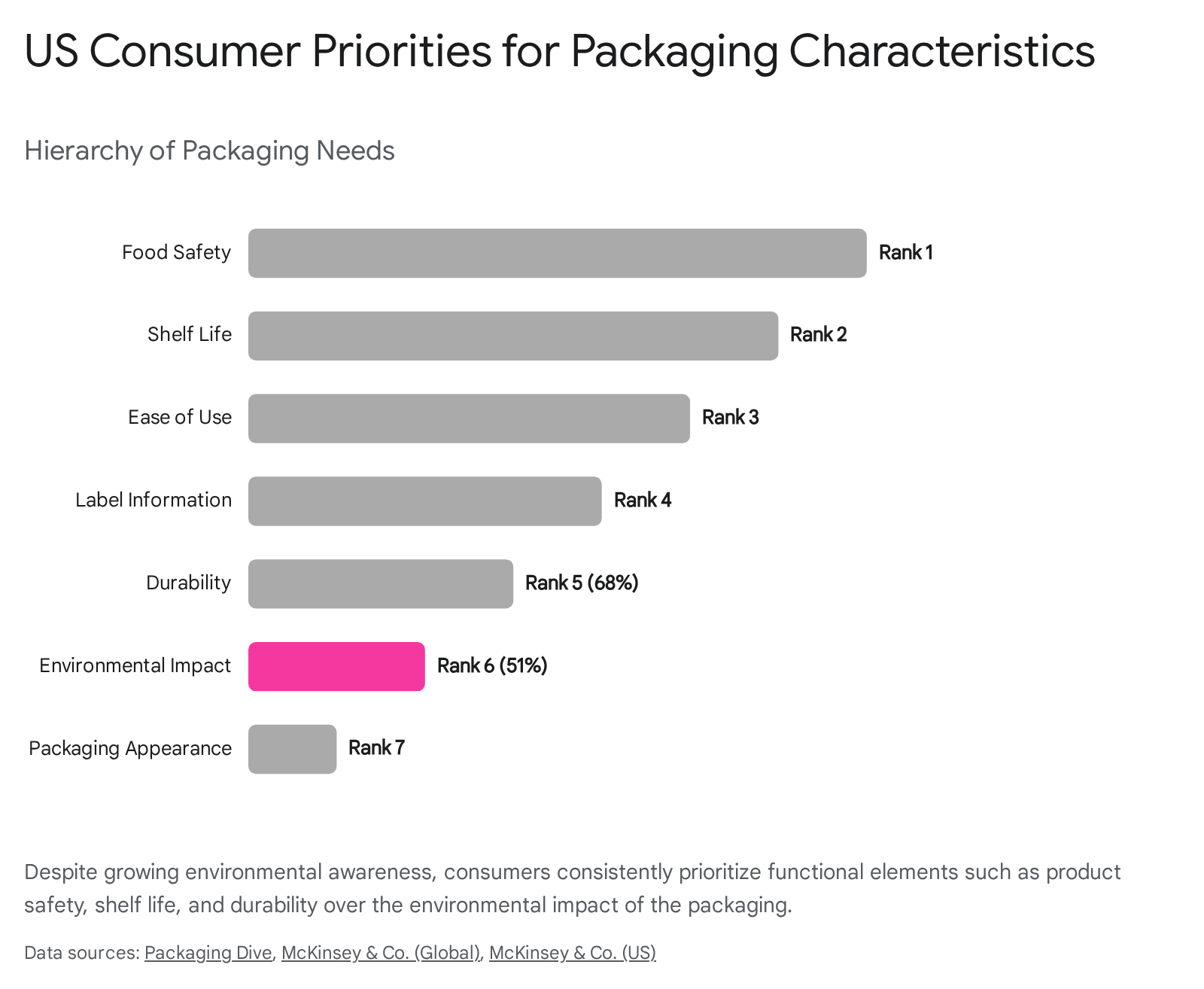
In absolute terms, the share of respondents ranking environmental impact as extremely or very important remained steady at roughly 51 percent across five years . Furthermore, consumer understanding of sustainability is highly fragmented; U.S. consumers deem glass to be the most sustainable substrate (60 percent rating it highly), while heavily penalizing plastics (22 to 33 percent), and prioritize recognizable heuristics like "recyclability" over more complex, yet potentially more impactful metrics like "carbon footprint" or "bio-based content" 4044.
To resolve this conflict, advanced packaging design substitutes heavy plastics with high-density, textured recycled papers that maintain structural rigidity and a premium acoustic profile (providing the expected "crisp tear") while adhering to circular economy principles 16263365. Secondary use design extends the packaging lifecycle; robust tins or magnetic boxes designed to be repurposed as in-home storage leverage the endowment effect permanently, justifying their initial material footprint by avoiding the landfill and serving as continuous brand reinforcement 42630.
Technological Augmentation of the Packaging Experience
As physical packaging materials are increasingly optimized for sustainability and mass reduction, brands are pivoting toward digital augmentation to amplify perceived value and emotional engagement during the unboxing process. The integration of embedded technology transforms static, disposable packaging into dynamic, interactive media interfaces.
Augmented Reality and Digital Gamification
The incorporation of Near Field Communication (NFC) chips, Smart Labels, and QR codes into the packaging architecture allows consumers to transition seamlessly from the physical unboxing to a curated digital ecosystem 266667. Scanning a discreetly placed marker on a package can trigger Augmented Reality (AR) overlays that project 3D product models, interactive setup tutorials, or origin stories directly onto the consumer's physical environment via their smartphone 67. Replacing dense paper manuals with interactive AR overlays simplifies onboarding and minimizes physical waste, satisfying the consumer's desire for experiential retail while establishing deeper brand loyalty 266667.
Furthermore, digital integration permits the gamification of the unboxing journey. By embedding AR mini-games, hidden digital content, or loyalty reward challenges within the physical structure of the packaging, brands transform the passive act of opening a box into an active, goal-oriented pursuit 167. This strategy exploits the digital "Dopamine Economy," utilizing variable reward schedules, scarcity cues, and micro-interactions to maintain user engagement long after the physical product has been extracted 1. As a result, the packaging is no longer discarded immediately; it serves as a persistent portal for digital interaction, behavioral nudging, and direct consumer data collection 6667.
Printed Illumination and Emotional Memory
Beyond mobile device integration, cutting-edge material technologies now allow for interaction directly on the packaging substrate itself. Innovations such as printed OLED (Organic Light-Emitting Diode) illumination enable packages to actively glow, animate, or change color upon opening 1423. According to emotional design frameworks, this sudden, surprise illumination triggers intense visceral delight and captures attention through rapid luminance contrast 1423.
Consumer neuroscience indicates that aesthetically pleasing, illuminated packaging strongly activates the brain's reward centers - specifically the ventromedial prefrontal cortex - driving emotional engagement that can override rational evaluations of cost or brand familiarity 23. Such interventions create a profound emotional memory; brand moments that trigger surprise and multisensory stimulation are retained longer, shared more frequently, and drastically accelerate the establishment of psychological ownership prior to actual product usage 1423. Through these technologies, packaging transcends its traditional role, becoming a dynamic storytelling medium capable of delivering immense perceived value with a minimal physical footprint.