
Psychology of Habit Formation and Reward in Loyalty Programs
The global loyalty management market has evolved from a tactical marketing function into a sophisticated behavioral engineering discipline. Valued at approximately $13.31 billion in 2024, the sector is projected to expand to $41.21 billion by 2032, driven by immense corporate investments in customer retention 1. While historically viewed as straightforward transactional systems designed to stimulate repeat purchases through financial incentives, modern empirical research reveals a significantly more complex psychological environment. Comprehensive meta-analyses, such as those by Belli et al. and Liu-Thompkins et al. (2022), establish that while loyalty programs are highly effective at driving behavioral retention, their success is mediated heavily by affective factors rather than purely cognitive or economic drivers 2. The architecture of a successful loyalty program relies on carefully engineered reinforcement schedules, the exploitation of cognitive biases, and a delicate balance between transactional habituation and emotional attachment.
Behavioral Conditioning and Reward Schedules
The foundation of any points- or tier-based loyalty program rests on the principles of operant conditioning, a psychological concept outlining how behaviors are shaped by their subsequent consequences 34. In commercial environments, specific customer actions - such as making a purchase, leaving a product review, or engaging with a mobile application - are systematically reinforced through reward distributions designed to ensure behavioral repetition.
Operant Conditioning Foundations
The application of operant conditioning in loyalty marketing involves defining the specific rules that dictate which instances of a desired behavior will be reinforced, a concept formalized by researchers such as B.F. Skinner and C.B. Ferster 3. Programs utilize either continuous reinforcement, which rewards every single occurrence of a behavior, or partial (intermittent) reinforcement, which rewards behaviors only occasionally 34. While continuous reinforcement is highly effective for rapidly teaching a new behavior - such as offering a welcome bonus for an initial application download or account creation - it is highly susceptible to extinction once the reward ceases 34. Consequently, mature loyalty ecosystems rely almost exclusively on partial reinforcement schedules to sustain long-term, cost-effective engagement.
Fixed Ratio Schedules and Behavioral Burnout
Partial reinforcement schedules in loyalty program design are generally categorized into ratio schedules, which are based on the volume of actions performed, and interval schedules, which are based on the passage of time 34. Ratio schedules consistently produce higher response rates than interval schedules, but the predictability of the ratio fundamentally alters consumer psychology 34.
In a Fixed Ratio (FR) schedule, reinforcement occurs after a set, unchanging number of behaviors 346. A classic example is the traditional coffee shop punch card: requiring ten purchases to receive the eleventh item free 46. While FR schedules effectively drive a high quantity of output as the customer nears the reward, they are prone to a psychological phenomenon known as the "post-reinforcement pause" 67. Once the predefined reward is achieved, the consumer's motivation drops back to baseline. The consumer may temporarily cease the desired behavior or experience burnout resulting from the repetitive, predictable effort required to reach the next milestone 678.
Variable Ratio Schedules and Habituation
Conversely, Variable Ratio (VR) schedules deliver rewards after an unpredictable number of responses 369. This unpredictability closely mimics the psychology of gambling and slot machines, triggering dopamine-driven anticipation cycles within the consumer 465. In modern digital loyalty programs, VR schedules manifest as "surprise and delight" mechanics, mystery boxes, or random "spin-to-win" gamification elements 567.
Because the consumer never knows exactly when the next reward will arrive, VR schedules generate the highest and most consistent response rates among all conditioning schedules 369. More importantly, behaviors conditioned under VR schedules exhibit high resistance to extinction 369. Even if the rewards are temporarily suspended or become sparse, the consumer persists in the behavior, driven by the ingrained anticipation that the very next action could yield a significant payout 39.
Interval Schedules and Time-Based Motivation
Interval schedules focus on the passage of time rather than the volume of actions 3. Fixed Interval (FI) schedules provide rewards after a specific period has elapsed, such as an annual birthday voucher or a weekly promotional discount 46. These schedules typically yield a scallop-shaped response pattern, where consumer engagement remains low immediately after receiving the reward and only spikes sharply as the next time threshold approaches 4. Variable Interval (VI) schedules offer rewards at unpredictable time intervals, such as randomized flash sales for loyalty members, which generate steady but moderate engagement over time, as the consumer checks the platform periodically without a fixed deadline 34.
| Schedule Type | Definition in Loyalty Context | Psychological Impact | Behavioral Outcome | Common Commercial Examples |
|---|---|---|---|---|
| Fixed Ratio (FR) | Reward provided after a set, predictable number of purchases. | High motivation near completion, followed by a post-reinforcement pause. | Predictable, high volume output; highly susceptible to consumer burnout. | Standard punch cards; "Spend $100 to earn a $10 voucher." |
| Variable Ratio (VR) | Reward provided after an unpredictable number of purchases. | Dopamine-driven anticipation; excitement generated by the unknown. | Steady, relentless engagement; highly resistant to behavioral extinction. | Mystery loot boxes; randomized digital scratch cards; unannounced upgrades. |
| Fixed Interval (FI) | Reward provided after a specific, scheduled period of time has elapsed. | Minimal motivation until the time threshold nears, causing a late spike in interest. | Low continuous engagement; activity concentrates directly before the deadline. | Annual birthday rewards; recurring weekly discounts. |
| Variable Interval (VI) | Reward provided after unpredictable, randomized time periods. | Constant, moderate anticipation without the pressure of a clear deadline. | Steady, moderate engagement over time. | Random "flash sale" notifications exclusively for program members. |
Gamification Mechanics and Consumer Motivation
To counteract the fatigue associated with fixed-ratio schedules, modern programs increasingly integrate gamification. Gamification refers to the integration of game design elements into non-game contexts to motivate individuals, influence behavior, and generate both hedonic (pleasure) and utilitarian (economic) value 8910.
Drivers of Hedonic and Utilitarian Value
Academic research throughout 2024 and 2025 demonstrates that gamified loyalty programs are highly effective at producing hedonic value, which transforms passive point collection into active, entertaining engagement 1011. This hedonic value is a critical psychological mediator; when consumers find the interaction intrinsically interesting, they display more positive attitudes toward the brand, participate more frequently, and demonstrate higher switching resistance 10. Elements such as leaderboards and tier-based progression stimulate status-driven motivation, fulfilling innate psychological needs for competence and social relatedness 569.
Variable Rewards and Dopamine Cycles
Specific gamification mechanics exploit distinct psychological drivers. Streaks, which require daily check-ins or weekly purchases, exploit consistency bias and loss aversion 518. By requiring a consumer to log in consecutively, the streak mechanic reframes the absence of an action not merely as a missed opportunity for a new reward, but as the tangible destruction of previously accumulated progress 51819. Empirical data from the Asia-Pacific region demonstrates that streak mechanics can result in daily application opens that are 2.3 times higher than baseline metrics, significantly reducing churn and fostering durable habit loops 56.
Furthermore, the integration of variable rewards into gamified environments serves to combat program stagnation. Retailers utilizing mystery boxes or sudden, unpredictable rewards tap into the core psychological drive of curiosity and unpredictability 7. These random rewards appear when a consumer achieves a win-state, generating short-term consumption spikes and ensuring that the platform interaction remains stimulating 57. Advanced platforms now utilize artificial intelligence to create adaptive gamification, autonomously analyzing individual behavior in real-time to adjust challenge difficulty and reward thresholds, thereby preventing the predictability that leads to burnout in traditional point accumulation systems 612.
The Goal Gradient Effect and Endowed Progress
The efficacy of a loyalty program is heavily dependent on how consumer perception regarding goal distance is managed. Program architects leverage specific cognitive biases to alter how consumers evaluate their own progress and physical effort.
Proximity and Behavioral Acceleration
The Goal Gradient Effect, originally coined by behaviorist Clark Hull in 1932 based on observations of animal maze running, dictates that the tendency to approach a goal increases proportionally with proximity to that goal 8132214. In a commercial context, human consumers expend more effort, increase their motivation, and accelerate their purchase frequency as a specific reward threshold comes within reach 13221424.
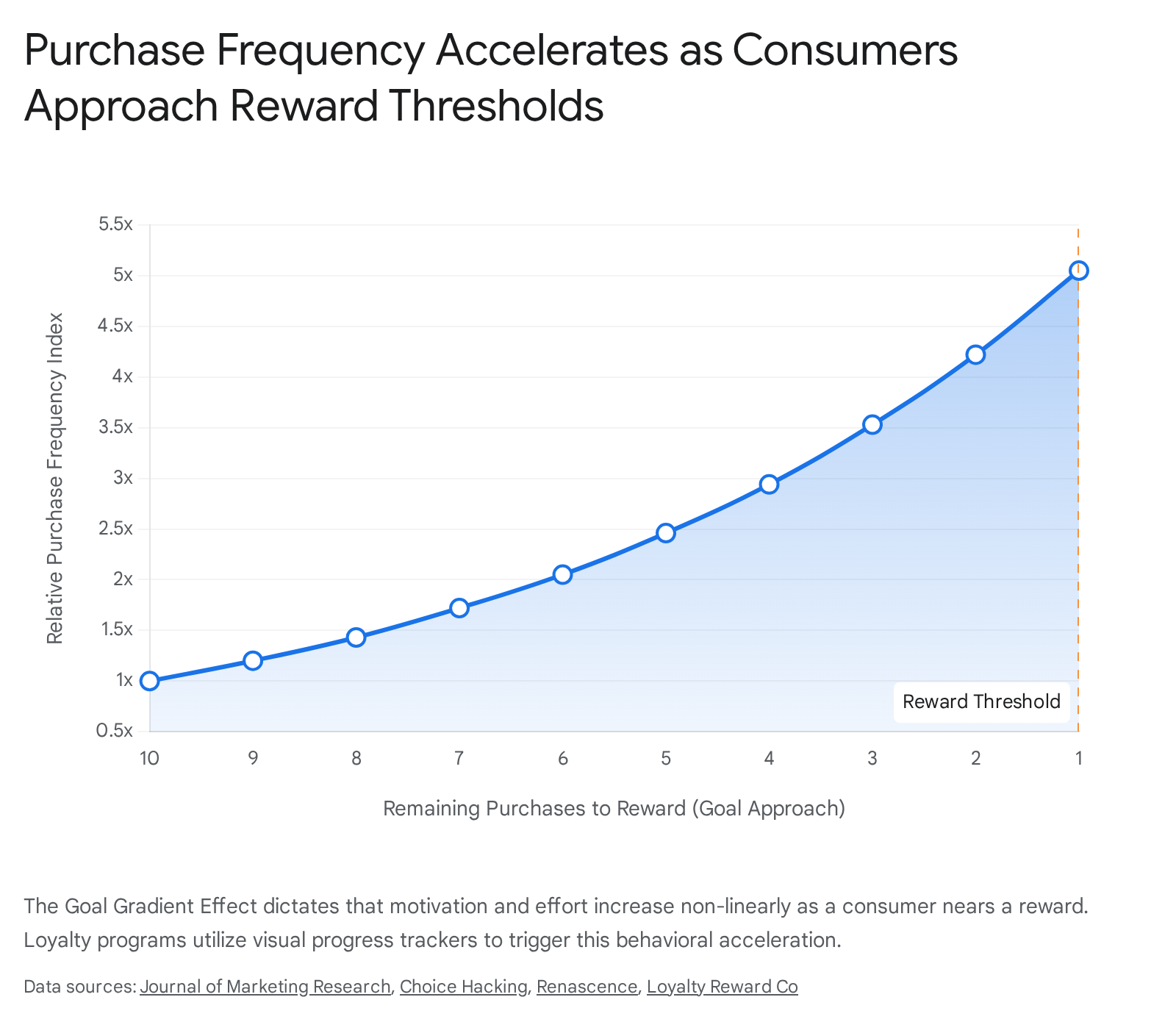
Seminal research by Kivetz, Urminsky, and Zheng (2006) mapped this physiological response directly to loyalty programs, observing that members in a café rewards program purchased coffee more frequently the closer they were to earning a free beverage 131425. This behavioral acceleration is similarly observed in complex travel loyalty programs, where airline and hotel program members engage in "status runs" - deliberately increasing their discretionary spending and consumption at the end of a qualification period specifically to secure the next elite tier status before the deadline 25.
To maximize this psychological effect, digital interfaces rely heavily on visual cues. Progress bars, completion checklists, and milestone badges make the remaining distance to the goal concrete, mitigating the cognitive ambiguity that otherwise suppresses motivation 132224.
Illusionary Progress and Motivation
An extension of the goal gradient hypothesis is the Endowed Progress Effect, identified by researchers Nunes and Drèze (2006) 192627. This psychological phenomenon occurs when consumers are provided with artificial advancement toward a goal, significantly increasing their persistence.
In a landmark field experiment at a car wash, researchers distributed two distinct types of loyalty cards. The first card required eight purchases to earn a free wash. The second card required ten purchases but came with two stamps already filled in as a promotional head start. Although the absolute effort required was mathematically identical (eight paid washes), only 19% of the first group redeemed the reward, compared to an elevated 34% of the second group 2627.
By providing an initial, illusory head start, the task is psychologically reframed. Rather than viewing the task as "not yet begun" (0% complete), the consumer perceives the task as already "incomplete" (20% complete) 27. This artificial advancement triggers the goal gradient effect prematurely, creating psychological momentum and significantly increasing the speed and likelihood of goal completion 2627. However, behavioral research notes a critical boundary condition: the endowed progress effect vanishes entirely if the head start appears arbitrary. A justification - such as a "welcome bonus" or a "special promotion" - must be explicitly provided to legitimize the artificial progress in the consumer's mind 2627.
Unintended Consequences of Explicit Goal Setting
While goal gradients generally drive engagement, highly structured goal setting can produce counterproductive behavioral inertia. Recent research by Friedman (2025) demonstrates that setting an explicit goal within a consumer program can decrease the likelihood that a consumer will switch to an alternative, more effective means of achieving that same outcome 1516. Once a consumer adopts a specific means (such as a specific loyalty tier mechanism) to pursue an explicit goal, the goal acts as a rigid reference point for monitoring progress 15. Consequently, consumers become irrationally committed to the initial means, artificially inflating its perceived relative effectiveness, and subsequently ignoring outside options or superior alternatives 1516.
Sunk Cost Fallacy in Tiered Ecosystems
While goal gradients pull consumers forward, the sunk cost effect prevents them from turning back or abandoning the brand. The sunk cost fallacy, articulated extensively by Arkes and Blumer (1985), describes the human cognitive bias to continue an endeavor once an investment of money, effort, or time has been made, even if abandoning the effort is the mathematically rational choice 191731.
Monetary Versus Temporal Sunk Costs
In the context of loyalty programs, sunk costs are manifested in accumulated points, paid premium subscriptions, and earned status tiers. When a consumer pays for a subscription (e.g., Amazon Prime, or specialized restaurant passes), waste aversion overrides immediate self-interest; the consumer alters their organic purchasing behavior to maximize the use of the service simply to justify the initial financial expenditure 191731.
However, consumers evaluate temporal sunk costs (time spent engaging with a brand) differently than monetary sunk costs 18. Research demonstrates a general tendency for consumers to devalue their own time, underestimating the sunk costs associated with temporal efforts 18. Consumers perceive rewards earned through time investment as "easily earned," making them initially less likely to redeem those rewards compared to rewards earned through monetary expenditure 18. Yet, when loyalty programs explicitly remind consumers of the opportunity costs of their prior temporal efforts, the sunk time effect is heightened, and the likelihood of redemption and subsequent repurchase increases significantly 18.
Status Preservation and Subscription Guilt
Tiered loyalty programs leverage both temporal and financial sunk costs to create immense switching barriers. If a consumer has accumulated high-tier status with a specific airline, choosing a competitor implies permanently forfeiting the progress, perks, and social standing earned 192519. The consumer remains loyal to protect their prior psychological and financial investments rather than acting out of genuine brand affinity 1917.
In corporate environments, the sunk cost trap manifests at the executive level regarding the loyalty programs themselves. Leadership teams often exhibit behavioral inertia, continuing to fund underperforming legacy loyalty initiatives simply because prior capital expenditure becomes an anchor, delaying redeployment to higher-value technological or experiential opportunities 31.
Transactional Versus Emotional Loyalty
A central theoretical debate in contemporary loyalty literature is the qualitative distinction between transactional retention and genuine emotional attachment. This distinction dictates whether a loyalty program functions as a strategic asset or merely a margin-eroding liability.
Economic Bonds and Psychological Reactance
Transactional loyalty is rooted strictly in economic bonds, habit, and calculated self-interest 202122. Programs built entirely on discounts, cashback, and rigid points ratios inherently commoditize the brand relationship 2023. While transactional programs successfully drive short-term purchase frequency, they possess the lowest retention durability. Transactionally loyal consumers anchor strictly on the incentive rather than the brand value, leading to immediate defection when a competitor introduces a superior financial offer 202123.
Strictly enforced transactional rules can also trigger psychological reactance. Reactance theory posits that when individuals perceive their freedom of choice to be threatened or restricted, they experience an aversive emotional state and act to restore that autonomy 2425. Contractual bonds or rigid program requirements inevitably limit future consumption freedom, provoking reactance and causing the program to decrease the overall perceived utility of the brand 24. This phenomenon is particularly evident in modern "green" loyalty programs dictating eco-friendly rewards. Consumers with high trait reactance often deliberately select non-eco-friendly rewards as a subconscious rejection of the brand's attempt to restrict their autonomy, unless they are specifically primed with pro-environmental goals beforehand to ensure goal-reward congruity 25.
The Loyalty Program Paradox
Heavy reliance on economic incentives leads to what Wallström et al. (2024) identify as the "Loyalty Program Paradox" 21926. Drawing on Social Resource Theory, researchers note that resources exchanged between parties range from "concrete" (money, physical goods) to "particular" (status, care, emotional connection) 26. The principle of reciprocity dictates that people feel psychologically obliged to return a resource of the same kind they receive 26.
Because traditional loyalty programs primarily exchange concrete resources in the form of discounts and bonuses, consumers respond in kind by returning concrete resources - namely, transactions driven purely by deals 26. The paradox emerges because the reward system intended to create deep emotional loyalty actually undermines it by framing the entire customer relationship as a clinical economic exchange 226. Customers who engage most frequently with monetary mechanics are repeatedly found to be the least emotionally attached to the core brand 2. By rewarding rational, deal-seeking shopping behaviors, brands inadvertently train their customers to be increasingly discount-dependent, accelerating margin erosion and creating a customer base that has "never been loyal to anything else but a satisfactory financial transaction" 22326.
Relative Value and Downward Social Comparison
To overcome the loyalty paradox, program strategies must transition from providing concrete resources to offering particular resources - such as trust, exclusive access, identity reinforcement, and personalized recognition 222326. Emotional loyalty exists when a personal connection transcends basic transactions, resulting in customers who deliver up to 306% higher lifetime value and who remain with brands for an average of 5.1 years compared to 3.4 years for merely satisfied customers 202122.
Interestingly, the internal structure of tiered programs can influence this emotional satisfaction through relative value and counterfactual thinking. Empirical studies demonstrate that when a brand is forced to reduce the benefits of a lower tier, members of higher tiers (whose benefits remain unchanged) actually experience an increase in program satisfaction 27. This downward social comparison increases the perceived relative economic value of their own tier, while the counterfactual thought of what "might have been" generates positive emotions like relief, paradoxically enhancing their psychological bond to the program despite an overall reduction in total program benefits 27.
| Loyalty Typology | Primary Motivator | Brand Relationship | Durability | Associated Risks |
|---|---|---|---|---|
| Transactional Loyalty | Economic value (discounts, points, cashback). | Commoditized; based on immediate, calculated self-interest. | Low; highly vulnerable to competitor pricing. | Margin erosion; "Loyalty Paradox"; discount dependency; high churn upon program changes. |
| Engagement Loyalty | Interactive mechanics (surveys, gamification). | Participatory; active interactions beyond pure purchasing. | Moderate; serves as a stepping stone. | Fatigue if mechanics become predictable or lack meaningful value exchange. |
| Emotional Loyalty | Identity, trust, shared values, and recognition. | Deeply personal; brand is integrated into consumer lifestyle. | High; resilient to competitor discounts. | Difficult and slow to scale; requires significant investment in personalized, experiential resources. |
Regional Architectures and Ecosystem Integration
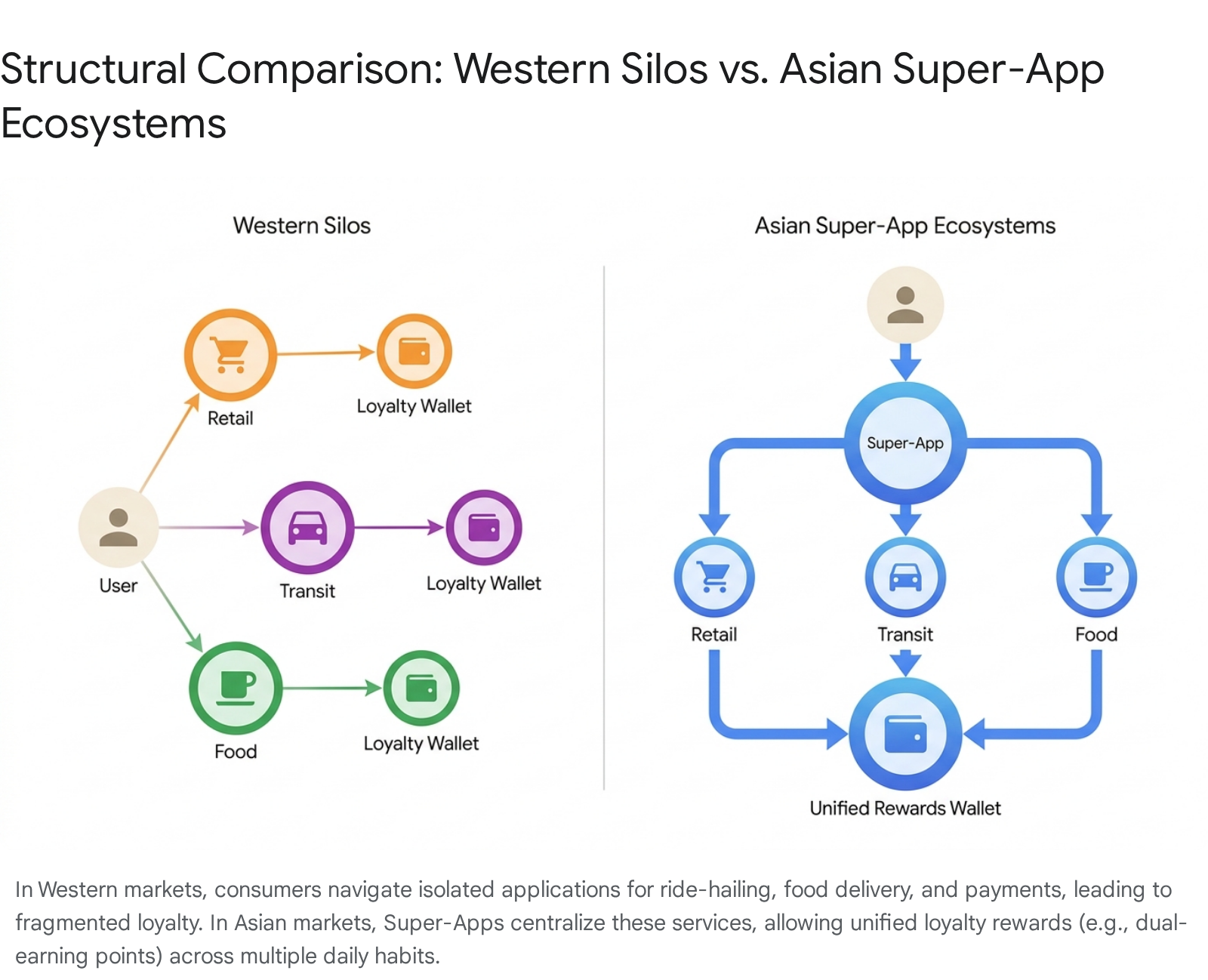
The structural execution of loyalty programs varies dramatically across global markets, heavily influenced by regional digital infrastructure, consumer technology adoption curves, and prevailing regulatory environments. The most profound divergence exists between the fragmented, siloed frameworks of Western markets and the integrated Super-App ecosystems of the Asia-Pacific (APAC) region 4328.
Asian Super-App Centralization
In APAC markets, consumer behavior is deeply entrenched in "Super Apps" - centralized digital platforms that aggregate a multitude of disparate services into a single, seamless user interface 2845. Platforms such as Grab (Southeast Asia), WeChat and Alipay (China), and GoTo (Indonesia) successfully bundle ride-hailing, food delivery, messaging, and financial services under one digital roof 4546.
This architecture was historically driven by mobile storage constraints; because smartphone adoption in emerging Asian markets relied on budget devices with limited storage capacity, consumers strongly preferred downloading a single omni-purpose application over dozens of specialized apps 4345. This consolidated environment allows for the creation of vast, interconnected loyalty loops that dominate daily consumer activity 47.
A prime example is the loyalty integration between Starbucks and Grab in Southeast Asia. Rather than forcing the consumer into a siloed Starbucks application, the loyalty mechanic is embedded directly into the Grab ecosystem 4748. A consumer ordering coffee via GrabFood and paying with the GrabPay digital wallet simultaneously earns "GrabRewards" points and "Starbucks Stars" 47. This dual-points model embeds the loyalty program into the consumer's pre-existing daily digital habits, lowering transactional friction to nearly zero and creating a powerful ecosystem lock-in that transcends basic coffee purchasing 454748.
Western Fragmentation and Coalition Models
In contrast, Western markets (such as North America and Europe) feature highly fragmented digital landscapes. Because early smartphone adopters in these regions possessed devices with ample storage and reliable high-speed internet access, consumers developed a strong preference for specialized, best-in-class applications (e.g., utilizing Uber strictly for rides, and DoorDash strictly for food delivery) 4329.
This fragmentation prevents a true Super-App ecosystem from forming, leading Western loyalty programs to evolve toward two distinct modalities: 1. Siloed Proprietary Apps: Brands rely entirely on their own standalone applications. To combat inevitable app fatigue, brands increasingly utilize paid subscription models to secure upfront sunk-cost commitments, guaranteeing future engagement through consumer loss aversion 1931. 2. Coalition Programs: Predominant in Europe and Australia (e.g., Payback, Nectar, Flybuys), these models allow consumers to earn and burn a unified point currency across a network of disparate retail partners . While coalition programs mirror the cross-industry utility of a Super-App, they fundamentally lack the deep, centralized integration of daily payments and messaging that drives habitual Asian platforms 46.
| Market Dynamics | Asian Super-App Ecosystems (e.g., Grab, WeChat) | Western Loyalty Models (e.g., US, UK, EU) |
|---|---|---|
| Platform Architecture | Centralized hub-and-spoke; multiple lifestyle services contained within one unified UI. | Highly fragmented; reliance on specialized, standalone brand applications. |
| Payment Integration | Deep fintech integration; native digital wallets power transactions and track rewards simultaneously. | Friction via third-party payment gateways; rewards are often tracked entirely separately from payments. |
| Loyalty Currency | Highly interoperable; dual-earning structures across brand partners. | Siloed point systems or distinct coalition networks with limited cross-brand utility. |
| Habit Formation | Passively embedded into high-frequency daily routines (messaging, transit, micro-payments). | Requires deliberate, isolated, and active engagement with the specific brand platform. |
Regulatory realities also dictate these structural differences. Super-App ecosystems face monumental challenges expanding westward due to stringent data privacy laws, decentralized payment regulations, and mature incumbent monopolies in search and social media sectors 4328.
Consumer Privacy and Data Trade-offs
As loyalty programs transition from simple retention mechanisms to highly sophisticated data-harvesting engines, they must navigate a complex, rapidly evolving landscape of consumer expectations and stringent regulatory scrutiny.
The Privacy-for-Perks Paradox
The modern loyalty ecosystem operates on a fundamental psychological tension: consumers demand hyper-personalized experiences, yet they remain deeply suspicious of corporate data surveillance 513031. Polling data indicates that while up to 83% of shoppers are willing to share their personal data in exchange for more personalized offers and rewards, 69% of those same shoppers simultaneously state that their data privacy is critical 3255.
This "privacy-for-perks" trade-off collapses when loyalty algorithms operate as opaque black boxes. Without transparency, hyper-personalized systems risk generating severe negative consumer sentiment, particularly regarding "surveillance pricing" - a controversial practice where AI-driven analytics utilize loyalty purchase history to determine the absolute maximum price an individual consumer might be willing to pay, resulting in algorithmic price discrimination against the very customers the program is designed to reward 3334. Furthermore, the mishandling of data is a catastrophic churn risk; survey data demonstrates that 93% of consumers report that a brand will permanently lose their trust if it mishandles their personal information 513133.
Regulatory Constraints and Zero-Party Data
Global data protection frameworks are fundamentally altering how loyalty programs capture and utilize consumer data. Regulations such as the European Union's GDPR and emerging state-level privacy laws in the United States (e.g., in California and Colorado) strictly prohibit automatic opt-ins, mandate data minimization, and enforce the consumer's right to delete their profiles 5134. Some jurisdictions even explicitly prohibit brands from making the surrender of private data a mandatory requirement for general loyalty program participation 51.
To maintain compliance and preserve hard-earned trust, sophisticated loyalty platforms are shifting away from passive, covert data extraction toward "zero-party data" collection 5534. Zero-party data is information a consumer intentionally, proactively, and explicitly shares with a brand. By utilizing gamification - such as offering points or unlocking tiers in exchange for completing preference quizzes or detailed profiles - brands can gather robust, highly accurate data with full consumer consent 55. Ensuring that loyalty design requires transparent consent, clearly defined benefits, and simple exit mechanisms prevents regulatory penalties while satisfying the consumer's simultaneous demand for both high personalization and robust privacy control 5134.