Variable reward scheduling and dopamine in shopping apps
Introduction
The digital retail landscape has undergone a profound structural shift over the past decade, evolving from static transactional platforms into highly immersive, gamified ecosystems. Modern e-commerce applications increasingly employ sophisticated choice architectures, integrating behavioral economics, human-computer interaction (HCI), and neurobiological conditioning to maximize user engagement and revenue. Rather than relying solely on traditional utilitarian value propositions - such as competitive pricing or straightforward product availability - these platforms leverage psychological triggers to sustain consumer attention and drive habituation 12.
Central to this paradigm is the implementation of variable reward scheduling, a mechanism derived from operant conditioning that delivers unpredictable reinforcements to users 34. When deployed through digital mini-games, dynamic flash sales, randomized discounts, and social group-buying loops, variable reward schedules directly exploit the brain's dopaminergic motivation systems 46. The resulting psychological phenomenon blurs the boundary between goal-oriented shopping and behavioral addiction, frequently manifesting in compulsive usage patterns that are functionally comparable to those observed in digital gaming and gambling environments 567.
This report examines the neurobiological and psychological mechanisms underlying gamified e-commerce. It analyzes how reward prediction errors and incentive salience drive consumer behavior, evaluates the HCI design patterns that facilitate this exploitation, and reviews the emerging global regulatory frameworks attempting to mitigate deceptive choice architectures.
Neurobiology of Reward Processing
To understand how gamified applications influence consumer behavior, it is necessary to distinguish between the neurobiological pathways governing the anticipation of a reward and the actual enjoyment of that reward. E-commerce gamification disproportionately targets the anticipatory pathways, engineering a persistent state of pursuit rather than a state of fulfillment.
Dopamine and Incentive Salience
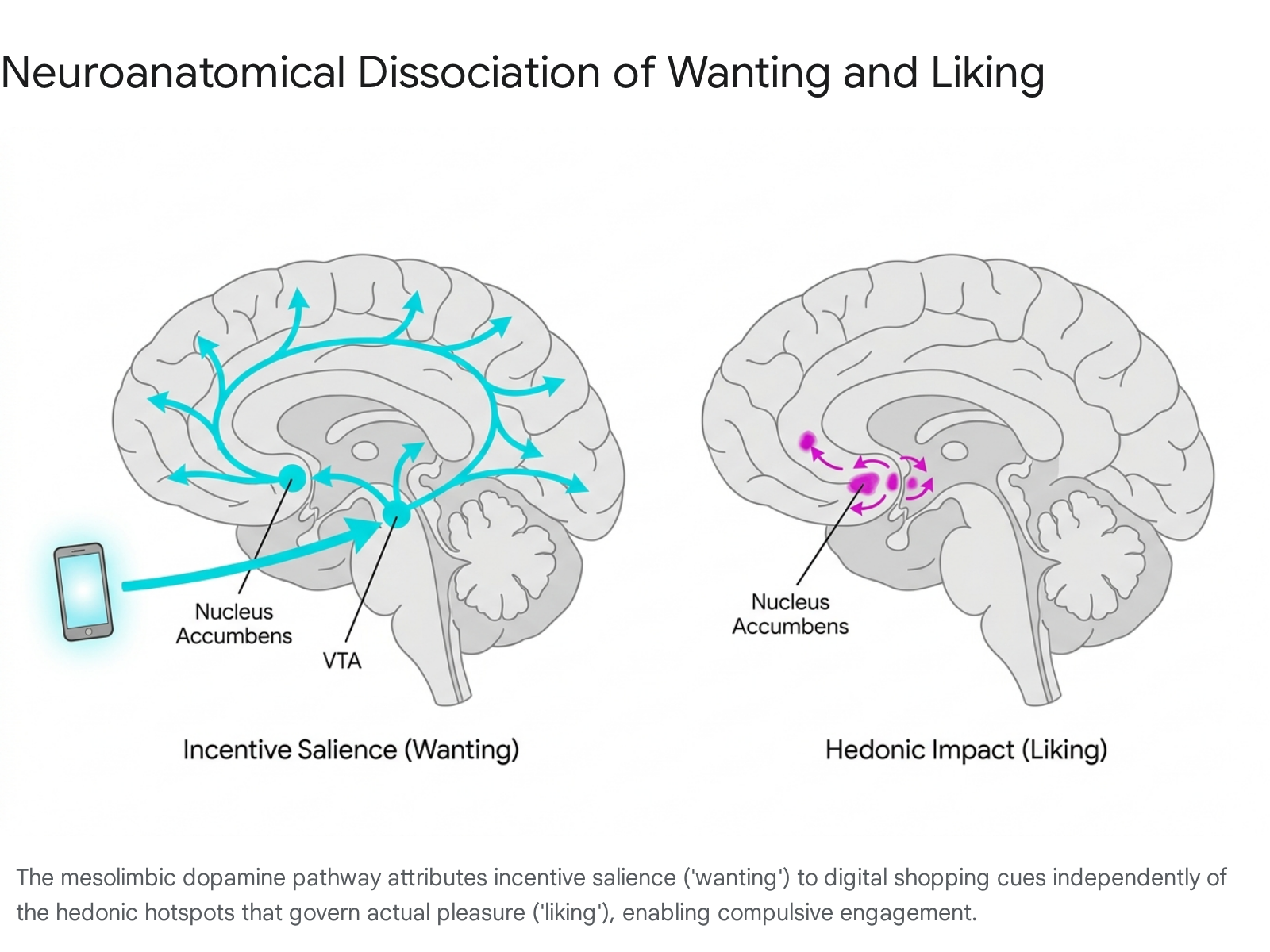
Historically, dopamine was characterized in popular and academic literature as the brain's primary "pleasure chemical." However, contemporary neuroscience has fundamentally revised this model. Research pioneered by investigators such as Kent Berridge demonstrates that the mesolimbic dopamine system mediates "wanting" (conceptually termed incentive salience) rather than "liking" (hedonic impact) 891011.
Incentive salience represents a motivational transformation of a neutral stimulus into an object of intense desire 1112. While the actual sensory pleasure or "liking" of a reward is mediated by fragile, localized hedonic hotspots in the nucleus accumbens shell and ventral pallidum - which utilize opioid and endocannabinoid signaling - the "wanting" response is driven by the robust, widespread dopaminergic projections from the ventral tegmental area (VTA) to the striatum 910.
Gamified shopping apps exploit this exact neuroanatomical dissociation. Users may not actually "like" or derive lasting hedonic utility from the products they purchase or the time spent navigating the interface; however, the dopaminergic cues - such as push notifications, countdown timers, and animated discount wheels - are imbued with overwhelming incentive salience 81112. This biological framework explains the phenomenon of "irrational wanting" observed in modern consumers, who frequently chase digital rewards and make impulsive purchases despite explicit cognitive awareness that the actual hedonic payoff will be minimal 89.
Reward Prediction Error
The specific mechanism by which dopamine attributes incentive salience to neutral cues is driven by the Reward Prediction Error (RPE). Elaborated through the seminal electrophysiological studies of Wolfram Schultz, the RPE operates as a biological instantiation of temporal difference learning within the brain 1513. Dopamine neurons do not simply fire in response to the receipt of a reward; rather, they fire in response to the mathematical difference between expected and actual outcomes 61514.
When an outcome is better than expected - termed a positive prediction error - midbrain dopamine neurons exhibit a phasic burst of activity that reinforces the preceding behaviors and synaptic connections 61415. Conversely, if an expected reward fails to materialize, dopamine firing pauses, dropping below baseline activity. This creates a negative prediction error that effectively suppresses the preceding behavior 61316. If an outcome exactly matches expectations, the dopamine neurons remain at their baseline firing rate, and no new learning or behavioral reinforcement occurs 1514.
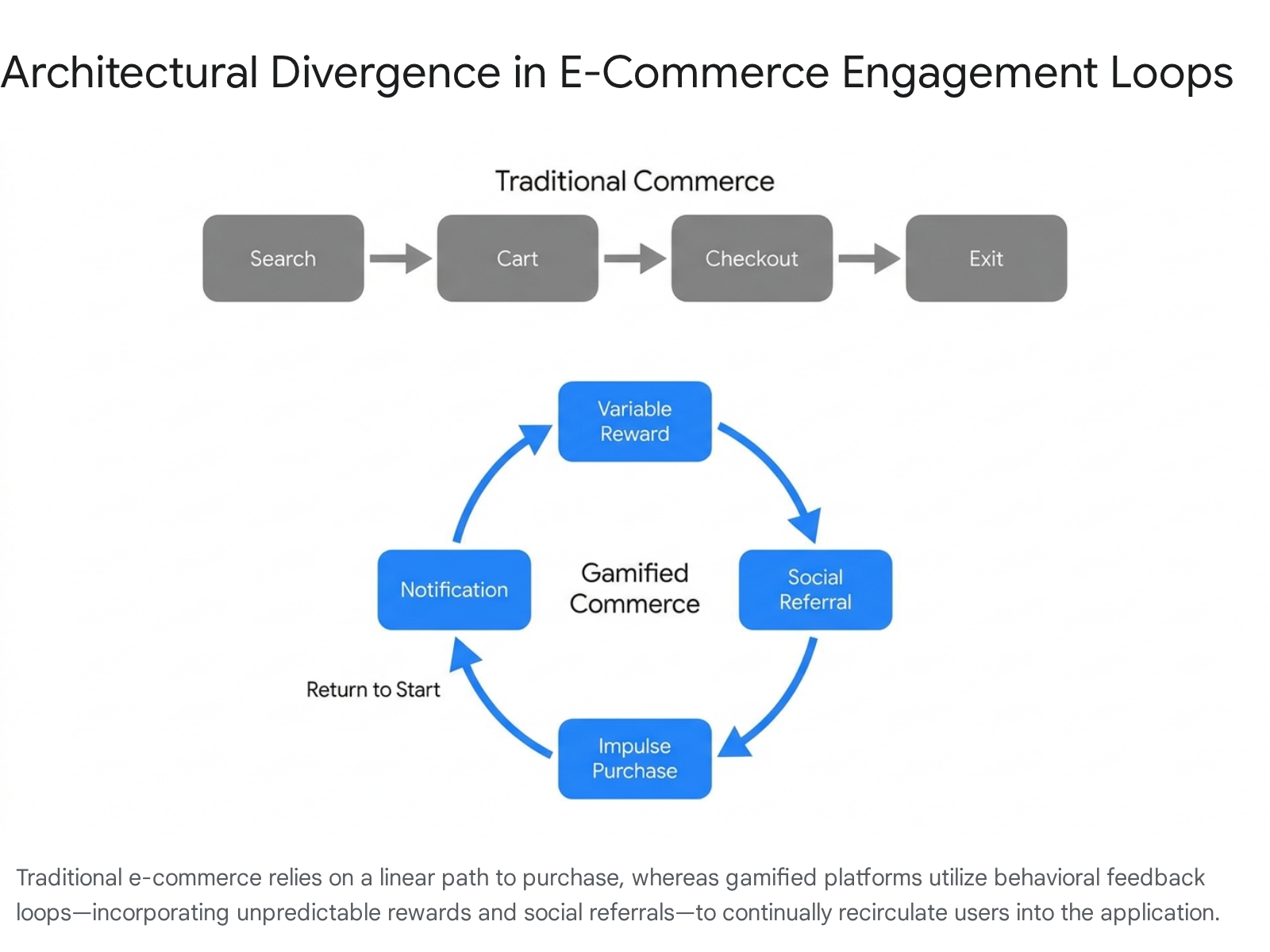
In traditional e-commerce paradigms, prices and shopping interfaces are generally static and predictable, resulting in a neutral RPE where dopamine remains at baseline 4. Gamified platforms deliberately disrupt this predictability. By presenting unexpected, massive discounts - such as flash sales revealing items at extreme markdowns - the applications engineer massive positive RPEs 4. The brain's computational algorithm interprets this as a highly significant learning event. Over repeated exposures, the dopaminergic response transfers from the actual receipt of the discounted item to the earliest predictive cue, such as opening the app or viewing a notification badge. This transfer drives automatic, habituated application engagement before any conscious purchasing decision is formulated 915.
Functional Neuroimaging of Discount Validation
Recent functional magnetic resonance imaging (fMRI) studies further elucidate how the brain processes these digital rewards. Research mapping the neural correlates of delay discounting - the tendency to devalue a reward based on its temporal distance - demonstrates that the anticipation of monetary rewards and discounts activates the striatum, the anterior insula, and the anterior cingulate cortex 1718.
When shopping platforms utilize time-sensitive, gamified discounts, they explicitly target temporal discounting behaviors. A countdown timer creates a scenario where the future value of a delayed purchase is perceived as significantly lower than the immediate, heavily discounted acquisition. This neural compression of time stimulates the mesolimbic pathway, overriding reflective cognitive control mechanisms located in the prefrontal cortex and directly facilitating impulsive purchase behavior 41719.
Operant Conditioning in Digital Environments
The neurobiological RPE algorithm seamlessly integrates with behavioral psychology principles, specifically the operant conditioning frameworks pioneered by B.F. Skinner. E-commerce platforms utilize these paradigms to shape long-term user retention, carefully modulating the frequency and predictability of rewards.
Intermittent Reinforcement
In behavioral psychology, a variable ratio schedule is a reinforcement pattern in which rewards are delivered after an unpredictable, varying number of responses 3423. Unlike fixed-ratio schedules, where a user knows exactly how many actions are required to receive a payoff, variable ratio schedules create a state of persistent uncertainty 420. Because the user cannot predict which specific action will trigger the reward, they are compelled to maintain a high, sustained rate of response 42122.
Decades of behavioral research indicate that variable ratio schedules produce the highest resistance to behavioral extinction 42322. This is the identical structural mechanism that underlies the addictive nature of slot machines and lottery games 32122. When applied to digital user interfaces, the unpredictability of the reward resolves psychological tension via continuous user interaction. Users repeatedly engage in behaviors such as scrolling feeds, opening mystery boxes, or completing daily check-in streaks 32223.
The Loot Box Mechanism in Retail
Modern gamified applications synthesize variable rewards directly into the shopping experience, frequently mimicking the mechanics of video game "loot boxes." Rather than offering a standard, predictable financial discount, applications prompt users to spin a digital wheel, crack open a virtual egg, or unlock a treasure chest to receive a randomized coupon 62425.
The rewards within these systems range from nominal benefits, such as free shipping, to highly salient rewards, such as a 90% discount on a premium item. The psychological allure relies on the potential of the high-value reward, which acts as a dopamine spike that drives the desire to continue engaging 25. In video gaming contexts, researchers have established that loot box mechanics share substantial structural and psychological similarities with gambling, leading to loss-chasing behaviors and an increased risk of behavioral addiction among susceptible populations 6726.
When translated to the retail sector, these mechanisms demonstrate profound efficacy. Quantitative analyses of consumer engagement on gamified e-commerce platforms reveal that users interacting with reward-based features exhibit an average session length of 18.4 minutes and a reward redemption rate of 67% 27. The integration of these features transitions the user from a utilitarian shopping task into a hedonic, immersive game state 52829. By maintaining users in a "flow state" - characterized by intense concentration and a loss of temporal awareness - platforms minimize analytical friction, leading to elevated rates of spontaneous, in-game purchasing 528.
Choice Architecture and Platform Case Studies
The most aggressive and successful applications of variable reward scheduling have emerged from platforms operating within the social commerce and fast-fashion sectors, notably the Chinese technology giant Pinduoduo, its international subsidiary Temu, and the fast-fashion retailer Shein. These applications systematically integrate extrinsic motivators with intrinsic psychological vulnerabilities, including social proof, reciprocity, and loss aversion 212327.
Social Commerce and Group-Buying Dynamics
Pinduoduo and Temu revolutionized the e-commerce model by transitioning from solitary, search-based purchasing into a decentralized, socially interactive "group-buying" ecosystem 343031. Under this architecture, users can secure drastically lower prices by initiating a group purchase and actively recruiting peers via social media networks, such as WeChat or WhatsApp 3233.
This operational model relies heavily on social reciprocity and the psychology of interpersonal obligation. The initiator receives a direct financial discount, while the invited participant receives both the benefit of a lower price and the social reward of perceived gratitude 3233. Under the Stimulus-Organism-Response (S-O-R) paradigm, perceived price fairness and reciprocity act as potent external stimuli. These stimuli elevate consumer trust and satisfaction, which in turn drastically reduces the cognitive friction associated with impulse buying 33.
However, to sustain this highly active ecosystem, these platforms rely on a continuous "viral loop" supported by integrated mini-games, such as "Fishland" or "Coin Spin" on the Temu application 2434. These features require users to log in daily, water virtual plants, feed virtual pets, and invite friends to earn incremental progress toward a "free" physical item. This mechanic merges variable ratio rewards with the sunk cost fallacy, ensuring high daily active user metrics 242535.
Structural Comparison of Retail Environments
To clarify the structural differences between traditional digital retail and gamified e-commerce, the following table summarizes how core retail functions are mapped to specific psychological mechanisms within gamified applications.
| Retail Function | Traditional E-Commerce Architecture | Gamified E-Commerce Architecture | Dominant Psychological Mechanism |
|---|---|---|---|
| Pricing & Discounts | Fixed percentage coupons, seasonal sales, predictable clearance events. | Randomized discount wheels, mystery boxes, probabilistic "spin to win" interfaces. | Variable Ratio Scheduling / Reward Prediction Error 346 |
| User Acquisition | Search engine optimization, traditional digital advertising, affiliate marketing. | Referral-based "group-buying" teams, team-up bonuses, social sharing quests. | Reciprocity / Social Proof 273233 |
| Daily Engagement | Email newsletters, product-driven push notifications. | Daily check-in streaks, virtual pet feeding, incremental point accumulation. | Loss Aversion / Sunk Cost Fallacy 2125 |
| Checkout Flow | Standard cart review, deliberate multi-step payment confirmation. | Scarcity countdown timers, flash sale progress bars, one-click impulsive buying. | Temporal Discounting / Exigency 436 |
Human-Computer Interaction and Dark Patterns
The implementation of gamification in retail relies extensively on manipulative human-computer interaction models characterized in academic literature as "dark patterns" or deceptive patterns. These are user interface designs explicitly crafted to subvert user autonomy, exploiting systemic cognitive biases to steer consumers into taking actions that disproportionately benefit the digital platform over the individual 36373839.
Cognitive Exploitation and Deceptive Interface Design
Dark patterns exploit the heuristic shortcuts that the human brain uses to process information rapidly in high-stimulus environments. The prevalence of these patterns is vast; a 2024 sweep conducted by the International Consumer Protection and Enforcement Network (ICPEN) and the Global Privacy Enforcement Network (GPEN) analyzed 642 subscription-based websites and applications globally. The review revealed that nearly 76% of the examined platforms employed at least one dark pattern, and nearly 67% utilized multiple deceptive tactics simultaneously 3940. Similarly, a study by researchers from Princeton University identified over 1,800 instances of dark patterns across 11,000 shopping websites 38.
In the context of gamified shopping, several specific categories of dark patterns are routinely deployed to maintain the dopaminergic loop:
- Sneaking and Hidden Costs: This pattern involves displaying an artificially low price to initiate a dopamine-driven click-through, only to reveal hidden conditions, mandatory subscriptions, or unexpected shipping costs at the final stage of the checkout process 384142.
- Confirmshaming: This relies on utilizing guilt-inducing language to dissuade users from rejecting a gamified offer. Interfaces force a user to click deliberately humiliating text, such as "No thanks, I prefer paying full price," in order to exit a randomized discount wheel, exploiting social anxiety and emotional compliance 424843.
- Interface Interference and Misdirection: These patterns manipulate visual hierarchy to obscure exit paths or cancellation buttons, while making the desired action - such as claiming a variable reward or accepting invasive data tracking - highly salient and frictionless 3942.
- Fake Urgency and Scarcity: Utilizing countdown timers or low-stock indicators that operate entirely independently of actual backend inventory. This artificially compresses the user's decision-making window, overriding reflective cognitive control and triggering fear of missing out (FOMO) 436425044.
Attention Capture and Habit Loop Formation
Gamification mechanisms frequently utilize "Attention Capture Dark Patterns," which are explicitly designed to monopolize a user's digital well-being by stealing attention through deceptive alerts and notifications 42. Habit-building features rely heavily on loss aversion, a psychological principle formalized in Prospect Theory demonstrating that the cognitive pain of losing something feels psychologically twice as severe as the pleasure of gaining an equivalent asset 2123.
When daily login streaks are broken or time-limited gamified badges expire, the platforms engineer a negative reward prediction error, causing mild distress and anxiety 2123. This architecture forces users to engage with the user interface purely to avoid psychological discomfort. Consequently, the user's primary motivation shifts from the intrinsic utility of acquiring goods to the extrinsic maintenance of a digital status 212336.
Psychological and Behavioral Consequences
The fusion of highly optimized variable rewards, social engineering, and deceptive interface design yields significant behavioral consequences. The primary outcomes are the erosion of consumer autonomy and the facilitation of digital behavioral addictions.
Compulsive Buying and the Illusion of Value
The behavioral markers of gamified e-commerce addiction closely mirror the diagnostic criteria for Internet Gaming Disorder (IGD) and pathological gambling 5745. Gamified platforms deliberately cultivate a continuous state of flow, diminishing analytical friction to facilitate impulsive behavior 528. The continuous chasing of variable ratio rewards generates functional adaptations in the dopaminergic pathways, leading to compulsive usage patterns where the individual feels unable to disengage despite negative financial or emotional consequences 37.
A 2024 global report highlighted the severe behavioral overlap between digital gaming and e-commerce, revealing that 71% of surveyed gamers actively attempt to buy as many listed items as possible during discount events, displaying highly compulsive and spontaneous purchasing habits 53. The psychological tension introduced by unpredictable rewards - such as waiting to see what a mystery box contains, or whether a peer will accept a group-buy invitation to finalize a discount - creates a chronic checking habit. This keeps the brain highly attentive and engaged long after the functional goal of shopping has been satisfied 2323.
Dissociation of Utility and the Sunk Cost Fallacy
As engagement with gamified shopping deepens, behavioral economists note a stark dissociation between product utility and purchasing behavior. Consumers often shift their evaluative priorities from assessing the actual quality, durability, or necessity of a product to merely acquiring points, advancing on leaderboards, or maintaining streaks 2346. Because the dopaminergic "wanting" system outpaces the hedonic "liking" system, the acquisition of the item becomes secondary to the thrill of winning the deal 91112.
This cognitive dissonance is compounded by the perception of lower-quality goods often distributed on ultra-discount platforms. While consumers may experience post-purchase regret or recognize that the product quality is inferior, the upfront sunk cost of the gamified effort - such as the time spent playing mini-games or the social capital expended recruiting friends - compels them to complete the transaction to justify the investment 25344748. Over time, continuous exposure to these deceptive patterns generates "DP blindness," wherein users become oblivious to the manipulation. However, when users do recognize the exploitation, it induces severe cognitive stress and irreversibly degrades long-term brand equity and consumer trust 36.
Global Regulatory Responses
Recognizing the intersection of behavioral exploitation, data privacy risks, and market distortion, regulatory bodies worldwide have begun implementing stringent legislative frameworks targeting deceptive design, variable reward mechanisms, and addictive algorithms.
European Union Regulatory Frameworks
The European Union has adopted the most aggressive and comprehensive legislative posture against gamified manipulation. A pivotal component of this strategy is the impending Digital Fairness Act (DFA). Initiated following a fitness check of EU consumer law - which explicitly concluded that existing consumer protection is undermined by digital dark patterns - the DFA targets the addictive design of digital products, unethical influencer marketing, and unfair personalization that exploits consumer vulnerabilities 504457.
This legislation works in tandem with an array of existing frameworks: * The Digital Services Act (DSA): Implemented for very large platforms in 2023 and extended to smaller platforms in 2024, the DSA expressly prohibits online interfaces that deceive or materially distort a user's ability to make autonomous, informed decisions 484959. Under the DSA, the European Commission has aggressively targeted major e-commerce players. In 2024, formal requests for information were issued to Temu and Shein regarding their compliance with obligations to mitigate manipulative design and protect users from dark patterns 59. Furthermore, TikTok was forced to legally bind commitments to permanently withdraw its "TikTok Lite Rewards" program in the EU due to concerns over its addictive variable reward design 59. * The AI Act: This regulation strictly prohibits AI systems from deploying subliminal techniques or exploiting vulnerabilities to materially distort human behavior in a manner that causes psychological or physical harm, directly addressing the underlying algorithms that power personalized gamification and dark patterns 4359.
Penalties under these European regimes are severe, with the DSA allowing for administrative fines of up to 6% of a company's global annual turnover for non-compliance 4849.
Enforcement Trends in the United States
In the United States, enforcement against gamified dark patterns is primarily spearheaded by the Federal Trade Commission (FTC) under Section 5 of the FTC Act, which prohibits unfair or deceptive acts or practices 5051. The FTC has increasingly focused its enforcement priorities on the overlap between gaming mechanics, deceptive interfaces, and digital commerce.
A landmark enforcement action occurred in 2023 when the FTC ordered Epic Games, the creator of the video game Fortnite, to pay $245 million in consumer refunds. The agency alleged that the company utilized counterintuitive, inconsistent, and confusing button layouts - a classic form of interface interference - to trick users, particularly minors, into making unintended in-app purchases 51. Furthermore, the FTC has prioritized actions against "roach motel" cancellation policies, targeting companies that make it exceedingly difficult to unsubscribe from a service. This signals a broader regulatory shift toward penalizing the underlying psychological manipulation of user interfaces rather than just overt financial fraud 395052. State-level legislation is also advancing; comprehensive privacy laws, including the California Consumer Privacy Act (CCPA) and the Colorado Privacy Act, now explicitly prohibit the use of dark patterns to obtain consumer consent 52.
Platform Regulation in China
China, functioning as the epicenter of the social commerce and gamified retail revolution, is concurrently tightening its regulatory grip on digital platforms. The National People's Congress Standing Committee enacted a sweeping revision to the Anti-Unfair Competition Law (AUCL), which takes effect in October 2025 5364.
The revised AUCL directly addresses the complexities of platform-based commerce and behavioral manipulation: * Algorithmic and Technical Manipulation: The law explicitly prohibits the use of algorithms, data advantages, or technical means to disrupt user autonomy or interfere with the normal operation of competitors' digital products 64. * Platform Rule Abuse: Operators are barred from utilizing platform architecture to force merchants into promotional events or orchestrating fake transactions and reviews to generate false social proof 5364. * Extraterritorial Reach: Notably, the law includes an extraterritoriality clause. Foreign entities whose digital operations disrupt Chinese market order or harm the legitimate rights of Chinese consumers can face massive financial penalties - up to RMB 5 million - and personal liability for key executives 64.
Additionally, specific amendments to China's E-Commerce Act, taking effect in February 2025, explicitly ban six high-risk categories of dark patterns. These include sequential pricing (the gradual disclosure of costs), the pre-selection of purchase options without explicit consent, and repeated interference, which targets the use of nagging pop-ups to alter consumer choices 4154.
Conclusion
The integration of variable reward scheduling into e-commerce applications represents a highly sophisticated exploitation of human neurobiology and behavioral psychology. By replacing predictable, utilitarian transactions with randomized discounts, social reciprocity loops, and gamified scarcity, digital retail platforms synthesize continuous positive reward prediction errors that successfully hijack the mesolimbic dopamine system. This complex choice architecture functionally divorces the physiological drive of "wanting" from the hedonic experience of "liking," driving habitual, compulsive engagement that frequently supersedes rational economic behavior.
Coupled with dark patterns that restrict user autonomy and ruthlessly enforce loss aversion, this methodology blurs the boundary between standard retail environments and unregulated digital gambling. While these psychological tactics have generated unprecedented user acquisition metrics and session lengths for platforms operating in the social commerce space, they inflict notable psychological and economic costs on consumers, including cognitive stress, compromised data privacy, and severe financial strain due to compulsive buying.
In response to these systemic risks, the global regulatory landscape is rapidly shifting from passive observation to active, aggressive enforcement. With the implementation of the European Union's Digital Fairness Act, heightened FTC enforcement in the United States, and China's comprehensive revisions to its Anti-Unfair Competition Law, the legal tolerance for manipulative user interfaces and addictive algorithmic design is rapidly contracting. For the digital commerce sector, the impending operational challenge will be untangling platform growth from dopaminergic exploitation, necessitating a fundamental transition toward transparent, utility-driven, and ethically calibrated user experiences.