
Marketing strategies to counteract consumer hedonic adaptation
Hedonic adaptation presents a foundational challenge in consumer psychology, behavioral economics, and strategic marketing. The phenomenon establishes that human beings possess a neurobiological and psychological tendency to habituate to environmental changes, rapidly returning to a relatively stable baseline of subjective well-being following exposure to positive or negative stimuli 1234. In the context of consumer behavior - often characterized by the "hedonic treadmill" metaphor - this means that the emotional gratification derived from acquiring a new product, service, or status symbol decays predictably over time 145. As consumer expectations naturally elevate to match their new circumstances, the emotional utility of the purchase approaches zero, neutralizing any permanent gains in satisfaction 25.
For commercial enterprises, this psychological decay creates an existential operational hurdle. To sustain long-term consumer engagement, brand loyalty, and recurring revenue, marketers can no longer rely on the isolated utility of a single product. Instead, they must deploy complex, ongoing interventions designed to systematically counteract, delay, or continually reset the consumer's hedonic baseline 17. This comprehensive analysis explores the theoretical and neurobiological underpinnings of hedonic adaptation, examines the divergent adaptation rates between material and experiential consumption, evaluates cross-cultural variances, and details the structural interventions - such as planned obsolescence, ecosystem lock-in, gamification, and artificial intelligence-driven hyper-personalization - utilized by modern organizations to sustain infinite engagement.
Theoretical Foundations of Hedonic Adaptation
Psychological Mechanisms and Baseline Return
The formal conceptualization of the hedonic treadmill was introduced in 1971 by psychologists Philip Brickman and Donald T. Campbell, who posited that human happiness is dictated less by objective circumstances and more by dynamic psychological adjustments to those circumstances 45. Their foundational studies demonstrated that even after profound life-altering events - such as winning a major financial lottery or suffering paraplegia - individuals tend to return to their prior baseline of emotional stability 45.
Subsequent theoretical modifications by British psychologist Michael Eysenck and integration with related frameworks (such as Helson's adaptation-level theory and Parducci's range-frequency theory) refined the model, clarifying that individuals must engage in a continuous pursuit of novel stimuli merely to maintain a static level of subjective satisfaction 23. The psychological mechanism involves a rapid recalibration of expectations. When a consumer encounters a positive stimulus, the initial emotional peak diminishes as the novel stimulus becomes assimilated into their baseline normality 35. The dual nature of the hedonic treadmill implies that future stimuli are subsequently evaluated against this elevated baseline, rendering previously satisfactory rewards insufficient and driving an endless cycle of escalating consumption 12.
Evolutionary and Neurobiological Context
The mechanics of hedonic adaptation are deeply rooted in human neurobiology and evolutionary survival strategies 56. Intense emotional sensations - whether pleasure or pain - are metabolically costly for the brain 6. Behavioral economists propose that the brain's reward architecture evolved to be adaptive rather than absolute; experienced utility operates as a function of the difference between actual consumption and expected consumption, rather than raw consumption volume 6.
Physiological studies on dopaminergic neurons demonstrate that neural activity spikes in response to unexpected rewards but systematically attenuates once those rewards become predictable 6. This neuroplasticity ensures that organisms do not remain perpetually fixated on a single positive stimulus or paralyzed by a single negative event, allowing them to remain vigilant to new environmental threats and opportunities 56. For marketers, this biological reality dictates that static product offerings, no matter how initially innovative, will inevitably suffer from psychological engagement decay.
Consumption Typology and Differential Adaptation Rates
Material Goods Versus Experiential Purchases
A robust body of empirical literature demonstrates that the rate of hedonic adaptation is highly contingent upon the ontological nature of the purchase. Consumers adapt significantly faster to material goods (such as electronics, clothing, and furniture) than they do to experiential purchases (such as vacations, theatrical performances, and outdoor recreation) 789.
Experience-sampling methodologies have extensively documented this divergence. In studies conducted by researchers at the University of Texas at Austin and Cornell University, involving large cohorts such as a 2,635-adult sample, participants routinely reported higher sustained positive affect when consuming experiences compared to material goods, even when statistical controls were applied to normalize the financial cost of the purchases 910. This differential adaptation rate presents a paradox regarding endurance: while material goods persist physically, they quickly fade into the psychological background, becoming part of the consumer's "dull and daily necessities" 111. Conversely, experiential purchases are inherently fleeting in the physical realm but endure persistently in the psychological landscape through memory and storytelling 791112.
Anticipatory and Retrospective Utility
The satisfaction derived from experiential purchases extends across a broader time horizon than that of material purchases, effectively stretching the consumer's emotional engagement across three distinct phases: anticipation, in-the-moment consumption, and retrospection 1314.
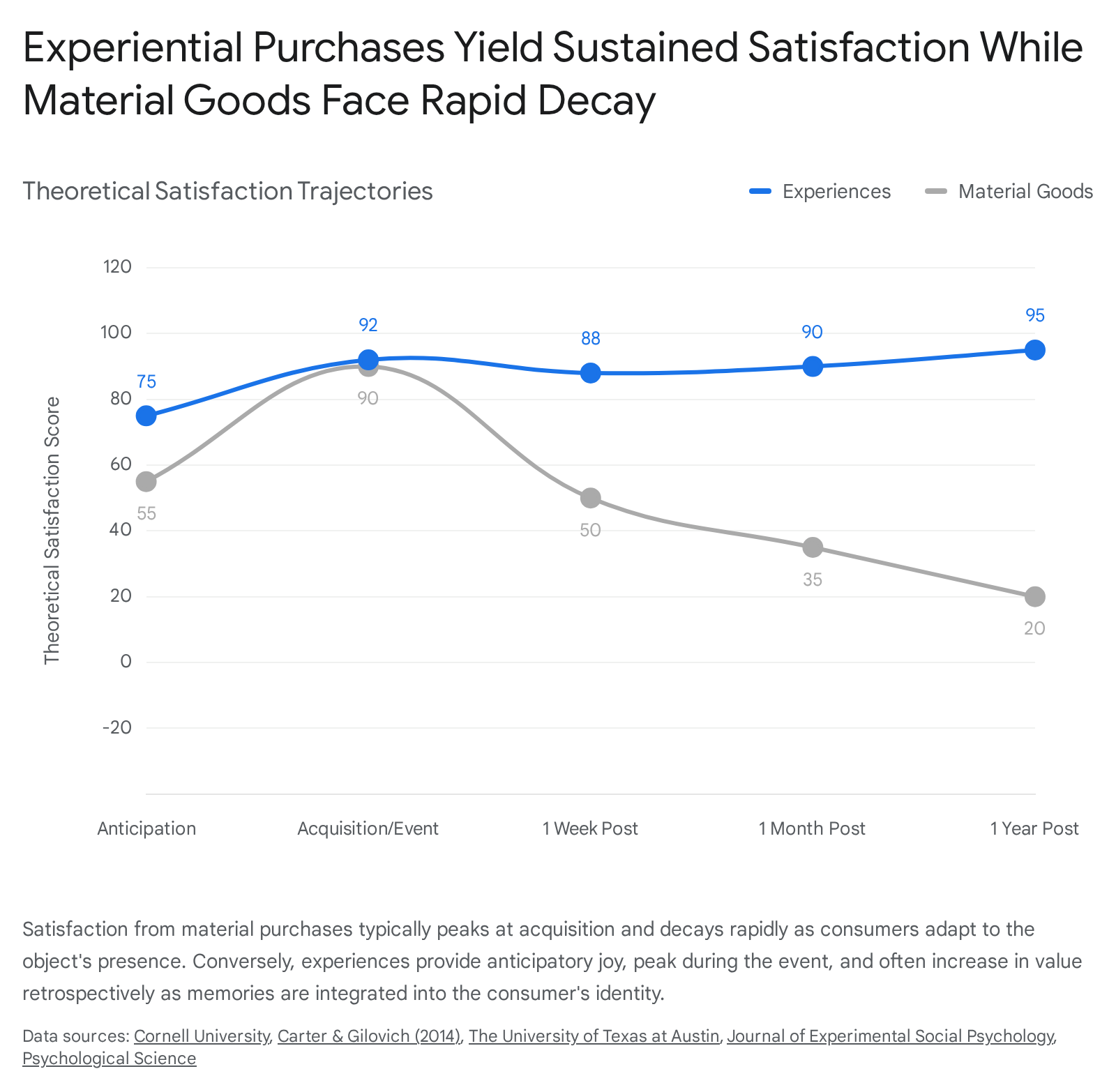
During the anticipatory phase, waiting for an experience generates significantly higher levels of happiness and excitement compared to waiting to acquire a material possession, which often induces impatience 1014. Observational research analyzing crowds waiting in line reveals that consumers waiting to purchase experiential access generally exhibit better moods and behavior than those waiting for material acquisitions, suggesting that anticipating experiences is processed in a more abstract, significant, and socially gratifying manner 14.
In the retrospective phase, memory plays a critical role in slowing hedonic adaptation. Memories of experiences are highly susceptible to positive reinterpretation - frequently becoming rosier and more idealized over time - whereas memories of material goods do not typically benefit from this retrospective enhancement 811. Furthermore, individuals are fundamentally more inclined to integrate experiences into their self-concept and core identity, ensuring that the utility of the purchase compounds rather than decays 811.
Social Comparison and Regret Asymmetries
The differential decay in satisfaction is fundamentally linked to the mechanics of social comparison 151816. Material goods are inherently objective and easily quantifiable, making them highly susceptible to invidious peer comparisons 1516. Consumers effortlessly evaluate their physical possessions against superior models, lower post-purchase market prices, or the acquisitions of their social circle 1516. This visible comparability rapidly undermines the enjoyment of material goods, accelerating hedonic adaptation and triggering buyer's remorse 1516. Laboratory experiments confirm this phenomenon; participants receiving a small physical gift next to a superior gift intended for someone else report sharp declines in satisfaction, whereas consuming an experiential good (e.g., premium food) alongside someone consuming a better one does not yield the same severe drop in enjoyment 15.
Experiences are inherently subjective and deeply personal, rendering them highly resistant to comparative evaluation 15. If a consumer vacations in a specific destination, learning that a peer stayed in a more luxurious hotel does not reliably overwrite the personal memories and intrinsic joy derived from their own unique experience 15. Consequently, consumers tend to satisfice when selecting experiences but maximize when selecting material goods, leading to greater post-purchase rumination and faster satisfaction decay in material categories 16.
Outcome Valence and Intrinsic Goal Alignment
While the academic consensus favors the "experience recommendation" (the guidance to spend on doing rather than having), this principle is moderated by the valence of the consumption outcome 717. If an experiential purchase results in a profoundly negative outcome (e.g., a disastrous and stressful vacation), the typically slower adaptation rate for experiences becomes a psychological liability 717. Because the negative memory persists and integrates into the consumer's narrative, negative experiences can induce significantly more sustained unhappiness than a negative material purchase, which can simply be discarded or ignored 717.
Contemporary consumer psychology suggests that the rigid material-experiential dichotomy may ultimately be insufficient for mapping long-term engagement. Recent longitudinal analyses demonstrate that purchases satisfying intrinsic goals (such as personal growth, autonomy, or deep interpersonal relationships) predict significantly more variance in sustained well-being (13% to 16%) than the simple material-experiential classification alone (which accounts for only 2% to 5% of variance) 18. Marketers aiming for durable long-term engagement must therefore align product utility with the consumer's intrinsic psychological goals, rather than merely attempting to artificially experientialize material commodities 18.
Macroeconomic Shifts in Consumer Spending
The psychological advantages of experiential consumption have manifested as broad, measurable shifts in global macroeconomic spending patterns over the past several decades.
The Historical Transition Toward Experiential Services
Historical data from the U.S. Bureau of Labor Statistics outlines a profound structural inversion in the consumer economy. During the 1947 - 1949 period, physical commodities constituted 72.9% of total consumer expenditures, with services accounting for only 27.1% 19. By 2012, these shares had entirely reversed, with expenditures on commodities dropping to 39.7% and services dominating at 60.3% 19. While falling relative prices of durable goods partly explain this transition, the data also reflects a sustained societal shift away from material accumulation toward service and experiential consumption 1920.
This trend has accelerated in the post-pandemic era. Analysis of 100 million U.S. credit and debit card accounts for the 12-month period ending August 2024 revealed that American consumer spending on experiences grew by 32% relative to pre-pandemic 2019 levels 21. This surge in experiential allocation vastly outpaced overall consumer goods spending (which grew 21%) and completely dwarfed purely discretionary goods spending (which grew only 5%) 21. The emergence of "super-spenders" - a segment that spends 18% more on experiences than average and accounts for 60% of total travel market spend - underscores a consumer base actively prioritizing enduring memories and human connection over rapid-decay material goods 21.
Extended Purchase Journeys and Intentionality
As consumers become more aware of hedonic decay, their purchasing behavior for physical retail has shifted from impulsive acquisition to highly intentional research 22. Analysis of 1,554 North American retail brands in early 2025 indicated a substantial behavioral disconnect: while consumer clicks and engagement surged by 18%, actual spending grew by a mere 0.4% 22. Conversion rates simultaneously dropped by 5% as purchase journeys extended and average order values fell by 10% 22.
This data indicates that consumers are not simply retreating from the market; rather, they are attempting to maximize utility and avoid buyer's remorse by lengthening the anticipatory and research phases of the consumption cycle 22. Marketers are adapting to this shift by diversifying their partnership ecosystems, investing heavily in content review platforms, and restructuring loyalty metrics to accommodate extended consideration periods 22.
Cross-Cultural Variances in Adaptation
The mechanics of hedonic adaptation and consumer engagement exhibit cultural variance, requiring multinational marketers to adjust their baseline expectations across different global regions 723242825.
Collectivist Versus Individualist Market Dynamics
Traditional sociological frameworks differentiate Western individualist cultures from Eastern collectivist cultures. Independent subjective well-being, prevalent in Western markets, is characterized by an explicit striving for personal, distinct happiness and the mastery of one's environment through individual consumption 2428. Conversely, interdependent self-construal, prevalent in East Asian markets, prioritizes interpersonal harmony, holistic processing, and in-group loyalty 2428. In collectivist contexts, the boundary between in-groups and out-groups is pronounced, and personal happiness is inextricably linked to the well-being of the collective 24. Consequently, consumption experiences and interventions that benefit close ties yield higher positive affect and potentially slower adaptation rates among Asian consumers compared to their Western counterparts 24.
However, modern macro-level demographic data challenges strict, binary East-West frameworks. A comprehensive 2025 study analyzing data from 102 countries covering 88% of the global population found that the individualism gap between the United States and Japan is highly marginal, differing by only 2.2 points on a 100-point scale 25. The research demonstrates that individualism and the associated consumer pursuit of distinct personal utility are strongly linked to socioeconomic development and existential security, rather than pure geography 25. Thus, marketers cannot rely on broad regional stereotypes to predict hedonic adaptation rates; they must segment based on specific socioeconomic indicators and highly localized market values 2825.
Methodological Limitations and Scale Usage
When marketers attempt to measure hedonic adaptation cross-culturally, they encounter severe methodological artifacts 23. The standard 9-point hedonic scale, ubiquitous in sensory and consumer acceptance evaluation, was developed and validated primarily in the United States 23. Empirical research demonstrates that this scale performs differently across populations 23.
Pacific Rim consumers - specifically Chinese, Korean, and Thai demographics - exhibit a significantly higher central tendency and a pronounced "dislike avoidance" error on these scales compared to Westerners 23. Because these populations structurally avoid utilizing the extreme anchors of the measurement scale, the mathematically measured rate of hedonic adaptation in these markets may appear artificially compressed or stabilized 23. Accurate cross-cultural engagement tracking requires the deployment of culturally calibrated alternative metrics to prevent misinterpretation of consumer fatigue data 23.
Strategic Interventions in Product Lifecycle and Pricing
To combat the inevitability of the hedonic treadmill, marketers deploy a spectrum of structural strategies designed to inject novelty, reset psychological baselines, and transform discrete transactions into continuous engagements.
Planned Obsolescence and Desirability Acceleration
Planned obsolescence is a foundational industrial strategy engineered to render a product useless, outdated, or unfashionable within a predetermined timeframe. By forcing the product to fail or lose social relevance, the manufacturer compels the consumer to seek a replacement, thereby artificially resetting the consumption cycle and counteracting long-term habituation 303132. The strategy manifests in three distinct typologies: 1. Obsolescence of Function: The introduction of a genuinely superior technological product that performs the primary task significantly better, rendering previous iterations obsolete 30. 2. Obsolescence of Quality (Built-in): Products deliberately manufactured with weaker components or software limitations engineered to wear out or degrade shortly after warranty expiration 3032. 3. Obsolescence of Desirability (Stylistic/Psychological): The rapid manipulation of aesthetics, styling, or minor features to make older, perfectly functional models seem socially obsolete and passé 303132.
Stylistic obsolescence explicitly leverages human vulnerability to social comparison, which, as established, accelerates dissatisfaction with material goods 3132. Fast-fashion retailers utilize rapid design turnover to instill a continuous desire for the new, combating hedonic adaptation not by providing deeper or more enduring satisfaction, but by constantly moving the goalposts of desirability 131.
Iterative Product Ecosystems and Switching Costs
Apple Inc. provides the premier commercial case study in counteracting brand fatigue and hedonic adaptation through ecosystem lock-in rather than isolated product lifecycles 33262737. By the late 1990s, when the company faced near-collapse, Apple leadership recognized that competing solely on isolated hardware features led to rapid commoditization and consumer fatigue 3327. Under strategic reinvention, the company transitioned to a holistic ecosystem model 33.
Rather than allowing consumers to adapt to and tire of a single device, Apple continually integrates the device into a broader, interconnected value web consisting of wearables, cloud services, and digital media 3337. This strategy addresses hedonic adaptation through two distinct mechanisms. First, iterative software updates and seamless accessory integrations introduce regular, incremental micro-novelty without requiring massive hardware redesigns, effectively keeping the consumer's psychological baseline in flux 3327. Second, the seamless interoperability (e.g., an iPhone automatically unlocking a Mac or transferring audio to AirPods) creates a psychological and functional safety net with exceptionally high switching costs 37. Even if the raw excitement of owning the device inevitably fades due to hedonic adaptation, the extreme friction of leaving the integrated ecosystem sustains long-term engagement and prevents defection to competitors 3337.
The Evolution and Failure of Rigid Subscription Models
Initially, the subscription business model was heralded as the ultimate structural solution to the hedonic treadmill 728. By shifting consumers from a model of one-time ownership to continuous access, companies secured predictable recurring revenue streams while ostensibly providing unending novelty (e.g., unlimited media streaming, monthly replenishment boxes) 2829. However, the ubiquity of subscriptions triggered a secondary adaptation response: subscription fatigue 7284041.
By 2024, the average U.S. consumer was juggling up to 12 active subscriptions, leading to severe cognitive overload and financial anxiety 72840. Research indicated that 84% of consumers consistently underutilized their subscriptions, creating a vast perceived value gap 28. As consumers adapted to the mere presence of the services without extracting proportionate utility, the fixed monthly fees became a source of resentment rather than convenience 72841. Consequently, 41% of consumers reported experiencing explicit subscription fatigue, and by 2025, American households abruptly slashed their active subscriptions from an average of 4.1 to just 2.8 - a catastrophic 32% drop in a single year 7.
To combat this fatigue and realign with consumer psychology, brands are increasingly abandoning rigid monthly commitments in favor of flexible pricing architectures designed to grant consumers a sense of autonomy and control 72841.
| Pricing Strategy | Structural Mechanism against Fatigue & Adaptation | Market Application Examples |
|---|---|---|
| Usage-Based (Pay-as-you-go) | Aligns cost directly with value extraction. Eliminates the "sunk cost" resentment of underutilized subscriptions, ensuring the consumer only pays when actively engaged. | Cloud computing platforms; B2B API services; digital micro-transactions. |
| Hybrid (Base + Variable) | Provides predictable core access while charging premiums for advanced consumption. Reduces baseline cost anxiety while capturing heavy-user surplus. | Enterprise software platforms; modern telecommunications; SaaS tools. |
| Ownership-Plus | Combines an upfront material purchase with an optional, value-additive software/service subscription, blending ownership psychology with continuous updates. | Connected fitness hardware (Peloton); professional creative software; automotive telemetry. |
| Freemium Escalation | Lowers the barrier to entry entirely, building profound habituation and dependency before introducing any cost friction. | Digital media streaming; language learning applications; mobile gaming. |
Gamification and Behavioral Reinforcement
When the intrinsic utility of a product or service naturally decays, organizations frequently turn to gamification - the application of game-design elements and mechanics in non-game contexts - to artificially sustain engagement 3031323334. By hijacking the brain's reward circuitry, gamification can temporarily override hedonic adaptation.
Habit Formation and Psychological Conditioning
Duolingo, a digital language-learning application, exemplifies how to engineer sustained engagement in a sector traditionally plagued by high churn rates 3031324748.
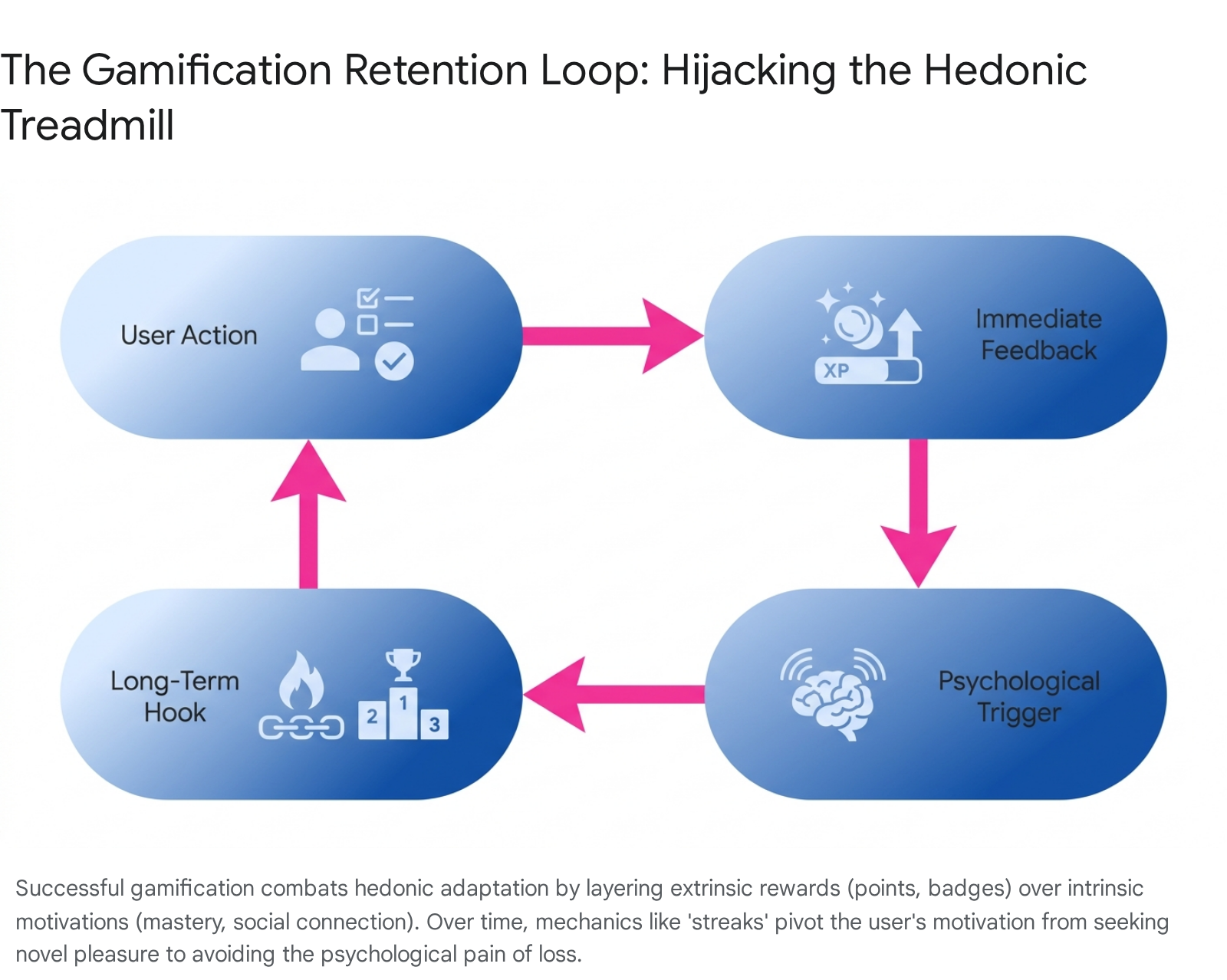
Facing the reality that the intrinsic motivation to learn a language adapts and fades rapidly, Duolingo integrates several psychological principles to force habituation: * Streaks and Loss Aversion: The application prominently displays the number of consecutive days a user has completed a lesson. As a streak lengthens, the primary psychological driver fundamentally shifts. The user is no longer motivated by the desire to learn (which has adapted), but by loss aversion - the profound psychological fear of breaking the chain and losing the accumulated status 30314748. * Immediate Feedback (Operant Conditioning): Users receive instantaneous validation (experience points, gems, auditory cues) before even leaving a screen, tightly coupling the action to a dopamine release and reinforcing correct behaviors instantly 304748. * Tiered Leaderboards (Social Influence): By grouping users into competitive, tiered leagues with promotion and demotion mechanics, the application weaponizes social comparison. While social comparison accelerates dissatisfaction in material consumption, in gamified environments it serves as a powerful extrinsic motivator for daily activity 3247.
Through the continuous AI-optimization of these gamified mechanics, Duolingo successfully reduced its user churn rate from 47% in 2020 to 28% in major markets by 2026, driving an industry-leading 36% year-over-year increase in daily active users 31.
The Transition from Extrinsic to Intrinsic Rewards
While gamification is highly effective in the short term, consumers inevitably adapt to extrinsic rewards just as they do to material goods 49. Customers initially drawn in by points, discounts, or badges eventually view these elements as baseline entitlements, neutralizing their motivational power 49. The evolution of Starbucks Rewards - a loyalty program that drives roughly 60% of the brand's US revenue and boasts over 34.6 million active members as of 2025 - illustrates the critical necessity of evolving reward systems 50513536.
Starbucks initially conditioned consumer behavior using a simple, highly effective extrinsic "Stars" system, where purchases equated to free coffee 4951. However, as the novelty faded and earning Stars became routine, the program faced perceived devaluation - a phenomenon exacerbated when a 2023 tier recalibration required members to spend more to attain standard rewards 493536. To combat this adaptation, Starbucks shifted its strategic focus toward intrinsic and experiential rewards 4950. Leveraging vast amounts of first-party data, the company implemented hyper-personalized offers tailored to specific individual behaviors and seamlessly integrated digital mobile ordering to eliminate wait times 5035. By prioritizing a frictionless, personalized experience over a simple transactional point exchange, Starbucks transitioned its user base from extrinsic loyalty (which adapts quickly) to a deeper, habitual emotional connection 4936. The company's subsequent abandonment of experimental extrinsic systems - such as its short-lived NFT Odyssey Program in 2024 - further demonstrates that digital gamification must provide genuine utility rather than purely speculative distraction 36.
Cross-Regional Nuances in Gamification Efficacy
The effectiveness of gamification strategies differs markedly across global markets, requiring careful localization 37383940. Market research indicates that in many Asian demographics, users exhibit a higher inherent cultural proclivity for gaming 37. Consequently, the novelty of gamified mechanics may persist longer, and users are more likely to persist with gamified systems once successfully onboarded 37.
However, cultural differences dictate the types of rewards required. Asian consumers generally demand tangible, "hard" commercial rewards (such as financial discounts or free merchandise) in exchange for their gameplay effort; purely symbolic "kudos" or digital badges frequently fail to sustain engagement without commercial backing 37. Furthermore, public leaderboards can be less effective in demographics highly sensitive to public perception, where private tracking, team-based competition, or competing against an algorithm is often preferred over public declarations of individual dominance 37.
Artificial Intelligence and Hyper-Personalization
While gamification targets the mechanical architecture of behavior, artificial intelligence (AI) targets the relevance of the stimulus itself. Modern marketers counteract the hedonic treadmill by ensuring the consumer rarely experiences the exact same stimulus twice, preventing the brain from fully habituating to the content 415942.
Dynamic Content and Baseline Interruption
Historically, digital personalization relied on static demographic segmentation or rudimentary data insertions (e.g., dynamically placing a user's first name in an email subject line) 5943. Modern hyper-personalization, driven by generative AI, machine learning, and natural language processing, dynamically alters content, messaging, and product interfaces based on real-time behavioral data, context, and inferred emotional states 415942.
By continuously analyzing user interactions, AI algorithms can predict when a user's engagement is beginning to decay along the hedonic curve and proactively inject novel, highly relevant stimuli to reset their attention baseline 42. Generative AI scales this capability infinitely, allowing brands to craft bespoke imagery, copy, and offers for micro-segments at unprecedented speed, transforming a static website or application into an adaptive, living ecosystem tailored to the individual 43.
Business Impact of Context-Aware Marketing
Consumers now inherently demand this level of algorithmic attunement. Market surveys indicate that over 75% of consumers become explicitly frustrated by irrelevant content, treating generic, unpersonalized marketing as cognitive friction 30. When executed comprehensively, AI-driven hyper-personalization fundamentally transforms the economic value exchange between brand and consumer 4159.
Data compiled by McKinsey and Deloitte between 2024 and 2025 reveals that organizations effectively embedding AI across their end-to-end marketing workflows achieve substantial financial returns: 40% greater revenue generation, a 50% reduction in customer acquisition costs, and conversion rate increases ranging from 10% to 30% 41. By delivering constant micro-relevance, the brand ensures the consumer never fully habituates to the communication stream, effectively suspending the downward trajectory of the hedonic treadmill.
Standardization Versus Adaptation in Global Marketing
When deploying anti-adaptation strategies globally, multinational corporations face a persistent strategic dilemma: whether to standardize marketing efforts to achieve scale, or adapt them to suit local hedonic baselines 6444454647.
Standardization involves applying identical marketing mixes globally, prioritizing cost efficiency, economies of scale, and speed to market 64454647. This approach relies on the assumption that underlying human desires - including the biological mechanics of the hedonic treadmill - transcend cultural boundaries 6445. Adaptation, conversely, involves customizing the marketing mix to suit local cultural values, tastes, and competitive environments to maximize local relevance 64464748.
| Strategic Dimension | Standardization Strategy | Adaptation Strategy |
|---|---|---|
| Primary Objective | Maximize cost efficiency, leverage global brand equity, and speed up time-to-market. | Maximize local market relevance, consumer satisfaction, and cultural resonance. |
| Cost Profile | Low marginal cost due to mass production, unified messaging, and amortized R&D. | High upfront and ongoing costs for localized market research, bespoke production, and unique campaigns. |
| Ideal Product Category | Industrial goods, B2B services, and universal digital technology platforms. | Consumer fast-moving goods, food and beverage, and culturally sensitive services. |
| Response to Hedonic Decay | Relies on uniform, globally synchronized product updates and universal feature obsolescence. | Relies on localized novelty, cultural trend integration, and regionally calibrated gamification mechanics. |
Empirical meta-analyses suggest that standardization is highly effective for industrial goods or universal technology platforms where the utility is purely functional and adaptation needs are minimal 444549. However, to build emotional loyalty and successfully combat hedonic decay in consumer goods, tactical adaptation - particularly in pricing, localized gamification, and culturally relevant promotional strategies - is frequently necessary to maintain engagement, despite the inherent disruption and expense it causes to global supply chains 64454649.
Ethical Implications of Countering Adaptation
As marketing organizations utilize increasingly sophisticated methodologies - from AI hyper-personalization to psychological gamification - to prevent consumers from resting at their natural hedonic baseline, profound ethical, psychological, and public health concerns emerge 3334505152.
Dark Patterns and Psychological Exploitation
The ethical boundary between enhancing user experience and exploiting fundamental psychological vulnerabilities is easily and frequently breached 33. "Dark patterns" represent deliberate design choices that leverage game mechanics and psychological biases against the user's best interests to artificially inflate engagement metrics 3353. Standard manifestations include: * Grinding Mechanics: Forcing users to perform repetitive, time-consuming tasks to achieve progress or maintain status 33. * Fear of Missing Out (FOMO) Tactics: Fabricating artificial scarcity or implementing countdown timers to induce anxiety and compel immediate action 33. * Infinite Scrolls: Removing natural stopping cues from interfaces to promote mindless, continuous digital consumption 33.
Such practices risk what academic ethicists term "bullshitification," a scenario where users become so fixated on arbitrary, gamified rewards (such as points or leaderboards) that the original, meaningful purpose of the engagement is entirely obscured 3450. This form of covert persuasion strips the consumer of informed autonomy, effectively trading long-term customer trust for short-term engagement spikes 3350.
Consumer Mental Health and Cognitive Fatigue
The most severe, long-term consequence of technologically preventing psychological adaptation is the systemic degradation of consumer mental health 51525455. Constant digital connectivity and infinite engagement loops keep the human brain's alert systems permanently activated 5152. Because psychological well-being fundamentally requires cycles of focused attention and restorative rest, the inability to return to a calm baseline results in "attention residue," profound cognitive fatigue, and digital burnout 51.
Clinical data from 2025 indicates that screen time exceeding four hours per day increases the prevalence of anxiety and depression by nearly 50%, particularly among highly vulnerable adolescent and young adult populations 5152. Habitual, excessive engagement with algorithmically optimized feeds leads to maladaptive neuroplasticity, fundamentally altering reward processing systems, elevating baseline stress, and diminishing sustained attention spans 5255. While digital platforms and consumer brands profit immensely from keeping users perpetually active on the hedonic treadmill, the externalized cost is a measurable and accelerating decline in global psychological resilience 525455.