
Human novelty seeking in digital environments
Humans are defined by a paradoxical behavioral duality: a drive to explore the unknown and an opposing tendency to rely on familiar routines. This tension between exploration and exploitation forms the basis of human adaptability. In the contemporary era, the digital environment has been meticulously engineered to intercept and amplify the evolutionary mechanisms that govern novelty seeking. Social media platforms, short-form video applications, and algorithmic recommender systems rely on psychological and neurobiological vulnerabilities to sustain user engagement. By deploying variable reward schedules, frictionless interfaces, and continuous algorithmic curation, these systems convert an innate evolutionary survival mechanism into a substrate for behavioral dependency.
Evolutionary Biology of Novelty Seeking
The human preference for novelty has deep evolutionary roots. In ancestral environments, the pursuit of new stimuli was essential for discovering resources, securing mates, and mitigating the risks associated with resource depletion. From an anthropological perspective, novelty seeking conferred a distinct survival advantage by promoting the exploration of unpredictable environments and fostering genetic variability 11.
The Anthropological Imperative for Exploration
Research into the genetic underpinnings of migratory behavior provides empirical support for this evolutionary trait. Variability in the frequency of the DRD4 exon III 7-repeat allele - a genetic variant theorized to dampen dopamine reception and thereby encourage compensatory novelty-seeking behavior - correlates positively with the migratory distance of prehistoric human populations from their origin point in East Africa 2. Hunter-gatherers and pastoralists possessing this genetic variant were likely driven by an exploratory urge that provided an evolutionary advantage when navigating unfamiliar terrains and adapting to ecological pressures 2.
In modern contexts, the physiological reward for discovering novel stimuli remains intact, even as the environmental context has shifted from physical landscapes to digital interfaces. The introduction of any novel stimulus - whether a new environment, a new social interaction, or an unexpected visual element - activates the midbrain and the hippocampus, resulting in a release of dopamine 14. This dopaminergic response acts as a reward system, facilitating long-term potentiation to encode the new stimulus into memory and encouraging continued exploration 13. However, to ensure that cognitive resources are not wasted on redundant information, the brain employs habituation. With repeated exposure to a constant stimulus, the dopamine reward diminishes, allowing the brain to filter out familiar data and refocus selective attention on fresh, relevant variables 1. This biological baseline dictates that continuous behavioral engagement requires a continuous supply of novelty.
Visual Foraging and Patch Abandonment
The design of digital interfaces can be analyzed through the lens of evolutionary foraging behavior. In anthropological terms, humans developed strategies to efficiently search multiple-target environments, constantly deciding when to exploit a current resource patch and when to abandon it to explore a new one 45. This behavior is mathematically modeled by Charnov's Marginal Value Theorem (MVT), which dictates that a forager will leave a specific patch when the rate of return drops below the average expected rate of the broader environment 4.
In digital contexts, users exhibit visual foraging behaviors characterized by identical decision-making processes. Empirical eye-tracking studies demonstrate that human visual fixations are irresistibly drawn to interface regions associated with higher average rewards, and fixation durations increase significantly when evaluating higher-value digital targets 6. Cross-cultural studies utilizing smartphone foraging simulations have shown that participants universally exhibit shorter inter-target times when navigating high-value digital environments, though minor variations exist in return rates between Western European and East Asian cohorts 7. Digital platforms manipulate the parameters of MVT by adjusting the physical and cognitive "cost" of moving to a new resource patch. Infinite scroll architectures effectively reduce the transition cost to zero 1011. Because the user never encounters the natural friction of pagination or a definitive end to a feed, the optimal foraging strategy defaults to continuous, uninterrupted consumption 89.
Neurobiology of Habituation and Dopamine Systems
The neurological mechanisms that drive engagement with digital platforms are deeply intertwined with the brain's reward and habituation circuits. Dopamine is fundamentally misunderstood in popular discourse as a chemical solely responsible for pleasure. In precise neurobiological terms, dopamine regulates anticipation, motivation, and goal-directed approach behavior 111011. It is the primary neurochemical driver of the "wanting" system, which propels action, rather than the "liking" system, which governs subsequent satisfaction 1112.
Reward Prediction Errors in Associative Learning
The most robust computational model for understanding dopamine's role in associative learning is the Reward Prediction Error (RPE) framework. Midbrain dopamine neurons, specifically those located in the ventral tegmental area (VTA) and the substantia nigra pars compacta, encode the discrepancy between an expected reward and the actual reward received 1314. When a reward is unexpected or exceeds expectations, a positive prediction error occurs, generating a phasic surge of dopamine that is broadcast to the striatum 1314. This surge functions as a teaching signal, strengthening the neural representations and synaptic plasticity of the actions that led to the reward 1315. Optogenetic studies in animal models confirm that artificial activation of dopamine neurons during reward delivery - mimicking a positive prediction error - is sufficient to cause long-lasting increases in cue-elicited reward-seeking behavior 15.
Digital interfaces, particularly those utilizing variable reward mechanisms, relentlessly exploit the RPE framework. When a user engages with a social media platform, the exact nature and emotional value of the subsequent content are unknown. The algorithm delivers unpredictable, highly salient content intermittently, which continuously triggers positive prediction errors 1621. Because the brain cannot reliably predict the reward sequence, the dopaminergic response does not fully habituate 1421. Instead, the user becomes highly sensitized to the Pavlovian cues predicting the reward - such as push notifications, auditory alerts, or the physical gesture of opening an application - shifting the dopamine release from the actual consumption of the content to the anticipation of it 11121621.
Action Prediction Errors and Habit Consolidation
While RPE explains how users initially learn to value digital interactions, recent neurobiological research indicates that a secondary, parallel system governs the transition from motivated engagement to automatic, compulsive habit. In recent studies, researchers identified a distinct dopaminergic teaching signal known as the Action Prediction Error (APE) 2217.
Unlike RPE, which evaluates the subjective value of an outcome to reinforce behavior, APE strengthens behaviors strictly based on how frequently they are repeated, operating as an entirely value-free teaching signal 17. RPE neurons project primarily to the nucleus accumbens to signal reward, whereas APE is encoded in the tail of the striatum, an area dedicated to movement and routine 2217.
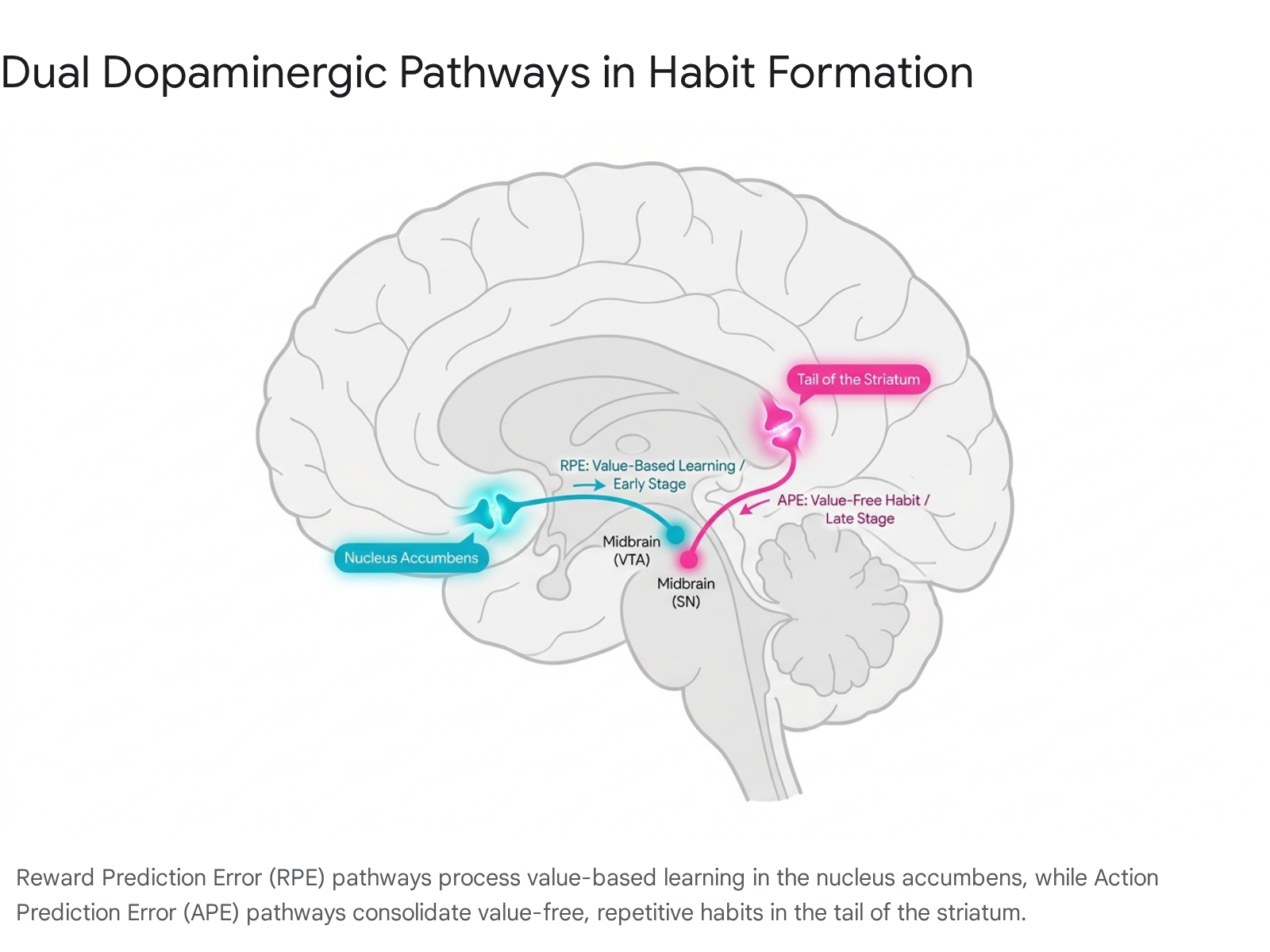
In the early stages of digital engagement, the user relies on the RPE system to discover valuable content. Over time, as the physical action of checking a device or scrolling is repeated, the brain shifts control to the APE system. This "default policy" bypasses the value-evaluation circuits to free up cognitive resources, resulting in a compulsive loop where the user continues to execute the action (e.g., refreshing a feed) regardless of whether the resulting content remains pleasurable 2217.
The Opponent-Process Mechanism of Motivation
The persistence of digital dependency, despite diminishing subjective pleasure, can be further understood through the opponent-process theory of motivation. Developed by Richard Solomon and John Corbit, the theory posits that emotional experiences are governed by two interacting neurobiological systems: a primary process (the a-process) and a physiological counter-response (the b-process) 182519.
When a user consumes highly stimulating digital content, the a-process initiates a state of hedonic pleasure, euphoria, and elevated arousal 1819. Simultaneously, the central nervous system activates the b-process to suppress this intense arousal and return the body to allostatic equilibrium 1820. The a-process acts rapidly but remains stable in magnitude, whereas the opponent b-process strengthens, activates sooner, and lasts longer with repeated exposure 1920.
As digital consumption becomes chronic, the initial pleasure (a-process) derived from social validation or novel media is blunted - a neurological phenomenon recognized as tolerance 1819. However, the intensified b-process manifests as an aversive, negative emotional state characterized by anxiety, restlessness, or dysphoria immediately upon cessation of the activity 182028. Consequently, the user's motivation shifts entirely. Behavior is no longer driven by the pursuit of pleasure, but rather by an urgent neurobiological mandate to alleviate the psychological discomfort of the b-process, driving the compulsive usage spirals observed in problematic digital behaviors 1928.
Interface Architecture and Psychological Triggers
Digital platforms weaponize these neurological vulnerabilities through deliberate User Interface (UI) and User Experience (UX) architecture. Modern applications are not merely passive tools; they are dynamic environments engineered to modulate human behavior by leveraging cognitive biases, emotional triggers, and evolutionary blind spots 2122.
The Hook Model and Variable Reward Schedules
The structural foundation of modern digital design is widely codified in the "Hook Model," a behavioral framework comprising four sequential phases: Trigger, Action, Variable Reward, and Investment 119.
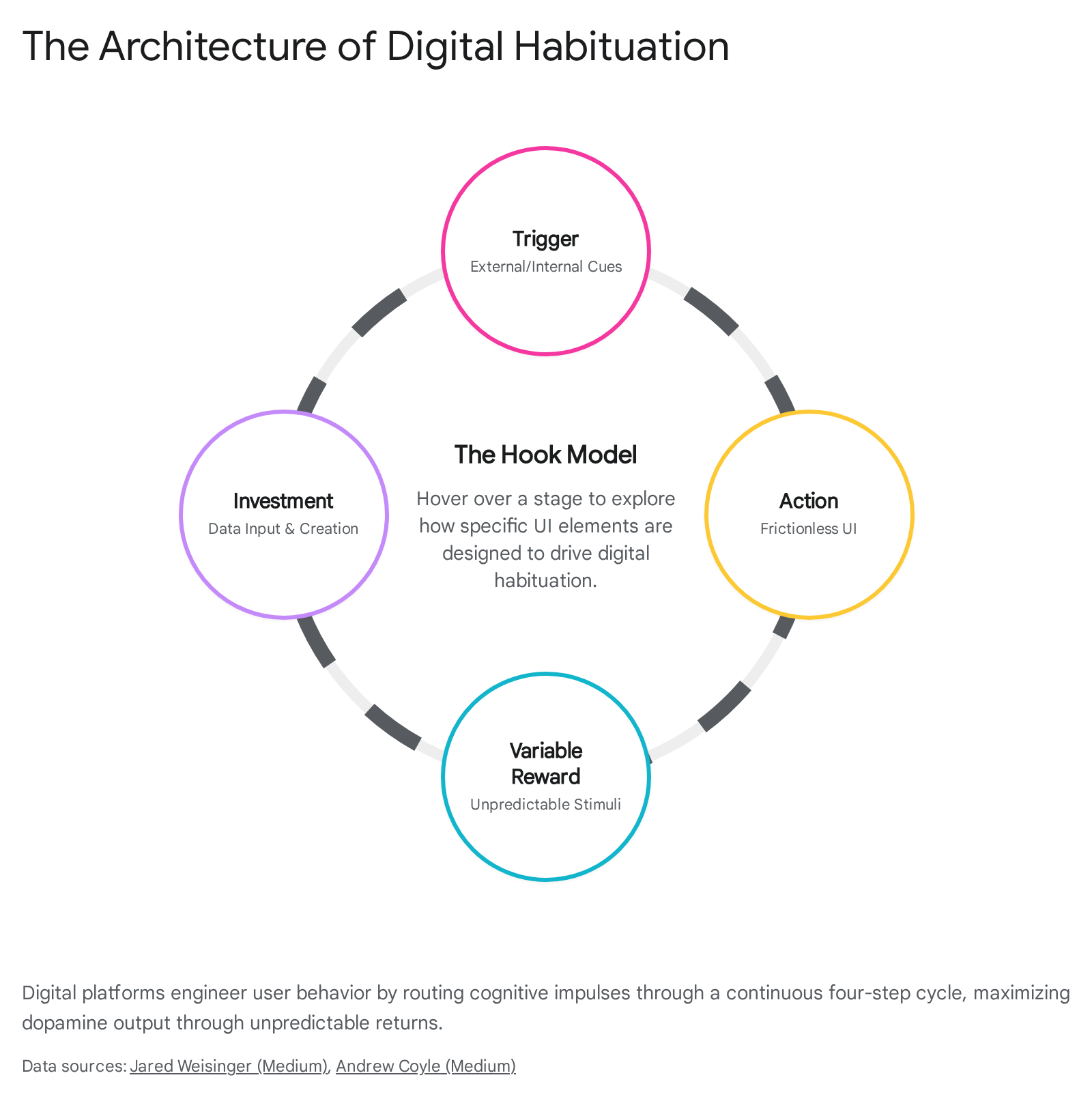
This model intercepts the dopamine prediction error pathways to create self-sustaining behavioral loops.
- Triggers: Cues that initiate behavior. External triggers include push notifications, auditory signals, and visible badges. More insidiously, platforms condition internal triggers, exploiting transient negative emotional states - such as boredom, loneliness, or social anxiety - to prompt the user to seek immediate digital relief 119.
- Action: The minimum viable behavior required to access the reward. Following the Fogg Behavior Model, designers reduce cognitive load to eliminate friction, ensuring the user has both the motivation and the immediate ability to act 2131. This manifests in UI decisions like "pull-to-refresh" gestures, auto-playing videos, and infinite scrolling, which remove natural stopping cues 113233.
- Variable Reward: The delivery of unpredictable stimuli. This phase mimics the psychology of slot machines and loot boxes; the uncertainty of whether the next interaction will yield a highly engaging video, a mundane advertisement, or a surge of social validation maximizes dopamine output 511.
- Investment: The user inputs data, social capital, or time into the system (e.g., leaving a comment, building a follower base, or configuring preferences). This psychological investment calibrates the algorithm to the user and increases the perceived cost of abandoning the platform 119.
Cognitive Load and Pattern Recognition Manipulation
Evolutionary psychology dictates that the human brain operates as a sophisticated pattern-recognition machine. In ancestral environments, connecting a rustle in the bushes to a predator allowed for rapid, life-saving decision-making without the necessity of extensive cognitive processing 522. Modern UX design heavily utilizes UI patterns that users intuitively recognize, allowing them to navigate complex digital spaces on cognitive auto-pilot 22. However, when operating in this low-friction, heuristic state, users are highly susceptible to manipulation.
Designers leverage principles such as loss aversion - the evolutionary tendency to weigh potential losses heavier than equivalent gains - by utilizing specific colors, artificial scarcity, and time-sensitive constraints to manufacture urgency 3423. Additionally, interfaces are engineered to induce a state of "flow," where the user becomes deeply immersed, losing track of time and external reality 3436.
Social Hierarchies and Identity Performance
Human interactions are fundamentally governed by social hierarchies and the evolutionary drive for status, group cohesion, and social proof 2425. Digital platforms operationalize these evolutionary imperatives into quantifiable metrics.
Social media networks function as digital stages where individuals perform their identities, seeking to build social currency 39. A complimentary interaction or metric increase from a high-status individual triggers an immediate neurological reward 11. Conversely, the omnipresent visibility of others' curated lives capitalizes on the Fear of Missing Out (FoMO) and the fear of social ostracization, which are potent drivers of continuous engagement 112627. Content that elicits high-arousal emotions - whether outrage, awe, or humor - spreads virally because it activates these deep-seated tribal dynamics, compelling users to share content to signal alignment with their in-group 1139.
| Evolutionary Driver | Psychological Mechanism | Digital UX/UI Implementation |
|---|---|---|
| Foraging Instinct | Marginal Value Theorem / Resource Seeking | Infinite scroll, algorithmic feeds, auto-play videos 468. |
| Social Cohesion | Status signaling / Tribal alignment / FoMO | "Likes," public follower counts, read receipts, share buttons 113927. |
| Pattern Recognition | Cognitive Load Reduction / Heuristics | Standardized UI patterns, swipe mechanics, frictionless navigation 2122. |
| Threat/Loss Aversion | Urgency / Scarcity response | Red notification badges, disappearing content, countdown timers 3442. |
Algorithmic Personalization and Reinforcement Learning
The efficacy of front-end UI design is exponentially amplified by backend recommendation algorithms. Modern content delivery systems, such as those utilized by TikTok, Meta, and major e-commerce platforms, utilize advanced Reinforcement Learning (RL) frameworks. In these models, the task of content recommendation is not treated as a static filtering problem, but as a sequential, dynamic decision-making process formulated via Markov Decision Processes (MDPs) 282930.
The Exploration-Exploitation Tradeoff
At the core of RL-based recommender systems is the exploration-exploitation tradeoff 3132. "Exploitation" involves serving the user content that the algorithm confidently knows they will engage with, maximizing immediate historical metrics. "Exploration" involves serving novel, untested content to probe the user's evolving preferences, thereby reducing model uncertainty and preventing the creation of a stagnant information cocoon 313233.
RL algorithms, including multi-armed bandit models, must continuously balance these two imperatives 2829. The system functions as an opaque "black box," constantly analyzing variables such as video viewing duration, liking behavior, and micro-interactions to dynamically adjust the explore-exploit threshold, thereby keeping the user in an optimal state of engagement 293133. To quantify the quality of this algorithmic balancing act, developers utilize multifaceted metrics that measure not only accuracy but also the diversity, novelty, and serendipity of the recommendations, recognizing that unexpected relevance is highly effective at maintaining long-term user attention 32.
Deep Exploration and Delayed Feedback Probing
Recent advancements in AI have shifted the algorithmic focus from evaluating single-step, immediate rewards to optimizing for holistic, long-term user engagement through "deep exploration" 3032. Traditional supervised learning models often forgo learning from a user's subsequent behavior after a single recommendation 30. In contrast, deep exploration strategies probe for delayed feedback, mapping how a specific sequence of varied recommendations impacts a user's probability of retention and conversion over extended periods 3032.
A significant challenge in deep exploration is data sparsity and delayed rewards 2930. To overcome this, cutting-edge architectures now integrate RL with Large Language Models (LLMs). These LLMs act as sophisticated environment simulators, synthesizing realistic user feedback and generating positive action pathways that augment limited offline training data 34. By functioning simultaneously as state models that enrich user representation and reward models that capture nuanced behavioral preferences, these integrated systems exert unprecedented influence over the user's digital trajectory 34.
Neurocognitive and Psychological Impacts of Short-Form Media
The weaponization of the exploration instinct via short-form video (SFV) platforms and adaptive algorithms yields measurable neurocognitive consequences. SFV content relies on high-speed, visually stimulating formats that require minimal executive control but demand intense, fragmented attention, systematically bypassing higher-order cognitive processing 3536.
Attentional Disruption and Executive Function
Prolonged exposure to ultra-processed digital content significantly disrupts the executive control network of the human brain. Systematic reviews and meta-analyses assessing the impact of high-frequency SFV use have consistently linked it to reduced self-regulation, impaired working memory, degraded cognitive reasoning, and diminished language abilities 83536.
When individuals consume highly personalized SFV streams, functional magnetic resonance imaging (fMRI) data reveals hyper-activation in brain regions associated with the default mode network and self-referential processing, coupled with significantly suppressed activity in the prefrontal cortex - the area responsible for higher-order self-control and impulse inhibition 3537. The continuous barrage of highly stimulating, fast-paced content induces a state of acute cognitive overload. The brain struggles to filter relevant details, disrupting attentional control and shifting the user into a passive, low-effort flow state characterized by time distortion and deep immersion 3538.
Over time, this intense stimulation leads to neural habituation; users become desensitized, finding it increasingly difficult to sustain attention on slower, more cognitively demanding tasks such as deep reading, complex problem-solving, or academic endeavors 3739. Among adolescents and university students, this cognitive fatigue and superficiality of thought has been colloquialized as "brain rot," a phenomenon linked to attention deficits, mental fog, and weakened social relationships 40.
The Clinical Definition of Digital Addiction
The severe psychological toll of compulsive digital engagement has sparked a contentious debate regarding the formal psychiatric classification of "digital addiction." Digital dependency exhibits core behavioral hallmarks of substance use disorders (SUDs), including impaired control, tolerance, withdrawal symptoms (e.g., irritability or anxiety when access is restricted), and continued use despite severe negative consequences to occupational or academic functioning 3741.
Neuroimaging studies consistently demonstrate that individuals with severe internet dependencies undergo structural brain changes that mirror chemical addictions. These include reduced grey matter volume in prefrontal regions and disrupted resting-state functional connectivity between the executive control network and subcortical reward centers, indicating weakened top-down regulation over impulsive drives 3742.
However, the medical community remains divided on diagnostic terminology. The American Psychiatric Association's DSM-5 officially recognizes only Gambling Disorder as a behavioral addiction, including Internet Gaming Disorder (IGD) merely as a condition requiring further study 3743. Similarly, the World Health Organization's ICD-11 classifies gaming and gambling disorders as disorders due to addictive behaviors, but currently omits generalized social media or smartphone addiction 43.
Critics of the addiction metaphor argue that the terminology risks pathologizing normative, albeit maladaptive, modern coping behaviors, suggesting that excessive screen time is often a symptom of underlying affective disorders rather than a primary disease 3741. Conversely, proponents argue that syndromes such as Problematic Social Media Use (PSMU) or Social Media Use Disorder (SMUD) possess distinct, identifiable clinical criteria. Proposed criteria specific to SMUD include severe loss of control, an overwhelming Fear of Missing Out (FoMO), and a pronounced Preference for Online Social Interaction (POSI) 2744.
Recent umbrella reviews utilizing AMSTAR 2 and GRADE assessment tools have identified precise demographic and environmental risk factors for digital addiction, noting that urban residence, adverse childhood experiences, and pre-existing social anxiety significantly increase vulnerability, while positive parent-child relationships serve as effective mitigators 4145. Regardless of diagnostic semantics, the functional impairments are statistically undeniable; meta-analyses have found pooled prevalence rates of internet addiction exceeding 41% among university students globally, with notably higher incidence rates in low- and middle-income countries 37.
Cultural Dimensions of Digital Engagement
The manifestation, interpretation, and impact of digital dependency are heavily mediated by deep-seated cultural paradigms. Epidemiological data regarding internet addiction prevalence often reflects the fundamental cultural dichotomy between individualist and collectivist societies 4346.
Individualist versus Collectivist Orientations
In Western, individualist cultures, digital engagement is frequently driven by internal psychological states and the pursuit of personal autonomy. Western users tend to view social media as a tool for individual expression or mood modification, and often perceive aggressive algorithmic recommendations as an external infringement on their personal agency 4647.
In contrast, East Asian and Central Asian collectivist cultures place a high premium on group harmony, consensus-building, and social interconnectedness 4748. Social media usage in these regions is heavily oriented toward eliciting social support, seeking peer approval, conforming to group norms, and maintaining dense intergenerational family ties 4748. Psychometric analyses utilizing the Digital Participation Attitude Scale (DPAS) underscore that these culturally rooted family dynamics significantly dictate how technology is adopted and integrated into daily life 4849. Consequently, the anxiety surrounding digital disconnection in collectivist societies is often driven by a genuine fear of disrupting the social fabric rather than mere individual boredom 47.
Anthropomorphism and Attitudes Toward Artificial Intelligence
These distinct cultural orientations also shape societal attitudes toward artificial intelligence and autonomous algorithmic systems. Global psychological surveys suggest that individuals from East Asian backgrounds generally harbor significantly more favorable attitudes toward socially connecting with AI compared to their Western counterparts 4650.
This variance is partially explained by historical and religious contexts. Animistic beliefs prevalent in Eastern traditions may predispose individuals to view technology, including social chatbots like China's highly popular Xiaoice, as an integrated extension of the self or the natural world, rather than as cold, inanimate objects 4650. East Asian demographics exhibit a higher propensity to anthropomorphize technological systems, facilitating deeper emotional bonds with AI and greater trust in institutionally deployed algorithms 4650.
However, this cultural integration of technology is double-edged. The societal mandates for high academic achievement and intensely competitive work environments in regions like South Korea, China, and Japan can exacerbate the systemic stress that drives youth toward digital escapism, complicating the societal response to screen time regulation 5152.
Regulatory Responses and Policy Frameworks
Recognizing the systemic risks posed by algorithmic manipulation and behavioral engineering, global jurisdictions have initiated disparate regulatory frameworks aimed at curbing digital dependency, particularly to protect the cognitive development of minors.
Asian Approaches to Youth Screen Time Management
Asian regulatory approaches have historically favored direct, state-mandated intervention regarding youth screen time. In 2021, China's National Press and Publication Administration (NPPA) enacted the world's most stringent limits, confining minors to a single hour of online gaming strictly on Fridays, weekends, and statutory holidays (between 8 PM and 9 PM) 5354. This regulation is enforced via comprehensive national real-name registration systems 5354. Subsequent draft measures proposed by the NPPA in late 2023 attempted to target behavioral design mechanics directly by proposing bans on daily login rewards, consecutive funding incentives, and spending limits 55. The mere announcement of these draft rules precipitated a massive $80 billion drop in the market capitalization of Chinese tech firms, leading the government to subsequently walk back some of the harshest proposals to stabilize the sector 55. By 2024, game licensing in China had largely stabilized, with over 1,400 titles approved 7172.
South Korea offers a contrasting regulatory trajectory. In 2011, the National Assembly enacted the Youth Protection Revision Act, colloquially known as the "Shutdown Law" or "Cinderella Law," which mandated a strict midnight-to-6 AM curfew on PC gaming for users under the age of 16 5657. While upheld by the Constitutional Court in 2014, the law proved practically ineffective against the rise of mobile gaming, prompted widespread identity theft as minors utilized parental registration numbers, and drew sustained criticism from civil rights groups and the gaming industry 5156. Acknowledging these failures, the South Korean government officially abolished the blanket curfew in 2021, replacing it with a "Selective Game Hours System" that delegates the authority to restrict playtime back to individual parents 577558.
In Japan, approaches remain largely localized and non-punitive. In October 2025, the municipality of Toyoake established the country's first ordinance recommending a two-hour daily limit on digital devices to combat sleep deprivation and truancy 525960. The ordinance advises curfews of 9 PM for elementary students and 10 PM for older teens, but carries no legal penalties, serving primarily to foster family dialogue 5259. At the national level, the Japanese government is currently debating stricter age verification requirements and exploring holding platforms accountable for risk disclosure, avoiding outright bans while acknowledging the growing mental health crisis 6162.
European Structural Regulation of Systemic Risk
The European Union has adopted a fundamentally different, structural approach to digital regulation through the Digital Services Act (DSA), which became fully applicable in early 2024. Rather than policing individual user time, the DSA targets the underlying architecture of the platforms 63.
Under Article 34 of the DSA, Very Large Online Platforms (VLOPs) must proactively identify and mitigate systemic risks to public health, mental well-being, and the rights of the child 10. The European Commission has utilized this framework to launch formal proceedings against major platforms, arguing that features such as infinite scroll, persistent push notifications, algorithmic amplification of emotionally charged content, and game-like reward programs constitute unlawful "addictive design" 104263.
This represents a monumental shift in regulatory philosophy. The legal harm being addressed is no longer restricted to deceptive transactions or the hosting of illegal content; it is the engineered erosion of a user's capacity to disengage - a phenomenon academics term "cognitive exploitation" 10. To further this agenda, the EU is currently developing a Digital Fairness Act (DFA) specifically tasked with neutralizing manipulative interface designs. Proposed interventions include requiring chronological feeds by default, demanding that attention-seeking push notifications be disabled, and enforcing algorithmic transparency 3264. Since the implementation of the DSA, the EU has successfully facilitated the reversal of millions of algorithmic content moderation decisions, demonstrating the tangible impact of structural oversight 64.
| Regulatory Jurisdiction | Primary Framework | Core Mechanisms & Interventions | Current Status / Execution |
|---|---|---|---|
| China | NPPA Notices (2019, 2021, 2024 draft) | Hard limits: 1 hour/day on weekends for minors. Real-name verification. Proposed bans on variable reward mechanics. | 2021 limits actively enforced. Draft 2024 behavioral rules caused market volatility 535455. |
| South Korea | Youth Protection Act / Game Industry Promotion Act | 2011 Shutdown Law banned PC gaming 12 AM - 6 AM. Replaced by parental "Selective Game Hours System." | 2011 Law abolished in 2021 due to ineffectiveness and industry pushback 565758. |
| Japan | Municipal Ordinances (e.g., Toyoake) | Non-binding guidelines advising < 2 hours of screen time daily. Curfews of 9 PM/10 PM for minors. | Localized implementation. Carries no legal penalties; designed to prompt family intervention 5259. |
| European Union | Digital Services Act (DSA) & Digital Fairness Act (DFA) | Classifies "addictive design" (infinite scroll, auto-play) as a systemic risk. Mandates algorithmic transparency. | Fully applicable. Formal proceedings initiated against VLOPs for engagement-based design 10326364. |
Digital Resilience and Algorithmic Literacy
As technological architecture advances at a pace that invariably outstrips regulatory frameworks, cultivating individual and organizational resilience is imperative. Digital resilience encompasses the capacity to maintain functional autonomy, manage stress, and ensure societal continuity despite the disruptive influence of ubiquitous digital systems and generative artificial intelligence 656667.
At the organizational level, research demonstrates that treating digital adaptation as a continuous, iterative process is critical. Firms that leverage algorithmic capabilities to adjust operations during crises demonstrate significantly higher resilience-seeking behaviors, ensuring long-term survival in poly-crisis environments 6568.
At the individual level, achieving digital resilience relies on the rapid development of "Algorithmic Literacy." Traditional digital and media literacies, which focus on evaluating the veracity of consumed content or basic software operation, are insufficient against opaque engagement algorithms 6970. Algorithmic literacy is defined as a critical, structural understanding of how AI systems select, personalize, and influence online content to maximize platform engagement rather than user well-being 697071.
This literacy requires users to recognize the mechanics of variable reward schedules, understand the deployment of predictive error loops, and identify the dark patterns utilized in user interfaces 3370. By demystifying the black box of recommendation engines, algorithmic literacy fosters cognitive and emotional agency. It empowers adolescents and adults alike to reframe digital distress as a contextual and modifiable variable, shifting them from passive subjects of behavioral engineering to empowered architects of their digital environments 70. Ultimately, navigating the modern digital landscape requires a stark acknowledgment that human evolutionary instincts are fundamentally mismatched with environments optimized for infinite consumption. Recognizing this biological asymmetry is the first necessary step toward reclaiming cognitive agency.