
STEM vs Liberal Arts: Who Earns More
Science, technology, engineering, and mathematics (STEM) majors generally secure significantly higher starting salaries and lower initial underemployment rates than their liberal arts counterparts. However, as professionals enter mid-career and leadership roles, the wage gap substantially narrows, with both groups reporting comparable levels of long-term job satisfaction and well-being. Furthermore, the rapid integration of artificial intelligence is actively shifting employer demand toward the communication, adaptability, and critical thinking skills traditionally cultivated in the humanities.
The Economic Baseline: Initial Earnings and Labor Market Friction
The financial return on investment for a college degree remains undeniably strong compared to entering the workforce with only a high school diploma. Despite declining public confidence in higher education, the economic case for earning a bachelor's degree is solid, with college graduates earning approximately $1 million to $1.19 million more on average over the course of their working years than adults with no college degree 123. However, the exact payout of that degree is heavily dictated by the student's chosen major. The Georgetown University Center on Education and the Workforce (CEW) reports that the lifetime earnings gap between the highest-paying and lowest-paying college majors is a staggering $3.4 million 24.
Right out of college, the financial advantage leans heavily toward STEM, alongside healthcare and business disciplines. For prime-age workers between the ages of 25 and 54, median earnings vary significantly by major, ranging from $58,000 in education and public service fields to $98,000 in STEM fields 567. Within those broad categories, specific degrees dictate even wider extremes. For example, among 65 analyzed STEM majors, median earnings range from $64,000 for miscellaneous agriculture to $146,000 for petroleum engineering, which ranks as the most lucrative bachelor's degree 57. By contrast, early childhood education majors earn a median of $39,000, placing them among the lowest-earning college graduates 24.
The Underemployment Challenge for Recent Graduates
The transition from academia to the workforce is rarely seamless, and the post-pandemic labor market has introduced a unique set of challenges for new college graduates across all disciplines. Data from the Federal Reserve Bank of New York indicates that the labor market for recent college graduates deteriorated noticeably between 2024 and 2026 8910. By the first quarter of 2026, the unemployment rate for recent college graduates stood at 5.7%, significantly higher than the 2.9% unemployment rate for prime-age workers holding bachelor's degrees 578.
More pressing than absolute unemployment is the persistent issue of underemployment, which occurs when a college graduate works in a job that typically does not require a college degree. In early 2026, the underemployment rate for recent graduates reached 41.5% 8. While underemployed, roughly 36% of these graduates secure "good non-college jobs" that pay an annual full-time wage of $45,000 or more, but 13% find themselves in low-wage positions earning $25,000 or less 11.
Interestingly, while STEM degrees generally offer higher pay, they are not immune to early-career friction. Recent graduates with bachelor's degrees in computer science, statistics, and mathematics boast high median earnings of $79,000, but recently faced the highest unemployment rate in all STEM fields at 6.8% 6. This spike is largely attributed to a contraction in the technology sector, which experienced massive hiring booms in the early 2020s followed by sharp course corrections and layoffs in subsequent years 12.
Long-Term Earnings Trajectories: The Mid-Career Catch-Up
While the narrative that liberal arts majors face permanent financial hardship is pervasive, longitudinal data reveals a much more nuanced reality. Liberal arts graduates generally start with lower salaries, but their earnings growth rate is exceptionally steep as they transition into their thirties and forties.
According to research from the Public Policy Institute of California, the typical recent graduate in computer science earns 60% more than their counterpart in English. However, as workers gain experience, earn graduate degrees, and move into leadership or managerial roles, that difference shrinks to 40% among mid-career workers 13.
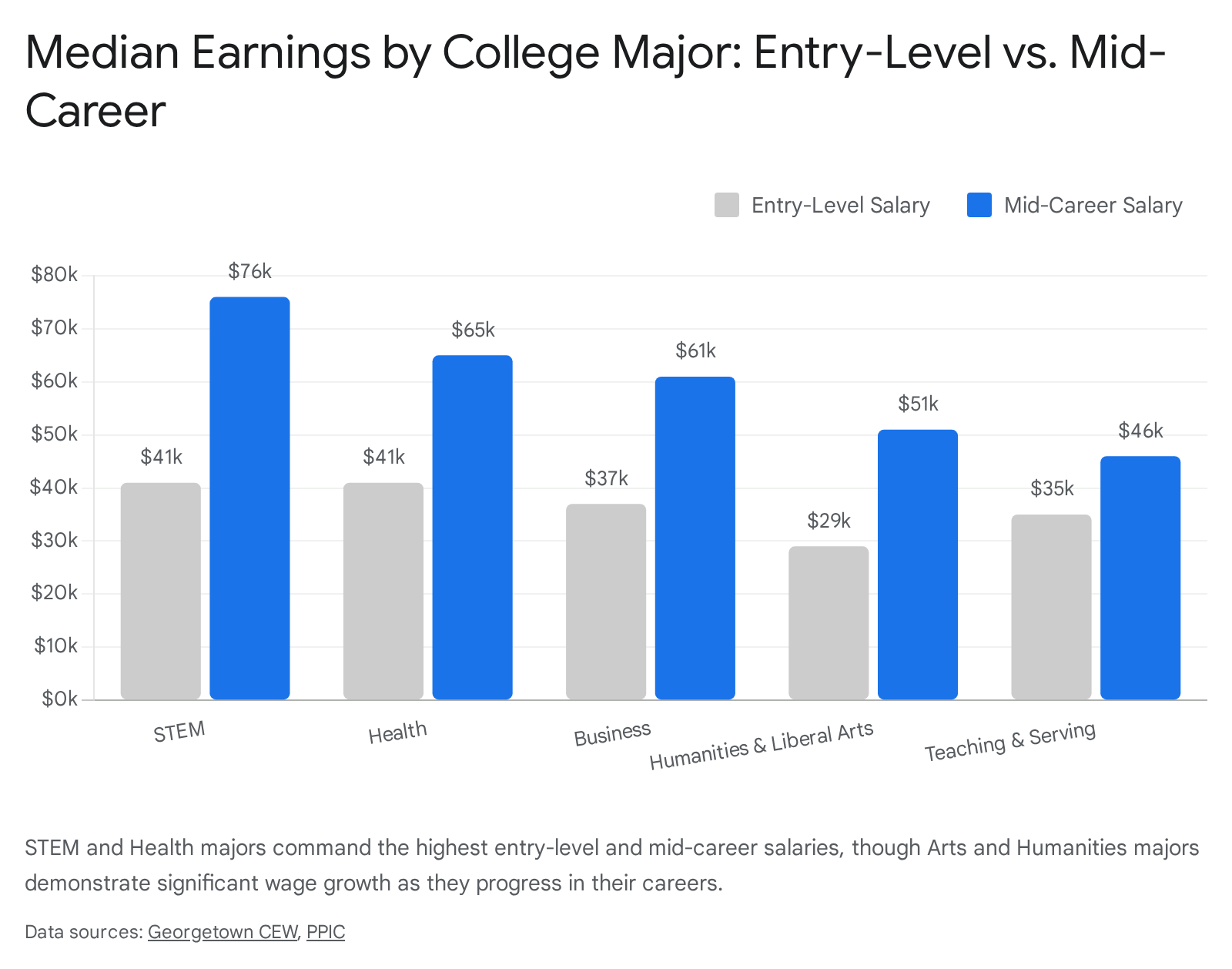
This is consistent with demographic studies showing that liberal arts majors develop critical thinking skills, problem-solving abilities, and adaptability that are highly valuable for mid-career success, even if they do not immediately translate to high-paying entry-level jobs 13.
By age fifty, the average earnings for a worker with a liberal arts degree reach $67,000 a year. While this remains lower than the $81,000 average for non-liberal arts degrees, it is substantially higher than the $49,000 earned by associate degree holders and the $33,000 earned by those with only a high school diploma 14.
The Impact of Age and Graduate Education
The steepest jump in income for all college graduates appears between the ages of 25 and 34, a period when many shift from entry-level roles into specialized, full-time positions 15. Median American earnings generally peak in the 45 to 54 age range 15. During this peak earning phase, the disparities between educational attainment levels become stark.
Furthermore, a significant portion of the wage premium achieved by workers is driven by graduate education. Overall, workers with a graduate degree earn 29% more than those with a bachelor's degree alone, yet the graduate degree earnings premium varies dramatically across majors 5. For example, workers with a bachelor's degree in health and medical preparatory programs earn $70,000 at the median, compared with $152,000 among those who also hold a graduate degree in the field 5. Humanities majors are highly likely to pursue advanced degrees, which reduces their short-term earnings due to the opportunity costs of delayed employment, but ultimately results in higher lifetime earnings that traditional ten-year outcome studies often fail to capture 16.
Internal Variance Within Majors
It is a common misconception that all STEM graduates out-earn all liberal arts graduates. In reality, there is massive overlap when viewing the data by percentiles. Because earnings within majors are heavily driven by geographic location, industry choice, and the selectivity of a graduate's alma mater, the top earners in lower-paying fields frequently outpace the bottom earners in high-paying fields 13.
For instance, the top 25 percent of education majors earn $59,000 or more annually, while the bottom 25 percent of engineering majors earn $59,000 or less annually 217. Similarly, the top 10 percent of humanities graduates working in business roles make over $85,000 annually, pushing well past the median salaries of many applied science fields 18.
| Major Category | 25th Percentile Earnings | Median Earnings | 75th Percentile Earnings |
|---|---|---|---|
| Computer Science | $74,000 | $114,000 | $165,000 |
| Nursing | $65,000 | $89,000 | $110,000 |
| Economics | $43,000 | $73,000 | $100,000 |
| Political Science | $44,000 | $59,000 | $80,000 |
| Communications | $43,000 | $57,000 | $73,000 |
| Biology | $40,000 | $54,000 | $72,000 |
| Psychology | $32,000 | $45,000 | $60,000 |
Data sourced from the American Community Survey, restricted to full-time, year-round workers with a bachelor's degree ages 22 to 27 13.
The AI Disruption: A Paradigm Shift in Labor Demand
The conversation surrounding college majors is currently being rewritten by the rapid advancement and deployment of generative artificial intelligence. Historically, entry-level white-collar roles served as essential training grounds for recent graduates. Junior staff traditionally handled data processing, basic coding, and primary research as a rite of passage. Today, those specific tasks are highly susceptible to automation.
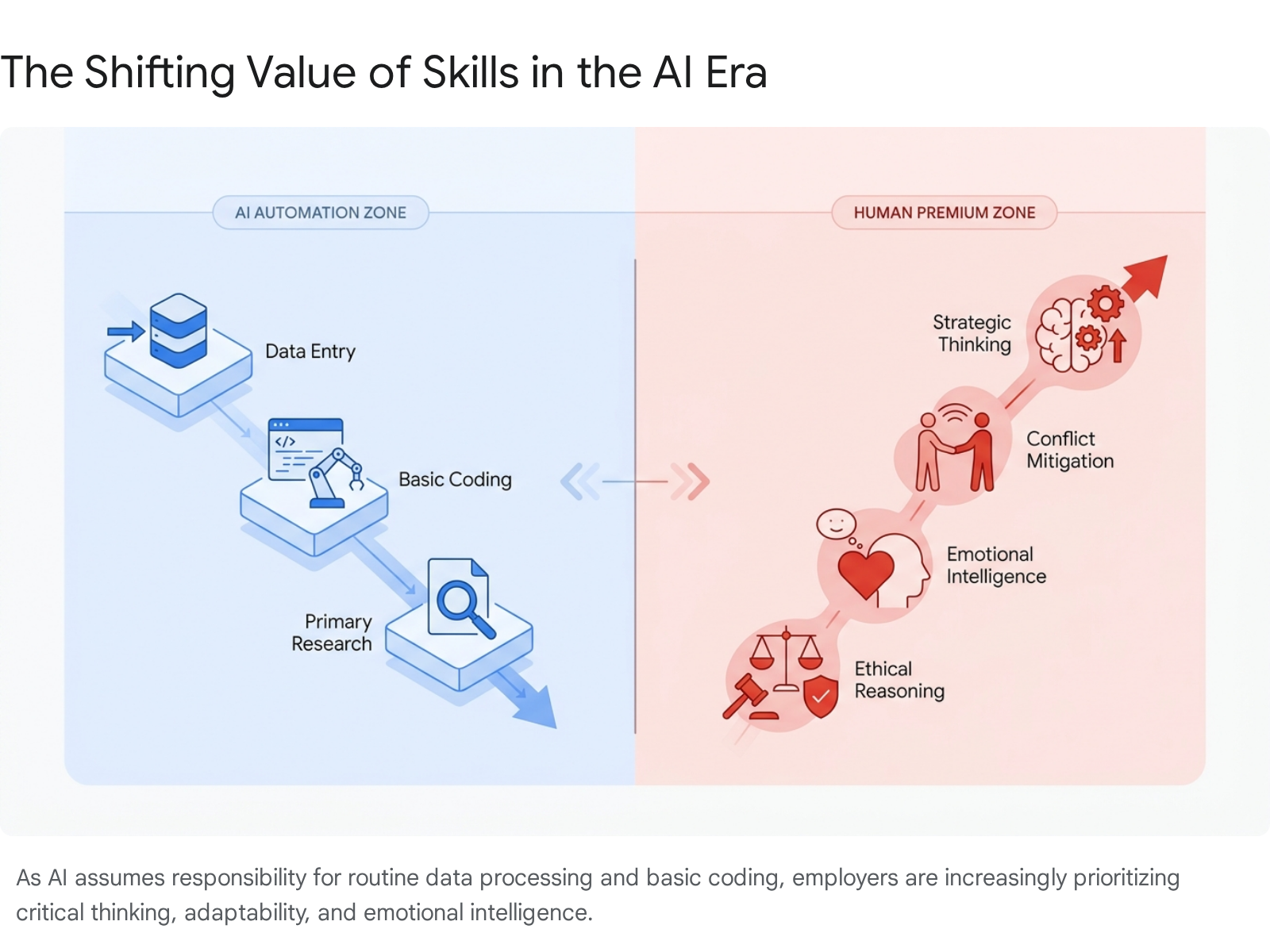
A 2025 report from the World Economic Forum revealed that 40% of employers expect to reduce their workforce in areas where AI can automate tasks 19. Bloomberg estimates that AI could replace more than 50% of the tasks performed by entry-level market research analysts and sales representatives, compared to a much lower impact on their managerial counterparts 19. The impact is already measurable: early-career workers in occupations heavily exposed to generative AI experienced a 13% relative decline in employment between 2024 and 2025 12.
This technological shift has resulted in a tangible decline in junior job postings. The Bureau of Labor Statistics' job openings data confirms that white-collar openings recently hit a roughly ten-year trough 20. Instead of executing mass layoffs, many companies are adopting silent cuts, choosing not to refill junior positions when employees leave, and instead augmenting their senior staff with AI tools to handle the volume 20. In the technology sector alone, United States entry-level postings decreased by 67% over a single year, while the United Kingdom saw a 46% drop in graduate tech roles 12.
The Resurgence of the Human Skillset
Paradoxically, the rise of automated data analysis and AI-assisted coding is making the qualitative skills of the liberal arts significantly more valuable. When a machine can write functional code or generate a financial model in seconds, the premium shifts to the human worker who can ask the right questions, navigate ethical ambiguities, and communicate strategy across an organization.
LinkedIn's Skills on the Rise 2025 report indicates that seven out of the top ten fastest-growing skills requested by employers fall into the category of human-centric abilities 20. The top rising skills globally include creativity and innovation, conflict mitigation, adaptability, and strategic thinking 2021. Industry experts argue that the term "soft skills" does a disservice to these competencies, as they are now the primary game-changers for career success in an automated economy 20.
According to a survey by the National Association of Colleges and Employers, 85% of hiring managers prioritize critical thinking and communication over technical expertise when evaluating candidates for entry-level roles 22. While AI makes past knowledge instantly accessible, a liberal arts education trains students to creatively problem-solve, manage ambiguity, and synthesize complex information - forms of reasoning that remain instinctual for humans but exceptionally difficult for machines to replicate 23.
The "Human+" Strategy: Blending Disciplines
For today's college students and recent graduates, the debate between pursuing STEM or liberal arts is increasingly viewed as a false dichotomy. The most lucrative and resilient career paths are emerging at the intersection of the two - a concept labor market analytics firm Lightcast refers to as the "Human+ skill" paradigm 24.
Liberal arts graduates can dramatically improve their job prospects and salary trajectories by acquiring a baseline proficiency in technical skill sets 25. A National Center for Educational Statistics report found that over 70% of liberal arts graduates regularly use digital technologies in their careers, underscoring the necessity of technical fluency 22. Integrating just one technical competency - such as data analysis, digital marketing, or general business administration - can yield a 20% faster salary growth rate within five years compared to purely generalist peers 26.
Furthermore, combining technical and human skills is highly protective in a volatile job market. Earning an industry-recognized certification alongside a humanities degree allows candidates to apply their communication and cultural literacy to tech-adjacent roles. For example, obtaining a Project Management Professional credential or a data analytics certificate equips humanities graduates to lead complex projects across the nonprofit and consulting sectors, pushing their mid-career earnings significantly higher 27. Traditional subjects like history and literature are already being reimagined through the lens of data analytics in higher education, enabling students to utilize computational methodologies like text encoding and sentiment analysis before they even enter the job market 28.
Subjective Well-Being and Job Satisfaction
If the ultimate goal of a college education is to build a fulfilling life, salary figures are only one piece of the puzzle. Extensive psychological and sociological polling indicates that higher earnings do not universally translate to higher job satisfaction or overall well-being.
A comprehensive study by Lumina Foundation and Gallup found that 80% of bachelor's degree holders say their job is a good fit for their personal talents and interests, compared to just 58% of those with no education after high school 1. College graduates, regardless of their major, are highly likely to be satisfied with their jobs and their lives 29. They report fewer chronic worries, lower rates of depression, and significantly better physical health, with 60% of bachelor's degree holders stating their health is excellent or very good compared to 43% of non-graduates 130.
The Satisfaction Disconnect by Major
When breaking down job satisfaction by specific fields of study, surprising trends emerge that challenge the supremacy of high-earning majors. Despite having some of the lowest median earnings, graduates from education, health, and medical sciences consistently report the highest levels of job satisfaction and meaning 2932.
Furthermore, a study by the American Academy of Arts & Sciences found that while humanities graduates earn less than engineering majors, their perceived well-being and job satisfaction are virtually identical 2933. Values alignment plays a critical role in this dynamic. Business and engineering majors are the least likely to indicate that "contributing to society" is a vital aspect of their work, with only around 40% citing it as highly important, compared to 53% among all graduates 29.
The Double-Edged Sword of Formal Education
It is important to note that higher education does introduce specific workplace pressures. A University of Notre Dame study found that while better-educated individuals enjoy greater job-related resources, income, and autonomy, they also endure longer work hours and increased job pressure 31. These intensive demands are associated with increased stress, which can largely offset the positive gains associated with higher income 31. Interestingly, the study noted that highly educated women experience more stress at work and lower job satisfaction compared to their highly educated male counterparts 31.
The Mentorship Multiplier
The Gallup Alumni Survey underscores a vital finding: how a student goes through college matters just as much as what they study. Graduates who felt they had a professor who cared about them as a person are nearly twice as likely to be engaged at work later in life, regardless of their specific degree 3532. Those who had mentors encouraging their dreams or who participated in meaningful internships that allowed them to apply their learning were more than twice as likely to be engaged in their careers 3532. This suggests that university faculty engagement and experiential learning are foundational drivers of long-term career satisfaction.
Flexibility and Remote Work Outcomes
In the post-pandemic economy, workplace flexibility has become a primary metric of career quality. Nearly two-thirds of employees state that remote work is the most important aspect of a job, ranking it even higher than salary 37. The ability to secure this flexibility is highly correlated with educational attainment and, by extension, choice of major.
As of the 2024 - 2025 labor market, advanced degree holders represent roughly 38% of the remote workforce, followed closely by bachelor's degree holders at 37.6% 3334. In stark contrast, individuals with only a high school diploma make up just 7% of remote workers, and those with less than a high school education account for a mere 2% 3334.
| Educational Attainment Level | Share of Total Remote Workforce |
|---|---|
| Advanced Degree | 38.0% - 42.8% |
| Bachelor's Degree | 35.0% - 37.6% |
| Some College / Associate Degree | 15.0% - 18.4% |
| High School Diploma Only | 7.0% |
| Less than High School | 2.0% |
Data aggregated from Forbes Advisor and Awisee Remote Work Statistics 3334. Ranges reflect slight variations in major polling methodologies.
This flexibility provides massive financial and psychological benefits. Remote workers report the lowest stress levels compared to hybrid and in-office employees, with just 36% of remote workers stating their stress increased over the past year, compared to 59% of in-office workers 37. Additionally, fully remote workers save an estimated $12,000 annually on commuting, professional clothing, and food expenses, while companies save up to $10,600 per remote employee on overhead costs 37.
Because the finance, insurance, and professional services sectors offer the highest rates of remote work - frequently allowing 20% to 30% of their staff to work fully remotely - STEM and business majors currently enjoy a slight structural advantage in securing geographic flexibility 34. However, as digital communications and marketing roles increasingly embrace remote structures, humanities graduates in those sectors are also securing high levels of workplace autonomy.
International Perspectives: Europe, the UK, and Singapore
The dynamics of the graduate labor market are not isolated to the United States. Similar trends regarding the graduate premium, the disparity between academic fields, and early-career employment rates are visible across global economies.
The United Kingdom and the European Union
In the United Kingdom, the median nominal salary for working-age graduates in 2024 was £42,000, significantly higher than the £30,500 median for non-graduates 35. The Institute for Fiscal Studies estimates that over a lifetime, male graduates in the UK earn about £130,000 more than non-graduates, and female graduates earn around £100,000 more, even after factoring in taxes and student loan repayments 36.
Following the global trend, field of study dictates starting pay. Medicine, dentistry, and engineering offer the highest starting salaries in the UK, generally ranging from £30,000 to £35,000 3637. By contrast, graduates in the creative arts, media, and communications trail behind, with average starting salaries clustering between £18,000 and £24,000 3637.
Across the broader European Union, a 2024 Eurostat report highlighted stark income disparities based on education. The median disposable net income for highly educated workers was €29,490, compared to €17,517 for those with low education - a 68% income premium for university graduates 3839. However, this gap varies widely by geography. In countries with highly structured safety nets like Iceland, the income gap between high and medium education is just 6% 38. Conversely, the gap swells to 57% in Lithuania and 62% in Türkiye, where absolute graduate earnings are the lowest in Europe at just €7,542 annually 3840.
The Graduate Landscape in Singapore
The 2024 Joint Autonomous Universities Graduate Employment Survey in Singapore highlights an intensely competitive market dominated by the technology and legal sectors. The highest median gross monthly starting salaries belonged to graduates with degrees in Law ($7,000 SGD) and Computer Science ($6,500 SGD) from institutions like the National University of Singapore and Singapore Management University 414243.
Conversely, arts, design, and media graduates saw median starting salaries around $3,800 SGD, demonstrating a gap similar to Western markets 4445. Despite minor dips in overall employment rates attributed to global economic uncertainty, 97.2% of Singaporean university graduates secured employment shortly after graduation, showcasing the robust baseline value of a degree in the Asian financial hub 4445.
Bottom line
The labor market data is definitive: STEM and business degrees offer a highly reliable path to strong entry-level wages and superior lifetime earnings. However, the economic value of a liberal arts degree is frequently underestimated by viewing only immediate post-graduation salaries. Humanities graduates experience aggressive mid-career wage growth, report identical levels of life satisfaction, and possess the adaptable communication and critical thinking skills that employers increasingly demand as artificial intelligence automates routine technical work. Ultimately, the most successful and resilient professionals in the modern economy will be those who actively combine the technical rigor of STEM with the ethical reasoning and adaptability inherent to the liberal arts.