
How Much Your College Major Determines Your Career
Your college major heavily influences your starting salary and the industry of your first professional job, but it does not rigidly dictate your lifetime career path. Research shows that while graduates in specialized vocational fields like nursing or engineering frequently secure initial employment directly tied to their studies, a significant percentage eventually transition into management or unrelated sectors due to burnout or career evolution. Conversely, students in generalized majors like the humanities face substantially higher initial rates of underemployment, but they often close the professional gap over a ten-year period by leveraging transferable skills across diverse, unexpected industries.
The Macroeconomic Landscape of the College Degree
For decades, the standard narrative surrounding higher education has been straightforward and deterministic: a student attends university, selects a specific major, and graduates into a linear career trajectory governed entirely by that chosen discipline. However, modern labor economics, supported by massive longitudinal datasets, reveals a reality that is far more fluid, complex, and unpredictable. The relationship between a student's chosen academic discipline and their eventual career trajectory is not a simple cause-and-effect mechanism; rather, it is governed by an intricate interplay of labor market demand, technological disruption, geographic location, and systemic demographic factors.
To accurately assess whether a college major dictates a career, it is necessary to first separate immediate post-graduation labor market entry from long-term career arcs. On a macroeconomic level, the data overwhelmingly demonstrates that obtaining a bachelor's degree provides a substantial economic advantage over holding only a high school diploma, regardless of the specific field of study.
According to data from the U.S. Census Bureau's Current Population Survey Annual Social and Economic Supplement, prime-age workers (ages 25 - 54) with a bachelor's degree earn 70% more at the median than workers with only a high school diploma 12. Furthermore, the lifetime earnings of a full-time, year-round worker with a high school diploma average $1.6 million, while those with an associate's degree earn $2 million, and those with a bachelor's degree earn a median of $2.8 million over their careers 34. Unemployment figures tell a similar story of broad collegiate advantage: workers with a bachelor's degree face a significantly lower unemployment rate (2.9%) compared to those with only a high school education (6.2%) 1.
Yet, beneath this broad macroeconomic premium lies massive variance. The economic return and the specific occupational trajectory of a college degree are profoundly shaped by the specific major chosen. The determinism of a major is strongest at the exact moment of graduation, fading gradually as professional experience, networking, and continuous skill acquisition begin to outweigh academic credentials.
The First Destination: How Major Dictates the Initial Job
The most direct and measurable link between a college major and a career occurs in the first one to five years following graduation. When students leave the university ecosystem, their major serves as the primary signaling mechanism to employers regarding their technical proficiencies, cognitive abilities, and vocational interests. For many, this transition is highly turbulent and often fails to align with their academic preparations.
The Underemployment Crisis
The transition from higher education to the professional workforce is increasingly characterized by a phenomenon known as vertical mismatch, colloquially referred to as underemployment. According to "Talent Disrupted," an exhaustive 2024 joint report by the Strada Institute for the Future of Work and the Burning Glass Institute, 52% of graduates with a terminal bachelor's degree (meaning they have not pursued advanced degrees) are underemployed one year after graduation 566. Underemployment is strictly defined in these labor studies as holding a job where the majority of workers do not have, nor are they required to have, a four-year college degree.
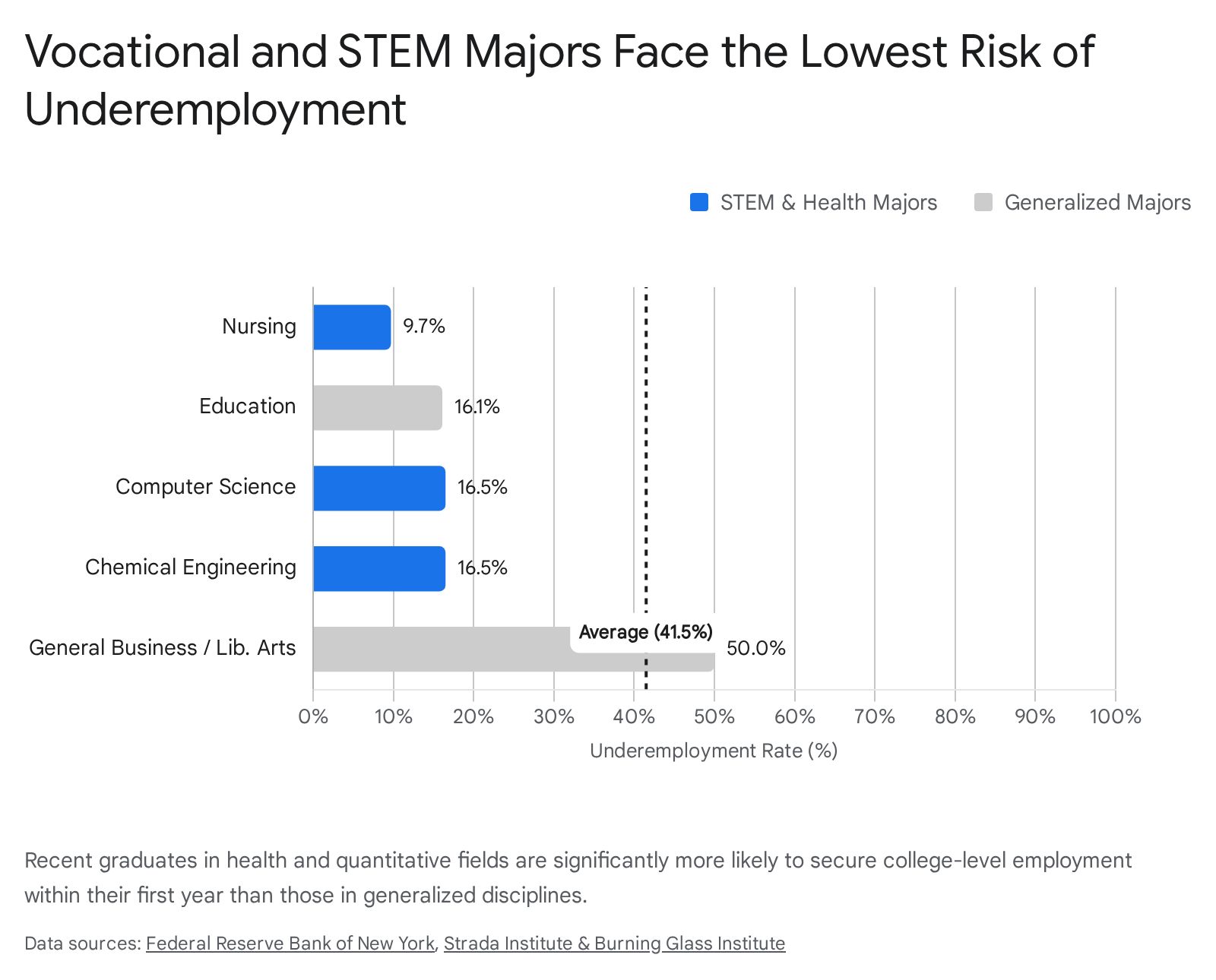
The Federal Reserve Bank of New York, which meticulously tracks the labor market for recent college graduates (defined as ages 22 to 27), places the underemployment rate at roughly 41.5% as of early 2026, with an overall unemployment rate for recent graduates sitting at 5.7% 878. The statistical discrepancy between the Strada Institute and the New York Fed arises primarily from population definitions: the New York Fed includes graduates who have earned advanced degrees, a cohort that historically experiences significantly lower rates of underemployment, whereas Strada focuses solely on terminal bachelor's degree holders 6.
Regardless of the specific metric or dataset utilized, the overarching conclusion remains stark: roughly half of all college graduates fail to launch immediately into a "college-level" job. However, the risk of falling into this underemployment gap is highly stratified by the student's chosen major.
Quantitative and Specialized vs. Generalized Fields
Majors that require substantial quantitative reasoning, rigorous technical training, or provide direct vocational licensure lead to much higher rates of immediate, field-specific employment.
Graduates in technical and healthcare fields consistently exhibit the lowest rates of underemployment. For example, nursing graduates have an astonishingly low underemployment rate of roughly 9.7%, as their degree acts as a direct, non-negotiable credential for their profession . Elementary education majors sit at 16.1% underemployment, while highly technical degrees like computer science and chemical engineering maintain underemployment rates of 16.5% . Broader tracking shows that nearly 75% of students who major in fields requiring heavy quantitative reasoning secure college-level roles within five years of graduation 6.
Conversely, majors in the humanities, generalized business, and social sciences face significantly higher hurdles in the initial job market. Graduates in public safety, recreation and wellness, and general business frequently experience underemployment rates exceeding 50% upon their initial labor market entry . These generalized disciplines do not correspond to a single, clearly defined entry-level job title, forcing graduates to navigate a much broader and less structured job search.
The Path Dependency of the First Job
The major a student chooses often dictates their first job, and longitudinal researchers have found that this initial labor market placement is highly predictive of long-term career success. According to the "Talent Disrupted" report, the die is frequently cast upon graduation. Among those who successfully secure a college-level job immediately after graduating, 79% remain in a college-level occupation five years later, and an impressive 86% remain ten years later 5910.
However, the reverse trajectory is notoriously difficult to escape. Individuals who start their careers underemployed are 3.5 times more likely to remain underemployed a decade after graduation compared to those whose first job required a degree. Fully 73% of college graduates who start their careers in underemployment remain in that situation ten years later 59.
Therefore, while a major does not necessarily force a student into a specific lifelong career, it heavily dictates their first job placement. Because the modern labor market places a heavy premium on early-career experience - with nearly 40% of employers actively avoiding recent graduates in favor of candidates with two to five years of experience - that initial placement often creates a path dependency that is difficult to break 6.
The Financial Impact: Does Major Dictate Earnings?
If the college major heavily influences early career placement, it has a correspondingly massive impact on early and mid-career earnings. The Georgetown University Center on Education and the Workforce (CEW) has extensively documented this disparity in its "Major Payoff" reports.
The Wide Disparity in Median Earnings
The CEW found that median earnings for prime-age workers vary dramatically depending on the specific field of study printed on their diploma. At the top of the spectrum, graduates in science, technology, engineering, and mathematics (STEM) fields earn a median of $98,000 annually 1. At the lower end, those in education, public service, and the arts earn a median of roughly $58,000 1.
Even within broad disciplinary categories, specific majors dictate highly divergent financial outcomes. Early-career median earnings range from a low of $34,000 for majors in communication disorders sciences and services to a high of $86,000 for computer science majors 11. Engineering subfields are particularly lucrative; petroleum engineering frequently ranks as the highest-earning STEM major, yielding median earnings upward of $146,000 for mid-career professionals 1. The Federal Reserve Bank of New York corroborates these engineering premiums, noting that aerospace engineering majors have early-career median wages around $72,000, scaling to approximately $112,000 by mid-career 8.
The Four Quadrants of Major Outcomes
The relationship between a college major, its earning potential, and its job security is not linear. High pay does not always guarantee low unemployment, and low pay does not necessarily indicate a lack of job security. Georgetown CEW researchers map these outcomes into distinct quadrants to better understand the true risk profile of different academic disciplines:
| Market Outcome Profile | Typical Majors | Characteristics and Labor Market Dynamics |
|---|---|---|
| High Earnings, Low Unemployment | Nursing, General Business, Finance, Accounting, Engineering | Highly sought-after skills with structural demand. Some fields require professional licensure for maximum payoff. Represents the safest career bets. 11 |
| High Earnings, High Unemployment | Computer Science, Economics | Lucrative fields facing temporary headwinds or heavy market saturation. CS unemployment recently hit 6.8% to 7.2%, but median early-career pay remains high at $79,000. 111 |
| Low Earnings, Low Unemployment | Education, Social Work, Medical Preparatory | High job security due to constant societal need, but wage ceilings are structurally low. Often requires a master's degree to advance financially. 111 |
| Low Earnings, High Unemployment | Film, Video, Photographic Arts, Fine Arts | Highest overall unemployment (up to 11% early career). Graduates often take longer to find their niche, rely heavily on freelancing, or work multiple part-time roles. 11 |
The Exceptions: Where Generalized Majors Out-Earn Specialists
While the median statistics heavily favor STEM and business disciplines, earning potential is not entirely determined by the major. The distribution of earnings within any given major is wide, meaning the most successful graduates in historically lower-paying fields often out-earn the least successful graduates in high-paying technical fields.
For example, CEW data reveals that bachelor's degree holders who study communications and journalism earn $4.1 million over their lifetimes at the 75th percentile. This figure is actually higher than the median lifetime earnings ($3.8 million) for bachelor's degree holders in the highest-earning field, architecture and engineering 3. In other words, at least a quarter of workers who majored in communications out-earn half of the workers who majored in engineering over the course of a 40-year career.
This overlap suggests that while a major sets the statistical baseline and expected ceiling for a graduate's initial salary, individual drive, career pivoting, geographic mobility, and continuous skill acquisition play a massive role in actual career outcomes.
Anatomy of a Mismatch: Horizontal vs. Vertical Outcomes
To truly understand if a college major permanently dictates a career, labor economists look at the concept of "educational mismatch," which is divided into two distinct categories: horizontal mismatch and vertical mismatch.
Horizontal Mismatch occurs when a graduate works in an occupation that requires a bachelor's degree, but the job is entirely unrelated to their specific field of study 121314. For instance, a history major who becomes a software project manager, or a biology major who works in corporate human resources.
Vertical Mismatch occurs when a graduate works in a job that does not require the level of education they possess (this is synonymous with underemployment or over-education) 131415.
The Financial Cost of the Mismatch
The Organisation for Economic Co-operation and Development (OECD) and the International Labour Organization (ILO) have heavily researched the economic consequences of these educational mismatches across global economies. The consensus is striking: horizontal mismatch alone does not result in a severe wage penalty 1214. If a communications major successfully secures a college-level job as a data analyst, their salary will largely align with the market rate for data analysts, regardless of what their degree says. As noted by researchers examining PIAAC (Programme for the International Assessment of Adult Competencies) data, skills matter for earnings, but only if they are required by the specific job 15.
The true danger to a graduate's career trajectory lies in vertical mismatch, or a combination of both vertical and horizontal mismatch. When a field-of-study mismatch is combined with a qualifications mismatch (being overeducated for the role), workers face the largest wage penalties, lower job satisfaction, and a much higher risk of persistent unemployment 1214.
Furthermore, horizontal mismatch is incredibly common, proving that majors rarely dictate lifelong career parameters. According to a Hamilton Project economic analysis tracking employment trajectories, in most fields, a large majority of graduates are not working in the most common occupation associated with their specific major 16. While 68.4% of graduates in a longitudinal Canadian college study reported their current jobs were "very" or "extremely" related to their majors one year out, this alignment often drifts significantly as workers age, gain new interests, or hit promotional ceilings 17.
The Myth of the Straight-Line Career Path in Specialized Fields
The idea that a major permanently dictates a career is undermined by the long-term career data of even the most highly specialized, vocational degrees. While engineering, nursing, and accounting boast excellent starting salaries and near-perfect horizontal matching at graduation, these fields experience massive attrition as workers advance through their twenties and thirties.
The Attrition of the Engineer
Engineering is widely considered one of the safest, most direct, and most lucrative college majors. Yet, research shows that a bachelor's degree in engineering does not guarantee a lifetime career in the field.
First, attrition during the degree program itself is famously high; roughly 50% of students who declare an engineering major drop out or switch to another discipline, usually within their freshman or sophomore year, often citing the rigorous foundational calculus and physics courses 18.
More surprising is the post-graduation attrition. U.S. Department of Labor statistics and longitudinal cohort studies suggest that between 35% and 45% of workers with engineering degrees are no longer employed in core engineering jobs a decade or two into their careers 1923. According to Nuffield Foundation cohort studies tracking STEM graduates from age 26 to 42, the proportion of STEM graduates working as functional managers rises steadily as they age. By age 42, 13% of STEM graduates were working as functional managers, nearly matching the proportion working in hands-on science or engineering roles 20.
Engineers frequently transition out of technical design roles into technical sales, corporate management, finance, or executive leadership. In these cases, their engineering major did not dictate their specific daily tasks, but the quantitative rigor and problem-solving framework of the degree served as a highly respected springboard into top-tier business roles.
Burnout in Nursing and Accounting
Nursing and accounting are two other fields where the major directly dictates the first job, operating as a functional prerequisite for employment. However, the grueling realities of the workplace often drive horizontal mismatch later in life.
Nursing boasts an incredibly low unemployment rate (around 1.6%) and strong job security 25. However, the intense physical and emotional demands of the profession lead to alarming turnover rates. According to Press Ganey's "State of Nursing 2026" report, which analyzed data from over 422,000 registered nurses, overall nursing turnover remains elevated at approximately 17% 2122. More alarmingly, one in five early-career nurses (with turnover hitting 22% for Generation Z and 21% for millennials) depart their organizations within their first few years 21. Many cite an inability to disconnect from work, poor safety cultures, and unsustainable workloads 2122. While many transition to advanced practice roles, administrative positions, or outpatient care, a significant portion leaves patient care entirely, effectively breaking the link between their major and their daily career.
Accounting graduates face a similar professional inflection point. The accounting profession provides a very linear, stable career path, with employment projected to grow steadily alongside the global economy 2829. However, the demanding hours - particularly during the infamous "busy season" - and the stress of regulatory scrutiny take a heavy toll. A poll by the National Pipeline Advisory Group (NPAG) found that 41% of respondents report that accounting staff turnover is highest between three to five years of employment 30. Many licensed CPAs transition out of high-stress public accounting firms into corporate finance, internal auditing, or broad business operations roles where their accounting background is an asset, but no longer their primary function 2823.
Transferable Skills: The Hidden Power of Generalized Degrees
If specialized degrees are characterized by high initial matching followed by later attrition, generalized degrees - such as history, English, communications, and philosophy - follow the exact opposite trajectory. These majors do not dictate a specific career, which is both their greatest weakness upon graduation and their greatest strength in the long term.
Because liberal arts and humanities majors lack a predefined vocational pathway, they suffer from the high initial underemployment rates documented by the Strada Institute 6. However, the long-term career outcomes for these graduates are heavily dependent on their ability to articulate and market "transferable skills."
Translating Coursework into Corporate Value
Universities and career counselors heavily emphasize that the rigorous coursework of a humanities degree replicates the analytical work expected in many corporate environments. For example, a history degree requires synthesizing massive amounts of contradictory qualitative data, identifying structural biases, and producing coherent, persuasive written arguments under tight deadlines 322425.
Dr. Ambrogio Caiani at the University of Kent notes that an academic essay requires the same underlying cognitive mechanics as drafting a corporate policy, a business report, or a marketing strategy 24. Presenting research in a seminar prepares a student for client-facing meetings and internal corporate communication. Employers across finance, technology, and the public sector consistently rank written communication, problem-solving, active listening, and adaptability as the most desirable traits in new hires 352627.
When generalized majors succeed economically, it is because they successfully pivot their academic training into high-value corporate competencies. A retail worker with a communications degree who efficiently resolves customer complaints can leverage those interpersonal and conflict-resolution skills into high-paying client success roles in the software or healthcare industries 3526. History and philosophy graduates routinely find themselves in project management, human resources, public relations, and law - fields where their undergraduate major does not strictly align with their job title, but the underlying analytical skills are identical 28. Over a 10-year period, this catch-up effect is notable; a 2022 survey showed that 78% of history alumni advance to leadership roles within a decade of graduation 32.
Structural Realities: Demographics and Institutional Prestige
To suggest that a college major alone determines a career ignores the systemic inequalities deeply embedded in the modern labor market. Two students holding the exact same degree from the exact same institution may experience vastly different career trajectories based on race, gender, and socioeconomic background.
The Impact of Race and Gender
Representation and compensation remain highly unequal across fields of study. The Georgetown CEW points out that certain groups - particularly male, white, and Asian workers - continue to be vastly overrepresented in the most lucrative STEM fields relative to their share of the bachelor's degree-holding workforce 129.
However, even when individuals from historically underrepresented groups successfully navigate into high-paying majors, systemic disparities persist. For example, white and Asian workers with a bachelor's degree in engineering earn 61% and 71% more, respectively, than the average for all bachelor's degree holders. In stark contrast, Black and Latinx engineering majors earn just 15% and 18% more than the average 30.
Furthermore, Black and Latinx students who major in engineering are far more likely to graduate with "general engineering" degrees rather than lucrative specialized degrees (like petroleum or electrical engineering). Crucially, 25% of Black engineers and 24% of Latinx engineers work in the field without a bachelor's credential (relying on sub-baccalaureate credentials or associate's degrees), trapping them in lower-paying tiers of the industry compared to just 16% of white engineers 3031.
The Strada report corroborates these disparities across all majors. Black and Hispanic students are substantially more likely to face underemployment one year out of college (60% and 57%, respectively) compared to their white (53%) and Asian (47%) peers 56.
Gender also plays a massive structural role in determining how a major translates to a career. The U.S. Census Bureau reports that across the 30 most common fields of degree, women earn less than men in every single category, ranging from 70.8% to 90.5% of men's earnings 32. Additionally, male-dominated fields like engineering, computer science, and economics feature much higher median wages than female-dominated fields like early childhood education, social work, and nursing 132. Ten years after completing college, 49% of male graduates and 44% of female graduates remained underemployed, reflecting complex differences in occupational choice, career interruptions, and systemic wage gaps 10.
The Weight of Institutional Prestige
Where a student earns their degree can sometimes dictate their career trajectory as heavily as what they studied. Five years after graduation, 58% of graduates from for-profit institutions are underemployed, a rate substantially higher than graduates from public colleges (46%) or private, nonprofit universities (43%) 510.
The network, recruiting pipelines, and raw prestige associated with elite universities often allow liberal arts graduates from those institutions to bypass the underemployment trap that ensnares liberal arts graduates from less selective schools. Interestingly, institutions serving specific demographic groups show strong outcomes: graduates of Historically Black Colleges and Universities (HBCUs) are 15% less likely than graduates from other institutions to be underemployed, and graduates from Hispanic Serving Institutions (HSIs) are 3% less likely to be underemployed 10.
The Master's Pivot: Resetting the Career Path
For a significant portion of the workforce, the undergraduate major does not determine their career simply because the bachelor's degree is not their terminal credential. Graduate school acts as a primary mechanism for resetting a career trajectory, effectively severing the link between an undergraduate major and a lifelong profession.
The National Center for Education Statistics (NCES) Baccalaureate and Beyond Longitudinal Study (B&B) tracks cohorts of students 1, 4, and 10 years after graduation. The data reveals that a massive percentage of graduates return to school 3334. Among the 2007 - 08 cohort, 39% had enrolled in a graduate degree program within four years of graduating, and 40% of the 1992-93 cohort had enrolled within ten years 35.
The decision to pursue graduate school is heavily correlated with the undergraduate major. Graduates in fields with lower immediate employment prospects are statistically more likely to continue their education. Only 28% of computer and information sciences graduates and 35% of business graduates enrolled in graduate school shortly after finishing their bachelor's 35. Because the corporate sector pays lucrative salaries to entry-level coders and accountants, the opportunity cost of graduate school is often too high.
In contrast, students majoring in psychology, history, biology, or generalized humanities frequently pursue master's degrees, medical school, or law school. In these professions, workers explicitly require a graduate degree to advance in their careers and reach their full earnings potential 1. The "Major Payoff" report notes that, overall, workers with a graduate degree earn 29% more than those with a bachelor's degree alone 1. For these students, the undergraduate major does not dictate their career; it merely serves as an intellectual foundation and an administrative prerequisite for the professional degree that ultimately will.
Bridging the Gap: How to Defy the Statistics
If a college major heavily influences the first job, but does not strictly determine long-term career outcomes, how can students ensure they navigate this complex landscape successfully? The longitudinal research points to several clear, data-driven interventions that break the determinism of the college major.
1. The Power of the Internship
The single most effective way to decouple a generalized major from a high underemployment rate is through experiential, work-based learning. According to the Burning Glass Institute, completing an internship during college reduces a student's risk of becoming underemployed by a staggering 48.5% 910.
Internships provide the necessary bridge between academic theory and corporate reality. They allow students to build a portfolio of tangible results, establish professional networks, and prove their competency to risk-averse employers. A one-year longitudinal study from the Center for Research on College-Workforce Transitions (CCWT) at Madison College confirmed that graduates who participated in internships tended to find jobs that were significantly more related to their college majors, and students who participated in multiple internships reported the highest annual incomes 17. Similarly, Spanish employment data reveals that working in a job related to one's field of study before graduation drastically increases the probability of securing a permanent contract and avoiding job-education mismatch four years later 36.
2. Strategic Skill Layering
Students can dramatically alter their career trajectories by intentionally layering hard, technical skills over generalized degrees. A sociology major who takes certification courses in data analytics, Python, or advanced Excel suddenly becomes a highly competitive candidate for market research and consumer behavior roles. A communications major who masters search engine optimization (SEO), web analytics, and digital graphic design transforms from a generalist into a specialized, highly sought-after digital marketer. By combining the critical thinking of the humanities with the technical proficiencies of STEM, graduates can bypass the underemployment trap.
3. Exploiting New Technologies and Industries
The labor market is not static; it is continually shifting and creating new occupations that did not exist a decade ago. A recent study from MIT utilizing U.S. Census Bureau data found that roughly 18% of workers between 2011 and 2023 were employed in lines of work that did not exist prior to 1970 37.
The rise of artificial intelligence, renewable energy infrastructure, digital health, and advanced manufacturing means that the strict boundaries between majors and careers are dissolving. Associated Builders and Contractors projects massive shortages in skilled trades and construction management, while the BLS projects 40% growth for nurse practitioners and 28% growth for medical and health services managers by 2031 838. As new forms of expertise emerge, adaptability, lifelong learning, and the willingness to tackle unfamiliar disciplines are becoming just as critical to career success as the title of an undergraduate major 837.
Bottom line
Your college major acts as a powerful professional launching pad, heavily influencing the industry of your first job, your immediate risk of underemployment, and your baseline starting salary. However, a major does not operate as a lifelong contract; horizontal mismatch is incredibly common across the economy, with huge swaths of engineers, nurses, and accountants eventually leaving their primary fields due to shifting interests or burnout. Ultimately, while specialized degrees offer a safer initial entry into the workforce, long-term career success is determined less by the specific title of your degree and more by your ability to secure internships, continuously adapt to technological shifts, and combine specialized industry knowledge with generalized problem-solving skills.