
The College Majors with the Highest ROI
The highest-return college majors are overwhelmingly concentrated in engineering, computer science, and nursing, with graduates in these quantitative and clinical fields consistently earning lifetime premiums exceeding $1 million over high school graduates. However, securing a positive financial return requires more than simply choosing a lucrative field; maximizing college ROI demands aggressive mitigation of student debt, graduating on a strict four-year timeline, and strategically navigating regional costs of living to preserve the actual purchasing power of the degree's earnings premium.
The Evolving Calculus of Higher Education
For decades, the prevailing narrative surrounding higher education in the United States was uniformly optimistic: obtain a bachelor's degree in any field, and middle-class financial security would inevitably follow. This generalized assumption has fractured under the macroeconomic weight of a $1.87 trillion national student debt crisis and skyrocketing institutional tuition rates 12. As of 2026, the average total cost of attendance for four years at an in-state public university falls between $110,000 and $120,000, while out-of-state public tuition averages $183,000 3. At private nonprofit colleges, four-year costs frequently approach $243,000, with some elite, undiscounted private institutions commanding up to $390,000 3.
Despite these escalating costs, the aggregate data indicates that college remains a highly profitable long-term investment. Research consistently demonstrates that individuals holding a bachelor's degree earn approximately $2.8 million over a full working career, a massive increase compared to the roughly $1.6 million earned by individuals whose education ends with a high school diploma 3. Those who progress to earn a master's degree see those lifetime earnings climb to an average of $3.2 million 3. Furthermore, bachelor's degree holders aged 25 to 54 experience significantly lower unemployment rates - roughly 2.9 percent compared to 6.2 percent for high school graduates - and report higher life satisfaction and life expectancy metrics 31.
However, these national medians mask extreme disparities based on the specific academic discipline a student chooses to pursue. The economic reality is that the financial return on a college degree is now hyper-dependent on the major. An extensive analysis conducted by the Foundation for Research on Equal Opportunity (FREOPP), which evaluated nearly 30,000 bachelor's degree programs across 1,775 U.S. colleges and universities, revealed a stark divide. While programs in engineering and computer science frequently deliver lifetime returns exceeding $500,000 to $1 million, approximately one-quarter of all bachelor's degree programs currently deliver a negative return on investment 56. For these graduates, the combination of student loan debt, tuition costs, and wages lost while studying ultimately leaves them financially worse off than if they had bypassed college and entered the workforce directly at age eighteen 52.
Deciphering Return on Investment (ROI)
Before ranking specific academic fields, it is necessary to establish how financial return on investment is calculated in the context of higher education. ROI is not merely a measurement of a graduate's starting salary; it is a comprehensive formula that weighs the lifetime financial benefits of a degree against its total accrued costs.
The true cost side of the equation incorporates three primary variables. First are the direct costs, which include net tuition, fees, room, board, and required supplies. Importantly, accurate ROI calculations rely on the "net price" - the amount a student actually pays out-of-pocket or via loans after institutional scholarships and federal grants are applied, rather than the heavily advertised "sticker price" 52. Second is the opportunity cost, which represents the wages a student forfeits by sitting in a classroom instead of participating in the full-time labor market. Analysts estimate that every year spent enrolled in a bachelor's degree program costs a student approximately $24,000 in lost counterfactual earnings 2. Third is the cost of debt service, which accounts for the compounding interest paid on student loans over the life of the repayment term 5.
The financial benefit side of the equation is represented by the "earnings premium." This metric calculates the exact amount a college graduate earns above the median earnings of someone holding only a high school diploma over a standardized 40-year career horizon 28.
When researchers at the Georgetown University Center on Education and the Workforce (CEW) and FREOPP aggregate these inputs, the median bachelor's degree ROI settles between $160,000 and $306,000 56. However, this figure is highly sensitive to completion timelines. When the statistical risk of dropping out or taking longer than four years to graduate is factored into the calculation, the median ROI for a bachelor's degree plummets to $129,000 6.
Furthermore, ROI is heavily dependent on the time horizon being analyzed. Georgetown CEW data indicates that at the 10-year and 15-year intervals following enrollment, the median ROI of sub-baccalaureate credentials - such as certificates and associate's degrees - actually exceeds or matches that of bachelor's degree-granting institutions 13. This early advantage occurs because certificates and associate's programs are vastly less expensive and take significantly less time to complete, allowing students to enter the workforce and begin generating a positive financial return much faster 14. However, the earnings curve for bachelor's degrees is steeper. By the 40-year time horizon, the financial supremacy of the four-year degree asserts itself. Public bachelor's degree-granting institutions boast a median 40-year ROI of nearly $1.8 million, comfortably outpacing the median $1.43 million for public associate's degree institutions and $1.37 million for certificate-granting institutions 14.
The Heavyweights: Engineering and Computer Science
By every available macroeconomic metric - lifetime earnings premium, median starting salary, early-career unemployment rates, and years to payoff - STEM (Science, Technology, Engineering, and Mathematics) degrees dominate the upper echelon of college ROI. Students who major in quantitative, technical fields are consistently the fastest to recoup their initial educational investments and secure long-term wealth.
The Engineering Premium
Engineering stands unchallenged as the highest-ROI bachelor's degree category available in the modern economy. According to data compiled by CollegeNPV and the Georgetown CEW, engineering graduates earn a lifetime premium of more than $1.1 million compared to workers possessing only a high school diploma 811.
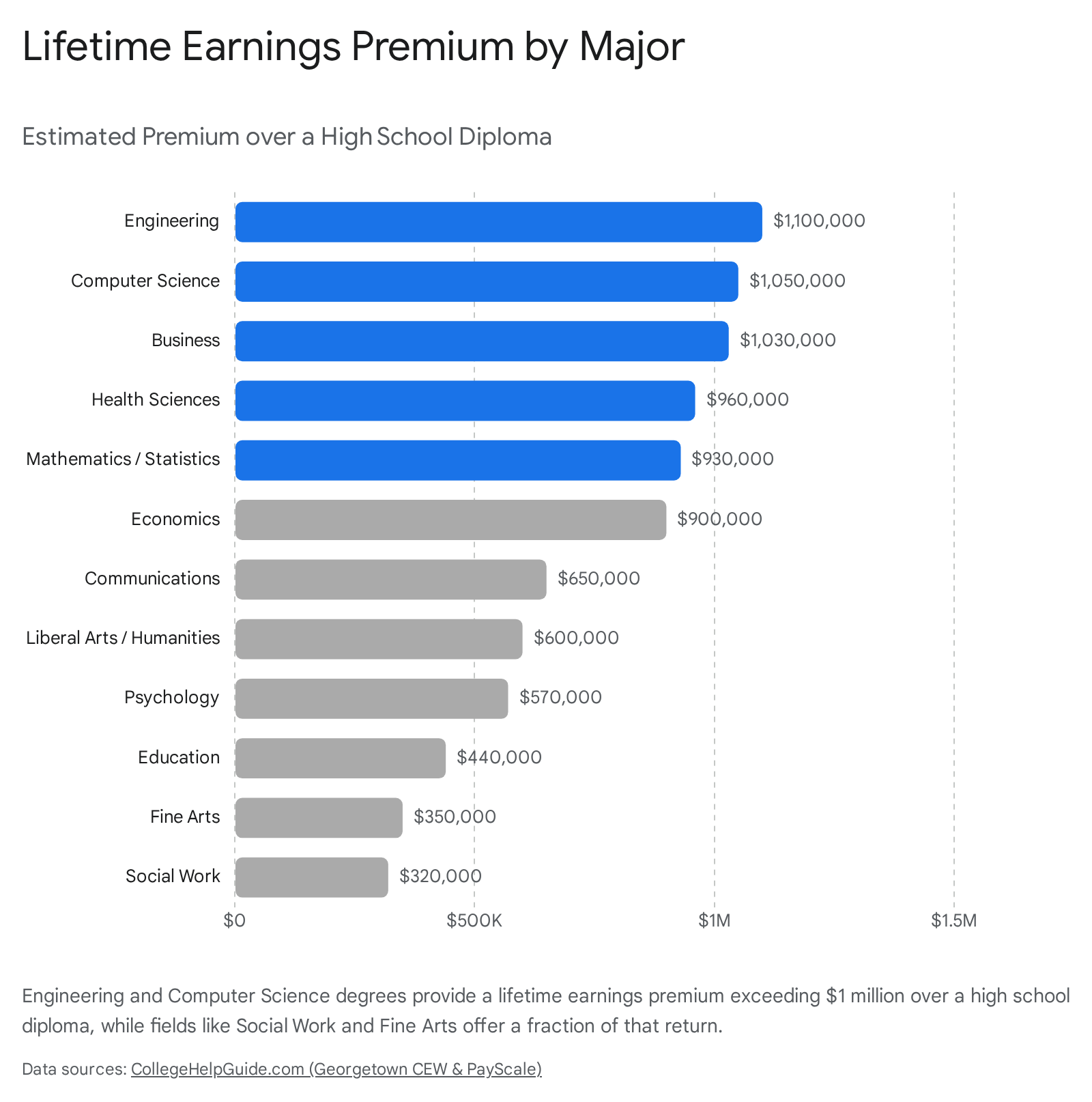
When strictly calculating expected lifetime income minus debt compared to working immediately after high school, the average net return on investment for a generalized engineering degree is estimated at $570,616, marking it as the most valuable broad field of study in the United States 1112.
The superiority of engineering degrees is heavily driven by immediate, high-paying labor market demand. Bureau of Labor Statistics (BLS) data and 2024 - 2026 U.S. Census figures analyzed by the Federal Reserve Bank of New York confirm that early-career salaries for engineers dramatically outpace the national median. While the national median salary for all early-career graduates sits near $45,000 to $56,153, specialized engineers enter an entirely different financial bracket 513. Computer engineering and chemical engineering majors boast early-career median earnings of roughly $80,000 to $90,000 immediately upon graduating 1314. Electrical, aerospace, and mechanical engineering majors secure early-career median salaries ranging from $75,000 to $78,000 14.
By mid-career, defined as workers between the ages of 35 and 45, the financial gap widens further. Aerospace engineering majors top the list of high mid-career earners with a median annual income of $125,000 14. Computer, electrical, chemical, and mechanical engineering majors all reliably cross into the six-figure threshold, with mid-career median earnings exceeding $115,000 annually 14.
Because these starting salaries are extraordinarily high relative to baseline degree costs, engineering graduates at public universities typically recover their total tuition and opportunity costs in an astonishingly brief two to four years 8. Furthermore, FREOPP data indicates that 97 percent of all engineering programs have an ROI exceeding $500,000, and 69 percent deliver a lifetime payoff of $1 million or more 6. This makes the major incredibly robust financially, virtually guaranteeing a positive return regardless of the specific prestige of the institution a student chooses to attend.
Computer Science: High Returns Amidst Market Evolution
Computer science acts as the closest financial peer to engineering, offering an identical timeline to break even and similarly astronomical lifetime value. Graduates holding a bachelor's in computer science enjoy a lifetime earnings premium of approximately $1.05 million and typically pay off their degree in just three years when attending a public institution 8. The five-year ROI percentage for a computer science and IT major is calculated at 310.3 percent, with graduates reporting a median annual wage of $95,000 just five years into their careers 155. At the absolute top end of the spectrum, graduates of elite programs - such as Harvard University's computer science track - can expect a net lifetime ROI exceeding $4 million, fueled by mid-career median incomes of $256,539 and astonishingly low median debt loads of $14,000 1112.
However, the labor market for computer science in 2026 is undergoing a period of structural evolution and heightened volatility. While the long-term ROI remains elite, the short-term landscape for new entrants has experienced turbulence. As major technology corporations recalibrated their workforces following pandemic-era overhiring binges, and as generative artificial intelligence began efficiently automating entry-level software coding and quality assurance tasks, demand for junior developers softened 5.
This macroeconomic shift is reflected in recent unemployment data. According to the Federal Reserve Bank of New York, the unemployment rate for recent computer science graduates rose to roughly 6.06 to 7.0 percent in early 2026, noticeably higher than the national average for all college graduates 67. Despite this hurdle at the entry level, the underemployment rate for computer science graduates remains quite low, sitting at approximately 16.46 to 19.0 percent 67. This critical metric indicates that while it may take slightly longer for a recent computer science graduate to secure their initial position in 2026, once they do, the role is highly likely to require their specialized degree and pay a commensurate premium salary, rather than forcing them into retail or administrative work.
| Academic Major | Early-Career Median Salary (Ages 22-27) | Mid-Career Median Salary (Ages 35-45) | Underemployment Rate |
|---|---|---|---|
| Computer Engineering | $80,000 | $125,000 | ~18.0% |
| Computer Science | $80,000 | $115,000 | 16.5% |
| Chemical Engineering | $80,000 | $115,000 | 16.4% |
| Electrical Engineering | $78,000 | $115,000 | 19.5% |
| Mechanical Engineering | $75,000 | $115,000 | 19.4% |
| Finance / Economics | $70,000 | $105,000 | ~31.0% |
Data synthesized from the Federal Reserve Bank of New York and the Bureau of Labor Statistics covering outcomes for bachelor's degree holders 1478.
The Healthcare Engine: Nursing and Clinical Sciences
While technology and engineering sectors capture significant attention for their maximum salary ceilings, nursing offers arguably the most compelling blend of high financial return, localized geographic demand, and near-absolute career stability.
Nursing ranks as a top-tier investment across multiple methodologies. Data analyzing Bureau of Labor Statistics figures calculates the five-year ROI of a nursing degree at 280.9 percent, with graduates reporting median annual wages of $86,000 five years into their careers 155. More critically, the unemployment rate for recent nursing graduates is an incredibly low 1.42 percent, paired with an underemployment rate of under 10 to 12.8 percent - the absolute lowest of any widely tracked academic major 568. The structural reality is that the healthcare industry simply cannot produce enough clinical practitioners to meet the accelerating demands of an aging global population, ensuring that nursing graduates face essentially zero friction when entering the workforce.
Within the nursing profession, the specific type of degree dramatically alters lifetime earnings. While Associate Degree in Nursing (ADN) prepared nurses earn a respectable average of $78,000 annually, nurses who complete a Bachelor of Science in Nursing (BSN) earn approximately $88,000 9. This $10,000 to $17,000 annual premium compounds massively over a 40-year career 9. Furthermore, a BSN acts as the necessary gateway to advanced practice roles. Nurses who leverage their bachelor's degree into a Master of Science in Nursing (MSN) or Doctor of Nursing Practice (DNP) access entirely new salary tiers. Nurse Practitioners (NPs) earn average salaries of $118,000, Clinical Nurse Specialists earn $114,000, and Certified Registered Nurse Anesthetists (CRNAs) secure average salaries of $217,000, rivaling or exceeding the pay of general practice physicians 9.
Nursing also offers a unique structural advantage in higher education: it completely circumvents the prestige premium. A degree does not require the backing of an elite, expensive private university to yield a top-tier return. A February 2026 analysis of 24,479 bachelor's degree programs using federal College Scorecard data revealed that nursing programs housed at community colleges that offer four-year bachelor's degrees deliver some of the best ROI in the entire national dataset 5. Because graduates of these local programs enter high-wage clinical careers with identical licensing to graduates of private institutions, but without the crippling six-figure debt load, their net ROI is wildly inflated. For students looking to maximize their financial return while aggressively minimizing upfront risk and tuition costs, an in-state public nursing degree remains one of the most mathematically efficient pathways to the upper-middle class 5.
Business, Quantitative Methods, and Economics
Falling just behind STEM and clinical healthcare are the quantitative business and applied mathematics majors. As a broad aggregate, business degrees carry a lifetime earnings premium of $1.03 million and typically require about eight years of work to pay off the initial educational investment 8.
However, "business" is a highly stratified category. The outsized returns within this umbrella belong strictly to students who focus their coursework on quantitative analysis, risk management, and logistics, rather than general management or human resources. * Accounting: Acts as the bedrock of business stability, offering a 261.3 percent ROI after five years with an exceptional early-career unemployment rate of just 1.88 percent 1558. * Finance and Economics: Both fields offer excellent median early-career salaries of $70,000 14. When looking at lifetime metrics against the net cost of the degree, a bachelor's in finance carries a lifetime ROI of 1,842 percent, while economics delivers a 1,707 percent return 5. However, these fields do feature higher underemployment rates (approximately 31 percent) compared to engineering, indicating that a significant portion of graduates end up in generic corporate roles rather than specialized high-finance positions 8. * Logistics and Supply Chain Management: Projected to grow by an aggressive 18 percent through 2032, these majors prepare students for highly lucrative careers optimizing global trade networks, procurement, and supplier relationships 10. * Data Science and Business Analytics: Straddling the line between business and technology, entry-level data analytics salaries range from $60,000 to $85,000, with mid-career professionals regularly exceeding $110,000 to $130,000 511.
Traditional mathematics and statistics majors also perform exceptionally well in the modern economy. Mathematics majors carry a lifetime premium of $930,000 and boast a rapid four-year payoff period 8. These degrees are prized for their versatility, allowing mathematically rigorous graduates to pivot seamlessly into high-paying domains like actuarial science, quantitative trading, or software development without needing a specific vocational degree.
The Science Trap: Life Sciences and the Graduate Degree Imperative
A pervasive misconception among incoming college students - and their parents - is that all degrees bearing the label of "science" automatically lead to high salaries and guaranteed employment. The empirical data reveals a much more complicated and dangerous reality, particularly concerning the life sciences and general biology.
While computer science and engineering degrees are considered "bachelor's-terminal" - meaning a four-year undergraduate degree is entirely sufficient to secure top-tier, six-figure industry jobs - biology is fundamentally not. Surprisingly, nearly 31 percent of all bachelor's programs in life sciences and biology yield a negative ROI when evaluating strictly undergraduate outcomes 6.
The core issue stems from labor market demand. A standalone bachelor's degree in general biology often qualifies graduates only for entry-level biological technician or laboratory assistant roles. These positions pay a highly modest average salary of roughly $52,000 per year and face a sluggish projected job growth rate of just 3 percent through the next decade 12.
To achieve the prestigious, high-paying salaries typically associated with the sciences, biology majors almost universally must attend graduate school - whether that means pursuing medical school, a specialized master's program, or a doctoral PhD track 24.
Pursuing advanced degrees fundamentally alters the ROI equation for the worse before it gets better. It adds multiple years of lost wages (compounding the opportunity cost) and drastically increases total student debt 24. While medical professionals like specialized physicians and surgeons are ultimately some of the highest earners in the global economy, the journey requires surviving up to a decade of high-interest debt accumulation and deferred earning potential 12. Even those who earn a PhD in biology often face bleak mid-career salaries hovering around $90,000 after dedicating eight years to post-baccalaureate study 25.
When prospective students are forced to choose between computer science and biology for a standalone bachelor's degree, the labor market heavily favors technology. Computer science offers vastly superior immediate job prospects, significantly higher starting pay, and maximum flexibility without the absolute, expensive requirement of attending graduate school 25. Students determined to blend these interests are increasingly advised to pursue highly quantitative crossover fields like biomedical engineering or bioinformatics, which marry the high-paying technical skills of engineering and data analysis with healthcare applications 112526.
The Humanities Exception: The Financial Power of Philosophy
Humanities and liberal arts degrees are frequently, and often rightfully, criticized for their low starting salaries and high rates of underemployment. However, treating all humanities majors as financially equivalent is a critical error.
Data compiled by PayScale and the National Association of Colleges and Employers (NACE) demonstrates that philosophy majors consistently and significantly out-earn graduates from any other humanities field over the course of their lifetimes 13. Philosophy students boast the highest starting salary among all humanities majors ($52,600) and experience the most dramatic percentage increase between their starting and mid-career pay, eventually reaching a median late-career salary of $94,300 13. This mid-career surge places philosophy majors above business management, chemistry, and nursing in terms of raw mid-career earnings potential 14.
The financial success of philosophy majors is rooted in cognitive sorting and skill translation. The rigorous demands of philosophy programs - which focus heavily on formal logic, ethical reasoning, and high-level persuasive writing - translate exceptionally well into lucrative, complex corporate environments 15. Philosophy majors frequently pivot into high-paying professional sectors such as corporate law, management consulting, and public policy analysis. Entry-level policy analysts and legal assistants start between $45,000 and $65,000, while those who transition into management consulting can see mid-career salaries exceed $130,000 1516. Furthermore, philosophy majors consistently achieve some of the highest scores on standardized graduate admissions tests like the LSAT and GRE, facilitating their entry into elite law schools and graduate programs that further multiply their lifetime earnings 17.
While they start slower than software engineers, liberal arts and philosophy graduates experience a well-documented "slow-start, strong-finish" earnings curve. According to the Georgetown CEW, liberal arts graduates eventually pull 25 percent above the median ROI at age 40 and beyond, as their broad communication and critical thinking skills become highly valuable prerequisites for senior leadership and executive management roles 8.
The Bottom Dwellers: Education, Arts, and Negative Returns
At the opposite end of the financial spectrum are academic majors where the exorbitant cost of the degree routinely eclipses the financial benefit, leaving graduates trapped in a cycle of high debt and low wages.
The Education Crisis
Despite the unquestionable societal importance of the teaching profession, undergraduate education degrees are financially punishing. A bachelor's degree in education carries a devastating lifetime ROI of negative 55 percent, representing a projected financial loss compared to entering the workforce with only a high school diploma 5.
Education majors have some of the lowest median lifetime earnings premiums of any bachelor's degree ($440,000) and can take 15 years or more to pay off their initial tuition costs 8. Exacerbating the low wages is the surprisingly high debt burden carried by these graduates. Among new bachelor's program graduates, those majoring in Curriculum and Instruction have the highest median debt of any major tracked by the Department of Education, owing an astonishing $46,820 upon graduation 18. When median salaries hover at $58,000 and total lifetime costs can approach $273,000, the mathematics of an education degree simply do not reconcile without substantial external scholarships or public service loan forgiveness programs 33.
Fine Arts and Social Sciences
Visual and performing arts, theology, and social work face similar, if not worse, financial headwinds. Fine arts majors carry a lifetime premium of just $350,000 and take an estimated 18 years to pay off 8. Social work degrees take nearly two full decades to break even 8. Nearly 70 percent of all programs in visual arts and music result in a negative ROI, as do the vast majority of programs in religious studies and theology 6.
Underemployment is rampant and structurally embedded in these fields. While computer science underemployment sits safely below 20 percent, the underemployment rate for recent criminal justice grads is nearly 66 percent, and for those pursuing careers in the performing arts, it approaches 64 percent 7. Graduates in these fields are statistically highly likely to end up working as baristas, retail managers, or administrative assistants - jobs that do not require a college degree at all, entirely negating the financial purpose of the credential while still requiring the graduate to service the debt 7.
The Debt Denominator: How Borrowing Destroys ROI
Return on investment cannot be calculated by analyzing income projections in a vacuum; the debt required to finance the degree acts as a heavy anchor on early-career wealth building, delaying homeownership, marriage, and retirement savings.
The Current State of Student Debt
The macroeconomic picture of student debt in the United States is grim. Total outstanding federal and private student loan debt reached $1.87 trillion in the first quarter of 2026, impacting over 44.6 million federal borrowers 1. Approximately 47 percent of the class of 2024 bachelor's degree recipients graduated with student loans, carrying an average balance of $29,560 1.
However, this debt is not distributed evenly across the student population. Students attending private, for-profit colleges take on the highest debt burdens, averaging $47,525 for a bachelor's degree 19. At private, non-profit schools, the average debt climbs to $39,548 19. Public universities offer a significant advantage, with bachelor's recipients borrowing substantially less - averaging $31,835 - due to state-subsidized tuition operations 19. Demographic disparities also exist; female bachelor's students borrow an average of $36,146 compared to male students who borrow $34,520 19.
Debt Burdens by Major
The most critical metric for evaluating the true cost of a specific major is the Debt-to-Earnings Ratio. This ratio divides the median debt accrued by graduates of a specific program by their median first-year earnings. The federal threshold for manageable debt is a ratio below 1.0, meaning total debt is less than one year's gross salary 3536. Over time, this ratio typically improves; for bachelor's degrees overall, the ratio drops from 0.703 in the first year after graduation to 0.485 by year four as salaries rise 37.
However, examining median cumulative federal debt across specific disciplines reveals why some majors are financially toxic.
| Bachelor's Degree Major | Median Cumulative Federal Debt | Market Demand / Payback Grade |
|---|---|---|
| Computer Science | $21,000 | Strong / Excellent |
| Mechanical Engineering | $22,800 | Strong / Excellent |
| Accounting and Related Services | $23,300 | Strong / Excellent |
| Nursing (RN, Admin, Research) | $22,200 | Strong / Excellent |
| Architecture | $25,300 | Mixed / Moderate |
| Education, General | $25,900 | Softer / Poor |
| Fine and Studio Arts | $22,700 | Softer / Poor |
| Business Administration/Commerce | $43,100 | Mixed / Varies |
Data compiled from the U.S. Department of Education College Scorecard evaluating typical federal borrowing by Title IV aid recipients 353839.
When debt is cross-referenced with expected starting salaries, the contrast is stark. High-performing degrees like a Bachelor's of Nuclear Engineering Technologies offer an incredible ratio where median debt represents just 16.4 percent of the median first-year salary 18. Conversely, graduates holding a Bachelor's in Educational Assessment, Evaluation, and Research have a catastrophic median debt-to-income ratio of 154.1 percent, meaning their debt is more than one and a half times their starting salary 18.
Hidden Variables: Time to Completion and Dropout Risks
Two frequently overlooked factors can systematically destroy the ROI of even the most prestigious college majors: elongated graduation timelines and failure to complete the degree.
The standard ROI calculation models assume a student seamlessly completes their bachelor's degree in exactly four years. In reality, a massive percentage of undergraduate students take five or even six years to earn their credential. Every additional semester destroys ROI through two distinct mechanisms. First, the direct cost: the student must finance additional tuition, mandatory fees, and housing. Second, the opportunity cost: the student delays their entry into the full-time professional workforce, permanently missing out on $50,000 to $80,000 in starting salary that could have been invested or used to pay down principal debt 5. Graduating in four years instead of five is one of the most mathematically effective ways to preserve a degree's financial return 5.
Furthermore, the most catastrophic financial outcome in higher education is not choosing a low-paying major; it is incurring student debt but failing to earn the credential. If a student drops out, the ROI of their college attempt is entirely negative. They must carry the financial burden of the non-dischargeable loans without receiving the employer-recognized earnings premium of the degree 6. When FREOPP analysts mathematically adjusted their institutional ROI models to account for the statistical risk of dropping out or taking longer than four years to graduate, the median financial value of a bachelor's degree plummeted from $306,000 to just $129,000 6.
The Geography of ROI: State Taxes and Cost of Living
A $90,000 salary in one state does not equal a $90,000 salary in another. The regional cost of living and specific state tax structures drastically alter the real-world purchasing power - and therefore the true ROI - of a degree.
The California vs. Texas Nursing Paradigm
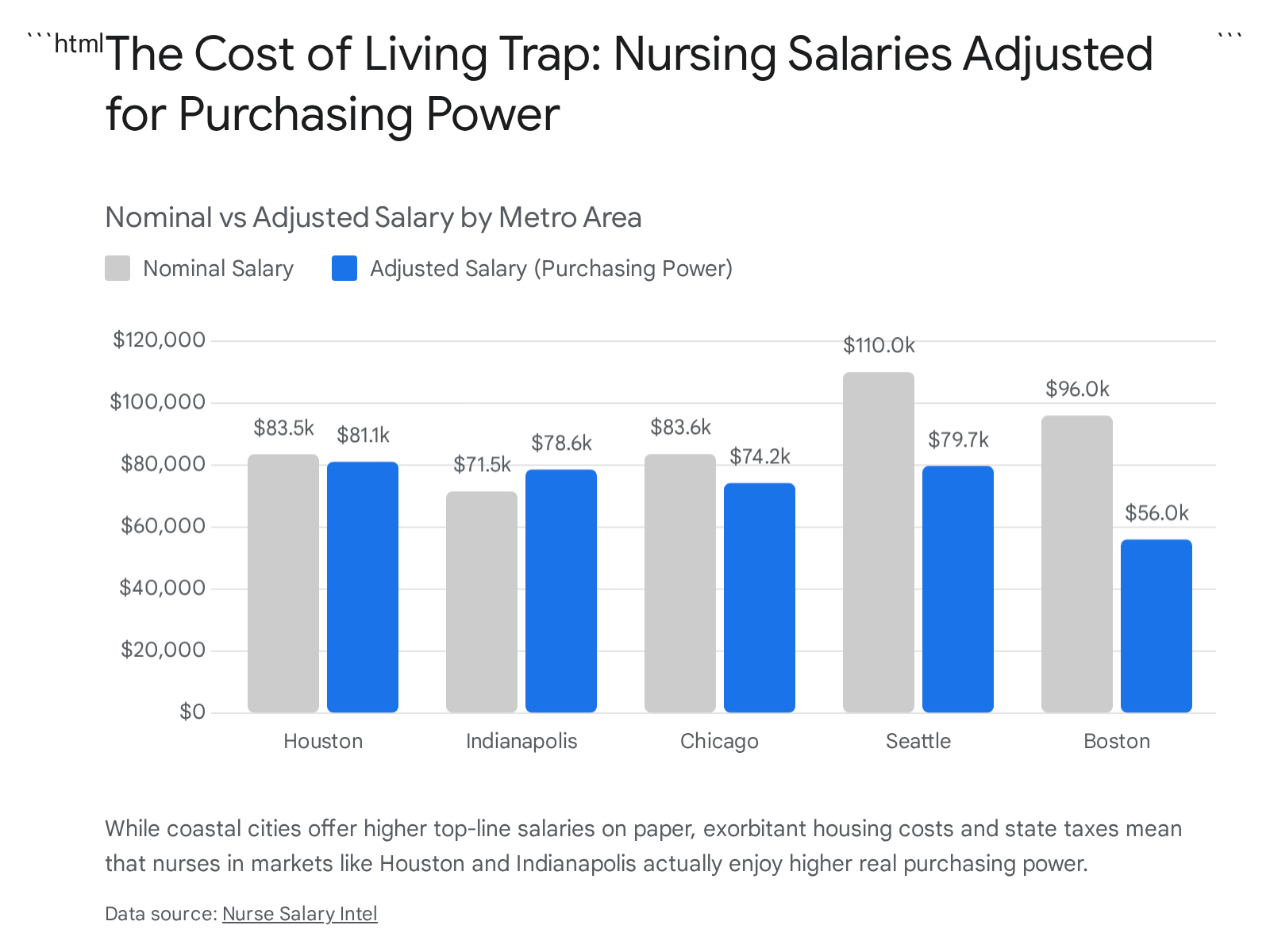
This phenomenon is highly visible in the nursing profession, where salaries are heavily localized. If analysts evaluate only nominal data (the raw number printed on an offer letter), California appears to be the undisputed champion for Registered Nurses, offering the highest average salary in the nation at $137,690 940. Hawaii ranks second at $119,710 40.
However, adjusting these top-line salaries for the local cost of living (housing, groceries, utilities) and effective state income tax paints a completely inverted picture. A nurse earning $137,690 in California loses a massive portion of their income to an 11 percent effective state tax rate and must navigate a cost-of-living index that is 42 percent above the national average 404120. In San Francisco, an RN nominally earning $133,340 actually sees their adjusted purchasing power drop to approximately $66,000 41.
Conversely, a nurse earning $83,500 in Houston, Texas, pays zero state income tax and faces a cost of living roughly equal to the national average 41. Once adjusted for real purchasing power, the Texas nurse actually enjoys a higher standard of living and more disposable income than a nurse making nominally $50,000 more on paper in coastal cities like Boston or New York 41.
Flagship vs. Regional Public Universities
When calculating ROI, the specific institution matters, but rarely in the way prestige-focused families assume. There is a pervasive cultural belief that attending a state's elite flagship university (such as UT Austin, UMass Amherst, or UW Seattle) will yield a vastly superior financial return compared to attending a lesser-known regional public university.
Data from the Georgetown CEW actively dismantles this assumption. For example, while the University of Washington-Seattle yields an impressive 40-year ROI of $2.62 million, its less selective land-grant counterpart, Washington State University, yields $2.28 million 4. When accounting for the massive difference in the cost of living between booming Seattle and rural Pullman, Washington, the real-world financial gap narrows significantly 4.
Similarly, the 40-year ROI of regional Texas campuses like Texas A&M-College Station ($2.46 million) and UT Dallas ($2.26 million) are remarkably close to the highly selective flagship UT Austin ($2.53 million) 4. In Massachusetts, the regional University of Massachusetts-Lowell and the flagship University of Massachusetts-Amherst both boast identical 40-year ROI values of $2.28 million 4. Regional public institutions allow students to earn degrees without incurring the premium tuition costs and competitive stress associated with flagship prestige, driving up their net financial return 4. In almost all scenarios across the modern economy, the major chosen dictates lifetime earnings far more heavily than the prestige of the university printed on the diploma.
Bottom line
The macroeconomic data is unequivocal: STEM degrees - particularly in engineering and computer science - and clinical healthcare degrees like nursing offer the highest, most reliable return on investment in higher education today. Graduates in these fields routinely see lifetime earnings premiums exceeding $1 million, face minimal underemployment, and can often pay off their student debt in under five years. Conversely, degrees in education, fine arts, and theology pose severe financial risks, frequently leaving graduates with non-dischargeable debt that vastly outpaces their earning potential.
However, selecting a high-ROI major is only one piece of the puzzle. To truly maximize the financial value of a degree, students must aggressively minimize student loan borrowing, graduate on a strict four-year timeline to avoid compounding opportunity costs, and build careers in geographic regions where exorbitant housing costs and state taxes do not silently erase their earnings premium.
- College Help Guide
- Visual Capitalist - Best Bang for Buck
- Student Choice - Popular College Degrees Ranked by ROI
- Voronoi App - Engineering Degrees ROI
- College Flight Path - Understanding ROI
- LendingTree - Student Loan Debt Statistics
- Education Data - Average Student Loan Debt
- Education Data - Average Debt for a Bachelor's Degree
- Student Loan Professor - Debt Statistics
- Best Colleges - Average Student Loan Debt
- Google Search Time
- Let's Data Science - Top Paying Majors
- New York Fed - College Labor Market
- BLS Weekly Earnings 2026
- BLS NY Economy at a Glance
- New York Fed - Survey of Consumer Expectations
- NATI - Georgetown ROI Report
- Georgetown CEW - Blog Year in Review
- Georgetown CEW - ROI 2025
- Globe Newswire - Georgetown ROI Tool Update
- Georgetown CEW - Explore ROI Rankings
- MBM College Consulting - Financial Matters
- Education and Career News - Maximize ROI
- Forbes - 80% of Students Seek Affordable Degrees
- Oglethorpe - College ROI Costs Outcomes Fit
- FREOPP - Is College Worth It?
- New York Fed - Outcomes By Major
- Georgetown CEW ROI 2025 Data
- LendingTree Student Loan Debt Statistics 2
- Education Data - Debt 2
- Student Loan Professor Debt 2
- Ramsey Solutions - Average Student Loan Debt
- Business Insider - Average Student Loan Debt
- College Flight Path - Financial Considerations 2
- Georgetown CEW - Regional Public Universities ROI
- California Competes - Degrees of Value
- MBM College Consulting - ROI Understanding 2
- JobsPikr - ROI on College Education
- CollegeWorth - Degrees by Payback
- National University - Best Degrees for Employment
- Poets and Quants - Best College Majors 2026
- Research.com - Best College Majors
- National University - Highest Paying Majors
- Best Colleges - Highest Paying Majors
- Quora - Engineering vs Biology vs CS
- Research.com - Science Degree Careers
- CBS News - College Majors Unemployment Rate
- Financial Aha - Debt Burden by Major
- CampusROI - Data Sources
- Robert Kelchen - Debt to Earnings Ratios
- IHEP - College Scorecard Updates
- GradFax - Student Debt by College
- Research.com - Philosophy Degree Salary
- Research.com - Philosophy Careers
- APA - Philosophy Majors After College
- Big Think - Philosophy Majors
- APA - Data
- World Population Review - Nurse Salary by State
- NurseWala - Highest Paying States for Nurses
- Research.com - Nursing Salary by State
- Nurse Salary Intel - Cost of Living
- Becker's Hospital Review - RN Pay by State Adjusted
- LendingTree - Student Debt Statistics 3
- Education Data - Student Loan Debt by Major
- Voronoi App - Median Student Debt
- Student Loan Professor - Indebtedness
- Education Data - Bachelor's Degree Debt
- College Flight Path - Understanding ROI 3
- Wally Boston - College ROI Study
- Reddit - CS vs Biology
- Forbes - Top 5 Most Popular College Degrees
- TuitionHero - Is Your Major a Money Pit
- CollegeWorth - Median Debt by Major