
How to Choose a College Major
Choosing a college major requires balancing intrinsic personal interests with hard data on labor market demands, long-term earning potential, and technological disruptions. Rather than relying on guesswork, students can utilize evidence-based psychological frameworks like the Holland Codes to test their academic aptitude, evaluate the lifetime financial return on investment of specific degrees, and use career prototyping to validate their choices before committing. Ultimately, the most resilient approach pairs specialized technical skills with adaptable human traits - such as through a carefully selected double major - to weather economic shifts and survive artificial intelligence-driven industry changes.
The decision of what to study in college is one of the most economically and psychologically consequential choices a young adult will make. Historically, students received conflicting advice, forced to choose between the romanticized ideal to "follow your passion" or the pragmatic command to "pick a practical degree that pays the bills." Modern educational research demonstrates that both extremes are structurally flawed. A purely passion-driven choice can result in underemployment and financial distress, while a purely market-driven choice frequently leads to academic burnout, low career persistence, and profound job dissatisfaction.
To navigate this highly complex decision, higher education researchers, labor economists, and behavioral scientists have developed robust, data-driven frameworks. These frameworks treat major selection not as a single gamble, but as a systematic process of human capital diversification. This comprehensive report examines the psychological models that predict academic success, the hard economic data behind degree valuations, the structural differences in global university systems, and the actionable strategies students can deploy to future-proof their academic choices in an increasingly automated world.
What Drives the Choice of a College Major?
Before examining how students should choose a major, it is critical to understand how they currently make these decisions. Research indicates that the selection process is rarely purely rational; it is heavily mediated by societal pressures, gender conditioning, familial expectations, and varying levels of access to accurate labor market data.
Gender Differences and Societal Conditioning
Significant disparities exist in how men and women approach major selection. A recent study of college sophomores analyzing gender differences in the major selection process found that 45% of men major in business and 35% in the humanities, whereas 58% of women major in the humanities and only 26% major in business 1. These choices directly contribute to the broader gender wage gap, as women disproportionately self-select into fields with historically lower economic yields 1.
The timing and drivers of these interests also differ. Approximately 48% of women develop an interest in their eventual college major by their sophomore year of high school, compared to only 29% of men 1. When evaluating influence factors on a Likert scale, men are significantly more influenced by the overall popularity of a major, traditional media (books and websites), general social media, YouTube, and the advice of extended family members like grandparents 1.
However, these choices are highly malleable when confronted with hard data. In one experimental intervention, when rising college sophomores were presented with accurate median salary data from Bankrate for various fields, 46% of the respondents immediately changed their major selections 1. A probit regression model confirmed that exposure to actual salary data significantly predicts the likelihood of a student switching their major post-intervention, highlighting that many initial major choices are based on informational deficits rather than genuine, unyielding passion 1.
The Role of Family and Cultural Capital
The influence of a student's socioeconomic background and "cultural capital" plays an equally massive, yet often concealed, role in major selection. This is particularly evident in rapidly developing nations and among international student populations. A massive nationwide study in China analyzing 19,772 college students revealed stark behavioral differences between urban and rural demographics 2. Urban students, particularly those from families with higher cultural capital, demonstrated a 32.4% increased likelihood of selecting humanities and social science majors 2. Conversely, rural students - who often prioritize immediate economic stability and upward mobility - were significantly more inclined to choose practical science, engineering, agricultural, and medical fields 2.
This dynamic is similarly observed among non-traditional Asian students in the United States. While traditional Asian American students often emphasize lucrative STEM careers to meet parental expectations, non-traditional students (those who are 25 or older, or balancing dependents) exhibit different patterns, often factoring in their immediate employment status and attendance intensity when selecting a major 3. The familial pressure to pursue culturally esteemed and financially lucrative STEM degrees remains a profound external driver that frequently overrides a student's internal vocational interests 3.
Evolving Student Orientations
Students also arrive at college with fundamentally different "orientations" toward higher education. Longitudinal research following students from their first year through their senior year identifies three primary orientations that guide major selection 4: 1. Career Orientation: Choosing a major strictly as a vocational credential to secure a specific job or gain entry to graduate school. 2. Interest Orientation: Choosing a major to explore broad, intrinsic curiosities, often delaying specific career alignment until later. 3. Course Orientation: Choosing a major purely based on which individual classes seem the most engaging or entertaining in the short term, with little thought to long-term implications.
These orientations are not static. Longitudinal interviews reveal that as students embed themselves in institutional contexts, their orientations shift, often moving from a broad "interest" orientation to a more focused "career" orientation as graduation and financial realities loom closer 4.
Assessing Internal Fit: Personality and Purpose
While external pressures are powerful, the foundation of a sustainable college major choice begins with the student's own psychological makeup. Educational psychologists emphasize that a poorly chosen major delays a student's progress, increases the likelihood of transferring or dropping out, and leads to deep dissatisfaction with their institution 5.
Personal Intelligence and the Choice of Major Scale (CMS)
Recent psychological research highlights the concept of "personal intelligence" (PI) - defined as an individual's capacity to reason about their own and other people's personalities - as a critical factor in academic success 5. Students who possess high personal intelligence navigate the major selection process much more effectively because they understand the personal attributes they need to "fit" into specific academic and career environments 5.
To measure this, researchers developed the Choice of Major Scale (CMS), a 26-item metric designed to represent a student's internal experience regarding their academic focus. The CMS evaluates factors across three broad conceptual areas: satisfaction (confidence, commitment), motivation (valuing work, autonomous choice, external rewards), and thinking about the major (exploration, personal growth, alignment) 5.
Studies across hundreds of students show a clear pattern: those with higher personal intelligence score higher in "Positive Choice" on the CMS 5. They exhibit more intrinsic motivation and confidence, and report lower levels of decision avoidance 5. Crucially, while these high-PI students actively consider more alternative majors initially, they ultimately choose and declare their final major more quickly than their peers 5. Once declared, they experience fewer changes in their major, exhibit better academic adaptability, and achieve significantly higher Grade Point Averages (GPAs) - often while requiring fewer hours of study 5.
The Holland Code (RIASEC) Framework
One of the most heavily researched and empirically validated frameworks for aligning personality with academic environments is John L. Holland's Theory of Career Choice, commonly known as the RIASEC model 67. This theory posits that both people and academic environments can be categorized into six distinct typologies. According to the theory, behavior is determined by the interaction between personality and environment, and people search for congenial environments that allow them to exercise their skills and express their attitudes 6.
| RIASEC Type | Core Characteristics | Ideal Academic Environments & Example Majors |
|---|---|---|
| Realistic (R) | Practical, hands-on, tool-oriented, physical coordination. Avoids abstract, theoretical tasks. | Mechanical Engineering, Agriculture, Construction Management, Athletics. |
| Investigative (I) | Analytical, intellectual, scientific, complex problem solving. Values theoretical knowledge. | Biology, Physics, Computer Science, Economics, Mathematics. |
| Artistic (A) | Creative, original, unstructured, expressive. Avoids highly ordered or repetitive activities. | Fine Arts, Literature, Graphic Design, Theater, Music. |
| Social (S) | Helping, healing, cooperative, empathetic. Focuses on teaching, counseling, and teamwork. | Nursing, Education, Social Work, Counseling Psychology. |
| Enterprising (E) | Persuasive, ambitious, energetic, leadership-oriented. Values economic gain and taking risks. | Business Management, Marketing, Pre-Law, Public Relations. |
| Conventional (C) | Organized, detail-oriented, data-driven, rule-following. Values accuracy and clear authority. | Accounting, Finance, Library Science, Data Administration. |
Table data synthesizing John L. Holland's RIASEC framework applications in higher education 676.
The concept of "congruence" is the beating heart of the RIASEC model. Congruence occurs when a student's personality type matches the academic environment created by the professors and peers within that major 66. As research shows, the environment of a major is heavily dictated by the faculty. For example, an Investigative environment like a biology department is created by professors with dominant Investigative personalities who prioritize mathematics, scientific method, and rigorous examination 6.
Extensive longitudinal research - including a massive study following 80,574 students across 87 colleges over a five-year period - demonstrates that high congruence between a student's RIASEC personality and their chosen major profoundly impacts their academic trajectory 6. High congruence predicts higher grades, a greater likelihood of persisting in the major, and a higher probability of graduating on time 6.
Conversely, incongruence leads to friction. An "Artistic" student who forces themselves into a "Conventional" accounting major purely for financial security will likely find the highly structured, rule-bound environment stifling. This lack of fit often leads to academic dissatisfaction, poor performance, and early dropout, entirely negating the perceived financial safety of the degree 66. While it is common for students to use simplified three-letter Holland Codes (e.g., SAI for Social, Artistic, Investigative), career experts warn against oversimplification; the model is designed to measure person-environment fit, not to restrict individuals into rigid boxes 7.
Applying the Ikigai Intersection
While Western career counseling relies heavily on trait-factor matching like RIASEC, global perspectives offer holistic, meaning-oriented alternatives. In recent years, academic counselors have increasingly applied the Japanese concept of ikigai (roughly translated as "reason for being" or "purpose in life") to the field of study choice 71112.
Unlike traditional models that focus primarily on aligning abilities with interests, the ikigai framework integrates psychological fulfillment with economic sustainability and social contribution. It challenges students to find an academic path that sits at the exact intersection of four distinct elements 1113: 1. What you love: Intrinsic interests, curiosities, and activities that bring joy. 2. What you are good at: Natural aptitudes, talents, and developed competencies. 3. What the world needs: Societal challenges, global demands, and areas where one can make a positive impact (e.g., environmental conservation, healthcare). 4. What you can get paid for: Economic viability, market demand, and the ability to sustain a living wage.
The utility of the ikigai model lies in mapping the overlaps.
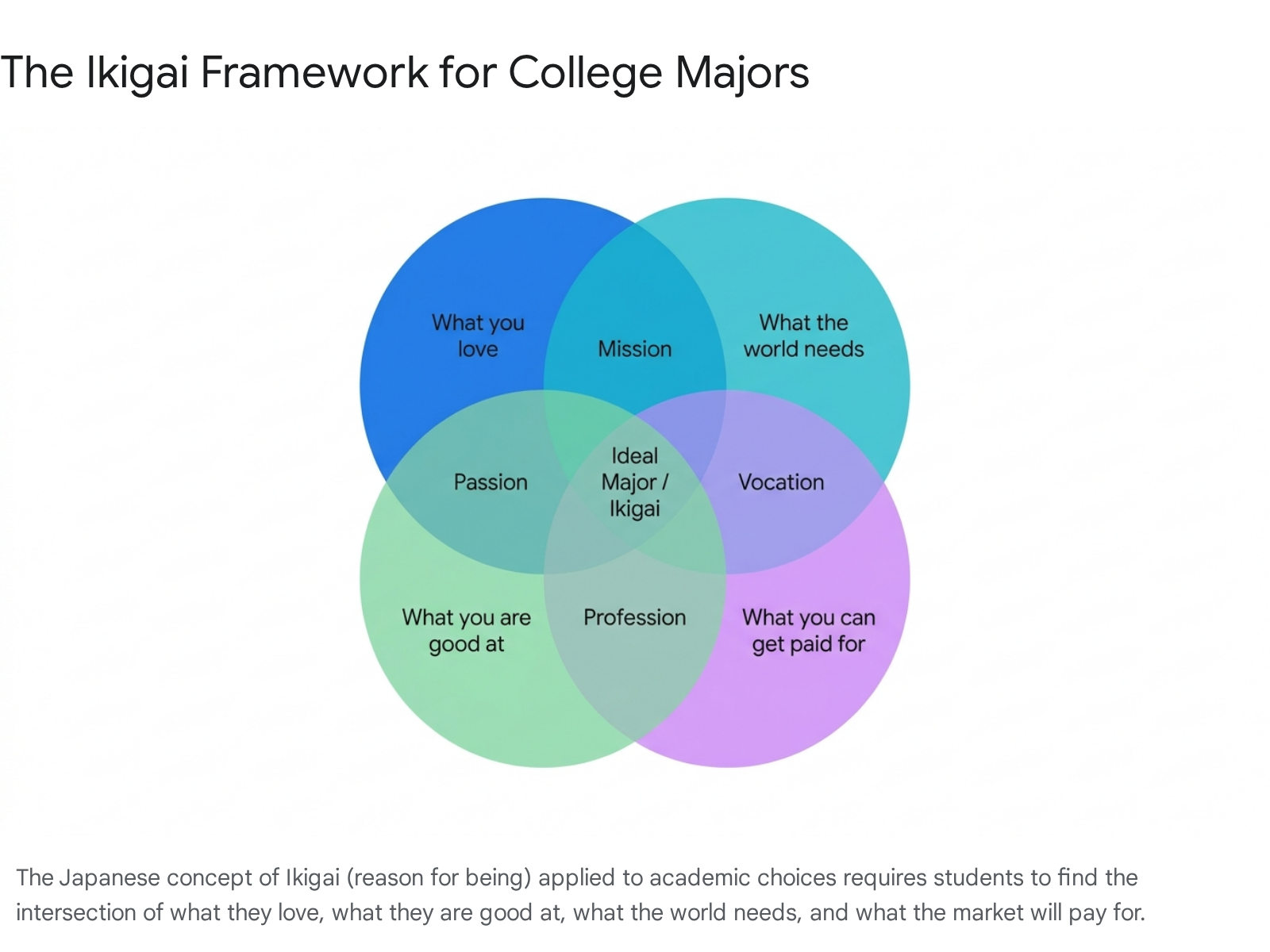
If a student chooses a major based only on what they love and what the world needs, they satisfy a "Mission" but may struggle with financial insolvency 13. If they choose based only on what they are good at and what pays well, they secure a "Profession" but risk long-term burnout and a feeling of existential emptiness 13.
Academic researchers note that the ikigai model aligns well with Self-Determination Theory (SDT), acting as a practical framework for satisfying the core psychological needs of autonomy (discovering values), competence (developing skills), and relatedness (contributing to society) 7. Furthermore, the model draws parallels to existential psychology, particularly Viktor Frankl's Logotherapy, which emphasizes the human pursuit of deeper meaning beyond mere hedonic satisfaction, and Morita therapy, which suggests that purpose is cultivated through modest, everyday actions and routines 7. By using ikigai as a reflective tool, Generation Z students - who increasingly express purpose-focused expectations over mere salary demands - can navigate career decisions with reduced anxiety and greater clarity 11.
Analyzing the Financial Return on Investment (ROI)
While psychological fit and a sense of purpose are prerequisites for personal fulfillment and graduating on time, the harsh economic realities of the modern labor market cannot be ignored. The financial stakes of selecting a college major are astronomical. Data from the Georgetown University Center on Education and the Workforce (CEW) indicates that the choice of major is often more economically consequential than the decision to attend college in the first place 89.
Over a lifetime, the average difference in wages between a high school graduate and a college graduate is approximately $1 million. However, the difference in lifetime earnings between the lowest-paying and highest-paying college majors is a staggering $3.4 million 8910. When evaluating a major, students must look beyond emotional appeal and analyze the hard metrics of educational ROI.
Lifetime Earnings by Educational Attainment
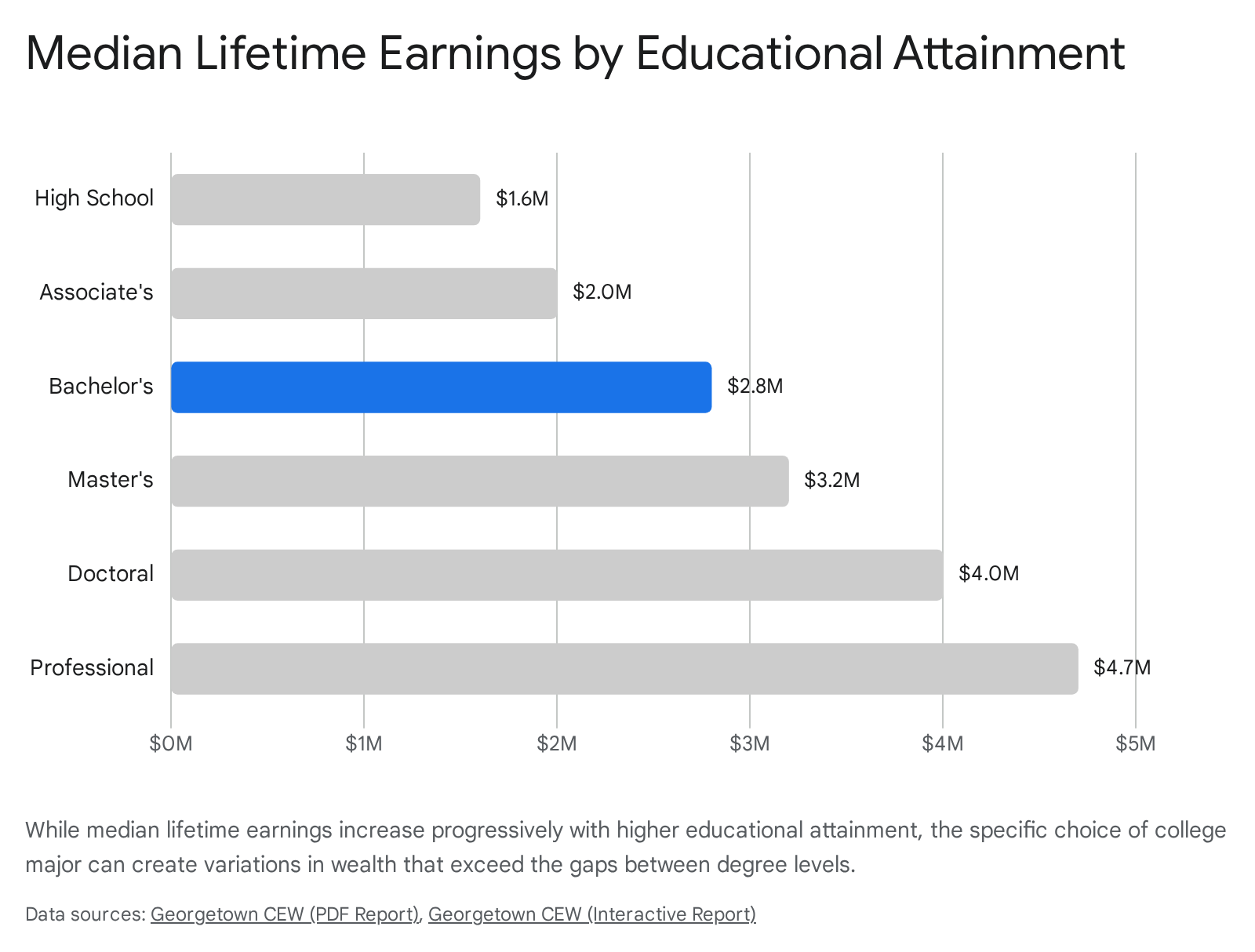
Before dissecting specific majors, it is vital to establish the baseline economic value of educational tiers. Earnings generally increase with every level of education attained, resulting in lower unemployment rates and higher wages 1112.
According to U.S. Bureau of Labor Statistics (BLS) data for 2024, workers with less than a high school diploma faced the highest unemployment rate (6.2%) and lowest median weekly earnings ($738), while those with professional or doctoral degrees enjoyed the highest earnings and lowest unemployment (around 1.2%) 11.
Median lifetime earnings by educational attainment for full-time, full-year workers illustrate this step-change 1219: * High School Diploma: $1.6 million * Associate's Degree: $2.0 million * Bachelor's Degree: $2.8 million * Master's Degree: $3.2 million * Doctoral Degree: $4.0 million * Professional Degree: $4.7 million
Despite these medians, a higher degree does not automatically guarantee greater wealth, and less education does not universally mandate poverty. Due to the massive variations in specific fields of study, there is substantial overlap between the percentiles of different degree levels 12. For instance, at least 16% of workers with only a high school diploma out-earn more than half of all workers with a bachelor's degree 12. Furthermore, 25% of associate's degree holders earn more over their lifetimes ($2.9 million at the 75th percentile) than the median bachelor's degree holder ($2.8 million), a phenomenon largely driven by highly lucrative, short-term sub-baccalaureate technical credentials in fields like engineering technologies and allied health 1220.
Starting vs. Mid-Career Earnings by Major
A critical, financially devastating mistake many students make when evaluating majors is looking exclusively at starting salaries. Some degrees offer explosive initial pay but plateau quickly, while others start slowly but offer massive mid-career wage growth and executive potential.
When analyzing prime-age workers (ages 25 - 54), the divergence in median earnings by field is severe. Georgetown CEW research analyzing U.S. Census Bureau data finds that median earnings range from $58,000 in education and public service fields up to $98,000 for STEM fields 13. Two of the highest-paying major categories - STEM and business - are also the most popular, accounting for roughly 46% of all college graduates 10.
However, assuming that all STEM degrees lead to extreme wealth, or that all humanities degrees lead to poverty, is statistically inaccurate. Median earnings at the broad field level hide considerable variation across specific majors 13. For example, within the STEM category, a worker with a bachelor's degree in petroleum engineering boasts median earnings of $146,000, while a graduate in miscellaneous agriculture has median earnings of just $64,000 13. Conversely, while the median range for the 19 primary humanities and arts majors is narrower ($58,000 to $73,000), 14 of those majors lead to median earnings above $65,000, placing them ahead of several biological science and agricultural degrees 13.
Furthermore, some college graduates with generally lower-paying majors ultimately out-earn their peers in higher-paying fields due to personal ambition and career trajectory: the top 25% of education majors earn $59,000 or more annually, while the bottom 25% of engineering majors earn $59,000 or less annually 89.
Data from the Federal Reserve Bank of New York, the U.S. Census Bureau, and the BLS highlights the significant trajectory differences among popular degree categories 142315:
| Major Category | Median Early-Career Salary | Median Mid-Career Salary | Trajectory & Employment Context |
|---|---|---|---|
| Aerospace Engineering | $76,000 | $125,000 | Highest mid-career earner across most data sets; highly specialized. |
| Computer Science | $80,000 | $115,000 | Highest early-career earners, but currently facing an elevated 6.8% unemployment rate for recent graduates due to tech market volatility. |
| Business / Finance | $55,000 - $70,000 | $88,000 - $110,000 | High variance. Accounting boasts the lowest underemployment (18%). Finance leads mid-career growth. |
| Psychology | $45,000 | $70,000 | Slower start; often requires attaining a graduate degree to unlock higher clinical earning brackets. |
| Early Childhood Ed. | $39,000 | $43,000 | Consistently ranks among the lowest-earning bachelor's degrees over a lifetime. |
Table data aggregated from Federal Reserve Bank of New York, U.S. Census Bureau, and BLS analyses for 2023-2025 101314.
The Liberal Arts "Catch-Up" Effect
The public debate between STEM disciplines and the liberal arts often centers entirely on immediate employability. Ten years after graduation, the numbers appear to validate the skeptics: liberal arts students show an ROI of roughly $62,000, which is 40% lower than the median across all colleges 16.
However, researchers tracking 40-year time horizons note a profound "catch-up" effect. Over a 40-year career, the Net Present Value (NPV) of a liberal arts education rises to $918,000 - which is 25% higher than the median ROI for all colleges 16. By this metric, liberal arts colleges actually have the third-highest long-term value among the 14 institution types in the Carnegie Classification system, trailing only the top two tiers of elite doctoral research institutions 16.
This delayed financial acceleration is attributed to two primary factors. First, liberal arts majors have a high propensity to pursue graduate degrees 16. Because a bachelor's degree holder earns an average of $61,000 annually while a graduate degree holder earns $78,000, this further schooling creates a massive wage premium 817. Second, the "soft skills" emphasized in the humanities - critical thinking, complex communication, and adaptability - become increasingly valuable as professionals transition out of entry-level technical roles and into lucrative upper-management and executive leadership positions later in their careers 916.
Demographic variables also heavily influence these outcomes. Geography matters significantly; students tend to search for jobs near their universities, meaning schools situated in high-income regions like New England and the Mid-Atlantic naturally produce higher unadjusted ROI figures 16. Furthermore, gender and racial disparities remain persistent. On average, female graduates earn roughly 27% to 28% less than their male counterparts across associate, bachelor's, and master's degree levels 15.
Does Your Major Actually Dictate Your Career?
A common, paralyzing anxiety among college students is the belief that choosing a major permanently locks them into a single, lifelong career track. Census data and labor market tracking prove this is largely a myth.
The Disconnect Between Degrees and Jobs
For the graduating class of 2024, only 41% of graduates were employed in a field directly related to their field of study. By the class of 2025, that number had plummeted to just 30% 18. Furthermore, 26% of 2025 graduates secured employment in fields entirely unrelated to their degree 18.
This disconnect highlights a fundamental shift in the labor market. While degree requirements are actually resurging - with 71% of employers now requiring a two- or four-year degree for entry-level roles (up from 55% in previous years) - employers increasingly view a bachelor's degree as a baseline proxy for cognitive ability, discipline, and trainability, rather than a strict certification of specialized trade skills 1819. A degree lends credibility and signals a certain level of commitment to a hiring manager, but it does not rigidly constrain the applicant's trajectory 19. In fast-paced, creative, or technical fields, a robust portfolio of tangible projects and continuous skill development is frequently more impactful than the specific title of the degree on the diploma 19.
Market-Driven vs. Passion-Driven Decision Models
When evaluating this disconnect, business strategy research on "market-driven" versus "market-driving" strategies offers a useful parallel for career planning 20.
Students who adopt a purely market-driven approach base their major solely on current labor shortages and high starting salaries. While this strategy yields excellent short-term gains (securing the first job), it often fails to provide long-term prosperity or sustainable competitive advantage if the individual lacks genuine interest in the field, leading to burnout 2021. Conversely, students who adopt a purely passion-driven approach often struggle initially; studies show that 65% of individuals state an inability to perfectly balance their passion with a financially viable career 21.
The most successful graduates utilize a hybrid model 223223. In hybrid career pathway selection, students leverage data-driven market analytics (understanding where the high-growth sectors are) while cross-referencing those insights with their internal competencies and passions (the Ikigai approach) 23. This ensures they enter fields where they have the intrinsic motivation required to upskill continuously, which is the true driver of long-term success 2123.
How Will Generative AI Impact College Majors?
The rapid proliferation of Generative Artificial Intelligence (AI) since late 2022 has injected unprecedented volatility into major selection. Occupations that were once considered safe, lucrative harbors - such as entry-level software coding, basic financial auditing, data entry, and copywriting - are facing the immediate threat of automation or severe augmentation 2425.
Student Anxiety and Shifting Academic Paths
This technological shift is acutely felt by the student body. A recent Lumina Foundation-Gallup survey of students pursuing bachelor's and associate degrees found that a staggering 47% had considered changing their majors because of AI 26. Ultimately, 16% of currently enrolled students explicitly changed their major or field of study due to fears regarding AI's potential impact 27. The anxiety is not evenly distributed; it is most concentrated among men (21% changed majors compared to 12% of women) and those in technology fields, where 70% of students have heavily pondered the longevity of their chosen path 2627. Beyond major selection, approximately one in seven students cited preparing for AI and technological advances as a primary reason for enrolling in higher education in the first place 27.
Analyses from the Federal Reserve indicate that Mathematics, Computer Science, Engineering, and Accounting are among the collegiate fields most exposed to generative AI language models and image generation 24. This exposure is a double-edged sword: it means these jobs will either be partially automated away (reducing overall labor demand) or massively augmented (increasing the productivity, wage premium, and value of the human operator) 2428. In contrast, students studying natural sciences and healthcare are currently the least likely to rethink their majors, as the physical interventions required in medicine and laboratory science remain largely insulated from digital AI capabilities 26.
Building AI Resilience Through Transferable Skills
Experts strongly warn against attempting to find an entirely "AI-proof" major, noting that artificial intelligence will eventually impact every discipline across the economy. Instead of fleeing to perceived safe havens, students are advised to focus on academic programs that teach adaptability, critical thinking, ethical reasoning, and how to work alongside rapidly changing technologies 2629.
The strongest signal from the current labor market is the sheer scale of AI adoption, with project demand growing by more than 230% in a single year 40. Employers are aggressively seeking professionals who understand Large Language Models (LLMs), Retrieval-Augmented Generation (RAG), and cloud security 2540.
However, technical depth alone is no longer sufficient. The most in-demand professionals will not be those with hyper-niche knowledge of a single, easily automated coding language, but those who can move fluidly between domains 40. The ability to connect the dots between AI, data governance, cloud architecture, and cybersecurity is becoming a superpower 40. An engineering graduate who understands legal compliance, or a data executive who understands ethical constraints and AI bias, becomes vastly more attractive to employers than a pure technician 294041. Consequently, majors that offer multidisciplinary approaches, foster lifelong learning habits, and emphasize human-centric soft skills are positioned to weather technological disruptions most effectively 2941.
Structural Flexibility: US vs. International Systems
The strategy for choosing a major is heavily dictated by the geographic region and the specific educational philosophy of the institution. As international student mobility increases, many students weigh the flexibility of the American liberal arts model against the highly specialized European and Asian models. Understanding these structural differences is vital for long-term planning.
The American Exploratory Model
The United States higher education system features over 4,000 degree-granting institutions that generally follow a breadth-based, liberal arts philosophy. A typical bachelor's degree spans four years, with the first two years heavily dedicated to general education clusters and electives 424330. Students are frequently not required to formally declare a major until the end of their sophomore year 45.
This structure provides significant breathing room. It is designed for students who want to explore diverse interests, sample multiple disciplines, and discover hidden passions before narrowing their focus 423031. In the U.S. system, changing majors is relatively common and procedurally straightforward, though the tradeoff is a longer time to degree completion and significantly higher tuition costs 424331.
European Specialization and Asian Meta-Majors
In stark contrast, European education is largely harmonized under the Bologna Process, which standardizes a three-cycle model (Bachelor, Master, Doctorate) across 46 countries 42. European bachelor's programs typically last only three years (equivalent to 180-240 ECTS credits) and are highly specialized from day one 4243.
When applying to a European university, particularly in the UK or Germany, students do not simply apply to the university; they apply to a specific degree program and are expected to have a clear understanding of their career direction 304531. There is little to no general education outside the major discipline 4245. While this path shaves a full year off tuition and living costs and allows for faster entry into the labor market, it is highly rigid; changing paths may require entirely restarting the degree 424331.
| Structural Feature | United States Universities | European Universities (Bologna Framework) |
|---|---|---|
| Standard Duration | 4 Years | 3 Years (some 4-year exceptions) |
| Major Declaration Timeline | Typically late sophomore year | Chosen strictly at the time of initial application |
| Curriculum Structure | High emphasis on general education, electives, and clusters | Highly specialized from day one; focused solely on the discipline |
| Flexibility to Pivot | High (relatively easy to change majors mid-stream) | Low (changing paths may require restarting the degree) |
| Cost & Speed | Higher total cost, slower entry into the workforce | Lower overall tuition, faster entry into the labor market |
Table data aggregated from international education and university admissions analyses comparing structural academic models 4243304531.
Educational structures in rapidly developing nations enforce different types of rigidity. In China, for example, traditional admission mechanisms required a joint "college-major" choice upfront, creating high-pressure environments where changing a major later was practically impossible 32. Recently, some Chinese institutions have adopted "meta-major" reforms (a college-then-major deferred choice), allowing students to enter broad categories (like "science-related majors") for two years before specializing 32. However, the intense competition and influence of family cultural capital still make the environment highly restrictive compared to the U.S. exploratory model, which is why the American system remains highly attractive to international students seeking academic freedom 2323334.
The Strategic Advantage of Double Majoring
For students torn between the high starting salaries of STEM degrees and the long-term executive adaptability of the humanities, the double major presents a compelling structural solution. Approximately 10% to 20% of college graduates pursue a double major 3536.
However, the primary benefit of a double major is frequently misunderstood by both students and parents. Economic research indicates that double majoring does not inherently guarantee a massive premium in starting salary compared to a single degree in a high-paying field. In fact, within one year of graduation, a double major might earn slightly less than a peer with a single, highly specialized technical degree 35.
Human Capital Diversification in Economic Downturns
Instead of viewing the double major as a lottery ticket for higher immediate pay, researchers from the National Bureau of Economic Research (NBER) suggest treating it as a form of insurance - specifically, "human capital diversification" 3637. Just as a savvy investor diversifies a financial portfolio across various asset classes to protect against market crashes, a student can diversify their skill set to protect against industry downturns and automation 37.
During economic slumps or periods of rapid labor market volatility, individuals with double majors demonstrate profound financial resilience. Data spanning from 2009 to 2019 reveals that double majors experience a massive 56% reduction in the impact of income fluctuations (such as pay cuts or job losses) compared to single majors 3637. While single majors feel the full, unprotected brunt of wage declines in their specific sector, double majors are shielded 3637.
Crucially, the protective value of the double major depends entirely on how distant the two fields are from one another. Students who major in two unrelated fields (e.g., Engineering and Philosophy, or Computer Science and English) are buffered from earnings shocks by 64% 3637. Conversely, students who choose two closely related fields (e.g., Economics and Finance, or Sociology and Psychology) only see a 36% reduction in risk 3637. By combining an analytical, quantitative STEM discipline with a communication-heavy, qualitative humanities discipline, a student creates a highly versatile, transdisciplinary professional profile 353839. These individuals are less likely to work in occupations narrowly related to their majors, and more likely to thrive in complex roles that require diverse problem-solving - making them highly valuable to employers and incredibly difficult to replace with AI 3639.
How to Prototype Your Major Before Committing
Deciding on a major should not be an abstract, theoretical exercise done entirely by reading university course catalogs. Career development experts advocate for "prototyping" - a concept borrowed from engineering and design thinking - to test academic and career hypotheses quickly and cheaply before committing tens of thousands of tuition dollars 40.
Applying the Designing Your Life methodology to higher education involves treating potential majors as prototypes that can be tested in the real world through two primary avenues 40:
Informational Interviews and Career Conversations
Rather than guessing what a career is like based on media representations, students should actively seek out alumni or professionals currently working in their fields of interest. These 30-to-60 minute "prototype conversations" are not job interviews; they are strict data-gathering missions 404142.
Students are advised to send a polite, concise email stating their major, their interests, and requesting a brief phone call or meeting 414344. During the interview, students should ask targeted, revealing questions: What is a typical day actually like? What parts of your job are the most frustrating? What major genuinely prepared you for this work? What skills are you currently lacking? 414245. This practice quickly shatters romanticized illusions about prestige professions, grounds the student's expectations in reality, and often leads to valuable networking referrals 4243.
Job Shadowing and Auditing
While an informational interview provides a narrative, job shadowing provides raw, observational data. Job shadowing takes the prototype one step further by allowing a student to spend anywhere from half a day to a full week observing a professional in their actual workplace 414244.
Shadowing allows a student to gauge the true environment - the pace of the office, the nature of the teamwork, the management styles, and the physical demands of the role 4244. Observing non-verbal cues and daily stressors provides a visceral clarity that can save years of misdirected academic effort 44. Furthermore, showing the initiative to shadow signals to employers that the student is proactive, providing concrete examples to discuss in future job interviews 44.
Additionally, students unsure about a major should sit in on upper-level lectures (auditing) in that specific department to gauge if the subject matter remains engaging beyond the introductory 100-level courses. By aggressively prototyping through interviews and shadowing, a student minimizes the risk of the "sunk cost fallacy," where they feel compelled to finish a degree they dislike simply because they have already completed a few semesters.
Bottom line
Choosing a college major is a high-stakes, multifaceted decision that permanently shapes early earning potential, professional resilience, and long-term life satisfaction. Students achieve the optimal outcomes when they align their intrinsic personality traits (using tools like the RIASEC model and the Ikigai framework) with evidence-based market realities, recognizing that while specialized technical degrees offer high initial salaries, the liberal arts offer slow but steady gains in executive management. Ultimately, the most successful graduates treat their education not as a rigid, inescapable track, but as an opportunity to build a diversified portfolio of skills - often through unrelated double majoring and aggressive real-world career prototyping - capable of adapting to an unpredictable, AI-driven global economy.