
Social proof as a cognitive shortcut in online consumer decisions
The transition of consumer behavior from physical retail environments to digital ecosystems has fundamentally altered how individuals assess risk, evaluate quality, and finalize purchase decisions. In the absence of physical product inspection, tactile verification, and direct interpersonal interaction with knowledgeable sales personnel, the e-commerce landscape necessitates a reliance on alternative, digitally mediated trust signals 1. Chief among these signals is social proof, a psychological and sociological phenomenon wherein individuals copy the actions, beliefs, and feedback of others to navigate ambiguous or uncertain situations 23. The term, originally codified by psychologist Robert Cialdini in his 1984 work on the psychology of persuasion, describes the innate human tendency to assume that the surrounding collective possesses superior knowledge regarding the appropriate mode of behavior 234.
While the fundamental evolutionary psychology of conformity remains static, its modern digital manifestations have evolved into highly sophisticated mechanisms. From aggregated star ratings and user-generated textual reviews to real-time live-streaming concurrent viewer metrics and algorithmically generated review summaries, social proof functions as the primary cognitive shortcut driving online commerce. By observing the aggregated behavior of a larger group, a consumer effectively offloads the cognitive burden of product evaluation onto the collective, mitigating perceived risk and accelerating the path to purchase 45. However, as digital marketplaces become increasingly saturated with algorithmic curation, artificial intelligence, and manipulative interface designs, the efficacy of social proof is undergoing a complex transformation, balancing between profound persuasive power and the growing threat of algorithmic trust fatigue 468.
Theoretical Foundations of Cognitive Processing
The efficacy of social proof in digital environments is deeply rooted in the architecture of human cognition, specifically the necessity to conserve mental resources when faced with complex, unfamiliar, or overwhelming information. E-commerce platforms naturally generate high cognitive load due to an abundance of choices, dynamic price points, competitive marketing claims, and the spatial separation between the buyer and the product.
Dual-Process Theory and Heuristic Adoption
Human decision-making is heavily influenced by the dual-process theory of cognition, which delineates between two distinct modes of thought: System 1, which is intuitive, automatic, emotional, and heuristic-based; and System 2, which is analytical, slow, deliberative, and logical 7. In a saturated digital marketplace, consumers frequently lack the motivation, temporal bandwidth, or cognitive capacity to engage in a rigorous System 2 evaluation of every available product attribute 89. Consequently, they default to System 1 heuristics - mental shortcuts or rules of thumb - relying on environmental cues and peripheral signals to estimate product quality and reduce perceived risk 11011.
Social proof operates as one of the most prominent and powerful of these heuristics. This phenomenon aligns with bounded rationality, the concept that human decision-making is limited by the cognitive tractability of the problem, the information available, and the time permitted to make a choice 9. Instead of seeking the absolute optimal decision through exhaustive research, consumers "satisfice" by leaning on the experiences of previous buyers. This behavior satisfies both an informational need, which is the desire to make an objectively correct purchasing choice based on peer validation, and a normative need, which is the psychological pressure to conform to the expectations or trends of a group in order to feel a sense of belonging or avoid social exclusion 214.
The degree to which a consumer engages in heuristic processing is often modeled using the Elaboration Likelihood Model (ELM) and the Stimulus-Organism-Response (S-O-R) framework 121314. When involvement is low or cognitive load is exceptionally high, consumers follow the peripheral route of the ELM, making rapid judgments based almost entirely on surface-level social proof cues, such as the total volume of reviews or the presence of a "best seller" badge 1913. Furthermore, a six-level information processing model suggests that cognitive biases map unevenly across different stages of attitude formation, indicating that social proof interventions must be perfectly timed within the user interface to effectively intercept the consumer's decision-making process before analytical resistance builds 915.
Taxonomy of Social Influence Biases in E-Commerce
The broad umbrella of social proof is not a monolithic concept; rather, it interacts with and triggers multiple distinct cognitive biases, each manipulating different facets of consumer perception and judgment. Understanding these specific biases is necessary to categorize how various e-commerce platform features influence purchasing behavior. Recent academic frameworks propose that many of these seemingly disparate biases share underlying fundamental beliefs - namely, the human desire to confirm existing worldviews and the reliance on confirmation bias as a unifying genesis for decision-making errors 19.
| Bias Classification | Psychological Mechanism | Digital E-commerce Manifestation |
|---|---|---|
| Bandwagon Effect | The tendency to adopt beliefs or behaviors simply because a vast majority of others have already done so, driven by the assumption of collective safety and validity 41416. | "Best Seller" tags, total items sold counters, high review volumes, and follower metrics on social media profiles 51117. |
| Authority Bias | The attribution of greater accuracy, weight, and credibility to the opinions of perceived experts or figures of high social status 141618. | "Expert Reviewer" badges, influencer endorsements, professional certifications, and curation by platform algorithms 41920. |
| In-Group / Conformity Bias | The psychological tendency to favor the behaviors and choices of individuals perceived as similar to oneself, valuing their input over out-group members 21418. | Customer testimonials highlighting specific demographic traits, user-generated photos demonstrating real-world use, and peer recommendations 421. |
| Availability Heuristic | Judging the likelihood, quality, or popularity of an event based on how easily and recently examples come to mind 14. | Persistent display of highly rated products on landing pages and algorithms constantly surfacing viral trending items 117. |
| Loss Aversion / FOMO | The psychological preference for avoiding losses over acquiring equivalent gains, driving urgent action to prevent exclusion or resource depletion 1920. | Real-time notifications of low stock, pop-ups showing recent purchases by other users, and limited-time offer countdowns 4720. |
These cognitive biases rarely operate in isolation within modern digital interfaces. Marketers frequently architect environments that compound these biases to maximize heuristic processing and minimize critical thought. For instance, a product page might simultaneously deploy authority bias through an expert endorsement while leveraging the bandwagon effect by displaying a notification that hundreds of users have purchased the item within the last hour 416. This layered approach creates a robust psychological pressure matrix that rapidly accelerates the path from product discovery to transaction completion 111.
The Impact of Product Involvement on Social Proof Efficacy
The degree to which consumers rely on social proof as a cognitive shortcut is heavily contingent upon the product's inherent risk profile, a concept classified in marketing literature as the product's "involvement" level. First articulated thoroughly in the 1980s, the level of product involvement remains one of the most critical moderating variables in determining how consumers process informational influence 2223.
High-Involvement Product Dynamics
High-involvement products are generally characterized as items that are complex, expensive, infrequently purchased, or carry significant consequences regarding personal safety, identity, and environmental impact 22. Examples include luxury electronics, automotive purchases, advanced software subscriptions, and specialized healthcare products 142223.
When evaluating high-involvement products, the financial or physical stakes are elevated, resulting in heightened consumer uncertainty. To mitigate this substantial perceived risk, consumers actively seek cognitive reassurance, heavily scrutinizing social proof metrics before committing to a transaction 1523. In these scenarios, the display of detailed product reviews generates a significantly more pronounced impact on conversion rates compared to cheaper items. Research indicates that the introduction of reviews for a lower-priced product might increase conversion rates by approximately 190%, whereas the presence of identical review structures for a high-priced, high-involvement product can escalate conversion rates by an exceptional 380% 24.
In high-involvement contexts, consumers tend to shift away from simple volume-based heuristics (the bandwagon effect) and place greater emphasis on the qualitative depth of the social proof, heavily relying on authority bias and expert endorsements to validate their choices 16. The presence of detailed, well-written, and informative reviews significantly bolsters the website's overall reputation, fostering the deep consumer trust required for expensive transactions 14. Notably, cost alone does not exclusively define involvement. Inexpensive but highly consequential products - such as baby food or organic apparel - also exhibit dynamics consistent with high-involvement decision-making, where the qualitative substance of star ratings and social responsibility claims dramatically outweigh basic price considerations 2223.
Low-Involvement Product Dynamics
Conversely, low-involvement products are characterized as everyday commodities that are frequently purchased, relatively inexpensive, and carry minimal risk of buyer's remorse 22. For these goods, consumers are significantly less motivated to expend cognitive energy reading extensive textual reviews. Instead, they rely heavily on the peripheral route of persuasion, trusting simple visual heuristics such as a high star-rating average or a massive volume of total reviews 1121.
The demographic profile of the consumer also intersects with product involvement to dictate social proof efficacy. Research focusing on adolescent consumers demonstrates a high susceptibility to peer influence and social proof marketing. Experimental data reveals that positive product reviews significantly increase the likelihood of adolescent purchasing behavior 1025. However, the same studies show that layering excessive social proof cues - such as combining static positive reviews with dynamic pop-up messages about other buyers' real-time purchases - can actually reduce the overall persuasive impact on younger demographics, suggesting an upper limit to cognitive load where excessive nudging triggers skepticism rather than compliance 1025.
Mathematical Dynamics of Consumer Trust and Star Ratings
While qualitative user-generated content provides necessary narrative context, quantitative metrics - specifically aggregated star ratings - serve as the primary, immediate gateway for digital social proof. However, empirical research reveals that the relationship between mathematical perfection and consumer trust is highly non-linear, subverting traditional expectations regarding product evaluations.
The Rating Anomaly and the 4.7 Threshold
A widespread and intuitive assumption in digital marketing is that a perfect 5.0-star average yields the highest possible conversion rate. Extensive data analysis conclusively refutes this assumption. Groundbreaking research conducted by the Spiegel Research Center at Northwestern University, utilizing massive databases of consumer packaged goods ratings supplied by PowerReviews, identified a distinctly non-linear relationship between average star ratings and purchase likelihood 2324.
Across multiple product categories and varying price points, purchase probability does not scale uniformly with higher ratings. Instead, conversion rates typically peak when a product's average rating falls within the 4.0 to 4.7 range 24.
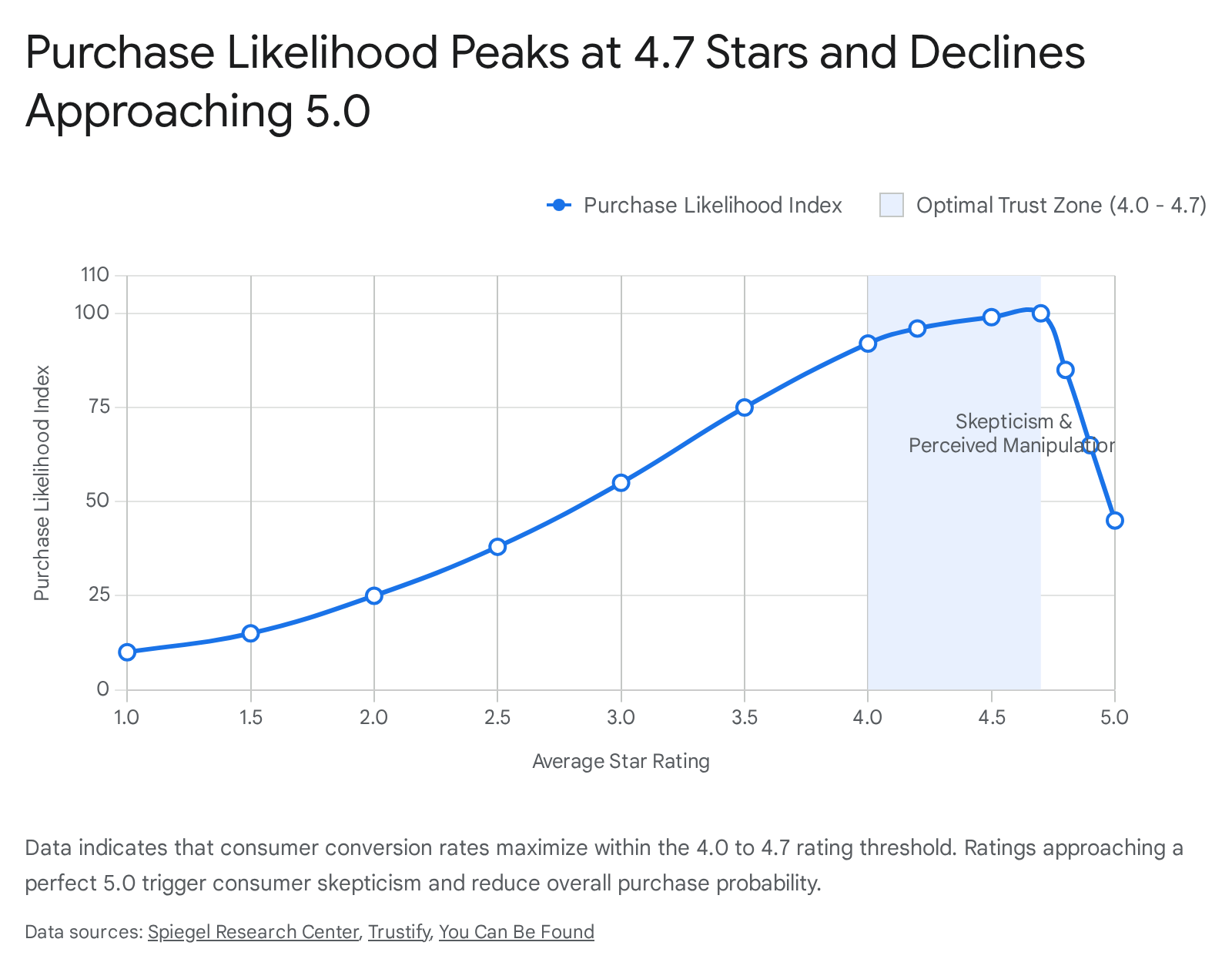
As the average rating breaches the 4.7 threshold and approaches a perfect 5.0, purchase likelihood demonstrably decreases 2324.
This phenomenon, frequently referred to in industry analyses as the "uncanny valley of ratings," is rooted in modern consumer skepticism and a sophisticated pursuit of authenticity 2631. A flawless 5.0 score across a substantial volume of reviews is mathematically and statistically improbable. Genuine consumer ratings naturally follow a right-skewed distribution; while the majority of satisfied customers may award five stars, a natural subset of buyers will invariably note minor subjective flaws and award four stars, while a smaller cohort will experience genuine issues and leave highly critical feedback 26. Consequently, an average that typically stabilizes between 4.5 and 4.8 represents a mathematically authentic distribution of human experience 2627.
When modern consumers encounter a product with hundreds of exclusively perfect reviews, they interpret it not as an indicator of divine quality, but as a severe red flag for systemic manipulation. A perfect score suggests the deployment of purchased fake reviews, the aggressive filtering of negative feedback, or the use of incentivized rating systems 3127. Therefore, a rating of 4.7, complete with a visible minority of moderate or negative critiques, signals a realistic, unmanipulated product history, thereby establishing superior credibility compared to a flawless facade 2627.
Review Volume, Verification, and Negativity Bias
Beyond the numerical average, the sheer volume of reviews and the verification status of the reviewers heavily influence social proof mechanics. As products transition from zero reviews to displaying early customer feedback, conversion rates escalate rapidly. The purchase likelihood for a product with just five reviews is approximately 270% greater than that of a product with zero reviews 2428. However, the marginal benefit of additional reviews exhibits diminishing returns; while climbing from zero to five reviews is highly impactful, climbing from fifty to one hundred reviews provides a much smaller incremental boost to conversion 2428. Furthermore, excessive review volume can occasionally overwhelm consumers, leading to choice paralysis and reducing purchase intentions if the sheer amount of data creates unmanageable cognitive load 14.
The source credibility of the rating further modulates its effectiveness. Reviews appended with a "verified buyer" badge generate substantially higher trust than anonymous submissions. Statistical analysis reveals that verified purchasers are significantly more likely to leave positive four- or five-star ratings, whereas anonymous reviewers are disproportionately responsible for highly critical one- and two-star ratings 24. This disparity indicates that unverified channels are frequently utilized for emotional venting, trolling, or malicious competitive sabotage rather than authentic product evaluation 24. Because human psychology is wired with a negativity bias - the tendency to focus on and remember negative information more vividly than positive experiences - consumers are highly sensitive to these critical reviews, making the presence of authentic, verified positive feedback essential to counteracting unwarranted negative noise 1414.
Cross-Cultural Variances in Social Proof Processing
While cognitive biases and reliance on heuristics are universally human traits, the specific weight, interpretation, and application of social proof vary significantly across global consumer markets. The most robust academic framework for understanding these geographical and societal discrepancies in e-commerce behavior is Geert Hofstede's Cultural Dimensions Theory, first developed in 1980 through extensive survey data collected from over 117,000 IBM employees worldwide 293031.
Hofstede's model evaluates national cultures across six distinct dimensions, including Power Distance Index (PDI), Individualism versus Collectivism (IDV), Masculinity versus Femininity (MAS), Uncertainty Avoidance Index (UAI), Long-Term Orientation (LTO), and Indulgence versus Restraint (IVR) 293031. In the context of digital social proof, the spectrum of Individualism versus Collectivism serves as the most profound determinant of how consumers interpret peer influence and make online purchasing decisions 3732.
Collectivistic Market Dynamics
In collectivist cultures, which are predominantly located across East Asia, Southeast Asia, and Latin America, individuals define their self-image interdependently within the context of a broader, cohesive social network 313732. Societal norms in these regions prioritize group loyalty, social harmony, consensus, and the maintenance of strong interpersonal relationships over individual autonomy 3139.
In these markets, the efficacy and necessity of social proof are exceptionally high. Consumers are highly susceptible to normative social influence and tend to evaluate products largely based on their social attributes 393334. For example, when evaluating a product, a collectivist consumer prioritizes whether the item is suitable as a gift to maintain familial relationships or whether it aligns with prevailing group aesthetics to ensure social integration 33. Purchasing decisions frequently involve extended discussions within family units or reliance on established social group consensus prior to transaction execution 3334.
Consequently, e-commerce strategies targeting countries like China, India, and South Korea rely heavily on demonstrating massive community endorsement, highlighting crowd wisdom, and utilizing live-streaming environments that foster a warm, collective, and interactive atmosphere 3233. Marketing messages that emphasize group identity (the "we" rather than the "me") and leverage high power distance by utilizing highly respected societal authorities are significantly more effective 293234.
Individualistic Market Dynamics
Conversely, individualistic cultures - most prominent in the United States, the United Kingdom, Australia, and Western Europe - prioritize personal achievement, self-reliance, autonomy, and the expression of a unique identity 313732. Consumers in these regions possess loose-knit social frameworks and view products through the lens of personal utility, intrinsic reward, and self-expression, rather than communal integration 373239.
While social proof remains a highly effective cognitive shortcut in individualistic markets, its underlying mechanics differ significantly. Consumers in these regions are more likely to conduct independent pre-purchase research, focusing heavily on objective product performance specifications, contractual guarantees, and data-driven comparative analyses 3733. When they look to social proof, they are primarily seeking objective validation of functional quality (informational social influence) rather than seeking permission to conform to a group standard 22933. E-commerce platforms targeting individualists succeed by emphasizing verified purchase data, personalized recommendations, clear competitive advantages, and symbols of personal success 373933.
| Cultural Dimension | Primary Motivation | E-Commerce Focus | Highly Effective Social Proof Mechanisms |
|---|---|---|---|
| Collectivist (e.g., China, South Korea, India) | Group harmony, consensus, social relationship maintenance, long-term orientation 293933. | Social attributes, gift-giving potential, community integration, interpersonal value 33. | Large-scale crowd wisdom, community endorsements, family recommendations, interactive live-stream environments focusing on shared experience 323334. |
| Individualist (e.g., US, UK, Australia) | Personal achievement, autonomy, expression of unique identity, short-term utility 313732. | Functional utility, specific product performance, competitive superiority, personalization 373933. | Expert/authority reviews, detailed unboxing content, individual verified buyer testimonials, personalized data matching, emphasis on individual benefits 373933. |
Algorithmic Ecosystems and Live Commerce
The traditional infrastructure of digital retail - characterized by static product catalogs augmented by asynchronous written reviews - is currently undergoing a massive structural shift, being rapidly supplanted by dynamic, algorithmically driven social commerce. Platforms integrating highly personalized video feeds have redefined the consumer journey by entirely collapsing the traditional marketing funnel, merging entertainment directly with real-time purchasing capabilities to create a new paradigm known as "shoppertainment" 353637.
Immersive Video, Real-Time Purchasing, and the Dual-Route Mechanism
The scale of this shift is unprecedented; in 2025, the global Gross Merchandise Value (GMV) of TikTok Shop alone reached an estimated $64.3 billion, driven by an interface that leverages short-form algorithmic video and live-streaming 3538. This immersive environment supercharges traditional social proof mechanisms. Rather than passively reading delayed text reviews, consumers watch real people - influencers, creators, and fellow users - demonstrating and validating products in real-time 363738.
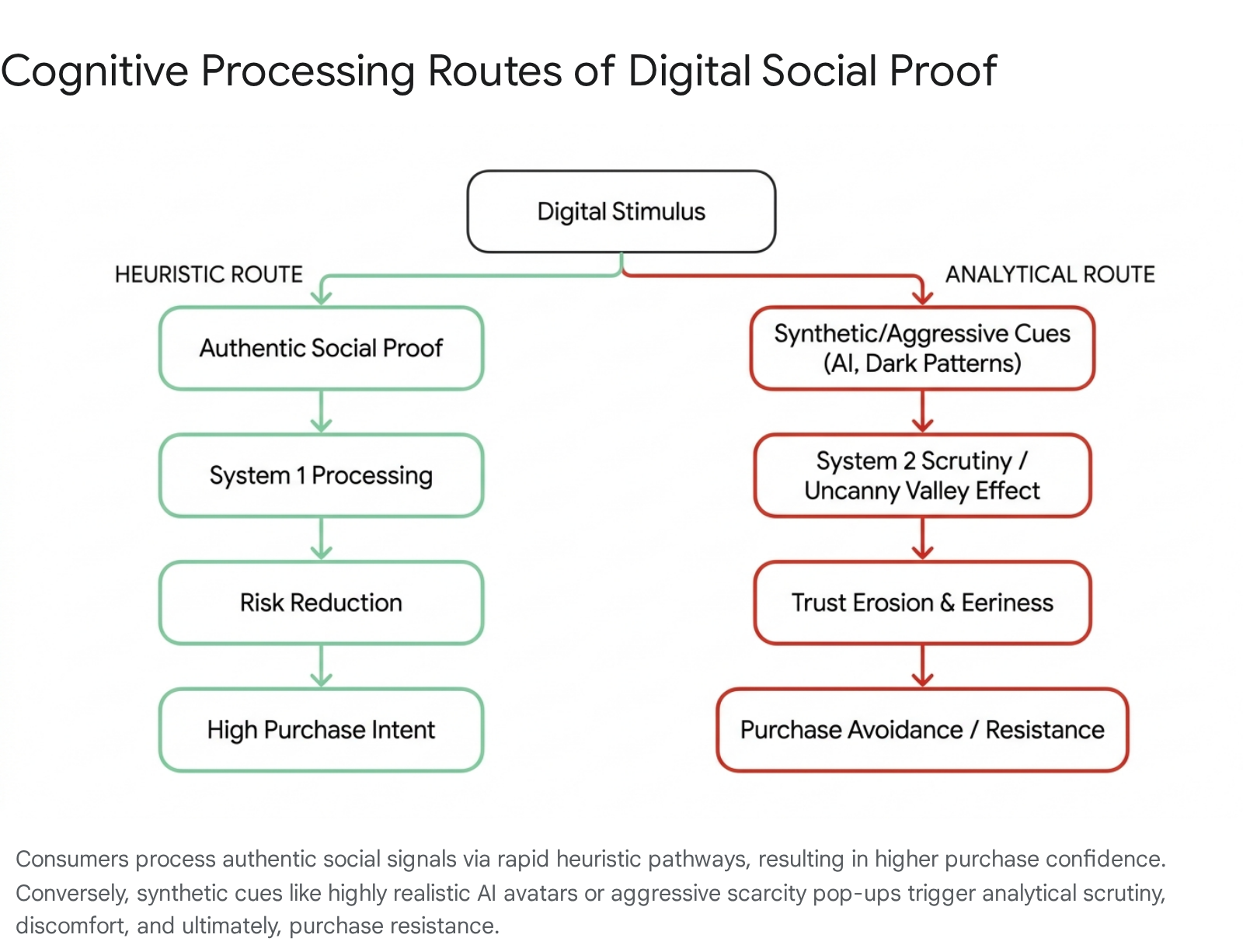
This format triggers intense heuristic processing through a dual-route framework of decision-making 12. The live broadcast creates an artificial environment of extreme social immersion and psychological time pressure. The highly visible presence of concurrent viewer counts, a rapidly scrolling chat interface filled with real-time comments, and continuous on-screen pop-ups indicating immediate purchases by others all activate the bandwagon effect and the fear of missing out (FOMO) to an unprecedented degree 41236. Sophisticated recommendation algorithms amplify this effect by matching highly targeted video content with integrated, frictionless payment systems, resulting in immediate, impulsive conversions driven by cue-driven heuristics before the consumer's System 2 analytical processing can logically intervene 123536.
The Uncanny Valley of Virtual Streamers
As live commerce scales globally, platforms and enterprise brands have increasingly experimented with replacing human influencers with artificial intelligence-driven virtual avatars to host continuous, cost-effective sales streams. However, the deployment of these digital entities has revealed complex psychological limitations regarding source credibility and social proof validity.
Academic research in human-computer interaction highlights that highly realistic virtual streamers - particularly AI avatars designed to mimic real celebrities - trigger a profound psychological aversion known as the "Uncanny Valley Effect" (UVE) 3940. Originally hypothesized by robotics professor Masahiro Mori in 1970, the uncanny valley theory posits a non-linear relationship between how human-like an entity appears and how people emotionally respond to it 3941. As an entity becomes increasingly human-like, affinity grows, but right before the entity achieves perfect human realism, there is a severe dip in affinity, replaced by feelings of eeriness, discomfort, and disgust 394041.
In the high-stakes context of live-streaming sales, this perceived eeriness functions as a severe and systematic disruption to social proof 39. The cognitive dissonance caused by subtle, unnatural imperfections in the avatar's facial expressions, vocal synthesis, or micro-movements systematically degrades the avatar's source credibility across three critical dimensions: physical attractiveness, perceived expertise, and most importantly, trustworthiness 3940. Because the fundamental premise of social proof relies on trusting the authentic, lived experience of the entity recommending the product, the synthetic nature of the avatar prompts consumers to question the sincerity and validity of the product claims, viewing the interaction as manipulative rather than informative 3940. This chain of mediation - from virtual entity presence, to heightened perceived eeriness, to the erosion of source credibility - ultimately results in a marked decline in consumer purchase intention compared to streams hosted by flawed but authentic human beings 39.
Interestingly, the uncanny valley effect is highly context-dependent. Studies assessing the use of androids versus humanoids in static, text-based online hotel bookings found that the uncanny valley effect is largely diminished in low-immersion, visually mediated environments, but is aggressively reactivated when consumers are prompted to imagine close, real-time interaction with the synthetic entity, precisely the environment simulated by live commerce 41.
Trust Erosion, Artificial Intelligence, and Digital Fatigue
Despite the historically documented success of social proof in driving e-commerce, the relentless over-saturation of marketing messages and the aggressive optimization of digital platforms have birthed a profound counter-trend: algorithmic trust fatigue, skepticism, and active consumer resistance. As the digital marketplace becomes increasingly gamified, consumers are developing sophisticated psychological defenses against perceived manipulation.
Deceptive Interfaces and Dark Patterns
When platforms attempt to artificially simulate social proof or weaponize cognitive biases, the strategy frequently backfires, creating long-term brand damage. E-commerce sites routinely deploy "dark patterns" - user interface design choices deliberately crafted to coerce, steer, deceive, or pressure users into making hasty decisions that are not in their best interest 425043. Common examples of these deceptive practices include aggressive urgency notifications (e.g., highlighting that "10 people are looking at this property right now" to create artificial scarcity), "confirmshaming" (wording decline options to induce guilt), disguised advertisements, and forced continuity in subscription models 7504445.
While these tactics successfully exploit fundamental biases like loss aversion and FOMO in the short term, their ubiquitous application across the internet has severely degraded their efficacy 72044. A large-scale analysis of thousands of online shopping interfaces revealed that modern consumers increasingly recognize these aggressive cues not as helpful information, but as manipulative "sludge" intended to inhibit deliberative thinking 87. Rather than acting as a comforting cognitive shortcut, fake urgency and manipulative social proof trigger psychological reactance 746. When users feel their digital autonomy is threatened by high-pressure tactics, they consciously switch from compliant System 1 processing to highly critical System 2 evaluation, resulting in heightened skepticism, immediate cart abandonment, and a reduction in long-term company credibility 74243.
Generative Artificial Intelligence and Algorithmic Aversion
The recent, widespread integration of Generative Artificial Intelligence (AI) and Large Language Models (LLMs) into the review ecosystem introduces the most significant modern threat to the validity of social proof. In an effort to scale content, platforms increasingly host fully AI-generated customer reviews, or deploy AI systems to synthesize thousands of individual reviews into concise, auto-generated summaries placed at the top of product detail pages 134748.
The scale of this synthetic content injection is massive; data from major platforms like AliExpress highlights a dramatic increase in AI-generated reviews, rising from just 0.83% of total reviews in 2020 to an estimated 7.1% in 2024 13. Because LLMs can generate text with sophisticated grammatical fluency, impressive coherence, and perfectly mimicking sentiment, consumers fundamentally struggle to differentiate between genuine human feedback and synthetic, machine-generated text 134849.
However, when the presence of AI generation is explicitly disclosed, or even strongly suspected due to overly pristine phrasing, the value of the review as a trust signal completely collapses. Empirical experiments across diverse geographic markets - including recent PLS-SEM modeling utilizing the Theory of Reasoned Action (TRA) and Elaboration Likelihood Model (ELM) in emerging markets like Nigeria - reveal that consumers experience intense "algorithmic aversion" 131947. Consumers view AI-generated content as inherently less authentic, completely effortless, and entirely devoid of the actual lived, sensory experience that is strictly necessary to constitute genuine social proof 131949.
The knowledge that a review was generated by a machine fully mediates the relationship between the review's content and the consumer's purchase intent, resulting in significant drops in perceived product quality and subsequent willingness to buy 1347. Furthermore, while AI-generated review summaries (AGRS) are intended to reduce information overload and assist consumers, research shows they provide negligible uplift in high-trust scenarios and can actively undermine consumer confidence if users suspect the underlying data pool contains synthetic, manipulated inputs 48.
Manifestations of Digital Fatigue and Consumer Resistance
The relentless bombardment of personalized algorithmic recommendations, manipulative push notifications, and the lingering suspicion of synthetic social proof has resulted in a heavily documented phenomenon known as "digital fatigue." Qualitative phenomenological research focusing on urban e-commerce consumers indicates that individuals are experiencing profound emotional exhaustion, cognitive overload, and decision-making paralysis when forced to navigate algorithm-driven environments 6. Consumers report feeling overwhelmed by the sheer volume of choices and the aggressive nature of personalization, which paradoxically reduces their tolerance for commercial digital stimuli 6.
In response to this exhaustion, consumers are not merely passively ignoring platforms; they are actively engaging in robust resistance strategies designed to reclaim their digital agency and protect their cognitive bandwidth 6. Studies indicate a sharp rise in privacy-enhancing behaviors, such as exclusively browsing in incognito mode, routinely clearing cookies, and utilizing sophisticated ad-blocking extensions to obfuscate personal behavioral data from tracking systems 6. More subversively, younger and highly tech-savvy demographics have been observed engaging in active "algorithm hacking" - intentionally clicking on irrelevant products, leaving false digital trails, or deliberately abandoning carts to confuse the platform's recommendation engine, thereby escaping hyper-targeted social proof traps 6. Older demographics tend to favor complete withdrawal methods, temporarily uninstalling applications or retreating entirely to offline, non-algorithmic channels for purchasing 6. In this landscape of high skepticism, consumer trust is shifting away from platform-mediated social proof and returning to highly vetted, direct human recommendations from close family and peer networks .
Conclusion
Social proof remains the foundational cognitive shortcut in online consumer decision-making. By leveraging deeply ingrained heuristic processing pathways, digital platforms allow consumers to bypass exhaustive analytical scrutiny, relying instead on the aggregated wisdom of the crowd, the endorsement of perceived authorities, and the momentum of trending behavior to mitigate the inherent risks of digital purchasing. The efficacy of these mechanisms is highly context-dependent, varying dramatically based on product involvement levels, pricing structures, and macro-level cultural orientations that span from collectivist desires for group consensus to individualistic pursuits of personal utility.
However, the architecture of digital trust is growing increasingly fragile. The distinct, non-linear relationship between star ratings and purchase likelihood demonstrates that modern consumers possess an acute sensitivity to manipulated perfection, interpreting flawless social proof as a signal of deception rather than quality. As platforms increasingly deploy artificial intelligence to synthesize reviews, utilize virtual avatars to automate live commerce, and embed aggressive dark patterns in pursuit of unyielding conversion optimization, they risk triggering widespread digital fatigue and profound psychological reactance. For social proof to maintain its power as a functional cognitive shortcut, it must preserve its most fundamental requirement: verifiable authenticity. As the technological capacity to synthesize consensus accelerates at an unprecedented pace, the e-commerce platforms and brands that prioritize transparent, ethically grounded, and distinctly human validation will command the highest long-term market trust and consumer loyalty.