
Psychology of effective testimonials and social proof
Foundational Mechanisms of Social Influence
Human decision-making operates under significant cognitive constraints, requiring mechanisms to bypass exhaustive analytical evaluation for every choice. Social proof functions as one of the most robust heuristics in this ecosystem, providing a mental shortcut where individuals assume the actions, beliefs, or endorsements of others reflect correct behavior for a given situation. While contemporary analysis applies this concept to digital commerce and marketing, the psychological architecture of social proof is rooted in foundational sociological and psychological experiments of the twentieth century.
The mechanism was first distinctly isolated by social psychologist Muzafer Sherif in 1935 through his experiments on the autokinetic effect, which demonstrated how individuals naturally seek guidance from peers when navigating highly ambiguous environments 12. Sherif's work established the concept of informational social influence, a state in which people lack confidence in their own knowledge and subsequently default to the collective consensus, assuming the group possesses superior information 12.
Decades later, Solomon Asch expanded this understanding through his 1951 line judgment tasks, demonstrating normative social influence. Asch proved that individuals would conform to a group's publicly stated opinion even when the group was objectively incorrect, driven by an innate psychological desire to avoid friction, be accepted, and align with group norms 123.
In modern commercial environments, these twin pillars - informational and normative influence - govern the efficacy of testimonials and user-generated content. Consumers utilize product reviews, influencer endorsements, and case studies to resolve ambiguity regarding product quality (informational influence) and to align their consumption habits with their desired peer groups (normative influence) 134. However, as the volume of available social proof has exponentially increased across digital platforms, consumers have evolved complex cognitive filters to distinguish between authentic peer consensus and orchestrated manipulation.
The Persuasion Knowledge Model
To understand the differential efficacy of modern testimonials, one must examine the cognitive filters through which consumers process persuasive messaging. The prevailing theoretical framework for this evaluation is the Persuasion Knowledge Model (PKM), formalized by Marian Friestad and Peter Wright in 1994 567. The PKM outlines how consumers develop, access, and deploy knowledge regarding the tactics marketers use to influence them.
The model posits that when a consumer engages with a persuasion attempt - such as reading an online review or watching a sponsored video - they synthesize three distinct cognitive structures. The first is Topic Knowledge, which encompasses the consumer's pre-existing beliefs and factual understanding of the product, service, or industry in question. The second is Agent Knowledge, which involves the consumer's assessment of the entity delivering the message, including assumptions about the agent's character, competencies, and underlying goals. The third and most critical structure is Persuasion Knowledge, which represents the consumer's accumulated understanding of psychological manipulation, marketing tactics, and the overarching mechanics of commercial influence 689.
The Change-of-Meaning Principle
Persuasion knowledge is not static; it is a developmental framework that evolves over a consumer's lifespan as they acquire marketplace experience 71011. A central tenet of the PKM is the "change-of-meaning" principle. This occurs when a consumer suddenly recognizes that a seemingly benign interaction is actually a calculated persuasion tactic. Once this cognitive threshold is crossed, the consumer's interpretation of the agent's behavior shifts radically 5.
For example, a consumer might initially view a social media post praising a new product as a genuine peer recommendation. If the consumer subsequently notices a subtle sponsorship disclosure or recognizes algorithmic syntax indicative of a bot, a change of meaning occurs. The post is reclassified from organic social proof to a commercial persuasion attempt. Consequently, the consumer detaches from heuristic processing - where they might have passively accepted the recommendation - and initiates systematic processing to critically evaluate the agent's ulterior motives 3512.
Activation Triggers and Defensive Coping
When persuasion knowledge is activated, it initiates a series of psychological coping mechanisms designed to protect the consumer's autonomy and prevent manipulation 59. These coping mechanisms frequently manifest as source derogation, heightened skepticism, and psychological reactance, which collectively neutralize the persuasive power of the testimonial and often generate negative brand attitudes 7811.
Empirical research highlights several specific triggers that activate defensive coping. The most direct trigger is structural disclosure, such as regulatory mandates requiring influencers to label content as sponsored. While intended to foster transparency, these disclosures immediately heighten the accessibility of ulterior motives, leading consumers to perceive the endorsement as less authentic 510.
More nuanced triggers involve behavioral anomalies that deviate from expected human interaction. A recent empirical analysis of managerial responses to online customer reviews demonstrated this phenomenon through the lens of linguistic politeness. When business managers responded to negative customer feedback with exceedingly high, artificial levels of politeness, it triggered a backfire effect. Consumers recognized the hyper-politeness as a scripted reputation-management tactic rather than a genuine apology, which activated their persuasion knowledge and deepened their skepticism toward the brand 13. Similar backfire effects have been observed in corporate social responsibility (CSR) messaging; when organizations promote minor, inconsequential CSR activities alongside major initiatives, stakeholders perceive the communication as manipulative greenwashing, resulting in reputational damage 11.
Trust Stratification in Modern Advertising Channels
The activation of persuasion knowledge creates a highly stratified hierarchy of trust across different advertising and social proof channels. As digital environments saturate with diverse formats of commercial messaging, consumers demonstrate acute sensitivity to the origin and intent of the information they consume.
Data synthesized from Nielsen's 2025 Global Trust in Advertising Report - which surveyed 40,000 individuals across North America, Latin America, EMEA, and Asia-Pacific - provides a definitive map of this hierarchy 14. The data illustrates an overwhelming consumer preference for earned media and organic peer consensus over owned or paid media channels.
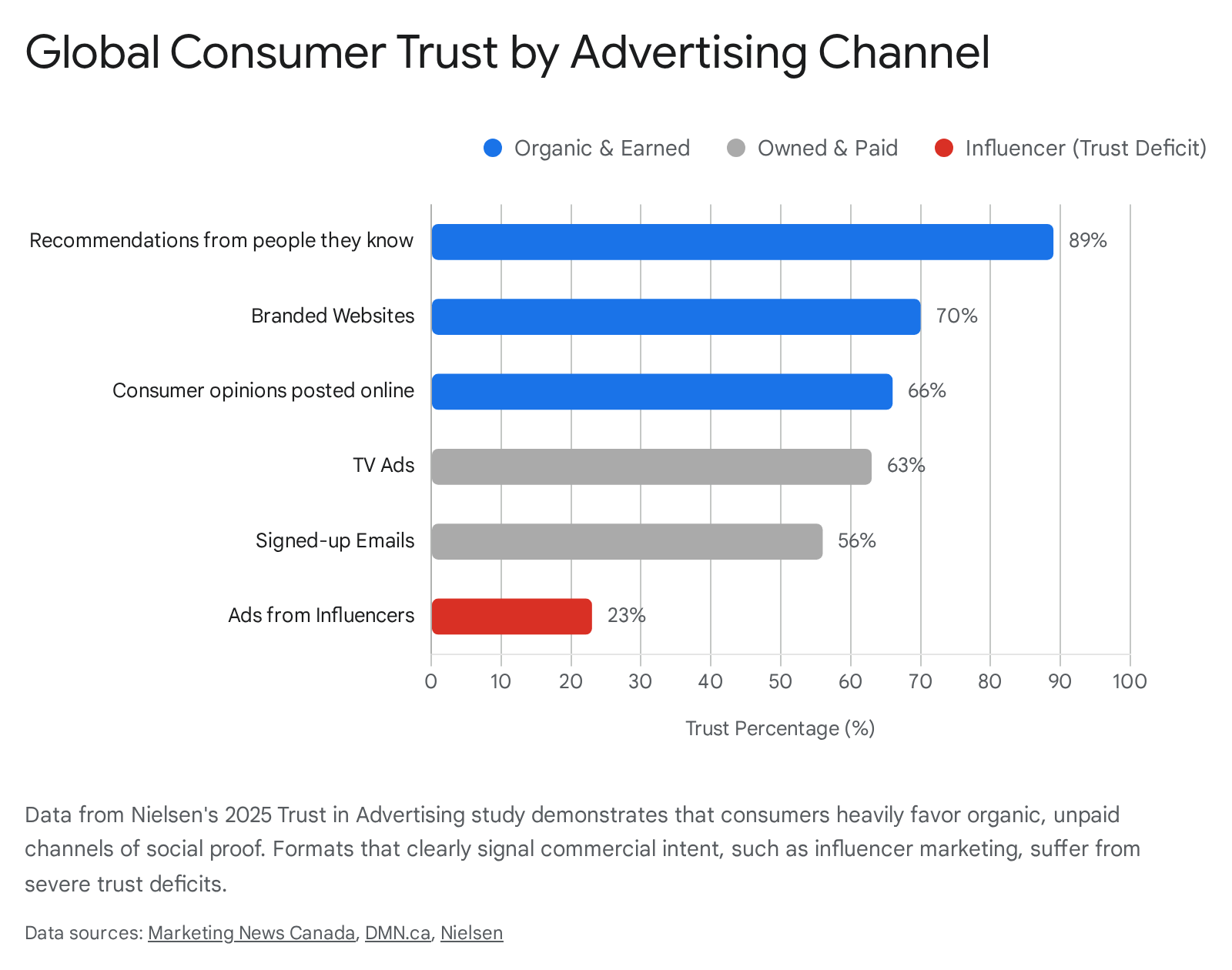
The most trusted channel globally remains word-of-mouth recommendations from personal acquaintances, securing the trust of 89% of respondents 14. Consumer opinions posted online by strangers rank as the third most trusted format, at 66% 1516. Conversely, trust plummets when the messenger is financially compensated; only 23% of global consumers report trusting advertisements delivered via influencers 14.
Demographic Discrepancies in Trust Baselines
The aggregate data obscures significant demographic divergence regarding baseline trust levels and the propensity to take action based on social proof. While gender parity exists regarding overall trust in advertising, generational cohorts exhibit stark differences in their cognitive reception of marketing materials 14.
The table below summarizes the psychological reception of advertising and social proof across generational cohorts, leveraging recent global behavioral data.
| Demographic Cohort | Overall Advertising Trust | Primary Trusted Formats | Persuasion Knowledge Activation Threshold |
|---|---|---|---|
| Gen Z (15-24) | Very Low | Peer-generated video, unpolished social content. | Extremely Low. Highly skeptical of polished content and macro-influencers. |
| Millennials (25-40) | Highest | Traditional media (TV/Print), branded websites, search ads. | Moderate. Most likely to balance skepticism with immediate commercial action. |
| Gen X (41-56) | High | Search engine results, consumer email subscriptions. | Moderate. Receptive to data-driven and direct-response formats. |
| Boomers (57-66) | Low | TV ads, online consumer opinions. | High for new media (influencers/social), but unusually trusting of legacy TV formatting. |
| Silent Gen (65+) | Lowest | Print newspapers, long-form editorial content. | High for all digital formats. Low action orientation overall. |
Millennials demonstrate an anomaly within the data, exhibiting the highest baseline trust in advertising formats, driving global engagement metrics across both traditional media (TV, newspapers) and digital formats 1415. Conversely, Generation Z and cohorts aged 65 and older report the lowest levels of general trust 14.
However, Gen Z's skepticism operates uniquely. While they mistrust formal advertising, they exhibit deep reliance on highly specific forms of unpolished user-generated content and tight-knit micro-communities, suggesting their persuasion knowledge is hyper-calibrated to detect high production value rather than peer-to-peer influence 1018. Older demographics, particularly Boomers, display unusually high trust in aggregated online consumer opinions (52% in markets like Canada versus only 15% globally) and traditional television advertising, reflecting a legacy media socialization 19.
The Discrepancy Between Trust and Action
A critical nuance in the psychology of social proof is that high trust is not a strict prerequisite for commercial action. While earned media generates the highest trust, paid digital formats leverage frictionless commerce to drive conversion despite lower credibility.
For example, self-reported consumer action exceeds reported trust by double-digit margins for search engine advertisements (47% trust versus 58% action), social network ads (46% trust versus 56% action), and mobile text ads 1516. In these instances, the psychological mechanism at play is convenience overriding persuasion knowledge. The immediate accessibility of the product allows consumers to bypass deep cognitive evaluation; the temporal proximity to purchase limits the friction required to trigger defensive skepticism 15.
The Authenticity Paradox in Quantitative Ratings
The tension between calculated manipulation and authentic consensus is most measurable in aggregated quantitative social proof, such as five-star rating systems on e-commerce platforms. Traditional commercial logic posits a linear relationship: optimal product ratings should yield optimal conversion rates. However, behavioral data reveals a pronounced non-linear phenomenon recognized as the Authenticity Paradox.
Research conducted by the Northwestern University Spiegel Research Center analyzed the correlation between online review ratings and actual purchase behavior. The findings prove that purchase likelihood does not maximize at a perfect 5.0 out of 5 stars. Instead, conversion rates peak when a product's average rating sits between 4.2 and 4.5 stars 20172324. As the average rating breaches the 4.5 threshold and approaches a perfect 5.0, the probability of purchase enters a steep decline 1723.
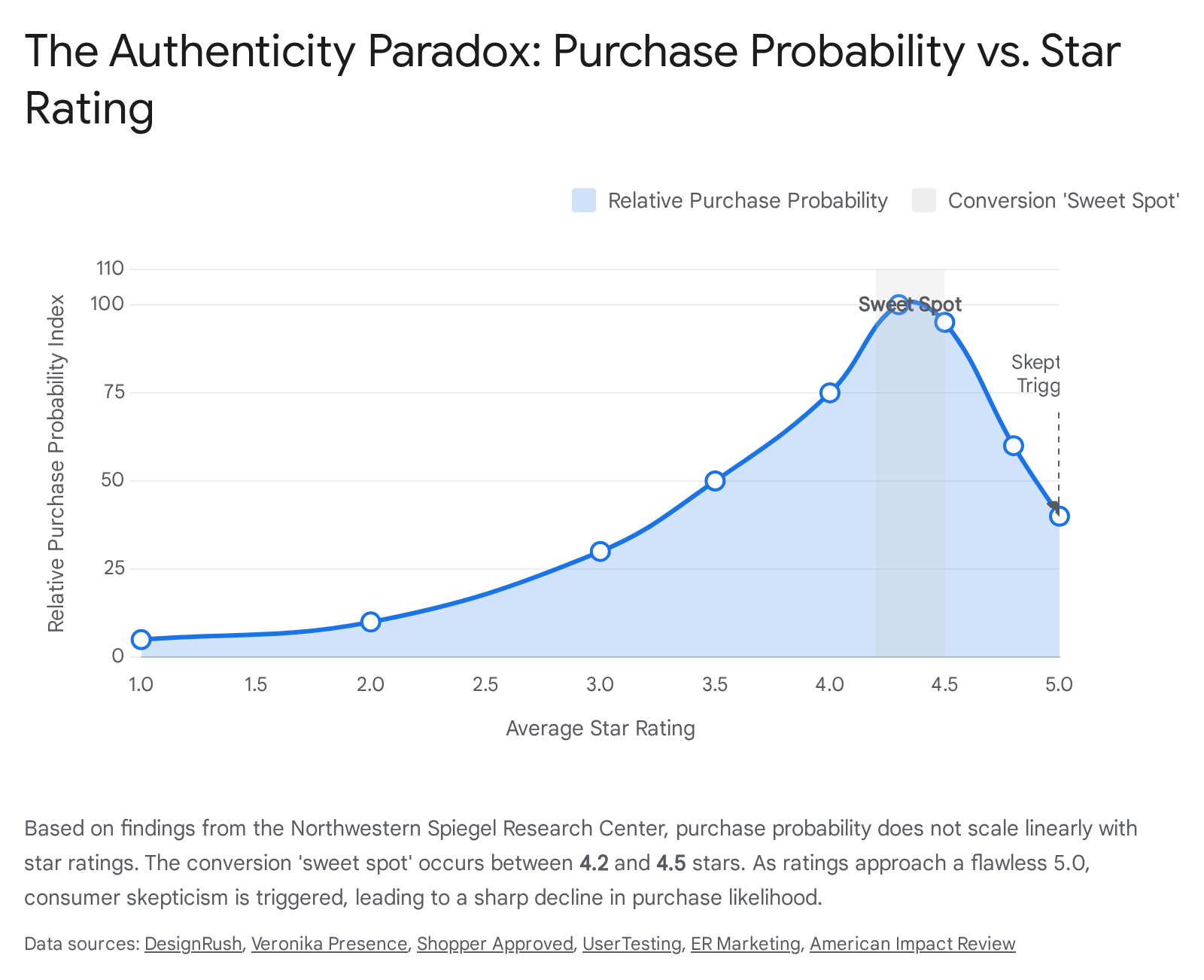
This decline occurs because a flawless rating across a visible volume of reviews violates the consumer's innate understanding of statistical probability and human variance. Perfection does not mirror reality. When a consumer encounters a wall of unmitigated five-star reviews, it acts as a severe trigger for their persuasion knowledge. The consumer's cognitive framework assumes the data has been manipulated, the negative feedback filtered, or the reviews artificially generated 1723.
The Necessity of Dissonance and Volume
In the architecture of trust, friction serves a functional purpose. The presence of negative reviews or moderate criticisms within a testimonial ecosystem validates the positive endorsements. When consumers observe a 4.3-star average containing detailed three-star or four-star critiques, they infer that the brand operates transparently and is confident enough to display unvarnished feedback. This transparency satisfies the consumer's need to assess potential downsides, anchoring their trust in the aggregate score 1724.
Furthermore, absolute rating scores are heavily contextualized by volume. Volume acts as a secondary heuristic, communicating that the entity has been vetted by a statistically significant sample. For example, a 4.3 rating derived from 300 reviews generates a much stronger signal of trust - and subsequent conversion - than a 4.9 rating based on only 14 reviews . High volume dilutes the perceived risk of outlier opinions and algorithmic manipulation.
The impact of this social proof is heavily mediated by the financial risk profile of the purchase. The Spiegel Research Center identified that the mere presence of reviews escalates purchase likelihood by up to 380% for high-priced, high-risk items, compared to a ~190% lift for lower-priced, low-risk items 2017. When consumers face high cognitive or financial stakes, they exhibit pronounced anxiety - nearly double the hesitation felt when re-purchasing familiar brands 18. In these high-stakes scenarios, the reliance on a robust, imperfect, but highly populated review ecosystem becomes the primary mechanism for resolving pre-purchase anxiety.
Production Fidelity and the Creator Economy
The psychological mandate for authenticity over perfection extends deeply into visual media. In contemporary digital marketing, there is sustained conflict between high-production commercial assets and low-production, user-generated content. For decades, organizations assumed that high-fidelity, cinematic video production projected authority and reliability, thereby maximizing persuasion. Modern behavioral data contradicts this assumption entirely.
Current analysis of the creator economy indicates that unpolished, "raw" video content - often captured vertically on smartphones with natural lighting, minimal editing, and conversational syntax - systematically outperforms highly produced commercial assets. Industry performance metrics from 2025 and 2026 demonstrate that short-form, unpolished video content featuring real staff or customers can outperform high-production advertisements by a ratio of 3:1 in engagement and conversion metrics 262728.
Cognitive Routing and Commercial Heuristics
The psychological mechanism dictating this preference is best explained through dual-process theories such as the Elaboration Likelihood Model (ELM) and the Heuristic-Systematic Model (HSM) 3419. High production value currently serves as a negative heuristic cue indicating commercial intent. When a video features pristine lighting, professional audio, and scripted dialogue, the consumer's persuasion knowledge immediately categorizes the asset as a corporate advertisement. The viewer inherently expects the narrative to be biased, prompting them to process the information systematically with heightened skepticism and resistance.
Conversely, unpolished elements - such as a slightly shaky camera, unscripted pauses, or a chaotic background - serve as heuristic cues for authentic peer experience. Because the video lacks the structural markers of a commercial, the viewer's defensive filters remain dormant. The consumer processes the message via the peripheral route, allowing the emotional resonance and practical demonstration of the product to penetrate their cognitive defenses without triggering psychological reactance 32627.
The Disintegration of Macro-Influencer Efficacy
This shift toward unvarnished authenticity has radically altered the influencer marketing landscape. Macro-influencers (those possessing follower counts in the millions) have seen their persuasive efficacy plummet. Data indicates that 61% of younger consumers (aged 13 to 39) believe that the more advertisements an influencer posts, the less trustworthy they become 20. The ubiquity of sponsored content has eroded the perceived boundary between macro-influencers and traditional corporate spokespeople.
In contrast, micro-influencers (creators maintaining audiences between 10,000 and 50,000 followers) routinely generate up to 60% higher engagement rates than their macro counterparts 21. The psychological driver here is vulnerability and homophily. Micro-influencers often share unvarnished struggles, specific niche interests, and documented failures, fostering a parasocial intimacy that mimics real-world friendships. When an endorser expresses frustration with a problem before introducing a solution, they invite the viewer into an empathetic state, creating an emotional alignment that drives deep brand loyalty 21.
Cross-Cultural Variances in Social Proof Processing
While the cognitive mechanics of persuasion knowledge and social proof are innate to human psychology, the specific formats of testimonials that successfully persuade vary significantly across cultural boundaries. Behavioral research analyzing global consumer markets frequently applies Geert Hofstede's cultural dimensions - most notably the spectrum of Individualism versus Collectivism, as well as Power Distance and Uncertainty Avoidance - to map these variances 12222324.
The Individualist Paradigm
In highly individualistic cultures, such as the United States, the United Kingdom, and Australia, societal structures prioritize personal autonomy, self-reliance, and individual achievement over group cohesion 123. Within these populations, consumers view overt conformity with suspicion, interpreting it as a surrender of personal agency.
Consequently, the processing of social proof in individualistic markets favors distinct attributes: * Logical and Data-Driven Appeals: Individualists exhibit a preference for expert reviews, analytical breakdowns, and quantitative data that allow them to formulate independent conclusions, rather than relying solely on emotional consensus 23. * Peer Homophily over Authority: Conformity to top-down authority is lower. Consumers in these markets are more easily persuaded by relatable, independent peers who resemble their own socioeconomic status rather than institutional authority figures 22223. * Emphasis on Unique Advantage: Testimonials that emphasize how a product delivers a unique personal benefit, enhances self-expression, or provides a competitive edge are highly effective. Scarcity cues and exclusivity appeal directly to the individualist desire to stand apart from the crowd 23.
The Collectivist Paradigm
In collectivist cultures, prevalent across many Asian, African, and Latin American societies, core values center on social harmony, group welfare, and mutual interdependence 123. In these environments, aligning with the group is not perceived as a loss of autonomy, but as a necessary demonstration of social intelligence and stability.
The mechanics of persuasion in these markets reflect these priorities: * The Power of Consensus: Social proof techniques that highlight massive aggregate popularity or wide community adoption are highly persuasive. The knowledge that a large group approves of an action validates the choice and minimizes social risk 2323. * Deference to Authority and Expertise: Collectivist societies frequently exhibit high Power Distance. Consequently, testimonials from respected elders, industry experts, or established institutional leaders carry immense weight and face significantly lower resistance from persuasion knowledge filters compared to individualist markets 222324. * Reciprocity and Group Benefit: Persuasive messaging that emphasizes social obligations, community improvement, and reciprocal benefits resonates deeply. Emotional appeals centered on group pride or avoiding societal shame are frequently deployed with high efficacy 23.
These cultural mechanics heavily dictate the architecture of emerging digital channels. For instance, comparative studies on livestream commerce demonstrate that in mature collectivist markets like China, consumers rely heavily on heuristic cues such as aggregate viewer counts and broad product trust metrics to make rapid purchasing decisions. Conversely, in the emerging livestream markets of the individualistic United States, consumers engage in more systematic, dual-processing evaluations, placing a heavier burden on the specific credibility and personal relatability of the influencer hosting the stream 12.
Cognitive Filters in Business-to-Business Markets
While business-to-consumer (B2C) psychology is heavily mediated by impulse, aesthetic heuristics, and emotional resonance, the Business-to-Business (B2B) market operates under drastically different cognitive constraints. In B2B environments, sales cycles span months, financial investments are substantial, and procurement decisions are scrutinized by diverse committees. The primary psychological driver governing B2B purchasing is not aspiration, but risk mitigation.
In this context, social proof is not merely a persuasive accessory; it is foundational infrastructure. Data indicates that 92% of B2B buyers require trusted reviews before executing a purchase, and strategically placing customer testimonials on B2B landing pages can elevate conversion rates by up to 34% 3536. Because 97% of B2B buyers perceive user-generated content and peer reviews as inherently more credible than brand-authored marketing materials, the deployment of social proof is essential for bridging the trust gap 36.
However, the anatomical requirements of a persuasive B2B testimonial are uniquely rigorous. Vague praise that succeeds in consumer markets (e.g., "This platform is amazing and easy to use") is immediately discarded by procurement teams as insufficient. To survive the systematic processing of a B2B buyer, social proof must exhibit the following attributes:
| B2B Testimonial Requirement | Psychological Function | Consequence of Omission |
|---|---|---|
| Quantifiable Metrics | Resolves ambiguity and provides empirical evidence of return on investment (e.g., "Reduced server latency by 22%"). | The claim is dismissed as corporate hyperbole; persuasion knowledge activates to block the message 3536. |
| Persona Homophily | Ensures contextual relevance. A Chief Financial Officer demands proof from another CFO facing identical regulatory and scale challenges. | The social proof is categorized as irrelevant to the buyer's specific risk profile, neutralizing its impact 353637. |
| Acknowledgment of Friction | Enhances authenticity by addressing pre-purchase anxiety (e.g., "We feared the integration would disrupt operations, but it finalized over the weekend"). | The testimonial is viewed as artificially curated, failing to address the very real implementation anxieties of the buying committee 2635. |
| Long-Term Deployment | Demonstrates stability over time. B2B buyers prefer longitudinal case studies over immediate, post-purchase emotional reactions. | Fails to mitigate the risk of long-term vendor lock-in or post-implementation software decay 3537. |
When deployed effectively through case studies, white papers, and targeted video interviews, B2B social proof transitions the abstract promises of a vendor into the concrete, verifiable reality of a peer. By placing these high-fidelity testimonials precisely at friction points in the buyer's journey, organizations can effectively lower the cognitive threshold required for enterprise adoption.
Artificial Intelligence and the Digital Trust Crisis
The psychological architecture of social proof is currently facing its most severe stress test due to the explosive proliferation of Generative Artificial Intelligence (GenAI). Throughout 2025 and into 2026, the digital economy experienced a profound baseline shift in consumer trust, catalyzed by the industrial-scale deployment of synthetic media, AI-generated fake reviews, and deepfake endorsements 38394025.
The economic and psychological scale of this infiltration is staggering. Industry data from the end of 2025 revealed that approximately 30% of all online reviews are now categorized as fake or algorithmically generated. This tidal wave of deceptive social proof is projected to cost global consumers $787 billion in 2025 alone due to misleading purchases 39. Consequently, the default psychological posture of the modern consumer has transitioned from passive heuristic acceptance to active, defensive suspicion.
Surveys tracking the societal impact of AI report that 95% of consumers have encountered suspicious or likely AI-generated content online, while 85% suspect that the reviews they read are fake "sometimes or often" 3940. Across all generational cohorts, nearly 40% of consumers cite the inability to distinguish real from manufactured digital content as their primary technological fear 40.
Algorithmic Detection and Syntactic Skepticism
To combat the degradation of platform integrity, organizations have deployed AI-driven detection systems to identify and purge fraudulent reviews. While these systems offer necessary scalability, they introduce complex challenges regarding platform governance, false positives, and algorithmic opacity 42.
Simultaneously, consumers have developed their own rapid-response heuristic filters to detect synthetic content. The clinical perfection of AI-generated text and imagery has become a negative signal. Data shows that 46% of consumers will immediately suspect a review is fake if the syntax appears algorithmically polished, and 52% of users report actively disengaging from content when they suspect undisclosed AI involvement 3926. This phenomenon is a direct extension of the Persuasion Knowledge Model; the mere categorization of content as "artificial" triggers an immediate heuristic rejection response, circumventing any evaluation of the actual message 2526.
The Emergence of the Proof Economy
This profound crisis of trust has given rise to a paradigm shift that industry analysts term the "proof economy." In an environment saturated with synthetic text and generated images, baseline visibility and polished marketing assets possess negligible persuasive power. Consumers now demand definitive, verifiable signals of authentic human presence before extending trust or capital 44.
This demand explains the escalating reliance on the unpolished, raw video formats discussed previously. A five-star review paragraph can be fabricated by an LLM in milliseconds, but an unscripted, single-take video of a human physically interacting with a product in a realistic environment remains difficult and costly to falsify convincingly 2644. The proof economy also severely penalizes brands that attempt to obscure their use of AI. When consumers uncover undisclosed AI usage in testimonials or advertising, it generates intense feelings of deception and betrayal, inflicting lasting damage on brand equity 182544.
Ultimately, the psychology of testimonials remains an evolutionary arms race between the mechanisms of commercial influence and the adaptive skepticism of the consumer. While the biological imperative to seek safety in social consensus remains hardwired, the vehicles delivering that consensus are under unprecedented scrutiny. Testimonials that successfully persuade do not attempt to bypass this scrutiny with polished perfection; instead, they embrace vulnerability, leverage verifiable human friction, and provide incontrovertible proof of life in an increasingly synthetic world.